FEELINGS AND
MORAL
DECISION-MAKING
While emotions start as sensations in the body,
feelings are generated from our thoughts about
those emotions. Or in other words, feelings are
how we interpret emotions and let them sink in.
We use the word, "feel," for both physical and
emotional states.
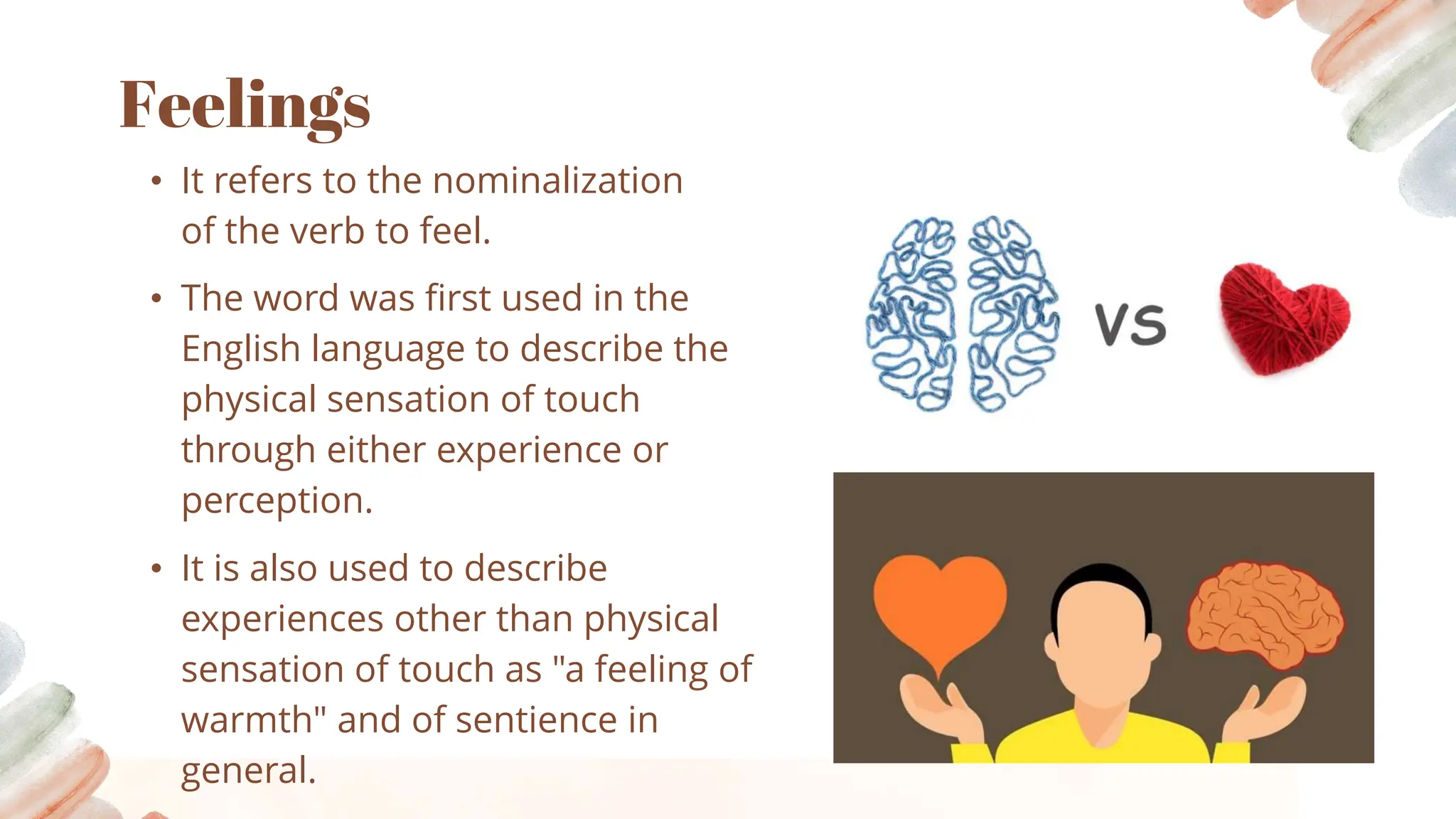
Feelings
• It refers to the nominalization
of the verb to feel.
• The word was first used in the
English language to describe the
physical sensation of touch
through either experience or
perception.
• It is also used to describe
experiences other than physical
sensation of touch as "a feeling of
warmth" and of sentience in
general.
• In Latin "sentire" meant to feel, hear or smell.
• In psychology, the word is usually reserved for the conscious
subjective experience of emotion. No one can deny the fact that
when the human person is placed in a moral dilemma, his or her
decisions can also be greatly affected by his/ her feelings.
• However, using your emotions in making decision will not be fully
objective. For example, one's decision regarding the morality of
death penalty will vary if he is placed in a situation wherein his
family is greatly affected by murderous act.
• A person who is never a victim of any crime may view the death
penalty as morally unacceptable.
• At the same time, a person who has a very close relative indicted for
robbery may cry for forgiveness while those who do not have such
may demand punishment.
• In this regard, a moral decision can be product of feelings or
emotion.
FEELINGS AS INSTICTIVE
AND TRAINED RESPONSE
TO MORAL DILEMMAS
Plato
• He would argue that the function of
reason is to rule the appetites and
emotions.
• He held that the mind or the intellect,
which is the highest level of the soul, is
that immortal part of the soul that gives a
man the capacity for truth and wisdom.
THREE COMPONENTS OF THE SOUL
1.RATIONAL SOUL - Forged by the reason and intellect has to
govern the affairs of the human person.
2.SPIRITED SOUL - Which is in charge of emotions.
3. APPETITIVE SOUL - In charge of base desire, like eating, drinking,
sleeping, and having sexual intercourse, is controlled as well
• Western philosophers were actually reacting to the position held by
the church scholars who asserted that religion is a necessary
foundation for morality.
• For the western thinkers, the foundation of morality is reason.
Stoics
• upheld that the human person must be able to learn to control his
passion with reason in order to live a moral life.
• They believe that every man shares a common element: reason.
• The right reason is the Law.
• Hence moral decisions must always be rooted on the Law.
• He believed virtue is in conformity to
reason.
• Philosophers during the time of Hume,
placed greater emphasis on the
prominence of reason over feelings.
• For Hume, the central fact about ethics
is that moral judgments are formed
not by reason alone but through
feelings or emotion.
David Hume
• Hume believed that, indeed, reason plays an important
role in ethical decisions. However, Hume says, reason
“is not sufficient alone to produce any moral blame or
approbation.
• What limits the role of reason in ethics is that reason
makes judgments concerning the empirical truth
“matter of fact” and analytical “relations of ideas”
• Moral assessments are emotional reactions.
• Hume held that judgment of good and evil is not a new
fact discovered or deduced by reason. If this is the
case, we might be ending up with saying that moral
assessment is similar to mathematical judgment. Good
and evil are not existing matter of fact.
• Goodness and badness of an act lies in the person, not
in the object or in the action.
• For example, because I will feel sympathetic pain for my friend
whose brother is brutally killed by a gunman. I will surely develop a
moral condemnation of the action of the killer.
• However, if somebody will do charitable deed of feeding a street
child, I will surely feel sympathetic pleasure for that person. Such
pleasure originates from my moral approval of the good deed.
• From the point of view of Hume, moral sentiments are found in all
people.
• Everyone has the instinctive capacity to praise and uphold moral
actions performed by a person to others.
• Basing ourselves on experience, our moral decisions are based not
on judgments or based on reason but on feelings.
• Hume believes that the usefullness and agreeableness can be
considered as a clear criterion of moral judgment.
• He believed that the behavior is considered virtuous if it is useful or
agreeable to people who are affected by the action being considered.
• Then, religious moralist critiques Hume's moral point of view because
Hume did not include the role of God in determining the morality of
one's action.
• For this reason, the religious moralist would consider Hume's moral
philosophy to be weak and groundless.
• An American philosopher that believes that morality must be rooted
not in feelings or emotions because that will make morality
subjective.
• Morality must be objective.
• According to him, no matter how great our feelings on a particular
situation can be, such feelings will not be considered as basis for
universal moral principle because feelings may be different from the
feelings of others.
Thomas Nagel
• Our feelings may be irrational. They may be a product of prejudice,
selfishness, or cultural conditioning.
• From the point of view of Nagel, the basis of morality must be on the
happiness of one's action may cause to others.
• If action is going to cause harm to others, then the action is
considered evil.
Thomas Nagel
• It has to be noted that discovering truth can only be made possible if
one is guided by reason.
• Most philosophers would consider this as the essence of morality.
• Morally right is to do actions that are supported by rational
arguments.
• Making moral decision is the ability to produce a reasonable and
defensible answer to an ethical question or case. It must be noted
that every reason is good. There may still be valid reasons.
• It is important that one knows how to be morally good in decision
making.
A. Feelings can Help in Making the
Right Decisions
• In discerning the facts, it is important that decision maker must be
impartial to certain issues.
• One should be able to consider that every moral decision is equally
important to others.
• In this regard, no decisions should be given more favor than the
others.
• Nagel points out that it is quite difficult to establish a universal moral
decision because there are many disagreements among those who
accept morality in general and about what is, in particular, right or
wrong.
• The feelings or emotions involved in moral thinking should be
anchored on careful consideration of a full range of right goals,
including altruistic ones.
• This consideration ought to mesh with an emotional instinctive
reaction that provides a motivation to act ethically and correct
injustices.
• is the basis or motive for an action, decision, or conviction.
• As a quality, it refers to the capacity for logical, rational, and
analytic thought; for consciously making sense of things,
establishing and verifying facts, applying common sense
and logic, and justifying, and if necessary, changing
practices, intuitions, and beliefs based on existing or new
existing information.
B. Reason and Impartiality as
Minimum, requirements for Morality
Reason
• Involves the idea that each individual's interests and point
of view are equally important.
• It is a principle of justice holding that decisions ought to be
based on objective criteria, rather than on a basis of bias,
prejudice, or preferring the benefit to one person over
another for improper reasons.
Impartiality
• Impartiality in morality requires that we give an equal
and/or adequate consideration to the interests of all
concerned parties.
• The principle of impartiality assumes that every person,
generally speaking, is equally important; that is, no one is
seen intrinsically more significant than anyone else.
Impartiality
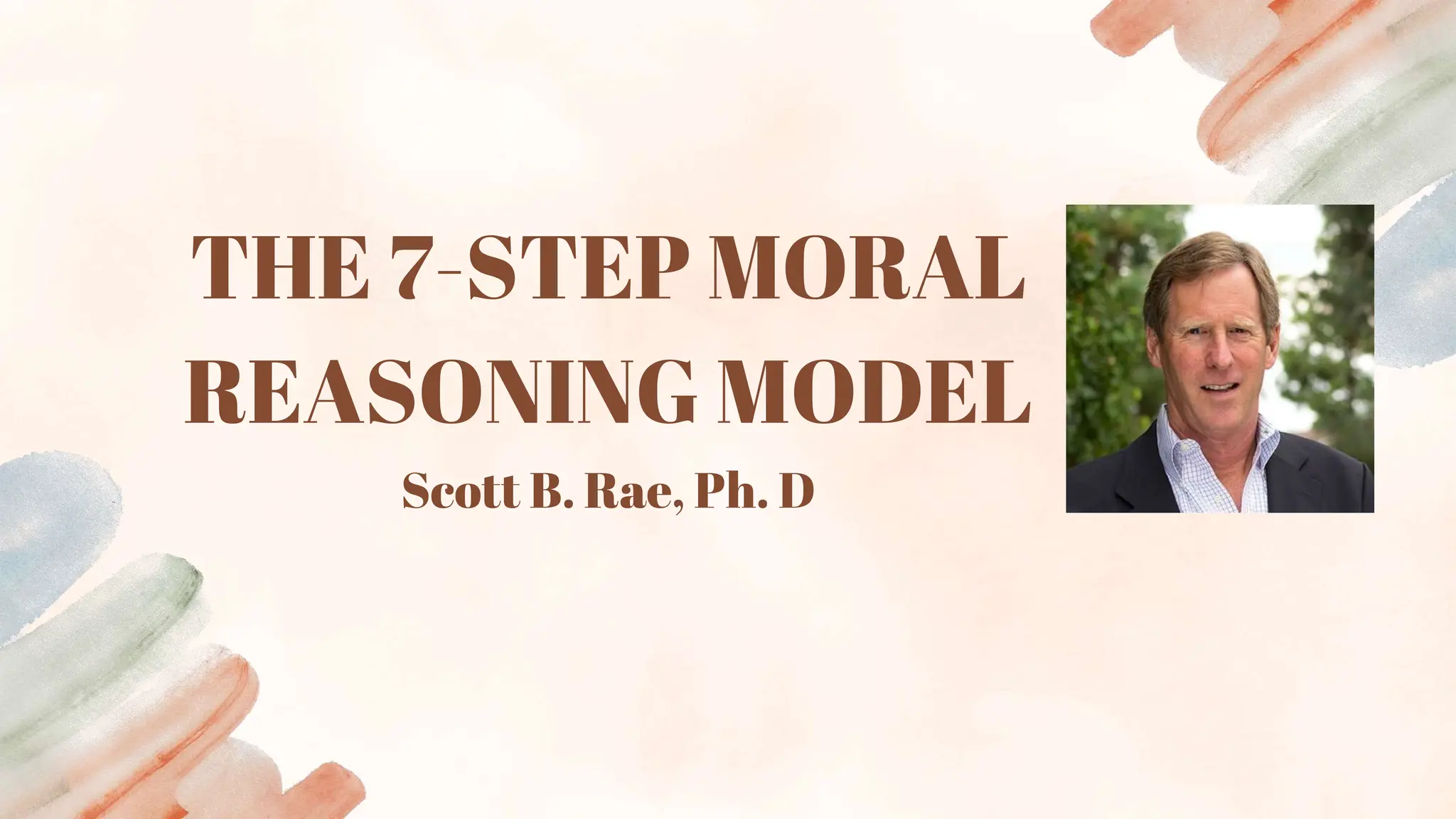
THE 7-STEP MORAL
REASONING MODEL
Scott B. Rae, Ph. D
• The simplest way of clarifying an ethical dilemma is to make
sure the facts are clear.
• Ask: Do you have the facts that are necessary to make a
good decision? What do we know? What do we need to
know?
• In this light it might become clear that the dilemma is not
ethical but about communication or strategy.
• Gather Facts
• Ethical interests are stated in terms of legitimate competing
interests or goods. The competing interests are what creates
the dilemma.
• Moral values and virtues must support competing interests in
order for an ethical dilemma to exist.
• If you cannot identify the underlying values/virtues then you do
not have an ethical dilemma. Often people hold these
positions strongly and with passion because of the value /
virtue beneath them.
2. Determine the Ethical Issues
• In an ethical dilemma certain values and principles are central
to the competing positions.
• Identify these. Determine if some should be given more weight
than others. Ask what the source for the principle is -
constitution, culture, natural law, religious tradition.
3. Determine what virtues/ principles have a
bearing on the case
• Creatively determine possible courses of action for your
dilemma.
• Some will almost immediately be discarded but generally, the
more you list the greater potential for coming up with a really
good one. It will also help you come up with a broader
selection of ideas.
4. List the alternatives
• This step eliminates alternatives as they are weighed by the
moral principles which have a bearing on the case.
• Potentially the issue will be resolved here as all alternatives
except one are eliminated.
• Here you must satisfy all the relevant virtues and values - so at
least some of the alternatives will be eliminated (even if you
still have to go on to step 6).
• Often here you have to weight principles and virtues - make
sure you have a good reason for each weighting.
5. Compare alternatives with the
virtues/principles
• If principles have not yielded a clear decision consider the
consequences of your alternatives.
• Take the alternatives and work out the positive and negative
consequences of each.
• Estimate how beneficial each positive and negative
consequence is - some might have greater weight than others.
6. Consider consequences
• Ethical decisions rarely have pain-free solutions - it might be
you have to choose the solution with the least number of
problems / painful consequences.
• Even when making a “good” decision you might still lose sleep
over it.
7. Make a decision

FEELINGS AND MORAL DECISION-MAKING IN ETHICS

  • 1.
  • 2.
    While emotions startas sensations in the body, feelings are generated from our thoughts about those emotions. Or in other words, feelings are how we interpret emotions and let them sink in. We use the word, "feel," for both physical and emotional states.
  • 3.
    Feelings • It refersto the nominalization of the verb to feel. • The word was first used in the English language to describe the physical sensation of touch through either experience or perception. • It is also used to describe experiences other than physical sensation of touch as "a feeling of warmth" and of sentience in general.
  • 4.
    • In Latin"sentire" meant to feel, hear or smell. • In psychology, the word is usually reserved for the conscious subjective experience of emotion. No one can deny the fact that when the human person is placed in a moral dilemma, his or her decisions can also be greatly affected by his/ her feelings. • However, using your emotions in making decision will not be fully objective. For example, one's decision regarding the morality of death penalty will vary if he is placed in a situation wherein his family is greatly affected by murderous act.
  • 5.
    • A personwho is never a victim of any crime may view the death penalty as morally unacceptable. • At the same time, a person who has a very close relative indicted for robbery may cry for forgiveness while those who do not have such may demand punishment. • In this regard, a moral decision can be product of feelings or emotion.
  • 9.
    FEELINGS AS INSTICTIVE ANDTRAINED RESPONSE TO MORAL DILEMMAS
  • 10.
    Plato • He wouldargue that the function of reason is to rule the appetites and emotions. • He held that the mind or the intellect, which is the highest level of the soul, is that immortal part of the soul that gives a man the capacity for truth and wisdom.
  • 11.
    THREE COMPONENTS OFTHE SOUL 1.RATIONAL SOUL - Forged by the reason and intellect has to govern the affairs of the human person. 2.SPIRITED SOUL - Which is in charge of emotions. 3. APPETITIVE SOUL - In charge of base desire, like eating, drinking, sleeping, and having sexual intercourse, is controlled as well
  • 12.
    • Western philosopherswere actually reacting to the position held by the church scholars who asserted that religion is a necessary foundation for morality. • For the western thinkers, the foundation of morality is reason. Stoics • upheld that the human person must be able to learn to control his passion with reason in order to live a moral life. • They believe that every man shares a common element: reason. • The right reason is the Law. • Hence moral decisions must always be rooted on the Law.
  • 13.
    • He believedvirtue is in conformity to reason. • Philosophers during the time of Hume, placed greater emphasis on the prominence of reason over feelings. • For Hume, the central fact about ethics is that moral judgments are formed not by reason alone but through feelings or emotion. David Hume
  • 14.
    • Hume believedthat, indeed, reason plays an important role in ethical decisions. However, Hume says, reason “is not sufficient alone to produce any moral blame or approbation. • What limits the role of reason in ethics is that reason makes judgments concerning the empirical truth “matter of fact” and analytical “relations of ideas” • Moral assessments are emotional reactions.
  • 15.
    • Hume heldthat judgment of good and evil is not a new fact discovered or deduced by reason. If this is the case, we might be ending up with saying that moral assessment is similar to mathematical judgment. Good and evil are not existing matter of fact. • Goodness and badness of an act lies in the person, not in the object or in the action.
  • 16.
    • For example,because I will feel sympathetic pain for my friend whose brother is brutally killed by a gunman. I will surely develop a moral condemnation of the action of the killer. • However, if somebody will do charitable deed of feeding a street child, I will surely feel sympathetic pleasure for that person. Such pleasure originates from my moral approval of the good deed.
  • 17.
    • From thepoint of view of Hume, moral sentiments are found in all people. • Everyone has the instinctive capacity to praise and uphold moral actions performed by a person to others. • Basing ourselves on experience, our moral decisions are based not on judgments or based on reason but on feelings. • Hume believes that the usefullness and agreeableness can be considered as a clear criterion of moral judgment. • He believed that the behavior is considered virtuous if it is useful or agreeable to people who are affected by the action being considered.
  • 18.
    • Then, religiousmoralist critiques Hume's moral point of view because Hume did not include the role of God in determining the morality of one's action. • For this reason, the religious moralist would consider Hume's moral philosophy to be weak and groundless.
  • 19.
    • An Americanphilosopher that believes that morality must be rooted not in feelings or emotions because that will make morality subjective. • Morality must be objective. • According to him, no matter how great our feelings on a particular situation can be, such feelings will not be considered as basis for universal moral principle because feelings may be different from the feelings of others. Thomas Nagel
  • 20.
    • Our feelingsmay be irrational. They may be a product of prejudice, selfishness, or cultural conditioning. • From the point of view of Nagel, the basis of morality must be on the happiness of one's action may cause to others. • If action is going to cause harm to others, then the action is considered evil. Thomas Nagel
  • 21.
    • It hasto be noted that discovering truth can only be made possible if one is guided by reason. • Most philosophers would consider this as the essence of morality. • Morally right is to do actions that are supported by rational arguments.
  • 22.
    • Making moraldecision is the ability to produce a reasonable and defensible answer to an ethical question or case. It must be noted that every reason is good. There may still be valid reasons. • It is important that one knows how to be morally good in decision making. A. Feelings can Help in Making the Right Decisions
  • 23.
    • In discerningthe facts, it is important that decision maker must be impartial to certain issues. • One should be able to consider that every moral decision is equally important to others. • In this regard, no decisions should be given more favor than the others.
  • 24.
    • Nagel pointsout that it is quite difficult to establish a universal moral decision because there are many disagreements among those who accept morality in general and about what is, in particular, right or wrong. • The feelings or emotions involved in moral thinking should be anchored on careful consideration of a full range of right goals, including altruistic ones. • This consideration ought to mesh with an emotional instinctive reaction that provides a motivation to act ethically and correct injustices.
  • 25.
    • is thebasis or motive for an action, decision, or conviction. • As a quality, it refers to the capacity for logical, rational, and analytic thought; for consciously making sense of things, establishing and verifying facts, applying common sense and logic, and justifying, and if necessary, changing practices, intuitions, and beliefs based on existing or new existing information. B. Reason and Impartiality as Minimum, requirements for Morality Reason
  • 26.
    • Involves theidea that each individual's interests and point of view are equally important. • It is a principle of justice holding that decisions ought to be based on objective criteria, rather than on a basis of bias, prejudice, or preferring the benefit to one person over another for improper reasons. Impartiality
  • 27.
    • Impartiality inmorality requires that we give an equal and/or adequate consideration to the interests of all concerned parties. • The principle of impartiality assumes that every person, generally speaking, is equally important; that is, no one is seen intrinsically more significant than anyone else. Impartiality
  • 28.
    THE 7-STEP MORAL REASONINGMODEL Scott B. Rae, Ph. D
  • 29.
    • The simplestway of clarifying an ethical dilemma is to make sure the facts are clear. • Ask: Do you have the facts that are necessary to make a good decision? What do we know? What do we need to know? • In this light it might become clear that the dilemma is not ethical but about communication or strategy. • Gather Facts
  • 30.
    • Ethical interestsare stated in terms of legitimate competing interests or goods. The competing interests are what creates the dilemma. • Moral values and virtues must support competing interests in order for an ethical dilemma to exist. • If you cannot identify the underlying values/virtues then you do not have an ethical dilemma. Often people hold these positions strongly and with passion because of the value / virtue beneath them. 2. Determine the Ethical Issues
  • 31.
    • In anethical dilemma certain values and principles are central to the competing positions. • Identify these. Determine if some should be given more weight than others. Ask what the source for the principle is - constitution, culture, natural law, religious tradition. 3. Determine what virtues/ principles have a bearing on the case
  • 32.
    • Creatively determinepossible courses of action for your dilemma. • Some will almost immediately be discarded but generally, the more you list the greater potential for coming up with a really good one. It will also help you come up with a broader selection of ideas. 4. List the alternatives
  • 33.
    • This stepeliminates alternatives as they are weighed by the moral principles which have a bearing on the case. • Potentially the issue will be resolved here as all alternatives except one are eliminated. • Here you must satisfy all the relevant virtues and values - so at least some of the alternatives will be eliminated (even if you still have to go on to step 6). • Often here you have to weight principles and virtues - make sure you have a good reason for each weighting. 5. Compare alternatives with the virtues/principles
  • 34.
    • If principleshave not yielded a clear decision consider the consequences of your alternatives. • Take the alternatives and work out the positive and negative consequences of each. • Estimate how beneficial each positive and negative consequence is - some might have greater weight than others. 6. Consider consequences
  • 35.
    • Ethical decisionsrarely have pain-free solutions - it might be you have to choose the solution with the least number of problems / painful consequences. • Even when making a “good” decision you might still lose sleep over it. 7. Make a decision

Editor's Notes