Moral Frameworks
in Ethics
1. Md. Efthakhar Ul Alam 2. Tayeb Himel
ID : 142000512 ID : 132000212
3. Real Barua 4. Mubasshwir Raihan
ID : 141000312 ID : 142000712
5. Sayed Faruqi
ID : 142
Group members
Objectives
 Learning about Moral Framework.
 Theories of Moral Framework.
 How to solve a problem ethically.
 Approaches to Moral Framework.
 Ethical Decision making.
 What role does Moral Framework plays in society.
What Exactly Is Moral Framework!
An ethical framework is a set of codes that an individual uses to guide
his or her behavior. Ethics are what people use to distinguish right from
wrong in the way they interact with the world.
So based on your moral judgment what you think is the best solution for
a particular problem is moral framework.
Why is it necessary!
 Moral values help in improving behavior, instilling respect and enhancing
relationships with others. Knowing what is right or wrong is an important
element in life that shapes the character on an individual. Good moral
values allows a person to make the right decisions and improve their
interactions with other people.
Ethical Theories
 Ethical theories are often broadly divided into three types:
 i) Consequentialist theories
 ii) Non-consequentialist theories
 iii) Agent-centered theories
i) Consequentialist Theories
o The Utilitarian Approach
o The Egoistic Approach
o The Common Good Approach
1. The Utilitarian Approach
 To analyze an issue using the utilitarian approach, we first identify the
various courses of action available to us. Second, we ask who will be
affected byeach action and what benefits or harms will be derived from
each. And third, we choose the action that will produce the greatest
benefits and the least harm. The ethical action is the one that provides the
greatest good for the greatest number.
2. The Egoistic Approach
 One variation of the utilitarian approach is known as ethical egoism, or the
ethics of self- interest. In this approach, an individual often uses utilitarian
calculation to produce the greatest amount of good for him or herself.
3. The Common Good Approach
 This approach to ethics underscores the networked aspects of society and
emphasizes respect and compassion for others, especially those who are
more vulnerable. 
ii.) Non-consequentialist Theories:
 The Duty-Based Approach
 The Rights Approach
 The Fairness or Justice Approach
 The Divine Command Approach
The Duty-Based Approach
The duty-based approach, sometimes called deontological ethics.  The
ethical action is one taken from duty, that is, it is done precisely because it is
our obligation to perform the action. Ethical obligations are the same for all
rational creatures .
The Rights Approach
The second important approach to ethics has its roots in the philosophy of the
18th-century thinker Immanuel Kant and others like him, who focused on the
individual's right to choose for herself or himself . what makes human beings
different from mere things is that people have dignity based on their ability to
choose freely what they will do with their lives, and they have a fundamental
moral right to have these choices respected.
The Fairness or Justice Approach
 This approach stipulates that the best ethical action is that which protects
the ethical rights of those who are affected by the action. It emphasizes
the belief that all humans have a right to dignity. 
 Act in such a way that you treat humanity, whether in your own person or in
the person of another, always at the same time as an end and never simply
as a means to an end.
The Divine Command Approach
 As its name suggests, this approach sees what is right as the same as what
God commands, and ethical standards are the creation of God’s will.
Following God’s will is seen as the very definition what is ethical. Because
God is seen as omnipotent and possessed of free will, God could change
what is now considered ethical, and God is not bound by any standard of
right or wrong short of logical contradiction. 
iii.) Agent-centered Theories:
 The Virtue Approach
 The Feminist Approach
The Virtue Approach
 The virtue approach to ethics assumes that there are certain ideals toward
which we should strive, which provide for the full development of our
humanity. These ideals are discovered through thoughtful reflection on
what kind of people we have the potential to become.
The Feminist Approach
In recent decades, the virtue approach to ethics has been supplemented and
sometimes significantly revised by thinkers in the feminist tradition, who often
emphasize the importance of the experiences of women and other
marginalized groups to ethical deliberation. 
Frameworks For Ethical Decision-
Making
 The Consequentialist Framework
 The Duty Framework
 The Virtue Framework
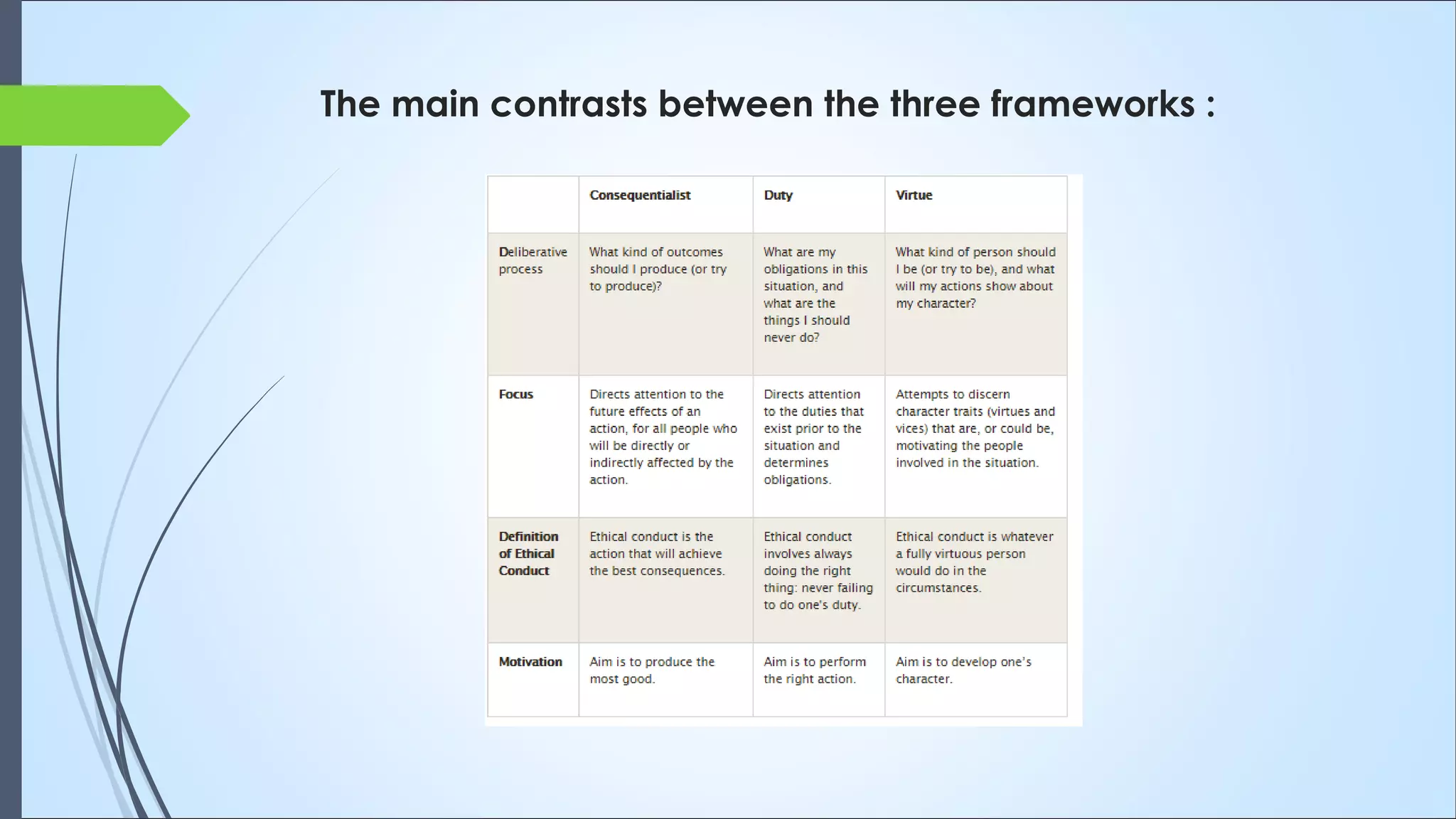
The main contrasts between the three frameworks :
Applying Ethical Frameworks in Cases
 Recognizing an Ethical Issue
 Consider the Parties Involved
 Gather all of the Relevant Information
 Formulate Actions and Consider Alternatives
 Make a Decision and Consider It
 Implementing the Decision
 Reflect on the Outcome
Role of Moral Framework in society.
 Family
 Education
 Media
 Government
 Religion
 As efficient actions reveal themselves to an evolving
society, its people develop the means to make
productive choices between one type of action and
another. Some choices are decidedly better than
others. This prioritizing of human actions into efficient
hierarchies establishes the foundations of rule systems
which later refine themselves into more sophisticated
systems of morals
Evolution of Ethics
References
 https://www.brown.edu/academics/science-and-technology-
studies/framework-making-ethical-decisions
 http://peopleof.oureverydaylife.com/society-influence-ethical-beliefs-
4448.html
 https://www.reference.com/world-view/importance-moral-values-
7e9052f22b13b7ff?qo=contentSimilarQuestions#
 https://www.scu.edu/ethics/ethics-resources/ethical-decision-making/a-
framework-for-ethical-decision-making/
 Introduction To Engineering Ethics By Mike W. Martin Roland Schinzinger
The Necessity of Ethics in Engineering?
 There are various reasons moral and
ethical.
Questions?

Moral Framework for Ethics

  • 1.
  • 2.
    1. Md. EfthakharUl Alam 2. Tayeb Himel ID : 142000512 ID : 132000212 3. Real Barua 4. Mubasshwir Raihan ID : 141000312 ID : 142000712 5. Sayed Faruqi ID : 142 Group members
  • 3.
    Objectives  Learning aboutMoral Framework.  Theories of Moral Framework.  How to solve a problem ethically.  Approaches to Moral Framework.  Ethical Decision making.  What role does Moral Framework plays in society.
  • 4.
    What Exactly IsMoral Framework! An ethical framework is a set of codes that an individual uses to guide his or her behavior. Ethics are what people use to distinguish right from wrong in the way they interact with the world. So based on your moral judgment what you think is the best solution for a particular problem is moral framework.
  • 5.
    Why is itnecessary!  Moral values help in improving behavior, instilling respect and enhancing relationships with others. Knowing what is right or wrong is an important element in life that shapes the character on an individual. Good moral values allows a person to make the right decisions and improve their interactions with other people.
  • 6.
    Ethical Theories  Ethicaltheories are often broadly divided into three types:  i) Consequentialist theories  ii) Non-consequentialist theories  iii) Agent-centered theories
  • 7.
    i) Consequentialist Theories oThe Utilitarian Approach o The Egoistic Approach o The Common Good Approach
  • 8.
    1. The UtilitarianApproach  To analyze an issue using the utilitarian approach, we first identify the various courses of action available to us. Second, we ask who will be affected byeach action and what benefits or harms will be derived from each. And third, we choose the action that will produce the greatest benefits and the least harm. The ethical action is the one that provides the greatest good for the greatest number.
  • 9.
    2. The EgoisticApproach  One variation of the utilitarian approach is known as ethical egoism, or the ethics of self- interest. In this approach, an individual often uses utilitarian calculation to produce the greatest amount of good for him or herself.
  • 10.
    3. The CommonGood Approach  This approach to ethics underscores the networked aspects of society and emphasizes respect and compassion for others, especially those who are more vulnerable. 
  • 11.
    ii.) Non-consequentialist Theories: The Duty-Based Approach  The Rights Approach  The Fairness or Justice Approach  The Divine Command Approach
  • 12.
    The Duty-Based Approach Theduty-based approach, sometimes called deontological ethics.  The ethical action is one taken from duty, that is, it is done precisely because it is our obligation to perform the action. Ethical obligations are the same for all rational creatures .
  • 13.
    The Rights Approach Thesecond important approach to ethics has its roots in the philosophy of the 18th-century thinker Immanuel Kant and others like him, who focused on the individual's right to choose for herself or himself . what makes human beings different from mere things is that people have dignity based on their ability to choose freely what they will do with their lives, and they have a fundamental moral right to have these choices respected.
  • 14.
    The Fairness orJustice Approach  This approach stipulates that the best ethical action is that which protects the ethical rights of those who are affected by the action. It emphasizes the belief that all humans have a right to dignity.   Act in such a way that you treat humanity, whether in your own person or in the person of another, always at the same time as an end and never simply as a means to an end.
  • 15.
    The Divine CommandApproach  As its name suggests, this approach sees what is right as the same as what God commands, and ethical standards are the creation of God’s will. Following God’s will is seen as the very definition what is ethical. Because God is seen as omnipotent and possessed of free will, God could change what is now considered ethical, and God is not bound by any standard of right or wrong short of logical contradiction. 
  • 16.
    iii.) Agent-centered Theories: The Virtue Approach  The Feminist Approach
  • 17.
    The Virtue Approach The virtue approach to ethics assumes that there are certain ideals toward which we should strive, which provide for the full development of our humanity. These ideals are discovered through thoughtful reflection on what kind of people we have the potential to become.
  • 18.
    The Feminist Approach Inrecent decades, the virtue approach to ethics has been supplemented and sometimes significantly revised by thinkers in the feminist tradition, who often emphasize the importance of the experiences of women and other marginalized groups to ethical deliberation. 
  • 19.
    Frameworks For EthicalDecision- Making  The Consequentialist Framework  The Duty Framework  The Virtue Framework
  • 20.
    The main contrastsbetween the three frameworks :
  • 21.
    Applying Ethical Frameworksin Cases  Recognizing an Ethical Issue  Consider the Parties Involved  Gather all of the Relevant Information  Formulate Actions and Consider Alternatives  Make a Decision and Consider It  Implementing the Decision  Reflect on the Outcome
  • 22.
    Role of MoralFramework in society.  Family  Education  Media  Government  Religion
  • 23.
     As efficientactions reveal themselves to an evolving society, its people develop the means to make productive choices between one type of action and another. Some choices are decidedly better than others. This prioritizing of human actions into efficient hierarchies establishes the foundations of rule systems which later refine themselves into more sophisticated systems of morals Evolution of Ethics
  • 24.
    References  https://www.brown.edu/academics/science-and-technology- studies/framework-making-ethical-decisions  http://peopleof.oureverydaylife.com/society-influence-ethical-beliefs- 4448.html https://www.reference.com/world-view/importance-moral-values- 7e9052f22b13b7ff?qo=contentSimilarQuestions#  https://www.scu.edu/ethics/ethics-resources/ethical-decision-making/a- framework-for-ethical-decision-making/  Introduction To Engineering Ethics By Mike W. Martin Roland Schinzinger
  • 25.
    The Necessity ofEthics in Engineering?  There are various reasons moral and ethical.
  • 27.