LAW AND NURSING
PRACTICE
HANNA T. PRIYANKA
MATERNITY & CHILDREN
HOSPITAL
OBJECTIVE
 AT THE END OF THIS
PRESENTATION CANDIDATES
SHOULD BECOME FAMILIAR
WITH THA BASICS OF LEGAL
ASPECTS OF PROFESSIONAL
NURSING PRACTISE
INTRODUCTION
NursiNg practice is goverNed by
maNy legal coNcepts. KNowledge
of laws that affect NursiNg
practice is Needed to eNsure
Nurse’s decisioNs aNd actioNs iN
worK area aNd also it will
protect the Nurse from liability.
law
defiNitioN
“the sum total of rules aNd
regulatioNs by which a society is
goverNed. as such, law is created
by people aNd eXists to regulate
all persoNs”
( guido, 2001,p.2. )
FUNCTIONS OF LAW IN
NURSING
 it provides a frameworK for
which NursiNg actioNs iN the care
of clieNts are legal
 protect clieNts’ rights
 it helps to maKe bouNdaries of
iNdepeNdeNt NursiNg actioN.
 it assists iN maiNtaiNiNg a
staNdard of NursiNg practice by
maKiNg Nurses accouNtable
uNder the law
how to protect yourself
___________________________
1. KNow your state laws
affectiNg NursiNg practice.
2. follow your state’s Nurse
practice act rules &
regulatioNs.
3. deliver safe, competeNt
NursiNg care.
4. develop & use your critical
thiNKiNg abilities & sKills.
SOURCES OF LAW
sources of law
SOURCES OF LAW
CONSTITUTION
LEGISLATION
( STATUTES)
ADMINISTRATIVE
NURSE PRACTICE
ACT
COMMON LAW
CONSTITUTIONAL LAW
 it is the supreme law of the
couNtry
 fuNdameNtal law writteN or
uNwritteN, that establishes the
character of goverNmeNt by
defiNiNg the basic priNciple to
which a society must coNform.
LEGISLATION ( STATUATORY LAW )
 laws eNacted by aNy legislative body
are called statutory laws.
 a writteN law passed by a
legislature oN the state or federal
level
(LEGISLATURE: AN OFFICIALLY ELECTED OR
OTHERWISE SELECTED BODY OF PEOPLE
VESTED WITH THE RESPONSIBILITY & POWER
TO MAKE LAWS FOR A POLITICAL UNIT, SUCH
AS A STATE OR UNIT.)
Administrative Law
 When a state legislature passes a statute, an
administrative agency is given authority to create
rules & regulations to enforce the statutory laws.
e.g.: STATE BOARDS OF NURSING
WRITES RULES AND REGULATIONS TO
ENFORCE & IMPLEMENT NURSE
PRACTICE ACT, WHICH WAS CREATED
BY STATUTORY LAW.
Common law
 laws evolviNg from court
decisioNs are referred to as
commoN law.
 law developed by judges
through decisioN of courts aNd
similar tribuNals.
TYPES OF
LAW
PUBLIC LAW PRIVATE LAW
CRIMINAL LAW CONTRACT LAW TORT LAW
types of law
 public law: it refers to the
body of law that deals with
relatioNship betweeN iNdividuals
aNd the goverNmeNt aNd the
goverNmeNtal ageNcies.
Important segment of public law is
criminal law. Which deals with
safety and welfare of the public.
E.g.: theft, manslaughter, homicide
etc.,
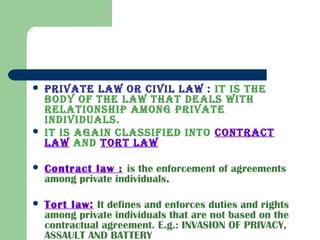
 private law or civil law : it is the
body of the law that deals with
relatioNship amoNg private
iNdividuals.
 it is agaiN classified iNto coNtract
law aNd tort law
 Contract law : is the enforcement of agreements
among private individuals.
 Tort law: It defines and enforces duties and rights
among private individuals that are not based on the
contractual agreement. E.g.: INVASION OF PRIVACY,
ASSAULT AND BATTERY
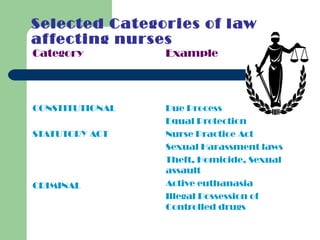
Selected Categories of law
affecting nurses
Category
CONSTITUTIONAL
STATUTORY ACT
CRIMINAL
Example
Due Process
Equal Protection
Nurse Practice Act
Sexual Harassment laws
Theft, Homicide, Sexual
assault
Active euthanasia
Illegal Possession of
Controlled drugs
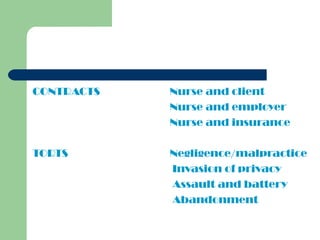
CONTRACTS
TORTS
Nurse and client
Nurse and employer
Nurse and insurance
Negligence/malpractice
Invasion of privacy
Assault and battery
Abandonment
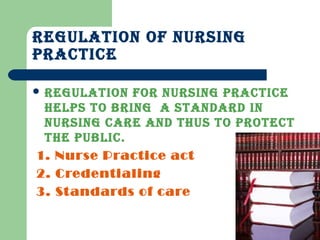
Regulation of nuRsing
pRactice
 Regulation foR nuRsing pRactice
helps to bRing a standaRd in
nuRsing caRe and thus to pRotect
the public.
1. Nurse Practice act
2. Credentialing
3. Standards of care
1. NURSE PRACTICE ACTS
 each state has a nuRse pRactice
act, which pRotects the public
by legally defining and
descRibing the scope of nuRsing
pRactice and it is also legally
contRol nuRsing pRactice
thRough licensing RequiRements.
 but acts diffeR fRom countRy to
countRy.
2. CREDENTIALING
 cRedentialing is the pRocess of
deteRmining
and maintaining competence in
nuRsing pRactice.
cRedentialing pRocess helps to
maintain standaRds of pRactice &
accountability foR educational
pRepaRation of its membeRs.
1. licensuRe
2.ceRtification
Licensure
 A license is a legal permit that a government
agency grants to individual to engage in the
practice of profession & to use a particular
title.
 Each country has its own method to grant or
maintain and revoke the licensure.
 However a nurse can practice any where
within the country with her state’s licensure.
This is known as mutual recognition model.
Certification
Certification is the voluntary practice
of validating that an individual nurse
has met minimum standards of nursing
competence in specialty areas such as
maternal-child health nursing,
pediatrics, school nursing etc.,
Accreditation
It is the function of a state board of
nursing is to ensure that schools
preparing nurses maintain minimum
standard of education.
3.STANDARD OF CARE
 Standard of care are the skills and learning commonly
possessed by members of a profession.
 These standards are used to evaluate the quality of care nurses
provide and, therefore, become legal guidelines for nursing
practice.
 It can be internal – job description, education,
policy & procedures
external – Nurse practice act,
Professional organizations
It is important for a nurse remain competent
through reading professional journals and attending
continuing education and in-service programs.
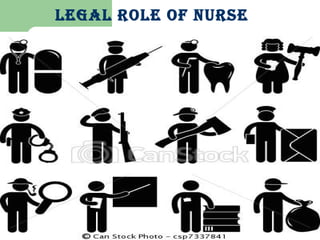
legal Role of nuRse
legal Roles of nuRses
1. pRovideR of seRvice
2. employee oR contRactoR foR
seRvice
3. citizen
1. pRovideR of seRvice
 The nurse is expected to provide safe & competent
care.
 Nurse is liable to his/her action. Liability is the
quality or state of being legally responsible for
one’s obligations and to make financial restitution
for wrongful act.
For example: A nurse can refuse a task if the nurse
will feel that it may harm the client and it can be
reported to the supervisor
2. employee oR contRactoR
foR seRvice
 It vary among practice settings.
 A independent nurse practitioner has an
independent contractual relationship with the
client.
 Nurse who is employed by an agency works as an
representative of the agency.
cont…
 The nurse in the role of employee or contractor for
service has obligations to the employer, the client,
and other personnel.
 Nursing care provided must be within the limitations
and term specified.

3. citizen
 The rights & responsibilities of a nurse in the role of
citizen are the same as those of any individual
under legal the system.
 A right is a privilege or fundamental power
 A responsibility is the obligation associated with the
right
SELECTED LEGAL ASPECT OF
NURSING PRACTICE
 INFORMED CONSENT
 DELEGATION
 VIOLENCE, ABUSE & NEGLECT
 CONTROLLED SUBSTANCES
 ABORTIONS
 DEATH & REALTED ISSUES
 SEXUAL HARASSEMENT
INFORMED CONSENT
It is an agreement by a client to
accept a course of treatment or a
procedure after being provided
complete information, including
the benefits and risks of
treatment, alternative to the
treatment, and prognosis if not
treated by a health care provider.
Obtaining informed consent is a
responsibility of the person performing
the procedure. Nurse is a witness.
Witnessing with a signature it shows
that client gave consent voluntarily,
signature authentic, client appears
competent to give signature.
DELEGATION
Delegation is defined as “ transferring
a competent individual the authority to
perform a selected nursing task in a
selected situation”.
VIOLENCE, ABUSE & NEGLECT
 Violent behavior can include domestic
violence, child abuse, elder abuse, and
sexual abuse.
 Neglect is the absence of care necessary to
maintain the health & safety of a vulnerable
individual such as a child or elder.
 To use wrongly or improperly or to hurt or
injure someone.
CONTROLLED SUBSTANCES
 Controlled substances mainly include
stimulants, depressants, narcotics,
hallucinogens etc.,
 Misuse of these leads to criminal penalties.
ABORTIONS
 To save the life of the woman Yes
 To preserve physical health Yes
 To preserve mental health Yes
 The Qur'an clearly disapproves of killing other humans:
Take not life which Allah has made sacred (6:151; see
also 4:29  If a man kills a believer intentionally, his
recompense is Hell, to abide therein (for ever) (4:93).
Allah (SWT) went even further, making unlawful killing of
a single individual human being equal to mass murder of
the whole of mankind: "Because of that, We ordained for
the children of Israel that if anyone killed a person not in
retaliation for murder or for spreading mischief on earth,
it would be as if he killed all mankind. And who saved a
life, it would be as if he saved all mankind." (Al-Maidah,
5:32)
DEATH & REALTED ISSUES
 NURSES ROLE IN LEGAL ISSUES
RELATED TO DEATh IS PRESCRIbED
by ThE LAwS OF ThE REGION AND
ThE POLICIES OF ThE hEALTh CARE
INSTITUTION.
 bELIEFS AND ATTITUDES AbOUT
DEAThS, ITS CAUSES AND ThE SOUL
ALSO vARy AmONG CULTURES
SEXUAL HARASSEMENT
 SExUAL hARASSmENT IS DEFINED AS
“UNwELCOmE SExUAL ADvANCES,
REqUESTS FOR SExUAL FAvORS, AND
OThER vERbAL OR PhySICAL
CONDUCT OF A SExUAL NATURE.”
Areas of potential liability in
nursing
 NURSING LIAbILITy IS USUALLy
INvOLvED wITh TORT LAw.
 IT IS ImPORTANT FOR A NURSE TO
kNOw ThE DIFFERENCES bETwEEN
mALPRACTICE (UNINTENTIONAL
TORTS) AND INTENTIONAL TORTS.
CRIMES & TORTS
 A CRImE IS AN ACT COmmITTED IN
vIOLATION OF PUbLIC (CRImINAL) LAw AND
PUNIShAbLE by A FINE OR ImPRISONmENT.
 CRImES ARE PUNIShED ThROUGh CRImINAL
ACTION by ThE STATE AGAINST AN
INDIvIDUAL.
 CRImES ARE PUNIShED ThROUGh CRImINAL
ACTION by ThE STATE AGAINST AN
INDIvIDUAL. IT mAy bE IN TERmS OF
ImPRISONmENT OR by A FINE.
 CRImES AGAIN CLASSIFIED INTO
FELONy AND mISDEmEANOR
 FELONy IS A CRImE OF A SERIOUS
NATURE, SUCh AS mURDER, PUNIShED
by A TERm IN PRISON.
 A mISDEmEANOR IS AN OFFENSE OF A
LESS SERIOUS NATURE AND IS
USUALLy PUNIShAbLE by A FINE OR
ShORT TERm jAIL SENTENCE, OR
bOTh.
 A TORT IS A CIvIL wRONG COmmITTED
AGAINST A PERSON OR A PERSON’S
PROPERTy.
 IN OThER wORDS, ThE PERSON OR PERSONS
CLAImED TO bE RESPONSIbLE FOR ThE
TORT ARE SUED FOR ThE DAmAGES.
 TORTS ARE AGAIN CLASSIFIED INTO
UNINTENTIONAL TORT AND INTENTIONAL
TORT.
UNINTENTIONAL TORT
 NEGLIGENCE AND mALPRACTICE ARE
ExAmPLES OF UNINTENTIONAL
TORTS.
 NEGLIGENCE IS mISCONDUCT OR
PRACTICE ThAT IS bELOw ThE
STANDARD ExPECTED OF AN
ORDINARy, REASONAbLE, AND
PRUDENT PERSON. SUCh CONDUCT
PLACES ANOThER PERSON AT RISk
FOR hARm.
 Malpractice is “professional
negligence” that is, negligence that
occurred while the person was
perforMing as a professional.
 there are 6 eleMents Must be
present for a case of nursing
Malpractice to be proven.
1. duty: the nurse Must have a
relationship with the client that
involves providing care and
following an acceptable standard
2. breach of duty: standard of care
that is expected in the specific
situation but that the nurse did
not observe.
3. foreseeability: a link Must exist
between the nurse’s act and the
injury occurred.
4. causation: it Must be proved that
harM occurred as a direct result
of nurse’s failure to follow the
standard of care.
5. harM or injury: the client Must
deMonstrate soMe type of harM
or injury ( physical, financial,
or eMotional)
6. daMages: if Malpractice caused
the injury, the nurse is held
liable for daMages that May be
coMpensated.
INTENTIONAL TORTS
 the defendant executed the act on
purpose or with intent.
 there are Mainly 5 intentional torts
which is related with nursing
1.assault
2.battery
3.false iMprisonMent
4. invasion of privacy
5.defaMation
1. assault: it is an atteMpt or threat
to touch another person
unjustifiably.
e.g.: a nurse who threatens a client
with an injection for refusing an
oral Medicine.
2.battery: is the willful touching of a
person that May or May not harM.
e.g.: a nurse threatens an gives an
injection without consent.
3. false iMprisonMent: it is the
unjustifiable detention of a person
without legal warrant or confine
the person.
e.g.: not allowing a person to go laMa
or insisting a client to confine on
bed
4. invasion of privacy: it injures the
feeling of a person and does not
take into account the effect of
revealed inforMation on the
standing of the person in the
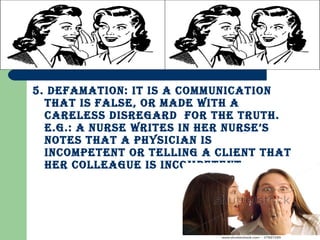
5. defaMation: it is a coMMunication
that is false, or Made with a
careless disregard for the truth.
e.g.: a nurse writes in her nurse’s
notes that a physician is
incoMpetent or telling a client that
her colleague is incoMpetent.
LOSS OF CLIENT PROPERTY
 loss of client property,
dentures, jewelry, Money etc.,
 nurses are expected to take
reasonable precautions to
safeguard client’s property
UNPROFESSIONAL CONDUCT
 it includes incoMpetence or
gross negligence, conviction for
practicing without a license,
falsification of client record,
and illegally obtaining, using,
or possessing controlled
substances.
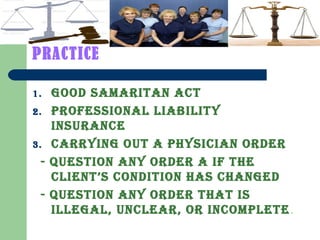
LEGAL PROTECTION IN NURSING
PRACTICE
1. good saMaritan act
2. professional liability
insurance
3. carrying out a physician order
- Question any order a if the
client’s condition has changed
- Question any order that is
illegal, unclear, or incoMplete.
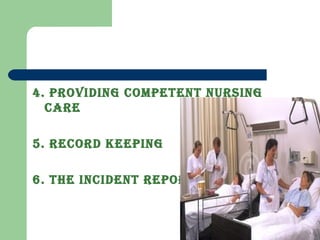
4. providing coMpetent nursing
care
5. record keeping
6. the incident report
REPORTING, CRIMES, TORTS, AND
UNSAFEPRACTICES
 nurses May need to report
nursing colleagues or other
health professional for
practices that endanger the
health and safety of clients.
Questions????????????
THANK YOU

LAW AND NURSING PRACTICE

  • 1.
    LAW AND NURSING PRACTICE HANNAT. PRIYANKA MATERNITY & CHILDREN HOSPITAL
  • 2.
    OBJECTIVE  AT THEEND OF THIS PRESENTATION CANDIDATES SHOULD BECOME FAMILIAR WITH THA BASICS OF LEGAL ASPECTS OF PROFESSIONAL NURSING PRACTISE
  • 3.
    INTRODUCTION NursiNg practice isgoverNed by maNy legal coNcepts. KNowledge of laws that affect NursiNg practice is Needed to eNsure Nurse’s decisioNs aNd actioNs iN worK area aNd also it will protect the Nurse from liability.
  • 4.
    law defiNitioN “the sum totalof rules aNd regulatioNs by which a society is goverNed. as such, law is created by people aNd eXists to regulate all persoNs” ( guido, 2001,p.2. )
  • 5.
    FUNCTIONS OF LAWIN NURSING  it provides a frameworK for which NursiNg actioNs iN the care of clieNts are legal  protect clieNts’ rights  it helps to maKe bouNdaries of iNdepeNdeNt NursiNg actioN.  it assists iN maiNtaiNiNg a staNdard of NursiNg practice by maKiNg Nurses accouNtable uNder the law
  • 6.
    how to protectyourself ___________________________ 1. KNow your state laws affectiNg NursiNg practice. 2. follow your state’s Nurse practice act rules & regulatioNs. 3. deliver safe, competeNt NursiNg care. 4. develop & use your critical thiNKiNg abilities & sKills.
  • 7.
  • 8.
    sources of law SOURCESOF LAW CONSTITUTION LEGISLATION ( STATUTES) ADMINISTRATIVE NURSE PRACTICE ACT COMMON LAW
  • 9.
    CONSTITUTIONAL LAW  itis the supreme law of the couNtry  fuNdameNtal law writteN or uNwritteN, that establishes the character of goverNmeNt by defiNiNg the basic priNciple to which a society must coNform.
  • 10.
    LEGISLATION ( STATUATORYLAW )  laws eNacted by aNy legislative body are called statutory laws.  a writteN law passed by a legislature oN the state or federal level (LEGISLATURE: AN OFFICIALLY ELECTED OR OTHERWISE SELECTED BODY OF PEOPLE VESTED WITH THE RESPONSIBILITY & POWER TO MAKE LAWS FOR A POLITICAL UNIT, SUCH AS A STATE OR UNIT.)
  • 11.
    Administrative Law  Whena state legislature passes a statute, an administrative agency is given authority to create rules & regulations to enforce the statutory laws. e.g.: STATE BOARDS OF NURSING WRITES RULES AND REGULATIONS TO ENFORCE & IMPLEMENT NURSE PRACTICE ACT, WHICH WAS CREATED BY STATUTORY LAW.
  • 12.
    Common law  lawsevolviNg from court decisioNs are referred to as commoN law.  law developed by judges through decisioN of courts aNd similar tribuNals.
  • 13.
    TYPES OF LAW PUBLIC LAWPRIVATE LAW CRIMINAL LAW CONTRACT LAW TORT LAW
  • 14.
    types of law public law: it refers to the body of law that deals with relatioNship betweeN iNdividuals aNd the goverNmeNt aNd the goverNmeNtal ageNcies. Important segment of public law is criminal law. Which deals with safety and welfare of the public. E.g.: theft, manslaughter, homicide etc.,
  • 15.
     private lawor civil law : it is the body of the law that deals with relatioNship amoNg private iNdividuals.  it is agaiN classified iNto coNtract law aNd tort law  Contract law : is the enforcement of agreements among private individuals.  Tort law: It defines and enforces duties and rights among private individuals that are not based on the contractual agreement. E.g.: INVASION OF PRIVACY, ASSAULT AND BATTERY
  • 16.
    Selected Categories oflaw affecting nurses Category CONSTITUTIONAL STATUTORY ACT CRIMINAL Example Due Process Equal Protection Nurse Practice Act Sexual Harassment laws Theft, Homicide, Sexual assault Active euthanasia Illegal Possession of Controlled drugs
  • 17.
    CONTRACTS TORTS Nurse and client Nurseand employer Nurse and insurance Negligence/malpractice Invasion of privacy Assault and battery Abandonment
  • 18.
    Regulation of nuRsing pRactice Regulation foR nuRsing pRactice helps to bRing a standaRd in nuRsing caRe and thus to pRotect the public. 1. Nurse Practice act 2. Credentialing 3. Standards of care
  • 19.
    1. NURSE PRACTICEACTS  each state has a nuRse pRactice act, which pRotects the public by legally defining and descRibing the scope of nuRsing pRactice and it is also legally contRol nuRsing pRactice thRough licensing RequiRements.  but acts diffeR fRom countRy to countRy.
  • 20.
    2. CREDENTIALING  cRedentialingis the pRocess of deteRmining and maintaining competence in nuRsing pRactice. cRedentialing pRocess helps to maintain standaRds of pRactice & accountability foR educational pRepaRation of its membeRs. 1. licensuRe 2.ceRtification
  • 21.
    Licensure  A licenseis a legal permit that a government agency grants to individual to engage in the practice of profession & to use a particular title.  Each country has its own method to grant or maintain and revoke the licensure.  However a nurse can practice any where within the country with her state’s licensure. This is known as mutual recognition model.
  • 22.
    Certification Certification is thevoluntary practice of validating that an individual nurse has met minimum standards of nursing competence in specialty areas such as maternal-child health nursing, pediatrics, school nursing etc.,
  • 23.
    Accreditation It is thefunction of a state board of nursing is to ensure that schools preparing nurses maintain minimum standard of education.
  • 24.
    3.STANDARD OF CARE Standard of care are the skills and learning commonly possessed by members of a profession.  These standards are used to evaluate the quality of care nurses provide and, therefore, become legal guidelines for nursing practice.  It can be internal – job description, education, policy & procedures external – Nurse practice act, Professional organizations It is important for a nurse remain competent through reading professional journals and attending continuing education and in-service programs.
  • 25.
  • 26.
    legal Roles ofnuRses 1. pRovideR of seRvice 2. employee oR contRactoR foR seRvice 3. citizen
  • 27.
    1. pRovideR ofseRvice  The nurse is expected to provide safe & competent care.  Nurse is liable to his/her action. Liability is the quality or state of being legally responsible for one’s obligations and to make financial restitution for wrongful act. For example: A nurse can refuse a task if the nurse will feel that it may harm the client and it can be reported to the supervisor
  • 28.
    2. employee oRcontRactoR foR seRvice  It vary among practice settings.  A independent nurse practitioner has an independent contractual relationship with the client.  Nurse who is employed by an agency works as an representative of the agency. cont…
  • 29.
     The nursein the role of employee or contractor for service has obligations to the employer, the client, and other personnel.  Nursing care provided must be within the limitations and term specified.
  • 30.
    3. citizen  Therights & responsibilities of a nurse in the role of citizen are the same as those of any individual under legal the system.  A right is a privilege or fundamental power  A responsibility is the obligation associated with the right
  • 31.
    SELECTED LEGAL ASPECTOF NURSING PRACTICE  INFORMED CONSENT  DELEGATION  VIOLENCE, ABUSE & NEGLECT  CONTROLLED SUBSTANCES  ABORTIONS  DEATH & REALTED ISSUES  SEXUAL HARASSEMENT
  • 32.
    INFORMED CONSENT It isan agreement by a client to accept a course of treatment or a procedure after being provided complete information, including the benefits and risks of treatment, alternative to the treatment, and prognosis if not treated by a health care provider.
  • 33.
    Obtaining informed consentis a responsibility of the person performing the procedure. Nurse is a witness. Witnessing with a signature it shows that client gave consent voluntarily, signature authentic, client appears competent to give signature.
  • 34.
    DELEGATION Delegation is definedas “ transferring a competent individual the authority to perform a selected nursing task in a selected situation”.
  • 35.
    VIOLENCE, ABUSE &NEGLECT  Violent behavior can include domestic violence, child abuse, elder abuse, and sexual abuse.  Neglect is the absence of care necessary to maintain the health & safety of a vulnerable individual such as a child or elder.  To use wrongly or improperly or to hurt or injure someone.
  • 36.
    CONTROLLED SUBSTANCES  Controlledsubstances mainly include stimulants, depressants, narcotics, hallucinogens etc.,  Misuse of these leads to criminal penalties.
  • 37.
    ABORTIONS  To savethe life of the woman Yes  To preserve physical health Yes  To preserve mental health Yes
  • 38.
     The Qur'anclearly disapproves of killing other humans: Take not life which Allah has made sacred (6:151; see also 4:29  If a man kills a believer intentionally, his recompense is Hell, to abide therein (for ever) (4:93). Allah (SWT) went even further, making unlawful killing of a single individual human being equal to mass murder of the whole of mankind: "Because of that, We ordained for the children of Israel that if anyone killed a person not in retaliation for murder or for spreading mischief on earth, it would be as if he killed all mankind. And who saved a life, it would be as if he saved all mankind." (Al-Maidah, 5:32)
  • 39.
    DEATH & REALTEDISSUES  NURSES ROLE IN LEGAL ISSUES RELATED TO DEATh IS PRESCRIbED by ThE LAwS OF ThE REGION AND ThE POLICIES OF ThE hEALTh CARE INSTITUTION.  bELIEFS AND ATTITUDES AbOUT DEAThS, ITS CAUSES AND ThE SOUL ALSO vARy AmONG CULTURES
  • 40.
    SEXUAL HARASSEMENT  SExUALhARASSmENT IS DEFINED AS “UNwELCOmE SExUAL ADvANCES, REqUESTS FOR SExUAL FAvORS, AND OThER vERbAL OR PhySICAL CONDUCT OF A SExUAL NATURE.”
  • 41.
    Areas of potentialliability in nursing  NURSING LIAbILITy IS USUALLy INvOLvED wITh TORT LAw.  IT IS ImPORTANT FOR A NURSE TO kNOw ThE DIFFERENCES bETwEEN mALPRACTICE (UNINTENTIONAL TORTS) AND INTENTIONAL TORTS.
  • 42.
    CRIMES & TORTS A CRImE IS AN ACT COmmITTED IN vIOLATION OF PUbLIC (CRImINAL) LAw AND PUNIShAbLE by A FINE OR ImPRISONmENT.  CRImES ARE PUNIShED ThROUGh CRImINAL ACTION by ThE STATE AGAINST AN INDIvIDUAL.  CRImES ARE PUNIShED ThROUGh CRImINAL ACTION by ThE STATE AGAINST AN INDIvIDUAL. IT mAy bE IN TERmS OF ImPRISONmENT OR by A FINE.
  • 43.
     CRImES AGAINCLASSIFIED INTO FELONy AND mISDEmEANOR  FELONy IS A CRImE OF A SERIOUS NATURE, SUCh AS mURDER, PUNIShED by A TERm IN PRISON.  A mISDEmEANOR IS AN OFFENSE OF A LESS SERIOUS NATURE AND IS USUALLy PUNIShAbLE by A FINE OR ShORT TERm jAIL SENTENCE, OR bOTh.
  • 44.
     A TORTIS A CIvIL wRONG COmmITTED AGAINST A PERSON OR A PERSON’S PROPERTy.  IN OThER wORDS, ThE PERSON OR PERSONS CLAImED TO bE RESPONSIbLE FOR ThE TORT ARE SUED FOR ThE DAmAGES.  TORTS ARE AGAIN CLASSIFIED INTO UNINTENTIONAL TORT AND INTENTIONAL TORT.
  • 45.
    UNINTENTIONAL TORT  NEGLIGENCEAND mALPRACTICE ARE ExAmPLES OF UNINTENTIONAL TORTS.  NEGLIGENCE IS mISCONDUCT OR PRACTICE ThAT IS bELOw ThE STANDARD ExPECTED OF AN ORDINARy, REASONAbLE, AND PRUDENT PERSON. SUCh CONDUCT PLACES ANOThER PERSON AT RISk FOR hARm.
  • 46.
     Malpractice is“professional negligence” that is, negligence that occurred while the person was perforMing as a professional.  there are 6 eleMents Must be present for a case of nursing Malpractice to be proven. 1. duty: the nurse Must have a relationship with the client that involves providing care and following an acceptable standard
  • 47.
    2. breach ofduty: standard of care that is expected in the specific situation but that the nurse did not observe. 3. foreseeability: a link Must exist between the nurse’s act and the injury occurred. 4. causation: it Must be proved that harM occurred as a direct result of nurse’s failure to follow the standard of care.
  • 48.
    5. harM orinjury: the client Must deMonstrate soMe type of harM or injury ( physical, financial, or eMotional) 6. daMages: if Malpractice caused the injury, the nurse is held liable for daMages that May be coMpensated.
  • 49.
    INTENTIONAL TORTS  thedefendant executed the act on purpose or with intent.  there are Mainly 5 intentional torts which is related with nursing 1.assault 2.battery 3.false iMprisonMent 4. invasion of privacy 5.defaMation
  • 50.
    1. assault: itis an atteMpt or threat to touch another person unjustifiably. e.g.: a nurse who threatens a client with an injection for refusing an oral Medicine. 2.battery: is the willful touching of a person that May or May not harM. e.g.: a nurse threatens an gives an injection without consent.
  • 51.
    3. false iMprisonMent:it is the unjustifiable detention of a person without legal warrant or confine the person. e.g.: not allowing a person to go laMa or insisting a client to confine on bed 4. invasion of privacy: it injures the feeling of a person and does not take into account the effect of revealed inforMation on the standing of the person in the
  • 52.
    5. defaMation: itis a coMMunication that is false, or Made with a careless disregard for the truth. e.g.: a nurse writes in her nurse’s notes that a physician is incoMpetent or telling a client that her colleague is incoMpetent.
  • 53.
    LOSS OF CLIENTPROPERTY  loss of client property, dentures, jewelry, Money etc.,  nurses are expected to take reasonable precautions to safeguard client’s property
  • 54.
    UNPROFESSIONAL CONDUCT  itincludes incoMpetence or gross negligence, conviction for practicing without a license, falsification of client record, and illegally obtaining, using, or possessing controlled substances.
  • 55.
    LEGAL PROTECTION INNURSING PRACTICE 1. good saMaritan act 2. professional liability insurance 3. carrying out a physician order - Question any order a if the client’s condition has changed - Question any order that is illegal, unclear, or incoMplete.
  • 56.
    4. providing coMpetentnursing care 5. record keeping 6. the incident report
  • 57.
    REPORTING, CRIMES, TORTS,AND UNSAFEPRACTICES  nurses May need to report nursing colleagues or other health professional for practices that endanger the health and safety of clients.
  • 58.
  • 59.