Editorial Slides
VP Watch, February 5, 2003, Volume 3, Issue 5
Towards The Future Cath Lab
Jarek Wosik
Paul Cherukuri
Texas Heart Institute
– In the past two decades, MRI has been
slowly introduced into the world of
cardiovascular medicine.
– In early 1980s Higgins and others
envisioned MRI applications for detection
of cardiac structural abnormalities (such
as congenital anomalies) as well as acute
and remote myocardial infarctions,
atherosclerotic plaques, hypertrophic
cardiomyopathy, pericardial diseases,
aneurysms, and patency of bypass graft. 2
 Manning et al. demonstrated the
power of noninvasive MRI coronary
angiography to identify substantial
stenosis correctly within the proximal
portion of major coronary arteries in
a group of patients undergoing
conventional contrast coronary
angiography. Other investigators
also introduced MRI application in
non-invasive coronary imaging.3,4,5
• Intravascular MRI (iMRI) is a potential tool
for the detailed characterization and
localization of plaques as well as having
the added benefit of implementing local
therapy.
• iMRI is simply a wire resonator tuned to
the external applied pulse generated by
an extravascular MRI system. The
resonator due to it’s close proximity to the
target body increases the signal from that
region thereby capable of providing
microscopic images
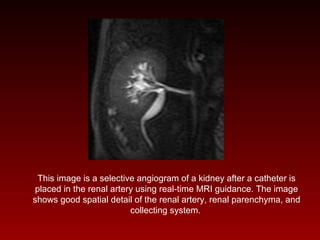
This image is a selective angiogram of a kidney after a catheter is
placed in the renal artery using real-time MRI guidance. The image
shows good spatial detail of the renal artery, renal parenchyma, and
collecting system.
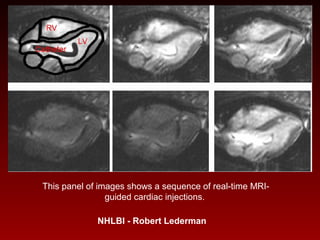
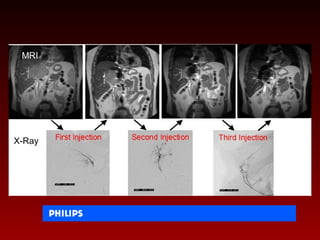
This panel of images shows a sequence of real-time MRI-
guided cardiac injections.
NHLBI - Robert Lederman
 Atlar also showed a new development
that uses high-resolution MR imaging as
an in vivo imaging tool to monitor
catheter-based vascular gene delivery. 9
 In another study Atalar et al showed
that coronary artery catheterization and
intracoronary balloon angioplasty are
feasible with MRI guidance indicating
that iMRI maybe an alternative to X-ray
guidance in coronary artery interventions
in the future. 8
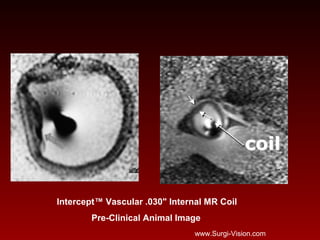
Intercept™ Vascular .030" Internal MR Coil
Pre-Clinical Animal Image
www.Surgi-Vision.com
• Guenther RW et al have shown that active tip
tracking simultaneous with MRI of the vascular
anatomy-both in real time-is possible, enabling
MR-guided percutaneous dilatation (PTA) of
iliac arteries.10
• Buecker A et al presented a new sequence
for real-time MR imaging sequence reliably
allowed for high-quality coronary MR
fluoroscopy without motion artifacts in all pigs
for accurate stent placement. Ten of 11
coronary stents were correctly placed under
MR guidance. 11
• Wilke NM et al recently
demonstrated that catheter
tracking and ASD device
closure can be performed
under real-time MRI guidance
with the use of intravascular
antenna guide wires. 12
• As highlighted in VP Watch of
this week, Serfaty, Atalar and
colleagues have shown the
feasibility of using an MR imaging
guide wire as a potential tool for
use in endovascular interventional
MR imaging-guided balloon
angioplasty. 7
• A prototype 0.014-inch coronary
MRI guidewire, a prototype 7 French
MRI-guiding catheter, and two
flexible surface coils were
connected to a GE 1.5 T CV/i
scanner for simultaneous
visualization of the guidewire,
guiding catheter, and chest
anatomy.
• Images were displayed in real
time on an in-room monitor. A
nongated, single-slice fast
gradient-echo sequence was
used to obtain real-time images
of the catheters and background
anatomy during the intervention.
• Fifteen selective catheterizations were
attempted in the coronary arteries, and
all were successful.
• Selective injection of diluted
gadolinium into the MRI-guiding
catheter provided dynamic 2D
projection coronary angiography in all
cases, confirming successful
catheterization.
• Percutaneouse transluminal
coronary angioplasty (PTCA) was
attempted after two
catheterizations, and all attempts
were successful. Inflation of the
balloon angioplasty catheter was
performed successfully in the left
anterior and circumflex arteries.
Conclusion:
• Coronary artery catheterization and
intracoronary balloon angioplasty
are feasible with MRI guidance only.
• MRI guidance may be used as an
alternative to X-ray guidance in
coronary artery interventions in the
future.
Questions:
• 1- What are the technological and
non-technological barriers for the
implementation of MRI guided PCI?
• 2- Can we make everything in cath
labs MR compatible? Or should we
try to make MRI cath lab
compatible?
Questions:
• 3- What are the accreditation
and reimbursement issues in
cardiovascular MRI?
• 4- Can MRI replace X-ray
systems in future cath labs?
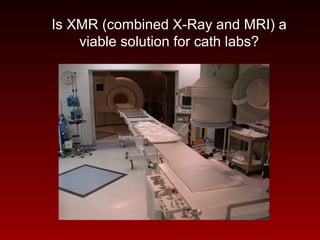
Is XMR (combined X-Ray and MRI) a
viable solution for cath labs?
MRI
X-Ray

Esv3n5

  • 1.
    Editorial Slides VP Watch,February 5, 2003, Volume 3, Issue 5 Towards The Future Cath Lab Jarek Wosik Paul Cherukuri Texas Heart Institute
  • 2.
    – In thepast two decades, MRI has been slowly introduced into the world of cardiovascular medicine. – In early 1980s Higgins and others envisioned MRI applications for detection of cardiac structural abnormalities (such as congenital anomalies) as well as acute and remote myocardial infarctions, atherosclerotic plaques, hypertrophic cardiomyopathy, pericardial diseases, aneurysms, and patency of bypass graft. 2
  • 3.
     Manning etal. demonstrated the power of noninvasive MRI coronary angiography to identify substantial stenosis correctly within the proximal portion of major coronary arteries in a group of patients undergoing conventional contrast coronary angiography. Other investigators also introduced MRI application in non-invasive coronary imaging.3,4,5
  • 4.
    • Intravascular MRI(iMRI) is a potential tool for the detailed characterization and localization of plaques as well as having the added benefit of implementing local therapy. • iMRI is simply a wire resonator tuned to the external applied pulse generated by an extravascular MRI system. The resonator due to it’s close proximity to the target body increases the signal from that region thereby capable of providing microscopic images
  • 5.
    This image isa selective angiogram of a kidney after a catheter is placed in the renal artery using real-time MRI guidance. The image shows good spatial detail of the renal artery, renal parenchyma, and collecting system.
  • 6.
    This panel ofimages shows a sequence of real-time MRI- guided cardiac injections. NHLBI - Robert Lederman
  • 7.
     Atlar alsoshowed a new development that uses high-resolution MR imaging as an in vivo imaging tool to monitor catheter-based vascular gene delivery. 9  In another study Atalar et al showed that coronary artery catheterization and intracoronary balloon angioplasty are feasible with MRI guidance indicating that iMRI maybe an alternative to X-ray guidance in coronary artery interventions in the future. 8
  • 8.
    Intercept™ Vascular .030"Internal MR Coil Pre-Clinical Animal Image www.Surgi-Vision.com
  • 9.
    • Guenther RWet al have shown that active tip tracking simultaneous with MRI of the vascular anatomy-both in real time-is possible, enabling MR-guided percutaneous dilatation (PTA) of iliac arteries.10 • Buecker A et al presented a new sequence for real-time MR imaging sequence reliably allowed for high-quality coronary MR fluoroscopy without motion artifacts in all pigs for accurate stent placement. Ten of 11 coronary stents were correctly placed under MR guidance. 11
  • 10.
    • Wilke NMet al recently demonstrated that catheter tracking and ASD device closure can be performed under real-time MRI guidance with the use of intravascular antenna guide wires. 12
  • 11.
    • As highlightedin VP Watch of this week, Serfaty, Atalar and colleagues have shown the feasibility of using an MR imaging guide wire as a potential tool for use in endovascular interventional MR imaging-guided balloon angioplasty. 7
  • 12.
    • A prototype0.014-inch coronary MRI guidewire, a prototype 7 French MRI-guiding catheter, and two flexible surface coils were connected to a GE 1.5 T CV/i scanner for simultaneous visualization of the guidewire, guiding catheter, and chest anatomy.
  • 13.
    • Images weredisplayed in real time on an in-room monitor. A nongated, single-slice fast gradient-echo sequence was used to obtain real-time images of the catheters and background anatomy during the intervention.
  • 14.
    • Fifteen selectivecatheterizations were attempted in the coronary arteries, and all were successful. • Selective injection of diluted gadolinium into the MRI-guiding catheter provided dynamic 2D projection coronary angiography in all cases, confirming successful catheterization.
  • 15.
    • Percutaneouse transluminal coronaryangioplasty (PTCA) was attempted after two catheterizations, and all attempts were successful. Inflation of the balloon angioplasty catheter was performed successfully in the left anterior and circumflex arteries.
  • 16.
    Conclusion: • Coronary arterycatheterization and intracoronary balloon angioplasty are feasible with MRI guidance only. • MRI guidance may be used as an alternative to X-ray guidance in coronary artery interventions in the future.
  • 17.
    Questions: • 1- Whatare the technological and non-technological barriers for the implementation of MRI guided PCI? • 2- Can we make everything in cath labs MR compatible? Or should we try to make MRI cath lab compatible?
  • 18.
    Questions: • 3- Whatare the accreditation and reimbursement issues in cardiovascular MRI? • 4- Can MRI replace X-ray systems in future cath labs?
  • 19.
    Is XMR (combinedX-Ray and MRI) a viable solution for cath labs?
  • 20.