Shah Hrishi Shivaswamy Anirudh
Introduction “Computer-assisted intervention” is defined as the use of automated systems in surgery Two different approaches :  As a tool (assisting the surgeon) An autonomous system (replacing the surgeon) Several assistive systems are available, but the  autonomous systems are still in the development stages
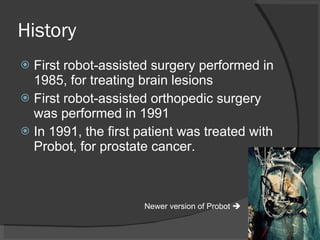
History First robot-assisted surgery performed in 1985, for treating brain lesions First robot-assisted orthopedic surgery was performed in 1991 In 1991, the first patient was treated with Probot, for prostate cancer. Newer version of Probot  
Classification of surgical systems Surgical Robots Service Robots Prostheses Simulators Robots for diagnosis Passive manipulators Assistive Robots
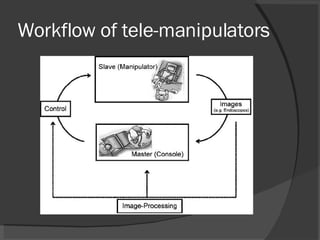
Surgical Robots Surgical robots can be tele-manipulators   or preprogrammed robots Tele-manipulators are handled by the surgeon during surgery (intraoperative images used) Preprogrammed robots are guided by a fixed plan (preoperative images used)
Workflow of tele-manipulators
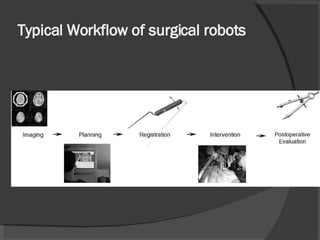
Typical Workflow of surgical robots
Service Robots. These are used for rehabilitation They have some pre-programmed movements which help the patient regain lost functionality A vision system may be present to support interaction
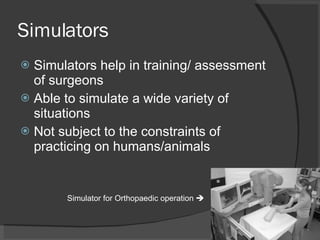
Simulators Simulators help in training/ assessment of surgeons Able to simulate a wide variety of situations Not subject to the constraints of practicing on humans/animals Simulator for Orthopaedic operation  
Applications Orthopaedics Urology Radiosurgery Biopsies / interventional radiotherapy Endoscopy/Colonoscopy/Endoscopy Cardiac Surgery Neurosurgery ENT Surgery Oral/Cranio-maxillofacial surgery
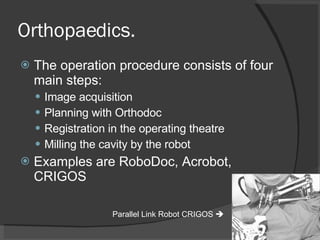
Orthopaedics. The operation procedure consists of four main steps: Image acquisition Planning with Orthodoc Registration in the operating theatre Milling the cavity by the robot Examples are RoboDoc, Acrobot, CRIGOS Parallel Link Robot CRIGOS  
Urology. Probot used for transurethral resection of the prostate Both imaging and cutting done in the operating theatre - no pre-operative planning required Main steps: Measuring gland size with ultrasound Imaging and cavity design Cutting
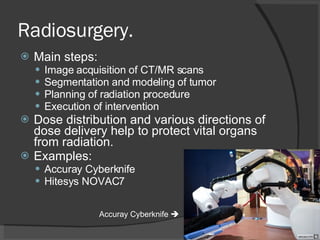
Radiosurgery. Main steps: Image acquisition of CT/MR scans Segmentation and modeling of tumor Planning of radiation procedure Execution of intervention Dose distribution and various directions of dose delivery help to protect vital organs from radiation. Examples: Accuray Cyberknife Hitesys NOVAC7 Accuray Cyberknife  
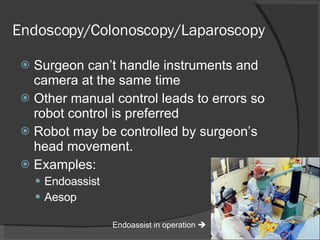
Endoscopy/Colonoscopy/Laparoscopy Surgeon can’t handle instruments and camera at the same time Other manual control leads to errors so robot control is preferred Robot may be controlled by surgeon’s head movement. Examples: Endoassist Aesop Endoassist in operation  
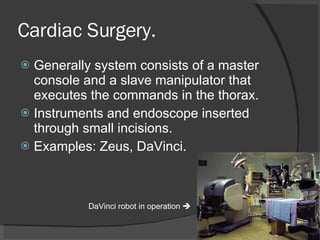
Cardiac Surgery. Generally system consists of a master console and a slave manipulator that executes the commands in the thorax. Instruments and endoscope inserted through small incisions. Examples: Zeus, DaVinci. DaVinci robot in operation  
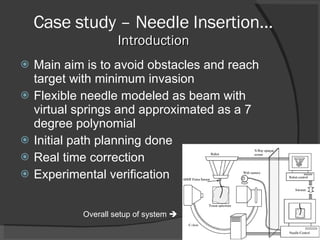
Case study – Needle Insertion… Introduction Main aim is to avoid obstacles and reach target with minimum invasion Flexible needle modeled as beam with virtual springs and approximated as a 7 degree polynomial Initial path planning done Real time correction Experimental verification Overall setup of system  
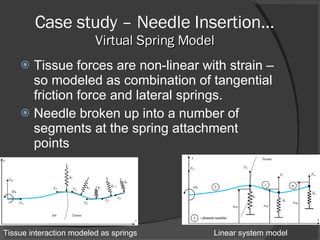
Case study – Needle Insertion… Virtual Spring Model Tissue forces are non-linear with strain – so modeled as combination of tangential friction force and lateral springs. Needle broken up into a number of segments at the spring attachment points Tissue interaction modeled as springs Linear system model
Case study – Needle Insertion… Forward / Inverse Kinematics Generally, forward kinematics required to ascertain position of needle end-point from known needle base parameters. In this scenario, inverse kinematics is done for each point on the planned path to ascertain needle base parameters for this position.
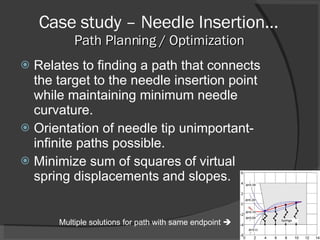
Case study – Needle Insertion… Path Planning / Optimization Relates to finding a path that connects the target to the needle insertion point while maintaining minimum needle curvature. Orientation of needle tip unimportant- infinite paths possible. Minimize sum of squares of virtual spring displacements and slopes. Multiple solutions for path with same endpoint  
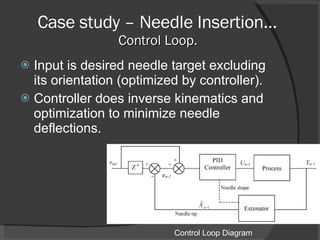
Case study – Needle Insertion… Control Loop. Input is desired needle target excluding its orientation (optimized by controller). Controller does inverse kinematics and optimization to minimize needle deflections. Control Loop Diagram
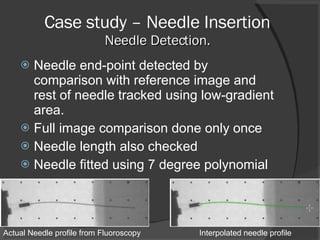
Case study – Needle Insertion Needle Detection. Needle end-point detected by comparison with reference image and rest of needle tracked using low-gradient area. Full image comparison done only once Needle length also checked Needle fitted using 7 degree polynomial Actual Needle profile from Fluoroscopy Interpolated needle profile
Current Trends… MRI-compatible materials / mechatronics / actuators Safety studies Incorporating haptic feedback into surgical systems
Challenges/Future Scope Robotic systems are not usable for routine treatment Unlike industrial robots, medical robots need to operate in conjunction with the operator Ease of training and assessment Minimally invasive surgery
References Various product websites ( Prosurgic, Intuitive etc.) “ Robots in the operating theatre—chances and challenges” - Korb, Marmulla et. al. ,  Int. J. Oral Maxillofac. Surg. 2004(33) “ Image-Guided Robotic Flexible Needle Steering” – Shoham, Glozman, IEEE Trans. Robotics Vol.23 No.3 Encyclopedia Britannica

Computer Assisted Surgical Intervention

  • 1.
  • 2.
    Introduction “Computer-assisted intervention”is defined as the use of automated systems in surgery Two different approaches : As a tool (assisting the surgeon) An autonomous system (replacing the surgeon) Several assistive systems are available, but the autonomous systems are still in the development stages
  • 3.
    History First robot-assistedsurgery performed in 1985, for treating brain lesions First robot-assisted orthopedic surgery was performed in 1991 In 1991, the first patient was treated with Probot, for prostate cancer. Newer version of Probot 
  • 4.
    Classification of surgicalsystems Surgical Robots Service Robots Prostheses Simulators Robots for diagnosis Passive manipulators Assistive Robots
  • 5.
    Surgical Robots Surgicalrobots can be tele-manipulators or preprogrammed robots Tele-manipulators are handled by the surgeon during surgery (intraoperative images used) Preprogrammed robots are guided by a fixed plan (preoperative images used)
  • 6.
  • 7.
    Typical Workflow ofsurgical robots
  • 8.
    Service Robots. Theseare used for rehabilitation They have some pre-programmed movements which help the patient regain lost functionality A vision system may be present to support interaction
  • 9.
    Simulators Simulators helpin training/ assessment of surgeons Able to simulate a wide variety of situations Not subject to the constraints of practicing on humans/animals Simulator for Orthopaedic operation 
  • 10.
    Applications Orthopaedics UrologyRadiosurgery Biopsies / interventional radiotherapy Endoscopy/Colonoscopy/Endoscopy Cardiac Surgery Neurosurgery ENT Surgery Oral/Cranio-maxillofacial surgery
  • 11.
    Orthopaedics. The operationprocedure consists of four main steps: Image acquisition Planning with Orthodoc Registration in the operating theatre Milling the cavity by the robot Examples are RoboDoc, Acrobot, CRIGOS Parallel Link Robot CRIGOS 
  • 12.
    Urology. Probot usedfor transurethral resection of the prostate Both imaging and cutting done in the operating theatre - no pre-operative planning required Main steps: Measuring gland size with ultrasound Imaging and cavity design Cutting
  • 13.
    Radiosurgery. Main steps:Image acquisition of CT/MR scans Segmentation and modeling of tumor Planning of radiation procedure Execution of intervention Dose distribution and various directions of dose delivery help to protect vital organs from radiation. Examples: Accuray Cyberknife Hitesys NOVAC7 Accuray Cyberknife 
  • 14.
    Endoscopy/Colonoscopy/Laparoscopy Surgeon can’thandle instruments and camera at the same time Other manual control leads to errors so robot control is preferred Robot may be controlled by surgeon’s head movement. Examples: Endoassist Aesop Endoassist in operation 
  • 15.
    Cardiac Surgery. Generallysystem consists of a master console and a slave manipulator that executes the commands in the thorax. Instruments and endoscope inserted through small incisions. Examples: Zeus, DaVinci. DaVinci robot in operation 
  • 16.
    Case study –Needle Insertion… Introduction Main aim is to avoid obstacles and reach target with minimum invasion Flexible needle modeled as beam with virtual springs and approximated as a 7 degree polynomial Initial path planning done Real time correction Experimental verification Overall setup of system 
  • 17.
    Case study –Needle Insertion… Virtual Spring Model Tissue forces are non-linear with strain – so modeled as combination of tangential friction force and lateral springs. Needle broken up into a number of segments at the spring attachment points Tissue interaction modeled as springs Linear system model
  • 18.
    Case study –Needle Insertion… Forward / Inverse Kinematics Generally, forward kinematics required to ascertain position of needle end-point from known needle base parameters. In this scenario, inverse kinematics is done for each point on the planned path to ascertain needle base parameters for this position.
  • 19.
    Case study –Needle Insertion… Path Planning / Optimization Relates to finding a path that connects the target to the needle insertion point while maintaining minimum needle curvature. Orientation of needle tip unimportant- infinite paths possible. Minimize sum of squares of virtual spring displacements and slopes. Multiple solutions for path with same endpoint 
  • 20.
    Case study –Needle Insertion… Control Loop. Input is desired needle target excluding its orientation (optimized by controller). Controller does inverse kinematics and optimization to minimize needle deflections. Control Loop Diagram
  • 21.
    Case study –Needle Insertion Needle Detection. Needle end-point detected by comparison with reference image and rest of needle tracked using low-gradient area. Full image comparison done only once Needle length also checked Needle fitted using 7 degree polynomial Actual Needle profile from Fluoroscopy Interpolated needle profile
  • 22.
    Current Trends… MRI-compatiblematerials / mechatronics / actuators Safety studies Incorporating haptic feedback into surgical systems
  • 23.
    Challenges/Future Scope Roboticsystems are not usable for routine treatment Unlike industrial robots, medical robots need to operate in conjunction with the operator Ease of training and assessment Minimally invasive surgery
  • 24.
    References Various productwebsites ( Prosurgic, Intuitive etc.) “ Robots in the operating theatre—chances and challenges” - Korb, Marmulla et. al. , Int. J. Oral Maxillofac. Surg. 2004(33) “ Image-Guided Robotic Flexible Needle Steering” – Shoham, Glozman, IEEE Trans. Robotics Vol.23 No.3 Encyclopedia Britannica