Company
LOGO
By: Sharmaine Estrada
COMPUTER ASSISTED
MEDICAL PROCEDURE
COMPUTER ASSISTED SURGERY
Represents a surgical concept and set
of methods, that use computer
technology for pre-surgical
planning, and for guiding or performing
surgical interventions.
What is Computer Assisted Surgery?
GENERAL PRINCIPLES
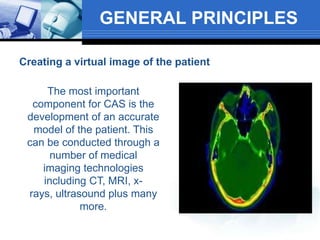
Creating a virtual image of the patient
The most important
component for CAS is the
development of an accurate
model of the patient. This
can be conducted through a
number of medical
imaging technologies
including CT, MRI, x-
rays, ultrasound plus many
more.
Company
LOGOAPPLICATIONS
NEUROSURGERY
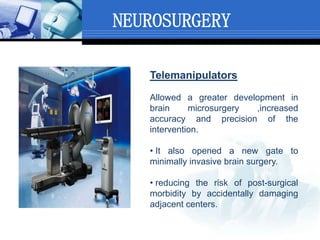
Telemanipulators
Allowed a greater development in
brain microsurgery ,increased
accuracy and precision of the
intervention.
• It also opened a new gate to
minimally invasive brain surgery.
• reducing the risk of post-surgical
morbidity by accidentally damaging
adjacent centers.
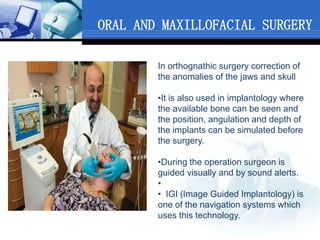
ORAL AND MAXILLOFACIAL SURGERY
In orthognathic surgery correction of
the anomalies of the jaws and skull
•It is also used in implantology where
the available bone can be seen and
the position, angulation and depth of
the implants can be simulated before
the surgery.
•During the operation surgeon is
guided visually and by sound alerts.
•
• IGI (Image Guided Implantology) is
one of the navigation systems which
uses this technology.
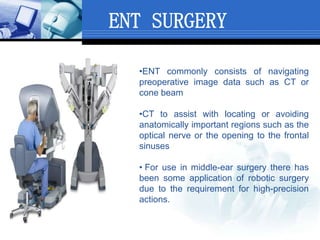
ENT SURGERY
•ENT commonly consists of navigating
preoperative image data such as CT or
cone beam
•CT to assist with locating or avoiding
anatomically important regions such as the
optical nerve or the opening to the frontal
sinuses
• For use in middle-ear surgery there has
been some application of robotic surgery
due to the requirement for high-precision
actions.
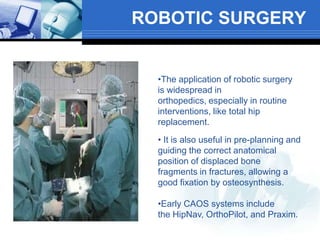
ROBOTIC SURGERY
•The application of robotic surgery
is widespread in
orthopedics, especially in routine
interventions, like total hip
replacement.
• It is also useful in pre-planning and
guiding the correct anatomical
position of displaced bone
fragments in fractures, allowing a
good fixation by osteosynthesis.
•Early CAOS systems include
the HipNav, OrthoPilot, and Praxim.
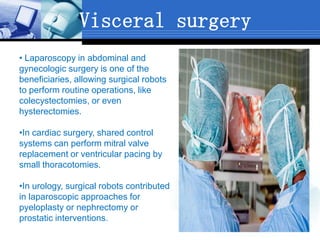
Visceral surgery
• Laparoscopy in abdominal and
gynecologic surgery is one of the
beneficiaries, allowing surgical robots
to perform routine operations, like
colecystectomies, or even
hysterectomies.
•In cardiac surgery, shared control
systems can perform mitral valve
replacement or ventricular pacing by
small thoracotomies.
•In urology, surgical robots contributed
in laparoscopic approaches for
pyeloplasty or nephrectomy or
prostatic interventions.
RADIOSURGERY
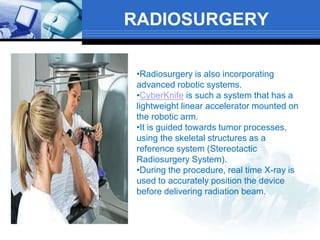
•Radiosurgery is also incorporating
advanced robotic systems.
•CyberKnife is such a system that has a
lightweight linear accelerator mounted on
the robotic arm.
•It is guided towards tumor processes,
using the skeletal structures as a
reference system (Stereotactic
Radiosurgery System).
•During the procedure, real time X-ray is
used to accurately position the device
before delivering radiation beam.
ADVANTAGES
1. Preoperative diagnostic and a well-defined surgical planning
2.Surgeon can easily assess most of the surgical difficulties and risks
and have a clear idea about how to optimize the surgical approach and
decrease surgical morbidity.
3.The operation, the computer guidance improves the geometrical
accuracy of the surgical gestures and also reduce the redundancy of
the surgeon’s acts.
4.This significantly improves ergonomy in the operating theatre,
decreases the risk of surgical errors and reduces the operating time.
DISADVANTAGES
 New technology and its uses and efficacy have not yet
been well established.
 Another disadvantage of these systems is their cost.
With a price tag of a million dollars, their cost is nearly
prohibitive.
 One of the potential disadvantages identified is a lack of
compatible instruments and equipment. Lack of certain
instruments increases reliance on tableside assistants to
perform part of the surgery
HOSPITALS WITH COMPUTER
ASSISTED PROCEDURE IN THE
PHILIPPINES
CONCLUSION

Presentation1estrada

  • 1.
  • 2.
    COMPUTER ASSISTED SURGERY Representsa surgical concept and set of methods, that use computer technology for pre-surgical planning, and for guiding or performing surgical interventions. What is Computer Assisted Surgery?
  • 3.
    GENERAL PRINCIPLES Creating avirtual image of the patient The most important component for CAS is the development of an accurate model of the patient. This can be conducted through a number of medical imaging technologies including CT, MRI, x- rays, ultrasound plus many more.
  • 4.
  • 5.
    NEUROSURGERY Telemanipulators Allowed a greaterdevelopment in brain microsurgery ,increased accuracy and precision of the intervention. • It also opened a new gate to minimally invasive brain surgery. • reducing the risk of post-surgical morbidity by accidentally damaging adjacent centers.
  • 6.
    ORAL AND MAXILLOFACIALSURGERY In orthognathic surgery correction of the anomalies of the jaws and skull •It is also used in implantology where the available bone can be seen and the position, angulation and depth of the implants can be simulated before the surgery. •During the operation surgeon is guided visually and by sound alerts. • • IGI (Image Guided Implantology) is one of the navigation systems which uses this technology.
  • 7.
    ENT SURGERY •ENT commonlyconsists of navigating preoperative image data such as CT or cone beam •CT to assist with locating or avoiding anatomically important regions such as the optical nerve or the opening to the frontal sinuses • For use in middle-ear surgery there has been some application of robotic surgery due to the requirement for high-precision actions.
  • 8.
    ROBOTIC SURGERY •The applicationof robotic surgery is widespread in orthopedics, especially in routine interventions, like total hip replacement. • It is also useful in pre-planning and guiding the correct anatomical position of displaced bone fragments in fractures, allowing a good fixation by osteosynthesis. •Early CAOS systems include the HipNav, OrthoPilot, and Praxim.
  • 9.
    Visceral surgery • Laparoscopyin abdominal and gynecologic surgery is one of the beneficiaries, allowing surgical robots to perform routine operations, like colecystectomies, or even hysterectomies. •In cardiac surgery, shared control systems can perform mitral valve replacement or ventricular pacing by small thoracotomies. •In urology, surgical robots contributed in laparoscopic approaches for pyeloplasty or nephrectomy or prostatic interventions.
  • 10.
    RADIOSURGERY •Radiosurgery is alsoincorporating advanced robotic systems. •CyberKnife is such a system that has a lightweight linear accelerator mounted on the robotic arm. •It is guided towards tumor processes, using the skeletal structures as a reference system (Stereotactic Radiosurgery System). •During the procedure, real time X-ray is used to accurately position the device before delivering radiation beam.
  • 11.
  • 12.
    1. Preoperative diagnosticand a well-defined surgical planning 2.Surgeon can easily assess most of the surgical difficulties and risks and have a clear idea about how to optimize the surgical approach and decrease surgical morbidity. 3.The operation, the computer guidance improves the geometrical accuracy of the surgical gestures and also reduce the redundancy of the surgeon’s acts. 4.This significantly improves ergonomy in the operating theatre, decreases the risk of surgical errors and reduces the operating time.
  • 13.
    DISADVANTAGES  New technologyand its uses and efficacy have not yet been well established.  Another disadvantage of these systems is their cost. With a price tag of a million dollars, their cost is nearly prohibitive.  One of the potential disadvantages identified is a lack of compatible instruments and equipment. Lack of certain instruments increases reliance on tableside assistants to perform part of the surgery
  • 14.
    HOSPITALS WITH COMPUTER ASSISTEDPROCEDURE IN THE PHILIPPINES
  • 15.

Editor's Notes

  • #6 A remote manipulator, also known as a telefactor, telemanipulator, orwaldo (after the short story "Waldo" by Robert A. Heinlein which features a man who invents and uses such devices),[1] is a device which, throughelectronic, hydraulic, or mechanical linkages, allows a hand-like mechanism to be controlled by a human operator. The purpose of such a device is usually to move or manipulate hazardous materials for reasons of safety.