Pressure Pulse Testing
in Heterogeneous Reservoirs
            Sanghui Sandy Ahn
          Advisor: Roland N. Horne

 Department of Energy Resources Engineering
            Stanford University
                Jan 26, 2012
Pressure Pulse Testing Technique
• Apply periodic pressure pulses from an active well and
  measure at an observation point to estimate the
  heterogeneous permeability.
• Several cycles by alternating flow and shut-in period
• Data: time-series pressure signals pinj(t), pobs (t)
             q(t)


                                        pobs(t)


             pinj(t)        k?


                                                           2
Challenges for Estimating Permeability Distribution
  and Opportunities for Pressure Pulse Technique
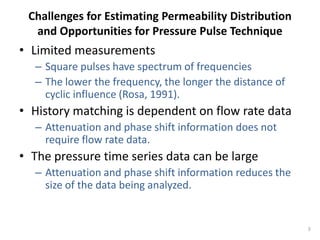
• Limited measurements
  – Square pulses have spectrum of frequencies
  – The lower the frequency, the longer the distance of
    cyclic influence (Rosa, 1991).
• History matching is dependent on flow rate data
  – Attenuation and phase shift information does not
    require flow rate data.
• The pressure time series data can be large
  – Attenuation and phase shift information reduces the
    size of the data being analyzed.


                                                          3
Overview
• Background
• Two Reservoir Models
    – Characterization by Multiple Frequency Data
• Detrending
    –   Transient Reconstruction
    –   Detrending on Injection & Observation Pressure
    –   Effect of Number and Position of Pulses
    –   Effect of Sampling Frequency and Noise
• Inverse Problem Formulation
• Synthetic Data- Permeability Estimation Results
    –   Sinusoidal Frequencies
    –   Harmonic Frequencies from Square Pulses
    –   Comparison between the Three Methods
    –   Sensitivity to Perturbation in Frequencies
    –   Storage and Skin Effects
• Real Data - Permeability Estimation Results
    – Quantization Noise
    – Pressure Matching Results

                                                         4
Previous Approach
 for Estimating Average Permeability in Time Domain
• Used to estimate average permeability and
  porosity by:
  – Transmissivity
     kh              pD
           141.2qB          Amplitude reduction
                      p

  – Storativity
                                         Time lag
                   kh            t
  ct h    0.0002637                      2
                          r 2 t D / rD


                                                    (Ryuzo, 1991)   5
Previous Approach
            for Estimating Average Permeability in Time Domain
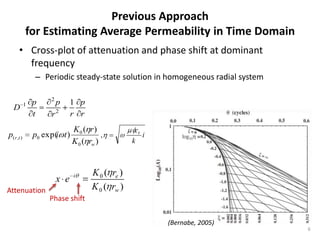
      • Cross-plot of attenuation and phase shift at dominant
        frequency
                – Periodic steady-state solution in homogeneous radial system

                      2
            1   p         p     1 p
   D
                t     r2        r r
                                K0 ( r )             ct
p( r ,t )       p0 exp(i t )               ,            i
                                K 0 ( rw )          k


                                i      K 0 ( re )
                          x e
Attenuation                            K 0 ( rw )
                     Phase shift


                                                            (Bernabe, 2005)
                                                                                6
Pressure Data to Reveal Heterogeneity
     • Extracting heterogeneous permeability distribution from a
       single well

                sqrt(t)K(rD,tD) with t D =102
   0.4


  0.35


   0.3


  0.25


   0.2


  0.15
            K1(rD,tD)
   0.1


  0.05


    0
      0                        1                 2
    10                       10                 10
                             rD


                                            kref               (Oliver, 1992)
            1           1
pwD (tD )                  K1 (rD , tD )(1         )drD
            2           21                 k (rD )
Known
                                                To estimate              7
Sourcing Multiple Frequencies by Square Pulses


                 1                          1
                 3                          3
+                5 ..    +                  5 ..


                                                   8
Solvability Condition for Inverse Problem:
What Multiple Frequencies Can Do with Limited Spatial Measurements


                                         Permeability estimation problem
                          i   sin i t
                                                    { pinj(t), pobs(t) }
   Spectrum of frequencies


               +                                    pinj(t)
                                                                                pobs(t)

      (Rosa, 1991 )
                                                              k1 k
                                                                  2
                                                                      …
                                                       ?                   kn


                                         Careful frequency selection is
      Different frequency carries         required for successful extraction.
different effective propagation length
                                                                                          9
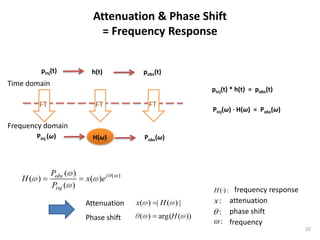
Attenuation & Phase Shift
                             = Frequency Response


          pinj(t)          h(t)             pobs(t)
Time domain
                                                                pinj(t) * h(t) = pobs(t)

        FT                  FT                FT
                                                                Pinj(ω) ∙ H(ω) = Pobs(ω)

Frequency domain
       Pinj (ω)            H(ω)             Pobs(ω)


              Pobs ( )
   H( )                  x ( )e i   ( )
              Pinj ( )
                                                                H ( ) : frequency response
                         Attenuation      x( ) | H ( ) |        x : attenuation
                                                                  : phase shift
                         Phase shift       ( )     arg(H ( ))
                                                                   : frequency
                                                                                             10
Visualization of Attenuation and Phase Shift

                                    c      d

Attenuation
• Amplitude ratio                                   a
   =a/b
                              Output pressure

Time Shift (~ Phase Shift )                                  b
• Delay in cycle
                                   Input pressure
   =c/d


                                                        11
Visualization of Attenuation and Phase Shift

Attenuation              Phase Shift
• Amplitude ratio        • Delay normalized in cycle
              pobs ( )                    obs (   )   inj (   )
 x( )                         ( )
              pinj ( )                            2


  1                           1
   3                           3
       5 ..                        5 ..


                                                                  12
Objectives
Characterize heterogeneous reservoir models using
  analysis of multiple frequencies:
• Investigate how a frequency response represents
  heterogeneity.
• Formulate the periodic steady-state solutions for
  radial and vertical permeability distributions.
• Provide a new method that utilizes attenuation and
  phase shift information at multiple frequencies to
  determine the permeability distribution.
• Provide the desirable pulsing conditions for using the
  frequency method.

                                                           13
Overall Procedure


                    14
Overview
• Background
• Two Reservoir Models
    – Characterization by Multiple Frequency Data
• Detrending
    –   Transient Reconstruction
    –   Detrending on Injection & Observation Pressure
    –   Effect of Number and Position of Pulses
    –   Effect of Sampling Frequency and Noise
• Inverse Problem Formulation
• Synthetic Data- Permeability Estimation Results
    –   Sinusoidal Frequencies
    –   Harmonic Frequencies from Square Pulses
    –   Comparison between the Three Methods
    –   Sensitivity to Perturbation in Frequencies
    –   Storage and Skin Effects
• Real Data - Permeability Estimation Results
    – Quantization Noise
    – Pressure Matching Results

                                                         15
Radial Heterogeneity Inspection
using Pressure Pulse Testing Technique


                                                            Pinj (ω)                         x (ω)                      kr(r)
                                                            Pobs(ω)                          θ (ω)


                                            600                          600                          600


              Radial permeability, kr, md   500   Model 1                500       Model 2            500       Model 3

                                            400                          400                          400


                                            300                          300                          300


                                            200                          200                          200


                                            100                          100                          100


                                             0                            0                            0
                                                  0   200    400   600         0    200   400   600         0   200   400   600
                                                                         Radial distance, r, ft                                   16
Vertical Heterogeneity Inspection
       using Pressure Pulse Testing Technique
• Partially penetrating well with cross flow

                                                  Pinj (ω)                   x (ω)              kv(h)
                                                  Pobs(ω)                    θ (ω)


                                             Model 4                   Model 5             Model 6
                                    2                         2                       2
                                    4                         4                       4
                                    6                         6                       6
                     Depth, h, ft


                                    8                         8                       8
                                    10                        10                      10
                                    12                        12                      12
                                    14                        14                      14
                                    16                        16                      16
                                    18                        18                      18

                                         0       10      20        0        10   20        0    10        20
                                                        Vertical permeability, kv, md                17
Frequency Response
                   for Radial Ring Model
• Periodic steady-state solution at multiple frequencies
• Using conditions: inner/outer boundary, continuity
• Attenuation and phase shift are obtained directly without
  time information


                                               → Diffusivity equation

                                           → Steady state assumption


                                                   → Pressure solution


                                         → Attenuation and phase shift

                                                                         18
Frequency Response
                  for Multilayered Model
• Periodic steady-state solution at multiple frequencies
• Using conditions: inner/outer boundary
• Attenuation and phase shift are obtained directly without
  time information

                                                  → Diffusivity equation

                                              → Steady state assumption


                                                      → Pressure solution


                                            → Attenuation and phase shift


                                                                     19
Frequency Response and Permeability Distribution
• Attenuation and phase shift information at varying frequencies forms a
  differentiating characteristic for heterogeneity.
• H ( k , i ) H (k ,1       i )

Radial Ring model                           Multilayered model, kv/kr =0.1

    High                                          High
    frequency                                     frequency


                       Low                                             Low
                       frequency                                       frequency


                                                                             20
Appropriate Sourcing Frequency Range with kr


                          Over one cycle,
                          too high frequency


                                               21
Appropriate Sourcing Frequency Range with kv


                                   Over one cycle,
                                   too high frequency


                                                        22
Extension to Heterogeneous Permeability Distribution


                                      Not only an option
                                      but a necessary step


                                                             23
Overview
• Background
• Two Reservoir Models
    – Characterization by Multiple Frequency Data
• Detrending
    –   Transient Reconstruction
    –   Detrending on Injection & Observation Pressure
    –   Effect of Number and Position of Pulses
    –   Effect of Sampling Frequency and Noise
• Inverse Problem Formulation
• Synthetic Data- Permeability Estimation Results
    –   Sinusoidal Frequencies
    –   Harmonic Frequencies from Square Pulses
    –   Comparison between the Three Methods
    –   Sensitivity to Perturbation in Frequencies
    –   Storage and Skin Effects
• Real Data - Permeability Estimation Results
    – Quantization Noise
    – Pressure Matching Results

                                                         24
Detrending
                             • To eliminate the pressure transient and obtain frequency data
                               at periodically steady-state
                             • Challenge: flow rate is unknown
                                                                 q0       2q0             1
                                                       q(t )                    sin t       sin3 t ...
                                                                 2                        3

                                                       (Different weight based on duty cycle)
                       120
                                                                                                               50

                                                                                                               40
                       100
                                                                                                                                              Injection
Pressure change, psi


                                                                                        Pressure change, psi
                                          Upward trend                                                         30
                                                                                                                                              Observation
                       80                   Injection                                                          20
                                            Observation                                                        10
                                            True transient, injection
                       60                                                                                       0
                                            True transient, observation
                                            Reconstructed transients                                           -10
                                                                           Removing
                       40                                                                                      -20
                                                                           transient
                                                                                                               -30
                       20
                                                                                                               -40

                                                                                                               -50

                                 5   10       15       20       25                                                   5   10       15     20        25
                                          Time, hr                                                                            Time, hr                  25
Transient Reconstruction
• A good reconstruction of the first transient is obtained by
  using the periodicity
   – The first transient curvature till its maximum peak
   – Pivot points per period:


                                             Linearly interpolate between pivots


                                           For unequal pulses,
                                           at least at every pivots αTp :


                                               Iteratively compute                 26
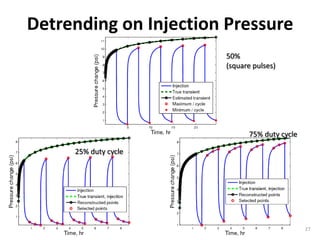
Detrending on Injection Pressure
                       50%
                       (square pulses)


                             75% duty cycle

     25% duty cycle


                                              27
Detrending on Observation Pressure
                          50%
                          (square pulses)


                                75% duty cycle

25% duty cycle


                                                 28
Effect of Detrending on Square Pulses


No dc component


                            Change in the decomposition
                            at high frequencies


                                                          29
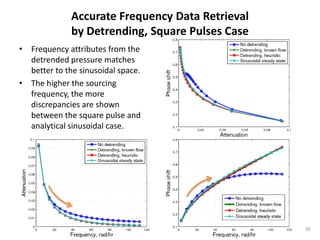
Accurate Frequency Data Retrieval
              by Detrending, Square Pulses Case
• Frequency attributes from the
  detrended pressure matches
  better to the sinusoidal space.
• The higher the sourcing
  frequency, the more
  discrepancies are shown
  between the square pulse and
  analytical sinusoidal case.


                                                  30
Effect of Number and Position of Pulses


Accurate frequency data with
- Larger number of pulses
- Pulses at later time
                                            31
Effect of Sampling Frequency
                                                       MAE Summary of
                                                       10 realizations with
With sampling rate of 22.6, 5.7, and 1.4 sec
                                                       1% Normal pressure noise
                                                        N
                                                               i
                                                              xnoise       x x
                                                        i 1
                                                                   N


                                               with
                                               noise

                                                         N      i
                                                                noise
                                                         i 1
                                                                       N

  Accurate frequency data with
  - Higher sampling frequency                                                     32
Effect of Sampling Frequency with Noise
                                                              Pressure Pulses with 128 pts /cycle
                 100                                                                                                        80
                                                                                   With noise                                                                                        With noise
                                                                                                                            70
                  80              Injection                                        No noise                                           Observation                                    No noise
                                                                                                                            60
Magnitude (dB)


                                                                                                           Magnitude (dB)
                                                                                                                            50
                  60
                                                                                                                            40

                  40                                                                                                        30

                                                           0.8                                                              20
                  20
                                                                                                                            10

                                                           0.7                                                               0
                   0
                                                                                                                            -10

                                                           0.6
                 -20                                                                                                        -20
                       0    50   100   150     200          250      300   350     400    450    500                              0   50   100       150   200    250    300   350   400   450    500
                                             Phase shift


                                        Frequency, rad/hr                                                                                             Frequency, rad/hr
                  0.1                                      0.5                                                               1
                                                                                        No noise                                                                        No noise
                 0.09                                                                                                       0.9

                 0.08
                                                           0.4                                                              0.8

                 0.07                                                                                                       0.7
Attenuation


                                                           0.3
                                                                                                           Phase shift
                 0.06                                                                                                       0.6

                 0.05
                                       10 realizations                                                                      0.5

                 0.04
                                       with 1% Gaussian noise
                                             0.2
                                                                                                                            0.4

                 0.03                                                                                                       0.3
                                                           0.1
                                                                 0    0.01       0.02     0.03     0.04   0.05               0.06      0.07        0.08    0.09    0.1
                 0.02                                                                                                       0.2

                 0.01
                                                                                                   Attenuation
                                                                                                           0.1

                   0                                                                                                         0
                        0        50             100                  150           200             250                            0           50           100           150         200          250   33
                                         Frequency, rad/hr                                                                                            Frequency, rad/hr
Overview
• Background
• Two Reservoir Models
    – Characterization by Multiple Frequency Data
• Detrending
    –   Transient Reconstruction
    –   Detrending on Injection & Observation Pressure
    –   Effect of Number and Position of Pulses
    –   Effect of Sampling Frequency and Noise
• Inverse Problem Formulation
• Synthetic Data- Permeability Estimation Results
    –   Sinusoidal Frequencies
    –   Harmonic Frequencies from Square Pulses
    –   Comparison between the Three Methods
    –   Sensitivity to Perturbation in Frequencies
    –   Storage and Skin Effects
• Real Data - Permeability Estimation Results
    – Quantization Noise
    – Pressure Matching Results

                                                         34
Inverse Problem Formulation and Performance
BFGS Quasi-Newton method with a cubic line search
• Matching attenuation and phase shift at multiple frequencies
   – Computation: O(2Nw), with Nw frequencies
                           2                             2                      2                        2
   min x       x(k,   1)       ...   x       x(k,   n)               (k,   1)       ...       (k,   n)
    k      1               2             n               2       1              2         n              2


• Pressure history matching
                           2                                 2
   min pt1     p(k, t1 )       ...   ptm      p(k, t m )
    k                      2                                 2
   – Computation: O(2Nt*Ns), with Nt time series & Ns Stehfest coefficients
• Wavelet thresholding
                           2                             2
   min wt1     w(k, t1 )       ...   wtl     w(k, tl )
    k                      2                             2
   – Computation: similar to pressure history matching


                                                                                                             35
Pressure Reconstruction
• Reconstruction of pressure by varying number
  of wavelets


                                                 36
Computational Effort Comparison
• Convergence over iterations


                         Example of computational effort
                         1. History matching and Wavelet: ~ 30 mins
                            - Time points: 5000
                            - Stehfest: 8
                         2. Frequency information: ~ 30 secs
                            - Frequency points: 10


                                                                      37
Overview
• Background
• Two Reservoir Models
    – Characterization by Multiple Frequency Data
• Detrending
    –   Transient Reconstruction
    –   Detrending on Injection & Observation Pressure
    –   Effect of Number and Position of Pulses
    –   Effect of Sampling Frequency and Noise
• Inverse Problem Formulation
• Synthetic Data- Permeability Estimation Results
    –   Sinusoidal Frequencies
    –   Harmonic Frequencies from Square Pulses
    –   Comparison between the Three Methods
    –   Sensitivity to Perturbation in Frequencies
    –   Storage and Skin Effects
• Real Data - Permeability Estimation Results
    – Quantization Noise
    – Pressure Matching Results

                                                         38
Parameter Estimation Result for Radial Ring Model
                        Using Multiple Sinusoidal Frequencies


         3
                                                                Model 1
                         4
                     2
                                       1


5: rDc inf   j
                 1.1 1   Dj   (radius of cyclic influence)


                         Model 2                                 Model 3


                                                                           39
Parameter Estimation Result for Multilayered Model
          Using Multiple Sinusoidal Frequencies


3
                                                 Model 4
          4
      2
                    1


                                                  Model 6


          Model 5


                                                            40
Parameter Estimation Result for Radial Ring Model
         Using Varying Number of Sinusoidal Frequencies
                                                     Model 1
• Estimation with three or more
frequency components resulted in a
good match with the true distribution.


                                                      Model 3
             Model 2


                                                                41
Parameter Estimation Result for Multilayered Model
         Using Varying Number of Sinusoidal Frequencies
                                                     Model 4
• Estimation with three or more
frequency components resulted in a
good match with the true distribution.


                                                     Model 6
             Model 5


                                                               42
Parameter Estimation Result for Radial Ring Model
     Using Harmonic Frequencies from Square Pulses

• Model 2, comparison between three methods
        No noise                 With 1% Gaussian noise in pressure


                                                                      43
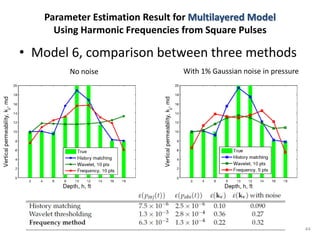
Parameter Estimation Result for Multilayered Model
     Using Harmonic Frequencies from Square Pulses

• Model 6, comparison between three methods
        No noise                 With 1% Gaussian noise in pressure


                                                                      44
Robustness Check on Radial Ring Model
  by Perturbation in Frequency Space
                     Model 1


 Model 2                                Model 3


                                                  45
Robustness Check on Multilayered Model
  by Perturbation in Frequency Space
                      Model 4


       Model 5                     Model 6


                                             46
Storage Effect


Periodic steady-state space remains the same


                                               47
Skin Effect
With skin factor in the injection well:
• Injection pressure changes → periodic steady-state space changes


                                                                     48
Combined Effect of Storage and Skin


                                               Multiple distributions are possible
                                               with unknown skin factor


• The larger the CD and skin, the more discrepancy with a steady state
  model is observed
• Only a few low frequency points are reliable in steady state space.
  cf. Sinusoidal model remains unchanged with varying CD
                                                                                 49
Storage and Skin Estimation

• Estimate from a constant rate pressure
  response with a permeability estimation
  – Storage:
  – Skin (assuming that the skin effect is small)


                                                    50
Overview
• Background
• Two Reservoir Models
    – Characterization by Multiple Frequency Data
• Detrending
    –   Transient Reconstruction
    –   Detrending on Injection & Observation Pressure
    –   Effect of Number and Position of Pulses
    –   Effect of Sampling Frequency and Noise
• Inverse Problem Formulation
• Synthetic Data- Permeability Estimation Results
    –   Sinusoidal Frequencies
    –   Harmonic Frequencies from Square Pulses
    –   Comparison between the Three Methods
    –   Sensitivity to Perturbation in Frequencies
    –   Storage and Skin Effects
• Real Data - Permeability Estimation Results
    – Quantization Noise
    – Pressure Matching Results

                                                         51
Quantization Noise on Pressure
                                    5                                                                                            5
Pressure change, injection (psi)


                                                                                             Pressure change, injection (psi)
                                   4.5                                                                                          4.5
                                                                  Original                                                                                     Original
                                    4                                                                                            4
                                                                  Discretized                                                                                  Discretized
                                   3.5                            Quantization error                                            3.5                            Quantization error
                                    3                                                                                            3

                                   2.5                                                                                          2.5

                                    2                                                                                            2

                                   1.5                                                                                          1.5

                                    1                                                                                            1

                                   0.5                                                                                          0.5

                                    0                                                                                            0
                                         0   0.2   0.4      0.6         0.8       1    1.2                                            0   0.2   0.4      0.6         0.8      1      1.2
                                                         Time, hr                                                                                     Time, hr
    • Discretization in time                                                                 • Discretization in pressure amplitude
       - Finite precision to record in time                                                     - Finite bit-representation for
                                                                                                    magnitudes
                                                                                                                                                                                    52
Quantization Noise
                                           Aliasing effect
              Quantization noise in time
 in time


                                           White noise
in pressure                                White noise
amplitude         Quantization noise
                  in pressure amplitude


                                                             53
Field Data 1
Transient Extraction


                       54
Field Data 1
Detrending and Spectrum Analysis


                                   55
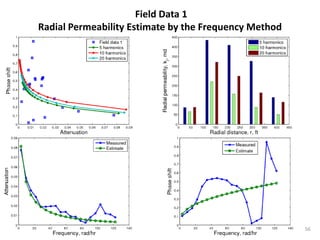
Field Data 1
Radial Permeability Estimate by the Frequency Method


                                                       56
Field Data 1
Radial Permeability Estimate in Comparison with History Matching


                                      CD = 10000
                                      s = 0.2


                                                                   57
Conclusions
• Developed framework for estimating permeability distribution using
  frequency attributes
    – Periodic steady-state solutions for radial and mutilayered models
    – Detrending is established without flow information, which brings a
      clearer periodicity in the pressure data
    – Utilization of harmonic frequency contents
• Conditions for accurate frequency attributes to periodically steady
  state:
    –   Sufficient attenuation and phase shift data pairs
    –   Greater number of pulses
    –   Higher sampling rate
    –   Pulses at later time
    –   Beyond wellbore storage and skin effects: tD > CD(60 + 3.5s)
• Compared to history matching and wavelet thresholding:
    – No need to know the flow information
    – Less computational effort
    – Can perform as good as history matching
                                                                           58
Limitations of the Frequency Method


• Storage and skin should be determined separately from the
  frequency method.
• Only several harmonics are useful from real pulsing data due
  to noise.
• The available frequency components may not be enough to
  cover the whole distance range.


                                                                 59
Acknowledgements
• Prof. Roland Horne, Lou Durlofsky, Jef Caers,
  Tapan Mukerji, and Michael Saunders
• Department of Energy Resources Engineering
  Faculty, Staff, and Students
• Shell
• SUPRI-D members


                                                  60
Pressure Pulse Testing
                in Heterogeneous Reservoirs


                    Thank you!
                      Q&A


Sanghui Sandy Ahn
Energy Resources Engineering, Stanford University


                                                    61
Supplementary slides


                       62
Abstraction of Pressure Transmission (1)


                             [Model 1]


             [Model 2]                   [Model 3]
                                                     63
Abstraction of Pressure Transmission (2)
• By attenuation and phase shift
• General trend from the injection well:
   – Decreasing attenuation and increasing phase shift
• Distinctive heterogeneity appearing as different slopes


                                                            64
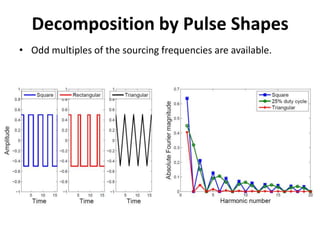
Decomposition by Pulse Shapes
• Odd multiples of the sourcing frequencies are available.
Sensitivity to Boundary Conditions
                     lim p jD            0
                     rD                      Infinite reservoir
                      p jD
                                         0   No flow
                          rD   rD re D

                     p jD (reD , t D ) 0     Constant pressure


                                                                  Multilayered Model

 Radial Ring Model


                                                                                       66
Parameter Estimation Result for Radial Ring Model
     Using Harmonic Frequencies from Square Pulses

• Model 1, comparison between three methods
        No noise                 With 1% Gaussian noise in pressure


                                                                      67
Parameter Estimation Result for Radial Ring Model
     Using Harmonic Frequencies from Square Pulses

• Model 3, comparison between three methods
        No noise                 With 1% Gaussian noise in pressure


                                                                      68
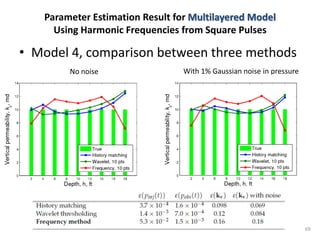
Parameter Estimation Result for Multilayered Model
     Using Harmonic Frequencies from Square Pulses

• Model 4, comparison between three methods
        No noise                 With 1% Gaussian noise in pressure


                                                                      69
Parameter Estimation Result for Multilayered Model
     Using Harmonic Frequencies from Square Pulses

• Model 5, comparison between three methods
        No noise                 With 1% Gaussian noise in pressure


                                                                      70
Wavelet Thresholding


                       71
Future Work


More examples to apply the frequency method
• Incorporating horizontal well configuration, fractured
  reservoirs, etc.
• Water and oil relative permeabilities estimation


                                                           72

Dissertation Slides

  • 1.
    Pressure Pulse Testing inHeterogeneous Reservoirs Sanghui Sandy Ahn Advisor: Roland N. Horne Department of Energy Resources Engineering Stanford University Jan 26, 2012
  • 2.
    Pressure Pulse TestingTechnique • Apply periodic pressure pulses from an active well and measure at an observation point to estimate the heterogeneous permeability. • Several cycles by alternating flow and shut-in period • Data: time-series pressure signals pinj(t), pobs (t) q(t) pobs(t) pinj(t) k? 2
  • 3.
    Challenges for EstimatingPermeability Distribution and Opportunities for Pressure Pulse Technique • Limited measurements – Square pulses have spectrum of frequencies – The lower the frequency, the longer the distance of cyclic influence (Rosa, 1991). • History matching is dependent on flow rate data – Attenuation and phase shift information does not require flow rate data. • The pressure time series data can be large – Attenuation and phase shift information reduces the size of the data being analyzed. 3
  • 4.
    Overview • Background • TwoReservoir Models – Characterization by Multiple Frequency Data • Detrending – Transient Reconstruction – Detrending on Injection & Observation Pressure – Effect of Number and Position of Pulses – Effect of Sampling Frequency and Noise • Inverse Problem Formulation • Synthetic Data- Permeability Estimation Results – Sinusoidal Frequencies – Harmonic Frequencies from Square Pulses – Comparison between the Three Methods – Sensitivity to Perturbation in Frequencies – Storage and Skin Effects • Real Data - Permeability Estimation Results – Quantization Noise – Pressure Matching Results 4
  • 5.
    Previous Approach forEstimating Average Permeability in Time Domain • Used to estimate average permeability and porosity by: – Transmissivity kh pD 141.2qB Amplitude reduction p – Storativity Time lag kh t ct h 0.0002637 2 r 2 t D / rD (Ryuzo, 1991) 5
  • 6.
    Previous Approach for Estimating Average Permeability in Time Domain • Cross-plot of attenuation and phase shift at dominant frequency – Periodic steady-state solution in homogeneous radial system 2 1 p p 1 p D t r2 r r K0 ( r ) ct p( r ,t ) p0 exp(i t ) , i K 0 ( rw ) k i K 0 ( re ) x e Attenuation K 0 ( rw ) Phase shift (Bernabe, 2005) 6
  • 7.
    Pressure Data toReveal Heterogeneity • Extracting heterogeneous permeability distribution from a single well sqrt(t)K(rD,tD) with t D =102 0.4 0.35 0.3 0.25 0.2 0.15 K1(rD,tD) 0.1 0.05 0 0 1 2 10 10 10 rD kref (Oliver, 1992) 1 1 pwD (tD ) K1 (rD , tD )(1 )drD 2 21 k (rD ) Known To estimate 7
  • 8.
    Sourcing Multiple Frequenciesby Square Pulses 1 1 3 3 + 5 .. + 5 .. 8
  • 9.
    Solvability Condition forInverse Problem: What Multiple Frequencies Can Do with Limited Spatial Measurements Permeability estimation problem i sin i t { pinj(t), pobs(t) } Spectrum of frequencies + pinj(t) pobs(t) (Rosa, 1991 ) k1 k 2 … ? kn Careful frequency selection is Different frequency carries required for successful extraction. different effective propagation length 9
  • 10.
    Attenuation & PhaseShift = Frequency Response pinj(t) h(t) pobs(t) Time domain pinj(t) * h(t) = pobs(t) FT FT FT Pinj(ω) ∙ H(ω) = Pobs(ω) Frequency domain Pinj (ω) H(ω) Pobs(ω) Pobs ( ) H( ) x ( )e i ( ) Pinj ( ) H ( ) : frequency response Attenuation x( ) | H ( ) | x : attenuation : phase shift Phase shift ( ) arg(H ( )) : frequency 10
  • 11.
    Visualization of Attenuationand Phase Shift c d Attenuation • Amplitude ratio a =a/b Output pressure Time Shift (~ Phase Shift ) b • Delay in cycle Input pressure =c/d 11
  • 12.
    Visualization of Attenuationand Phase Shift Attenuation Phase Shift • Amplitude ratio • Delay normalized in cycle pobs ( ) obs ( ) inj ( ) x( ) ( ) pinj ( ) 2 1 1 3 3 5 .. 5 .. 12
  • 13.
    Objectives Characterize heterogeneous reservoirmodels using analysis of multiple frequencies: • Investigate how a frequency response represents heterogeneity. • Formulate the periodic steady-state solutions for radial and vertical permeability distributions. • Provide a new method that utilizes attenuation and phase shift information at multiple frequencies to determine the permeability distribution. • Provide the desirable pulsing conditions for using the frequency method. 13
  • 14.
  • 15.
    Overview • Background • TwoReservoir Models – Characterization by Multiple Frequency Data • Detrending – Transient Reconstruction – Detrending on Injection & Observation Pressure – Effect of Number and Position of Pulses – Effect of Sampling Frequency and Noise • Inverse Problem Formulation • Synthetic Data- Permeability Estimation Results – Sinusoidal Frequencies – Harmonic Frequencies from Square Pulses – Comparison between the Three Methods – Sensitivity to Perturbation in Frequencies – Storage and Skin Effects • Real Data - Permeability Estimation Results – Quantization Noise – Pressure Matching Results 15
  • 16.
    Radial Heterogeneity Inspection usingPressure Pulse Testing Technique Pinj (ω) x (ω) kr(r) Pobs(ω) θ (ω) 600 600 600 Radial permeability, kr, md 500 Model 1 500 Model 2 500 Model 3 400 400 400 300 300 300 200 200 200 100 100 100 0 0 0 0 200 400 600 0 200 400 600 0 200 400 600 Radial distance, r, ft 16
  • 17.
    Vertical Heterogeneity Inspection using Pressure Pulse Testing Technique • Partially penetrating well with cross flow Pinj (ω) x (ω) kv(h) Pobs(ω) θ (ω) Model 4 Model 5 Model 6 2 2 2 4 4 4 6 6 6 Depth, h, ft 8 8 8 10 10 10 12 12 12 14 14 14 16 16 16 18 18 18 0 10 20 0 10 20 0 10 20 Vertical permeability, kv, md 17
  • 18.
    Frequency Response for Radial Ring Model • Periodic steady-state solution at multiple frequencies • Using conditions: inner/outer boundary, continuity • Attenuation and phase shift are obtained directly without time information → Diffusivity equation → Steady state assumption → Pressure solution → Attenuation and phase shift 18
  • 19.
    Frequency Response for Multilayered Model • Periodic steady-state solution at multiple frequencies • Using conditions: inner/outer boundary • Attenuation and phase shift are obtained directly without time information → Diffusivity equation → Steady state assumption → Pressure solution → Attenuation and phase shift 19
  • 20.
    Frequency Response andPermeability Distribution • Attenuation and phase shift information at varying frequencies forms a differentiating characteristic for heterogeneity. • H ( k , i ) H (k ,1 i ) Radial Ring model Multilayered model, kv/kr =0.1 High High frequency frequency Low Low frequency frequency 20
  • 21.
    Appropriate Sourcing FrequencyRange with kr Over one cycle, too high frequency 21
  • 22.
    Appropriate Sourcing FrequencyRange with kv Over one cycle, too high frequency 22
  • 23.
    Extension to HeterogeneousPermeability Distribution Not only an option but a necessary step 23
  • 24.
    Overview • Background • TwoReservoir Models – Characterization by Multiple Frequency Data • Detrending – Transient Reconstruction – Detrending on Injection & Observation Pressure – Effect of Number and Position of Pulses – Effect of Sampling Frequency and Noise • Inverse Problem Formulation • Synthetic Data- Permeability Estimation Results – Sinusoidal Frequencies – Harmonic Frequencies from Square Pulses – Comparison between the Three Methods – Sensitivity to Perturbation in Frequencies – Storage and Skin Effects • Real Data - Permeability Estimation Results – Quantization Noise – Pressure Matching Results 24
  • 25.
    Detrending • To eliminate the pressure transient and obtain frequency data at periodically steady-state • Challenge: flow rate is unknown q0 2q0 1 q(t ) sin t sin3 t ... 2 3 (Different weight based on duty cycle) 120 50 40 100 Injection Pressure change, psi Pressure change, psi Upward trend 30 Observation 80 Injection 20 Observation 10 True transient, injection 60 0 True transient, observation Reconstructed transients -10 Removing 40 -20 transient -30 20 -40 -50 5 10 15 20 25 5 10 15 20 25 Time, hr Time, hr 25
  • 26.
    Transient Reconstruction • Agood reconstruction of the first transient is obtained by using the periodicity – The first transient curvature till its maximum peak – Pivot points per period: Linearly interpolate between pivots For unequal pulses, at least at every pivots αTp : Iteratively compute 26
  • 27.
    Detrending on InjectionPressure 50% (square pulses) 75% duty cycle 25% duty cycle 27
  • 28.
    Detrending on ObservationPressure 50% (square pulses) 75% duty cycle 25% duty cycle 28
  • 29.
    Effect of Detrendingon Square Pulses No dc component Change in the decomposition at high frequencies 29
  • 30.
    Accurate Frequency DataRetrieval by Detrending, Square Pulses Case • Frequency attributes from the detrended pressure matches better to the sinusoidal space. • The higher the sourcing frequency, the more discrepancies are shown between the square pulse and analytical sinusoidal case. 30
  • 31.
    Effect of Numberand Position of Pulses Accurate frequency data with - Larger number of pulses - Pulses at later time 31
  • 32.
    Effect of SamplingFrequency MAE Summary of 10 realizations with With sampling rate of 22.6, 5.7, and 1.4 sec 1% Normal pressure noise N i xnoise x x i 1 N with noise N i noise i 1 N Accurate frequency data with - Higher sampling frequency 32
  • 33.
    Effect of SamplingFrequency with Noise Pressure Pulses with 128 pts /cycle 100 80 With noise With noise 70 80 Injection No noise Observation No noise 60 Magnitude (dB) Magnitude (dB) 50 60 40 40 30 0.8 20 20 10 0.7 0 0 -10 0.6 -20 -20 0 50 100 150 200 250 300 350 400 450 500 0 50 100 150 200 250 300 350 400 450 500 Phase shift Frequency, rad/hr Frequency, rad/hr 0.1 0.5 1 No noise No noise 0.09 0.9 0.08 0.4 0.8 0.07 0.7 Attenuation 0.3 Phase shift 0.06 0.6 0.05 10 realizations 0.5 0.04 with 1% Gaussian noise 0.2 0.4 0.03 0.3 0.1 0 0.01 0.02 0.03 0.04 0.05 0.06 0.07 0.08 0.09 0.1 0.02 0.2 0.01 Attenuation 0.1 0 0 0 50 100 150 200 250 0 50 100 150 200 250 33 Frequency, rad/hr Frequency, rad/hr
  • 34.
    Overview • Background • TwoReservoir Models – Characterization by Multiple Frequency Data • Detrending – Transient Reconstruction – Detrending on Injection & Observation Pressure – Effect of Number and Position of Pulses – Effect of Sampling Frequency and Noise • Inverse Problem Formulation • Synthetic Data- Permeability Estimation Results – Sinusoidal Frequencies – Harmonic Frequencies from Square Pulses – Comparison between the Three Methods – Sensitivity to Perturbation in Frequencies – Storage and Skin Effects • Real Data - Permeability Estimation Results – Quantization Noise – Pressure Matching Results 34
  • 35.
    Inverse Problem Formulationand Performance BFGS Quasi-Newton method with a cubic line search • Matching attenuation and phase shift at multiple frequencies – Computation: O(2Nw), with Nw frequencies 2 2 2 2 min x x(k, 1) ... x x(k, n) (k, 1) ... (k, n) k 1 2 n 2 1 2 n 2 • Pressure history matching 2 2 min pt1 p(k, t1 ) ... ptm p(k, t m ) k 2 2 – Computation: O(2Nt*Ns), with Nt time series & Ns Stehfest coefficients • Wavelet thresholding 2 2 min wt1 w(k, t1 ) ... wtl w(k, tl ) k 2 2 – Computation: similar to pressure history matching 35
  • 36.
    Pressure Reconstruction • Reconstructionof pressure by varying number of wavelets 36
  • 37.
    Computational Effort Comparison •Convergence over iterations Example of computational effort 1. History matching and Wavelet: ~ 30 mins - Time points: 5000 - Stehfest: 8 2. Frequency information: ~ 30 secs - Frequency points: 10 37
  • 38.
    Overview • Background • TwoReservoir Models – Characterization by Multiple Frequency Data • Detrending – Transient Reconstruction – Detrending on Injection & Observation Pressure – Effect of Number and Position of Pulses – Effect of Sampling Frequency and Noise • Inverse Problem Formulation • Synthetic Data- Permeability Estimation Results – Sinusoidal Frequencies – Harmonic Frequencies from Square Pulses – Comparison between the Three Methods – Sensitivity to Perturbation in Frequencies – Storage and Skin Effects • Real Data - Permeability Estimation Results – Quantization Noise – Pressure Matching Results 38
  • 39.
    Parameter Estimation Resultfor Radial Ring Model Using Multiple Sinusoidal Frequencies 3 Model 1 4 2 1 5: rDc inf j 1.1 1 Dj (radius of cyclic influence) Model 2 Model 3 39
  • 40.
    Parameter Estimation Resultfor Multilayered Model Using Multiple Sinusoidal Frequencies 3 Model 4 4 2 1 Model 6 Model 5 40
  • 41.
    Parameter Estimation Resultfor Radial Ring Model Using Varying Number of Sinusoidal Frequencies Model 1 • Estimation with three or more frequency components resulted in a good match with the true distribution. Model 3 Model 2 41
  • 42.
    Parameter Estimation Resultfor Multilayered Model Using Varying Number of Sinusoidal Frequencies Model 4 • Estimation with three or more frequency components resulted in a good match with the true distribution. Model 6 Model 5 42
  • 43.
    Parameter Estimation Resultfor Radial Ring Model Using Harmonic Frequencies from Square Pulses • Model 2, comparison between three methods No noise With 1% Gaussian noise in pressure 43
  • 44.
    Parameter Estimation Resultfor Multilayered Model Using Harmonic Frequencies from Square Pulses • Model 6, comparison between three methods No noise With 1% Gaussian noise in pressure 44
  • 45.
    Robustness Check onRadial Ring Model by Perturbation in Frequency Space Model 1 Model 2 Model 3 45
  • 46.
    Robustness Check onMultilayered Model by Perturbation in Frequency Space Model 4 Model 5 Model 6 46
  • 47.
    Storage Effect Periodic steady-statespace remains the same 47
  • 48.
    Skin Effect With skinfactor in the injection well: • Injection pressure changes → periodic steady-state space changes 48
  • 49.
    Combined Effect ofStorage and Skin Multiple distributions are possible with unknown skin factor • The larger the CD and skin, the more discrepancy with a steady state model is observed • Only a few low frequency points are reliable in steady state space. cf. Sinusoidal model remains unchanged with varying CD 49
  • 50.
    Storage and SkinEstimation • Estimate from a constant rate pressure response with a permeability estimation – Storage: – Skin (assuming that the skin effect is small) 50
  • 51.
    Overview • Background • TwoReservoir Models – Characterization by Multiple Frequency Data • Detrending – Transient Reconstruction – Detrending on Injection & Observation Pressure – Effect of Number and Position of Pulses – Effect of Sampling Frequency and Noise • Inverse Problem Formulation • Synthetic Data- Permeability Estimation Results – Sinusoidal Frequencies – Harmonic Frequencies from Square Pulses – Comparison between the Three Methods – Sensitivity to Perturbation in Frequencies – Storage and Skin Effects • Real Data - Permeability Estimation Results – Quantization Noise – Pressure Matching Results 51
  • 52.
    Quantization Noise onPressure 5 5 Pressure change, injection (psi) Pressure change, injection (psi) 4.5 4.5 Original Original 4 4 Discretized Discretized 3.5 Quantization error 3.5 Quantization error 3 3 2.5 2.5 2 2 1.5 1.5 1 1 0.5 0.5 0 0 0 0.2 0.4 0.6 0.8 1 1.2 0 0.2 0.4 0.6 0.8 1 1.2 Time, hr Time, hr • Discretization in time • Discretization in pressure amplitude - Finite precision to record in time - Finite bit-representation for magnitudes 52
  • 53.
    Quantization Noise Aliasing effect Quantization noise in time in time White noise in pressure White noise amplitude Quantization noise in pressure amplitude 53
  • 54.
  • 55.
    Field Data 1 Detrendingand Spectrum Analysis 55
  • 56.
    Field Data 1 RadialPermeability Estimate by the Frequency Method 56
  • 57.
    Field Data 1 RadialPermeability Estimate in Comparison with History Matching CD = 10000 s = 0.2 57
  • 58.
    Conclusions • Developed frameworkfor estimating permeability distribution using frequency attributes – Periodic steady-state solutions for radial and mutilayered models – Detrending is established without flow information, which brings a clearer periodicity in the pressure data – Utilization of harmonic frequency contents • Conditions for accurate frequency attributes to periodically steady state: – Sufficient attenuation and phase shift data pairs – Greater number of pulses – Higher sampling rate – Pulses at later time – Beyond wellbore storage and skin effects: tD > CD(60 + 3.5s) • Compared to history matching and wavelet thresholding: – No need to know the flow information – Less computational effort – Can perform as good as history matching 58
  • 59.
    Limitations of theFrequency Method • Storage and skin should be determined separately from the frequency method. • Only several harmonics are useful from real pulsing data due to noise. • The available frequency components may not be enough to cover the whole distance range. 59
  • 60.
    Acknowledgements • Prof. RolandHorne, Lou Durlofsky, Jef Caers, Tapan Mukerji, and Michael Saunders • Department of Energy Resources Engineering Faculty, Staff, and Students • Shell • SUPRI-D members 60
  • 61.
    Pressure Pulse Testing in Heterogeneous Reservoirs Thank you! Q&A Sanghui Sandy Ahn Energy Resources Engineering, Stanford University 61
  • 62.
  • 63.
    Abstraction of PressureTransmission (1) [Model 1] [Model 2] [Model 3] 63
  • 64.
    Abstraction of PressureTransmission (2) • By attenuation and phase shift • General trend from the injection well: – Decreasing attenuation and increasing phase shift • Distinctive heterogeneity appearing as different slopes 64
  • 65.
    Decomposition by PulseShapes • Odd multiples of the sourcing frequencies are available.
  • 66.
    Sensitivity to BoundaryConditions lim p jD 0 rD Infinite reservoir p jD 0 No flow rD rD re D p jD (reD , t D ) 0 Constant pressure Multilayered Model Radial Ring Model 66
  • 67.
    Parameter Estimation Resultfor Radial Ring Model Using Harmonic Frequencies from Square Pulses • Model 1, comparison between three methods No noise With 1% Gaussian noise in pressure 67
  • 68.
    Parameter Estimation Resultfor Radial Ring Model Using Harmonic Frequencies from Square Pulses • Model 3, comparison between three methods No noise With 1% Gaussian noise in pressure 68
  • 69.
    Parameter Estimation Resultfor Multilayered Model Using Harmonic Frequencies from Square Pulses • Model 4, comparison between three methods No noise With 1% Gaussian noise in pressure 69
  • 70.
    Parameter Estimation Resultfor Multilayered Model Using Harmonic Frequencies from Square Pulses • Model 5, comparison between three methods No noise With 1% Gaussian noise in pressure 70
  • 71.
  • 72.
    Future Work More examplesto apply the frequency method • Incorporating horizontal well configuration, fractured reservoirs, etc. • Water and oil relative permeabilities estimation 72

Editor's Notes

  • #14 Robustness of the method in different conditionsSampling rate and number of pulsesStorage, skin and boundary conditions
  • #27 Sugg for pivots: every half or one period. Or any notable pts such as min or max
  • #36 (depending on the resolution required for grid blocks)
  • #40 Logarithmically spaced frequency range
  • #41 Logarithmically spaced frequency range
  • #59 The sourced frequency range must be wide enough to cover the whole distance range of inspection.