1
1
CARBOHYDRATE
ANALYSIS
2
2
• Carbohydrates are important in foods as a major source of
energy, to impart crucial textural properties, and as dietary
fibre which influences physiological processes.
• Digestible carbohydrates, which are converted into
monosaccharides, are absorbed, provide metabolic
energy.
• Ingested carbohydrates are almost exclusively of plant origin,
with milk lactose being the major exception.
INTRODUCTION
3
• Of the monosaccharides (simple sugars), only D-glucose and
D-fructose are found in other than minor amounts.
– Monosaccharides are the only carbohydrates that can be
absorbed from the small intestine.
• Oligo- and polysaccharides must first be digested
(hydrolyzed to monosaccharides) before absorption and
utilization can occur.
– An oligosaccharide to be a carbohydrate composed of from 2 to
10 sugar (saccharide) units.
– A polysaccharide usually contains from 30 to at least 60,000
monosaccharide units.
4
• Humans can digest only sucrose, lactose, maltooligosaccharides/
maltodextrins, and starch.
• All are digested with enzymes found in the small intestine.
• Starch polymers are the only polysaccharides that humans can
digest and use as a source of calories.
• All other polysaccharides are nondigestible.
• Nondigestible polysaccharides can be divided into soluble and
insoluble classes.
– They make up dietary fibre.
– They regulate normal bowel function, reduce the postprandial
hyperglycemic response, and may lower serum cholesterol,
among other effects.
5
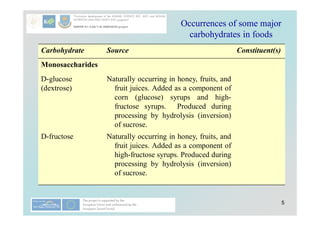
Carbohydrate Source Constituent(s)
Monosaccharides
D-glucose
(dextrose)
Naturally occurring in honey, fruits, and
fruit juices. Added as a component of
corn (glucose) syrups and high-
fructose syrups. Produced during
processing by hydrolysis (inversion)
of sucrose.
D-fructose Naturally occurring in honey, fruits, and
fruit juices. Added as a component of
high-fructose syrups. Produced during
processing by hydrolysis (inversion)
of sucrose.
Occurrences of some major
carbohydrates in foods
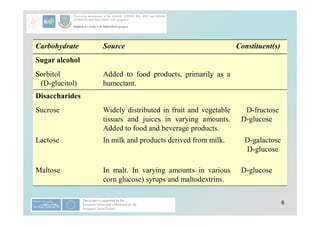
6
Carbohydrate Source Constituent(s)
Sugar alcohol
Sorbitol
(D-glucitol)
Added to food products, primarily as a
humectant.
Disaccharides
Sucrose Widely distributed in fruit and vegetable
tissues and juices in varying amounts.
Added to food and beverage products.
D-fructose
D-glucose
Lactose In milk and products derived from milk. D-galactose
D-glucose
Maltose In malt. In varying amounts in various
corn glucose) syrups and maltodextrins.
D-glucose
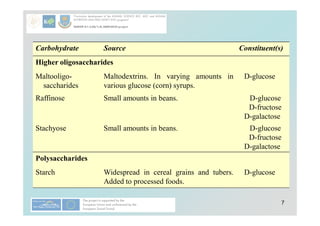
7
Carbohydrate Source Constituent(s)
Higher oligosaccharides
Maltooligo-
saccharides
Maltodextrins. In varying amounts in
various glucose (corn) syrups.
D-glucose
Raffinose Small amounts in beans. D-glucose
D-fructose
D-galactose
Stachyose Small amounts in beans. D-glucose
D-fructose
D-galactose
Polysaccharides
Starch Widespread in cereal grains and tubers.
Added to processed foods.
D-glucose
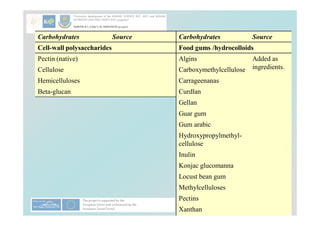
8
Carbohydrates Source Carbohydrates Source
Cell-wall polysaccharides Food gums /hydrocolloids
Pectin (native) Algins Added as
ingredients.
Cellulose Carboxymethylcellulose
Hemicelluloses Carrageenanas
Beta-glucan Curdlan
Gellan
Guar gum
Gum arabic
Hydroxypropylmethyl-
cellulose
Inulin
Konjac glucomanna
Locust bean gum
Methylcelluloses
Pectins
Xanthan
9
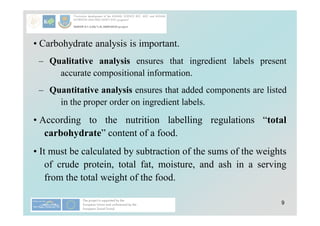
• Carbohydrate analysis is important.
– Qualitative analysis ensures that ingredient labels present
accurate compositional information.
– Quantitative analysis ensures that added components are listed
in the proper order on ingredient labels.
• According to the nutrition labelling regulations “total
carbohydrate” content of a food.
• It must be calculated by subtraction of the sums of the weights
of crude protein, total fat, moisture, and ash in a serving
from the total weight of the food.
10
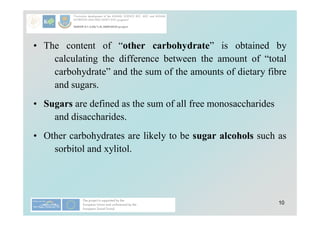
• The content of “other carbohydrate” is obtained by
calculating the difference between the amount of “total
carbohydrate” and the sum of the amounts of dietary fibre
and sugars.
• Sugars are defined as the sum of all free monosaccharides
and disaccharides.
• Other carbohydrates are likely to be sugar alcohols such as
sorbitol and xylitol.
11
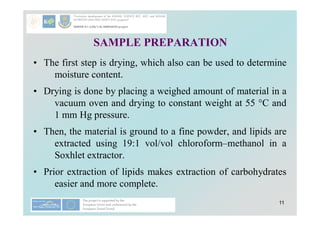
SAMPLE PREPARATION
• The first step is drying, which also can be used to determine
moisture content.
• Drying is done by placing a weighed amount of material in a
vacuum oven and drying to constant weight at 55 °C and
1 mm Hg pressure.
• Then, the material is ground to a fine powder, and lipids are
extracted using 19:1 vol/vol chloroform–methanol in a
Soxhlet extractor.
• Prior extraction of lipids makes extraction of carbohydrates
easier and more complete.
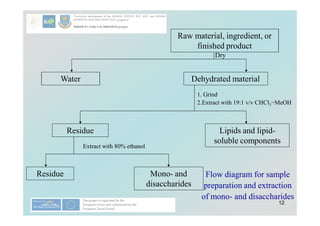
12
Residue Mono- and
disaccharides
Extract with 80% ethanol
Residue Lipids and lipid-
soluble components
1. Grind
2.Extract with 19:1 v/v CHCl3−MeOH
Dehydrated material
Water
Raw material, ingredient, or
finished product
Flow diagram for sample
preparation and extraction
of mono- and disaccharides
Dry
13
MONO- AND
OLIGOSACCHARIDES
Extraction
• Food raw materials may contain substances that interfere with
measurement of the mono- and oligosaccharides present.
• The aldehydo or keto group of the sugar can react with other
components, especially amino groups of proteins, a reaction
(the nonenzymatic browning or Maillard reaction) that
simultaneously produces colour and destroys the sugar.
• For determination of any mono-, di-, tri-, tetra-, or other
oligosaccharides present, the dried, lipid-free sample is
extracted with hot 80% ethanol in the presence of
precipitated calcium carbonate to neutralize any acidity.
14
• Carbohydrates are soluble in polar solvents.
• Much of the composition of a food is in the form of
polymers, and almost all polysaccharides and proteins are
insoluble in hot 80% ethanol.
• The 80% ethanol extract will contain components other than
carbohydrates, in particular ash, pigments, organic acids,
and perhaps free amino acids and low-molecular-weight
peptides.
• The contaminants can be removed by ion-exchange
techniques.
15
• Because sucrose and sucrose-related oligosaccharides are
very susceptible to acid-catalyzed hydrolysis, the anion-
exchange resin should be used.
• The aqueous alcohol of the ethanol extract is removed under
reduced pressure using a rotary evaporator and a
temperature of 45–50 °C.
• The residue is dissolved in a known, measured amount of
water.
• Filtration should not be required, but should be used if
necessary.
16
Total carbohydrate: phenol-sulfuric acid method
Principle and characteristics
• Carbohydrates are destroyed by strong acids and/or high
temperatures.
• Under these conditions, a series of complex reactions takes
place, beginning with a simple dehydration reaction.
• Continued heating in the presence of acid produces various
furan derivatives.
• These products then condense with themselves and other
products to produce brown and black substances.
17
• They will also condense with various phenolic compounds,
such as phenol, resorcinol, orcinol, α-naphthol, and
napthoresorcinol, and with various aromatic amines, such
as aniline and o-toluidine, to produce coloured
compounds that are useful for carbohydrate analysis.
• The most often used condensation is with phenol itself.
• This method is simple, rapid, sensitive, accurate, specific for
carbohydrates, and widely applied.
• All classes of sugars, including sugar derivatives and oligo-
and polysaccharides, can be determined with the phenol-
sulfuric acid method.
18
• A stable colour is produced, and results are reproducible.
• Under proper conditions, the phenolsulfuric method is
accurate to ±2%.
• Neither this method nor those for measuring reducing sugar
content involves stoichiometric reactions.
• Therefore, a standard curve must be used.
• Ideally, the standard curve will be prepared using mixtures
of the same sugars present in the same ratio as they are
found in the unknown.
• The phenol-sulfuric acid procedure is often used as a
qualitative test for the presence of carbohydrate.
19
Outline of procedure
1. A clear, aqueous solution of carbohydrate(s) is transferred
using a pipette into a small tube. A blank of water also is
prepared.
2. An aqueous solution of phenol is added, and the contents are
mixed.
3. Concentrated sulfuric acid is added rapidly to the tube so that
the stream produces good mixing. The tube is agitated. A
yellow-orange colour results.
4. Absorbance is measured at 490 nm.
5. The average absorbance of the blanks is subtracted, and the
amount of sugar is determined by reference to a standard
curve.
20
Total reducing sugar
Somogyi-Nelson Method
• Principle:
– Oxidation is a loss of electrons; reduction is a gain of electrons.
– Reducing sugars are those sugars that have an aldehydo group
(aldoses) that can give up electrons to an oxidizing agent,
which is reduced by receiving the electrons.
– Oxidation of the aldehydo group produces a carboxylic acid
group.
– Under alkaline conditions, ketoses behave as weak reducing
sugars because they will partially isomerize to aldoses.
21
– The most often used method to determine amounts of reducing
sugars is the Somogyi–Nelson method.
– This and other reducing sugar methods can be used in
combination with enzymic methods for determination of
oligo- and polysaccharides.
– In enzymic methods, specific hydrolases are used to convert the
oligo- or polysaccharide into its constituent monosaccharide
or repeating oligosaccharide units, which are measured using
a reducing sugar method.
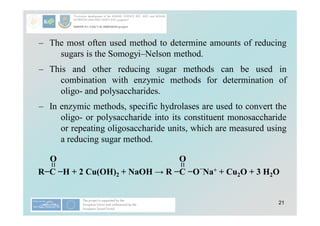
R−C −H + 2 Cu(OH)2 + NaOH → R −C −O−
Na+ + Cu2O + 3 H2O
O
O
22
– The Somogyi–Nelson method is based on the reduction of
Cu(II) ions to Cu(I) ions by reducing sugars.
– The Cu(I) ions then reduce an arsenomolybdate complex,
prepared by reacting ammonium molybdate [(NH4)6Mo7O24]
and sodium arsenate (Na2HAsO7) in sulfuric acid.
– Reduction of the arsenomolybdate complex produces an intense,
stable blue colour that is measured spectrophotometrically.
– This reaction is not stoichiometric and must be used with a
standard curve of the sugar(s) being determined or D-
glucose.
23
• Outline of procedure:
– A solution of copper(II) sulfate and an alkaline buffer are added
by pipettes to a solution of reducing sugars(s) and a water
blank.
– The resulting solution is heated in a boiling water bath.
– A reagent prepared by mixing solutions of acidic ammonium
molybdate and sodium arsenate is added.
– After mixing, dilution, and remixing, absorbance is measured at
520 nm.
– After subtracting the absorbance of the reagent blank, the A520 is
converted into glucose equivalents using a standard plot of
micrograms of glucose vs. absorbance.
24
Other methods
• There are other methods, are based on the reduction of
Cu(II) ions in alkaline solution to Cu(I) ions that
precipitate as the brick-red oxide Cu2O.
• Tartrate or citrate ions are added to keep the Cu(II) ions in
solution under the alkaline conditions.
• The precipitate of cuprous oxide can be determined
gravimetrically, by titration with sodium thiosulfate, by
titration with potassium permanganate, by titration in the
presence of methylene blue, and electrolytically.
25
• A keto group cannot be oxidized to a carboxylic acid group,
and thus ketoses are not reducing sugars.
• Under the alkaline conditions employed, ketoses are
isomerized to aldoses and, therefore, are measured as
reducing sugars.
26
Specific analysis of mono-
and oligosaccharides
1. High-performance liquid chromatography
• HPLC is the method of choice for analysis of mono- and
oligosaccharides and can be used for analysis of
polysaccharides after hydrolysis.
• HPLC gives both qualitative analysis and, with peak integration,
quantitative analysis.
• HPLC analysis is rapid, can tolerate a wide range of sample
concentrations, and provides a high degree of precision and
accuracy.
• HPLC requires no prior derivatization of carbohydrates, but does
require micronfilter filtration prior to injection.
• Complex mixtures of mono- and oligosaccharides can be
analyzed.
27
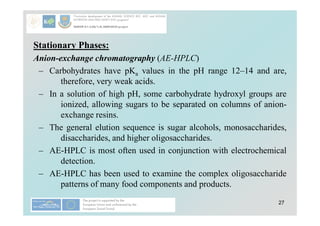
Stationary Phases:
Anion-exchange chromatography (AE-HPLC)
– Carbohydrates have pKa values in the pH range 12–14 and are,
therefore, very weak acids.
– In a solution of high pH, some carbohydrate hydroxyl groups are
ionized, allowing sugars to be separated on columns of anion-
exchange resins.
– The general elution sequence is sugar alcohols, monosaccharides,
disaccharides, and higher oligosaccharides.
– AE-HPLC is most often used in conjunction with electrochemical
detection.
– AE-HPLC has been used to examine the complex oligosaccharide
patterns of many food components and products.
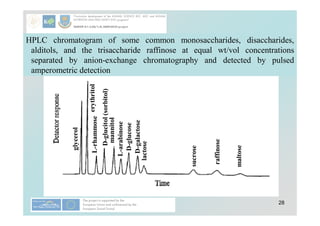
28
HPLC chromatogram of some common monosaccharides, disaccharides,
alditols, and the trisaccharide raffinose at equal wt/vol concentrations
separated by anion-exchange chromatography and detected by pulsed
amperometric detection
glycerol
erythritol
L-rhammose
D-glucitol
(sorbitol)
mannitol
L-arabinose
D-glucose
D-galactose
lactose
sucrose
raffinose
maltose
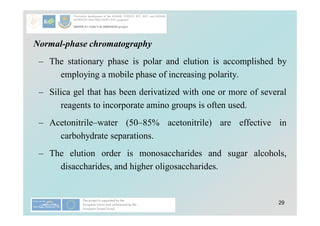
29
Normal-phase chromatography
– The stationary phase is polar and elution is accomplished by
employing a mobile phase of increasing polarity.
– Silica gel that has been derivatized with one or more of several
reagents to incorporate amino groups is often used.
– Acetonitrile–water (50–85% acetonitrile) are effective in
carbohydrate separations.
– The elution order is monosaccharides and sugar alcohols,
disaccharides, and higher oligosaccharides.
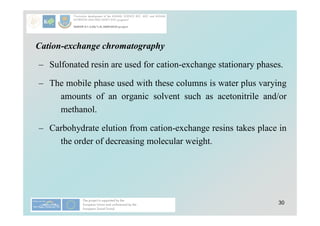
30
Cation-exchange chromatography
– Sulfonated resin are used for cation-exchange stationary phases.
– The mobile phase used with these columns is water plus varying
amounts of an organic solvent such as acetonitrile and/or
methanol.
– Carbohydrate elution from cation-exchange resins takes place in
the order of decreasing molecular weight.
31
Reversed-phase chromatography
– The stationary phase is hydrophobic, and the mobile phase is
largely water.
– The hydrophobic stationary phase is made by reacting silica gel
with a reagent that adds alkyl chains, such as an 18-carbon-
atom alkyl chain or a phenyl group.
– Reversedphase chromatography has been used for separation of
mono-, di-, and trisaccharides by groups.
– A wide variety of stationary phases is available.
– Both normal- and reversedphase columns have long lives, have
good stability over a wide range of solvent compositions and
pH values, are suitable for the separation of a range of
carbohydrates, and are of relatively low cost.
32
• Detectors:
Refractive index detection
– The refractive index (RI) detector is commonly employed for
carbohydrate analysis.
– RI measurements are linear over a wide range of carbohydrate
concentrations and can be universally applied to all
carbohydrates.
– With RI detection gradient elution cannot be used.
33
Electrochemical detection
– The triplepulsed electrochemical detector, called a
pulsedamperometric detector (PAD) is universally used
with AE-HPLC.
– It requires a high pH.
– Gradient and graded elutions can be used with the PAD.
– The detector is suitable for both reducing and nonreducing
carbohydrates.
– Limits are approximately 1.5 ng for monosaccharides and 5 ng
for di-, tri-, and tetrasaccharides.
34
Postcolumn derivatization
– The purpose of pre- and postcolumn derivatization is to increase
detection sensitivity by addition of a substituent whose
concentration can be measured using an ultraviolet (UV) or
fluorescence detector.
Precolumn derivatization
– Reactions must be stoichiometric.
– Oligosaccharides derivatized with aromatic groups are often
separated with higher resolution in normal-phase HPLC.
35
2. Gas chromatography
• GC (gas-liquid chromatography, GLC), provides both
qualitative and quantitative analysis of carbohydrates.
• Sugars must be converted into volatile derivatives.
• The most commonly used derivatives are the alditol
peracetates.
• Conversion of sugars into peracetylated aldononitrile and
peracetylated ketooxime derivatives for GC has also been
done.
• A flame ionization detector is the detector of choice for
peracetylated carbohydrate derivatives.
36
• Neutral Sugars: Outline of Procedure
Reduction to alditols
– Neutral sugars from the 80% ethanol extract or from hydrolysis
of a polysaccharide are reduced with an excess of sodium or
potassium borohydride dissolved in dilute ammonium hydroxide
solution.
Acetylation of alditols
– Acetic anhydride and 1-methylimidazole (as a catalyst) are
added.
GC of alditol peracetates
– Alditol acetates may be chromatographed isothermally and
identified by their retention times relative to that of inositol
hexaacetate, inositol being added as an internal standard prior
to acetylation.
37
• Hydrolyzates of polysaccharides containing uronic acids
Outline of procedure
Reduction
– The hydrolyzate is evaporated to dryness.
– The residue is dissolved in sodium carbonate solution and treated
with an excess of sodium borohydride.
– Excess borohydride is decomposed by addition of glacial acetic
acid; borate may be removed by addition and evaporation of
methanol.
– This procedure reduces uronic acids to aldonic acids and aldoses
to alditols.
38
Preparation and chromatography of trimethylsilyl (TMS)
derivatives
– The aldonic acids are converted into per-TMS ethers rather than
peracetate esters.
– Trimethylsilyation of free aldonic acids gives derivatives of
lactones, while trimethylsilyation of the sodium salt produces
the ester.
39
3. Enzymatic methods
– The method of choice for the determination of starch employs a
combination of enzymes in sequential enzyme-catalyzed
reactions and is specific for starch, as long as purified
enzyme preparations are used.
– Limits of detection by methods involving enzyme- or coupled
enzyme-catalyzed reactions are generally low.
– Enzymic methods are usually quite specific for a specific
carbohydrate.
40
• Sample preparation:
– Sometimes is recommended that the Carrez treatment, which
breaks emulsions, precipitates proteins, and absorbs some
colours, be applied to food products prior to determination of
carbohydrates by enzymic methods.
– The Carrez treatment involves addition of a solution of
potassium hexacyanoferrate (K4[Fe(CN)6], potassium
ferrocyanide), followed by addition of a solution of zinc
sulfate (ZnSO4), followed by addition of a solution of sodium
hydroxide.
– The suspension is filtered, and the clear filtrate is used directly
in enzyme-catalyzed assays.
41
• Enzymatic determination of D-glucose:
– The enzyme glucose oxidase oxidizes D-glucose quantitatively
to D-glucono-1,5-lactone (glucono-deltalactone), the
other product being hydrogen peroxide.
– To measure the amount of D-glucose present, peroxidase is
added along with a colourless compound that can be oxidized
to a coloured compound.
– In a second enzyme-catalyzed reaction, the leuco dye is oxidized
to a coloured compound which is measured spectro-
photometrically.
– Various dyes are used in commercial kits.
– The method using this combination of two enzymes and an
oxidizable colourless compound is known as the GOPOD
(glucose oxidase-peroxidase) method.
42
Coupled enzyme-catalyzed
reactions for the
determination of D-glucose
43
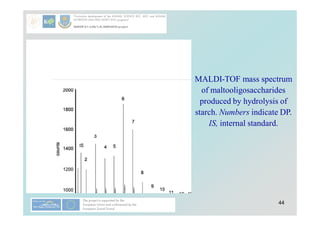
4. Mass spectrometry
• Most of the techniques are used for structural analysis; MS
has been used for analysis of carbohydrates.
• Particularly useful is the matrix-assisted laser desorption
time-of-flight (MALDI-TOF) technique for analysis of a
homologous series of oligosaccharides.
44
MALDI-TOF mass spectrum
of maltooligosaccharides
produced by hydrolysis of
starch. Numbers indicate DP.
IS, internal standard.
45
5. Thin-layer chromatography
• Thin-layer chromatography has been used for identification
and quantitation of the sugars present in the molasses
from sugar beet and cane processing.
6. Capillary electrophoresis
• Capillary zone electrophoresis has been used to separate and
measure carbohydrates, but because carbohydrates lack
chromophores, precolumn derivatization and detection
with a UV or fluorescence detector is required.
46
POLISACCHARIDES
Starch
• Starch is second only to water as the most abundant
component of food.
• Starch is found in all parts of plants.
• A variety of commercial starches are available worldwide as
food additives.
• These include corn, waxy maize, high-amylose corn, potato,
wheat, rice, tapioca (cassava), arrowroot, and sago
starches.
• Starch is the main component of wheat, rye, barley, oat, rice,
corn, mung bean, and pea flours and certain roots and
tubers such as potatoes, sweet potatoes, and yams.
47
Total starch
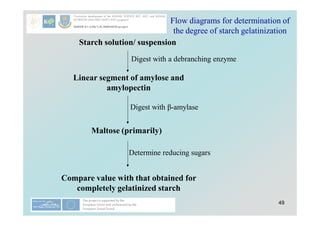
– The only reliable method for determination of total starch is
based on complete conversion of the starch into D-glucose
by purified enzymes specific for starch and determination
of the D-glucose released by an enzyme specific for it.
– Starch-hydrolyzing enzymes must be purified to eliminate
any other enzymic activity that would release D-glucose
and catalase, which would destroy the hydrogen peroxide
on which the enzymic determination of D-glucose depends.
– Resistant starch (RS), by definition, is composed of starch
and starch-degradation products that escape digestion in the
small intestine.
48
Starch
Starch solution
Linear and branches fragments
of amylose and amylopectin
D-glucose
Colour proportional to the
amount of D-glucose released
Gelatinize
Digest with α-amylase
Digest with glucoamylase
1. Treat with glucose oxidase
2. Treat with peroxidase and a leuco dye
Flow diagrams for determination
of total starch
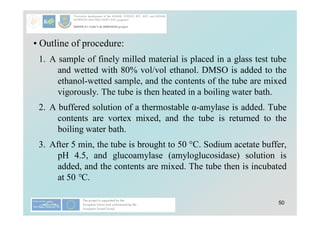
49
Starch solution/ suspension
Linear segment of amylose and
amylopectin
Maltose (primarily)
Compare value with that obtained for
completely gelatinized starch
Digest with a debranching enzyme
Digest with β-amylase
Determine reducing sugars
Flow diagrams for determination of
the degree of starch gelatinization
50
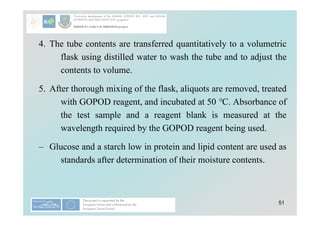
• Outline of procedure:
1. A sample of finely milled material is placed in a glass test tube
and wetted with 80% vol/vol ethanol. DMSO is added to the
ethanol-wetted sample, and the contents of the tube are mixed
vigorously. The tube is then heated in a boiling water bath.
2. A buffered solution of a thermostable α-amylase is added. Tube
contents are vortex mixed, and the tube is returned to the
boiling water bath.
3. After 5 min, the tube is brought to 50 °C. Sodium acetate buffer,
pH 4.5, and glucoamylase (amyloglucosidase) solution is
added, and the contents are mixed. The tube then is incubated
at 50 °C.
51
4. The tube contents are transferred quantitatively to a volumetric
flask using distilled water to wash the tube and to adjust the
contents to volume.
5. After thorough mixing of the flask, aliquots are removed, treated
with GOPOD reagent, and incubated at 50 °C. Absorbance of
the test sample and a reagent blank is measured at the
wavelength required by the GOPOD reagent being used.
– Glucose and a starch low in protein and lipid content are used as
standards after determination of their moisture contents.
52
Degree of gelatinization of starch
• When starch granules are heated in water to a temperature
specific for the starch being cooked, they swell, lose their
crystallinity and birefringence, and become much more
susceptible to enzyme-catalyzed hydrolysis.
• Heating starch in water produces phenomena that result from
two processes: gelatinization and pasting, often together
referred to simply as gelatinization, which are very
important in determining the texture and digestibility of
foods containing starch.
53
Degree of retrogradation of starch
• Upon storage of a product containing cooked starch, the two
starch polymers, amylose and amylopectin, associate
with themselves and with each other, forming
polycrystalline arrays.
• This process of reordering is called retrogradation.
54
Nonstarch polysaccharides (Hydrocolloids/food Gums)
• Food gum analysis is problematic because polysaccharides
present a variety of chemical structures, solubilities, and
molecular weights.
• Plant polysaccharides do not have uniform, repeating-unit
structures; rather the structure of a specific polysaccharide
such as κ-carrageenan varies from molecule to molecule.
• The average structure can vary with the source and the
conditions under which the plant is grown.
55
• Some polysaccharides are neutral; some are anionic. Some
are linear; some are branched.
• Some of the branched polysaccharides are still effectively
linear; some are bushlike.
• Some are soluble only in hot water; some are soluble only in
room temperature or colder water; some are soluble in
both hot and cold water.
56
Hydrocolloid/food gum content determination
• Isolation and purification of nonstarch, water-soluble
polysaccharides.
a) Lipid-soluble substances are removed first. Before this can
be effected, the sample must be dried. Freeze drying is
recommended.
b) Soluble sugars, other low-molecular-weight compounds, and
ash can be removed at this point using hot 80% ethanol.
c) Protein is removed by enzyme-catalyzed hydrolysis.
Bacterial alkaline proteases are recommended by some
because carbohydrases have acidic pH optima.
57
d) Any solubilized polysaccharides are precipitated by
addition of sodium chloride to the cooled dispersion.
e) The pellet is suspended in acetate buffer, usually pH 4.5.
To this suspension is added a freshly prepared solution
of glucoamylase (amyloglucosidase) in the same buffer.
f) Solubilized polysaccharides are reprecipitated by addition
of sodium chloride to the cooled dispersion, followed by
the addition of four volumes of absolute ethanol. The
precipitate (pellet) of water-soluble polysaccharides is
soluble dietary fibre.
58
g) The pellet is suspended in deionized water, transferred to
dialysis tubing, and dialyzed against frequent changes of
sodium azide solution. The retentate is recovered from
the dialysis tubing and freeze dried.
h) Polysaccharide identification relies on hydrolysis to
constituent monosaccharides and identification of these
sugars. For hydrolysis, polysaccharide material is added
to a Teflon-lined, screw-capped vial. Trifluoroacetic acid
solution is added and the vial is tightly capped and
heated. After cooling, the contents are evaporated to
dryness in a hood with a stream of air or nitrogen. Then,
sugars are determined by HPLC or GC.
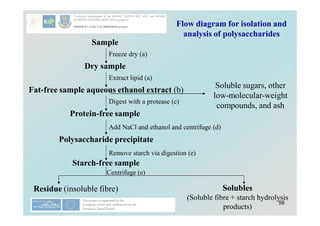
59
Flow diagram for isolation and
analysis of polysaccharides
Sample
Dry sample
Fat-free sample aqueous ethanol extract (b)
Protein-free sample
Polysaccharide precipitate
Starch-free sample
Freeze dry (a)
Extract lipid (a)
Digest with a protease (c)
Soluble sugars, other
low-molecular-weight
compounds, and ash
Add NaCl and ethanol and centrifuge (d)
Remove starch via digestion (e)
Residue (insoluble fibre) Solubles
(Soluble fibre + starch hydrolysis
products)
Centrifuge (e)
60
Solubles
(Soluble fibre + starch hydrolysis products)
Polysaccharide precipitate
Dry polysaccharide extract
Add NaCl and ethanol and centrifuge (f)
Dissolve, dialyze, and freeze dry (g)
Hydrolyze (h)
HPLC
analysis
GC
analysis
61
Pectin
• Nature of pectin:
– Methods basically involve its precipitation (by addition of
ethanol) from jams, jellies, etc. in which it is the only
polysaccharide present.
– Pectin in a native fruit or vegetable is a complex mixture of
polysaccharides whose structures depend on the source,
including the stage of development (degree of ripeness) of
the particular fruit or vegetable.
62
• Pectin content determination:
– The constant in pectins is D-galacturonic acid as the principal
component.
– One method employed for pectin uses saponification in sodium
hydroxide solution, followed by acidification, and addition of
Ca2+ to precipitate the pectin.
– Calcium pectate is collected, washed, dried, and measured
gravimetrically.
63
DIETARY FIBRE
• Dietary fibre is essentially the sum of the nondigestible
components of a foodstuff or food product.
• Most, dietary fibre is plant cell-wall material (cellulose,
hemicelluloses, lignin) and thus is composed primarily of
polysaccharide molecules.
• Some are components of insoluble fibre; some make up soluble
fibre.
• Insoluble dietary fibre components are cellulose,
microcrystalline cellulose added as a food ingredient, lignin,
hemicelluloses entrapped in a lignocellulosic matrix, and
resistant starch.
• The majority of hydrocolloids/food gums, are classified as
soluble dietary fibre.
64
Importance of dietary fibre
• Adequate consumption of dietary fibre from a variety of
foods will help protect against colon cancer and also help to
keep blood lipids within the normal range, thereby reducing
the risk of obesity, hypertension, and cardiovascular
disease in general.
• Fibre can slow D-glucose absorption and reduce insulin
secretion, which is of great importance for diabetics and
probably contributes to the well-being of nondiabetics as
well.
• Fibre helps prevent constipation and diverticular disease.
65
Definition
• Dietary fibre is the edible parts of plants or analogous
carbohydrates that are resistant to digestion and absorption
in the human small large intestine.
• Dietary fibre includes polysaccharides, oligosaccharides,
lignin, and associated plant substances.
• Dietary fibre promotes beneficial physiological effects, such
as laxation, and/or blood cholesterol attenuation, and/or
blood glucose attenuation.
• All polysaccharides other than nonresistant starch are
included in this definition of fibre.
66
Major components of dietary fibre
• Are cellulose, hemicelluloses, lignin, and other nonstarch
plant polysaccharides such as pectin.
Cell-wall polysaccharides of land plants
• Cellulose:
– Cellulose is a linear polymer of β-D-glucopyranosyl units.
– Some molecules may contain 10,000 or more glucosyl units.
– Hydrogen bonding between parallel polymers forms strong
microfibrils.
– Cellulose microfibrils provide the strength and rigidity required
in primary and secondary plant cell walls.
67
• Hemicelluloses:
– Hemicelluloses are a heterogeneous group of polysaccharides,
the only similarity between them being their association with
cellulose in plant cell walls.
– Units of D-xylose, D-mannose, and D-galactose frequently form
the main-chain structures of hemicelluloses; units of
Larabinose, D-galactose, and uronic acids are often present as
branch units or in side chains.
– Hemicelluloses may be soluble or insoluble in water.
– Molecular sizes and degrees of branching vary widely.
68
• Pectins:
– The main feature of all commercial pectins is a linear chain of
1,4-linked α-D-galactopyranosyluronic acid units.
Hydrocolloids/Food Gums as Dietary Fibre
• Food gums or hydrocolloids classified as dietary fibre.
Resistant starch
Lignin
• Lignin is a noncarbohydrate, three-dimensional, water-
insoluble polymer and a major component of the cell walls
of higher land plants.
• Lignin may be covalently linked to hemicellulose.
69
Methods
• Dietary fibre is often determined gravimetrically.
• In such a procedure, digestible carbohydrates, lipids, and
proteins are selectively solubilized by chemicals or
removed by enzyme-catalyzed hydrolysis.
• Then, nonsolubilized and/or nondigested materials are
collected by filtration, and the fibre residue is recovered,
dried, and weighed.
• It is essential that all digestible starch be removed, for
incomplete removal of digestible starch increases the
residue weight and inflates the estimate of fibre.
70
• Alpha-amylase, debranching enzymes, and glucoamylase
(amyloglucosidase) are enzymes used in starch analysis.
• α-Amylase catalyzes hydrolysis of unbranched segments of
1,4-linked α-D-glucopyranosyl units forming primarily
maltooligosaccharides composed of 3–6 units.
• Debranching enzymes (both pullulanase and isoamylase
are used) catalyze hydrolysis of the 1,6 linkages that
constitute the branch points and thereby produce short
linear molecules.
71
• Glucoamylase (amyloglucosidase) starts at the nonreducing
ends of starch chains and releases D-glucose, one unit at a
time; it will catalyze hydrolysis of both 1, 4 and 1, 6 α-D-
glucosyl linkages.
• It is essential either that all digestible materials be removed
from the sample so that only nondigestible
polysaccharides remain or that the nondigestible residue
be corrected for remaining digestible contaminants.
72
Sample preparation:
• If necessary, the sample is ground to pass through a
0.3–0.5 mm mesh screen.
• If the sample contains more than 10% lipid, the lipid is
removed by extraction with 25 parts (vol/wt) of petroleum
ether or hexane in an ultrasonic water bath.
• If samples contain large amounts of soluble sugars (mono-,
di-, and trisaccharides), they should be extracted three
times with 80% aqueous ethanol in an ultrasonic water
bath at room temperature for 15 min.
73
• Nonsolid samples with less than 10% fibre are best analyzed
after freeze drying.
• Nonsolid samples with greater than 10% fibre can be
analyzed without drying if the sample is homogeneous
and low in fat and if particle size is sufficiently small to
allow efficient removal of digestible carbohydrate and
protein.
Methods:
• This method determines soluble, insoluble, and total dietary
fibre in cereal products.
74
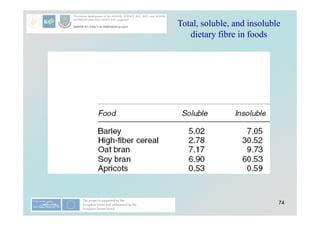
Total, soluble, and insoluble
dietary fibre in foods
75
• Principle:
– Starch and protein are removed from a sample by treating the
sample sequentially with a thermostable α-amylase, a
protease, and glucoamylase (amyloglucosidase).
– The insoluble residue is recovered and washed (insoluble
dietary fibre).
– Ethanol is added to the soluble portion to precipitate soluble
polysaccharides (soluble dietary fibre).
– To obtain total dietary fibre (TDF), the alcohol is added after
digestion with the glucoamylase, and the soluble and insoluble
dietary fibre fractions are collected together, dried, weighed,
and ashed.
76
• Outline of procedure:
a)To samples devoid of significant lipid solvent-soluble substances
is added (MES-TRIS) buffer (0.05 M each, pH 8.2) and a
thermostable α-amylase. The mixture is heated 35 min at 95–
100 °C to gelatinize any starch so that the α-amylase can
break it down.
b)After cooling to 60 °C, a protease is added, and the mixture is
incubated at 60 °C for 35 min to break down the protein.
c)The pH is adjusted to 4.1–4.8, glucoamylase is added, and the
mixture is incubated at 60 °C for 30 min to complete the
digestion of any starch.
77
d) To determine TDF, four volumes of 95% ethanol are added.
The residue plus precipitate is collected by filtration,
washed with 78% ethanol, 95% ethanol, and acetone in that
order, dried, and weighed. Protein and ash are determined on
duplicate samples and the weight is corrected for them.
Alternatively, TDF can be calculated as the sum of the
insoluble and soluble dietary fibre determined in the
remainder of the procedure.
e) The mixture obtained after step (c) is filtered through a crucible
containing fritted glass disk and preashed Celite (a siliceous
filter aid).
78
f) The residue is washed with water, 95% ethanol, and acetone in
that order, dried, and weighed.
g) The dried residue is analyzed for protein using the Kjeldahl
method. The weights of protein and ash are subtracted from
the residue weight obtained in step (f) to determine insoluble
dietary fibre.
h) To determine soluble dietary fibre, at 60 °C are added four
volumes of 95% ethanol. The precipitate is collected by
filtration through a crucible containing a fritted glass disk and
preashed Celite. The crucible is dried at 103 °C and weighed.
i) Protein and ash are determined and the weights of protein and
ash are subtracted from the residue weight.
79
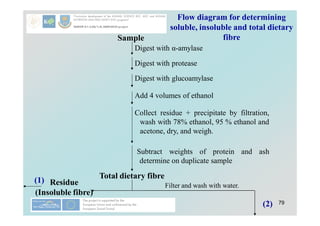
Flow diagram for determining
soluble, insoluble and total dietary
fibre
Sample
Total dietary fibre
Residue
(Insoluble fibre)
Filter and wash with water.
Digest with α-amylase
Digest with protease
Digest with glucoamylase
Add 4 volumes of ethanol
Collect residue + precipitate by filtration,
wash with 78% ethanol, 95 % ethanol and
acetone, dry, and weigh.
Subtract weights of protein and ash
determine on duplicate sample
(1)
(2)
80
(1)
Residue (Insoluble fibre)
Insoluble fibre
Wash with water, 95% ethanol, and
acetone, oven dry, and weigh.
Subtract weights of protein and ash
determined on duplicate samples.
81
(2)
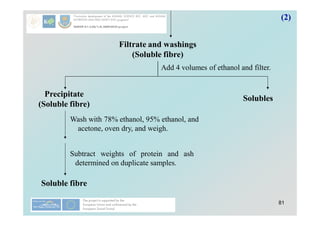
Filtrate and washings
(Soluble fibre)
Add 4 volumes of ethanol and filter.
Precipitate
(Soluble fibre)
Soluble fibre
Wash with 78% ethanol, 95% ethanol, and
acetone, oven dry, and weigh.
Subtract weights of protein and ash
determined on duplicate samples.
Solubles
82
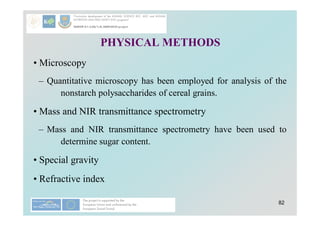
PHYSICAL METHODS
• Microscopy
– Quantitative microscopy has been employed for analysis of the
nonstarch polysaccharides of cereal grains.
• Mass and NIR transmittance spectrometry
– Mass and NIR transmittance spectrometry have been used to
determine sugar content.
• Special gravity
• Refractive index
83
SUMMARY
• For determination of low-molecular-weight carbohydrates,
older colorimetric methods for total carbohydrate, various
reducing sugar methods, and physical measurements have
largely been replaced by chromatographic methods.
• The older chemical methods are not stoichiometric and,
therefore, require standard curves.
• This makes them particularly problematic when a mixture of
sugars is being determined.
• Physical measurements are not specific for carbohydrates.
84
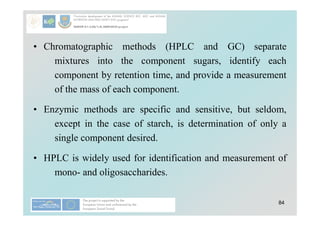
• Chromatographic methods (HPLC and GC) separate
mixtures into the component sugars, identify each
component by retention time, and provide a measurement
of the mass of each component.
• Enzymic methods are specific and sensitive, but seldom,
except in the case of starch, is determination of only a
single component desired.
• HPLC is widely used for identification and measurement of
mono- and oligosaccharides.
85
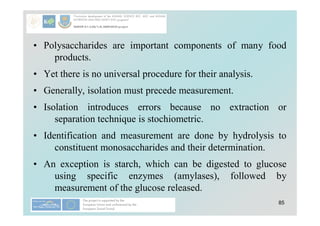
• Polysaccharides are important components of many food
products.
• Yet there is no universal procedure for their analysis.
• Generally, isolation must precede measurement.
• Isolation introduces errors because no extraction or
separation technique is stochiometric.
• Identification and measurement are done by hydrolysis to
constituent monosaccharides and their determination.
• An exception is starch, which can be digested to glucose
using specific enzymes (amylases), followed by
measurement of the glucose released.
86
• Insoluble dietary fibre, soluble dietary fibre, and total dietary
fibre are each composed primarily of nonstarch
polysaccharides.
• The method for the determination of starch is based on its
complete conversion to, and determination of, D-glucose.
• Methods for the determination of total dietary fibre and its
components rely on removal of the digestible starch in the
same way and often on removal of digestible protein with
a protease, leaving nondigestible components.

Carbohydrate Analysis simple starch and fiber

  • 1.
  • 2.
    2 2 • Carbohydrates areimportant in foods as a major source of energy, to impart crucial textural properties, and as dietary fibre which influences physiological processes. • Digestible carbohydrates, which are converted into monosaccharides, are absorbed, provide metabolic energy. • Ingested carbohydrates are almost exclusively of plant origin, with milk lactose being the major exception. INTRODUCTION
  • 3.
    3 • Of themonosaccharides (simple sugars), only D-glucose and D-fructose are found in other than minor amounts. – Monosaccharides are the only carbohydrates that can be absorbed from the small intestine. • Oligo- and polysaccharides must first be digested (hydrolyzed to monosaccharides) before absorption and utilization can occur. – An oligosaccharide to be a carbohydrate composed of from 2 to 10 sugar (saccharide) units. – A polysaccharide usually contains from 30 to at least 60,000 monosaccharide units.
  • 4.
    4 • Humans candigest only sucrose, lactose, maltooligosaccharides/ maltodextrins, and starch. • All are digested with enzymes found in the small intestine. • Starch polymers are the only polysaccharides that humans can digest and use as a source of calories. • All other polysaccharides are nondigestible. • Nondigestible polysaccharides can be divided into soluble and insoluble classes. – They make up dietary fibre. – They regulate normal bowel function, reduce the postprandial hyperglycemic response, and may lower serum cholesterol, among other effects.
  • 5.
    5 Carbohydrate Source Constituent(s) Monosaccharides D-glucose (dextrose) Naturallyoccurring in honey, fruits, and fruit juices. Added as a component of corn (glucose) syrups and high- fructose syrups. Produced during processing by hydrolysis (inversion) of sucrose. D-fructose Naturally occurring in honey, fruits, and fruit juices. Added as a component of high-fructose syrups. Produced during processing by hydrolysis (inversion) of sucrose. Occurrences of some major carbohydrates in foods
  • 6.
    6 Carbohydrate Source Constituent(s) Sugaralcohol Sorbitol (D-glucitol) Added to food products, primarily as a humectant. Disaccharides Sucrose Widely distributed in fruit and vegetable tissues and juices in varying amounts. Added to food and beverage products. D-fructose D-glucose Lactose In milk and products derived from milk. D-galactose D-glucose Maltose In malt. In varying amounts in various corn glucose) syrups and maltodextrins. D-glucose
  • 7.
    7 Carbohydrate Source Constituent(s) Higheroligosaccharides Maltooligo- saccharides Maltodextrins. In varying amounts in various glucose (corn) syrups. D-glucose Raffinose Small amounts in beans. D-glucose D-fructose D-galactose Stachyose Small amounts in beans. D-glucose D-fructose D-galactose Polysaccharides Starch Widespread in cereal grains and tubers. Added to processed foods. D-glucose
  • 8.
    8 Carbohydrates Source CarbohydratesSource Cell-wall polysaccharides Food gums /hydrocolloids Pectin (native) Algins Added as ingredients. Cellulose Carboxymethylcellulose Hemicelluloses Carrageenanas Beta-glucan Curdlan Gellan Guar gum Gum arabic Hydroxypropylmethyl- cellulose Inulin Konjac glucomanna Locust bean gum Methylcelluloses Pectins Xanthan
  • 9.
    9 • Carbohydrate analysisis important. – Qualitative analysis ensures that ingredient labels present accurate compositional information. – Quantitative analysis ensures that added components are listed in the proper order on ingredient labels. • According to the nutrition labelling regulations “total carbohydrate” content of a food. • It must be calculated by subtraction of the sums of the weights of crude protein, total fat, moisture, and ash in a serving from the total weight of the food.
  • 10.
    10 • The contentof “other carbohydrate” is obtained by calculating the difference between the amount of “total carbohydrate” and the sum of the amounts of dietary fibre and sugars. • Sugars are defined as the sum of all free monosaccharides and disaccharides. • Other carbohydrates are likely to be sugar alcohols such as sorbitol and xylitol.
  • 11.
    11 SAMPLE PREPARATION • Thefirst step is drying, which also can be used to determine moisture content. • Drying is done by placing a weighed amount of material in a vacuum oven and drying to constant weight at 55 °C and 1 mm Hg pressure. • Then, the material is ground to a fine powder, and lipids are extracted using 19:1 vol/vol chloroform–methanol in a Soxhlet extractor. • Prior extraction of lipids makes extraction of carbohydrates easier and more complete.
  • 12.
    12 Residue Mono- and disaccharides Extractwith 80% ethanol Residue Lipids and lipid- soluble components 1. Grind 2.Extract with 19:1 v/v CHCl3−MeOH Dehydrated material Water Raw material, ingredient, or finished product Flow diagram for sample preparation and extraction of mono- and disaccharides Dry
  • 13.
    13 MONO- AND OLIGOSACCHARIDES Extraction • Foodraw materials may contain substances that interfere with measurement of the mono- and oligosaccharides present. • The aldehydo or keto group of the sugar can react with other components, especially amino groups of proteins, a reaction (the nonenzymatic browning or Maillard reaction) that simultaneously produces colour and destroys the sugar. • For determination of any mono-, di-, tri-, tetra-, or other oligosaccharides present, the dried, lipid-free sample is extracted with hot 80% ethanol in the presence of precipitated calcium carbonate to neutralize any acidity.
  • 14.
    14 • Carbohydrates aresoluble in polar solvents. • Much of the composition of a food is in the form of polymers, and almost all polysaccharides and proteins are insoluble in hot 80% ethanol. • The 80% ethanol extract will contain components other than carbohydrates, in particular ash, pigments, organic acids, and perhaps free amino acids and low-molecular-weight peptides. • The contaminants can be removed by ion-exchange techniques.
  • 15.
    15 • Because sucroseand sucrose-related oligosaccharides are very susceptible to acid-catalyzed hydrolysis, the anion- exchange resin should be used. • The aqueous alcohol of the ethanol extract is removed under reduced pressure using a rotary evaporator and a temperature of 45–50 °C. • The residue is dissolved in a known, measured amount of water. • Filtration should not be required, but should be used if necessary.
  • 16.
    16 Total carbohydrate: phenol-sulfuricacid method Principle and characteristics • Carbohydrates are destroyed by strong acids and/or high temperatures. • Under these conditions, a series of complex reactions takes place, beginning with a simple dehydration reaction. • Continued heating in the presence of acid produces various furan derivatives. • These products then condense with themselves and other products to produce brown and black substances.
  • 17.
    17 • They willalso condense with various phenolic compounds, such as phenol, resorcinol, orcinol, α-naphthol, and napthoresorcinol, and with various aromatic amines, such as aniline and o-toluidine, to produce coloured compounds that are useful for carbohydrate analysis. • The most often used condensation is with phenol itself. • This method is simple, rapid, sensitive, accurate, specific for carbohydrates, and widely applied. • All classes of sugars, including sugar derivatives and oligo- and polysaccharides, can be determined with the phenol- sulfuric acid method.
  • 18.
    18 • A stablecolour is produced, and results are reproducible. • Under proper conditions, the phenolsulfuric method is accurate to ±2%. • Neither this method nor those for measuring reducing sugar content involves stoichiometric reactions. • Therefore, a standard curve must be used. • Ideally, the standard curve will be prepared using mixtures of the same sugars present in the same ratio as they are found in the unknown. • The phenol-sulfuric acid procedure is often used as a qualitative test for the presence of carbohydrate.
  • 19.
    19 Outline of procedure 1.A clear, aqueous solution of carbohydrate(s) is transferred using a pipette into a small tube. A blank of water also is prepared. 2. An aqueous solution of phenol is added, and the contents are mixed. 3. Concentrated sulfuric acid is added rapidly to the tube so that the stream produces good mixing. The tube is agitated. A yellow-orange colour results. 4. Absorbance is measured at 490 nm. 5. The average absorbance of the blanks is subtracted, and the amount of sugar is determined by reference to a standard curve.
  • 20.
    20 Total reducing sugar Somogyi-NelsonMethod • Principle: – Oxidation is a loss of electrons; reduction is a gain of electrons. – Reducing sugars are those sugars that have an aldehydo group (aldoses) that can give up electrons to an oxidizing agent, which is reduced by receiving the electrons. – Oxidation of the aldehydo group produces a carboxylic acid group. – Under alkaline conditions, ketoses behave as weak reducing sugars because they will partially isomerize to aldoses.
  • 21.
    21 – The mostoften used method to determine amounts of reducing sugars is the Somogyi–Nelson method. – This and other reducing sugar methods can be used in combination with enzymic methods for determination of oligo- and polysaccharides. – In enzymic methods, specific hydrolases are used to convert the oligo- or polysaccharide into its constituent monosaccharide or repeating oligosaccharide units, which are measured using a reducing sugar method. R−C −H + 2 Cu(OH)2 + NaOH → R −C −O− Na+ + Cu2O + 3 H2O O O
  • 22.
    22 – The Somogyi–Nelsonmethod is based on the reduction of Cu(II) ions to Cu(I) ions by reducing sugars. – The Cu(I) ions then reduce an arsenomolybdate complex, prepared by reacting ammonium molybdate [(NH4)6Mo7O24] and sodium arsenate (Na2HAsO7) in sulfuric acid. – Reduction of the arsenomolybdate complex produces an intense, stable blue colour that is measured spectrophotometrically. – This reaction is not stoichiometric and must be used with a standard curve of the sugar(s) being determined or D- glucose.
  • 23.
    23 • Outline ofprocedure: – A solution of copper(II) sulfate and an alkaline buffer are added by pipettes to a solution of reducing sugars(s) and a water blank. – The resulting solution is heated in a boiling water bath. – A reagent prepared by mixing solutions of acidic ammonium molybdate and sodium arsenate is added. – After mixing, dilution, and remixing, absorbance is measured at 520 nm. – After subtracting the absorbance of the reagent blank, the A520 is converted into glucose equivalents using a standard plot of micrograms of glucose vs. absorbance.
  • 24.
    24 Other methods • Thereare other methods, are based on the reduction of Cu(II) ions in alkaline solution to Cu(I) ions that precipitate as the brick-red oxide Cu2O. • Tartrate or citrate ions are added to keep the Cu(II) ions in solution under the alkaline conditions. • The precipitate of cuprous oxide can be determined gravimetrically, by titration with sodium thiosulfate, by titration with potassium permanganate, by titration in the presence of methylene blue, and electrolytically.
  • 25.
    25 • A ketogroup cannot be oxidized to a carboxylic acid group, and thus ketoses are not reducing sugars. • Under the alkaline conditions employed, ketoses are isomerized to aldoses and, therefore, are measured as reducing sugars.
  • 26.
    26 Specific analysis ofmono- and oligosaccharides 1. High-performance liquid chromatography • HPLC is the method of choice for analysis of mono- and oligosaccharides and can be used for analysis of polysaccharides after hydrolysis. • HPLC gives both qualitative analysis and, with peak integration, quantitative analysis. • HPLC analysis is rapid, can tolerate a wide range of sample concentrations, and provides a high degree of precision and accuracy. • HPLC requires no prior derivatization of carbohydrates, but does require micronfilter filtration prior to injection. • Complex mixtures of mono- and oligosaccharides can be analyzed.
  • 27.
    27 Stationary Phases: Anion-exchange chromatography(AE-HPLC) – Carbohydrates have pKa values in the pH range 12–14 and are, therefore, very weak acids. – In a solution of high pH, some carbohydrate hydroxyl groups are ionized, allowing sugars to be separated on columns of anion- exchange resins. – The general elution sequence is sugar alcohols, monosaccharides, disaccharides, and higher oligosaccharides. – AE-HPLC is most often used in conjunction with electrochemical detection. – AE-HPLC has been used to examine the complex oligosaccharide patterns of many food components and products.
  • 28.
    28 HPLC chromatogram ofsome common monosaccharides, disaccharides, alditols, and the trisaccharide raffinose at equal wt/vol concentrations separated by anion-exchange chromatography and detected by pulsed amperometric detection glycerol erythritol L-rhammose D-glucitol (sorbitol) mannitol L-arabinose D-glucose D-galactose lactose sucrose raffinose maltose
  • 29.
    29 Normal-phase chromatography – Thestationary phase is polar and elution is accomplished by employing a mobile phase of increasing polarity. – Silica gel that has been derivatized with one or more of several reagents to incorporate amino groups is often used. – Acetonitrile–water (50–85% acetonitrile) are effective in carbohydrate separations. – The elution order is monosaccharides and sugar alcohols, disaccharides, and higher oligosaccharides.
  • 30.
    30 Cation-exchange chromatography – Sulfonatedresin are used for cation-exchange stationary phases. – The mobile phase used with these columns is water plus varying amounts of an organic solvent such as acetonitrile and/or methanol. – Carbohydrate elution from cation-exchange resins takes place in the order of decreasing molecular weight.
  • 31.
    31 Reversed-phase chromatography – Thestationary phase is hydrophobic, and the mobile phase is largely water. – The hydrophobic stationary phase is made by reacting silica gel with a reagent that adds alkyl chains, such as an 18-carbon- atom alkyl chain or a phenyl group. – Reversedphase chromatography has been used for separation of mono-, di-, and trisaccharides by groups. – A wide variety of stationary phases is available. – Both normal- and reversedphase columns have long lives, have good stability over a wide range of solvent compositions and pH values, are suitable for the separation of a range of carbohydrates, and are of relatively low cost.
  • 32.
    32 • Detectors: Refractive indexdetection – The refractive index (RI) detector is commonly employed for carbohydrate analysis. – RI measurements are linear over a wide range of carbohydrate concentrations and can be universally applied to all carbohydrates. – With RI detection gradient elution cannot be used.
  • 33.
    33 Electrochemical detection – Thetriplepulsed electrochemical detector, called a pulsedamperometric detector (PAD) is universally used with AE-HPLC. – It requires a high pH. – Gradient and graded elutions can be used with the PAD. – The detector is suitable for both reducing and nonreducing carbohydrates. – Limits are approximately 1.5 ng for monosaccharides and 5 ng for di-, tri-, and tetrasaccharides.
  • 34.
    34 Postcolumn derivatization – Thepurpose of pre- and postcolumn derivatization is to increase detection sensitivity by addition of a substituent whose concentration can be measured using an ultraviolet (UV) or fluorescence detector. Precolumn derivatization – Reactions must be stoichiometric. – Oligosaccharides derivatized with aromatic groups are often separated with higher resolution in normal-phase HPLC.
  • 35.
    35 2. Gas chromatography •GC (gas-liquid chromatography, GLC), provides both qualitative and quantitative analysis of carbohydrates. • Sugars must be converted into volatile derivatives. • The most commonly used derivatives are the alditol peracetates. • Conversion of sugars into peracetylated aldononitrile and peracetylated ketooxime derivatives for GC has also been done. • A flame ionization detector is the detector of choice for peracetylated carbohydrate derivatives.
  • 36.
    36 • Neutral Sugars:Outline of Procedure Reduction to alditols – Neutral sugars from the 80% ethanol extract or from hydrolysis of a polysaccharide are reduced with an excess of sodium or potassium borohydride dissolved in dilute ammonium hydroxide solution. Acetylation of alditols – Acetic anhydride and 1-methylimidazole (as a catalyst) are added. GC of alditol peracetates – Alditol acetates may be chromatographed isothermally and identified by their retention times relative to that of inositol hexaacetate, inositol being added as an internal standard prior to acetylation.
  • 37.
    37 • Hydrolyzates ofpolysaccharides containing uronic acids Outline of procedure Reduction – The hydrolyzate is evaporated to dryness. – The residue is dissolved in sodium carbonate solution and treated with an excess of sodium borohydride. – Excess borohydride is decomposed by addition of glacial acetic acid; borate may be removed by addition and evaporation of methanol. – This procedure reduces uronic acids to aldonic acids and aldoses to alditols.
  • 38.
    38 Preparation and chromatographyof trimethylsilyl (TMS) derivatives – The aldonic acids are converted into per-TMS ethers rather than peracetate esters. – Trimethylsilyation of free aldonic acids gives derivatives of lactones, while trimethylsilyation of the sodium salt produces the ester.
  • 39.
    39 3. Enzymatic methods –The method of choice for the determination of starch employs a combination of enzymes in sequential enzyme-catalyzed reactions and is specific for starch, as long as purified enzyme preparations are used. – Limits of detection by methods involving enzyme- or coupled enzyme-catalyzed reactions are generally low. – Enzymic methods are usually quite specific for a specific carbohydrate.
  • 40.
    40 • Sample preparation: –Sometimes is recommended that the Carrez treatment, which breaks emulsions, precipitates proteins, and absorbs some colours, be applied to food products prior to determination of carbohydrates by enzymic methods. – The Carrez treatment involves addition of a solution of potassium hexacyanoferrate (K4[Fe(CN)6], potassium ferrocyanide), followed by addition of a solution of zinc sulfate (ZnSO4), followed by addition of a solution of sodium hydroxide. – The suspension is filtered, and the clear filtrate is used directly in enzyme-catalyzed assays.
  • 41.
    41 • Enzymatic determinationof D-glucose: – The enzyme glucose oxidase oxidizes D-glucose quantitatively to D-glucono-1,5-lactone (glucono-deltalactone), the other product being hydrogen peroxide. – To measure the amount of D-glucose present, peroxidase is added along with a colourless compound that can be oxidized to a coloured compound. – In a second enzyme-catalyzed reaction, the leuco dye is oxidized to a coloured compound which is measured spectro- photometrically. – Various dyes are used in commercial kits. – The method using this combination of two enzymes and an oxidizable colourless compound is known as the GOPOD (glucose oxidase-peroxidase) method.
  • 42.
    42 Coupled enzyme-catalyzed reactions forthe determination of D-glucose
  • 43.
    43 4. Mass spectrometry •Most of the techniques are used for structural analysis; MS has been used for analysis of carbohydrates. • Particularly useful is the matrix-assisted laser desorption time-of-flight (MALDI-TOF) technique for analysis of a homologous series of oligosaccharides.
  • 44.
    44 MALDI-TOF mass spectrum ofmaltooligosaccharides produced by hydrolysis of starch. Numbers indicate DP. IS, internal standard.
  • 45.
    45 5. Thin-layer chromatography •Thin-layer chromatography has been used for identification and quantitation of the sugars present in the molasses from sugar beet and cane processing. 6. Capillary electrophoresis • Capillary zone electrophoresis has been used to separate and measure carbohydrates, but because carbohydrates lack chromophores, precolumn derivatization and detection with a UV or fluorescence detector is required.
  • 46.
    46 POLISACCHARIDES Starch • Starch issecond only to water as the most abundant component of food. • Starch is found in all parts of plants. • A variety of commercial starches are available worldwide as food additives. • These include corn, waxy maize, high-amylose corn, potato, wheat, rice, tapioca (cassava), arrowroot, and sago starches. • Starch is the main component of wheat, rye, barley, oat, rice, corn, mung bean, and pea flours and certain roots and tubers such as potatoes, sweet potatoes, and yams.
  • 47.
    47 Total starch – Theonly reliable method for determination of total starch is based on complete conversion of the starch into D-glucose by purified enzymes specific for starch and determination of the D-glucose released by an enzyme specific for it. – Starch-hydrolyzing enzymes must be purified to eliminate any other enzymic activity that would release D-glucose and catalase, which would destroy the hydrogen peroxide on which the enzymic determination of D-glucose depends. – Resistant starch (RS), by definition, is composed of starch and starch-degradation products that escape digestion in the small intestine.
  • 48.
    48 Starch Starch solution Linear andbranches fragments of amylose and amylopectin D-glucose Colour proportional to the amount of D-glucose released Gelatinize Digest with α-amylase Digest with glucoamylase 1. Treat with glucose oxidase 2. Treat with peroxidase and a leuco dye Flow diagrams for determination of total starch
  • 49.
    49 Starch solution/ suspension Linearsegment of amylose and amylopectin Maltose (primarily) Compare value with that obtained for completely gelatinized starch Digest with a debranching enzyme Digest with β-amylase Determine reducing sugars Flow diagrams for determination of the degree of starch gelatinization
  • 50.
    50 • Outline ofprocedure: 1. A sample of finely milled material is placed in a glass test tube and wetted with 80% vol/vol ethanol. DMSO is added to the ethanol-wetted sample, and the contents of the tube are mixed vigorously. The tube is then heated in a boiling water bath. 2. A buffered solution of a thermostable α-amylase is added. Tube contents are vortex mixed, and the tube is returned to the boiling water bath. 3. After 5 min, the tube is brought to 50 °C. Sodium acetate buffer, pH 4.5, and glucoamylase (amyloglucosidase) solution is added, and the contents are mixed. The tube then is incubated at 50 °C.
  • 51.
    51 4. The tubecontents are transferred quantitatively to a volumetric flask using distilled water to wash the tube and to adjust the contents to volume. 5. After thorough mixing of the flask, aliquots are removed, treated with GOPOD reagent, and incubated at 50 °C. Absorbance of the test sample and a reagent blank is measured at the wavelength required by the GOPOD reagent being used. – Glucose and a starch low in protein and lipid content are used as standards after determination of their moisture contents.
  • 52.
    52 Degree of gelatinizationof starch • When starch granules are heated in water to a temperature specific for the starch being cooked, they swell, lose their crystallinity and birefringence, and become much more susceptible to enzyme-catalyzed hydrolysis. • Heating starch in water produces phenomena that result from two processes: gelatinization and pasting, often together referred to simply as gelatinization, which are very important in determining the texture and digestibility of foods containing starch.
  • 53.
    53 Degree of retrogradationof starch • Upon storage of a product containing cooked starch, the two starch polymers, amylose and amylopectin, associate with themselves and with each other, forming polycrystalline arrays. • This process of reordering is called retrogradation.
  • 54.
    54 Nonstarch polysaccharides (Hydrocolloids/foodGums) • Food gum analysis is problematic because polysaccharides present a variety of chemical structures, solubilities, and molecular weights. • Plant polysaccharides do not have uniform, repeating-unit structures; rather the structure of a specific polysaccharide such as κ-carrageenan varies from molecule to molecule. • The average structure can vary with the source and the conditions under which the plant is grown.
  • 55.
    55 • Some polysaccharidesare neutral; some are anionic. Some are linear; some are branched. • Some of the branched polysaccharides are still effectively linear; some are bushlike. • Some are soluble only in hot water; some are soluble only in room temperature or colder water; some are soluble in both hot and cold water.
  • 56.
    56 Hydrocolloid/food gum contentdetermination • Isolation and purification of nonstarch, water-soluble polysaccharides. a) Lipid-soluble substances are removed first. Before this can be effected, the sample must be dried. Freeze drying is recommended. b) Soluble sugars, other low-molecular-weight compounds, and ash can be removed at this point using hot 80% ethanol. c) Protein is removed by enzyme-catalyzed hydrolysis. Bacterial alkaline proteases are recommended by some because carbohydrases have acidic pH optima.
  • 57.
    57 d) Any solubilizedpolysaccharides are precipitated by addition of sodium chloride to the cooled dispersion. e) The pellet is suspended in acetate buffer, usually pH 4.5. To this suspension is added a freshly prepared solution of glucoamylase (amyloglucosidase) in the same buffer. f) Solubilized polysaccharides are reprecipitated by addition of sodium chloride to the cooled dispersion, followed by the addition of four volumes of absolute ethanol. The precipitate (pellet) of water-soluble polysaccharides is soluble dietary fibre.
  • 58.
    58 g) The pelletis suspended in deionized water, transferred to dialysis tubing, and dialyzed against frequent changes of sodium azide solution. The retentate is recovered from the dialysis tubing and freeze dried. h) Polysaccharide identification relies on hydrolysis to constituent monosaccharides and identification of these sugars. For hydrolysis, polysaccharide material is added to a Teflon-lined, screw-capped vial. Trifluoroacetic acid solution is added and the vial is tightly capped and heated. After cooling, the contents are evaporated to dryness in a hood with a stream of air or nitrogen. Then, sugars are determined by HPLC or GC.
  • 59.
    59 Flow diagram forisolation and analysis of polysaccharides Sample Dry sample Fat-free sample aqueous ethanol extract (b) Protein-free sample Polysaccharide precipitate Starch-free sample Freeze dry (a) Extract lipid (a) Digest with a protease (c) Soluble sugars, other low-molecular-weight compounds, and ash Add NaCl and ethanol and centrifuge (d) Remove starch via digestion (e) Residue (insoluble fibre) Solubles (Soluble fibre + starch hydrolysis products) Centrifuge (e)
  • 60.
    60 Solubles (Soluble fibre +starch hydrolysis products) Polysaccharide precipitate Dry polysaccharide extract Add NaCl and ethanol and centrifuge (f) Dissolve, dialyze, and freeze dry (g) Hydrolyze (h) HPLC analysis GC analysis
  • 61.
    61 Pectin • Nature ofpectin: – Methods basically involve its precipitation (by addition of ethanol) from jams, jellies, etc. in which it is the only polysaccharide present. – Pectin in a native fruit or vegetable is a complex mixture of polysaccharides whose structures depend on the source, including the stage of development (degree of ripeness) of the particular fruit or vegetable.
  • 62.
    62 • Pectin contentdetermination: – The constant in pectins is D-galacturonic acid as the principal component. – One method employed for pectin uses saponification in sodium hydroxide solution, followed by acidification, and addition of Ca2+ to precipitate the pectin. – Calcium pectate is collected, washed, dried, and measured gravimetrically.
  • 63.
    63 DIETARY FIBRE • Dietaryfibre is essentially the sum of the nondigestible components of a foodstuff or food product. • Most, dietary fibre is plant cell-wall material (cellulose, hemicelluloses, lignin) and thus is composed primarily of polysaccharide molecules. • Some are components of insoluble fibre; some make up soluble fibre. • Insoluble dietary fibre components are cellulose, microcrystalline cellulose added as a food ingredient, lignin, hemicelluloses entrapped in a lignocellulosic matrix, and resistant starch. • The majority of hydrocolloids/food gums, are classified as soluble dietary fibre.
  • 64.
    64 Importance of dietaryfibre • Adequate consumption of dietary fibre from a variety of foods will help protect against colon cancer and also help to keep blood lipids within the normal range, thereby reducing the risk of obesity, hypertension, and cardiovascular disease in general. • Fibre can slow D-glucose absorption and reduce insulin secretion, which is of great importance for diabetics and probably contributes to the well-being of nondiabetics as well. • Fibre helps prevent constipation and diverticular disease.
  • 65.
    65 Definition • Dietary fibreis the edible parts of plants or analogous carbohydrates that are resistant to digestion and absorption in the human small large intestine. • Dietary fibre includes polysaccharides, oligosaccharides, lignin, and associated plant substances. • Dietary fibre promotes beneficial physiological effects, such as laxation, and/or blood cholesterol attenuation, and/or blood glucose attenuation. • All polysaccharides other than nonresistant starch are included in this definition of fibre.
  • 66.
    66 Major components ofdietary fibre • Are cellulose, hemicelluloses, lignin, and other nonstarch plant polysaccharides such as pectin. Cell-wall polysaccharides of land plants • Cellulose: – Cellulose is a linear polymer of β-D-glucopyranosyl units. – Some molecules may contain 10,000 or more glucosyl units. – Hydrogen bonding between parallel polymers forms strong microfibrils. – Cellulose microfibrils provide the strength and rigidity required in primary and secondary plant cell walls.
  • 67.
    67 • Hemicelluloses: – Hemicellulosesare a heterogeneous group of polysaccharides, the only similarity between them being their association with cellulose in plant cell walls. – Units of D-xylose, D-mannose, and D-galactose frequently form the main-chain structures of hemicelluloses; units of Larabinose, D-galactose, and uronic acids are often present as branch units or in side chains. – Hemicelluloses may be soluble or insoluble in water. – Molecular sizes and degrees of branching vary widely.
  • 68.
    68 • Pectins: – Themain feature of all commercial pectins is a linear chain of 1,4-linked α-D-galactopyranosyluronic acid units. Hydrocolloids/Food Gums as Dietary Fibre • Food gums or hydrocolloids classified as dietary fibre. Resistant starch Lignin • Lignin is a noncarbohydrate, three-dimensional, water- insoluble polymer and a major component of the cell walls of higher land plants. • Lignin may be covalently linked to hemicellulose.
  • 69.
    69 Methods • Dietary fibreis often determined gravimetrically. • In such a procedure, digestible carbohydrates, lipids, and proteins are selectively solubilized by chemicals or removed by enzyme-catalyzed hydrolysis. • Then, nonsolubilized and/or nondigested materials are collected by filtration, and the fibre residue is recovered, dried, and weighed. • It is essential that all digestible starch be removed, for incomplete removal of digestible starch increases the residue weight and inflates the estimate of fibre.
  • 70.
    70 • Alpha-amylase, debranchingenzymes, and glucoamylase (amyloglucosidase) are enzymes used in starch analysis. • α-Amylase catalyzes hydrolysis of unbranched segments of 1,4-linked α-D-glucopyranosyl units forming primarily maltooligosaccharides composed of 3–6 units. • Debranching enzymes (both pullulanase and isoamylase are used) catalyze hydrolysis of the 1,6 linkages that constitute the branch points and thereby produce short linear molecules.
  • 71.
    71 • Glucoamylase (amyloglucosidase)starts at the nonreducing ends of starch chains and releases D-glucose, one unit at a time; it will catalyze hydrolysis of both 1, 4 and 1, 6 α-D- glucosyl linkages. • It is essential either that all digestible materials be removed from the sample so that only nondigestible polysaccharides remain or that the nondigestible residue be corrected for remaining digestible contaminants.
  • 72.
    72 Sample preparation: • Ifnecessary, the sample is ground to pass through a 0.3–0.5 mm mesh screen. • If the sample contains more than 10% lipid, the lipid is removed by extraction with 25 parts (vol/wt) of petroleum ether or hexane in an ultrasonic water bath. • If samples contain large amounts of soluble sugars (mono-, di-, and trisaccharides), they should be extracted three times with 80% aqueous ethanol in an ultrasonic water bath at room temperature for 15 min.
  • 73.
    73 • Nonsolid sampleswith less than 10% fibre are best analyzed after freeze drying. • Nonsolid samples with greater than 10% fibre can be analyzed without drying if the sample is homogeneous and low in fat and if particle size is sufficiently small to allow efficient removal of digestible carbohydrate and protein. Methods: • This method determines soluble, insoluble, and total dietary fibre in cereal products.
  • 74.
    74 Total, soluble, andinsoluble dietary fibre in foods
  • 75.
    75 • Principle: – Starchand protein are removed from a sample by treating the sample sequentially with a thermostable α-amylase, a protease, and glucoamylase (amyloglucosidase). – The insoluble residue is recovered and washed (insoluble dietary fibre). – Ethanol is added to the soluble portion to precipitate soluble polysaccharides (soluble dietary fibre). – To obtain total dietary fibre (TDF), the alcohol is added after digestion with the glucoamylase, and the soluble and insoluble dietary fibre fractions are collected together, dried, weighed, and ashed.
  • 76.
    76 • Outline ofprocedure: a)To samples devoid of significant lipid solvent-soluble substances is added (MES-TRIS) buffer (0.05 M each, pH 8.2) and a thermostable α-amylase. The mixture is heated 35 min at 95– 100 °C to gelatinize any starch so that the α-amylase can break it down. b)After cooling to 60 °C, a protease is added, and the mixture is incubated at 60 °C for 35 min to break down the protein. c)The pH is adjusted to 4.1–4.8, glucoamylase is added, and the mixture is incubated at 60 °C for 30 min to complete the digestion of any starch.
  • 77.
    77 d) To determineTDF, four volumes of 95% ethanol are added. The residue plus precipitate is collected by filtration, washed with 78% ethanol, 95% ethanol, and acetone in that order, dried, and weighed. Protein and ash are determined on duplicate samples and the weight is corrected for them. Alternatively, TDF can be calculated as the sum of the insoluble and soluble dietary fibre determined in the remainder of the procedure. e) The mixture obtained after step (c) is filtered through a crucible containing fritted glass disk and preashed Celite (a siliceous filter aid).
  • 78.
    78 f) The residueis washed with water, 95% ethanol, and acetone in that order, dried, and weighed. g) The dried residue is analyzed for protein using the Kjeldahl method. The weights of protein and ash are subtracted from the residue weight obtained in step (f) to determine insoluble dietary fibre. h) To determine soluble dietary fibre, at 60 °C are added four volumes of 95% ethanol. The precipitate is collected by filtration through a crucible containing a fritted glass disk and preashed Celite. The crucible is dried at 103 °C and weighed. i) Protein and ash are determined and the weights of protein and ash are subtracted from the residue weight.
  • 79.
    79 Flow diagram fordetermining soluble, insoluble and total dietary fibre Sample Total dietary fibre Residue (Insoluble fibre) Filter and wash with water. Digest with α-amylase Digest with protease Digest with glucoamylase Add 4 volumes of ethanol Collect residue + precipitate by filtration, wash with 78% ethanol, 95 % ethanol and acetone, dry, and weigh. Subtract weights of protein and ash determine on duplicate sample (1) (2)
  • 80.
    80 (1) Residue (Insoluble fibre) Insolublefibre Wash with water, 95% ethanol, and acetone, oven dry, and weigh. Subtract weights of protein and ash determined on duplicate samples.
  • 81.
    81 (2) Filtrate and washings (Solublefibre) Add 4 volumes of ethanol and filter. Precipitate (Soluble fibre) Soluble fibre Wash with 78% ethanol, 95% ethanol, and acetone, oven dry, and weigh. Subtract weights of protein and ash determined on duplicate samples. Solubles
  • 82.
    82 PHYSICAL METHODS • Microscopy –Quantitative microscopy has been employed for analysis of the nonstarch polysaccharides of cereal grains. • Mass and NIR transmittance spectrometry – Mass and NIR transmittance spectrometry have been used to determine sugar content. • Special gravity • Refractive index
  • 83.
    83 SUMMARY • For determinationof low-molecular-weight carbohydrates, older colorimetric methods for total carbohydrate, various reducing sugar methods, and physical measurements have largely been replaced by chromatographic methods. • The older chemical methods are not stoichiometric and, therefore, require standard curves. • This makes them particularly problematic when a mixture of sugars is being determined. • Physical measurements are not specific for carbohydrates.
  • 84.
    84 • Chromatographic methods(HPLC and GC) separate mixtures into the component sugars, identify each component by retention time, and provide a measurement of the mass of each component. • Enzymic methods are specific and sensitive, but seldom, except in the case of starch, is determination of only a single component desired. • HPLC is widely used for identification and measurement of mono- and oligosaccharides.
  • 85.
    85 • Polysaccharides areimportant components of many food products. • Yet there is no universal procedure for their analysis. • Generally, isolation must precede measurement. • Isolation introduces errors because no extraction or separation technique is stochiometric. • Identification and measurement are done by hydrolysis to constituent monosaccharides and their determination. • An exception is starch, which can be digested to glucose using specific enzymes (amylases), followed by measurement of the glucose released.
  • 86.
    86 • Insoluble dietaryfibre, soluble dietary fibre, and total dietary fibre are each composed primarily of nonstarch polysaccharides. • The method for the determination of starch is based on its complete conversion to, and determination of, D-glucose. • Methods for the determination of total dietary fibre and its components rely on removal of the digestible starch in the same way and often on removal of digestible protein with a protease, leaving nondigestible components.