BGE 503
Enzyme Technology
Effat Jahan Tamanna
Department of Biotechnology and Genetic Engineering,
Jahanginagar University.
α-Amylase
Introduction
 Enzymes are biological catalysts which are indispensable components of
reactions and work at milder conditions than chemical catalysts.
 Amylases are important hydrolase enzymes which have been widely used
since many decades.
 Randomly cleave internal glycosidic linkages in starch molecules to
hydrolyze them into dextrins and oligosaccharides.
 Three types of amylase enzymes: α-amylase, β-amylase, γ-amylase.
 Among these α-amylase is mostly used.
 α -Amylase is an enzyme which has ability to catalyze the hydrolysis of
internal α-1, 4-glycosidic linkages in starch to yield products like glucose and
maltose.
 It was first discovered and isolated by Anselme Payen in 1833.
 Mostly extracellular.
 EC (Enzyme Commission) number: 3.2.1.1
 Molecular weight: 51 - 55.4KDa.
 α-amylase is produced by plants, animals and microorganisms.
 It is a major digestive enzyme secreted in pancreas and salivary glands.
 Other names: glycogenase, endoamylase, 1,4-α-D-glucan glucanohydrolase.
α-Amylase
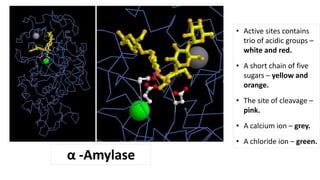
α -Amylase
• Active sites contains
trio of acidic groups –
white and red.
• A short chain of five
sugars – yellow and
orange.
• The site of cleavage –
pink.
• A calcium ion – grey.
• A chloride ion – green.
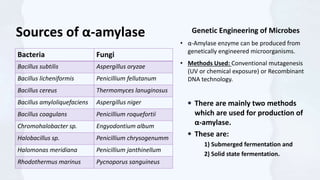
Sources of α-amylase
 There are mainly two methods
which are used for production of
α-amylase.
 These are:
1) Submerged fermentation and
2) Solid state fermentation.
Bacteria Fungi
Bacillus subtilis Aspergillus oryzae
Bacillus licheniformis Penicillium fellutanum
Bacillus cereus Thermomyces lanuginosus
Bacillus amyloliquefaciens Aspergillus niger
Bacillus coagulans Penicillium roquefortii
Chromohalobacter sp. Engyodontium album
Halobacillus sp. Penicillium chrysogenumm
Halomonas meridiana Penicillium janthinellum
Rhodothermus marinus Pycnoporus sanguineus
Genetic Engineering of Microbes
• α-Amylase enzyme can be produced from
genetically engineered microorganisms.
• Methods Used: Conventional mutagenesis
(UV or chemical exposure) or Recombinant
DNA technology.
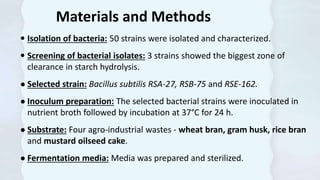
Materials and Methods
 Isolation of bacteria: 50 strains were isolated and characterized.
 Screening of bacterial isolates: 3 strains showed the biggest zone of
clearance in starch hydrolysis.
● Selected strain: Bacillus subtilis RSA-27, RSB-75 and RSE-162.
● Inoculum preparation: The selected bacterial strains were inoculated in
nutrient broth followed by incubation at 37°C for 24 h.
● Substrate: Four agro-industrial wastes - wheat bran, gram husk, rice bran
and mustard oilseed cake.
● Fermentation media: Media was prepared and sterilized.
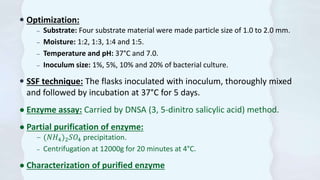
 Optimization:
─ Substrate: Four substrate material were made particle size of 1.0 to 2.0 mm.
─ Moisture: 1:2, 1:3, 1:4 and 1:5.
─ Temperature and pH: 37°C and 7.0.
─ Inoculum size: 1%, 5%, 10% and 20% of bacterial culture.
 SSF technique: The flasks inoculated with inoculum, thoroughly mixed
and followed by incubation at 37°C for 5 days.
● Enzyme assay: Carried by DNSA (3, 5-dinitro salicylic acid) method.
● Partial purification of enzyme:
─ (𝑁𝐻4)2 𝑆𝑂4 precipitation.
─ Centrifugation at 12000g for 20 minutes at 4°C.
● Characterization of purified enzyme
Table – 01
Strain Activity (U/g)
(on the third day)
RSA-27 900
RSB-75 200
RSE-162 626
Results and Discussions
Strain RSA-27, a gram positive
rod shaped bacterium, was
selected for further testing and
optimization.
Table – 02
Substrate Activity (U/g)
Mustard oilseed cake 5166
Wheat bran 1233
Gram husk 900
Rice bran 933
Mustard oilseed cake was
selected as substrate for further
optimization.
Figure: α-Amylase production by three strains RSB- 75 (▥), RSA- 27 (▦) and RSE 162 (▤).
Table – 03
Moisture Content Activity (U/g)
1:2 1233
1:3 5366
1:4 2166
1:5 2966
Table – 04
Inoculum size Activity (U/g)
1% 226
5% 1733
10% 3333
20% 5133
Best Result
Strain RSA-27 produced
about 5400 U/g of α-amylase
at 1:3 moisture content, 20%
inoculum, after 72 h of
incubation with mustard
oilseed cake as the
substrate.
Figure: Effects of variation in substrate, moisture content and inoculum size in enzyme production.
Various parameters that affects enzyme activity were optimized:
 Optimum temperature: 50°C
 Optimum pH: 6
Figure: (A) Temperature optimization for enzyme production [30°C to 70°C].
(B) pH optimization for enzyme production [5 to 9].
 Thermostability and pH stability of the enzyme:
─ The enzyme was found to be stable mostly at 30°C for 2h.
─ The enzyme was very stable at neutral pH (6- 7).
Figure: (A) Stability of enzyme at temperatures 30°c to 70°C (◆) 30°C, (●) 40°C, ( ▲) 50°C, (■) 60°C, (□) 70°C.
(B) Stability of enzyme at pH 5 – 9 (◆) 5, (■) 6, (▲) 7, (●) 8, ( Ж) 9
 Effects of metal ions: The presence of salts as 𝐶𝑎2+
, 𝑀𝑔2+
, 𝐶𝑜2+
and 𝑁𝑎+
at 5mM and
10mM concentration enhanced the activity of the enzyme.
Effect of 𝐶𝑎++ ions on
the thermal stability
of the enzyme at 70°C
(▦) Crude,
(▧) 5Mm 𝐶𝑎𝐶𝑙2,
(▥) 10mM 𝐶𝑎𝐶𝑙2.
Conclusion
 Among all enzymes, α-amylase covers 25% of total enzyme market.
 α-amylase is used in
─ Starch conversion
─ Bakery Industry
─ Detergent Industry
─ Textile Industry
─ Fuel alcohol Production
─ Pharmaceutical industry
 Textiles and apparel industries capture the leading position in Bangladesh and α-
amylase enzyme can minimize these costing.
 Living in an era of depleting fossil fuels with a desperate need to produce alternative
forms of energy, this enzyme is a ray of hope.
 As enzyme helps to keep the environment clean, more researchers are focusing on the
microbial production of the enzyme.
Alpha amylase
Alpha amylase

Alpha amylase

  • 1.
    BGE 503 Enzyme Technology EffatJahan Tamanna Department of Biotechnology and Genetic Engineering, Jahanginagar University. α-Amylase
  • 2.
    Introduction  Enzymes arebiological catalysts which are indispensable components of reactions and work at milder conditions than chemical catalysts.  Amylases are important hydrolase enzymes which have been widely used since many decades.  Randomly cleave internal glycosidic linkages in starch molecules to hydrolyze them into dextrins and oligosaccharides.  Three types of amylase enzymes: α-amylase, β-amylase, γ-amylase.  Among these α-amylase is mostly used.
  • 3.
     α -Amylaseis an enzyme which has ability to catalyze the hydrolysis of internal α-1, 4-glycosidic linkages in starch to yield products like glucose and maltose.  It was first discovered and isolated by Anselme Payen in 1833.  Mostly extracellular.  EC (Enzyme Commission) number: 3.2.1.1  Molecular weight: 51 - 55.4KDa.  α-amylase is produced by plants, animals and microorganisms.  It is a major digestive enzyme secreted in pancreas and salivary glands.  Other names: glycogenase, endoamylase, 1,4-α-D-glucan glucanohydrolase. α-Amylase
  • 4.
    α -Amylase • Activesites contains trio of acidic groups – white and red. • A short chain of five sugars – yellow and orange. • The site of cleavage – pink. • A calcium ion – grey. • A chloride ion – green.
  • 5.
    Sources of α-amylase There are mainly two methods which are used for production of α-amylase.  These are: 1) Submerged fermentation and 2) Solid state fermentation. Bacteria Fungi Bacillus subtilis Aspergillus oryzae Bacillus licheniformis Penicillium fellutanum Bacillus cereus Thermomyces lanuginosus Bacillus amyloliquefaciens Aspergillus niger Bacillus coagulans Penicillium roquefortii Chromohalobacter sp. Engyodontium album Halobacillus sp. Penicillium chrysogenumm Halomonas meridiana Penicillium janthinellum Rhodothermus marinus Pycnoporus sanguineus Genetic Engineering of Microbes • α-Amylase enzyme can be produced from genetically engineered microorganisms. • Methods Used: Conventional mutagenesis (UV or chemical exposure) or Recombinant DNA technology.
  • 6.
    Materials and Methods Isolation of bacteria: 50 strains were isolated and characterized.  Screening of bacterial isolates: 3 strains showed the biggest zone of clearance in starch hydrolysis. ● Selected strain: Bacillus subtilis RSA-27, RSB-75 and RSE-162. ● Inoculum preparation: The selected bacterial strains were inoculated in nutrient broth followed by incubation at 37°C for 24 h. ● Substrate: Four agro-industrial wastes - wheat bran, gram husk, rice bran and mustard oilseed cake. ● Fermentation media: Media was prepared and sterilized.
  • 7.
     Optimization: ─ Substrate:Four substrate material were made particle size of 1.0 to 2.0 mm. ─ Moisture: 1:2, 1:3, 1:4 and 1:5. ─ Temperature and pH: 37°C and 7.0. ─ Inoculum size: 1%, 5%, 10% and 20% of bacterial culture.  SSF technique: The flasks inoculated with inoculum, thoroughly mixed and followed by incubation at 37°C for 5 days. ● Enzyme assay: Carried by DNSA (3, 5-dinitro salicylic acid) method. ● Partial purification of enzyme: ─ (𝑁𝐻4)2 𝑆𝑂4 precipitation. ─ Centrifugation at 12000g for 20 minutes at 4°C. ● Characterization of purified enzyme
  • 8.
    Table – 01 StrainActivity (U/g) (on the third day) RSA-27 900 RSB-75 200 RSE-162 626 Results and Discussions Strain RSA-27, a gram positive rod shaped bacterium, was selected for further testing and optimization. Table – 02 Substrate Activity (U/g) Mustard oilseed cake 5166 Wheat bran 1233 Gram husk 900 Rice bran 933 Mustard oilseed cake was selected as substrate for further optimization.
  • 9.
    Figure: α-Amylase productionby three strains RSB- 75 (▥), RSA- 27 (▦) and RSE 162 (▤).
  • 10.
    Table – 03 MoistureContent Activity (U/g) 1:2 1233 1:3 5366 1:4 2166 1:5 2966 Table – 04 Inoculum size Activity (U/g) 1% 226 5% 1733 10% 3333 20% 5133 Best Result Strain RSA-27 produced about 5400 U/g of α-amylase at 1:3 moisture content, 20% inoculum, after 72 h of incubation with mustard oilseed cake as the substrate.
  • 11.
    Figure: Effects ofvariation in substrate, moisture content and inoculum size in enzyme production.
  • 12.
    Various parameters thataffects enzyme activity were optimized:  Optimum temperature: 50°C  Optimum pH: 6 Figure: (A) Temperature optimization for enzyme production [30°C to 70°C]. (B) pH optimization for enzyme production [5 to 9].
  • 13.
     Thermostability andpH stability of the enzyme: ─ The enzyme was found to be stable mostly at 30°C for 2h. ─ The enzyme was very stable at neutral pH (6- 7). Figure: (A) Stability of enzyme at temperatures 30°c to 70°C (◆) 30°C, (●) 40°C, ( ▲) 50°C, (■) 60°C, (□) 70°C. (B) Stability of enzyme at pH 5 – 9 (◆) 5, (■) 6, (▲) 7, (●) 8, ( Ж) 9
  • 14.
     Effects ofmetal ions: The presence of salts as 𝐶𝑎2+ , 𝑀𝑔2+ , 𝐶𝑜2+ and 𝑁𝑎+ at 5mM and 10mM concentration enhanced the activity of the enzyme. Effect of 𝐶𝑎++ ions on the thermal stability of the enzyme at 70°C (▦) Crude, (▧) 5Mm 𝐶𝑎𝐶𝑙2, (▥) 10mM 𝐶𝑎𝐶𝑙2.
  • 15.
    Conclusion  Among allenzymes, α-amylase covers 25% of total enzyme market.  α-amylase is used in ─ Starch conversion ─ Bakery Industry ─ Detergent Industry ─ Textile Industry ─ Fuel alcohol Production ─ Pharmaceutical industry  Textiles and apparel industries capture the leading position in Bangladesh and α- amylase enzyme can minimize these costing.  Living in an era of depleting fossil fuels with a desperate need to produce alternative forms of energy, this enzyme is a ray of hope.  As enzyme helps to keep the environment clean, more researchers are focusing on the microbial production of the enzyme.