Carbohydrates
Presented by : GROUP # 6
Alonzo, Angelo
Emata, Roshelle
Canlas, Sharmaine Mae
Cas, Julianna
TRIVIA TIME!
“Glass is actually a liquid, it just
flows very, very slowly.”
DID YOU KNOW?
 Define Carbohydrates:
 Molisch’s Test:
 Benedict’s Test:
 Nylander’s Test:
 Osazone Crystal Formation:
 Tollen’s Test:
 Barfoed’s Test
 Seliwanoff’s Test:
 Iodine Test:
OBJECTIVES:
Carbohydrates
● Carbohydrates are organic substances composed of certain
chemical groups, such as alcohols, aldehydes, or ketone
groups. These compounds include natural sugar which is
largely distributed in nature and is classified as
monosaccharides, disaccharides, or polysaccharides based
on the complexity of their molecules.
 Test Tubes (7)
 Droppers
 Graduated Cylinder
 Reagents
 Carbohydrates
 Test Tubes Racks
 Marker/Pen
 Notes
GENERAL MATERIALS
 Glucose
 Fructose
 Maltose
 Lactose
 Galactose
 Starch
 Sucrose
CARBOHYDRATES
Molisch’s Test
01.
- The general test for carbohydrates
- Concentrated “sulfuric acid” will be used for this test
- Hans Molisch.
a. Add at least 2-3ml of each carbohydrates solution in our 7 test tubes and
then we will be adding 5 drops of Molisch’s Reagent to each carbohydrate
sample and then mix thoroughly
b. Then carefully add 10 drops of sulfuric acid.
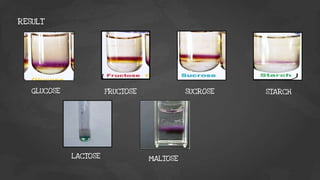
c. OBSERVE - Sulfuric Acid become denser than other substance.
PROCEDURE
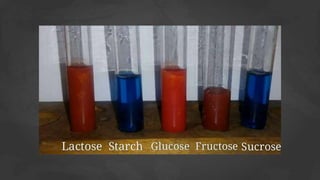
GLUCOSE FRUCTOSE SUCROSE STARCH
LACTOSE
RESULT
MALTOSE
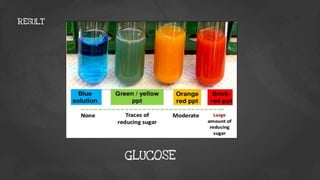
Benedict’s Test
02.
- Benedict's test detects reducing sugars
- Stanley Rossiter Benedict.
a. Place a 5 drop of Benedict’s Reagent to an empty 7 test tubes and place
into the water bath for 5 minutes.
b. If the solution remains blue we can continue with the test which means the
reagent is not contaminated, allow the test tubes to cool down
c. Add at least 2-3 drops of carbohydrates solution.
d. OBSERVE-
PROCEDURE
GLUCOSE
RESULT
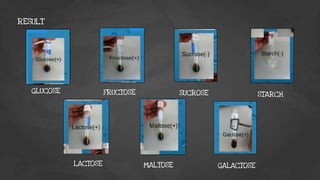
Nylander’s Test
03.
- Is a chemical test used for detecting the presence of reducing sugars.
- Glucose and Fructose reduce bismuth oxynitrate to bismuth under alkaline
conditions.
a. Add 5 drops of Nylander’s reagent to all 7 test tubes.
b. Heat in a water bath for 5 minutes.
c. Observe the change in color.
d. OBSERVE
PROCEDURE
RESULT
GLUCOSE FRUCTOSE SUCROSE STARCH
LACTOSE MALTOSE GALACTOSE
Osazone Crystals Formation
04.
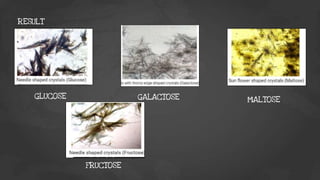
- are a class of carbohydrate derivatives found in organic chemistry formed
when sugars are reacted with phenylhydrazine.
- are highly colored and crystalline compounds and can be easily detected.
a. Take 5 ml of Osazone Test in a clean, dry test tube.
b. Add 0.3 g of Osazone mixture and five drops of glacial acetic acid to the test
tube.
c. Mix it well and warm the test tube gently in the water bath if required to
dissolve all the elements.
d. Keep the test tube in boiling water and observe the formation of crystals at
various time points.
PROCEDURE
RESULT
GLUCOSE
FRUCTOSE
MALTOSE
GALACTOSE
Tollen’s Test
05.
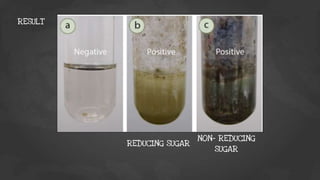
- Tollens’ test is a chemical test used to differentiate reducing sugars from
non-reducing sugars. This test is also called the silver mirror test based on
the end product of this test.
- Bernhard Tollens
a. Take two clean, dry test tubes and add 1 ml of the test sample in one test
tube and 1 ml of distilled water in another as blank.
b. Add 2 ml of Tollen’s reagent to both the test tubes.
c. Keep both the test tubes in a water bath for 5 minutes. Allow to stand
for another 5 minutes.
d. Observe the formation of color and note it down.
PROCEDURE
RESULT
REDUCING SUGAR
NON- REDUCING
SUGAR
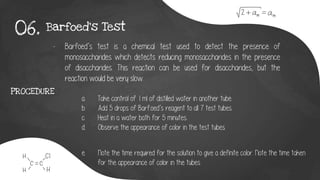
Barfoed’s Test
06.
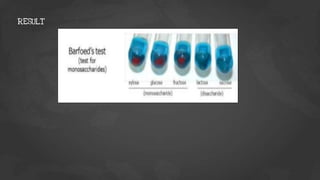
- Barfoed’s test is a chemical test used to detect the presence of
monosaccharides which detects reducing monosaccharides in the presence
of disaccharides. This reaction can be used for disaccharides, but the
reaction would be very slow.
a. Take control of 1 ml of distilled water in another tube.
b. Add 5 drops of Barf.oed’s reagent to all 7 test tubes.
c. Heat in a water bath for 5 minutes.
d. Observe the appearance of color in the test tubes
e. Note the time required for the solution to give a definite color. Note the time taken
for the appearance of color in the tubes.
PROCEDURE
RESULT
Seliwanoff’s Test
06.
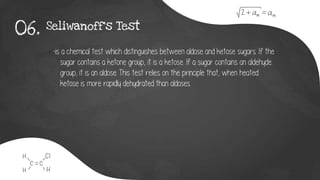
- -is a chemical test which distinguishes between aldose and ketose sugars. If the
sugar contains a ketone group, it is a ketose. If a sugar contains an aldehyde
group, it is an aldose. This test relies on the principle that, when heated
ketose is more rapidly dehydrated than aldoses.
1.To start the test, take a test tube and add 5 ml of
Seliwanoff’s reagent in it. Make sure that the amount of
reagent you are adding in the test tube doesn’t exceed 5
ml and measure it before pouring it.
2.Now the material which is to be tested, pick it up,
measure 1 ml of it and pour it down in the test tube.
3.The third step should be to heat the solution using
boiling water. Boil the solution in the boiling water
for 5 minutes and then wait for the results. After
sometime you will observe the color changes in the test
tube.
4.After the test is being performed, you will observe
the color changes in the solution. If the color turns to
red, then this means that your results are positive and
keto sugar is present inside the solution.
Iodine Test
06.
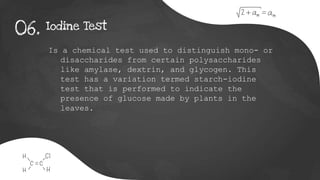
Is a chemical test used to distinguish mono- or
disaccharides from certain polysaccharides
like amylase, dextrin, and glycogen. This
test has a variation termed starch-iodine
test that is performed to indicate the
presence of glucose made by plants in the
leaves.
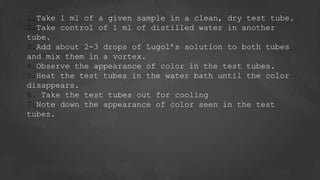
1.Take 1 ml of a given sample in a clean, dry test tube.
2.Take control of 1 ml of distilled water in another
tube.
3.Add about 2-3 drops of Lugol’s solution to both tubes
and mix them in a vortex.
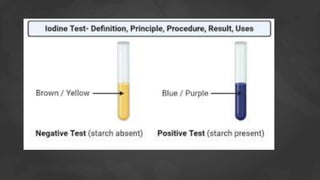
4.Observe the appearance of color in the test tubes.
5.Heat the test tubes in the water bath until the color
disappears.
6. Take the test tubes out for cooling
7.Note down the appearance of color seen in the test
tubes.
BIOCHEM CARBOHYDRATES

BIOCHEM CARBOHYDRATES

  • 1.
    Carbohydrates Presented by :GROUP # 6 Alonzo, Angelo Emata, Roshelle Canlas, Sharmaine Mae Cas, Julianna
  • 2.
  • 3.
    “Glass is actuallya liquid, it just flows very, very slowly.” DID YOU KNOW?
  • 4.
     Define Carbohydrates: Molisch’s Test:  Benedict’s Test:  Nylander’s Test:  Osazone Crystal Formation:  Tollen’s Test:  Barfoed’s Test  Seliwanoff’s Test:  Iodine Test: OBJECTIVES:
  • 5.
    Carbohydrates ● Carbohydrates areorganic substances composed of certain chemical groups, such as alcohols, aldehydes, or ketone groups. These compounds include natural sugar which is largely distributed in nature and is classified as monosaccharides, disaccharides, or polysaccharides based on the complexity of their molecules.
  • 6.
     Test Tubes(7)  Droppers  Graduated Cylinder  Reagents  Carbohydrates  Test Tubes Racks  Marker/Pen  Notes GENERAL MATERIALS  Glucose  Fructose  Maltose  Lactose  Galactose  Starch  Sucrose CARBOHYDRATES
  • 7.
    Molisch’s Test 01. - Thegeneral test for carbohydrates - Concentrated “sulfuric acid” will be used for this test - Hans Molisch. a. Add at least 2-3ml of each carbohydrates solution in our 7 test tubes and then we will be adding 5 drops of Molisch’s Reagent to each carbohydrate sample and then mix thoroughly b. Then carefully add 10 drops of sulfuric acid. c. OBSERVE - Sulfuric Acid become denser than other substance. PROCEDURE
  • 8.
    GLUCOSE FRUCTOSE SUCROSESTARCH LACTOSE RESULT MALTOSE
  • 9.
    Benedict’s Test 02. - Benedict'stest detects reducing sugars - Stanley Rossiter Benedict. a. Place a 5 drop of Benedict’s Reagent to an empty 7 test tubes and place into the water bath for 5 minutes. b. If the solution remains blue we can continue with the test which means the reagent is not contaminated, allow the test tubes to cool down c. Add at least 2-3 drops of carbohydrates solution. d. OBSERVE- PROCEDURE
  • 10.
  • 11.
    Nylander’s Test 03. - Isa chemical test used for detecting the presence of reducing sugars. - Glucose and Fructose reduce bismuth oxynitrate to bismuth under alkaline conditions. a. Add 5 drops of Nylander’s reagent to all 7 test tubes. b. Heat in a water bath for 5 minutes. c. Observe the change in color. d. OBSERVE PROCEDURE
  • 12.
    RESULT GLUCOSE FRUCTOSE SUCROSESTARCH LACTOSE MALTOSE GALACTOSE
  • 13.
    Osazone Crystals Formation 04. -are a class of carbohydrate derivatives found in organic chemistry formed when sugars are reacted with phenylhydrazine. - are highly colored and crystalline compounds and can be easily detected. a. Take 5 ml of Osazone Test in a clean, dry test tube. b. Add 0.3 g of Osazone mixture and five drops of glacial acetic acid to the test tube. c. Mix it well and warm the test tube gently in the water bath if required to dissolve all the elements. d. Keep the test tube in boiling water and observe the formation of crystals at various time points. PROCEDURE
  • 14.
  • 15.
    Tollen’s Test 05. - Tollens’test is a chemical test used to differentiate reducing sugars from non-reducing sugars. This test is also called the silver mirror test based on the end product of this test. - Bernhard Tollens a. Take two clean, dry test tubes and add 1 ml of the test sample in one test tube and 1 ml of distilled water in another as blank. b. Add 2 ml of Tollen’s reagent to both the test tubes. c. Keep both the test tubes in a water bath for 5 minutes. Allow to stand for another 5 minutes. d. Observe the formation of color and note it down. PROCEDURE
  • 16.
  • 17.
    Barfoed’s Test 06. - Barfoed’stest is a chemical test used to detect the presence of monosaccharides which detects reducing monosaccharides in the presence of disaccharides. This reaction can be used for disaccharides, but the reaction would be very slow. a. Take control of 1 ml of distilled water in another tube. b. Add 5 drops of Barf.oed’s reagent to all 7 test tubes. c. Heat in a water bath for 5 minutes. d. Observe the appearance of color in the test tubes e. Note the time required for the solution to give a definite color. Note the time taken for the appearance of color in the tubes. PROCEDURE
  • 18.
  • 19.
    Seliwanoff’s Test 06. - -isa chemical test which distinguishes between aldose and ketose sugars. If the sugar contains a ketone group, it is a ketose. If a sugar contains an aldehyde group, it is an aldose. This test relies on the principle that, when heated ketose is more rapidly dehydrated than aldoses.
  • 20.
    1.To start thetest, take a test tube and add 5 ml of Seliwanoff’s reagent in it. Make sure that the amount of reagent you are adding in the test tube doesn’t exceed 5 ml and measure it before pouring it. 2.Now the material which is to be tested, pick it up, measure 1 ml of it and pour it down in the test tube. 3.The third step should be to heat the solution using boiling water. Boil the solution in the boiling water for 5 minutes and then wait for the results. After sometime you will observe the color changes in the test tube. 4.After the test is being performed, you will observe the color changes in the solution. If the color turns to red, then this means that your results are positive and keto sugar is present inside the solution.
  • 22.
    Iodine Test 06. Is achemical test used to distinguish mono- or disaccharides from certain polysaccharides like amylase, dextrin, and glycogen. This test has a variation termed starch-iodine test that is performed to indicate the presence of glucose made by plants in the leaves.
  • 23.
    1.Take 1 mlof a given sample in a clean, dry test tube. 2.Take control of 1 ml of distilled water in another tube. 3.Add about 2-3 drops of Lugol’s solution to both tubes and mix them in a vortex. 4.Observe the appearance of color in the test tubes. 5.Heat the test tubes in the water bath until the color disappears. 6. Take the test tubes out for cooling 7.Note down the appearance of color seen in the test tubes.