ESTIMATING
AND
COSTING
Specification
Definition of Specification
 Specifications describe the nature and the class of the
work, materials to be used in the work, workmanship
etc. and is very important for the execution of the
work. The cost of a work depends much on the
specifications
2
Mr.A.B.Jadhav
Purpose of Specification
 The cost of a unit quantity of work is governed by its
specifications.
 Specification of a work is required to describe the quality
and quantity of different materials required for a
construction work and is one of the essential contract
documents.
 This also specifies the workmanship and the method of
doing the work. Thus specification of a work serves as a
guide to a supervising staff of a contractor as well as to the
owner to execute the work to their satisfaction. Drawings +
specification
 A work is carried out according to its specification and the
contractor is paid for the same. Any change in specification
changes the tendered rate.
3
Mr.A.B.Jadhav
Purpose of Specification
 As the rate of work is based on the specification, a
contractor can calculate the rates of various items of
works in tender with his procurement rates of materials
and labour. Thus tender rate without specification of
works is baseless, incomplete and invalid.
 Specification is necessary to specify the equipment
tools and plants to be engaged for a work and thus
enables to procure them beforehand.
 The necessity of specification is to verify and check the
strength of materials for a work involved in a project.
4
Mr.A.B.Jadhav
Objectives of specifications.
 Expressing the quality of constructional material or strength of
the constructional work.
 Expressing the ratio of components used in concrete or mortar.
 Expressing the type of material such as timber type and types
of bricks etc.
 Expressing the color of constructional materials.
 Listing the conditions of the contract.
 Evaluating the cost likely to be expended over the
constructional work.
 Explaining the methodology for conducting constructional
work.
 Explaining the machinery and tools used in the construction
work
5
Mr.A.B.Jadhav
Principles of Writing Specifications.
 Description of Material:
 A complete description of the constructional material must
be included.
 Type of materials and size must be described completely for
this purpose.
 Despite, the ratio of each component in concrete or mortar
and methodology of mixing must also be described
minutely.
 If a material requires certain treatment, then it should also
be written in the Specifications.
6
Mr.A.B.Jadhav
Principles of Writing Specifications.
 Workmanship:
 Workmanship must also be described during writing
Specifications.
 Workmanship must describe the method of work, different
steps of the work, surface preparation, surface compaction
and method of curing, etc.
 Tools and Plants:
 Tools and Plants must also be described during writing
specifications in the order they can be organized before
commencing the constructional project.
 It is also imperative to describe that whether Tools and
Plants will either be organized by the contractor or by
concerned department of the government.
7
Mr.A.B.Jadhav
Principles of Writing Specifications.
 The clause of Specifications:
 It must be endeavored to keep the organization of
conditions of work as per organization of real
constructional work.
 All these conditions must be practically possible.
 Clauses of Specifications must neither confer each
other not repeated.
8
Mr.A.B.Jadhav
Types of Specifications.
 There are two types of Specifications as
follows.
 General Specifications.
 Detailed Specifications.
9
Mr.A.B.Jadhav
Types of Specifications.
 General Specifications.
 General Specifications are also known as Brief
Specifications.
 They are used to show aspect, standard, and type of
constructional work.
 They would describe the general classifications of the
construction work of the project.
 These specifications are used to establish the standards of
the construction work that will help in establishing
a detailed estimate
10
Mr.A.B.Jadhav
Types of Specifications.
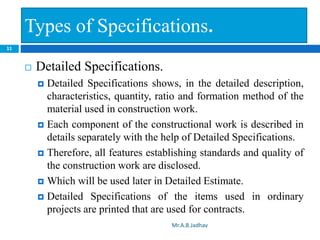
 Detailed Specifications.
 Detailed Specifications shows, in the detailed description,
characteristics, quantity, ratio and formation method of the
material used in construction work.
 Each component of the constructional work is described in
details separately with the help of Detailed Specifications.
 Therefore, all features establishing standards and quality of
the construction work are disclosed.
 Which will be used later in Detailed Estimate.
 Detailed Specifications of the items used in ordinary
projects are printed that are used for contracts.
11
Mr.A.B.Jadhav
Types of Specifications.
 Detailed Specifications.
 Detailed specifications consists of:
 General provisions
 Conditions of contract
 Depend on nature of work
 Relating to documents
 General obligations of the contractor
 Conditions relating to labour
 Subletting, execution of work
 Measurement and payment
 Default and non-completion settlement of disputes and specific
conditions etc..
12
Mr.A.B.Jadhav
Types of Specifications.
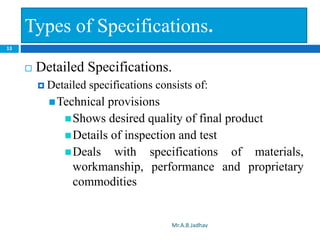
 Detailed Specifications.
 Detailed specifications consists of:
Technical provisions
Shows desired quality of final product
Details of inspection and test
Deals with specifications of materials,
workmanship, performance and proprietary
commodities
13
Mr.A.B.Jadhav
Types of Specifications.
 Detailed Specifications.
 Detailed specifications consists of:
Standard specifications
 Standardized format.
 Lengthy process of wording will be avoided.
 Saves time, labour and cost.
 Eg: earth work, brick work, etc.
14
Mr.A.B.Jadhav
Types of Specifications.
 Detailed Specifications.
 Detailed specifications consists of:
Standard specifications
 Standardized format.
 Lengthy process of wording will be avoided.
 Saves time, labour and cost.
 E.g.: earth work, brick work, etc.
15
Mr.A.B.Jadhav
Process in specification writing.
 Earthwork excavation
Starting of work Workmanship
excavated material protection to existing
services measurement.
 Cement concrete for foundation
Mix proportion cement mortar
aggregates mixing placing
Ramming curing measurement.
16
Mr.A.B.Jadhav

estimating and costing specification ppt -.pptx

  • 1.
  • 2.
    Definition of Specification Specifications describe the nature and the class of the work, materials to be used in the work, workmanship etc. and is very important for the execution of the work. The cost of a work depends much on the specifications 2 Mr.A.B.Jadhav
  • 3.
    Purpose of Specification The cost of a unit quantity of work is governed by its specifications.  Specification of a work is required to describe the quality and quantity of different materials required for a construction work and is one of the essential contract documents.  This also specifies the workmanship and the method of doing the work. Thus specification of a work serves as a guide to a supervising staff of a contractor as well as to the owner to execute the work to their satisfaction. Drawings + specification  A work is carried out according to its specification and the contractor is paid for the same. Any change in specification changes the tendered rate. 3 Mr.A.B.Jadhav
  • 4.
    Purpose of Specification As the rate of work is based on the specification, a contractor can calculate the rates of various items of works in tender with his procurement rates of materials and labour. Thus tender rate without specification of works is baseless, incomplete and invalid.  Specification is necessary to specify the equipment tools and plants to be engaged for a work and thus enables to procure them beforehand.  The necessity of specification is to verify and check the strength of materials for a work involved in a project. 4 Mr.A.B.Jadhav
  • 5.
    Objectives of specifications. Expressing the quality of constructional material or strength of the constructional work.  Expressing the ratio of components used in concrete or mortar.  Expressing the type of material such as timber type and types of bricks etc.  Expressing the color of constructional materials.  Listing the conditions of the contract.  Evaluating the cost likely to be expended over the constructional work.  Explaining the methodology for conducting constructional work.  Explaining the machinery and tools used in the construction work 5 Mr.A.B.Jadhav
  • 6.
    Principles of WritingSpecifications.  Description of Material:  A complete description of the constructional material must be included.  Type of materials and size must be described completely for this purpose.  Despite, the ratio of each component in concrete or mortar and methodology of mixing must also be described minutely.  If a material requires certain treatment, then it should also be written in the Specifications. 6 Mr.A.B.Jadhav
  • 7.
    Principles of WritingSpecifications.  Workmanship:  Workmanship must also be described during writing Specifications.  Workmanship must describe the method of work, different steps of the work, surface preparation, surface compaction and method of curing, etc.  Tools and Plants:  Tools and Plants must also be described during writing specifications in the order they can be organized before commencing the constructional project.  It is also imperative to describe that whether Tools and Plants will either be organized by the contractor or by concerned department of the government. 7 Mr.A.B.Jadhav
  • 8.
    Principles of WritingSpecifications.  The clause of Specifications:  It must be endeavored to keep the organization of conditions of work as per organization of real constructional work.  All these conditions must be practically possible.  Clauses of Specifications must neither confer each other not repeated. 8 Mr.A.B.Jadhav
  • 9.
    Types of Specifications. There are two types of Specifications as follows.  General Specifications.  Detailed Specifications. 9 Mr.A.B.Jadhav
  • 10.
    Types of Specifications. General Specifications.  General Specifications are also known as Brief Specifications.  They are used to show aspect, standard, and type of constructional work.  They would describe the general classifications of the construction work of the project.  These specifications are used to establish the standards of the construction work that will help in establishing a detailed estimate 10 Mr.A.B.Jadhav
  • 11.
    Types of Specifications. Detailed Specifications.  Detailed Specifications shows, in the detailed description, characteristics, quantity, ratio and formation method of the material used in construction work.  Each component of the constructional work is described in details separately with the help of Detailed Specifications.  Therefore, all features establishing standards and quality of the construction work are disclosed.  Which will be used later in Detailed Estimate.  Detailed Specifications of the items used in ordinary projects are printed that are used for contracts. 11 Mr.A.B.Jadhav
  • 12.
    Types of Specifications. Detailed Specifications.  Detailed specifications consists of:  General provisions  Conditions of contract  Depend on nature of work  Relating to documents  General obligations of the contractor  Conditions relating to labour  Subletting, execution of work  Measurement and payment  Default and non-completion settlement of disputes and specific conditions etc.. 12 Mr.A.B.Jadhav
  • 13.
    Types of Specifications. Detailed Specifications.  Detailed specifications consists of: Technical provisions Shows desired quality of final product Details of inspection and test Deals with specifications of materials, workmanship, performance and proprietary commodities 13 Mr.A.B.Jadhav
  • 14.
    Types of Specifications. Detailed Specifications.  Detailed specifications consists of: Standard specifications  Standardized format.  Lengthy process of wording will be avoided.  Saves time, labour and cost.  Eg: earth work, brick work, etc. 14 Mr.A.B.Jadhav
  • 15.
    Types of Specifications. Detailed Specifications.  Detailed specifications consists of: Standard specifications  Standardized format.  Lengthy process of wording will be avoided.  Saves time, labour and cost.  E.g.: earth work, brick work, etc. 15 Mr.A.B.Jadhav
  • 16.
    Process in specificationwriting.  Earthwork excavation Starting of work Workmanship excavated material protection to existing services measurement.  Cement concrete for foundation Mix proportion cement mortar aggregates mixing placing Ramming curing measurement. 16 Mr.A.B.Jadhav