Specifications
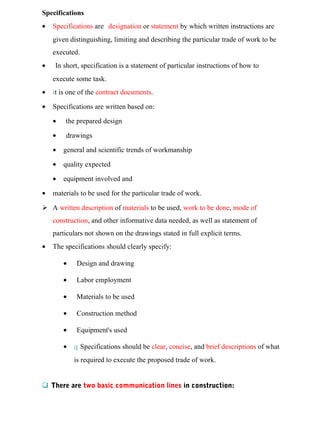
• Specifications are designation or statement by which written instructions are
given distinguishing, limiting and describing the particular trade of work to be
executed.
• In short, specification is a statement of particular instructions of how to
execute some task.
• it is one of the contract documents.
• Specifications are written based on:
• the prepared design
• drawings
• general and scientific trends of workmanship
• quality expected
• equipment involved and
• materials to be used for the particular trade of work.
 A written description of materials to be used, work to be done, mode of
construction, and other informative data needed, as well as statement of
particulars not shown on the drawings stated in full explicit terms.
• The specifications should clearly specify:
• Design and drawing
• Labor employment
• Materials to be used
• Construction method
• Equipment's used
• q Specifications should be clear, concise, and brief descriptions of what
is required to execute the proposed trade of work.
 There are two basic communication lines in construction:
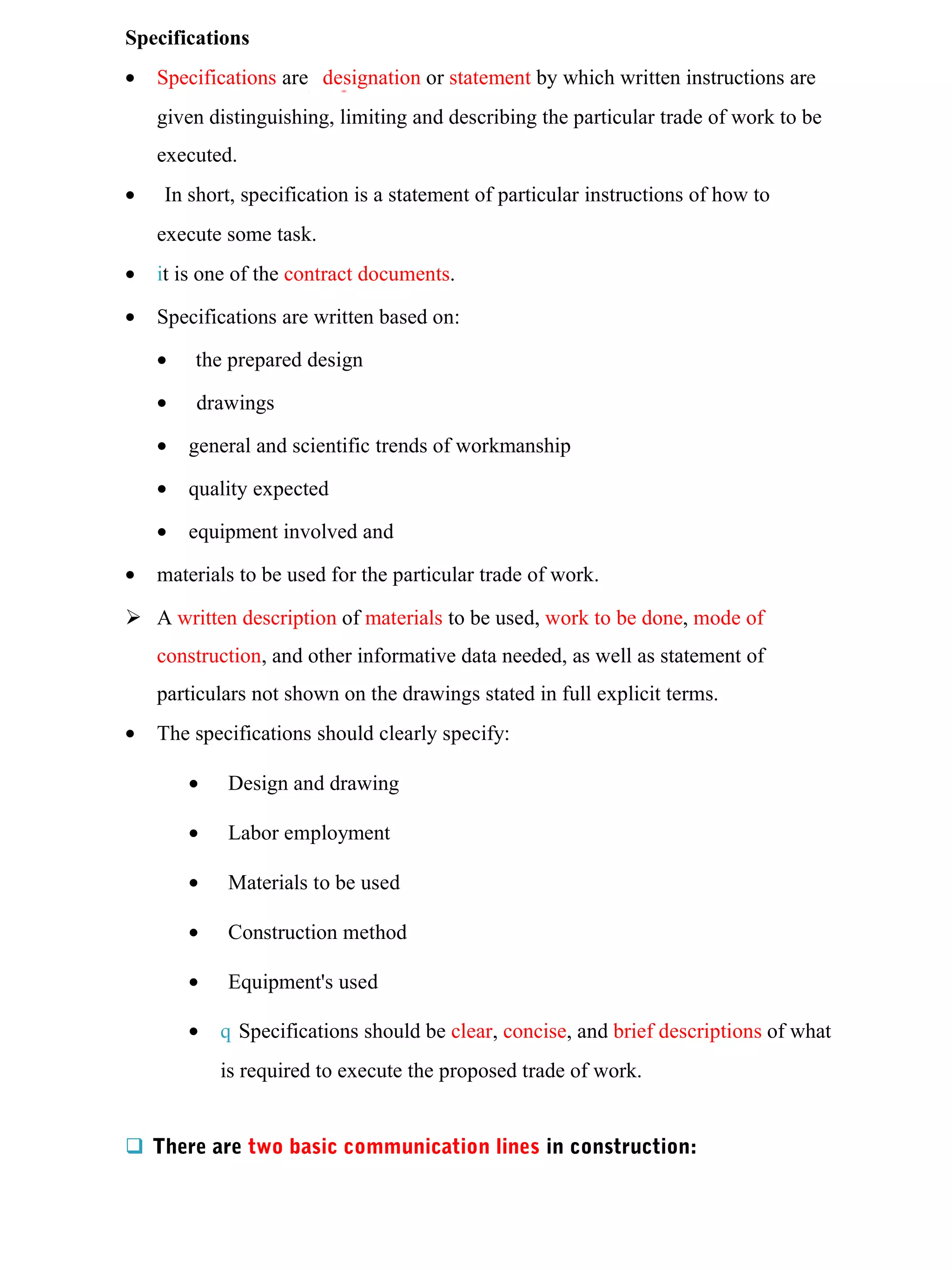
 The Drawings (Pictorial)
 The Specifications (Written)
 These two basic communication lines should compliment each
other and neither should overlap or duplicate the other.
 Drawings are the graphic means of showing/ representing work
to be done, which generally shows the following:
 Dimensions, extents, size, shape, and location of
component parts
 Location of materials, machineries, and fixtures
 Interaction of furniture, equipment's and space
 Schedules of finishes, windows and doors
 Specifications are written descriptions of materials, construction
methods and the legal and technical requirements of the works,
which mainly describes the following:
 Type and quality of materials, equipment's, labor or
workmanship
 Methods of fabrication, installation and erection
 Standards, codes and tests
 Allowance, submittals and substitutions
 Cost included, insurance and bonds
 Project records and site facilities.
 In the events of conflicts between specification and drawings,
the specification governs
Purpose of specification
1. Guide the bidder at the time of tendering to arrive at a
reasonable cost for the work.
2. Provide guidance for execution and supervision of works.
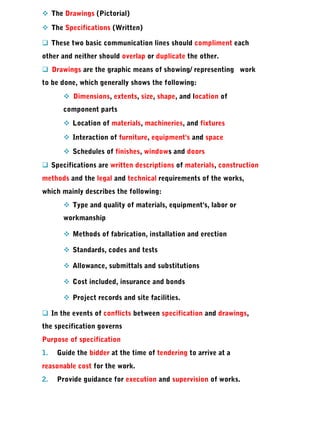
3. Guide the contractor for the purchase of materials.
4. Serve as a part of contract document to limit and describe the
rights and obligations of each contracting
parties.
5. Guide the bidder to identify his capacity to execute the work.
6. Serve as fabrication and installation guide for temporary and
permanent works
7. Guide the contractor for the purchase and/or hiring of
equipment's.
8. Serve for the owner to know what he/she is entitled to receive.
9. Serve for the manufacturers of construction materials,
equipment's, tools, etc. to grade, classify, and improve
qualities of their products.
10.Indirectly, the specifications are very much related to the legal
considerations, insurance considerations, bidding
requirements, alternates and options, rights, obligations and
remedial measures for the contracting parties
TYPES OF SPESFICATION
Specifications can be broadly classified into four categories:
1.Manufacturer’s Specification
• Manufacturers prepare specification of their product for the
guidance of their users.
• It includes property descriptions and installation guide lines.
2.Guide Specification: prepared by an individual or group of
individuals to be used as guidelines for preparation of contract
(project) specifications based on;
• manufacturer’s specifications
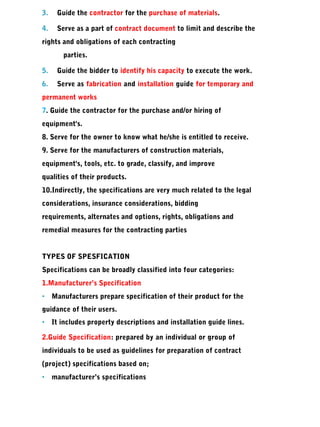
• established trends of workmanship
• service and laboratory tests and
• research findings
3.Standard Specification: are intended to be used as a
reference standard in the construction of a project. The guide
specification which has been standardized by a recognized
authority is considered as standard specification.
4.Contract (Project) Specification: Specification prepared for
a particular project to accompany the drawings and other
contract documents
 Specifications can be prepared with the format which has General
and Specific Parts (General Specification and Specific
Specification).
 In the general part of the standard specifications the following
items are included:-
• Administrative and Procedural Requirements
• Scope, definitions
• Reference organizations and Standards
• Project description, site facilities
• Submittals and quality assurance
• Delivery, storage and handling
• Project records
• Insurances
• Other general requirements
 In the specific part of the standard specifications, detailed
description of the quality of items to be used is given.
Specifications
Specifications

Specifications

  • 1.
    Specifications • Specifications aredesignation or statement by which written instructions are given distinguishing, limiting and describing the particular trade of work to be executed. • In short, specification is a statement of particular instructions of how to execute some task. • it is one of the contract documents. • Specifications are written based on: • the prepared design • drawings • general and scientific trends of workmanship • quality expected • equipment involved and • materials to be used for the particular trade of work.  A written description of materials to be used, work to be done, mode of construction, and other informative data needed, as well as statement of particulars not shown on the drawings stated in full explicit terms. • The specifications should clearly specify: • Design and drawing • Labor employment • Materials to be used • Construction method • Equipment's used • q Specifications should be clear, concise, and brief descriptions of what is required to execute the proposed trade of work.  There are two basic communication lines in construction:
  • 2.
     The Drawings(Pictorial)  The Specifications (Written)  These two basic communication lines should compliment each other and neither should overlap or duplicate the other.  Drawings are the graphic means of showing/ representing work to be done, which generally shows the following:  Dimensions, extents, size, shape, and location of component parts  Location of materials, machineries, and fixtures  Interaction of furniture, equipment's and space  Schedules of finishes, windows and doors  Specifications are written descriptions of materials, construction methods and the legal and technical requirements of the works, which mainly describes the following:  Type and quality of materials, equipment's, labor or workmanship  Methods of fabrication, installation and erection  Standards, codes and tests  Allowance, submittals and substitutions  Cost included, insurance and bonds  Project records and site facilities.  In the events of conflicts between specification and drawings, the specification governs Purpose of specification 1. Guide the bidder at the time of tendering to arrive at a reasonable cost for the work. 2. Provide guidance for execution and supervision of works.
  • 3.
    3. Guide thecontractor for the purchase of materials. 4. Serve as a part of contract document to limit and describe the rights and obligations of each contracting parties. 5. Guide the bidder to identify his capacity to execute the work. 6. Serve as fabrication and installation guide for temporary and permanent works 7. Guide the contractor for the purchase and/or hiring of equipment's. 8. Serve for the owner to know what he/she is entitled to receive. 9. Serve for the manufacturers of construction materials, equipment's, tools, etc. to grade, classify, and improve qualities of their products. 10.Indirectly, the specifications are very much related to the legal considerations, insurance considerations, bidding requirements, alternates and options, rights, obligations and remedial measures for the contracting parties TYPES OF SPESFICATION Specifications can be broadly classified into four categories: 1.Manufacturer’s Specification • Manufacturers prepare specification of their product for the guidance of their users. • It includes property descriptions and installation guide lines. 2.Guide Specification: prepared by an individual or group of individuals to be used as guidelines for preparation of contract (project) specifications based on; • manufacturer’s specifications
  • 4.
    • established trendsof workmanship • service and laboratory tests and • research findings 3.Standard Specification: are intended to be used as a reference standard in the construction of a project. The guide specification which has been standardized by a recognized authority is considered as standard specification. 4.Contract (Project) Specification: Specification prepared for a particular project to accompany the drawings and other contract documents  Specifications can be prepared with the format which has General and Specific Parts (General Specification and Specific Specification).  In the general part of the standard specifications the following items are included:- • Administrative and Procedural Requirements • Scope, definitions • Reference organizations and Standards • Project description, site facilities • Submittals and quality assurance • Delivery, storage and handling • Project records • Insurances • Other general requirements  In the specific part of the standard specifications, detailed description of the quality of items to be used is given.