SPECIFICATION
SPECIFICATIONS
Describe the NATURE and the QUALITY of the work,
MATERIALS to be used in the work, STRENGTH, WORKMANSHIP
and EXECUTION of the work. The COST of a work depends
much on the specifications.
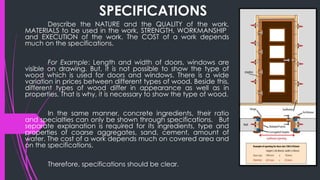
For Example: Length and width of doors, windows are
visible on drawing. But, it is not possible to show the type of
wood which is used for doors and windows. There is a wide
variation in prices between different types of wood. Beside this,
different types of wood differ in appearance as well as in
properties. That is why, it is necessary to show the type of wood.
In the same manner, concrete ingredients, their ratio
and specialties can only be shown through specifications. But
separate explanation is required for its ingredients, type and
properties of coarse aggregates, sand, cement, amount of
water. The cost of a work depends much on covered area and
on the specifications.
Therefore, specifications should be clear.
PURPOSE OF SPECIFICATION
🠶 The cost of an unit quantity of work is governed by its specifications.
🠶 Specification of a work is required to describe the quality and quantity of different
materials required for a construction work and is one of the essential contract documents.
🠶 This also specifies the workmanship and the method of doing the work. Thus specification
of a work serves as a guide to a supervising staff of a contractor as well as to the owner to
execute the work to their satisfaction.
🠶 A work is carried out according to its specification and the contractor is paid for the same.
Any change in specification changes the tendered rate.
🠶 As the rate of work is based on the specification, a contractor can calculate the rates of
various items of works in tender with his procurement rates of materials and labor. Thus
tender rate without specification of works is baseless, incomplete and invalid.
🠶 Specification is necessary to specify the equipment tools and plants to be engaged for a
work and thus enables to procure them beforehand.
🠶 The necessity of specification is to verify and check the strength of materials for a work
involved in a project.
IMPORTANCE OF SPECIFICATION
1. It provides clear instructions on the intent, performance and
construction of the project.
2. It can reference the quality and standards which should be applied.
3. Materials and manufacturers’ products can be clearly defined.
4. The requirements for installation, testing and handover can be
identified.
5. Classification in the specification can be used to support handover
and running of the asset.
6. The drawing or model does not need to be overloaded with detailed
information, which can sometimes be difficult to identify.
7. It can be used to support the costing of a project: not only the
materials and products but also the performance and workmanship
8. The specification forms part of the contractual documents, along
with the drawings, and therefore can help minimize project risk and
provide support should there be any legal disputes.
9. It supports the interpretation of the client brief and gives the client assurance
that the asset which they commissioned is being delivered.
10.It is not only essential for the construction phase but also used as part of the soft
landing process, subsequent asset management and the lifecycle plan.
11. By being clear and concise and containing all the information, it saves the
project team, the client and the contractor time and money by providing answers to
many of the on-site construction questions.
12. There is the option for the design team to build a suite of office masters, which
would improve efficiency, provide quality assurance and project consistency.
13. Office masters can save the team time and money by being developed over a
period of time and then being adapted to suit the project specifics, therefore
drawing on specialist knowledge when needed.
14. The specification should be used by all the project team throughout the
construction phase; it should be a living document and not stop being used at the
design phase.
15. The specification and any variations or value engineering can also be used for
the project audit trail and should form part of the handover documents. It will then
form the basis for the running of the asset by the asset management team
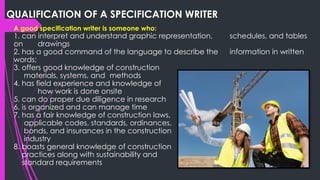
QUALIFICATION OF A SPECIFICATION WRITER
A good specification writer is someone who:
1. can interpret and understand graphic representation, schedules, and tables
on drawings
2. has a good command of the language to describe the information in written
words;
3. offers good knowledge of construction
materials, systems, and methods
4. has field experience and knowledge of
how work is done onsite
5. can do proper due diligence in research
6. is organized and can manage time
7. has a fair knowledge of construction laws,
applicable codes, standards, ordinances,
bonds, and insurances in the construction
industry
8. boasts general knowledge of construction
practices along with sustainability and
standard requirements
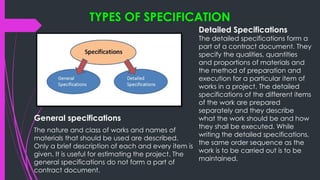
TYPES OF SPECIFICATION
General specifications
The nature and class of works and names of
materials that should be used are described.
Only a brief description of each and every item is
given. It is useful for estimating the project. The
general specifications do not form a part of
contract document.
Detailed Specifications
The detailed specifications form a
part of a contract document. They
specify the qualities, quantities
and proportions of materials and
the method of preparation and
execution for a particular item of
works in a project. The detailed
specifications of the different items
of the work are prepared
separately and they describe
what the work should be and how
they shall be executed. While
writing the detailed specifications,
the same order sequence as the
work is to be carried out is to be
maintained.
16 Division Uniform of Construction
16 Divisions refers to the 16 divisions of construction, as defined by
the Construction Specifications Institute (CSI)'s Master Format 1995 Edition.
🠶 Division 01 — General
Requirement
🠶 Division 02 — Site
Construction
🠶 Division 03 — Concrete
🠶 Division 04 — Masonry
🠶 Division 05 — Metals
🠶 Division 06 — Wood and
Plastics
🠶 Division 07 — Thermal and
Moisture Protection
🠶 Division 08 — Doors and
Windows
► Division 09 — Finishes
► Division 10 — Specialties
► Division 11 — Equipment
► Division 12 — Furnishings
► Division 13 — Special
Construction
► Division 14 — Conveying
Systems
► Division 15 —
Mechanical/Plumbing
► Division 16 — Electrical
THREE PARTS OF SECTION FORMAT
Part 1: General
Describes
administrative,
procedural and
temporary
requirements unique
to the section.
🠶 Summary
🠶 References
🠶 Submittals
🠶 Quality
Assurance
🠶 Delivery,
Storage and
Handling
🠶 Product/Site
Condition
🠶 Warranty
Part 2: Products
Describes materials,
products, equipment,
fabrications, mixes
systems and
assemblies that are
required for
incorporation into the
project. Materials and
products are included
with the quality level
required.
► Manufacturers
*Biding/Applications
* System
* Product Type etc.
► Manufactured masonry
surface units
► Materials
► Accessories
Part 3: Execution
Describes installation
or application,
including preparatory
actions and post
installation cleaning
and protection. Site-
built assemblies and
site-manufactured
products and systems
are
► INSTALLERS
► EXAMINATION*
► PREPARATION*
► INSTALLATION*
► TOLERANCES
► REPAIR
► RESTORATION
► RE-INSTALLATION
► FIELD QUALITY
CONTROL
► SYSTEM STARTUP
► ADJUSTING
► CLEANING
► COMMISSIONING*
► CLOSEOUT
ACTIVITIES
► PROTECTION
► MAINTENANCE
► SCHEDULES
► ATTACHMENTS
► END OF SECTION
Specification General
Requirements
General Requirements
General
defines Administrative and Procedural Requirements
Division 01 concept adheres to the CSI principle of
“stating information only once and in the right place”.
Division 01 – General
Requirements
General Requirements
🠶Area for performance requirements that overlap work
sections (building envelope, structure, etc.)
🠶This allows a mixture of broad performance
specifications and prescriptive specifications in a
project manual
Div. 01 General Requirements
🠶 01100 Summary
🠶 01200 Price and Payment Procedures
🠶 01300 Administrative Requirements
🠶 01400 Quality Requirements
🠶 01500 Temporary Facilities and Controls
🠶 01600 Product Requirements
🠶 01700 Execution Requirements
🠶 01900 Life Cycle Activities
01100 Summary
🠶 This Section describes the type of contractual
form of agreement, basic project conditions;
work not shown on drawings or specified.
🠶 Section includes:
🠶Contract description.
🠶Contractor's use of site.
🠶Coordination.
🠶Work sequence.
🠶Owner occupancy.
🠶Specification conventions.
01200 Price and Payment Procedures
🠶 This section includes procedural requirements
for preparation and submittal of Contractor's
Applications for Payment, for assessing,
developing and executing change orders,
and for processing final payment.
🠶 Section includes:
🠶Allowances.
🠶Unit Prices.
🠶Alternates.
🠶Substitution Procedures.
01300 Administrative Requirements
🠶 This section describes submittals, including
electronic submittal service, meetings,
schedules, reports, coordination, photographs,
closeout, etc.
🠶 Section includes:
🠶 Coordination and project conditions.
🠶 Field engineering.
🠶Regulatory Requirements.
🠶 Management and Administration Procedures.
🠶 Progress meetings.
🠶 Pre-installation meetings.
01400 Quality Requirements
🠶 This section describes testing, inspection,
mock-ups, reports, certificates; use of
reference standards.
🠶 Section includes:
🠶Quality control and control of installation.
🠶Tolerances.
🠶References.
🠶Mock-up requirements.
01400 Quality Requirements
🠶 This section describes testing, inspection,
mock-ups, reports, certificates; use of
reference standards.
🠶 Section includes:
🠶Testing and inspection services.
🠶Manufacturers' field services.
🠶Examination.
🠶Preparation.
01500 Temporary Facilities and Controls
🠶 Section includes provision, maintenance during
Contract implementation and removal at the
end of the entire project of the following:
🠶Temporary Utilities: Electricity, lighting for construction
purposes, site lighting, heating, cooling, ventilation,
telephone service, facsimile service, water service,
and sanitary facilities.
01500 Temporary Facilities and Controls
🠶 Section includes provision, maintenance during
Contract implementation and removal at the
end of the entire project of the following:
🠶Temporary Controls: Barriers, enclosures, fences and
gates, security, traffic safety and regulation, water
control, dust control, erosion and sediment control,
noise control, pest control, pollution control, rodent
control, and first aid facilities.
01500 Temporary Facilities and Controls
🠶 Section includes provision, maintenance during
Contract implementation and removal at the
end of the entire project of the following:
🠶Construction Facilities: Parking, progress cleaning and
waste removal, project identification, field offices and
sheds, vehicular access, plant andsmall tools, and
scaffolding and hoisting.
01600 Product Requirements
🠶 This Section describes product options; delivery,
storage, and protection.
🠶 Section specifies the General Requirements for:
🠶Products.
🠶Product delivery requirements.
🠶Product storage and handling requirements.
🠶Product options.
01600 Product Requirements
🠶 This Section describes product options; delivery,
storage, and protection.
🠶 Section specifies the General Requirements for:
🠶Product substitution procedures.
🠶Protection.
🠶Equipment electrical characteristics and
components.
01600 Product Requirements
🠶 The requirements of this section are augmented by
specific clauses specifying quality throughout all sections
of the Specification.
01700 Execution and Close-Out
Requirements
🠶 This section includes general execution
requirements that apply to most types of work
on the project.
🠶 Section includes:
🠶Closeout procedures.
🠶Cleaning.
🠶Starting of systems.
🠶Demonstration and instructions.
01700 Execution and Close-Out
Requirements
🠶 This section includes general execution
requirements that apply to most types of work
on the project.
🠶 Section includes:
🠶Testing, adjusting and balancing.
🠶Protecting installed construction.
🠶Project record documents.
01700 Execution and Close-Out
Requirements
🠶 Section includes:
🠶Operation and maintenance data.
🠶Manual for materials and finishes.
🠶Manual for equipment and systems.
🠶Instruction of Employer personnel.
🠶Spare parts and maintenance products.
🠶Product warranties and product bonds.
🠶Maintenance service.
🠶Protection and making good.
01900 Life Cycle Activities
🠶 This Section includes an optional checklist and
many options to accurately reflect the
responsibilities and many provisions that apply to
commissioning any type of product or system.
🠶 Section includes:
🠶General Commissioning Requirements.
🠶 Commissioning Authority Responsibilities.


SPECIFICATION.pptx yhuerirrtrututurterhs

  • 1.
  • 2.
    SPECIFICATIONS Describe the NATUREand the QUALITY of the work, MATERIALS to be used in the work, STRENGTH, WORKMANSHIP and EXECUTION of the work. The COST of a work depends much on the specifications. For Example: Length and width of doors, windows are visible on drawing. But, it is not possible to show the type of wood which is used for doors and windows. There is a wide variation in prices between different types of wood. Beside this, different types of wood differ in appearance as well as in properties. That is why, it is necessary to show the type of wood. In the same manner, concrete ingredients, their ratio and specialties can only be shown through specifications. But separate explanation is required for its ingredients, type and properties of coarse aggregates, sand, cement, amount of water. The cost of a work depends much on covered area and on the specifications. Therefore, specifications should be clear.
  • 3.
    PURPOSE OF SPECIFICATION 🠶The cost of an unit quantity of work is governed by its specifications. 🠶 Specification of a work is required to describe the quality and quantity of different materials required for a construction work and is one of the essential contract documents. 🠶 This also specifies the workmanship and the method of doing the work. Thus specification of a work serves as a guide to a supervising staff of a contractor as well as to the owner to execute the work to their satisfaction. 🠶 A work is carried out according to its specification and the contractor is paid for the same. Any change in specification changes the tendered rate. 🠶 As the rate of work is based on the specification, a contractor can calculate the rates of various items of works in tender with his procurement rates of materials and labor. Thus tender rate without specification of works is baseless, incomplete and invalid. 🠶 Specification is necessary to specify the equipment tools and plants to be engaged for a work and thus enables to procure them beforehand. 🠶 The necessity of specification is to verify and check the strength of materials for a work involved in a project.
  • 4.
    IMPORTANCE OF SPECIFICATION 1.It provides clear instructions on the intent, performance and construction of the project. 2. It can reference the quality and standards which should be applied. 3. Materials and manufacturers’ products can be clearly defined. 4. The requirements for installation, testing and handover can be identified. 5. Classification in the specification can be used to support handover and running of the asset. 6. The drawing or model does not need to be overloaded with detailed information, which can sometimes be difficult to identify. 7. It can be used to support the costing of a project: not only the materials and products but also the performance and workmanship 8. The specification forms part of the contractual documents, along with the drawings, and therefore can help minimize project risk and provide support should there be any legal disputes.
  • 5.
    9. It supportsthe interpretation of the client brief and gives the client assurance that the asset which they commissioned is being delivered. 10.It is not only essential for the construction phase but also used as part of the soft landing process, subsequent asset management and the lifecycle plan. 11. By being clear and concise and containing all the information, it saves the project team, the client and the contractor time and money by providing answers to many of the on-site construction questions. 12. There is the option for the design team to build a suite of office masters, which would improve efficiency, provide quality assurance and project consistency. 13. Office masters can save the team time and money by being developed over a period of time and then being adapted to suit the project specifics, therefore drawing on specialist knowledge when needed. 14. The specification should be used by all the project team throughout the construction phase; it should be a living document and not stop being used at the design phase. 15. The specification and any variations or value engineering can also be used for the project audit trail and should form part of the handover documents. It will then form the basis for the running of the asset by the asset management team
  • 6.
    QUALIFICATION OF ASPECIFICATION WRITER A good specification writer is someone who: 1. can interpret and understand graphic representation, schedules, and tables on drawings 2. has a good command of the language to describe the information in written words; 3. offers good knowledge of construction materials, systems, and methods 4. has field experience and knowledge of how work is done onsite 5. can do proper due diligence in research 6. is organized and can manage time 7. has a fair knowledge of construction laws, applicable codes, standards, ordinances, bonds, and insurances in the construction industry 8. boasts general knowledge of construction practices along with sustainability and standard requirements
  • 7.
    TYPES OF SPECIFICATION Generalspecifications The nature and class of works and names of materials that should be used are described. Only a brief description of each and every item is given. It is useful for estimating the project. The general specifications do not form a part of contract document. Detailed Specifications The detailed specifications form a part of a contract document. They specify the qualities, quantities and proportions of materials and the method of preparation and execution for a particular item of works in a project. The detailed specifications of the different items of the work are prepared separately and they describe what the work should be and how they shall be executed. While writing the detailed specifications, the same order sequence as the work is to be carried out is to be maintained.
  • 8.
    16 Division Uniformof Construction 16 Divisions refers to the 16 divisions of construction, as defined by the Construction Specifications Institute (CSI)'s Master Format 1995 Edition. 🠶 Division 01 — General Requirement 🠶 Division 02 — Site Construction 🠶 Division 03 — Concrete 🠶 Division 04 — Masonry 🠶 Division 05 — Metals 🠶 Division 06 — Wood and Plastics 🠶 Division 07 — Thermal and Moisture Protection 🠶 Division 08 — Doors and Windows ► Division 09 — Finishes ► Division 10 — Specialties ► Division 11 — Equipment ► Division 12 — Furnishings ► Division 13 — Special Construction ► Division 14 — Conveying Systems ► Division 15 — Mechanical/Plumbing ► Division 16 — Electrical
  • 9.
    THREE PARTS OFSECTION FORMAT Part 1: General Describes administrative, procedural and temporary requirements unique to the section. 🠶 Summary 🠶 References 🠶 Submittals 🠶 Quality Assurance 🠶 Delivery, Storage and Handling 🠶 Product/Site Condition 🠶 Warranty Part 2: Products Describes materials, products, equipment, fabrications, mixes systems and assemblies that are required for incorporation into the project. Materials and products are included with the quality level required. ► Manufacturers *Biding/Applications * System * Product Type etc. ► Manufactured masonry surface units ► Materials ► Accessories Part 3: Execution Describes installation or application, including preparatory actions and post installation cleaning and protection. Site- built assemblies and site-manufactured products and systems are ► INSTALLERS ► EXAMINATION* ► PREPARATION* ► INSTALLATION* ► TOLERANCES ► REPAIR ► RESTORATION ► RE-INSTALLATION ► FIELD QUALITY CONTROL ► SYSTEM STARTUP ► ADJUSTING ► CLEANING ► COMMISSIONING* ► CLOSEOUT ACTIVITIES ► PROTECTION ► MAINTENANCE ► SCHEDULES ► ATTACHMENTS ► END OF SECTION
  • 10.
  • 11.
    General Requirements General defines Administrativeand Procedural Requirements Division 01 concept adheres to the CSI principle of “stating information only once and in the right place”.
  • 12.
    Division 01 –General Requirements
  • 13.
    General Requirements 🠶Area forperformance requirements that overlap work sections (building envelope, structure, etc.) 🠶This allows a mixture of broad performance specifications and prescriptive specifications in a project manual
  • 14.
    Div. 01 GeneralRequirements 🠶 01100 Summary 🠶 01200 Price and Payment Procedures 🠶 01300 Administrative Requirements 🠶 01400 Quality Requirements 🠶 01500 Temporary Facilities and Controls 🠶 01600 Product Requirements 🠶 01700 Execution Requirements 🠶 01900 Life Cycle Activities
  • 15.
    01100 Summary 🠶 ThisSection describes the type of contractual form of agreement, basic project conditions; work not shown on drawings or specified. 🠶 Section includes: 🠶Contract description. 🠶Contractor's use of site. 🠶Coordination. 🠶Work sequence. 🠶Owner occupancy. 🠶Specification conventions.
  • 16.
    01200 Price andPayment Procedures 🠶 This section includes procedural requirements for preparation and submittal of Contractor's Applications for Payment, for assessing, developing and executing change orders, and for processing final payment. 🠶 Section includes: 🠶Allowances. 🠶Unit Prices. 🠶Alternates. 🠶Substitution Procedures.
  • 17.
    01300 Administrative Requirements 🠶This section describes submittals, including electronic submittal service, meetings, schedules, reports, coordination, photographs, closeout, etc. 🠶 Section includes: 🠶 Coordination and project conditions. 🠶 Field engineering. 🠶Regulatory Requirements. 🠶 Management and Administration Procedures. 🠶 Progress meetings. 🠶 Pre-installation meetings.
  • 18.
    01400 Quality Requirements 🠶This section describes testing, inspection, mock-ups, reports, certificates; use of reference standards. 🠶 Section includes: 🠶Quality control and control of installation. 🠶Tolerances. 🠶References. 🠶Mock-up requirements.
  • 19.
    01400 Quality Requirements 🠶This section describes testing, inspection, mock-ups, reports, certificates; use of reference standards. 🠶 Section includes: 🠶Testing and inspection services. 🠶Manufacturers' field services. 🠶Examination. 🠶Preparation.
  • 20.
    01500 Temporary Facilitiesand Controls 🠶 Section includes provision, maintenance during Contract implementation and removal at the end of the entire project of the following: 🠶Temporary Utilities: Electricity, lighting for construction purposes, site lighting, heating, cooling, ventilation, telephone service, facsimile service, water service, and sanitary facilities.
  • 21.
    01500 Temporary Facilitiesand Controls 🠶 Section includes provision, maintenance during Contract implementation and removal at the end of the entire project of the following: 🠶Temporary Controls: Barriers, enclosures, fences and gates, security, traffic safety and regulation, water control, dust control, erosion and sediment control, noise control, pest control, pollution control, rodent control, and first aid facilities.
  • 22.
    01500 Temporary Facilitiesand Controls 🠶 Section includes provision, maintenance during Contract implementation and removal at the end of the entire project of the following: 🠶Construction Facilities: Parking, progress cleaning and waste removal, project identification, field offices and sheds, vehicular access, plant andsmall tools, and scaffolding and hoisting.
  • 23.
    01600 Product Requirements 🠶This Section describes product options; delivery, storage, and protection. 🠶 Section specifies the General Requirements for: 🠶Products. 🠶Product delivery requirements. 🠶Product storage and handling requirements. 🠶Product options.
  • 24.
    01600 Product Requirements 🠶This Section describes product options; delivery, storage, and protection. 🠶 Section specifies the General Requirements for: 🠶Product substitution procedures. 🠶Protection. 🠶Equipment electrical characteristics and components.
  • 25.
    01600 Product Requirements 🠶The requirements of this section are augmented by specific clauses specifying quality throughout all sections of the Specification.
  • 26.
    01700 Execution andClose-Out Requirements 🠶 This section includes general execution requirements that apply to most types of work on the project. 🠶 Section includes: 🠶Closeout procedures. 🠶Cleaning. 🠶Starting of systems. 🠶Demonstration and instructions.
  • 27.
    01700 Execution andClose-Out Requirements 🠶 This section includes general execution requirements that apply to most types of work on the project. 🠶 Section includes: 🠶Testing, adjusting and balancing. 🠶Protecting installed construction. 🠶Project record documents.
  • 28.
    01700 Execution andClose-Out Requirements 🠶 Section includes: 🠶Operation and maintenance data. 🠶Manual for materials and finishes. 🠶Manual for equipment and systems. 🠶Instruction of Employer personnel. 🠶Spare parts and maintenance products. 🠶Product warranties and product bonds. 🠶Maintenance service. 🠶Protection and making good.
  • 29.
    01900 Life CycleActivities 🠶 This Section includes an optional checklist and many options to accurately reflect the responsibilities and many provisions that apply to commissioning any type of product or system. 🠶 Section includes: 🠶General Commissioning Requirements. 🠶 Commissioning Authority Responsibilities.