CHAPETR III
SPECIFICATION
1
OUTLINE
 Introduction
 Purpose of Specification
 Type of Specification
 Specification Writing
2
Introduction
 The information that is needed for construction is usually
conveyed by two basic communication lines:
 Drawings (pictorial) and
 Specifications (written).
 Specifications are devices for organizing the information
depicted on the drawings and they are written descriptions of
the legal and technical requirements forming the contract
documents.
3
Introduction
Difference b/n Drawing & Written spec
 Drawings should generally show the following:
 Dimensions, extents, size, shape, and
location of component parts
 Location of materials, machineries,
and fixtures
 Interaction of furniture, equipments
and space
 Schedules of finishes, windows and
doors
4
Introduction
Written Specification
 Specification is defined as the designation or statement by
which written instructions are given distinguishing and/or
limiting and describing the particular trade of work to be
executed.
 Specifications are written based on:
 The prepared design, drawings, general;
 Scientific trends of workmanship, quality expected, equipment
involved and
 Materials to be used for the particular trade of work.
5
Introduction
 The specifications should clearly specify:
 Type and quality of materials, equipments, labour or
workmanship
 Methods of fabrication, installation and erection
 Standards, codes and tests
 Allowance, submittals and substitutions
 Cost included, insurance and bonds
 Project records and site facilities.
6
Purposes of specifications
The purpose of specifications generally includes:
i. Guide the bidder at the time of tendering to arrive at a
reasonable cost for the work
ii. Provide guidance for execution and supervision of works.
iii. Guide the contractor for the purchase of materials
iv. Serve as a part of contract document to limit and describe
the rights and obligations of each contracting parties.
v. Guide the bidder to identify his capacity to execute the
work.
vi. Serve as fabrication and installation guide for temporary and
permanent works.
7
Purposes of specifications
vii. Guide the contractor for the purchase and/or renting of
equipments.
viii. Serve for the owner to know what he/she is entitled to receive
ix. Serve for the manufacturers of construction materials,
equipments, tools etc to grade, classify, and improve qualities
of their produces.
x. Indirectly, the specifications are very much related to the
legal considerations, insurance considerations, bidding
requirements, alternates and options, rights, obligations and
remedial measures for the contracting parties.
8
Types of Specifications
Classification
 Specifications can be broadly classified into four
categories:
 Manufacturer’s specification: Manufacturers prepare
specification of their product for the guidance of their users.
 Guide Specification: Specifications prepared by an individual
or group of individuals based on manufacturer’s
specifications, established trends of workmanship, service
and laboratory tests and research findings to be used as
guide lines for preparation of contract specifications.
9
Types of Specifications
Classification
 Standard Specification: Specifications which are
intended to be used as a reference standard in the
construction of a project.
 Contract (Project) Specification: the specification
prepared for a particular project to accompany
the drawings and other contract documents.
10
Types of Specifications
 In Ethiopia “Technical Specification and Methods of
Measurement for Construction of Buildings” of March
1991 applicable for many years.
 In the general requirement part the following items,
which may be applied to any project and any trade of
work are described in general terms:
 011 - General 012 - Site Description 013 - Quality Assurance
 014 -Project Records 015 - Site Facilities 016 - Cleaning up
11
Types of Specifications
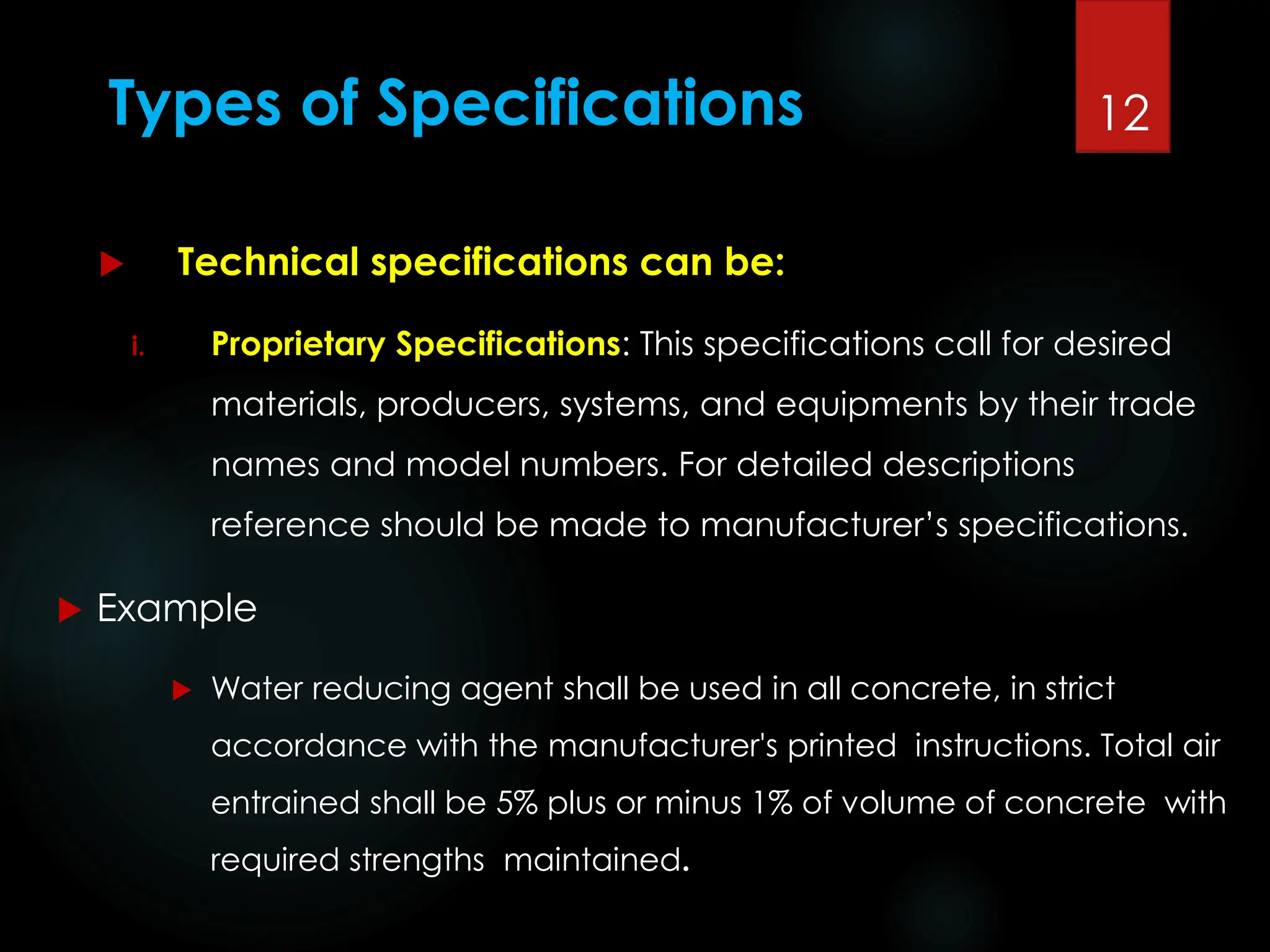
 Technical specifications can be:
i. Proprietary Specifications: This specifications call for desired
materials, producers, systems, and equipments by their trade
names and model numbers. For detailed descriptions
reference should be made to manufacturer’s specifications.
 Example
 Water reducing agent shall be used in all concrete, in strict
accordance with the manufacturer's printed instructions. Total air
entrained shall be 5% plus or minus 1% of volume of concrete with
required strengths maintained.
12
Types of Specifications
ii. Performance Specifications: specifications which
define products based on desired end results which
are performance oriented;
 most appropriate when new or unusual products or
systems are required or when innovation is necessary.
 Testing methods and evaluation procedures for defining
the required performances must be explicitly specified.
13
Types of Specifications
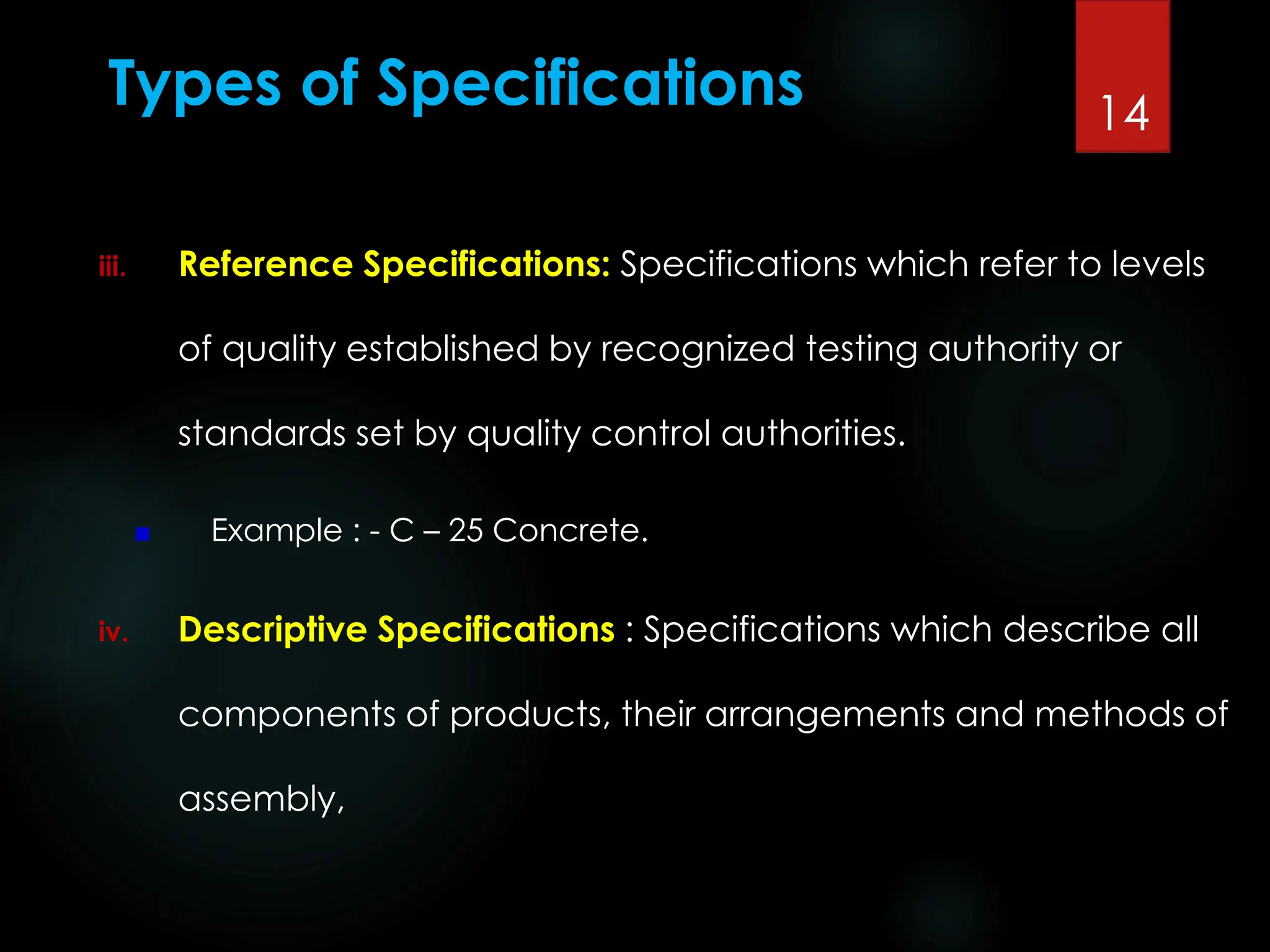
iii. Reference Specifications: Specifications which refer to levels
of quality established by recognized testing authority or
standards set by quality control authorities.
Example : - C – 25 Concrete.
iv. Descriptive Specifications : Specifications which describe all
components of products, their arrangements and methods of
assembly,
14
Types of Specifications
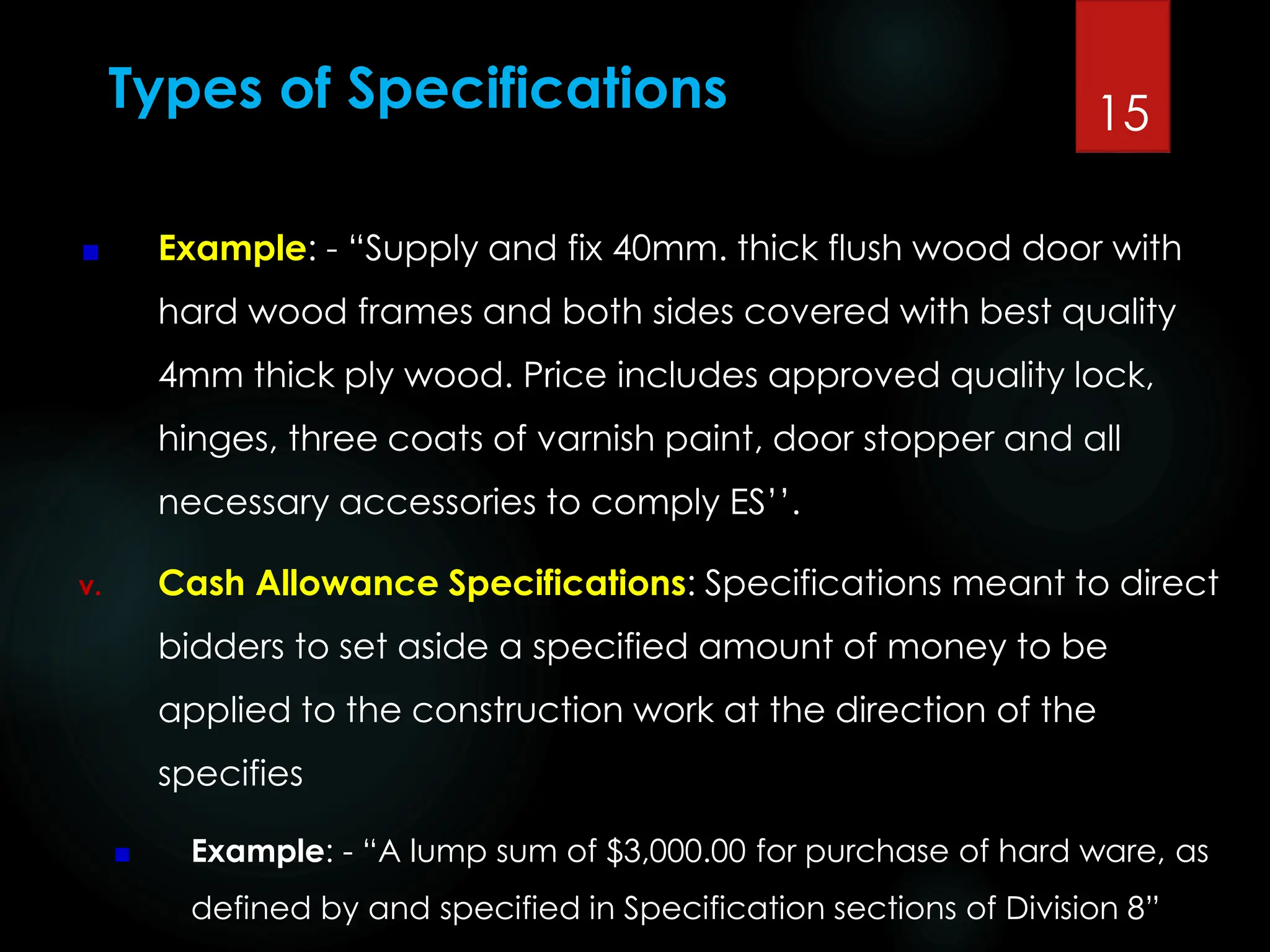
Example: - “Supply and fix 40mm. thick flush wood door with
hard wood frames and both sides covered with best quality
4mm thick ply wood. Price includes approved quality lock,
hinges, three coats of varnish paint, door stopper and all
necessary accessories to comply ES’’.
v. Cash Allowance Specifications: Specifications meant to direct
bidders to set aside a specified amount of money to be
applied to the construction work at the direction of the
specifies
Example: - “A lump sum of $3,000.00 for purchase of hard ware, as
defined by and specified in Specification sections of Division 8”
15
Types of Specifications
 When specifications are to be written, the following shall
be taken into consideration:-
1. Specification writing require
a. Visualization (having clear picture of the system)
b. Research (to know the legal impact correctly)
c. Clear thinking (understanding things directly without
misleading)
d. Organizing (organizing what we know to write the
specification)
2. Require professional ability to read drawings
16
Types of Specifications
4. Require wide knowledge of the construction materials,
various levels of workmanship, different construction
equipment's and method of construction to be
employed
5. Specifications use simple and clear language such that
it can readily be understood.
6. Specifications shall be brief and short as much as
possible
7. Specifications shall include all items affecting the cost of
the work
17
Types of Specifications
4. Specifications shall be fair and do not attempt to
throw all risks and responsibilities on one of the parties
signing the contract, the employer or the contractor.
5. Specifications shall avoid repetition of information
shown on drawings to avoid mistakes and
duplications within the specifications and drawings
6. Specifications shall not include inapplicable text and
do not specify the impossible or anything not
intended to be enforced.
18
What are the useful references in Specification
writing
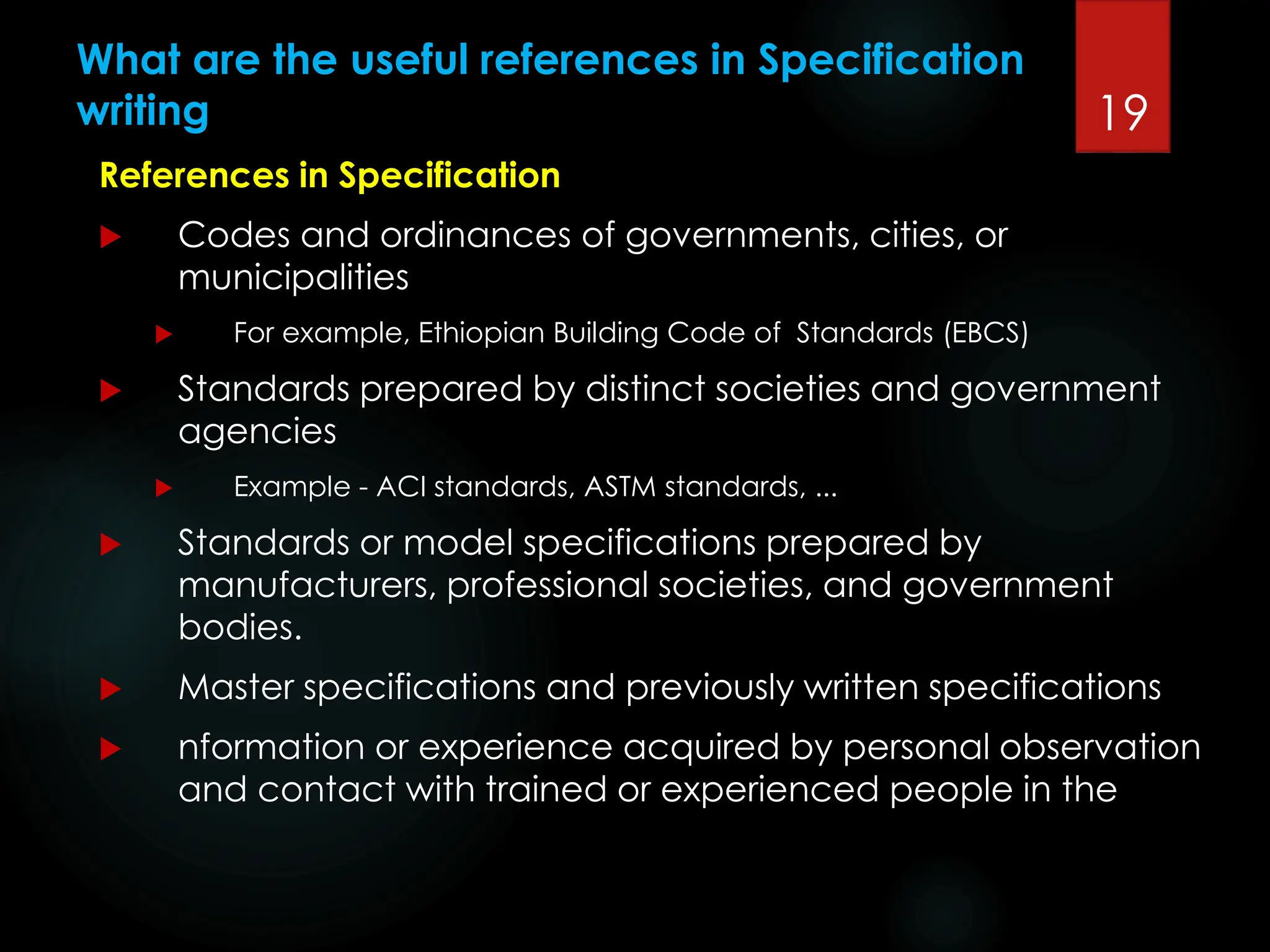
References in Specification
 Codes and ordinances of governments, cities, or
municipalities
 For example, Ethiopian Building Code of Standards (EBCS)
 Standards prepared by distinct societies and government
agencies
 Example - ACI standards, ASTM standards, ...
 Standards or model specifications prepared by
manufacturers, professional societies, and government
bodies.
 Master specifications and previously written specifications
 nformation or experience acquired by personal observation
and contact with trained or experienced people in the
19
Specification language
 The specification writer should present his instructions
regarding the particular work under consideration in such a
manner that: -
1. The drawings are more clearly interpreted, not
duplicated.
2. Rights, obligations, and remedial measures shall be
designated without ambiguity or prejudice.
20
Specification language
3. Clearly express the extent of works under
consideration; therefore, the phraseology used in this
regard shall be: -
i. Judged by its quality not its length
ii. Should be concise and short and written with
commonly used words
iii. Punctuations are important but their usage shall be
limited to few
21
Specification language
 Capitalizing the first letters is mandatory for the following
expressions: -
 Parties to the contract; e.g. Employer/Client /Contractor/ Engineer
 Space within the building; e.g. Bed Room, Toilet, Living Room
 Contract documents; e.g. Bill of Quantity, Working Drawing,
Specification
 Minimize pronouns, better to repeat nouns
 Minimize the use of symbols
 Do not use foot notes, do not underline within a sentence for
emphasis
22
Specification language
 Words shall be used as follows:-
 shall in place of must;
 “will” is used for the duties of the employer to represent the word
“must”
 “must” –avoid the use of the word “must” and substitute by the word
shall to prevent the inference of different degrees of obligation
 Avoid the use of words which have indefinite meanings or limitless and
ambiguous in their meanings. For example, any, either, same, similar,
etc.
23
… 24

3 specification_2008 fitsium.pdf

  • 1.
  • 2.
    OUTLINE  Introduction  Purposeof Specification  Type of Specification  Specification Writing 2
  • 3.
    Introduction  The informationthat is needed for construction is usually conveyed by two basic communication lines:  Drawings (pictorial) and  Specifications (written).  Specifications are devices for organizing the information depicted on the drawings and they are written descriptions of the legal and technical requirements forming the contract documents. 3
  • 4.
    Introduction Difference b/n Drawing& Written spec  Drawings should generally show the following:  Dimensions, extents, size, shape, and location of component parts  Location of materials, machineries, and fixtures  Interaction of furniture, equipments and space  Schedules of finishes, windows and doors 4
  • 5.
    Introduction Written Specification  Specificationis defined as the designation or statement by which written instructions are given distinguishing and/or limiting and describing the particular trade of work to be executed.  Specifications are written based on:  The prepared design, drawings, general;  Scientific trends of workmanship, quality expected, equipment involved and  Materials to be used for the particular trade of work. 5
  • 6.
    Introduction  The specificationsshould clearly specify:  Type and quality of materials, equipments, labour or workmanship  Methods of fabrication, installation and erection  Standards, codes and tests  Allowance, submittals and substitutions  Cost included, insurance and bonds  Project records and site facilities. 6
  • 7.
    Purposes of specifications Thepurpose of specifications generally includes: i. Guide the bidder at the time of tendering to arrive at a reasonable cost for the work ii. Provide guidance for execution and supervision of works. iii. Guide the contractor for the purchase of materials iv. Serve as a part of contract document to limit and describe the rights and obligations of each contracting parties. v. Guide the bidder to identify his capacity to execute the work. vi. Serve as fabrication and installation guide for temporary and permanent works. 7
  • 8.
    Purposes of specifications vii.Guide the contractor for the purchase and/or renting of equipments. viii. Serve for the owner to know what he/she is entitled to receive ix. Serve for the manufacturers of construction materials, equipments, tools etc to grade, classify, and improve qualities of their produces. x. Indirectly, the specifications are very much related to the legal considerations, insurance considerations, bidding requirements, alternates and options, rights, obligations and remedial measures for the contracting parties. 8
  • 9.
    Types of Specifications Classification Specifications can be broadly classified into four categories:  Manufacturer’s specification: Manufacturers prepare specification of their product for the guidance of their users.  Guide Specification: Specifications prepared by an individual or group of individuals based on manufacturer’s specifications, established trends of workmanship, service and laboratory tests and research findings to be used as guide lines for preparation of contract specifications. 9
  • 10.
    Types of Specifications Classification Standard Specification: Specifications which are intended to be used as a reference standard in the construction of a project.  Contract (Project) Specification: the specification prepared for a particular project to accompany the drawings and other contract documents. 10
  • 11.
    Types of Specifications In Ethiopia “Technical Specification and Methods of Measurement for Construction of Buildings” of March 1991 applicable for many years.  In the general requirement part the following items, which may be applied to any project and any trade of work are described in general terms:  011 - General 012 - Site Description 013 - Quality Assurance  014 -Project Records 015 - Site Facilities 016 - Cleaning up 11
  • 12.
    Types of Specifications Technical specifications can be: i. Proprietary Specifications: This specifications call for desired materials, producers, systems, and equipments by their trade names and model numbers. For detailed descriptions reference should be made to manufacturer’s specifications.  Example  Water reducing agent shall be used in all concrete, in strict accordance with the manufacturer's printed instructions. Total air entrained shall be 5% plus or minus 1% of volume of concrete with required strengths maintained. 12
  • 13.
    Types of Specifications ii.Performance Specifications: specifications which define products based on desired end results which are performance oriented;  most appropriate when new or unusual products or systems are required or when innovation is necessary.  Testing methods and evaluation procedures for defining the required performances must be explicitly specified. 13
  • 14.
    Types of Specifications iii.Reference Specifications: Specifications which refer to levels of quality established by recognized testing authority or standards set by quality control authorities. Example : - C – 25 Concrete. iv. Descriptive Specifications : Specifications which describe all components of products, their arrangements and methods of assembly, 14
  • 15.
    Types of Specifications Example:- “Supply and fix 40mm. thick flush wood door with hard wood frames and both sides covered with best quality 4mm thick ply wood. Price includes approved quality lock, hinges, three coats of varnish paint, door stopper and all necessary accessories to comply ES’’. v. Cash Allowance Specifications: Specifications meant to direct bidders to set aside a specified amount of money to be applied to the construction work at the direction of the specifies Example: - “A lump sum of $3,000.00 for purchase of hard ware, as defined by and specified in Specification sections of Division 8” 15
  • 16.
    Types of Specifications When specifications are to be written, the following shall be taken into consideration:- 1. Specification writing require a. Visualization (having clear picture of the system) b. Research (to know the legal impact correctly) c. Clear thinking (understanding things directly without misleading) d. Organizing (organizing what we know to write the specification) 2. Require professional ability to read drawings 16
  • 17.
    Types of Specifications 4.Require wide knowledge of the construction materials, various levels of workmanship, different construction equipment's and method of construction to be employed 5. Specifications use simple and clear language such that it can readily be understood. 6. Specifications shall be brief and short as much as possible 7. Specifications shall include all items affecting the cost of the work 17
  • 18.
    Types of Specifications 4.Specifications shall be fair and do not attempt to throw all risks and responsibilities on one of the parties signing the contract, the employer or the contractor. 5. Specifications shall avoid repetition of information shown on drawings to avoid mistakes and duplications within the specifications and drawings 6. Specifications shall not include inapplicable text and do not specify the impossible or anything not intended to be enforced. 18
  • 19.
    What are theuseful references in Specification writing References in Specification  Codes and ordinances of governments, cities, or municipalities  For example, Ethiopian Building Code of Standards (EBCS)  Standards prepared by distinct societies and government agencies  Example - ACI standards, ASTM standards, ...  Standards or model specifications prepared by manufacturers, professional societies, and government bodies.  Master specifications and previously written specifications  nformation or experience acquired by personal observation and contact with trained or experienced people in the 19
  • 20.
    Specification language  Thespecification writer should present his instructions regarding the particular work under consideration in such a manner that: - 1. The drawings are more clearly interpreted, not duplicated. 2. Rights, obligations, and remedial measures shall be designated without ambiguity or prejudice. 20
  • 21.
    Specification language 3. Clearlyexpress the extent of works under consideration; therefore, the phraseology used in this regard shall be: - i. Judged by its quality not its length ii. Should be concise and short and written with commonly used words iii. Punctuations are important but their usage shall be limited to few 21
  • 22.
    Specification language  Capitalizingthe first letters is mandatory for the following expressions: -  Parties to the contract; e.g. Employer/Client /Contractor/ Engineer  Space within the building; e.g. Bed Room, Toilet, Living Room  Contract documents; e.g. Bill of Quantity, Working Drawing, Specification  Minimize pronouns, better to repeat nouns  Minimize the use of symbols  Do not use foot notes, do not underline within a sentence for emphasis 22
  • 23.
    Specification language  Wordsshall be used as follows:-  shall in place of must;  “will” is used for the duties of the employer to represent the word “must”  “must” –avoid the use of the word “must” and substitute by the word shall to prevent the inference of different degrees of obligation  Avoid the use of words which have indefinite meanings or limitless and ambiguous in their meanings. For example, any, either, same, similar, etc. 23
  • 24.