+
From WBS to Integrated
Master Schedule
A step by step guide to increasing the Probability of Program success
start with the WBS, developing the Integrated Master Plan and
Integrated Master Schedule, risk adjusting the IMS, and measuring
progress to plan in units of measure meaningful to the decision
makers.
Performance–Based Project Management®, Copyright © Glen B. Alleman, 2002 - 2016 1
Performance–Based Project Management®, Copyright © Glen B. Alleman, 2002 - 2016
Research shows that some 70-80% of a project manager’s time is spent in
communicating inside and outside the project.
We need processes and tools that radiate project information as basis for the
communication that increases project success 2
+ Increasing the Probability of Program
Success through information radiators
 WBS is Paramount – it shows what is being delivered and what work
processes are used for this delivery (MIL-STD-881-C)
 Integrated Master Plan – shows how the deliverables increase in their
maturity toward the final product.
 Integrated Master Schedule – shows the sequence of work to
increases the maturity of the deliverables.
 Programmatic and Technical Risk Management – shows what
reducible and irreducible risks are present on the project and what
their mitigation activities are.
 Performance Measurement and Reporting – shows Physical Percent
Complete to date, Estimate to Complete, and Estimate At Complete
compared to plan.
Performance–Based Project Management®, Copyright © Glen B. Alleman, 2002 - 2016
3
5 Immutable
Principles of
Project
Success
5 Practices of Performance Based Project Management ®
Identify
Needed
Capabilities
Define
Requirements
Performance
Measurement
Baseline (PMB)
Execute PMB
Continuous Risk
Management
Where are we
going?
ConOps,
SOO, SOW
Technical And
Operational
Based Plan
Increment
Maturity
Assessment
Physical Percent
Complete
Risk
Identification
How are we going
to get there?
Integrated
Master Plan
Work
Breakdown
Structure Integrated
Master Schedule
Iterative And
Incremental
Delivery
Risk Analysis
What do we need
along the way?
Resource
Management
Plan
Future
Performance
Forecasting
Risk Planning
What Impediments
will we encounter
along the way?
4 Levels Of
Uncertainty
Planning
Technical And
Programmatic
Risks Assigned
To All WBS
Deliverables
Risk Adjustment
To Cost And
Schedule
Measures
Risk Adjusted
Performance
Measurement
Baseline
Risk Tracking
How do we
measure progress
to plan?
Measures Of
Effectiveness
(MOE)
Measures Of
Performance
(MOP)
Technical
Performance
Measures (TPM)
Earned Value
Management
(EVM)
Risk Control
Performance–Based Project Management®, Copyright © Glen B. Alleman, 2002 - 2016 4
+
WBS is Paramount
 The WBS describes the product and
services needed to produce the products
 The Work Breakdown Structure
development starts with NWS Policy
Directive 70-3, from DOC Scalable
Project Management Methodology,
§7.2.4 in accordance with PMI® Practice
Standard for Work Breakdown Structure
 A starting point for developing the WBS
is MIL-STD-881-C.
 Each Federal Agency may have their
own instance of the 881-C guide.
Without a WBS, we don’t know what is
being delivered by the project.
We don’t know what End Item
Deliverables are related to other items
– parents of the final deliverables.
Performance–Based Project Management®, Copyright © Glen B. Alleman, 2002 - 2016
5
+
Integrated Master
Plan (IMP)
 The IMP is a hierarchy of program
events, in which each event is supported
by specific accomplishments, and each
accomplishment is based on satisfying
specific criteria to be considered
complete.
 The IMP consists of three elements
 Program Events
 Significant Accomplishments
 Accomplishment Criteria
The Integrated Master Plan is a
hierarchical description of what Done
looks like in the form of increasing
maturity of the program’s deliverables
and the capabilities they provide
Performance–Based Project Management®, Copyright © Glen B. Alleman, 2002 - 2016
6
+
IMP / IMS Structure
7
Performance–Based Project Management®, Copyright © Glen B. Alleman, 2002 - 2016
IMS
IMP
Describes how program
capabilities will be
delivered and
how these
capabilities will
be recognized
as ready for
delivery
Supplemental Schedules (CAM Notebook)
Work Packages and Tasks
Criteria
Accomplishment
Events
or
Milestones
+
The Integrated Master Plan
 Program planning involves developing and maintaining plans for all
program processes, including those required for effective program
office-contractor interaction.
 Once the contract is signed and schedule, costs, and resources from
the contractor are established, the program plan takes into account, at
an appropriate level of detail, the contractor's estimations for the
program.
 The IMP should provide sufficient definition to track the step-by-step
completion of the required accomplishments for each event, and to
demonstrate satisfaction of the completion criteria for each
accomplishment.
Performance–Based Project Management®, Copyright © Glen B. Alleman, 2002 - 2016
8
+
The IMP …
 Provides flexibility in performing detailed program execution planning,
organization, and scheduling within any existing Request for Proposal
(RFP) constraints.
 Serve as the basis for detailed Execution IMS.
 Provides basis of integrated product development and systems
integration approaches
 Serve as the basis for ensuring mutual understanding of Government
expectations and agreement on the program content, program plan,
schedule, and risk.
 Provide detailed integrated execution plan and supporting schedule,
clearly identifying what has to be done and when it must be done.
Performance–Based Project Management®, Copyright © Glen B. Alleman, 2002 - 2016
9
+ The IMP enables the program office
to…
 Identify and assess actual progress versus the planned progress
 Monitor the program critical path and help develop workarounds to
problem areas
 Assess program maturity
 Assess the status of risk management activities based on the inclusion
of the program risk mitigation activities in the IMP and IMS
 Assess the progress on selected Key Performance Parameters
(KPPs) and Technical Performance Measures (TPMs)
 Provide an objective, quantitative basis for the contractor’s
performance assessment
Performance–Based Project Management®, Copyright © Glen B. Alleman, 2002 - 2016
10
+
IMP for Cloud Deployment
11
Performance–Based Project Management®, Copyright © Glen B. Alleman, 2002 - 2016
+
Integrated Master
Schedule (IMS)
 The IMS is an integrated, networked
schedule containing all the detailed
discrete work packages and planning
packages (or lower level tasks of
activities) necessary to support the
events, accomplishments, and criteria of
the IMP.
Performance–Based Project Management®, Copyright © Glen B. Alleman, 2002 - 2016
12
+ Vertical and Horizontal Traceability
between IMP and IMS
13
Performance–Based Project Management®, Copyright © Glen B. Alleman, 2002 - 2016
Program Events
Define the maturity
of a Capability at a point in time.
Significant Accomplishments
Represent requirements
that enable Capabilities.
Accomplishment Criteria
Exit Criteria for the Work
Packages that fulfill Requirements.
Work
Package
Work
Package
Work
Package
Work
Package
Work
Package
Work
Package
Work
package
Performance–Based Project Management®, Copyright © Glen B. Alleman, 2002 - 2016 14
+
Managing Technical
and Programmatic
Risk
 Risk Management is how adults manage
projects ‒ Tim Lister
 All risk comes from uncertainty
 The integrated master schedule must be
risk adjusted for these uncertainties
 Specific work must be in the IMS for
reducible uncertainties
 Schedule, cost, and technical margin
must be in the IMS for irreducible
uncertainties
All risk comes from uncertainty.
Uncertainty comes in two forms
Reducible uncertainty (Epistemic)
Irreducible uncertainty (Aleatory)
Performance–Based Project Management®, Copyright © Glen B. Alleman, 2002 - 2016
15
+
All Risk Comes from Uncertainty
Uncertainty
Irreducible
(Aleatory)
Reducible
(Epistemic)
Natural Variability
Ambiguity
Ontological
Uncertainty
Probabilistic Events
Probabilistic
Impacts
Periods of Exposure
Performance–Based Project Management®, Copyright © Glen B. Alleman, 2002 ― 2016
16
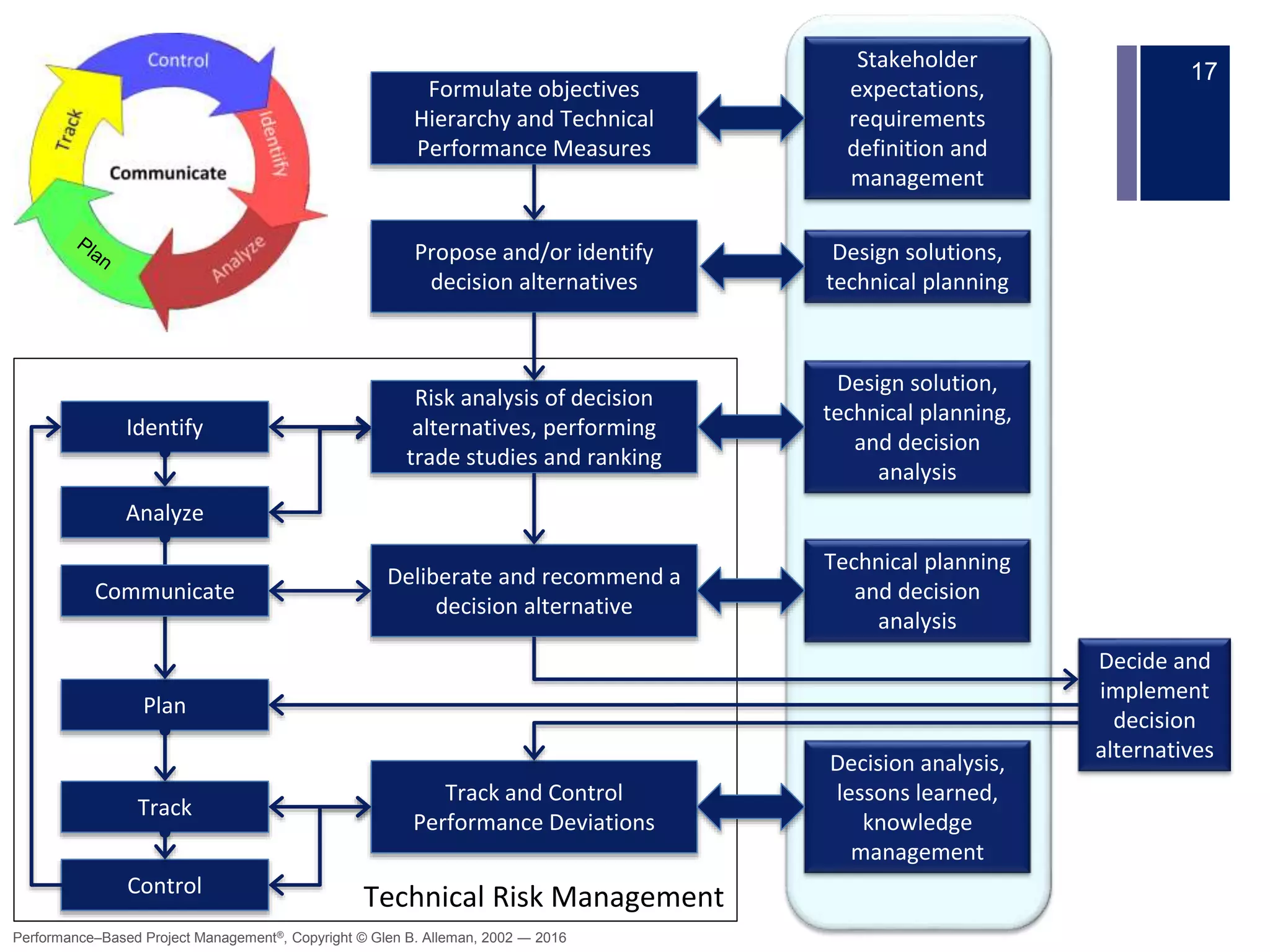
Technical Risk Management
Track and Control
Performance Deviations
Deliberate and recommend a
decision alternative
Risk analysis of decision
alternatives, performing
trade studies and ranking
Propose and/or identify
decision alternatives
Formulate objectives
Hierarchy and Technical
Performance Measures
Stakeholder
expectations,
requirements
definition and
management
Design solutions,
technical planning
Design solution,
technical planning,
and decision
analysis
Technical planning
and decision
analysis
Decision analysis,
lessons learned,
knowledge
management
Identify
Analyze
Plan
Track
Control
Decide and
implement
decision
alternatives
Communicate
Performance–Based Project Management®, Copyright © Glen B. Alleman, 2002 ― 2016
17
+
Performance
Measurement and
Reporting
 Physical Percent Complete is defined as
tangible evidence of progress to plan.
 Define this Physical Percent Complete
before the work starts in units of
measure meaningful to the decision
makers
 Effectiveness
 Performance
 Key Performance Parameters
Performance measurement is always
based on tangible evidence of
progress to plan.
The passage of time and consumption
of resources is not the basis of
performance measurement.
Physical Percent Complete of some
predefined measure of Effectiveness,
Performance, or Key Parameter is.
Performance–Based Project Management®, Copyright © Glen B. Alleman, 2002 - 2016
19
Performance–Based Project Management®, Copyright © Glen B. Alleman, 2002 - 2016 20
You Know you're applying the 5 Principals of Project
Success if you …
1
… have a defined Mission, Vision, Capabilities, and
Requirements ‒ by which to create …
2
… the Plan for fulling these capabilities and connected
Requirements and Schedule for producing the needed
outcomes to meet this Plan ‒ and have …
3
… allocated enough Time, Money, and Resources to
increase the probability of the project’s success ‒ and you
can …
4
… know what Risks are in front of you and their retirement or
handling plans ‒ and you can …
5
… confirm progress as Physical Percent Complete for each
planned Deliverables in the Plan “on or before the planned
time and “at or below” the planned cost.
+
Resources
 MIL-STD-881-C defines how to build a Work Breakdown Structure ‒
http://quicksearch.dla.mil/Transient/38A8B775A4BF4CEF8871CEF7E
EA34156.pdf
 Integrated Master Plan / Integrated Master Schedule Preparation and
Use Guide, http://www.acq.osd.mil/se/docs/IMP_IMS_Guide_v9.pdf
 Risk Project ‒ a tool for Microsoft Project for Risk Management and
Risk Modeling ‒ http://www.intaver.com/
 Guestimate ‒ a spread sheet for making estimating
https://www.getguesstimate.com/
 Reality Charting, using the Apollo Method,
https://www.wecc.biz/Administrative/2014%20HPWG%20Workshop%
202%20RealityCharting%20e-book.pdf
Performance–Based Project Management®, Copyright © Glen B. Alleman, 2002 - 2016
21

From WBS to Integrated Master Schedule

  • 1.
    + From WBS toIntegrated Master Schedule A step by step guide to increasing the Probability of Program success start with the WBS, developing the Integrated Master Plan and Integrated Master Schedule, risk adjusting the IMS, and measuring progress to plan in units of measure meaningful to the decision makers. Performance–Based Project Management®, Copyright © Glen B. Alleman, 2002 - 2016 1
  • 2.
    Performance–Based Project Management®,Copyright © Glen B. Alleman, 2002 - 2016 Research shows that some 70-80% of a project manager’s time is spent in communicating inside and outside the project. We need processes and tools that radiate project information as basis for the communication that increases project success 2
  • 3.
    + Increasing theProbability of Program Success through information radiators  WBS is Paramount – it shows what is being delivered and what work processes are used for this delivery (MIL-STD-881-C)  Integrated Master Plan – shows how the deliverables increase in their maturity toward the final product.  Integrated Master Schedule – shows the sequence of work to increases the maturity of the deliverables.  Programmatic and Technical Risk Management – shows what reducible and irreducible risks are present on the project and what their mitigation activities are.  Performance Measurement and Reporting – shows Physical Percent Complete to date, Estimate to Complete, and Estimate At Complete compared to plan. Performance–Based Project Management®, Copyright © Glen B. Alleman, 2002 - 2016 3
  • 4.
    5 Immutable Principles of Project Success 5Practices of Performance Based Project Management ® Identify Needed Capabilities Define Requirements Performance Measurement Baseline (PMB) Execute PMB Continuous Risk Management Where are we going? ConOps, SOO, SOW Technical And Operational Based Plan Increment Maturity Assessment Physical Percent Complete Risk Identification How are we going to get there? Integrated Master Plan Work Breakdown Structure Integrated Master Schedule Iterative And Incremental Delivery Risk Analysis What do we need along the way? Resource Management Plan Future Performance Forecasting Risk Planning What Impediments will we encounter along the way? 4 Levels Of Uncertainty Planning Technical And Programmatic Risks Assigned To All WBS Deliverables Risk Adjustment To Cost And Schedule Measures Risk Adjusted Performance Measurement Baseline Risk Tracking How do we measure progress to plan? Measures Of Effectiveness (MOE) Measures Of Performance (MOP) Technical Performance Measures (TPM) Earned Value Management (EVM) Risk Control Performance–Based Project Management®, Copyright © Glen B. Alleman, 2002 - 2016 4
  • 5.
    + WBS is Paramount The WBS describes the product and services needed to produce the products  The Work Breakdown Structure development starts with NWS Policy Directive 70-3, from DOC Scalable Project Management Methodology, §7.2.4 in accordance with PMI® Practice Standard for Work Breakdown Structure  A starting point for developing the WBS is MIL-STD-881-C.  Each Federal Agency may have their own instance of the 881-C guide. Without a WBS, we don’t know what is being delivered by the project. We don’t know what End Item Deliverables are related to other items – parents of the final deliverables. Performance–Based Project Management®, Copyright © Glen B. Alleman, 2002 - 2016 5
  • 6.
    + Integrated Master Plan (IMP) The IMP is a hierarchy of program events, in which each event is supported by specific accomplishments, and each accomplishment is based on satisfying specific criteria to be considered complete.  The IMP consists of three elements  Program Events  Significant Accomplishments  Accomplishment Criteria The Integrated Master Plan is a hierarchical description of what Done looks like in the form of increasing maturity of the program’s deliverables and the capabilities they provide Performance–Based Project Management®, Copyright © Glen B. Alleman, 2002 - 2016 6
  • 7.
    + IMP / IMSStructure 7 Performance–Based Project Management®, Copyright © Glen B. Alleman, 2002 - 2016 IMS IMP Describes how program capabilities will be delivered and how these capabilities will be recognized as ready for delivery Supplemental Schedules (CAM Notebook) Work Packages and Tasks Criteria Accomplishment Events or Milestones
  • 8.
    + The Integrated MasterPlan  Program planning involves developing and maintaining plans for all program processes, including those required for effective program office-contractor interaction.  Once the contract is signed and schedule, costs, and resources from the contractor are established, the program plan takes into account, at an appropriate level of detail, the contractor's estimations for the program.  The IMP should provide sufficient definition to track the step-by-step completion of the required accomplishments for each event, and to demonstrate satisfaction of the completion criteria for each accomplishment. Performance–Based Project Management®, Copyright © Glen B. Alleman, 2002 - 2016 8
  • 9.
    + The IMP … Provides flexibility in performing detailed program execution planning, organization, and scheduling within any existing Request for Proposal (RFP) constraints.  Serve as the basis for detailed Execution IMS.  Provides basis of integrated product development and systems integration approaches  Serve as the basis for ensuring mutual understanding of Government expectations and agreement on the program content, program plan, schedule, and risk.  Provide detailed integrated execution plan and supporting schedule, clearly identifying what has to be done and when it must be done. Performance–Based Project Management®, Copyright © Glen B. Alleman, 2002 - 2016 9
  • 10.
    + The IMPenables the program office to…  Identify and assess actual progress versus the planned progress  Monitor the program critical path and help develop workarounds to problem areas  Assess program maturity  Assess the status of risk management activities based on the inclusion of the program risk mitigation activities in the IMP and IMS  Assess the progress on selected Key Performance Parameters (KPPs) and Technical Performance Measures (TPMs)  Provide an objective, quantitative basis for the contractor’s performance assessment Performance–Based Project Management®, Copyright © Glen B. Alleman, 2002 - 2016 10
  • 11.
    + IMP for CloudDeployment 11 Performance–Based Project Management®, Copyright © Glen B. Alleman, 2002 - 2016
  • 12.
    + Integrated Master Schedule (IMS) The IMS is an integrated, networked schedule containing all the detailed discrete work packages and planning packages (or lower level tasks of activities) necessary to support the events, accomplishments, and criteria of the IMP. Performance–Based Project Management®, Copyright © Glen B. Alleman, 2002 - 2016 12
  • 13.
    + Vertical andHorizontal Traceability between IMP and IMS 13 Performance–Based Project Management®, Copyright © Glen B. Alleman, 2002 - 2016 Program Events Define the maturity of a Capability at a point in time. Significant Accomplishments Represent requirements that enable Capabilities. Accomplishment Criteria Exit Criteria for the Work Packages that fulfill Requirements. Work Package Work Package Work Package Work Package Work Package Work Package Work package
  • 14.
    Performance–Based Project Management®,Copyright © Glen B. Alleman, 2002 - 2016 14
  • 15.
    + Managing Technical and Programmatic Risk Risk Management is how adults manage projects ‒ Tim Lister  All risk comes from uncertainty  The integrated master schedule must be risk adjusted for these uncertainties  Specific work must be in the IMS for reducible uncertainties  Schedule, cost, and technical margin must be in the IMS for irreducible uncertainties All risk comes from uncertainty. Uncertainty comes in two forms Reducible uncertainty (Epistemic) Irreducible uncertainty (Aleatory) Performance–Based Project Management®, Copyright © Glen B. Alleman, 2002 - 2016 15
  • 16.
    + All Risk Comesfrom Uncertainty Uncertainty Irreducible (Aleatory) Reducible (Epistemic) Natural Variability Ambiguity Ontological Uncertainty Probabilistic Events Probabilistic Impacts Periods of Exposure Performance–Based Project Management®, Copyright © Glen B. Alleman, 2002 ― 2016 16
  • 17.
    Technical Risk Management Trackand Control Performance Deviations Deliberate and recommend a decision alternative Risk analysis of decision alternatives, performing trade studies and ranking Propose and/or identify decision alternatives Formulate objectives Hierarchy and Technical Performance Measures Stakeholder expectations, requirements definition and management Design solutions, technical planning Design solution, technical planning, and decision analysis Technical planning and decision analysis Decision analysis, lessons learned, knowledge management Identify Analyze Plan Track Control Decide and implement decision alternatives Communicate Performance–Based Project Management®, Copyright © Glen B. Alleman, 2002 ― 2016 17
  • 19.
    + Performance Measurement and Reporting  PhysicalPercent Complete is defined as tangible evidence of progress to plan.  Define this Physical Percent Complete before the work starts in units of measure meaningful to the decision makers  Effectiveness  Performance  Key Performance Parameters Performance measurement is always based on tangible evidence of progress to plan. The passage of time and consumption of resources is not the basis of performance measurement. Physical Percent Complete of some predefined measure of Effectiveness, Performance, or Key Parameter is. Performance–Based Project Management®, Copyright © Glen B. Alleman, 2002 - 2016 19
  • 20.
    Performance–Based Project Management®,Copyright © Glen B. Alleman, 2002 - 2016 20 You Know you're applying the 5 Principals of Project Success if you … 1 … have a defined Mission, Vision, Capabilities, and Requirements ‒ by which to create … 2 … the Plan for fulling these capabilities and connected Requirements and Schedule for producing the needed outcomes to meet this Plan ‒ and have … 3 … allocated enough Time, Money, and Resources to increase the probability of the project’s success ‒ and you can … 4 … know what Risks are in front of you and their retirement or handling plans ‒ and you can … 5 … confirm progress as Physical Percent Complete for each planned Deliverables in the Plan “on or before the planned time and “at or below” the planned cost.
  • 21.
    + Resources  MIL-STD-881-C defineshow to build a Work Breakdown Structure ‒ http://quicksearch.dla.mil/Transient/38A8B775A4BF4CEF8871CEF7E EA34156.pdf  Integrated Master Plan / Integrated Master Schedule Preparation and Use Guide, http://www.acq.osd.mil/se/docs/IMP_IMS_Guide_v9.pdf  Risk Project ‒ a tool for Microsoft Project for Risk Management and Risk Modeling ‒ http://www.intaver.com/  Guestimate ‒ a spread sheet for making estimating https://www.getguesstimate.com/  Reality Charting, using the Apollo Method, https://www.wecc.biz/Administrative/2014%20HPWG%20Workshop% 202%20RealityCharting%20e-book.pdf Performance–Based Project Management®, Copyright © Glen B. Alleman, 2002 - 2016 21