2012	


Glen	
  B.	
  Alleman	
  
Niwot	
  Ridge,	
  LLC	
  
Copyright	
  ©	
  2012	
  
All	
  Rights	
  Reserved	
  
+	
  1	
  303	
  241	
  9633	


[NOTIONAL	
  CAM	
  INTERVIEW	
  QUESTIONS]	
  
A	
  collection	
  of	
  CAM	
  interview	
  questions	
  and	
  typical	
  answers	
  based	
  on	
  ANSI-­‐748-­‐C	
  Earned	
  Value	
  Management	
  processes	
  
Notional	
  Control	
  Account	
  Manager	
  Interview	
  Questions	
  
	
   Niwot	
  Ridge,	
  LLC,	
  Copyright	
  ©	
  2012,	
  All	
  Rights	
  Reserved	
   P a g e 	
  |	
  2	


This	
  document	
  provides	
  “notional”	
  questions	
  and	
  answers	
  for	
  Control	
  Account	
  Managers	
  (CAM)	
  during	
  
CAM	
  interviews,	
  IBR	
  interviews	
  and	
  DCMA	
  validation	
  and	
  surveillance	
  interviews.	
  The	
  sections	
  are	
  
common	
  to	
  all	
  DCMA	
  style	
  programs.	
  The	
  body	
  of	
  this	
  document	
  has	
  sub	
  elements:	
  
«TOP	
  LEVEL	
  SECTION»	
  
§ Background	
  information	
  in	
  support	
  of	
  the	
  question	
  and	
  its	
  answer	
  –	
  this	
  is	
  the	
  basis	
  of	
  the	
  
activities	
  needed	
  for	
  the	
  CAM	
  interview	
  process.	
  It	
  contains	
  an	
  overview	
  of	
  the	
  guidance,	
  
references	
  to	
  the	
  guidance	
  materials,	
  and	
  any	
  external	
  compliance	
  requirements.	
  
! Questions	
  that	
  will	
  be	
  asked	
  during	
  the	
  interview	
  –	
  this	
  is	
  a	
  guide	
  to	
  the	
  types	
  of	
  questions	
  that	
  
will	
  be	
  asked	
  by	
  the	
  interviewer	
  or	
  auditor.	
  
" Answers	
  to	
  those	
  questions	
  –	
  these	
  are	
  the	
  sample	
  answers	
  to	
  the	
  questions.	
  In	
  all	
  cases	
  these	
  
answers	
  must	
  address	
  the	
  question	
  directly.	
  No	
  further	
  explanation	
  should	
  be	
  provided.	
  
These	
  need	
  to	
  be	
  tailored	
  to	
  the	
  specific	
  needs	
  of	
  the	
  program	
  and	
  the	
  firm’s	
  environment.	
  The	
  Earned	
  
Value	
  Management	
  System	
  –	
  System	
  Description	
  is	
  the	
  place	
  to	
  start	
  for	
  this	
  tailoring.	
  As	
  well	
  there	
  
should	
  be	
  a	
  set	
  of	
  Program	
  Directive	
  guidance	
  and	
  support	
  work	
  instructions	
  that	
  support	
  the	
  
implementation	
  of	
  the	
  System	
  Description	
  and	
  other	
  program	
  execution	
  processes.	
  Since	
  this	
  document	
  
is	
  generic	
  in	
  purpose	
  there	
  are	
  some	
  terms	
  that	
  are	
  also	
  generic.	
  
PPM	
  –	
  Program	
  Performance	
  Management	
  –	
  guidance	
  describing	
  the	
  processes	
  used	
  to	
  
management	
  programmatic	
  performance.	
  
EVMS-­‐SD	
  –	
  Earned	
  Value	
  Management	
  System	
  –	
  System	
  Description	
  –	
  guidance	
  for	
  applying	
  
Earned	
  Value	
  Management	
  to	
  the	
  program	
  and	
  the	
  source	
  of	
  guidance	
  for	
  the	
  DCMA	
  audits.	
  
Topics	
  in	
  the	
  notional	
  interview	
  guide	
  include:	
  
1. Training	
  –	
  what	
  training	
  materials,	
  course,	
  and	
  guidance	
  should	
  the	
  CAM	
  have	
  had	
  prior	
  to	
  
assuming	
  the	
  role	
  of	
  a	
  CAM?	
  
2. Organization	
  –	
  how	
  is	
  the	
  program	
  organized?	
  How	
  does	
  the	
  CAM	
  interact	
  with	
  the	
  
program	
  members?	
  Who	
  is	
  the	
  CAM	
  accountable	
  to	
  for	
  the	
  deliverables	
  and	
  reporting?	
  
3. Work	
  Authorization	
  –	
  how	
  is	
  work	
  authorized?	
  How	
  does	
  the	
  CAM	
  know	
  what	
  work	
  he	
  or	
  
she	
  is	
  accountable	
  for?	
  
4. Planning	
  –	
  how	
  is	
  the	
  Performance	
  Measurement	
  Baseline	
  represented?	
  How	
  does	
  the	
  CAM	
  
know	
  what	
  portions	
  of	
  the	
  PMB	
  he	
  or	
  she	
  is	
  accountable	
  for?	
  
5. Earned	
  Value	
  –	
  how	
  are	
  the	
  Earned	
  Value	
  metrics	
  taken?	
  
6. Change	
  Control	
  –	
  how	
  are	
  changes	
  to	
  the	
  PMB	
  managed?	
  
7. Analysis	
  –	
  what	
  analytical	
  metrics	
  are	
  used	
  to	
  manage	
  the	
  program?	
  
8. Risk	
  –	
  how	
  are	
  programmatic	
  and	
  technical	
  risk	
  managed?	
  
9. Estimate	
  at	
  Completion	
  –	
  what	
  processes	
  are	
  used	
  to	
  produce	
  a	
  credible	
  EAC?	
  
10. Subcontractor	
  Management	
  –	
  how	
  are	
  subcontracts	
  managed	
  by	
  the	
  CAM?	
  
11. Material	
  Management	
  –	
  how	
  is	
  material	
  managed	
  by	
  the	
  CAM?	
  
Notional	
  Control	
  Account	
  Manager	
  Interview	
  Questions	
  
	
   Niwot	
  Ridge,	
  LLC,	
  Copyright	
  ©	
  2012,	
  All	
  Rights	
  Reserved	
   P a g e 	
  |	
  3	


Evidence	
  Needed	
  by	
  the	
  CAM	
   Interview	
  support	
  
Statement	
  of	
  Work	
  (SOW)	
  for	
  the	
  
accountable	
  Control	
  Accounts	
  and	
  Work	
  
Packages	
  
§ Highlight	
  your	
  applicable	
  area	
  of	
  the	
  SOW	
  
Contract	
  Work	
  Breakdown	
  Structure	
  
(CWBS)	
  with	
  WBS	
  Dictionary	
  and	
  Exit	
  
Criteria	
  for	
  each	
  Work	
  Package	
  and	
  
deliverable	
  
§ WBS	
  dictionary	
  
§ Highlight	
  your	
  applicable	
  area	
  of	
  the	
  WBS	
  tree	
  
§ Technical	
  Performance	
  Measures	
  for	
  critical	
  deliverables	
  
§ Exit	
  criteria	
  for	
  Work	
  Package	
  
§ Quantifiable	
  Backup	
  Data	
  (QBD)	
  for	
  measures	
  of	
  percent	
  
complete	
  
Organization	
  (OBS)	
  
§ Level	
  II	
  organization	
  charts	
  
§ CAM	
  organizational	
  charts	
  
Responsibility	
  Assignment	
  Matrix	
  (RAM)	
  
§ Bring	
  the	
  RAM	
  to	
  the	
  interview	
  
§ Identify	
  your	
  items	
  in	
  the	
  RAM	
  
Schedules	
  (DID	
  81861	
  compliant	
  IMS)	
  
§ Integrated	
  Master	
  Plan	
  (IMP)	
  
§ Integrated	
  Master	
  Schedule	
  (IMS)	
  
§ IMS	
  Work	
  Package	
  Level	
  Data	
  
§ Predecessor	
  and	
  Successor	
  report	
  
§ Status	
  of	
  Late	
  Starts	
  and	
  Late	
  Finishes	
  
§ Supplemental	
  or	
  Detailed	
  Schedules	
  
Budget	
  and	
  Work	
  Authorization	
  
Documents	
  (WAD)	
  
§ Initial	
  signed	
  WAD	
  
§ Control	
  Account	
  WADs	
  and	
  any	
  changes	
  from	
  the	
  BCR	
  
Control	
  Account	
  Plans	
  (CAP)	
  /	
  Task	
  and	
  
Work	
  Plans	
  
§ Copy	
  of	
  the	
  discrete	
  MS	
  Project	
  reports	
  
§ Cost	
  system	
  budget	
  distribution	
  by	
  Control	
  Account	
  
Report	
  
Requesting	
  Work	
  Authorization	
  
Documents	
  	
  
§ Requesting	
  WADs	
  approved	
  and	
  signed	
  
§ IMS	
  Change	
  Request	
  &	
  Change	
  worksheets	
  
Estimate	
  Change	
  Request	
  (ECR)	
  
§ ECRs	
  
§ Bottoms	
  up	
  ground	
  rules	
  for	
  changes	
  
§ Basis	
  of	
  Estimate	
  (BOE)	
  and	
  ETC	
  justification	
  
§ Staffing	
  charts	
  
Performance	
  Measurement	
  processes	
  
§ Earned	
  Value	
  data	
  for	
  Work	
  PCKAGES	
  	
  
§ “redlined”	
  CAPs	
  showing	
  all	
  changes	
  
Actual	
  Cost	
  
Physical	
  Percent	
  Complete	
  with	
  QBD	
  
§ Weekly	
  actual	
  reports	
  
§ Cost	
  system	
  resource	
  code	
  index	
  
§ Control	
  account	
  instructions	
  
Analysis	
  and	
  Reporting	
  
§ Variance	
  threshold	
  requirement	
  contained	
  in	
  the	
  Program	
  
Directive	
  
§ Variance	
  At	
  Completion	
  (VAC)	
  
Risk	
  Management	
  
§ Outline	
  all	
  technical,	
  schedule,	
  cost,	
  resource,	
  and	
  
management	
  process	
  risks.	
  	
  
§ Risk	
  register	
  showing	
  handling	
  processes	
  in	
  the	
  IMS	
  
§ Risk	
  register	
  showing	
  Management	
  Reserve	
  allocation	
  	
  
§ Be	
  prepared	
  to	
  provide	
  risk	
  mitigation	
  plans	


Notional	
  Control	
  Account	
  Manager	
  Interview	
  Questions	
  
	
   Niwot	
  Ridge,	
  LLC,	
  Copyright	
  ©	
  2012,	
  All	
  Rights	
  Reserved	
   P a g e 	
  |	
  4	


«HISTORY	
  OF	
  THIS	
  DOCUMENT»	
  
CAM	
  interviews	
  are	
  part	
  of	
  every	
  Earned	
  Value	
  Management	
  System	
  verification	
  and	
  part	
  of	
  every	
  
weekly	
  program	
  performance	
  management	
  process.	
  These	
  “notional”	
  questions	
  have	
  been	
  captured	
  
over	
  several	
  decades	
  of	
  work	
  within	
  earned	
  value	
  based	
  project	
  and	
  programs,	
  going	
  back	
  to	
  the	
  C/SCSC	
  
days	
  before	
  ANSI-­‐748A/B/C.	
  The	
  content	
  grows	
  every	
  program	
  I	
  work.	
  
Over	
  time	
  DCMA,	
  Department	
  of	
  Defense,	
  and	
  the	
  Defense	
  Acquisition	
  University	
  have	
  developed	
  
guidelines	
  for	
  CAM	
  interviews	
  and	
  Validation	
  and	
  Surveillance	
  processes.	
  These	
  have	
  been	
  incorporated	
  
into	
  this	
  guide.	
  
As	
  well	
  hands	
  on	
  Validation	
  and	
  Surveillance	
  experience	
  has	
  shown	
  that	
  the	
  core	
  questions	
  asked	
  and	
  
the	
  critical	
  success	
  factors	
  for	
  any	
  program	
  are	
  incorporated	
  in	
  the	
  CAM’s	
  ability	
  to	
  answer	
  –	
  with	
  
credible	
  evidence	
  –	
  these	
  questions.	


Notional	
  Control	
  Account	
  Manager	
  Interview	
  Questions	
  
	
   Niwot	
  Ridge,	
  LLC,	
  Copyright	
  ©	
  2012,	
  All	
  Rights	
  Reserved	
   P a g e 	
  |	
  5	


«THE	
  ABRIDGED	
  VERSION	
  OF	
  THE	
  CAM	
  INTERVIEW»	
  
General	
  –	
  what	
  is	
  the	
  primary	
  role	
  of	
  the	
  CAM	
  on	
  a	
  weekly	
  project	
  rhythm	
  	
  
! Do	
  you	
  have	
  multiple	
  Control	
  Accounts,	
  or	
  just	
  one?	
  What	
  are	
  they?	
  
! What	
  is	
  the	
  approximate	
  dollar	
  value	
  of	
  your	
  Control	
  Account?	
  
! What	
  is	
  the	
  nature	
  of	
  work	
  in	
  your	
  Control	
  Account?	
  
! How	
  long	
  have	
  you	
  been	
  a	
  Control	
  Account	
  Manager?	
  
! Do	
  you	
  like	
  being	
  a	
  CAM?	
  If	
  not,	
  do	
  you	
  accept	
  the	
  responsibility	
  and	
  function?	
  
! Have	
  you	
  read	
  the	
  EVM	
  System	
  Description?	
  
! Have	
  you	
  read	
  the	
  accompanying	
  Work	
  Instructions?	
  
! Have	
  you	
  read	
  the	
  Program	
  Management	
  Plan	
  (PMP)?	
  
! Demonstrate	
  the	
  contents	
  of	
  your	
  CAM	
  Notebook.	
  
! Have	
  you	
  taken	
  the	
  CAM	
  training	
  provided?	
  Or	
  have	
  you	
  completed	
  an	
  equivalent	
  course?	
  
! What	
  training	
  do	
  you	
  think	
  you	
  need	
  to	
  be	
  effective	
  as	
  a	
  CAM?	
  
! What	
  areas	
  of	
  training	
  	
  
Organizing	
  Your	
  Control	
  Account	
  –	
  does	
  the	
  CAM	
  know	
  who	
  is	
  working	
  on	
  what	
  in	
  the	
  CA?	
  
! Show	
  me	
  your	
  OBS.	
  	
  
! Does	
  your	
  Functional	
  organization	
  align	
  with	
  your	
  OBS?	
  If	
  not,	
  how	
  is	
  it	
  traced	
  to	
  the	
  OBS?	
  
! Who	
  assigns	
  named	
  resources	
  to	
  your	
  Control	
  Account?	
  Can	
  you	
  get	
  whomever	
  you	
  need,	
  or	
  
must	
  you	
  request	
  resources?	
  
Authorizing	
  your	
  Work	
  –	
  does	
  the	
  CAM	
  know	
  what	
  should	
  be	
  worked	
  on	
  and	
  the	
  outcome?	
  
! Who	
  directs,	
  approves,	
  and	
  assigns	
  you	
  to	
  work	
  on	
  a	
  control	
  account?	
  
! Do	
  you	
  have	
  a	
  signed	
  CAP/PWAA?	
  Does	
  the	
  PWAA	
  indicate	
  WBS,	
  title/description	
  of	
  the	
  work,	
  
BAC	
  (in	
  hours	
  or	
  dollars),	
  with	
  Start-­‐End	
  dates?	
  
! What	
  paragraphs	
  in	
  your	
  SOW	
  describe	
  your	
  work?	
  	
  Is	
  your	
  work	
  specific	
  or	
  implied?	
  
! What	
  CDRLs	
  apply	
  to	
  your	
  work?	
  
! What	
  DIDs	
  apply	
  to	
  your	
  work?	
  	
  
! How	
  do	
  you	
  authorize	
  work?	
  Demonstrate	
  your	
  CNA	
  artifact	
  and	
  discuss	
  the	
  process.	


! How	
  are	
  charge	
  numbers	
  opened	
  and	
  closed?	
  	
  
! Do	
  your	
  planning	
  packages	
  have	
  charge	
  numbers?	
  
! Are	
  actuals	
  collected	
  and	
  charge	
  numbers	
  established	
  at	
  the	
  WP	
  level?	
  Lower?	
  
! Is	
  an	
  approved	
  BCR	
  authorization	
  your	
  to	
  proceed	
  or	
  do	
  you	
  need	
  a	
  revised	
  CAA?	
  
Organizing	
  the	
  Work	
  –	
  does	
  the	
  CAM	
  know	
  what	
  “done”	
  looks	
  like	
  for	
  this	
  CA	
  
! Where	
  is	
  your	
  WBS?	
  Is	
  work	
  decomposed	
  into	
  logical	
  Work	
  Packages	
  from	
  the	
  WBS	
  structure?	
  
! Show	
  me	
  your	
  WBS	
  dictionary?	
  Are	
  all	
  the	
  informational	
  elements	
  present?	
  Does	
  it	
  accurately	
  
reflect	
  the	
  SOW	
  and	
  IMP	
  (or	
  deliverables	
  plan)?	
  
! What	
  is	
  the	
  deliverable	
  for	
  the	
  work	
  done	
  in	
  your	
  Control	
  Account?	
  
! Demonstrate	
  your	
  program	
  level	
  RAM.	
  	
  
! Has	
  the	
  RAM	
  been	
  dollarized?	
  Does	
  each	
  Control	
  Account	
  have	
  an	
  established	
  value?	
  	
  
Notional	
  Control	
  Account	
  Manager	
  Interview	
  Questions	
  
	
   Niwot	
  Ridge,	
  LLC,	
  Copyright	
  ©	
  2012,	
  All	
  Rights	
  Reserved	
   P a g e 	
  |	
  6	


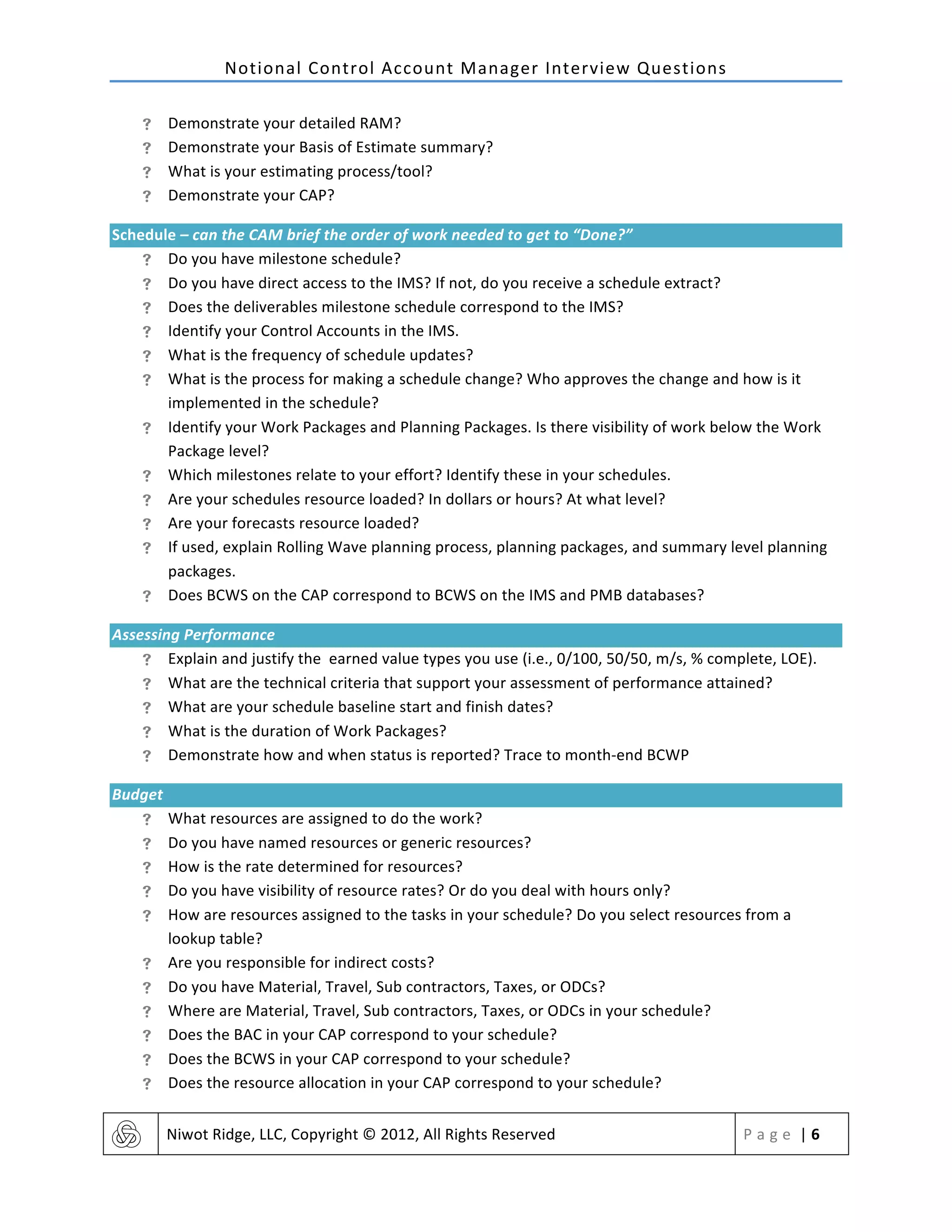
! Demonstrate	
  your	
  detailed	
  RAM?	
  	
  
! Demonstrate	
  your	
  Basis	
  of	
  Estimate	
  summary?	
  
! What	
  is	
  your	
  estimating	
  process/tool?	
  
! Demonstrate	
  your	
  CAP?	
  
Schedule	
  –	
  can	
  the	
  CAM	
  brief	
  the	
  order	
  of	
  work	
  needed	
  to	
  get	
  to	
  “Done?”	
  
! Do	
  you	
  have	
  milestone	
  schedule?	
  
! Do	
  you	
  have	
  direct	
  access	
  to	
  the	
  IMS?	
  If	
  not,	
  do	
  you	
  receive	
  a	
  schedule	
  extract?	
  	
  
! Does	
  the	
  deliverables	
  milestone	
  schedule	
  correspond	
  to	
  the	
  IMS?	
  
! Identify	
  your	
  Control	
  Accounts	
  in	
  the	
  IMS.	
  	
  
! What	
  is	
  the	
  frequency	
  of	
  schedule	
  updates?	
  	
  
! What	
  is	
  the	
  process	
  for	
  making	
  a	
  schedule	
  change?	
  Who	
  approves	
  the	
  change	
  and	
  how	
  is	
  it	
  
implemented	
  in	
  the	
  schedule?	
  
! Identify	
  your	
  Work	
  Packages	
  and	
  Planning	
  Packages.	
  Is	
  there	
  visibility	
  of	
  work	
  below	
  the	
  Work	
  
Package	
  level?	
  
! Which	
  milestones	
  relate	
  to	
  your	
  effort?	
  Identify	
  these	
  in	
  your	
  schedules.	
  
! Are	
  your	
  schedules	
  resource	
  loaded?	
  In	
  dollars	
  or	
  hours?	
  At	
  what	
  level?	
  	
  
! Are	
  your	
  forecasts	
  resource	
  loaded?	
  	
  
! If	
  used,	
  explain	
  Rolling	
  Wave	
  planning	
  process,	
  planning	
  packages,	
  and	
  summary	
  level	
  planning	
  
packages.	
  
! Does	
  BCWS	
  on	
  the	
  CAP	
  correspond	
  to	
  BCWS	
  on	
  the	
  IMS	
  and	
  PMB	
  databases?	
  
Assessing	
  Performance	
  
! Explain	
  and	
  justify	
  the	
  earned	
  value	
  types	
  you	
  use	
  (i.e.,	
  0/100,	
  50/50,	
  m/s,	
  %	
  complete,	
  LOE).	
  
! What	
  are	
  the	
  technical	
  criteria	
  that	
  support	
  your	
  assessment	
  of	
  performance	
  attained?	
  
! What	
  are	
  your	
  schedule	
  baseline	
  start	
  and	
  finish	
  dates?	
  	
  
! What	
  is	
  the	
  duration	
  of	
  Work	
  Packages?	
  
! Demonstrate	
  how	
  and	
  when	
  status	
  is	
  reported?	
  Trace	
  to	
  month-­‐end	
  BCWP	
  
Budget	
  
! What	
  resources	
  are	
  assigned	
  to	
  do	
  the	
  work?	
  
! Do	
  you	
  have	
  named	
  resources	
  or	
  generic	
  resources?	
  
! How	
  is	
  the	
  rate	
  determined	
  for	
  resources?	
  
! Do	
  you	
  have	
  visibility	
  of	
  resource	
  rates?	
  Or	
  do	
  you	
  deal	
  with	
  hours	
  only?	
  
! How	
  are	
  resources	
  assigned	
  to	
  the	
  tasks	
  in	
  your	
  schedule?	
  Do	
  you	
  select	
  resources	
  from	
  a	
  
lookup	
  table?	
  
! Are	
  you	
  responsible	
  for	
  indirect	
  costs?	
  
! Do	
  you	
  have	
  Material,	
  Travel,	
  Sub	
  contractors,	
  Taxes,	
  or	
  ODCs?	
  	
  
! Where	
  are	
  Material,	
  Travel,	
  Sub	
  contractors,	
  Taxes,	
  or	
  ODCs	
  in	
  your	
  schedule?	
  	
  
! Does	
  the	
  BAC	
  in	
  your	
  CAP	
  correspond	
  to	
  your	
  schedule?	
  
! Does	
  the	
  BCWS	
  in	
  your	
  CAP	
  correspond	
  to	
  your	
  schedule?	
  
! Does	
  the	
  resource	
  allocation	
  in	
  your	
  CAP	
  correspond	
  to	
  your	
  schedule?	
  
Notional	
  Control	
  Account	
  Manager	
  Interview	
  Questions	
  
	
   Niwot	
  Ridge,	
  LLC,	
  Copyright	
  ©	
  2012,	
  All	
  Rights	
  Reserved	
   P a g e 	
  |	
  7	


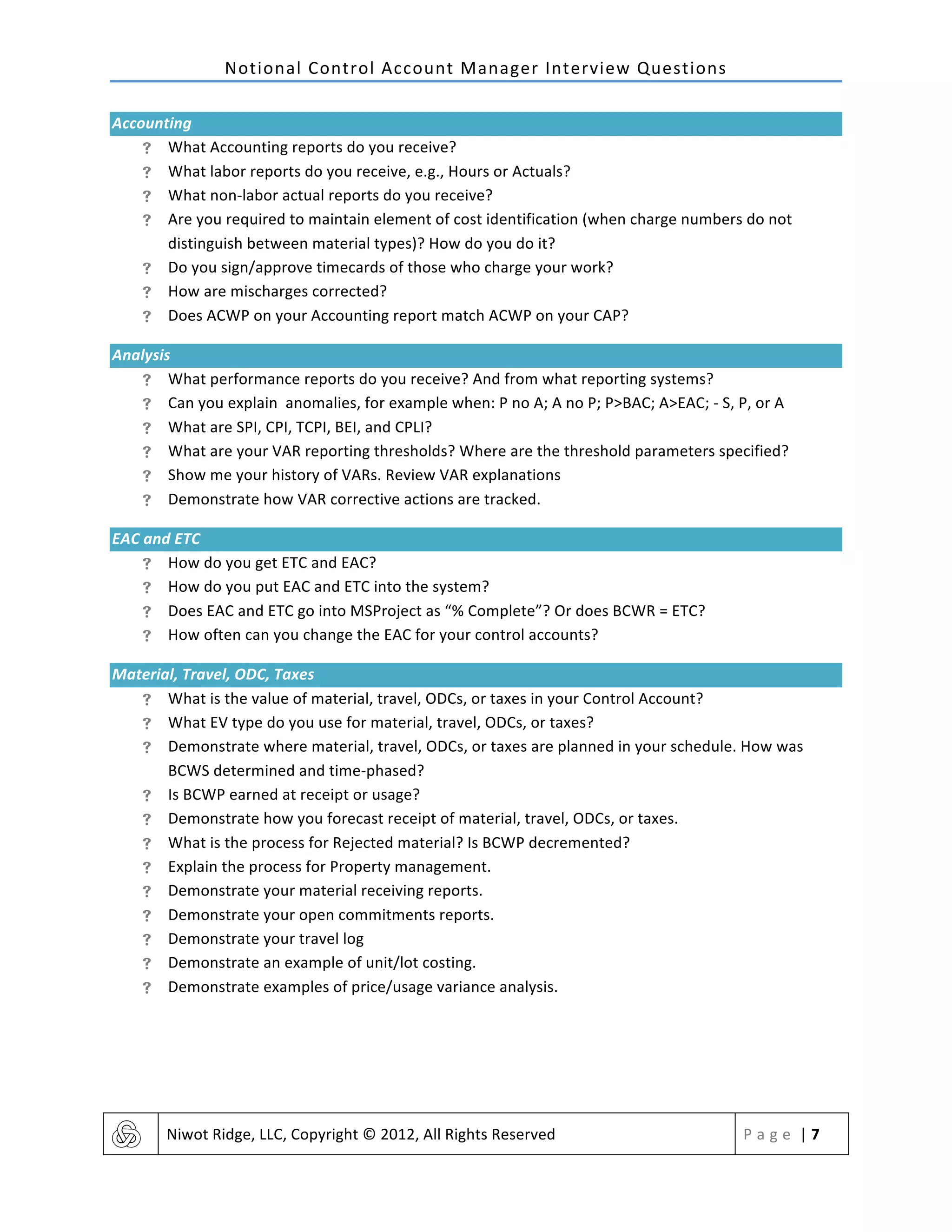
Accounting	
  
! What	
  Accounting	
  reports	
  do	
  you	
  receive?	
  
! What	
  labor	
  reports	
  do	
  you	
  receive,	
  e.g.,	
  Hours	
  or	
  Actuals?	
  
! What	
  non-­‐labor	
  actual	
  reports	
  do	
  you	
  receive?	
  	
  
! Are	
  you	
  required	
  to	
  maintain	
  element	
  of	
  cost	
  identification	
  (when	
  charge	
  numbers	
  do	
  not	
  
distinguish	
  between	
  material	
  types)?	
  How	
  do	
  you	
  do	
  it?	
  	
  
! Do	
  you	
  sign/approve	
  timecards	
  of	
  those	
  who	
  charge	
  your	
  work?	
  
! How	
  are	
  mischarges	
  corrected?	
  	
  
! Does	
  ACWP	
  on	
  your	
  Accounting	
  report	
  match	
  ACWP	
  on	
  your	
  CAP?	
  
Analysis	
  
! What	
  performance	
  reports	
  do	
  you	
  receive?	
  And	
  from	
  what	
  reporting	
  systems?	
  	
  
! Can	
  you	
  explain	
  anomalies,	
  for	
  example	
  when:	
  P	
  no	
  A;	
  A	
  no	
  P;	
  P>BAC;	
  A>EAC;	
  -­‐	
  S,	
  P,	
  or	
  A	
  
! What	
  are	
  SPI,	
  CPI,	
  TCPI,	
  BEI,	
  and	
  CPLI?	
  
! What	
  are	
  your	
  VAR	
  reporting	
  thresholds?	
  Where	
  are	
  the	
  threshold	
  parameters	
  specified?	
  
! Show	
  me	
  your	
  history	
  of	
  VARs.	
  Review	
  VAR	
  explanations	
  
! Demonstrate	
  how	
  VAR	
  corrective	
  actions	
  are	
  tracked.	
  	
  
EAC	
  and	
  ETC	
  
! How	
  do	
  you	
  get	
  ETC	
  and	
  EAC?	
  
! How	
  do	
  you	
  put	
  EAC	
  and	
  ETC	
  into	
  the	
  system?	
  
! Does	
  EAC	
  and	
  ETC	
  go	
  into	
  MSProject	
  as	
  “%	
  Complete”?	
  Or	
  does	
  BCWR	
  =	
  ETC?	
  	
  
! How	
  often	
  can	
  you	
  change	
  the	
  EAC	
  for	
  your	
  control	
  accounts?	
  	
  
Material,	
  Travel,	
  ODC,	
  Taxes	
  
! What	
  is	
  the	
  value	
  of	
  material,	
  travel,	
  ODCs,	
  or	
  taxes	
  in	
  your	
  Control	
  Account?	
  	
  
! What	
  EV	
  type	
  do	
  you	
  use	
  for	
  material,	
  travel,	
  ODCs,	
  or	
  taxes?	
  	
  
! Demonstrate	
  where	
  material,	
  travel,	
  ODCs,	
  or	
  taxes	
  are	
  planned	
  in	
  your	
  schedule.	
  How	
  was	
  
BCWS	
  determined	
  and	
  time-­‐phased?	
  
! Is	
  BCWP	
  earned	
  at	
  receipt	
  or	
  usage?	
  	
  
! Demonstrate	
  how	
  you	
  forecast	
  receipt	
  of	
  material,	
  travel,	
  ODCs,	
  or	
  taxes.	
  	
  
! What	
  is	
  the	
  process	
  for	
  Rejected	
  material?	
  Is	
  BCWP	
  decremented?	
  
! Explain	
  the	
  process	
  for	
  Property	
  management.	
  	
  
! Demonstrate	
  your	
  material	
  receiving	
  reports.	
  
! Demonstrate	
  your	
  open	
  commitments	
  reports.	
  
! Demonstrate	
  your	
  travel	
  log	
  	
  
! Demonstrate	
  an	
  example	
  of	
  unit/lot	
  costing.	
  
! Demonstrate	
  examples	
  of	
  price/usage	
  variance	
  analysis.	


Notional	
  Control	
  Account	
  Manager	
  Interview	
  Questions	
  
	
   Niwot	
  Ridge,	
  LLC,	
  Copyright	
  ©	
  2012,	
  All	
  Rights	
  Reserved	
   P a g e 	
  |	
  8	


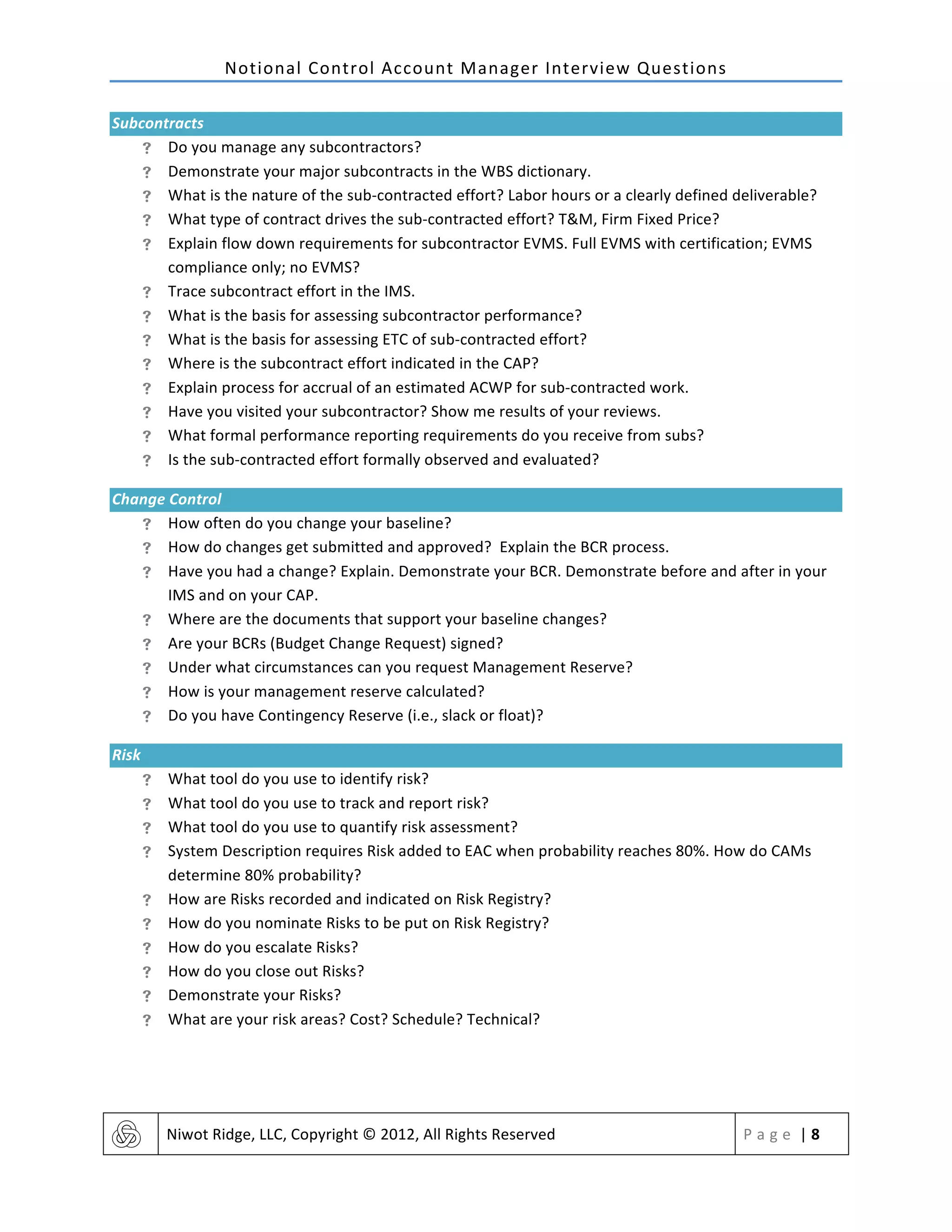
Subcontracts	
  
! Do	
  you	
  manage	
  any	
  subcontractors?	
  	
  
! Demonstrate	
  your	
  major	
  subcontracts	
  in	
  the	
  WBS	
  dictionary.	
  
! What	
  is	
  the	
  nature	
  of	
  the	
  sub-­‐contracted	
  effort?	
  Labor	
  hours	
  or	
  a	
  clearly	
  defined	
  deliverable?	
  	
  
! What	
  type	
  of	
  contract	
  drives	
  the	
  sub-­‐contracted	
  effort?	
  T&M,	
  Firm	
  Fixed	
  Price?	
  	
  
! Explain	
  flow	
  down	
  requirements	
  for	
  subcontractor	
  EVMS.	
  Full	
  EVMS	
  with	
  certification;	
  EVMS	
  
compliance	
  only;	
  no	
  EVMS?	
  
! Trace	
  subcontract	
  effort	
  in	
  the	
  IMS.	
  
! What	
  is	
  the	
  basis	
  for	
  assessing	
  subcontractor	
  performance?	
  	
  
! What	
  is	
  the	
  basis	
  for	
  assessing	
  ETC	
  of	
  sub-­‐contracted	
  effort?	
  	
  
! Where	
  is	
  the	
  subcontract	
  effort	
  indicated	
  in	
  the	
  CAP?	
  
! Explain	
  process	
  for	
  accrual	
  of	
  an	
  estimated	
  ACWP	
  for	
  sub-­‐contracted	
  work.	
  
! Have	
  you	
  visited	
  your	
  subcontractor?	
  Show	
  me	
  results	
  of	
  your	
  reviews.	
  	
  
! What	
  formal	
  performance	
  reporting	
  requirements	
  do	
  you	
  receive	
  from	
  subs?	
  
! Is	
  the	
  sub-­‐contracted	
  effort	
  formally	
  observed	
  and	
  evaluated?	
  	
  
Change	
  Control	
  
! How	
  often	
  do	
  you	
  change	
  your	
  baseline?	
  	
  
! How	
  do	
  changes	
  get	
  submitted	
  and	
  approved?	
  Explain	
  the	
  BCR	
  process.	
  
! Have	
  you	
  had	
  a	
  change?	
  Explain.	
  Demonstrate	
  your	
  BCR.	
  Demonstrate	
  before	
  and	
  after	
  in	
  your	
  
IMS	
  and	
  on	
  your	
  CAP.	
  
! Where	
  are	
  the	
  documents	
  that	
  support	
  your	
  baseline	
  changes?	
  
! Are	
  your	
  BCRs	
  (Budget	
  Change	
  Request)	
  signed?	
  
! Under	
  what	
  circumstances	
  can	
  you	
  request	
  Management	
  Reserve?	
  
! How	
  is	
  your	
  management	
  reserve	
  calculated?	
  
! Do	
  you	
  have	
  Contingency	
  Reserve	
  (i.e.,	
  slack	
  or	
  float)?	
  
Risk	
  
! What	
  tool	
  do	
  you	
  use	
  to	
  identify	
  risk?	
  
! What	
  tool	
  do	
  you	
  use	
  to	
  track	
  and	
  report	
  risk?	
  
! What	
  tool	
  do	
  you	
  use	
  to	
  quantify	
  risk	
  assessment?	
  
! System	
  Description	
  requires	
  Risk	
  added	
  to	
  EAC	
  when	
  probability	
  reaches	
  80%.	
  How	
  do	
  CAMs	
  
determine	
  80%	
  probability?	
  	
  
! How	
  are	
  Risks	
  recorded	
  and	
  indicated	
  on	
  Risk	
  Registry?	
  	
  
! How	
  do	
  you	
  nominate	
  Risks	
  to	
  be	
  put	
  on	
  Risk	
  Registry?	
  
! How	
  do	
  you	
  escalate	
  Risks?	
  
! How	
  do	
  you	
  close	
  out	
  Risks?	
  
! Demonstrate	
  your	
  Risks?	
  
! What	
  are	
  your	
  risk	
  areas?	
  Cost?	
  Schedule?	
  Technical?	


Notional	
  Control	
  Account	
  Manager	
  Interview	
  Questions	
  
	
   Niwot	
  Ridge,	
  LLC,	
  Copyright	
  ©	
  2012,	
  All	
  Rights	
  Reserved	
   P a g e 	
  |	
  9	


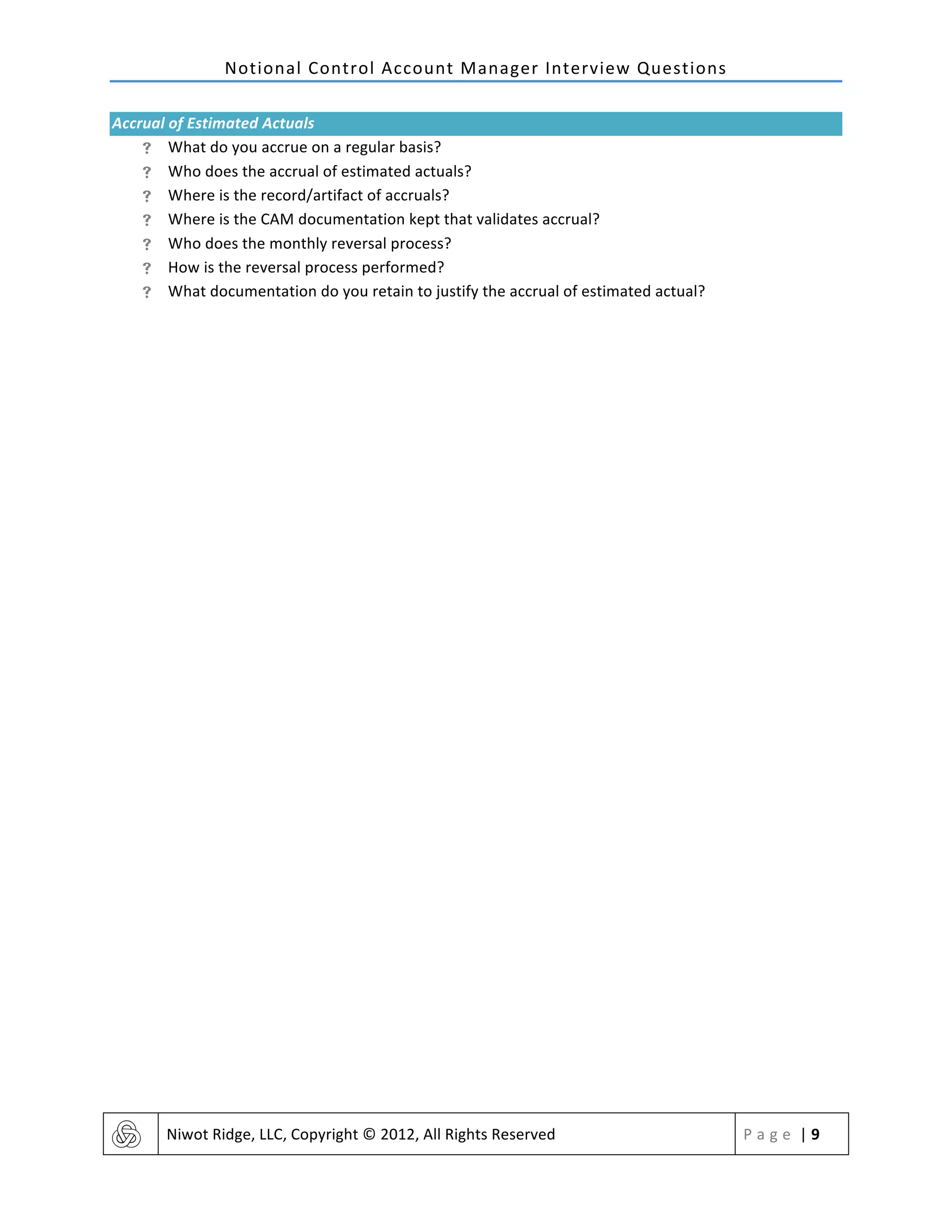
Accrual	
  of	
  Estimated	
  Actuals	
  
! What	
  do	
  you	
  accrue	
  on	
  a	
  regular	
  basis?	
  
! Who	
  does	
  the	
  accrual	
  of	
  estimated	
  actuals?	
  
! Where	
  is	
  the	
  record/artifact	
  of	
  accruals?	
  
! Where	
  is	
  the	
  CAM	
  documentation	
  kept	
  that	
  validates	
  accrual?	
  
! Who	
  does	
  the	
  monthly	
  reversal	
  process?	
  
! How	
  is	
  the	
  reversal	
  process	
  performed?	
  
! What	
  documentation	
  do	
  you	
  retain	
  to	
  justify	
  the	
  accrual	
  of	
  estimated	
  actual?	


Notional	
  Control	
  Account	
  Manager	
  Interview	
  Questions	
  
	
   Niwot	
  Ridge,	
  LLC,	
  Copyright	
  ©	
  2012,	
  All	
  Rights	
  Reserved	
   P a g e 	
  |	
  10	


«TRAINING»	
  
§ Training	
  processes	
  are	
  the	
  core	
  of	
  CAM	
  success.	
  This	
  training	
  must	
  include	
  the	
  mechanics	
  of	
  
the	
  EVMS	
  as	
  well	
  as	
  the	
  governance	
  process	
  applied	
  to	
  Control	
  Accounts	
  
! When	
  did	
  you	
  last	
  receive	
  PP&C	
  or	
  CAM	
  training?	
  
" Our	
  formal	
  EVM	
  System	
  Description	
  is	
  the	
  starting	
  point	
  for	
  our	
  training.	
  The	
  CAM	
  notebook	
  
training	
  covers	
  the	
  use	
  of	
  all	
  materials	
  we	
  need	
  to	
  do	
  our	
  job	
  as	
  a	
  CAM,	
  guided	
  by	
  the	
  EVM	
  
System	
  Description.	
  
«ORGANIZATION»	
  
§ Define	
  the	
  authorized	
  work	
  elements	
  for	
  the	
  program.	
  A	
  work	
  breakdown	
  structure	
  (WBS),	
  
tailored	
  for	
  effective	
  internal	
  management	
  control,	
  and	
  is	
  commonly	
  used	
  in	
  this	
  process.	
  
§ Identify	
  the	
  program	
  organizational	
  structure	
  including	
  the	
  major	
  subcontractors	
  responsible	
  
for	
  accomplishing	
  the	
  authorized	
  work,	
  and	
  define	
  the	
  organizational	
  elements	
  in	
  which	
  work	
  
will	
  be	
  planned	
  and	
  controlled.	
  
§ Provide	
  for	
  the	
  integration	
  of	
  the	
  company’s	
  planning,	
  scheduling,	
  budgeting,	
  work	
  
authorization	
  and	
  cost	
  accumulation	
  processes	
  with	
  each	
  other,	
  and	
  as	
  appropriate,	
  the	
  
program	
  work	
  breakdown	
  structure	
  and	
  the	
  program	
  organizational	
  structure.	
  
§ Identify	
  the	
  company	
  organization	
  or	
  function	
  responsible	
  for	
  controlling	
  overhead	
  (indirect	
  
costs).	
  
§ Provide	
  for	
  integration	
  of	
  the	
  program	
  work	
  breakdown	
  structure	
  and	
  the	
  program	
  
organizational	
  structure	
  in	
  a	
  manner	
  that	
  permits	
  cost	
  and	
  schedule	
  performance	
  
measurement	
  by	
  elements	
  of	
  either	
  or	
  both	
  structures	
  as	
  needed.	
  
! Show	
  your	
  organizational	
  chart	
  and	
  describe	
  your	
  responsibilities	
  
" Be	
  prepared	
  to	
  show	
  application	
  organizational	
  charts	
  with	
  traceability	
  from	
  the	
  highest	
  level	
  
program	
  organization	
  to	
  the	
  lowest	
  level	
  where	
  resources	
  support	
  your	
  work	
  scope.	
  	
  
" Highlight	
  this	
  traceability	
  from	
  the	
  highest	
  to	
  the	
  lowest	
  level.	
  Be	
  prepared	
  to	
  discuss	
  your	
  roles	
  
and	
  responsibilities	
  as	
  reference	
  on	
  your	
  applicable	
  organizational	
  chart.	
  
! Where	
  is	
  your	
  scope	
  of	
  work	
  defined?	
  
§ This	
  information	
  is	
  defined	
  in	
  the	
  Statement	
  of	
  Work	
  (SOW)	
  and	
  WBS	
  Dictionary.	
  	
  
§ The	
  WBS	
  Dictionary	
  is	
  correlated	
  with	
  each	
  WBS	
  element	
  to	
  the	
  SOW	
  tasks.	
  	
  
§ The	
  WBS	
  Dictionary	
  describes	
  the	
  effort,	
  and	
  the	
  Control	
  Accounts	
  through	
  with	
  the	
  effort	
  will	
  
be	
  accomplished.	
  	
  
" Be	
  prepared	
  to	
  show	
  the	
  SOW	
  and	
  WBS	
  dictionary.	
  	
  
" Explain	
  their	
  use	
  as	
  they	
  apply	
  to	
  your	
  Control	
  Accounts.	
  	
  
" Highlight	
  your	
  applicable	
  SOW	
  and	
  WBS	
  dictionary	
  paragraphs.	
  	
  
Notional	
  Control	
  Account	
  Manager	
  Interview	
  Questions	
  
	
   Niwot	
  Ridge,	
  LLC,	
  Copyright	
  ©	
  2012,	
  All	
  Rights	
  Reserved	
   P a g e 	
  |	
  11	


" Show	
  the	
  IMP	
  matrix	
  and	
  explain	
  its	
  logic.	
  	
  
! Do	
  you	
  own	
  or	
  support	
  any	
  of	
  the	
  Events,	
  Accomplishments,	
  or	
  Criteria	
  in	
  the	
  IMP?	
  
§ Systems	
  Engineering	
  is	
  responsible	
  for	
  the	
  development	
  of	
  the	
  Integrated	
  Master	
  Plan	
  (IMP)	
  
Matrix.	
  The	
  IMP	
  Matrix	
  is	
  an	
  event	
  driven	
  plan	
  of	
  Program	
  Events	
  (PE),	
  Significant	
  
Accomplishments	
  (SA),	
  Accomplishment	
  Criteria	
  (AC),	
  and	
  Process	
  Definition	
  (process	
  
narratives)	
  which	
  encompass	
  the	
  scope	
  of	
  your	
  program	
  activities.	
  The	
  IMP	
  defines	
  WHAT	
  and	
  
HOW	
  –	
  but	
  not	
  WHEN	
  (scheduled	
  dates).	
  
" Be	
  prepared	
  to	
  show	
  the	
  IMP	
  Matrix,	
  explain	
  that	
  the	
  IMP	
  Matrix	
  contains	
  Program	
  Events	
  (PE),	
  
Significant	
  Accomplishments	
  (SA),	
  and	
  Accomplishment	
  Criteria	
  (AC).	
  	
  
" Be	
  prepared	
  to	
  show	
  and	
  explain	
  those	
  PE’s,	
  SA’s	
  and	
  the	
  AC	
  as	
  they	
  pertain	
  to	
  your	
  Work	
  
Package,	
  its	
  scope,	
  the	
  Control	
  Accounts	
  and	
  how	
  they	
  relate	
  and	
  trace	
  to	
  the	
  Integrated	
  Master	
  
Schedule	
  (IMS).	
  High	
  light	
  your	
  applicable	
  IMP	
  PE’s,	
  SA’s	
  and	
  the	
  AC	
  in	
  the	
  IMP	
  Matrix.	
  
! What	
  WBS	
  elements	
  are	
  you	
  responsible	
  for?	
  
§ The	
  WBS	
  tree	
  reflects	
  the	
  WBS	
  elements	
  for	
  which	
  you	
  are	
  responsible.	
  	
  
" Be	
  prepared	
  to	
  show	
  the	
  applicable	
  WBS	
  elements	
  with	
  traceability	
  from	
  the	
  lowest	
  level	
  to	
  the	
  
highest	
  level	
  of	
  the	
  WBS	
  Tree.	
  	
  
" Highlight	
  traceability	
  from	
  the	
  lowest	
  to	
  the	
  highest	
  level.	
  
! Show	
  your	
  responsibility	
  Assignment	
  Matrix	
  (RAM)	
  
§ The	
  Responsibility	
  Assignment	
  Matrix	
  (RAM)	
  is	
  the	
  intersection	
  of	
  the	
  Organization	
  Breakdown	
  
Structure	
  (OBS)	
  and	
  the	
  Work	
  Breakdown	
  Structure	
  (WBS)	
  responsibilities.	
  	
  
" Be	
  prepared	
  to	
  show	
  the	
  intersection	
  with	
  your	
  Control	
  Accounts	
  as	
  reflected	
  on	
  the	
  RAM.	
  	
  
" Understand	
  all	
  components	
  contained	
  in	
  the	
  RAM	
  that	
  pertain	
  to	
  your	
  Control	
  Accounts.	
  	
  
" Highlight	
  your	
  applicable	
  Control	
  Account	
  data.	
  
! How	
  many	
  Control	
  Accounts	
  do	
  you	
  have	
  and	
  what	
  are	
  their	
  total	
  budgets?	
  	
  
" Identify	
  the	
  Control	
  Accounts	
  on	
  the	
  RAM	
  for	
  data	
  traces	
  
" Identify	
  your	
  Control	
  Accounts	
  on	
  the	
  RAM	
  and	
  be	
  prepared	
  to	
  show	
  the	
  Budget	
  At	
  Completion	
  
(BAC)	
  for	
  each	
  Control	
  Account	
  (burdened	
  and	
  direct	
  dollars).	
  	
  
" Show	
  how	
  the	
  BAC	
  for	
  each	
  Control	
  Account	
  is	
  reflected	
  on	
  the	
  current	
  month	
  Control	
  Account	
  
Organizational	
  Performance	
  Report	
  (CA	
  OPR).	


Notional	
  Control	
  Account	
  Manager	
  Interview	
  Questions	
  
	
   Niwot	
  Ridge,	
  LLC,	
  Copyright	
  ©	
  2012,	
  All	
  Rights	
  Reserved	
   P a g e 	
  |	
  12	


«WORK	
  AUTHORIZATION»	
  
§ Maintaining	
  the	
  proper	
  sequence	
  of	
  work	
  package	
  execution	
  is	
  critical	
  to	
  the	
  generation	
  of	
  
credible	
  Earned	
  Value	
  Management	
  data.	
  Work	
  preformed	
  out	
  of	
  sequence	
  either	
  has	
  not	
  
budget	
  assigned	
  for	
  that	
  period	
  of	
  performance	
  or	
  has	
  budget	
  assigned	
  but	
  no	
  work	
  be	
  
performed	
  or	
  some	
  combination.	
  
§ In	
  both	
  cases	
  the	
  Earned	
  Value	
  number	
  cannot	
  represent	
  the	
  proper	
  progress	
  of	
  the	
  project.	
  
! What	
  authorizes	
  you	
  to	
  begin	
  your	
  work?	
  Are	
  the	
  appropriate	
  signatures	
  present?	
  
§ Operation	
  Directives	
  (Program	
  Directives	
  or	
  other	
  firm	
  dependence	
  names)	
  provide	
  the	
  Program	
  
with	
  the	
  Authorization	
  to	
  Proceed	
  (ATP).	
  	
  
" Be	
  prepared	
  to	
  show	
  this	
  OD	
  (PD)	
  as	
  well	
  as	
  any	
  other	
  OD’s	
  (PD’s)	
  that	
  authorize	
  contract	
  
changes	
  which	
  impact	
  your	
  Control	
  Accounts.	
  Identify	
  appropriate	
  approval	
  signatures.	
  
" The	
  work	
  authorization	
  process	
  triggers	
  the	
  planning,	
  scheduling,	
  budgeting,	
  and	
  performance	
  of	
  
work	
  form	
  the	
  total	
  program	
  level	
  through	
  the	
  responsible	
  organizational	
  structure	
  to	
  the	
  
Control	
  Account	
  level.	
  	
  
" The	
  Work	
  Authorization	
  process	
  begins	
  with	
  an	
  OD	
  (PD)	
  issues	
  by	
  the	
  Contracts	
  Organization.	
  
The	
  OD	
  (PD)	
  authorizes	
  the	
  program	
  to	
  issues	
  a	
  Work	
  Authorization	
  Document	
  (WAD)	
  that	
  
defines	
  all	
  authorized	
  work	
  elements	
  on	
  the	
  program.	
  	
  
" Once	
  the	
  OD	
  (PD)	
  has	
  been	
  issued,	
  authorizing	
  work	
  to	
  commence	
  on	
  a	
  contract	
  or	
  contract	
  
change,	
  all	
  program	
  work	
  subsequently	
  must	
  be	
  authorized	
  or	
  directed	
  by	
  a	
  WAD.	
  
! Identify	
  the	
  key	
  elements	
  on	
  the	
  Work	
  Authorization	
  Document	
  (WAD)	
  
" The	
  WAD	
  contains	
  the	
  following	
  key	
  elements	
  
" Scope	
  of	
  the	
  work	
  to	
  be	
  performed	
  in	
  terms	
  of	
  activities	
  and	
  deliverables	
  
" Schedule	
  of	
  the	
  work	
  packages	
  that	
  performance	
  the	
  work	
  
" Budget	
  for	
  each	
  Work	
  Package	
  
" Period	
  of	
  Performance	
  for	
  the	
  collective	
  Work	
  Packages	
  
" Approval	
  processes	
  for	
  this	
  work	
  and	
  the	
  release	
  of	
  the	
  funding	
  
! Show	
  how	
  you	
  can	
  trace	
  the	
  key	
  work	
  elements	
  on	
  the	
  latest	
  approved	
  WAD?	
  
" The	
  following	
  key	
  elements	
  of	
  the	
  latest	
  approved	
  WAD	
  are:	
  
" Scope	
  to	
  SOW/WBS	
  Dictionary	
  or	
  equivalent	
  
" Budget	
  on	
  WAD	
  to	
  the	
  Cost	
  Control	
  System	
  –	
  the	
  Budget	
  Distribution	
  Reports	
  
" Validate	
  that	
  the	
  WAD	
  is	
  consistent	
  with	
  the	
  period	
  performance	
  on	
  the	
  Integrated	
  Master	
  
Schedule	
  (IMS),	
  baseline	
  date	
  and	
  revision	
  number	
  
" Provider	
  a	
  description	
  of	
  each	
  of	
  these	
  documents	
  and	
  the	
  processes	
  used	
  to	
  create	
  and	
  
management	
  them	
  
Notional	
  Control	
  Account	
  Manager	
  Interview	
  Questions	
  
	
   Niwot	
  Ridge,	
  LLC,	
  Copyright	
  ©	
  2012,	
  All	
  Rights	
  Reserved	
   P a g e 	
  |	
  13	


! Does	
  the	
  Control	
  Account	
  period	
  of	
  performance	
  on	
  the	
  WAD	
  match	
  the	
  start	
  and	
  end	
  dates	
  for	
  
the	
  time	
  phased	
  resources	
  in	
  your	
  Control	
  Account	
  Plan?	
  
" Be	
  prepared	
  to	
  trace	
  the	
  period	
  of	
  performance	
  for	
  each	
  Control	
  Account	
  budget	
  referenced	
  on	
  
the	
  current	
  approved	
  WAD	
  to	
  the	
  applicable	
  IMS	
  time–phases	
  Control	
  Account	
  /	
  task	
  period	
  of	
  
performance.	
  Ensure	
  all	
  dates	
  can	
  be	
  reconciled.	
  
! Do	
  the	
  Control	
  Account	
  periods	
  of	
  performance	
  match	
  the	
  schedule	
  time	
  spans	
  in	
  the	
  IMS?	
  
" Be	
  prepared	
  to	
  trace	
  the	
  period	
  of	
  performance	
  for	
  each	
  Control	
  Account	
  budget	
  referenced	
  on	
  
the	
  most	
  current	
  approved	
  WAD	
  to	
  the	
  applicable	
  IMS	
  time–phased	
  Control	
  Account	
  /	
  task	
  
period	
  of	
  performance.	
  Ensure	
  all	
  dates	
  reconcile.	
  	
  
" Be	
  prepared	
  to	
  justify	
  the	
  budget	
  and	
  the	
  Earned	
  Value	
  methods	
  selected.	
  
«PLANNING»	
  
§ Schedule	
  the	
  authorized	
  work	
  in	
  a	
  manner,	
  which	
  describes	
  the	
  sequence	
  of	
  work	
  and	
  
identifies	
  significant	
  task	
  interdependencies	
  required	
  to	
  meet	
  the	
  requirements	
  of	
  the	
  
program.	
  
§ Identify	
  physical	
  products,	
  milestones,	
  technical	
  performance	
  goals,	
  or	
  other	
  indicators	
  that	
  
will	
  be	
  used	
  to	
  measure	
  progress.	
  
§ Establish	
  and	
  maintain	
  a	
  time-­‐phased	
  budget	
  baseline,	
  at	
  the	
  Control	
  Account	
  level,	
  against	
  
which	
  program	
  performance	
  can	
  be	
  measured.	
  Budget	
  for	
  far-­‐term	
  efforts	
  may	
  be	
  held	
  in	
  
higher	
  level	
  accounts	
  until	
  an	
  appropriate	
  time	
  for	
  allocation	
  at	
  the	
  Control	
  Account	
  level.	
  
Initial	
  budgets	
  established	
  for	
  performance	
  measurement	
  will	
  be	
  based	
  on	
  either	
  internal	
  
management	
  goals	
  or	
  the	
  external	
  customer	
  negotiated	
  target	
  cost	
  including	
  estimates	
  for	
  
authorized	
  but	
  undefinitized	
  work.	
  On	
  government	
  contracts,	
  if	
  an	
  over	
  target	
  baseline	
  is	
  used	
  
for	
  performance	
  measurement	
  reporting	
  purposes;	
  prior	
  notification	
  must	
  be	
  provided	
  to	
  the	
  
customer.	
  
§ Establish	
  budgets	
  for	
  authorized	
  work	
  with	
  identification	
  of	
  significant	
  cost	
  elements	
  (labor,	
  
material,	
  etc.)	
  as	
  needed	
  for	
  internal	
  management	
  and	
  for	
  control	
  of	
  subcontractors.	
  
§ To	
  the	
  extent	
  it	
  is	
  practical	
  to	
  identify	
  the	
  authorized	
  work	
  in	
  discrete	
  work	
  packages,	
  establish	
  
budgets	
  for	
  this	
  work	
  in	
  terms	
  of	
  dollars,	
  hours,	
  or	
  other	
  measurable	
  units.	
  Where	
  the	
  entire	
  
Control	
  Account	
  is	
  not	
  subdivided	
  into	
  work	
  packages,	
  identify	
  the	
  far	
  term	
  effort	
  in	
  larger	
  
planning	
  packages	
  for	
  budget	
  and	
  scheduling	
  purposes.	
  
§ Provide	
  that	
  the	
  sum	
  of	
  all	
  work	
  package	
  budgets	
  plus	
  planning	
  package	
  budgets	
  within	
  a	
  
Control	
  Account	
  equals	
  the	
  Control	
  Account	
  budget.	
  
§ Identify	
  and	
  control	
  level	
  of	
  effort	
  activity	
  by	
  time-­‐phased	
  budgets	
  established	
  for	
  this	
  purpose.	
  
Only	
  that	
  effort	
  which	
  is	
  unmeasurable	
  or	
  for	
  which	
  measurement	
  is	
  impractical	
  may	
  be	
  
classified	
  as	
  Level	
  of	
  Effort.	
  
§ Establish	
  overhead	
  budgets	
  for	
  each	
  significant	
  organizational	
  component	
  of	
  the	
  company	
  for	
  
expenses	
  that	
  will	
  become	
  indirect	
  costs.	
  Reflect	
  in	
  the	
  program	
  budgets,	
  at	
  the	
  appropriate	
  
Notional	
  Control	
  Account	
  Manager	
  Interview	
  Questions	
  
	
   Niwot	
  Ridge,	
  LLC,	
  Copyright	
  ©	
  2012,	
  All	
  Rights	
  Reserved	
   P a g e 	
  |	
  14	


level,	
  the	
  amounts	
  in	
  overhead	
  pools	
  that	
  are	
  planned	
  to	
  be	
  allocated	
  to	
  the	
  program	
  as	
  
indirect	
  costs.	
  
§ Identify	
  management	
  reserves	
  and	
  undistributed	
  budget.	
  
§ Assure	
  that	
  the	
  program	
  target	
  cost	
  goal	
  is	
  reconciled	
  with	
  the	
  sum	
  of	
  all	
  internal	
  program	
  
budgets	
  and	
  management	
  reserves.	
  
! What	
  key	
  supporting	
  documentation	
  do	
  you	
  use	
  to	
  establish	
  and	
  plan	
  your	
  tasks?	
  
" Budgets	
  are	
  based	
  on	
  negotiated	
  proposal	
  values	
  less	
  Management	
  Reserve	
  (MR).	
  the	
  CAM	
  
plans	
  and	
  spreads	
  the	
  BCWS	
  received	
  according	
  to	
  how	
  the	
  scope	
  of	
  work	
  will	
  be	
  accomplished	
  
as	
  defined	
  in	
  the	
  Statement	
  of	
  Work	
  (SOW)	
  and	
  the	
  WBS	
  dictionary,	
  and	
  consistent	
  with	
  the	
  
Integrated	
  Master	
  Plan	
  (IMP)	
  and	
  Integrated	
  Master	
  Schedule	
  (IMS).	
  
" The	
  WBS	
  Dictionary	
  correlates	
  WBS	
  elements	
  to	
  the	
  SOW	
  tasks,	
  and	
  provides	
  a	
  description	
  of	
  the	
  
effort.	
  Control	
  Accounts	
  and	
  tasks	
  are	
  developed	
  by	
  the	
  CAMs	
  form	
  the	
  SOW	
  and	
  WBS.	
  The	
  
program	
  IMS	
  establishes	
  the	
  periods	
  of	
  performance,	
  work	
  tasks,	
  and	
  milestones	
  (if	
  needed).	
  
! How	
  do	
  you	
  time	
  phase	
  the	
  budget	
  for	
  the	
  tasks?	
  
" Based	
  on	
  the	
  documentation	
  provided	
  above	
  (SOW,	
  WBS,	
  IMP/IMS),	
  you	
  as	
  the	
  CAM	
  must	
  
provide	
  a	
  time	
  phased	
  budget	
  baseline	
  for	
  each	
  Control	
  Account	
  Work	
  Package	
  and	
  the	
  activities	
  
within	
  those	
  Work	
  packages	
  contained	
  in	
  the	
  IMS.	
  
! Do	
  you	
  have	
  any	
  Level	
  of	
  Effort	
  (LOE)	
  
" BCWP	
  for	
  LOE’s	
  is	
  earned	
  through	
  the	
  passage	
  of	
  time	
  and	
  is	
  not	
  based	
  on	
  work	
  accomplished.	
  
BCWP	
  always	
  equals	
  BCWS	
  through	
  the	
  current	
  period.	
  
" Each	
  CAM	
  may	
  have	
  Control	
  Accounts	
  that	
  are	
  classified	
  as	
  totally	
  LOE	
  or	
  Control	
  Accounts	
  that	
  
may	
  only	
  have	
  some	
  LOE	
  effort.	
  Be	
  prepared	
  to	
  justify	
  why	
  you	
  have	
  LOE	
  Control	
  Account(s)	
  or	
  
LOE	
  tasks	
  contained	
  with	
  a	
  Control	
  Account.	
  Explain	
  why	
  they	
  are	
  not	
  measureable.	
  
! What	
  is	
  the	
  recommended	
  ratio	
  of	
  LOE	
  to	
  discrete	
  budget	
  in	
  a	
  Control	
  Account	
  classified	
  as	
  
discrete?	
  
" As	
  stated	
  in	
  the	
  Program	
  Directive	
  (PD),	
  the	
  recommended	
  ratio	
  of	
  LOE	
  to	
  discrete	
  budget	
  within	
  
a	
  Control	
  Account	
  is	
  not	
  to	
  exceed	
  some	
  predefined	
  value.	
  This	
  is	
  typically	
  10%	
  to	
  20%	
  of	
  the	
  
burdened	
  dollar	
  Budget	
  at	
  Completion	
  (BAC).	
  
! In	
  the	
  current	
  rolling	
  wave,	
  do	
  you	
  have	
  any	
  discrete	
  Control	
  Accounts	
  with	
  more	
  LOE	
  than	
  
allowed?	
  
" No.	
  Ensure	
  that	
  any	
  LOE	
  effort	
  within	
  a	
  discrete	
  Control	
  Account	
  does	
  not	
  exceed	
  the	
  stated	
  PD	
  
guidance.	
  If	
  discrete	
  Control	
  Accounts	
  do	
  exceed	
  this	
  guidance,	
  then	
  the	
  LOE	
  effort	
  should	
  be	
  
extracted	
  and	
  a	
  new	
  separate	
  LOE	
  Control	
  Account	
  developed.	
  
Notional	
  Control	
  Account	
  Manager	
  Interview	
  Questions	
  
	
   Niwot	
  Ridge,	
  LLC,	
  Copyright	
  ©	
  2012,	
  All	
  Rights	
  Reserved	
   P a g e 	
  |	
  15	


! Are	
  all	
  your	
  LOE	
  Control	
  Accounts	
  detail	
  planned	
  through	
  completion?	
  
" Yes.	
  All	
  LOE	
  effort	
  has	
  been	
  planned	
  through	
  completion	
  
" When	
  the	
  current	
  program	
  has	
  multiple	
  rolling	
  wave	
  periods	
  –	
  Discrete	
  work	
  scope	
  must	
  be	
  
planned	
  through	
  the	
  current	
  rolling	
  wave	
  period.	
  Future	
  rolling	
  wave	
  periods	
  must	
  be	
  contained	
  
in	
  discrete	
  planning	
  packages.	
  	
  
" These	
  must	
  be	
  “detail	
  planned”	
  at	
  least	
  30	
  days	
  prior	
  to	
  the	
  start	
  of	
  the	
  next	
  rolling	
  wave	
  period	
  
of	
  performance.	
  
! Do	
  you	
  have	
  the	
  current	
  approved	
  version	
  of	
  the	
  Integrated	
  Master	
  Schedule	
  and	
  know	
  how	
  
your	
  work	
  packages	
  and	
  planning	
  packages	
  support	
  the	
  major	
  program	
  events	
  and	
  milestones?	
  
" Be	
  prepared	
  to	
  trace	
  the	
  period	
  of	
  performance	
  for	
  each	
  Control	
  Account	
  work	
  package	
  and	
  its	
  
work	
  activities	
  references	
  in	
  the	
  Control	
  Account	
  Plan	
  (CAP)	
  to	
  the	
  applicable	
  Program	
  Events	
  
referenced	
  in	
  the	
  program	
  Integrate	
  Master	
  Schedule	
  or	
  master	
  Milestones	
  contained	
  in	
  the	
  
Program	
  IMS.	
  	
  
" Ensure	
  all	
  dates	
  reconcile.	
  	
  
" Be	
  able	
  to	
  justify	
  the	
  budget	
  and	
  Earned	
  Value	
  methods	
  selected	
  for	
  each	
  Work	
  Package	
  and	
  
Planning	
  Package.	
  
! Is	
  the	
  task	
  /	
  milestone	
  exit	
  criteria	
  clearly	
  defined?	
  Either	
  separately	
  documented	
  or	
  embedded	
  
in	
  the	
  task	
  description.	
  
" A	
  Task	
  Entry	
  and	
  Exit	
  (TEC)	
  must	
  be	
  established	
  for	
  each	
  discrete	
  work	
  package.	
  If	
  the	
  task	
  
descriptions	
  in	
  the	
  IMS	
  are	
  at	
  such	
  a	
  detailed	
  level	
  that	
  clearly	
  defines	
  the	
  exit	
  criteria	
  closure,	
  
then	
  no	
  additional	
  exit	
  criteria	
  documentation	
  is	
  required.	
  
" Be	
  prepared	
  to	
  show	
  and	
  explain	
  the	
  TECs	
  referenced	
  on	
  the	
  IMS	
  that	
  support	
  your	
  Control	
  
Account	
  tasks.	
  Also	
  be	
  prepared	
  to	
  show	
  the	
  entrance	
  and	
  exit	
  criteria	
  for	
  each	
  discrete	
  Control	
  
Account	
  work	
  package.	
  Explain	
  how	
  they	
  were	
  derived.	
  
! For	
  the	
  current	
  planning	
  period,	
  what	
  is	
  your	
  total	
  LOE	
  versus	
  Discrete	
  in	
  dollars	
  and	
  hours?	
  
" Be	
  prepared	
  to	
  identify	
  the	
  Budget	
  At	
  Completion	
  (BAC)	
  in	
  burdened	
  dollars	
  and	
  hours	
  for	
  all	
  
current	
  LOE	
  effort	
  contained	
  in	
  your	
  Control	
  Accounts.	
  Divide	
  the	
  dollar	
  amount	
  by	
  the	
  total	
  of	
  all	
  
current	
  open	
  Control	
  Accounts	
  Budget	
  At	
  Completion.	
  This	
  will	
  provide	
  the	
  LOE	
  versus	
  Discrete	
  
percent	
  ratio.	
  
! Trace	
  a	
  task(s)	
  from	
  your	
  IMS	
  to	
  your	
  Control	
  Account	
  Plan	
  (CAP)	
  for	
  both	
  total	
  and	
  time	
  phase	
  
resources	
  
" Be	
  prepared	
  to	
  trace	
  the	
  period	
  of	
  performance	
  for	
  each	
  Control	
  Account	
  budget	
  referenced	
  on	
  
the	
  current	
  approved	
  WAD	
  to	
  the	
  applicable	
  IMS	
  time	
  phased	
  Control	
  Account	
  or	
  task	
  period	
  of	
  
performance.	
  Ensure	
  all	
  dates	
  and	
  resources	
  allocated	
  reconcile	
  with	
  the	
  current	
  rolling	
  wave	
  
period.	
  
Notional	
  Control	
  Account	
  Manager	
  Interview	
  Questions	
  
	
   Niwot	
  Ridge,	
  LLC,	
  Copyright	
  ©	
  2012,	
  All	
  Rights	
  Reserved	
   P a g e 	
  |	
  16	


! Show	
  an	
  example	
  that	
  you	
  have	
  predecessors	
  and	
  successors	
  identified	
  within	
  your	
  organization	
  
or	
  Integrated	
  Product	
  Team	
  (IPT)	
  and	
  between	
  other	
  organizations	
  or	
  IPTs.	
  
" A	
  series	
  or	
  network	
  of	
  activities	
  which	
  are	
  required	
  to	
  accomplish	
  a	
  task	
  are	
  linked	
  together	
  with	
  
logical	
  predecessors	
  and	
  successor	
  relationships	
  must	
  provide	
  for	
  the	
  identification	
  of	
  the	
  critical	
  
path(s).	
  Each	
  discrete	
  activity	
  has	
  an	
  output	
  predecessor	
  which	
  is	
  linked	
  to	
  an	
  input	
  or	
  successor	
  
activity.	
  This	
  defining	
  activity	
  relationship	
  enables	
  the	
  process	
  to	
  assess	
  progress	
  within	
  the	
  
network.	
  Be	
  prepared	
  to	
  show	
  an	
  example	
  of	
  how	
  your	
  predecessor/successor	
  activities	
  are	
  
indentified	
  with	
  your	
  organization	
  or	
  Integrated	
  Product	
  Team	
  (IPT)	
  are	
  dependent	
  or	
  linked	
  
between	
  other	
  organizations	
  or	
  IPTs	
  predecessors	
  and	
  successor	
  activities.	
  Program	
  Planning	
  
and	
  Controls	
  can	
  provide	
  predecessor	
  and	
  successor	
  reports	
  to	
  help	
  clarify	
  your	
  response.	
  
! If	
  you	
  are	
  responsible	
  for	
  any	
  major	
  subcontracts	
  or	
  intercompany	
  work	
  transfers,	
  where	
  is	
  it	
  
reflected	
  in	
  your	
  IMS?	
  
" Be	
  prepared	
  to	
  show	
  the	
  major	
  subcontracting	
  and	
  inter-­‐company	
  work	
  transfer	
  authorization	
  
(IWTA)	
  effort	
  reflected	
  in	
  the	
  IMS	
  and	
  how	
  your	
  tasks	
  support	
  the	
  major	
  events	
  and	
  milestones.	
  
! If	
  you	
  are	
  responsible	
  for	
  any	
  high	
  value	
  material,	
  where	
  is	
  it	
  reflected	
  in	
  your	
  IMS?	
  
" Be	
  prepared	
  to	
  show	
  any	
  high	
  value	
  material	
  effort	
  reflected	
  on	
  the	
  IMS.	
  Explain	
  how	
  your	
  tasks	
  
support	
  the	
  major	
  events	
  and	
  milestones.	
  
! Are	
  any	
  of	
  your	
  tasks	
  on	
  the	
  program	
  or	
  IPT	
  critical	
  path?	
  
" If	
  yes,	
  be	
  prepared	
  to	
  show	
  which	
  tasks	
  are	
  contained	
  on	
  the	
  critical	
  path.	
  
" The	
  critical	
  path	
  is	
  defined	
  as	
  the	
  longest	
  computed	
  path	
  through	
  a	
  program	
  schedule	
  network.	
  
The	
  critical	
  path	
  represents	
  scheduled	
  activities	
  with	
  the	
  highest	
  risk	
  and	
  the	
  least	
  margin	
  for	
  
error.	
  
! Do	
  you	
  have	
  any	
  special	
  requirements	
  because	
  you	
  are	
  on	
  the	
  critical	
  path?	
  
" Yes.	
  Any	
  schedule	
  activities	
  that	
  are	
  contained	
  on	
  the	
  critical	
  path	
  will	
  have	
  increased	
  
management	
  visibility	
  and	
  must	
  be	
  statused	
  weekly	
  for	
  impacts	
  to	
  the	
  program.	
  
! What	
  are	
  the	
  most	
  critical	
  areas	
  of	
  your	
  work	
  effort?	
  
" Identify	
  areas	
  in	
  your	
  work	
  scope	
  which	
  you	
  consider	
  the	
  most	
  critical.	
  Explain	
  why.	
  
! What	
  is	
  your	
  schedule	
  reserve?	
  
§ Schedule	
  reserve	
  is	
  generally	
  expressed	
  as	
  float.	
  Float	
  is	
  the	
  amount	
  of	
  time	
  an	
  activity	
  can	
  slip	
  
before	
  it	
  affects	
  another	
  activity	
  finish	
  date.	
  It	
  is	
  the	
  difference	
  between	
  when	
  the	
  activity	
  can	
  
happen	
  and	
  when	
  the	
  activity	
  must	
  happen.	
  Positive	
  float	
  (reserve)	
  should	
  be	
  conserved	
  and	
  
managed.	
  Negative	
  float	
  indicates	
  activities	
  that	
  must	
  be	
  reworked	
  to	
  meet	
  the	
  event	
  schedule.	
  
Events	
  may	
  be	
  milestones	
  or	
  deliverables.	
  If	
  the	
  total	
  float	
  is	
  less	
  than	
  or	
  equal	
  to	
  zero	
  (0),	
  then	
  
Notional	
  Control	
  Account	
  Manager	
  Interview	
  Questions	
  
	
   Niwot	
  Ridge,	
  LLC,	
  Copyright	
  ©	
  2012,	
  All	
  Rights	
  Reserved	
   P a g e 	
  |	
  17	


there	
  may	
  be	
  a	
  critical	
  condition	
  in	
  the	
  schedule.	
  Schedule	
  reserve	
  is	
  indentified	
  on	
  the	
  IMS	
  
network	
  by	
  Control	
  Account	
  or	
  task,	
  or	
  by	
  the	
  IMS	
  schedule	
  reserve	
  reports.	
  
" Be	
  prepared	
  to	
  describe	
  the	
  schedule	
  reserve	
  for	
  the	
  Control	
  Accounts	
  you’re	
  accountable	
  for	
  and	
  
how	
  that	
  schedule	
  margin	
  was	
  arrived	
  at.	
  
" Be	
  prepared	
  to	
  describe	
  how	
  you	
  measure	
  the	
  erosion	
  of	
  the	
  schedule	
  margin	
  as	
  the	
  program	
  
progresses	
  and	
  whether	
  the	
  remaining	
  schedule	
  margin	
  is	
  sufficient	
  to	
  protect	
  the	
  deliverable	
  
dates	
  in	
  the	
  IMS.	
  
! Do	
  you	
  have	
  resources	
  allocated	
  for	
  your	
  float	
  or	
  schedule	
  reserve?	
  
" No.	
  schedule	
  reserve,	
  or	
  float,	
  does	
  not	
  have	
  a	
  defined	
  work	
  scope.	
  Resources	
  may	
  be	
  allocated	
  
to	
  tasks	
  when	
  a	
  behind	
  schedule	
  condition	
  occurs	
  (which	
  may	
  cause	
  negative	
  schedule	
  reserve	
  or	
  
float).	
  If	
  this	
  occurs,	
  additional	
  resources	
  may	
  be	
  applied	
  to	
  the	
  task	
  to	
  help	
  mitigate	
  schedule	
  
degradation.	
  This	
  situation	
  most	
  likely	
  will	
  result	
  in	
  a	
  cost	
  overrun	
  condition	
  and	
  may	
  require	
  
additional	
  resources	
  or	
  estimates	
  to	
  be	
  applied.	
  This	
  should	
  not	
  be	
  view3ed	
  as	
  the	
  best	
  solution.	
  
! Do	
  you	
  status	
  your	
  IMS	
  detail	
  tasks	
  weekly?	
  
" Yes.	
  Control	
  account	
  task	
  activities	
  schedule	
  in	
  the	
  IMS	
  are	
  statused	
  weekly	
  which	
  includes	
  
accomplishments,	
  forecasts	
  (late	
  or	
  early)	
  and	
  all	
  schedule	
  changes	
  and	
  revisions.	
  
! Do	
  you	
  track	
  late	
  starts	
  and	
  late	
  finishes?	
  
" Be	
  prepared	
  to	
  show	
  the	
  status	
  of	
  late	
  starts	
  and	
  late	
  finishes	
  which	
  occurred	
  during	
  last	
  week.	
  
This	
  data	
  can	
  be	
  obtained	
  from	
  the	
  metric	
  produced	
  by	
  the	
  Program	
  Planning	
  and	
  Controls	
  staff.	
  
! Validate	
  that	
  the	
  month-­‐end	
  schedule	
  progress	
  for	
  a	
  Control	
  Account	
  taken	
  in	
  the	
  IMS	
  is	
  
consistent	
  with	
  the	
  cost	
  system.	
  
" Be	
  prepared	
  to	
  reconcile	
  the	
  current	
  month	
  Earned	
  Value	
  (BCWP)	
  values	
  contained	
  in	
  the	
  
monthly	
  Organizational	
  Performance	
  Report	
  (OPR)	
  with	
  the	
  Control	
  Account	
  and	
  task	
  Earned	
  
Value	
  (BCWP)	
  contained	
  the	
  IMS.	
  
! Do	
  you	
  have	
  approved,	
  documented,	
  discrete	
  criteria	
  for	
  all	
  percent	
  complete	
  work	
  packages	
  
and	
  or	
  tasks	
  that	
  exceed	
  45	
  workdays	
  in	
  length?	
  
§ Percent	
  Complete	
  Earned	
  Value	
  method	
  is	
  based	
  on	
  objective	
  (not	
  subjective)	
  criteria	
  and	
  is	
  
used	
  for	
  tasks	
  where	
  the	
  measured	
  accomplishment	
  is	
  for	
  equal	
  value	
  products	
  or	
  services.	
  Each	
  
lower	
  level	
  task	
  should	
  be	
  less	
  than	
  two	
  months	
  in	
  duration	
  and	
  must	
  have	
  a	
  start	
  and	
  
completion	
  along	
  with	
  associated	
  time	
  phased	
  resource	
  plan.	
  
" Be	
  prepared	
  to	
  show	
  the	
  approved	
  documents	
  and	
  the	
  discrete	
  criteria	
  for	
  all	
  percent	
  complete	
  
work.	
  The	
  percent	
  complete	
  evidence	
  can	
  be	
  in	
  the	
  form	
  of	
  actual	
  deliverables	
  or	
  in	
  a	
  document	
  
showing	
  how	
  you	
  would	
  calculate	
  this	
  percent	
  complete.	
  
Notional	
  Control	
  Account	
  Manager	
  Interview	
  Questions	
  
	
   Niwot	
  Ridge,	
  LLC,	
  Copyright	
  ©	
  2012,	
  All	
  Rights	
  Reserved	
   P a g e 	
  |	
  18	


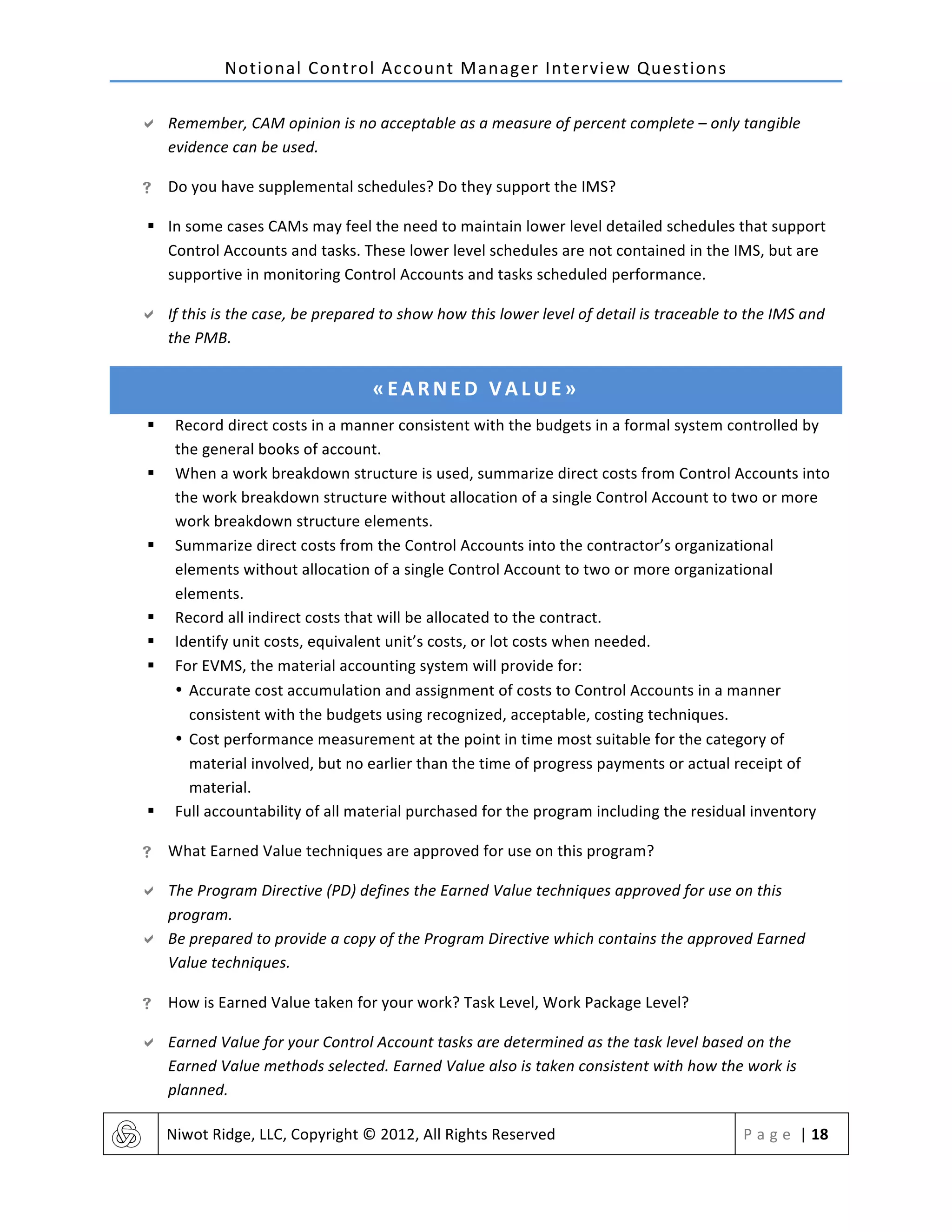
" Remember,	
  CAM	
  opinion	
  is	
  no	
  acceptable	
  as	
  a	
  measure	
  of	
  percent	
  complete	
  –	
  only	
  tangible	
  
evidence	
  can	
  be	
  used.	
  
! Do	
  you	
  have	
  supplemental	
  schedules?	
  Do	
  they	
  support	
  the	
  IMS?	
  
§ In	
  some	
  cases	
  CAMs	
  may	
  feel	
  the	
  need	
  to	
  maintain	
  lower	
  level	
  detailed	
  schedules	
  that	
  support	
  
Control	
  Accounts	
  and	
  tasks.	
  These	
  lower	
  level	
  schedules	
  are	
  not	
  contained	
  in	
  the	
  IMS,	
  but	
  are	
  
supportive	
  in	
  monitoring	
  Control	
  Accounts	
  and	
  tasks	
  scheduled	
  performance.	
  
" If	
  this	
  is	
  the	
  case,	
  be	
  prepared	
  to	
  show	
  how	
  this	
  lower	
  level	
  of	
  detail	
  is	
  traceable	
  to	
  the	
  IMS	
  and	
  
the	
  PMB.	
  
«EARNED	
  VALUE»	
  
§ Record	
  direct	
  costs	
  in	
  a	
  manner	
  consistent	
  with	
  the	
  budgets	
  in	
  a	
  formal	
  system	
  controlled	
  by	
  
the	
  general	
  books	
  of	
  account.	
  
§ When	
  a	
  work	
  breakdown	
  structure	
  is	
  used,	
  summarize	
  direct	
  costs	
  from	
  Control	
  Accounts	
  into	
  
the	
  work	
  breakdown	
  structure	
  without	
  allocation	
  of	
  a	
  single	
  Control	
  Account	
  to	
  two	
  or	
  more	
  
work	
  breakdown	
  structure	
  elements.	
  
§ Summarize	
  direct	
  costs	
  from	
  the	
  Control	
  Accounts	
  into	
  the	
  contractor’s	
  organizational	
  
elements	
  without	
  allocation	
  of	
  a	
  single	
  Control	
  Account	
  to	
  two	
  or	
  more	
  organizational	
  
elements.	
  
§ Record	
  all	
  indirect	
  costs	
  that	
  will	
  be	
  allocated	
  to	
  the	
  contract.	
  
§ Identify	
  unit	
  costs,	
  equivalent	
  unit’s	
  costs,	
  or	
  lot	
  costs	
  when	
  needed.	
  
§ For	
  EVMS,	
  the	
  material	
  accounting	
  system	
  will	
  provide	
  for:	
  
• Accurate	
  cost	
  accumulation	
  and	
  assignment	
  of	
  costs	
  to	
  Control	
  Accounts	
  in	
  a	
  manner	
  
consistent	
  with	
  the	
  budgets	
  using	
  recognized,	
  acceptable,	
  costing	
  techniques.	
  
• Cost	
  performance	
  measurement	
  at	
  the	
  point	
  in	
  time	
  most	
  suitable	
  for	
  the	
  category	
  of	
  
material	
  involved,	
  but	
  no	
  earlier	
  than	
  the	
  time	
  of	
  progress	
  payments	
  or	
  actual	
  receipt	
  of	
  
material.	
  
§ Full	
  accountability	
  of	
  all	
  material	
  purchased	
  for	
  the	
  program	
  including	
  the	
  residual	
  inventory	
  
! What	
  Earned	
  Value	
  techniques	
  are	
  approved	
  for	
  use	
  on	
  this	
  program?	
  
" The	
  Program	
  Directive	
  (PD)	
  defines	
  the	
  Earned	
  Value	
  techniques	
  approved	
  for	
  use	
  on	
  this	
  
program.	
  
" Be	
  prepared	
  to	
  provide	
  a	
  copy	
  of	
  the	
  Program	
  Directive	
  which	
  contains	
  the	
  approved	
  Earned	
  
Value	
  techniques.	
  
! How	
  is	
  Earned	
  Value	
  taken	
  for	
  your	
  work?	
  Task	
  Level,	
  Work	
  Package	
  Level?	
  
" Earned	
  Value	
  for	
  your	
  Control	
  Account	
  tasks	
  are	
  determined	
  as	
  the	
  task	
  level	
  based	
  on	
  the	
  
Earned	
  Value	
  methods	
  selected.	
  Earned	
  Value	
  also	
  is	
  taken	
  consistent	
  with	
  how	
  the	
  work	
  is	
  
planned.	
  
Notional	
  Control	
  Account	
  Manager	
  Interview	
  Questions	
  
	
   Niwot	
  Ridge,	
  LLC,	
  Copyright	
  ©	
  2012,	
  All	
  Rights	
  Reserved	
   P a g e 	
  |	
  19	


" Be	
  prepared	
  to	
  discuss	
  each	
  Control	
  Account	
  task	
  Earned	
  Value	
  technique	
  and	
  the	
  method	
  
selected	
  for	
  determining	
  earned	
  Value.	
  
! Is	
  the	
  Earned	
  Value	
  technique	
  or	
  method	
  chosen	
  appropriately	
  for	
  the	
  specific	
  task	
  or	
  work	
  
package?	
  
" Be	
  prepared	
  to	
  provide	
  a	
  rational	
  for	
  selecting	
  the	
  earned	
  value	
  method	
  for	
  each	
  task.	
  Explain	
  
why	
  the	
  earned	
  value	
  methods	
  selected	
  are	
  appropriate.	
  
! Do	
  you	
  have	
  any	
  apportioned	
  effort?	
  
" An	
  apportioned	
  earned	
  value	
  method	
  is	
  used	
  for	
  efforts	
  like	
  quality	
  assurance	
  which	
  can	
  be	
  
identified	
  and	
  measured	
  with	
  the	
  completion	
  of	
  an	
  assembly,	
  a	
  manufacturing	
  process,	
  or	
  a	
  
portion	
  thereof.	
  
" If	
  you	
  have	
  selected	
  an	
  apportioned	
  earned	
  value	
  method,	
  be	
  able	
  to	
  explain	
  the	
  BCWP	
  of	
  the	
  
base	
  or	
  parent	
  account.	
  Parent	
  apportioned	
  accounts	
  must	
  have	
  the	
  same	
  start	
  and	
  completion	
  
date.	
  Apportioned	
  accounts	
  must	
  have	
  discrete	
  effort	
  as	
  a	
  base	
  and	
  not	
  LOE.	
  BCWP	
  for	
  the	
  
apportioned	
  account	
  is	
  expressed	
  as	
  the	
  same	
  percentage	
  of	
  its	
  Budget	
  At	
  Completion	
  (BAC)	
  as	
  
the	
  BCWP	
  calculated	
  for	
  the	
  base	
  account	
  or	
  work	
  task.	
  
«CHANGE	
  CONTROL»	
  
§ Incorporate	
  authorized	
  changes	
  in	
  a	
  timely	
  manner,	
  recording	
  the	
  effects	
  of	
  such	
  changes	
  in	
  
budgets	
  and	
  schedules.	
  In	
  the	
  directed	
  effort	
  prior	
  to	
  negotiation	
  of	
  a	
  change,	
  base	
  such	
  
revisions	
  on	
  the	
  amount	
  estimated	
  and	
  budgeted	
  to	
  the	
  program	
  organizations.	
  
§ Reconcile	
  current	
  budgets	
  to	
  prior	
  budgets	
  in	
  terms	
  of	
  changes	
  to	
  the	
  authorized	
  work	
  and	
  
internal	
  replanning	
  in	
  the	
  detail	
  needed	
  by	
  management	
  for	
  effective	
  control.	
  
§ Control	
  retroactive	
  changes	
  to	
  records	
  pertaining	
  to	
  work	
  performed	
  that	
  would	
  change	
  
previously	
  reported	
  amounts	
  for	
  actual	
  costs,	
  Earned	
  Value,	
  or	
  budgets.	
  Adjustments	
  should	
  be	
  
made	
  only	
  for	
  correction	
  of	
  errors,	
  routine	
  accounting	
  adjustments,	
  effects	
  of	
  customer	
  or	
  
management	
  directed	
  changes,	
  or	
  to	
  improve	
  the	
  baseline	
  integrity	
  and	
  accuracy	
  of	
  
performance	
  measurement	
  data.	
  
§ Prevent	
  revisions	
  to	
  the	
  program	
  budget	
  except	
  for	
  authorized	
  changes.	
  
§ Document	
  changes	
  to	
  the	
  performance	
  measurement	
  baseline.	
  
! What	
  is	
  the	
  process	
  you	
  must	
  follow	
  to	
  make	
  a	
  change	
  to	
  your	
  baseline	
  budget?	
  
§ The	
  process	
  for	
  baseline	
  change	
  control	
  is	
  described	
  in	
  the	
  Earned	
  Value	
  Management	
  Systems	
  
Description.	
  It	
  should	
  read	
  something	
  like	
  this…	
  
" There	
  are	
  essentially	
  situations	
  that	
  permit	
  the	
  Performance	
  Measurement	
  Baseline	
  (PMB)	
  to	
  
change:	
  externally	
  directed	
  contract	
  changes,	
  formal	
  reprogramming,	
  and	
  internal	
  replanning.	
  
Each	
  situation	
  is	
  defines	
  and	
  described	
  in	
  the	
  EVMS	
  SD.	
  
Notional	
  Control	
  Account	
  Manager	
  Interview	
  Questions	
  
	
   Niwot	
  Ridge,	
  LLC,	
  Copyright	
  ©	
  2012,	
  All	
  Rights	
  Reserved	
   P a g e 	
  |	
  20	


" Externally	
  directed	
  contract	
  changes	
  and	
  formal	
  reprogramming	
  are	
  the	
  only	
  conditions	
  that	
  
permit	
  a	
  change	
  to	
  the	
  Contract	
  Budget	
  Base	
  (CBB)	
  and	
  both	
  require	
  permission	
  from	
  the	
  
customer.	
  	
  
" If	
  changes	
  to	
  the	
  PMB	
  are	
  within	
  the	
  constraints	
  of	
  the	
  contract	
  then	
  internal	
  replanning	
  is	
  
permitted	
  subject	
  to	
  the	
  limitation	
  of	
  the	
  EVMS	
  SD.	
  
" The	
  internal	
  budget	
  replanning	
  process	
  should	
  following	
  this	
  approach:	
  The	
  CAM	
  requests	
  a	
  
change	
  to	
  a	
  Control	
  Account(s)	
  level	
  budget	
  through	
  a	
  Requesting	
  WAD	
  and	
  reviews	
  the	
  request	
  
with	
  the	
  Program	
  Planning	
  and	
  Controls	
  lead	
  for	
  determination	
  of	
  any	
  impact	
  to	
  the	
  IMS.	
  If	
  it	
  is	
  
determined	
  that	
  the	
  change	
  will	
  impact	
  the	
  IMS,	
  then	
  the	
  process	
  for	
  internal	
  schedule	
  
replanning	
  must	
  be	
  followed.	
  
" Typically	
  this	
  internal	
  replanning	
  process	
  follows	
  these	
  steps	
  (1)	
  Intermediate	
  Management	
  and	
  
the	
  Change	
  Control	
  Board	
  (CCB)	
  approve	
  or	
  deny	
  the	
  request.	
  Approved	
  requests	
  are	
  sent	
  to	
  the	
  
Program	
  Planning	
  and	
  Control	
  Lead	
  for	
  approval	
  (2)	
  The	
  PP&C	
  Lead	
  reviews	
  and	
  approves	
  or	
  
denies	
  the	
  request;	
  (3)	
  if	
  the	
  requesting	
  WAD	
  is	
  disputed	
  or	
  involves	
  Management	
  Reserve	
  
distribution,	
  the	
  Program	
  Manager	
  makes	
  the	
  final	
  determination	
  of	
  approval;	
  (4)	
  If	
  the	
  changes	
  
are	
  to	
  occur	
  within	
  two	
  accounting	
  period	
  beyond	
  the	
  current	
  accounting	
  period,	
  the	
  Program	
  
Manager	
  or	
  Business	
  Deputy	
  notifies	
  the	
  customer	
  in	
  writing	
  of	
  the	
  change;	
  (5)	
  If	
  the	
  change	
  is	
  
approved,	
  the	
  WAD	
  is	
  sent	
  to	
  the	
  CAM.	
  The	
  CAM	
  revises	
  the	
  detailed	
  schedules	
  and	
  prepares	
  an	
  
Estimate	
  To	
  Complete	
  (ETC).	
  PP&C	
  inputs	
  the	
  data	
  into	
  the	
  cost	
  and	
  schedule	
  tools.	
  If	
  the	
  CAM	
  
states	
  in	
  the	
  Comments	
  Section	
  of	
  the	
  Requesting	
  WAD	
  that	
  this	
  ETC	
  is	
  equal	
  to	
  the	
  change	
  to	
  
the	
  time	
  phased	
  BCWS	
  (budget),	
  then	
  no	
  Estimate	
  Change	
  Request	
  (ECR)	
  is	
  required.	
  If	
  the	
  ETC	
  is	
  
different	
  than	
  the	
  time	
  phased	
  BCWS	
  on	
  the	
  Requesting	
  WAD,	
  then	
  the	
  CAM	
  must	
  submit	
  an	
  
ECR.	
  
! What	
  is	
  the	
  process	
  you	
  must	
  follow	
  to	
  make	
  a	
  change	
  to	
  your	
  baseline	
  schedule?	
  Where	
  is	
  this	
  
documented?	
  
" The	
  internal	
  schedule	
  replanning	
  process	
  is	
  usually	
  described	
  in	
  the	
  EVMS	
  Systems	
  Description.	
  
This	
  usually	
  is	
  described	
  as	
  follows:	
  
" The	
  CAM	
  submits	
  a	
  Request	
  for	
  IMS	
  Change	
  for	
  and	
  the	
  accompanying	
  IMS	
  Change	
  Request	
  
Worksheet	
  to	
  the	
  Schedule	
  Review	
  Board	
  (SRB).	
  The	
  SRB	
  includes	
  the	
  IPT	
  and	
  organizational	
  
scheduler,	
  intermediate	
  management	
  and	
  the	
  CAM.	
  The	
  SRB	
  determines	
  of	
  the	
  change	
  is	
  minor	
  
or	
  major.	
  Guidelines	
  for	
  the	
  classification	
  of	
  changes	
  is	
  usually	
  described	
  in	
  the	
  EVMS	
  System	
  
Description.	
  
" If	
  the	
  change	
  is	
  determined	
  minor,	
  then	
  the	
  forms	
  are	
  sent	
  to	
  the	
  Program	
  Master	
  Scheduler	
  for	
  
review.	
  Of	
  the	
  Program	
  Master	
  Scheduler	
  approves	
  the	
  request,	
  the	
  approved	
  forms	
  are	
  sent	
  to	
  
the	
  Schedule	
  Review	
  Board	
  (SRB)	
  and	
  evaluated.	
  Of	
  the	
  SRB	
  approves	
  the	
  change,	
  and	
  then	
  it	
  
may	
  be	
  implemented.	
  
" If	
  the	
  change	
  is	
  determined	
  major	
  by	
  the	
  SRB	
  and	
  the	
  Program	
  Master	
  Scheduler,	
  then	
  the	
  forms	
  
are	
  sent	
  to	
  the	
  Change	
  Control	
  Board	
  (CCB)	
  for	
  review.	
  If	
  the	
  CCB	
  approves	
  the	
  change,	
  the	
  
change	
  may	
  be	
  implemented.	
  
Notional	
  Control	
  Account	
  Manager	
  Interview	
  Questions	
  
	
   Niwot	
  Ridge,	
  LLC,	
  Copyright	
  ©	
  2012,	
  All	
  Rights	
  Reserved	
   P a g e 	
  |	
  21	


" If	
  approved	
  changes	
  are	
  to	
  occur	
  within	
  two	
  accounting	
  periods	
  beyond	
  the	
  current	
  accounting	
  
period,	
  the	
  Program	
  Manager	
  or	
  Business	
  Deputy	
  notifies	
  the	
  customer	
  in	
  writing	
  of	
  the	
  change.	
  
" As	
  soon	
  as	
  practical	
  WAD(s)	
  are	
  updated	
  to	
  reflect	
  the	
  schedule	
  change.	
  
! What	
  was	
  the	
  last	
  change	
  to	
  one	
  of	
  your	
  Control	
  Accounts?	
  
" Be	
  prepared	
  to	
  describe	
  this	
  change,	
  the	
  reason	
  for	
  the	
  change	
  
" Be	
  able	
  to	
  show	
  the	
  latest	
  revised	
  IMS	
  resulting	
  from	
  the	
  change	
  and	
  the	
  affected	
  Control	
  
Accounts	
  and	
  any	
  Work	
  Packages	
  affected	
  by	
  the	
  change.	
  
" If	
  no	
  changes	
  were	
  made	
  to	
  the	
  work	
  packages,	
  describe	
  the	
  process	
  used	
  to	
  make	
  a	
  change.	
  
! Were	
  any	
  changes	
  performed	
  in	
  the	
  last	
  60	
  days?	
  
" Walk	
  through	
  the	
  last	
  change	
  you	
  made	
  to	
  a	
  Control	
  Account.	
  
" If	
  no	
  changes	
  were	
  made,	
  describe	
  the	
  process	
  used	
  to	
  make	
  a	
  change	
  
! Were	
  all	
  appropriate	
  documents	
  used	
  to	
  process	
  the	
  change?	
  
" Show	
  the	
  requesting	
  WAD	
  or	
  IMS	
  change	
  request	
  involved.	
  
! What	
  is	
  the	
  difference	
  between	
  the	
  classes	
  of	
  change	
  defined	
  in	
  your	
  change	
  control	
  
management	
  system?	
  
" Class	
  1	
  changes	
  are	
  usually	
  out	
  of	
  scope	
  to	
  the	
  contract.	
  Class	
  I	
  changes	
  are	
  customer	
  directed	
  
(authorized	
  negotiated	
  work	
  scope	
  or	
  authorized	
  unpriced	
  work	
  scope).	
  All	
  contract	
  baseline	
  
changes	
  must	
  be	
  authorized	
  by	
  a	
  Program	
  Directive	
  (PD)	
  or	
  Operations	
  Directive	
  (OD)	
  and	
  
directed	
  by	
  Work	
  Authorization	
  Documents	
  (WAD)	
  
" Class	
  2	
  changes	
  are	
  in	
  scope	
  to	
  the	
  contract	
  but	
  out	
  of	
  scope	
  to	
  the	
  CAM	
  or	
  Control	
  Account.	
  
Class	
  2	
  changes	
  are	
  classified	
  to	
  internal	
  revisions	
  to	
  the	
  baseline.	
  They	
  are	
  either	
  within	
  the	
  
baseline	
  scope	
  or	
  are	
  changes	
  to	
  the	
  baseline	
  scope	
  which	
  requires	
  a	
  transfer	
  from	
  Management	
  
Reserve	
  (MR).	
  
! Were	
  the	
  changes	
  performed	
  in	
  a	
  timely	
  manner?	
  
" Changes	
  to	
  the	
  baseline	
  must	
  be	
  accomplished	
  in	
  a	
  timely	
  manner.	
  Revisions	
  to	
  the	
  budget	
  and	
  
schedule	
  must	
  be	
  completed	
  and	
  input	
  to	
  the	
  cost	
  and	
  schedule	
  tool	
  within	
  60	
  calendar	
  days	
  
after	
  authorization	
  of	
  a	
  change.	
  Work	
  authorizing	
  documents	
  and	
  schedules	
  must	
  be	
  amended	
  
where	
  appropriate	
  
! What	
  is	
  the	
  acceptable	
  use	
  of	
  management	
  reserve?	
  
" The	
  acceptable	
  use	
  of	
  Management	
  Reserve	
  (MR)	
  is	
  described	
  in	
  the	
  EVMS	
  Systems	
  Description	
  
and	
  a	
  sample	
  is	
  stated	
  below	
  
" Management	
  Reserve	
  (MR)	
  is	
  a	
  budget	
  account	
  established	
  by	
  Program	
  Management	
  for	
  use	
  in	
  
accommodating	
  growth	
  in	
  the	
  current	
  work	
  scope,	
  rate	
  changes,	
  and	
  other	
  program	
  unknowns.	
  
MR	
  must	
  be	
  held	
  for	
  current	
  and	
  future	
  needs.	
  Because	
  it	
  is	
  a	
  control	
  tool,	
  actual	
  and	
  Earned	
  
Notional	
  Control	
  Account	
  Manager	
  Interview	
  Questions	
  
	
   Niwot	
  Ridge,	
  LLC,	
  Copyright	
  ©	
  2012,	
  All	
  Rights	
  Reserved	
   P a g e 	
  |	
  22	


Value	
  are	
  never	
  allocated	
  to	
  the	
  MR	
  account.	
  It	
  must	
  be	
  not	
  allocated	
  to	
  offset	
  accumulated	
  
overruns	
  or	
  underruns.	
  MR	
  is	
  not	
  a	
  contingency	
  that	
  can	
  be	
  eliminated	
  from	
  contract	
  prices	
  
during	
  subsequent	
  negotiations.	
  It	
  must	
  not	
  be	
  used	
  to	
  absorb	
  the	
  cost	
  of	
  out-­‐of-­‐scope	
  contract	
  
changes.	
  The	
  customer	
  must	
  not	
  view	
  this	
  budget	
  reserve	
  as	
  a	
  source	
  of	
  funding	
  for	
  added	
  work	
  
scope.	
  
" In	
  some	
  instances	
  the	
  Program	
  Manager	
  may	
  elect	
  to	
  add	
  work	
  scope	
  to	
  what	
  has	
  already	
  been	
  
authorized	
  and	
  budgeted	
  and	
  /	
  or	
  CAMs	
  may	
  wish	
  to	
  request	
  MR	
  funds.	
  For	
  example:	
  there	
  may	
  
be	
  a	
  change	
  in	
  the	
  number	
  of	
  components	
  or	
  an	
  insignificant	
  amount	
  of	
  budget	
  transfer	
  
accompanying	
  a	
  transfer	
  in	
  work	
  scope.	
  New	
  or	
  revised	
  work	
  must	
  be	
  judged	
  to	
  be	
  within	
  the	
  
scope	
  of	
  the	
  existing	
  contract.	
  Technical	
  breakthroughs	
  or	
  improved	
  manufacturing	
  processes	
  
may	
  allow	
  previously	
  authorized	
  and	
  budgeted	
  work	
  to	
  be	
  canceled	
  or	
  reduced	
  in	
  scope.	
  In	
  these	
  
cases,	
  budgets	
  may	
  be	
  transferred	
  to	
  MR	
  from	
  the	
  affected	
  Control	
  Accounts.	
  WADs	
  and	
  
schedules	
  must	
  be	
  prepared	
  or	
  revised	
  as	
  necessary.	
  Budgets	
  must	
  be	
  issued	
  through	
  an	
  
approved	
  WAD	
  and	
  charge	
  numbers	
  opened	
  or	
  closed	
  as	
  necessary.	
  Consideration	
  of	
  potential	
  
liens	
  or	
  givebacks	
  to	
  MR	
  must	
  be	
  given	
  as	
  well	
  
" Changes	
  to	
  overhead	
  or	
  General	
  and	
  Administrative	
  (G&A)	
  rates	
  can	
  have	
  a	
  significant	
  impact	
  on	
  
budgets.	
  Revised	
  reporting	
  could	
  be	
  significantly	
  different	
  from	
  the	
  existing	
  rates	
  affecting	
  
budgets.	
  When	
  the	
  effect	
  of	
  a	
  burden	
  rate	
  change	
  is	
  so	
  great	
  that	
  the	
  budget	
  becomes	
  
unrealistic,	
  MR	
  may	
  be	
  used	
  to	
  compensate	
  for	
  the	
  rate	
  change.	
  
! What	
  would	
  you	
  do	
  of	
  your	
  requests	
  for	
  additional	
  resources	
  were	
  denied?	
  
" If	
  a	
  Requesting	
  Work	
  Authorization	
  Document	
  (WAD)	
  initiated	
  by	
  the	
  CAM	
  requesting	
  additional	
  
resources	
  was	
  denied,	
  then	
  the	
  CAM	
  must	
  (1)	
  maintain	
  a	
  copy	
  of	
  the	
  denied	
  WAD	
  to	
  reflect	
  
additional	
  budget	
  was	
  requested	
  and	
  disapproved;	
  (2)	
  initiate	
  and	
  submit	
  and	
  Estimate	
  Change	
  
Request	
  (ECR)	
  from	
  to	
  identify	
  the	
  resources	
  required	
  for	
  the	
  appropriate	
  Control	
  Account	
  and	
  to	
  
revise	
  the	
  Estimate	
  To	
  Complete	
  (ETC).	
  
! Who	
  initiates	
  requests	
  for	
  opening	
  and	
  closing	
  charge	
  numbers?	
  
" You	
  do.	
  CAMs	
  must	
  request	
  new	
  WBS	
  charge	
  numbers	
  be	
  opened	
  for	
  controls	
  accounts	
  that	
  are	
  
scheduled	
  to	
  commence	
  in	
  the	
  near	
  future.	
  WBS	
  charge	
  numbers	
  are	
  opened	
  or	
  closed	
  by	
  
authorized	
  Program	
  Planning	
  and	
  Controls	
  staff	
  using	
  an	
  appropriate	
  charge	
  number	
  form.	
  
! Is	
  it	
  permissible	
  to	
  make	
  changes	
  to	
  the	
  Budgeted	
  Cost	
  of	
  Work	
  Scheduled	
  or	
  Actual	
  Cost	
  of	
  
Work	
  Performed?	
  
" Yes,	
  but	
  under	
  limited	
  conditions.	
  Retroactive	
  changes	
  to	
  Budgeted	
  Cost	
  for	
  Work	
  Scheduled	
  
(BCWS)	
  may	
  be	
  made	
  only	
  to	
  correct	
  clerical	
  errors	
  or	
  to	
  make	
  customer	
  authorized	
  changes.	
  
Routine	
  accounting	
  adjustments	
  to	
  cumulative	
  BCWS	
  can	
  be	
  accomplished	
  only	
  through	
  a	
  
current	
  month	
  adjustment	
  and	
  not	
  retroactively.	
  
" Retroactive	
  changes	
  to	
  actual	
  cost	
  may	
  not	
  be	
  made	
  except	
  for	
  correction	
  of	
  clerical	
  errors	
  or	
  
normal	
  accounting	
  adjustments.	
  Adjustments	
  must	
  be	
  reflected	
  in	
  the	
  accounting	
  records	
  for	
  the	
  
Notional	
  Control	
  Account	
  Manager	
  Interview	
  Questions	
  
	
   Niwot	
  Ridge,	
  LLC,	
  Copyright	
  ©	
  2012,	
  All	
  Rights	
  Reserved	
   P a g e 	
  |	
  23	


month	
  the	
  adjustments	
  are	
  made.	
  The	
  categories	
  of	
  adjustments	
  are:	
  (1)	
  non	
  labor,	
  (2)	
  labor	
  
current	
  year,	
  (3)	
  labor	
  prior	
  year.	
  
«ANALYSIS»	
  
§ At	
  least	
  on	
  a	
  monthly	
  basis,	
  generate	
  the	
  following	
  information	
  at	
  the	
  Control	
  Account	
  and	
  
other	
  levels	
  as	
  necessary	
  for	
  management	
  control	
  using	
  actual	
  cost	
  data	
  from,	
  or	
  reconcilable	
  
with,	
  the	
  accounting	
  system:	
  
♦ Comparison	
  of	
  the	
  amount	
  of	
  planned	
  budget	
  and	
  the	
  amount	
  of	
  budget	
  earned	
  for	
  work	
  
accomplished.	
  This	
  comparison	
  provides	
  the	
  schedule	
  variance.	
  
♦ Comparison	
  of	
  the	
  amount	
  of	
  the	
  budget	
  earned	
  the	
  actual	
  (applied	
  where	
  appropriate)	
  
direct	
  costs	
  for	
  the	
  same	
  work.	
  This	
  comparison	
  provides	
  the	
  cost	
  variance.	
  
§ Identify,	
  at	
  least	
  monthly,	
  the	
  significant	
  differences	
  between	
  both	
  planned	
  and	
  actual	
  
schedule	
  performance	
  and	
  planned	
  and	
  actual	
  cost	
  performance,	
  and	
  provide	
  the	
  reasons	
  for	
  
the	
  variances	
  in	
  the	
  detail	
  needed	
  by	
  program	
  management.	
  
§ Identify	
  budgeted	
  and	
  applied	
  (or	
  actual)	
  indirect	
  costs	
  at	
  the	
  level	
  and	
  frequency	
  needed	
  by	
  
management	
  for	
  effective	
  control,	
  along	
  with	
  the	
  reasons	
  for	
  any	
  significant	
  variances.	
  
§ Summarize	
  the	
  data	
  elements	
  and	
  associated	
  variances	
  through	
  the	
  program	
  organization	
  
and/or	
  work	
  breakdown	
  structure	
  to	
  support	
  management	
  needs	
  and	
  any	
  customer	
  reporting	
  
specified	
  in	
  the	
  contract.	
  
§ Implement	
  managerial	
  actions	
  taken	
  as	
  the	
  result	
  of	
  Earned	
  Value	
  information.	
  
§ Develop	
  revised	
  estimates	
  of	
  cost	
  at	
  completion	
  based	
  on	
  performance	
  to	
  date,	
  commitment	
  
values	
  for	
  material,	
  and	
  estimates	
  of	
  future	
  conditions.	
  Compare	
  this	
  information	
  with	
  the	
  
performance	
  measurement	
  baseline	
  to	
  identify	
  variances	
  at	
  completion	
  important	
  to	
  company	
  
management	
  and	
  any	
  applicable	
  customer	
  reporting	
  requirements	
  including	
  statements	
  of	
  
funding	
  requirements.	
  
! Show	
  how	
  you	
  monitor	
  who	
  charges	
  your	
  Control	
  Account	
  
" By	
  using	
  the	
  Systems,	
  Applications,	
  Products	
  data	
  processing	
  (SAP)	
  or	
  equivalent	
  weekly	
  actual	
  
cost	
  reports.	
  These	
  reports	
  are	
  generated	
  and	
  distributed	
  weekly	
  by	
  Cost	
  Management	
  and	
  
Program	
  Controls.	
  Each	
  CAM	
  must	
  review	
  the	
  SAP	
  actual	
  cost	
  reports	
  on	
  a	
  weekly	
  basis	
  and	
  
assess	
  proper	
  charging	
  practices.	
  If	
  resources	
  aren’t	
  recognized	
  or	
  incorrect	
  charging	
  practices	
  
occur,	
  a	
  Current	
  Year	
  Labor	
  Cost	
  Transfer	
  form	
  must	
  be	
  completed	
  and	
  submitted	
  to	
  correct	
  any	
  
charging	
  anomalies.	
  
! How	
  does	
  Earned	
  Value	
  get	
  into	
  the	
  cost	
  accounting	
  system?	
  How	
  do	
  you	
  verify	
  what	
  was	
  
submitted?	
  
" The	
  Program	
  Directive	
  defines	
  the	
  Earned	
  Value	
  techniques	
  approved	
  for	
  use	
  on	
  the	
  program.	
  
Earned	
  Value	
  for	
  your	
  Control	
  Account	
  tasks	
  is	
  based	
  on	
  the	
  Earned	
  Value	
  methods	
  selected.	
  
Earned	
  Value	
  is	
  taken	
  consistent	
  with	
  how	
  the	
  work	
  is	
  planned.	
  
Notional	
  Control	
  Account	
  Manager	
  Interview	
  Questions	
  
	
   Niwot	
  Ridge,	
  LLC,	
  Copyright	
  ©	
  2012,	
  All	
  Rights	
  Reserved	
   P a g e 	
  |	
  24	


" On	
  a	
  monthly	
  basis	
  (month-­‐end)	
  Program	
  Planning	
  and	
  Controls	
  and	
  the	
  CAM	
  assess	
  each	
  work	
  
package	
  and	
  the	
  tasks	
  in	
  the	
  Work	
  Package	
  to	
  assure	
  progress	
  and	
  Earned	
  Value	
  is	
  taken	
  in	
  
accordance	
  with	
  the	
  method	
  selected.	
  
" After	
  this	
  process	
  is	
  complete	
  the	
  planning	
  tool’s	
  Earned	
  Value	
  is	
  uploaded	
  to	
  the	
  Cost	
  
Management	
  system	
  for	
  pricing	
  and	
  cost	
  analysis.	
  Once	
  the	
  Cost	
  System	
  has	
  been	
  uploaded	
  the	
  
Organizational	
  Performance	
  Reports	
  (OPR)	
  are	
  generated	
  to	
  validate	
  the	
  Earned	
  Value	
  taken.	
  
! How	
  do	
  you	
  use	
  weekly	
  labor	
  actual	
  reports	
  and	
  organizational	
  performance	
  reports?	
  
" Actual	
  cost	
  reports	
  are	
  generated	
  and	
  distributed	
  weekly	
  by	
  PP&C.	
  each	
  CAM	
  must	
  review	
  these	
  
actual	
  cost	
  reports	
  on	
  a	
  weekly	
  basis	
  to	
  assess	
  the	
  impacts	
  to	
  current	
  and	
  cumulative	
  cost	
  
variances	
  by	
  Control	
  Account.	
  
" Organizational	
  Performance	
  Reports	
  are	
  generated	
  from	
  the	
  Cost	
  System	
  each	
  month-­‐end	
  to	
  
reflect	
  BCWS,	
  BCWP,	
  ACWP,	
  Schedule	
  Variance,	
  Cost	
  Variance,	
  and	
  Variance	
  at	
  Completion	
  for	
  
the	
  current	
  period,	
  cumulative	
  to	
  date	
  and	
  at	
  completion	
  data	
  by	
  Control	
  Account	
  and	
  by	
  
resource.	
  
! What	
  weekly	
  and	
  monthly	
  meetings	
  do	
  you	
  attend	
  where	
  your	
  schedule	
  and	
  cost	
  performance	
  
is	
  discussed?	
  
§ Schedule	
  review	
  meetings	
  are	
  held	
  weekly	
  and	
  monthly	
  as	
  outlined	
  in	
  a	
  Business	
  Rhythms	
  
Calendar.	
  During	
  these	
  meetings	
  each	
  CAM	
  must	
  present	
  schedule	
  progress	
  and	
  monthly	
  
performance,	
  schedule	
  metric	
  reports,	
  risks,	
  risk	
  mitigation	
  plans,	
  etc.	
  CAMs	
  must	
  be	
  prepared	
  
to	
  discuss	
  all	
  details	
  relating	
  to	
  any	
  problems	
  and	
  proposed	
  resolutions	
  concerning	
  their	
  Control	
  
Accounts.	
  
§ CAMs	
  and	
  Program	
  Managers	
  must	
  review	
  schedule	
  status	
  at	
  the	
  Weekly	
  Program	
  Control	
  
meeting.	
  This	
  meeting	
  is	
  an	
  internal	
  review	
  in	
  which	
  the	
  Technical	
  and	
  Intermediate	
  Managers,	
  
and	
  CAMs	
  present	
  schedule	
  information	
  to	
  the	
  Program	
  Manager.	
  
" Be	
  prepared	
  to	
  discuss	
  other	
  pertinent	
  business	
  meeting	
  where	
  your	
  scope	
  of	
  performance	
  is	
  
reviewed.	
  
! Show	
  your	
  latest	
  variance	
  analysis	
  report.	
  Has	
  it	
  been	
  reviewed	
  and	
  approved?	
  
§ This	
  report	
  is	
  provided	
  from	
  the	
  Cost	
  Management	
  System	
  and	
  used	
  as	
  required.	
  
§ With	
  this	
  report	
  the	
  CAM	
  can	
  speak	
  directly	
  to	
  the	
  performance	
  of	
  the	
  Control	
  Account	
  and	
  the	
  
Work	
  Packages	
  that	
  make	
  up	
  the	
  CA	
  
" Be	
  prepared	
  to	
  explain	
  variances	
  or	
  trending	
  thresholds	
  that	
  determine	
  how	
  you	
  take	
  corrective	
  
actions	
  for	
  your	
  Control	
  Account.	
  
! Is	
  the	
  root	
  cause	
  of	
  the	
  variance	
  drivers	
  clearly	
  and	
  accurately	
  identified?	
  
" Be	
  prepared	
  to	
  explain	
  the	
  root	
  causes	
  of	
  any	
  variances	
  shown	
  in	
  the	
  Variance	
  Analysis	
  Report	
  
Notional	
  Control	
  Account	
  Manager	
  Interview	
  Questions	
  
	
   Niwot	
  Ridge,	
  LLC,	
  Copyright	
  ©	
  2012,	
  All	
  Rights	
  Reserved	
   P a g e 	
  |	
  25	


! Has	
  the	
  impact	
  to	
  other	
  Control	
  Accounts	
  or	
  the	
  program	
  been	
  identified?	
  
" Be	
  prepared	
  to	
  explain	
  the	
  impacts	
  to	
  other	
  Control	
  Accounts	
  and	
  the	
  Program.	
  
! If	
  recoverable,	
  has	
  a	
  corrective	
  action	
  plan	
  been	
  identified?	
  
" Be	
  prepared	
  to	
  explain	
  your	
  corrective	
  action	
  plan.	
  
! Does	
  the	
  schedule	
  variance	
  correlate	
  with	
  the	
  schedule	
  status?	
  
" Be	
  prepared	
  to	
  explain	
  how	
  the	
  schedule	
  variance	
  is	
  correlated	
  with	
  the	
  schedule	
  status.	
  	
  
! Who	
  reviewed	
  and	
  approves	
  the	
  variance	
  analysis	
  reports?	
  
" The	
  approval	
  signatures	
  for	
  a	
  Control	
  Account	
  variance	
  analysis	
  for	
  are:	
  (a)	
  The	
  Control	
  Account	
  
Manager	
  (CAM);	
  (b)	
  the	
  Intermediate	
  Manager	
  or	
  Business	
  Manager;	
  (c)	
  the	
  Program	
  Manager	
  
or	
  Director.	
  
! How	
  do	
  you	
  use	
  the	
  organizations	
  performance	
  reports	
  or	
  their	
  equivalents?	
  
" Organizational	
  Performance	
  Reports	
  (OPRs)	
  are	
  generated	
  from	
  the	
  Cost	
  Management	
  System	
  
each	
  month	
  end	
  to	
  reflect	
  BCWS,	
  BCWP,	
  ACWP,	
  schedule	
  variance,	
  cost	
  variance,	
  and	
  variance	
  at	
  
completion	
  for	
  the	
  current	
  period	
  and	
  cumulative	
  to	
  date	
  and	
  at	
  completion	
  data	
  by	
  Control	
  
Account.	
  
" The	
  OPR	
  is	
  the	
  official	
  Cost	
  Management	
  System	
  document	
  used	
  to	
  identify	
  and	
  status	
  all	
  
variance	
  analyses	
  for	
  each	
  Control	
  Account.	
  Be	
  prepared	
  to	
  provide	
  the	
  OPR	
  for	
  all	
  your	
  Control	
  
Accounts.	
  Be	
  able	
  to	
  explain	
  all	
  variance	
  calculations	
  and	
  indices	
  referenced	
  along	
  with	
  their	
  
impacts	
  to	
  your	
  Control	
  Accounts.	
  
" Some	
  type	
  of	
  Performance	
  Management	
  Fact	
  Sheet	
  contain	
  all	
  variance	
  analyses,	
  indices	
  and	
  
percentage	
  calculations	
  must	
  be	
  contained	
  in	
  your	
  CAM	
  Notebook	
  
! Show	
  and	
  explain	
  your	
  CPI	
  and	
  SPI	
  values	
  that	
  support	
  your	
  TCPI	
  values?	
  
" Be	
  prepared	
  to	
  show	
  your	
  CPI	
  and	
  SPI	
  values	
  from	
  the	
  Cost	
  Management	
  System	
  performance	
  
reports	
  and	
  how	
  they	
  support	
  the	
  To	
  Complete	
  Performance	
  Index.	
  
! What	
  drives	
  your	
  variances?	
  
" The	
  following	
  are	
  explanations	
  that	
  must	
  be	
  considered	
  tin	
  order	
  to	
  address	
  properly	
  favorable	
  
or	
  unfavorable	
  cost	
  and	
  schedule	
  performance	
  measurement	
  variance	
  analysis	
  problem	
  
statements:	
  
" Cost	
  Variance	
  –	
  problem	
  statement	
  (favorable	
  or	
  unfavorable)	
  
" BCWP	
  >	
  BCWS	
  –	
  favorable	
  variance	
  explanations	
  
" The	
  task	
  is	
  less	
  complex	
  and	
  will	
  be	
  completed	
  earlier	
  than	
  planned	
  
" Early	
  effort	
  has	
  been	
  confined	
  to	
  tasks	
  which	
  are	
  less	
  complex	
  than	
  those	
  that	
  follow	
  
" The	
  task	
  has	
  been	
  overstaffed	
  early	
  in	
  order	
  to	
  recognize	
  the	
  establishment	
  of	
  a	
  higher	
  priority	
  
Notional	
  Control	
  Account	
  Manager	
  Interview	
  Questions	
  
	
   Niwot	
  Ridge,	
  LLC,	
  Copyright	
  ©	
  2012,	
  All	
  Rights	
  Reserved	
   P a g e 	
  |	
  26	


" Deliverables	
  of	
  hardware	
  have	
  been	
  accomplished	
  in	
  advance	
  of	
  need	
  date	
  
" Earned	
  Value	
  may	
  be	
  incorrect	
  and	
  require	
  an	
  adjustment	
  in	
  the	
  next	
  reporting	
  period	
  
" The	
  plan	
  is	
  time	
  phased	
  poorly	
  and	
  the	
  current	
  status	
  is	
  not	
  reflective	
  of	
  what	
  is	
  really	
  happening	
  
" BCWP	
  <	
  BCWS	
  –	
  unfavorable	
  variance	
  explanation	
  
" The	
  task	
  is	
  more	
  complex	
  than	
  originally	
  planned	
  
" Early	
  effort	
  has	
  been	
  more	
  complex	
  than	
  the	
  effort	
  that	
  follows	
  
" Delays	
  in	
  staffing	
  have	
  slowed	
  progress	
  
" Hardware	
  deliverables	
  are	
  late	
  
" Design	
  of	
  rework	
  activities	
  has	
  delayed	
  progress	
  
" Software	
  deliverables	
  are	
  late	
  
" Data	
  from	
  another	
  organization	
  (drawings	
  or	
  technical	
  analysis)	
  has	
  been	
  late	
  
" Additional	
  requirements	
  have	
  been	
  established	
  or	
  changed	
  
" Higher	
  priority	
  has	
  been	
  establishes	
  on	
  other	
  work	
  
" The	
  plan	
  is	
  time	
  phased	
  poorly	
  
" Schedule	
  Variance	
  –	
  favorable	
  or	
  unfavorable	
  explanations	
  
" The	
  complexity	
  of	
  the	
  task	
  is	
  less	
  than	
  originally	
  estimated	
  
" The	
  less	
  complex	
  tasks	
  have	
  been	
  completed	
  early	
  
" The	
  task	
  is	
  primarily	
  LOE	
  and	
  not	
  been	
  fully	
  staffed	
  
" The	
  plan	
  is	
  time	
  phased	
  poorly	
  
" BCWP	
  <	
  BCWS	
  –	
  unfavorable	
  
" The	
  task	
  is	
  more	
  complex	
  than	
  originally	
  planned	
  
" The	
  more	
  complex	
  tasks	
  have	
  been	
  complete	
  early	
  
" Program	
  priorities	
  have	
  resulted	
  in	
  application	
  of	
  resources	
  in	
  an	
  inefficient	
  manner	
  –	
  more	
  
overtime	
  or	
  additional	
  staffing	
  
" Delays	
  in	
  receipt	
  of	
  data	
  have	
  resulted	
  in	
  implementation	
  of	
  workarounds	
  to	
  make	
  schedule.	
  
More	
  overtime	
  or	
  additional	
  staffing	
  
" Changes,	
  redesign,	
  additional	
  requirements,	
  or	
  out-­‐of-­‐scope	
  effort	
  
" The	
  plan	
  is	
  time	
  phased	
  poorly	
  
" Rate	
  or	
  usage	
  variance	
  
«RISK»	
  
§ DID	
  81650	
  calls	
  out	
  a	
  Statistical	
  Risk	
  Analysis	
  (SRA)	
  for	
  the	
  Integrated	
  Master	
  Schedule	
  (IMS).	
  	
  
§ The	
  risk	
  management	
  of	
  the	
  technical	
  aspects	
  of	
  the	
  program	
  should	
  be	
  included	
  in	
  the	
  IMS	
  as	
  
well.	
  
§ Technical	
  risk	
  management	
  is	
  guided	
  by	
  the	
  specific	
  procurement	
  agency,	
  but	
  DoD	
  Risk	
  
Management	
  is	
  the	
  starting	
  document.	
  
Notional	
  Control	
  Account	
  Manager	
  Interview	
  Questions	
  
	
   Niwot	
  Ridge,	
  LLC,	
  Copyright	
  ©	
  2012,	
  All	
  Rights	
  Reserved	
   P a g e 	
  |	
  27	


! What	
  is	
  risk	
  mitigation?	
  
" Risk	
  mitigation	
  is	
  a	
  formal	
  process	
  of	
  identifying,	
  tracking	
  and	
  minimizing	
  potential	
  hazards,	
  
obstacles,	
  and	
  risks	
  to	
  successful	
  program	
  performance.	
  Risk	
  mitigation	
  is	
  described	
  more	
  
formally	
  as:	
  
" “The	
  Program	
  Manager	
  is	
  responsible	
  for	
  overseeing	
  the	
  implementation	
  and	
  maintenance	
  of	
  a	
  
program	
  Risk	
  and	
  Opportunities	
  Management	
  Plan.”	
  
" Risk	
  and	
  Opportunity	
  potentials	
  are	
  identified	
  and	
  quantified	
  at	
  both	
  the	
  Intermediate	
  
Management	
  and	
  CAM	
  levels.	
  Mitigation	
  Plans,	
  including	
  estimated	
  plan	
  costs,	
  are	
  developed	
  as	
  
necessary	
  and	
  submitted	
  either	
  to	
  Intermediate	
  Management	
  for	
  approval	
  or	
  directly	
  to	
  the	
  Risk	
  
Management	
  and	
  Opportunities	
  Board.	
  Upon	
  Board	
  approval,	
  the	
  Risk	
  Mitigation	
  Plan	
  and	
  
associated	
  cost	
  are	
  submitted	
  to	
  the	
  Program	
  Manager.	
  
" The	
  Program	
  Manager	
  approves	
  the	
  plans	
  and	
  determines	
  if	
  the	
  cost	
  will	
  be	
  funded	
  out	
  of	
  
Management	
  Reserve.	
  If	
  so,	
  the	
  Program	
  Manager	
  directs	
  Program	
  Planning	
  and	
  Controls	
  to	
  
issue	
  a	
  WAS	
  to	
  Intermediate	
  Management	
  or	
  CAM	
  so	
  the	
  appropriate	
  Control	
  Account(s)	
  can	
  
then	
  be	
  replanned	
  and	
  input	
  through	
  Program	
  Planning	
  and	
  Controls	
  to	
  the	
  Cost	
  Management	
  
System.	
  If	
  the	
  Program	
  Manager	
  decides	
  the	
  Mitigation	
  Plan	
  will	
  not	
  be	
  funded	
  out	
  of	
  MR,	
  
Program	
  Planning	
  and	
  Controls	
  notifies	
  the	
  CAM	
  who	
  prepares	
  and	
  submits	
  an	
  ECR	
  package,	
  
which	
  is	
  then	
  input	
  into	
  the	
  Cost	
  Management	
  System.	
  
! Do	
  you	
  have	
  adequate	
  budget	
  and	
  facilities	
  to	
  complete	
  your	
  work?	
  
" Provide	
  and	
  explain	
  as	
  required	
  
! Is	
  the	
  risk	
  high,	
  medium,	
  or	
  low?	
  
" Provide	
  and	
  explain	
  as	
  required	
  
! Are	
  there	
  any	
  cost,	
  schedule,	
  or	
  technical	
  risks	
  in	
  your	
  Control	
  Accounts?	
  
" Provide	
  and	
  explain	
  as	
  required	
  
! Have	
  the	
  risks	
  been	
  documented	
  in	
  the	
  Risk	
  Management	
  Plan?	
  
" Provide	
  and	
  explain	
  as	
  required	
  
! Are	
  you	
  risk	
  mitigation	
  activities	
  incorporated	
  in	
  the	
  IMS?	
  
" Provide	
  and	
  explain	
  as	
  required	
  
! What	
  is	
  the	
  process	
  for	
  retiring	
  or	
  closing	
  out	
  a	
  risk	
  when	
  the	
  mitigation	
  plan	
  is	
  successful?	
  
" Once	
  an	
  identified	
  risk	
  has	
  been	
  successfully	
  mitigated	
  in	
  accordance	
  with	
  the	
  Risk	
  Mitigation	
  
Plan,	
  the	
  final	
  risk	
  action	
  plan	
  must	
  be	
  reviewed	
  by	
  the	
  Risk	
  Management	
  Board	
  for	
  final	
  
disposition	
  and	
  closure.	
  
Notional	
  Control	
  Account	
  Manager	
  Interview	
  Questions	
  
	
   Niwot	
  Ridge,	
  LLC,	
  Copyright	
  ©	
  2012,	
  All	
  Rights	
  Reserved	
   P a g e 	
  |	
  28	


! What	
  is	
  the	
  process	
  for	
  retiring	
  or	
  closing	
  out	
  a	
  risk	
  when	
  the	
  mitigation	
  plan	
  is	
  unsuccessful?	
  
" If	
  an	
  identified	
  risk	
  has	
  not	
  been	
  mitigated	
  completely	
  in	
  accordance	
  with	
  the	
  Risk	
  Mitigation	
  
Plan,	
  then	
  the	
  Risk	
  Management	
  Board	
  must	
  review	
  the	
  mitigation	
  plan	
  actions	
  taken	
  and	
  make	
  
appropriate	
  adjustments	
  as	
  needed	
  (mitigation	
  plans,	
  mitigation	
  times,	
  etc.).	
  The	
  Risk	
  
Management	
  Board	
  may	
  simply	
  accept	
  the	
  risk	
  level	
  as	
  is	
  and	
  continue	
  to	
  monitor	
  as	
  
appropriate.	
  These	
  actions	
  could	
  result	
  in	
  additional	
  revisions	
  to	
  the	
  Control	
  Account	
  Baseline.	
  
This	
  change	
  may	
  require	
  a	
  WAD	
  or	
  an	
  Estimate	
  Change	
  Request	
  
! Have	
  resources	
  been	
  provided	
  for	
  the	
  mitigation	
  plans?	
  
" Identify	
  any	
  resources	
  that	
  have	
  been	
  provided	
  for	
  the	
  mitigation	
  plans.	
  If	
  none	
  have	
  been	
  
provided,	
  explain	
  why?	
  
! Where	
  critical	
  skills	
  exist,	
  are	
  you	
  sufficiently	
  staffed	
  in	
  these	
  areas?	
  Do	
  you	
  have	
  succession	
  
planning	
  for	
  these	
  critical	
  areas?	
  
" Provide	
  and	
  explain	
  as	
  required	
  
«ESTIMATE	
  AT	
  COMPLETION	
  (EAC)»	


! Describe	
  the	
  process	
  you	
  use	
  to	
  update	
  your	
  EAC	
  and	
  what	
  documentation	
  is	
  used?	
  
§ The	
  acceptance	
  process	
  for	
  updating	
  the	
  Estimate	
  To	
  Complete	
  (ETC)	
  and	
  Estimate	
  At	
  
Completion	
  (EAC)	
  are	
  described	
  in	
  the	
  published	
  Earned	
  Value	
  Management	
  System	
  Description	
  
and	
  summarized	
  below	
  
§ “Every	
  month	
  CAMs	
  review	
  the	
  Control	
  Account	
  cost	
  and	
  schedule	
  data	
  and	
  assess	
  the	
  ETC	
  and	
  
EAC	
  of	
  each	
  Control	
  Account.	
  CAMs	
  make	
  an	
  assessment	
  based	
  on	
  the	
  historical	
  performance	
  of	
  
the	
  accounts	
  current	
  metrics	
  and	
  future	
  projections.”	
  
§ “The	
  projections	
  should	
  consider	
  potential	
  process	
  improvements,	
  risk	
  assessments,	
  and	
  other	
  
applicable	
  factors	
  that	
  may	
  affect	
  remaining	
  work.	
  The	
  EAC	
  is	
  updates	
  in	
  the	
  cost	
  tool	
  as	
  Actual	
  
Cost	
  for	
  Work	
  Performed	
  (ACWP)	
  replaces	
  ETC.	
  It	
  is	
  recommended	
  that	
  this	
  occur	
  monthly.	
  If	
  
not	
  monthly	
  than	
  quarterly.	
  If	
  the	
  current	
  ACWP	
  is	
  different	
  from	
  the	
  current	
  ETC	
  minor	
  
perturbations	
  will	
  result	
  in	
  the	
  EAC.	
  If	
  the	
  customer	
  mandates	
  a	
  stable	
  EAC,	
  then	
  a	
  log	
  must	
  be	
  
maintained	
  to	
  reconcile	
  internal	
  EAC	
  values	
  and	
  customer	
  reported	
  EACs.	
  
§ Where	
  Control	
  Account	
  ETC	
  changes	
  are	
  required,	
  the	
  CAM	
  generates	
  and	
  redlines	
  a	
  time	
  
phased	
  ETC.	
  The	
  change	
  request	
  form	
  is	
  completed,	
  or	
  other	
  documentation	
  that	
  contains	
  the	
  
appropriate	
  data	
  elements	
  are	
  attached	
  to	
  the	
  form.	
  The	
  Change	
  Request	
  is	
  then	
  submitted	
  to	
  
Program	
  Controls	
  for	
  review	
  
Notional	
  Control	
  Account	
  Manager	
  Interview	
  Questions	
  
	
   Niwot	
  Ridge,	
  LLC,	
  Copyright	
  ©	
  2012,	
  All	
  Rights	
  Reserved	
   P a g e 	
  |	
  29	


! How	
  do	
  you	
  update	
  your	
  Estimate	
  to	
  Compete	
  (ETC)?	
  When	
  was	
  the	
  ETC	
  last	
  updated?	
  
" The	
  Estimate	
  At	
  Completion	
  should	
  be	
  reviewed	
  monthly	
  and	
  updated	
  as	
  appropriate.	
  Provide	
  
the	
  rationale	
  for	
  the	
  latest	
  ETC	
  and	
  EAC	
  revisions.	
  
! Show	
  documentation	
  of	
  that	
  update	
  and	
  rationale	
  for	
  the	
  new	
  ETC	
  numbers.	
  
" Provide	
  and	
  explain	
  as	
  required.	
  
! Who	
  reviews	
  and	
  approves	
  your	
  ETC?	
  
" The	
  CAM,	
  Program	
  Controls,	
  and	
  the	
  Program	
  Manager	
  
! Do	
  the	
  cost	
  and	
  schedule	
  variances	
  support	
  the	
  EAC?	
  
" If	
  you	
  have	
  experienced	
  unfavorable	
  cost	
  or	
  schedule	
  variances	
  and	
  have	
  not	
  revised	
  your	
  EAC	
  
and	
  ETC	
  values,	
  then	
  the	
  following	
  actions	
  should	
  be	
  taken:	
  
" Compare	
  the	
  CPI	
  percent	
  against	
  the	
  TCPI	
  percentage.	
  Of	
  the	
  delta	
  value	
  is	
  less	
  than	
  X%	
  then	
  
your	
  EAC	
  is	
  considered	
  credible.	
  The	
  Independent	
  Estimate	
  At	
  Completion	
  (IEAC)	
  indices	
  are	
  used	
  
to	
  assess	
  the	
  validity	
  of	
  the	
  range	
  and	
  to	
  evaluate	
  the	
  realism	
  of	
  the	
  projected	
  EAC.	
  
! How	
  often	
  is	
  a	
  comprehensive	
  EAC	
  (CEAC)	
  performed?	
  
§ Each	
  program	
  should	
  performance	
  a	
  Comprehensive	
  Estimate	
  At	
  Completion	
  (CEAC)	
  using	
  a	
  
“bottoms	
  up”	
  method	
  at	
  least	
  annually.	
  This	
  date	
  should	
  be	
  defined	
  in	
  the	
  Program	
  Directive.	
  	
  
" Be	
  prepared	
  to	
  answer	
  which	
  data	
  has	
  been	
  chosen	
  for	
  your	
  program.	
  
! If	
  a	
  CEAC	
  was	
  performed,	
  show	
  your	
  memo	
  with	
  the	
  ground	
  rules	
  from	
  Program	
  Control?	
  
" Be	
  prepared	
  to	
  describe	
  what	
  ground	
  rules	
  are	
  used	
  for	
  the	
  CEAC,	
  who	
  participants	
  in	
  the	
  CEAC,	
  
and	
  how	
  the	
  program	
  Performance	
  Measurement	
  Baseline	
  (PMB)	
  is	
  adjusted	
  using	
  the	
  output	
  of	
  
the	
  CEAC.	
  
«SUBCONTRACTOR	
  MANAGEMENT»	
  
§ Do	
  any	
  of	
  your	
  Control	
  Accounts	
  contain	
  subcontractor	
  effort?	
  If	
  so,	
  answer	
  the	
  following	
  
questions:	
  
! What	
  scope	
  is	
  the	
  subcontract	
  responsible	
  for?	
  
" Subcontracts	
  and	
  or	
  inter-­‐company	
  work	
  transfer	
  agreements	
  (IWTAs)	
  scope	
  is	
  based	
  on	
  
negotiated	
  or	
  documented	
  contracted	
  work.	
  Be	
  prepared	
  to	
  discuss	
  your	
  subcontract	
  /	
  IWTA	
  
contract	
  type	
  and	
  work	
  scope	
  and	
  be	
  prepared	
  to	
  provide	
  the	
  Statement	
  of	
  Work	
  (SOW)	
  and	
  
work	
  authorization	
  for	
  each	
  subcontract	
  /	
  IWTA	
  
Notional	
  Control	
  Account	
  Manager	
  Interview	
  Questions	
  
	
   Niwot	
  Ridge,	
  LLC,	
  Copyright	
  ©	
  2012,	
  All	
  Rights	
  Reserved	
   P a g e 	
  |	
  30	


! How	
  does	
  the	
  subcontractor	
  receive	
  authorizations	
  for	
  scope,	
  schedule,	
  and	
  resources	
  from	
  the	
  
prime?	
  
§ Subcontractor	
  and	
  IWTA	
  direction	
  is	
  provided	
  by	
  the	
  contract	
  administration	
  organization	
  
through	
  a	
  negotiated	
  contract	
  or	
  a	
  contract	
  modification	
  to	
  amend	
  or	
  change	
  work	
  scope,	
  
schedule,	
  and	
  resources.	
  
! What	
  reporting	
  requirements	
  have	
  been	
  levied	
  on	
  the	
  subcontractors?	
  
§ Any	
  nonrecurring	
  or	
  development	
  subcontract	
  that	
  is	
  larger	
  than	
  $25M	
  and	
  not	
  Firm	
  Fixed	
  Price	
  
(FFP),	
  has	
  a	
  Cost	
  Performance	
  Report	
  (CPR)	
  requirement.	
  A	
  non-­‐FFP	
  sub-­‐contract	
  larger	
  than	
  
$10M,	
  but	
  less	
  than	
  $25M,	
  has	
  a	
  modified	
  Cost	
  Performance	
  Report	
  (MCPR)	
  requirement.	
  The	
  
Non-­‐FFP	
  subcontracts	
  under	
  $10M	
  have	
  minor	
  reporting	
  requirements	
  although	
  if	
  considered	
  a	
  
high	
  cost,	
  schedule,	
  or	
  technical	
  risk	
  a	
  MCPR	
  is	
  required.	
  Firm	
  Fixed	
  Price	
  contracts	
  fall	
  into	
  two	
  
categories:	
  Delivery	
  and	
  Support	
  /	
  Level	
  of	
  Effort	
  
" Be	
  prepared	
  to	
  provide	
  copies	
  of	
  the	
  latest	
  reporting	
  documentation	
  pertaining	
  to	
  your	
  
subcontracts	
  /	
  IWTAs	
  
! Are	
  the	
  subcontractor’s	
  schedules	
  status	
  weekly?	
  
" Provide	
  and	
  explain	
  as	
  required	
  
! How	
  are	
  the	
  resources	
  planned	
  for	
  the	
  subcontractors	
  (BCWS	
  spreads	
  for	
  the	
  subcontractor	
  
work	
  packages)	
  
§ The	
  budget	
  information	
  should	
  represent	
  the	
  cost	
  baseline	
  negotiated	
  or	
  proposed.	
  The	
  BCWS	
  
must	
  be	
  time-­‐phased	
  consistent	
  with	
  the	
  baseline	
  schedule	
  spans	
  negotiated	
  with	
  each	
  
subcontractor,	
  and	
  should	
  be	
  reconciled	
  to	
  the	
  reporting	
  requirement	
  documentation	
  (CPR,	
  
MCPR)	
  with	
  the	
  cost	
  management	
  system.	
  Regardless	
  of	
  the	
  Program	
  Performance	
  
Management	
  system	
  applied	
  to	
  the	
  subcontractor,	
  the	
  Program	
  Performance	
  Management	
  data	
  
must	
  be	
  reviewed	
  for	
  logic,	
  consistently,	
  and	
  validity	
  	
  
§ For	
  minor	
  subcontracts	
  the	
  CAM	
  uses	
  the	
  IMS	
  information	
  and	
  the	
  time	
  phased	
  budget	
  to	
  plan	
  
and	
  status	
  the	
  effort	
  in	
  the	
  PPM	
  cost	
  management	
  tool.	
  The	
  BCWS	
  in	
  input	
  into	
  the	
  PPM	
  Cost	
  
Tool	
  and	
  planned	
  by	
  the	
  CAM	
  using	
  the	
  time	
  phased	
  data	
  in	
  conjunction	
  with	
  the	
  schedules	
  
tasks.	
  The	
  subcontractor’s	
  scheduled	
  tasks	
  are	
  given	
  as	
  associated	
  dollar	
  value	
  using	
  the	
  
appropriate	
  Earned	
  Value	
  techniques	
  allowed	
  in	
  the	
  PPM	
  cost	
  tool.	
  The	
  recommended	
  
technciques	
  for	
  minor	
  subcontarcts	
  is	
  Percent	
  Complete	
  method.	
  It	
  provide	
  a	
  means	
  to	
  gain	
  
partial	
  earnings,	
  thereby	
  minimizing	
  erroneous	
  cost	
  and	
  schedule	
  variances.	
  
! Is	
  the	
  BCWS	
  time	
  phased	
  with	
  the	
  baseline	
  schedule	
  plans?	
  
" Be	
  prepared	
  to	
  provide	
  copies	
  of	
  your	
  sibcontracts	
  or	
  IWTAs	
  latest	
  budget	
  milestone	
  plans	
  and	
  
reporting	
  documentation,	
  and	
  show	
  traceability	
  to	
  the	
  applicable	
  Control	
  Account	
  
Notional	
  Control	
  Account	
  Manager	
  Interview	
  Questions	
  
	
   Niwot	
  Ridge,	
  LLC,	
  Copyright	
  ©	
  2012,	
  All	
  Rights	
  Reserved	
   P a g e 	
  |	
  31	


! Can	
  you	
  trace	
  the	
  budget	
  from	
  the	
  Work	
  Authorization	
  to	
  the	
  Control	
  Account	
  Plans,	
  to	
  the	
  
subcontractors?	
  
" Be	
  prepared	
  to	
  provide	
  traceability	
  for	
  each	
  subcontractor	
  /	
  IWTA	
  Work	
  Authorization	
  Document	
  
(WAD)	
  that	
  provides	
  scope,	
  schedule,	
  budget,	
  period	
  of	
  performance,	
  and	
  approvals	
  to	
  the	
  
applicable	
  PPM	
  cost	
  report	
  and	
  control	
  account	
  plan.	
  
! Can	
  you	
  trace	
  the	
  schedule	
  from	
  the	
  subcontractor’s	
  schedule	
  to	
  the	
  Control	
  Account	
  Plan,	
  to	
  
the	
  IMS?	
  
" Be	
  prepared	
  to	
  provide	
  copies	
  of	
  your	
  subcontract	
  /	
  IWTA	
  latest	
  milestone	
  plans	
  and	
  reporting	
  
documentation	
  and	
  provide	
  traceability	
  to	
  the	
  program	
  IMS	
  
! How	
  do	
  you	
  determine	
  BCWP	
  for	
  each	
  subcontractor?	
  
§ Subcontract	
  Earned	
  Value	
  Budgeted	
  Cost	
  for	
  Work	
  Performed	
  (BCWP)	
  is	
  taken	
  from	
  the	
  CPR	
  or	
  
MCPR.	
  This	
  value	
  is	
  represented	
  at	
  cost,	
  but	
  appropriate	
  fee	
  must	
  be	
  added.	
  BCWP	
  is	
  handled	
  
based	
  on	
  the	
  contract	
  type	
  and	
  fee	
  type.	
  Once	
  the	
  appropriate	
  fee	
  is	
  added	
  to	
  the	
  cost,	
  BCWP	
  
form	
  the	
  subcontract	
  CPR	
  or	
  MCPR	
  data	
  is	
  then	
  input	
  into	
  the	
  PPM	
  Cost	
  Tool.	
  	
  
" As	
  a	
  CAM	
  you	
  must	
  provide	
  a	
  sanity	
  check	
  to	
  ensure	
  that	
  the	
  Earned	
  Value	
  represented	
  in	
  the	
  
subcontract	
  reports	
  is	
  accurate	
  and	
  that	
  progress	
  has	
  been	
  assessed	
  properly	
  based	
  on	
  your	
  
knowledge	
  of	
  the	
  work	
  being	
  performed.	
  
" For	
  minor	
  subcontract	
  effort	
  the	
  CAM	
  must	
  update	
  progress	
  and	
  Earned	
  Value	
  monthly	
  on	
  both	
  
an	
  IMS	
  and	
  on	
  the	
  Work	
  Packages	
  listed	
  on	
  the	
  CAP	
  worksheets.	
  Immediately	
  upon	
  receipt	
  of	
  the	
  
subcontractor’s	
  status	
  and	
  schedule	
  data,	
  the	
  CAM	
  must	
  determine	
  the	
  current	
  Earned	
  Value	
  
(BCWP)	
  by	
  using	
  the	
  appropriate	
  approved	
  technique.	
  
" IWTAs	
  are	
  handled	
  in	
  the	
  same	
  fashion	
  as	
  previously	
  described.	
  The	
  only	
  difference	
  between	
  
subcontracts	
  and	
  IWTAs	
  is	
  that	
  no	
  fee	
  is	
  added.	
  
! What	
  are	
  the	
  thresholds	
  for	
  generating	
  a	
  variance	
  analysis	
  report	
  for	
  the	
  subcontractors?	
  
§ Variance	
  Analysis	
  thresholds	
  for	
  subcontracts	
  and	
  IWTAs	
  must	
  be	
  the	
  same	
  as,	
  or	
  are	
  greater	
  
than,	
  customer	
  directed	
  variance	
  analysis	
  reporting	
  requirements.	
  It	
  is	
  imperative	
  that	
  the	
  
subcontract	
  or	
  IWTA	
  cost	
  and	
  schedule	
  variances,	
  and	
  Variance	
  At	
  Completion	
  (VAC)	
  thresholds	
  
are	
  assessed	
  and	
  reported	
  in	
  the	
  same	
  manner	
  as	
  the	
  prime	
  contractor	
  in	
  order	
  to	
  provide	
  
uniform	
  CPR	
  Format	
  5	
  variance	
  analysis	
  narratives	
  and	
  corrective	
  actions.	
  
§ There	
  are	
  two	
  primary	
  methods	
  of	
  variance	
  analysis	
  required	
  by	
  most	
  customers:	
  variance	
  
drivers	
  or	
  traditional	
  dollar	
  and	
  or	
  percentage	
  thresholds.	
  If	
  the	
  customer	
  requires	
  the	
  variance	
  
driver	
  method,	
  then	
  the	
  subcontractor	
  should	
  also	
  be	
  required	
  to	
  use	
  this	
  method.	
  If	
  the	
  
traditional	
  dollar	
  and	
  or	
  percentage	
  method	
  is	
  required	
  ,	
  the	
  program	
  should	
  flow	
  down	
  that	
  
same	
  percentage	
  but	
  reduce	
  the	
  dollar	
  amount.	
  Non-­‐FFP	
  subcontractor’s	
  value	
  data	
  in	
  the	
  PPM	
  
tool	
  system	
  includes	
  fee,	
  which	
  increases	
  the	
  subcontractor’s	
  values	
  by	
  as	
  much	
  as	
  5%	
  to	
  15%/	
  
Notional	
  Control	
  Account	
  Manager	
  Interview	
  Questions	
  
	
   Niwot	
  Ridge,	
  LLC,	
  Copyright	
  ©	
  2012,	
  All	
  Rights	
  Reserved	
   P a g e 	
  |	
  32	


as	
  such,	
  tighter	
  variance	
  thresholds	
  should	
  be	
  given	
  to	
  the	
  subcontractor,	
  and	
  these	
  should	
  be	
  
documented	
  in	
  the	
  variance	
  reporting	
  thresholds	
  section	
  of	
  the	
  PPM	
  Program	
  Directive.	
  	
  
! Is	
  the	
  subcontractor’s	
  ETC	
  consistent	
  with	
  the	
  IMS	
  forecast	
  completion	
  date?	
  
" Be	
  prepared	
  to	
  provide	
  copies	
  of	
  your	
  subcontract	
  or	
  IWTA	
  latest	
  milestone	
  plans	
  and	
  reporting	
  
documentation	
  and	
  provide	
  traceability	
  to	
  the	
  program	
  IMS.	
  
" Show	
  traceability	
  for	
  each	
  subcontract	
  Estimate	
  To	
  Complete	
  (ETC)	
  period	
  of	
  performance	
  as	
  
reflected	
  in	
  the	
  appropriate	
  Organizational	
  Performance	
  Report	
  or	
  equivalent,	
  to	
  the	
  completion	
  
dates	
  reflected	
  in	
  the	
  IMS.	
  
! Is	
  you	
  subcontractor	
  required	
  to	
  do	
  a	
  Comprehensive	
  EAC	
  (CEAC)?	
  
§ Subcontract	
  or	
  IWTA	
  Estimate	
  At	
  Complete	
  (EAC)	
  should	
  be	
  reviewed	
  monthly	
  and	
  updated	
  as	
  
appropriated.	
  Subcontract	
  and	
  IWTA	
  Comprehensive	
  Estimate	
  At	
  Completion	
  (EAC)	
  must	
  be	
  
conducted	
  annually	
  at	
  the	
  same	
  time	
  the	
  prime	
  contractor	
  perform	
  its	
  CEAC,	
  as	
  described	
  
Program	
  Directive	
  and	
  the	
  Business	
  Rhythm	
  Calendar.	
  Subcontract	
  or	
  IWTA	
  CEAC	
  process	
  may	
  
be	
  performed	
  more	
  often,	
  or	
  at	
  a	
  different	
  time	
  as	
  the	
  prime,	
  but	
  must	
  be	
  authorized	
  and	
  
documented	
  in	
  the	
  PPM	
  Program	
  Directive	
  and	
  Business	
  Rhythm	
  Calendar.	
  
" Be	
  prepared	
  to	
  show	
  the	
  PPM	
  Program	
  Directive	
  and	
  Business	
  Rhythm	
  Calendar	
  reflects	
  the	
  
latest	
  upcoming	
  subcontract	
  or	
  IWTA	
  CEAC	
  process	
  dates.	
  
" Provide	
  the	
  latest	
  CEAC	
  documentation	
  (if	
  performed)	
  and	
  be	
  able	
  to	
  explain	
  the	
  process	
  and	
  
how	
  the	
  data	
  is	
  incorporated	
  in	
  the	
  Contract	
  Performance	
  Report	
  (CPR)	
  and	
  IMS	
  documentation.	
  
! How	
  often	
  is	
  this	
  done?	
  
" Be	
  prepared	
  to	
  support	
  the	
  period	
  of	
  assessment	
  for	
  the	
  Subcontractor	
  CEAC	
  and	
  its	
  relation	
  to	
  
programmatic	
  risk	
  reduction.	
  	
  
! How	
  is	
  it	
  incorporated?	
  
" Be	
  prepared	
  to	
  show	
  who	
  the	
  subcontract	
  CEAC	
  and	
  the	
  associated	
  programmatic	
  risk	
  is	
  
incorporated	
  in	
  the	
  Performance	
  Measurement	
  Baseline.	
  
! Does	
  your	
  subcontractor	
  have	
  a	
  risk	
  mitigation	
  plan?	
  
" If	
  the	
  Subcontract	
  has	
  a	
  risk	
  management	
  plan,	
  show	
  a	
  copy	
  and	
  explain	
  its	
  use.	
  
«MATERIAL	
  MANAGEMENT»	
  
§ If	
  there	
  are	
  Control	
  Accounts	
  with	
  material,	
  you	
  need	
  to	
  answer	
  the	
  following	
  questions:	
  
! Is	
  the	
  material	
  high	
  or	
  low	
  value,	
  and	
  how	
  are	
  these	
  values	
  determined?	
  
" The	
  process	
  of	
  material	
  management	
  is	
  described	
  below	
  
Notional	
  Control	
  Account	
  Manager	
  Interview	
  Questions	
  
	
   Niwot	
  Ridge,	
  LLC,	
  Copyright	
  ©	
  2012,	
  All	
  Rights	
  Reserved	
   P a g e 	
  |	
  33	


§ “Initially	
  material	
  budgets	
  can	
  be	
  placed	
  in	
  planning	
  packages	
  until	
  specific	
  material	
  
requirements	
  are	
  identified	
  (by	
  purchase	
  requisition,	
  purchase	
  order,	
  development	
  Bill	
  of	
  
Materials,	
  or	
  material	
  lists).	
  As	
  requirements	
  are	
  identified,	
  budgets	
  are	
  converted	
  into	
  tasks	
  
with	
  schedules	
  and	
  estimated	
  or	
  know	
  costs.	
  For	
  the	
  purpose	
  of	
  performance	
  management	
  
there	
  are	
  generally	
  three	
  type	
  of	
  material:	
  direct	
  charge,	
  inventory,	
  and	
  miscellaneous	
  material.	
  
BCWS	
  and	
  BCWP	
  are	
  handled	
  differently	
  for	
  each	
  category.”	
  
§ “If	
  a	
  program	
  does	
  not	
  utilize	
  a	
  Materials	
  Requirements	
  Plan	
  (MRP)	
  system	
  for	
  tracking	
  direct	
  or	
  
inventory	
  material,	
  it	
  must	
  be	
  tracked	
  using	
  high-­‐dollar-­‐value	
  or	
  high-­‐quantity	
  level	
  that	
  
warrants	
  planning	
  and	
  statusing	
  by	
  part	
  number	
  because	
  of	
  its	
  criticality	
  to	
  the	
  program.	
  The	
  
definition	
  of	
  “high	
  dollar	
  or	
  high	
  quantity”	
  must	
  be	
  defined	
  in	
  the	
  Program	
  Directive.	
  High	
  Value	
  
Material	
  is	
  to	
  be	
  planned	
  discretely	
  while	
  low	
  value	
  material	
  may	
  be	
  planned	
  as	
  Level	
  of	
  Effort.”	
  
" Be	
  prepared	
  to	
  explain	
  how	
  the	
  program	
  determine	
  “high”	
  and	
  “low”	
  value	
  material	
  
requirements,	
  and	
  provide	
  the	
  definition	
  referenced	
  in	
  the	
  Program	
  Directive.	
  
! How	
  do	
  you	
  plan	
  your	
  material?	
  Is	
  it	
  listed	
  by	
  Bill	
  of	
  Materials	
  or	
  an	
  equivalent?	
  
§ BCWS	
  for	
  Direct	
  Charge	
  Material:	
  typically	
  Direct	
  Charge	
  Material	
  is	
  represented	
  by	
  estimated	
  
(of	
  not	
  yet	
  negotiated)	
  pt	
  negotiated	
  values	
  time-­‐phased	
  by	
  month;	
  and	
  based	
  on	
  milestone	
  
schedules,	
  on	
  expected	
  receipt	
  of	
  hardware	
  to	
  the	
  point-­‐of-­‐use,	
  or	
  on	
  a	
  monthly	
  percentage.	
  
§ In	
  determining	
  the	
  BCWS	
  methodology	
  consideration	
  should	
  be	
  given	
  to	
  program	
  requirements,	
  
the	
  subcontractor	
  /	
  purchase	
  order	
  type	
  of	
  the	
  contract	
  and	
  the	
  payment	
  terms	
  (milestones,	
  
payment	
  on	
  delivery,	
  etc.).	
  Tasks	
  should	
  be	
  primarily	
  considered	
  “discrete	
  effort”	
  and	
  planned	
  
as	
  such,	
  using	
  any	
  of	
  the	
  Earned	
  Value	
  techniques	
  defined	
  in	
  the	
  Program	
  Directive.	
  
§ Inventory	
  Material	
  BCWS:	
  BCWS	
  for	
  inventory	
  material	
  should	
  be	
  time	
  phased	
  in	
  months	
  based	
  
on	
  the	
  expected	
  point	
  of	
  consumption.	
  Typically	
  this	
  is	
  based	
  on	
  anticipated	
  inventory	
  
withdrawal,	
  or	
  the	
  expected	
  parts	
  fabrication	
  support.	
  Inventory	
  materials	
  tasks	
  should	
  be	
  
primarily	
  considered	
  “discrete	
  effort.”	
  The	
  only	
  tasks	
  that	
  should	
  be	
  planned	
  as	
  LOE	
  are	
  
common	
  use	
  inventory	
  items	
  such	
  as	
  fasteners,	
  wire,	
  bulks	
  supplies	
  and	
  standard	
  parts.	
  
§ Miscellaneous	
  Material	
  BCWS:	
  BCWS	
  for	
  miscellaneous	
  material	
  Work	
  Packages	
  should	
  be	
  
planned	
  as	
  LOE.	
  
" Be	
  prepared	
  to	
  explain	
  how	
  you	
  have	
  planned	
  your	
  material,	
  and	
  provide	
  Bill	
  of	
  Materials	
  if	
  
available.	
  	
  
" Explain	
  any	
  alternative	
  methods	
  you	
  use	
  to	
  track	
  your	
  material	
  requirements.	
  
! Is	
  the	
  high	
  value	
  material	
  tracked	
  in	
  the	
  cost	
  system?	
  
" Based	
  on	
  the	
  answer	
  from	
  above,	
  show	
  the	
  appropriate	
  high	
  level	
  materials	
  Control	
  Account	
  or	
  
work	
  package	
  monthly	
  BCWS	
  spreads	
  as	
  reflected	
  in	
  the	
  cost	
  accounting	
  system	
  report.	
  
Notional	
  Control	
  Account	
  Manager	
  Interview	
  Questions	
  
	
   Niwot	
  Ridge,	
  LLC,	
  Copyright	
  ©	
  2012,	
  All	
  Rights	
  Reserved	
   P a g e 	
  |	
  34	


! What	
  Earned	
  Value	
  techniques	
  are	
  used	
  for	
  the	
  high	
  value	
  materials?	
  
" Utilizing	
  the	
  definitions	
  for	
  BCWS	
  provided	
  in	
  answer	
  above,	
  explain	
  the	
  appropriated	
  Earned	
  
Value	
  techniques	
  you	
  use	
  for	
  your	
  Low	
  and	
  High	
  Value	
  material	
  Control	
  Accounts	
  or	
  work	
  
packages.	
  
! Are	
  material	
  actual	
  and	
  Earned	
  Value	
  recorded	
  on	
  the	
  same	
  basis	
  /	
  time	
  period?	
  
§ Direct	
  Charge	
  BCWP:	
  is	
  based	
  on	
  completion	
  or	
  milestones,	
  percent	
  complete,	
  or	
  receipt	
  and	
  
acceptance	
  of	
  material	
  
§ Direct	
  Charge	
  ACWP:	
  are	
  typically	
  entered	
  into	
  work	
  in	
  progress	
  when	
  material	
  is	
  received,	
  
milestone	
  requirements	
  are	
  completed,	
  or	
  nondeliverable	
  items	
  have	
  been	
  invoiced.	
  When	
  
using	
  the	
  Percent	
  Complete	
  methodology,	
  ACWP	
  must	
  be	
  ratioed	
  (allocated)	
  relative	
  to	
  BCWP	
  
percentages,	
  thereby	
  reflecting	
  true	
  purchase	
  order	
  values.	
  Estimated	
  actual	
  can	
  be	
  used	
  to	
  
avoid	
  billing	
  lags	
  between	
  accrual	
  and	
  paid	
  values.	
  In	
  addition,	
  based	
  on	
  program	
  requirements,	
  
ACWP	
  may	
  be	
  allocated	
  but	
  must	
  be	
  readily	
  traceable	
  to	
  subcontract	
  or	
  purchase	
  order	
  values.	
  
§ Miscellaneous	
  Material	
  BCWS:	
  is	
  credited	
  using	
  LOE	
  Earned	
  Value	
  methodology.	
  BCWP	
  is	
  
measured	
  through	
  the	
  passage	
  of	
  time	
  and	
  always	
  equals	
  BCWS	
  values.	
  
§ Miscellaneous	
  Material	
  ACWP:	
  are	
  entered	
  into	
  work	
  in	
  progress	
  when	
  material	
  is	
  withdrawn	
  
from	
  common	
  usage	
  inventory	
  based	
  on	
  accounting	
  system	
  practices	
  (average	
  unit	
  costs,	
  
standards,	
  latest	
  purchase	
  order	
  price,	
  etc.)	
  or	
  based	
  on	
  invoice	
  value	
  for	
  non-­‐inventory	
  or	
  
deliverable	
  items.	
  
" Based	
  in	
  the	
  information	
  provided	
  above,	
  explain	
  how	
  and	
  at	
  what	
  time	
  period,	
  actual	
  and	
  
Earned	
  Value	
  /	
  BCWP	
  are	
  recorded	
  for	
  the	
  material	
  you	
  manage.	
  
! To	
  what	
  extent	
  is	
  the	
  variance	
  being	
  driven	
  by	
  price	
  and	
  /	
  or	
  quantity?	
  
§ Variance	
  analysis	
  includes	
  schedule,	
  cost	
  (price	
  and	
  usage)	
  and	
  “at	
  complete”	
  variances.	
  
§ Schedule	
  Variances:	
  are	
  used	
  to	
  determine	
  if	
  material	
  availability	
  jeopardized	
  completion	
  of	
  
program	
  milestones.	
  Corrective	
  actions	
  include	
  improved	
  availability	
  or	
  a	
  satisfactory	
  work	
  
around.	
  Schedule	
  variances	
  reflect	
  whether	
  material	
  was	
  received,	
  accepted,	
  completes,	
  by	
  the	
  
user	
  when	
  planned	
  or	
  in	
  the	
  case	
  of	
  point	
  consumption	
  items,	
  whether	
  the	
  performance	
  
occurred	
  at	
  expected	
  consumption	
  rates	
  (manufacturing	
  delays	
  or	
  re-­‐prioritization	
  of	
  tasks	
  have	
  
contributed	
  to	
  different	
  than	
  planned	
  inventory	
  withdrawal	
  rates).	
  
§ Cost	
  Variances:	
  are	
  analyzed	
  by	
  segregating	
  the	
  price	
  and	
  use	
  of	
  components	
  for	
  the	
  direct	
  and	
  
inventory	
  material	
  categories.	
  Segregation	
  of	
  price	
  and	
  usage	
  is	
  not	
  practical	
  for	
  LOE	
  or	
  
miscellaneous	
  types	
  of	
  material.	
  
§ Price	
  Variances:	
  analysis	
  of	
  potential	
  price	
  variances	
  should	
  begin	
  when	
  difference	
  between	
  the	
  
actual	
  material	
  costs	
  and	
  amounts	
  initially	
  planned	
  are	
  recognized.	
  The	
  CAM	
  is	
  responsible	
  for	
  
analyzing	
  price	
  variances	
  and	
  ensuring	
  they	
  are	
  included	
  in	
  the	
  Estimate-­‐At-­‐Completion	
  (EAC).	
  
The	
  price	
  variance	
  is	
  calculated	
  as:	
  	
  
(Budgeted	
  Unit	
  Price)	
  –	
  (Actual	
  Unit	
  Prices)	
  x	
  (Actual	
  Quantity	
  Used)	
  
Notional	
  Control	
  Account	
  Manager	
  Interview	
  Questions	
  
	
   Niwot	
  Ridge,	
  LLC,	
  Copyright	
  ©	
  2012,	
  All	
  Rights	
  Reserved	
   P a g e 	
  |	
  35	


§ Usage	
  Variance:	
  can	
  be	
  attributed	
  to	
  many	
  causes	
  including	
  engineering	
  changes,	
  liaison	
  calls,	
  
order	
  policies	
  (safety	
  stock),	
  economics	
  of	
  scale,	
  spares,	
  minimum	
  buys,	
  nonconforming	
  
material,	
  substitute	
  parts,	
  part	
  availability,	
  etc.	
  The	
  usage	
  variance	
  calculation	
  is:	
  
(Budgeted	
  Quantity)	
  –	
  (Actual	
  Quantity)	
  x	
  (Budgeted	
  Unit	
  Price)	
  
" If	
  your	
  material	
  Control	
  Account	
  has	
  a	
  variance,	
  explain	
  to	
  what	
  extent	
  the	
  variance	
  is	
  being	
  
driven	
  by	
  price	
  and	
  or	
  quantity.	
  

Notional cam interview questions (update)

  • 1.
                2012                   Glen  B.  Alleman   Niwot  Ridge,  LLC   Copyright  ©  2012   All  Rights  Reserved   +  1  303  241  9633       [NOTIONAL  CAM  INTERVIEW  QUESTIONS]   A  collection  of  CAM  interview  questions  and  typical  answers  based  on  ANSI-­‐748-­‐C  Earned  Value  Management  processes  
  • 2.
    Notional  Control  Account  Manager  Interview  Questions     Niwot  Ridge,  LLC,  Copyright  ©  2012,  All  Rights  Reserved   P a g e  |  2     This  document  provides  “notional”  questions  and  answers  for  Control  Account  Managers  (CAM)  during   CAM  interviews,  IBR  interviews  and  DCMA  validation  and  surveillance  interviews.  The  sections  are   common  to  all  DCMA  style  programs.  The  body  of  this  document  has  sub  elements:   «TOP  LEVEL  SECTION»   § Background  information  in  support  of  the  question  and  its  answer  –  this  is  the  basis  of  the   activities  needed  for  the  CAM  interview  process.  It  contains  an  overview  of  the  guidance,   references  to  the  guidance  materials,  and  any  external  compliance  requirements.   ! Questions  that  will  be  asked  during  the  interview  –  this  is  a  guide  to  the  types  of  questions  that   will  be  asked  by  the  interviewer  or  auditor.   " Answers  to  those  questions  –  these  are  the  sample  answers  to  the  questions.  In  all  cases  these   answers  must  address  the  question  directly.  No  further  explanation  should  be  provided.   These  need  to  be  tailored  to  the  specific  needs  of  the  program  and  the  firm’s  environment.  The  Earned   Value  Management  System  –  System  Description  is  the  place  to  start  for  this  tailoring.  As  well  there   should  be  a  set  of  Program  Directive  guidance  and  support  work  instructions  that  support  the   implementation  of  the  System  Description  and  other  program  execution  processes.  Since  this  document   is  generic  in  purpose  there  are  some  terms  that  are  also  generic.   PPM  –  Program  Performance  Management  –  guidance  describing  the  processes  used  to   management  programmatic  performance.   EVMS-­‐SD  –  Earned  Value  Management  System  –  System  Description  –  guidance  for  applying   Earned  Value  Management  to  the  program  and  the  source  of  guidance  for  the  DCMA  audits.   Topics  in  the  notional  interview  guide  include:   1. Training  –  what  training  materials,  course,  and  guidance  should  the  CAM  have  had  prior  to   assuming  the  role  of  a  CAM?   2. Organization  –  how  is  the  program  organized?  How  does  the  CAM  interact  with  the   program  members?  Who  is  the  CAM  accountable  to  for  the  deliverables  and  reporting?   3. Work  Authorization  –  how  is  work  authorized?  How  does  the  CAM  know  what  work  he  or   she  is  accountable  for?   4. Planning  –  how  is  the  Performance  Measurement  Baseline  represented?  How  does  the  CAM   know  what  portions  of  the  PMB  he  or  she  is  accountable  for?   5. Earned  Value  –  how  are  the  Earned  Value  metrics  taken?   6. Change  Control  –  how  are  changes  to  the  PMB  managed?   7. Analysis  –  what  analytical  metrics  are  used  to  manage  the  program?   8. Risk  –  how  are  programmatic  and  technical  risk  managed?   9. Estimate  at  Completion  –  what  processes  are  used  to  produce  a  credible  EAC?   10. Subcontractor  Management  –  how  are  subcontracts  managed  by  the  CAM?   11. Material  Management  –  how  is  material  managed  by  the  CAM?  
  • 3.
    Notional  Control  Account  Manager  Interview  Questions     Niwot  Ridge,  LLC,  Copyright  ©  2012,  All  Rights  Reserved   P a g e  |  3     Evidence  Needed  by  the  CAM   Interview  support   Statement  of  Work  (SOW)  for  the   accountable  Control  Accounts  and  Work   Packages   § Highlight  your  applicable  area  of  the  SOW   Contract  Work  Breakdown  Structure   (CWBS)  with  WBS  Dictionary  and  Exit   Criteria  for  each  Work  Package  and   deliverable   § WBS  dictionary   § Highlight  your  applicable  area  of  the  WBS  tree   § Technical  Performance  Measures  for  critical  deliverables   § Exit  criteria  for  Work  Package   § Quantifiable  Backup  Data  (QBD)  for  measures  of  percent   complete   Organization  (OBS)   § Level  II  organization  charts   § CAM  organizational  charts   Responsibility  Assignment  Matrix  (RAM)   § Bring  the  RAM  to  the  interview   § Identify  your  items  in  the  RAM   Schedules  (DID  81861  compliant  IMS)   § Integrated  Master  Plan  (IMP)   § Integrated  Master  Schedule  (IMS)   § IMS  Work  Package  Level  Data   § Predecessor  and  Successor  report   § Status  of  Late  Starts  and  Late  Finishes   § Supplemental  or  Detailed  Schedules   Budget  and  Work  Authorization   Documents  (WAD)   § Initial  signed  WAD   § Control  Account  WADs  and  any  changes  from  the  BCR   Control  Account  Plans  (CAP)  /  Task  and   Work  Plans   § Copy  of  the  discrete  MS  Project  reports   § Cost  system  budget  distribution  by  Control  Account   Report   Requesting  Work  Authorization   Documents     § Requesting  WADs  approved  and  signed   § IMS  Change  Request  &  Change  worksheets   Estimate  Change  Request  (ECR)   § ECRs   § Bottoms  up  ground  rules  for  changes   § Basis  of  Estimate  (BOE)  and  ETC  justification   § Staffing  charts   Performance  Measurement  processes   § Earned  Value  data  for  Work  PCKAGES     § “redlined”  CAPs  showing  all  changes   Actual  Cost   Physical  Percent  Complete  with  QBD   § Weekly  actual  reports   § Cost  system  resource  code  index   § Control  account  instructions   Analysis  and  Reporting   § Variance  threshold  requirement  contained  in  the  Program   Directive   § Variance  At  Completion  (VAC)   Risk  Management   § Outline  all  technical,  schedule,  cost,  resource,  and   management  process  risks.     § Risk  register  showing  handling  processes  in  the  IMS   § Risk  register  showing  Management  Reserve  allocation     § Be  prepared  to  provide  risk  mitigation  plans      
  • 4.
    Notional  Control  Account  Manager  Interview  Questions     Niwot  Ridge,  LLC,  Copyright  ©  2012,  All  Rights  Reserved   P a g e  |  4     «HISTORY  OF  THIS  DOCUMENT»   CAM  interviews  are  part  of  every  Earned  Value  Management  System  verification  and  part  of  every   weekly  program  performance  management  process.  These  “notional”  questions  have  been  captured   over  several  decades  of  work  within  earned  value  based  project  and  programs,  going  back  to  the  C/SCSC   days  before  ANSI-­‐748A/B/C.  The  content  grows  every  program  I  work.   Over  time  DCMA,  Department  of  Defense,  and  the  Defense  Acquisition  University  have  developed   guidelines  for  CAM  interviews  and  Validation  and  Surveillance  processes.  These  have  been  incorporated   into  this  guide.   As  well  hands  on  Validation  and  Surveillance  experience  has  shown  that  the  core  questions  asked  and   the  critical  success  factors  for  any  program  are  incorporated  in  the  CAM’s  ability  to  answer  –  with   credible  evidence  –  these  questions.      
  • 5.
    Notional  Control  Account  Manager  Interview  Questions     Niwot  Ridge,  LLC,  Copyright  ©  2012,  All  Rights  Reserved   P a g e  |  5     «THE  ABRIDGED  VERSION  OF  THE  CAM  INTERVIEW»   General  –  what  is  the  primary  role  of  the  CAM  on  a  weekly  project  rhythm     ! Do  you  have  multiple  Control  Accounts,  or  just  one?  What  are  they?   ! What  is  the  approximate  dollar  value  of  your  Control  Account?   ! What  is  the  nature  of  work  in  your  Control  Account?   ! How  long  have  you  been  a  Control  Account  Manager?   ! Do  you  like  being  a  CAM?  If  not,  do  you  accept  the  responsibility  and  function?   ! Have  you  read  the  EVM  System  Description?   ! Have  you  read  the  accompanying  Work  Instructions?   ! Have  you  read  the  Program  Management  Plan  (PMP)?   ! Demonstrate  the  contents  of  your  CAM  Notebook.   ! Have  you  taken  the  CAM  training  provided?  Or  have  you  completed  an  equivalent  course?   ! What  training  do  you  think  you  need  to  be  effective  as  a  CAM?   ! What  areas  of  training     Organizing  Your  Control  Account  –  does  the  CAM  know  who  is  working  on  what  in  the  CA?   ! Show  me  your  OBS.     ! Does  your  Functional  organization  align  with  your  OBS?  If  not,  how  is  it  traced  to  the  OBS?   ! Who  assigns  named  resources  to  your  Control  Account?  Can  you  get  whomever  you  need,  or   must  you  request  resources?   Authorizing  your  Work  –  does  the  CAM  know  what  should  be  worked  on  and  the  outcome?   ! Who  directs,  approves,  and  assigns  you  to  work  on  a  control  account?   ! Do  you  have  a  signed  CAP/PWAA?  Does  the  PWAA  indicate  WBS,  title/description  of  the  work,   BAC  (in  hours  or  dollars),  with  Start-­‐End  dates?   ! What  paragraphs  in  your  SOW  describe  your  work?    Is  your  work  specific  or  implied?   ! What  CDRLs  apply  to  your  work?   ! What  DIDs  apply  to  your  work?     ! How  do  you  authorize  work?  Demonstrate  your  CNA  artifact  and  discuss  the  process.       ! How  are  charge  numbers  opened  and  closed?     ! Do  your  planning  packages  have  charge  numbers?   ! Are  actuals  collected  and  charge  numbers  established  at  the  WP  level?  Lower?   ! Is  an  approved  BCR  authorization  your  to  proceed  or  do  you  need  a  revised  CAA?   Organizing  the  Work  –  does  the  CAM  know  what  “done”  looks  like  for  this  CA   ! Where  is  your  WBS?  Is  work  decomposed  into  logical  Work  Packages  from  the  WBS  structure?   ! Show  me  your  WBS  dictionary?  Are  all  the  informational  elements  present?  Does  it  accurately   reflect  the  SOW  and  IMP  (or  deliverables  plan)?   ! What  is  the  deliverable  for  the  work  done  in  your  Control  Account?   ! Demonstrate  your  program  level  RAM.     ! Has  the  RAM  been  dollarized?  Does  each  Control  Account  have  an  established  value?    
  • 6.
    Notional  Control  Account  Manager  Interview  Questions     Niwot  Ridge,  LLC,  Copyright  ©  2012,  All  Rights  Reserved   P a g e  |  6     ! Demonstrate  your  detailed  RAM?     ! Demonstrate  your  Basis  of  Estimate  summary?   ! What  is  your  estimating  process/tool?   ! Demonstrate  your  CAP?   Schedule  –  can  the  CAM  brief  the  order  of  work  needed  to  get  to  “Done?”   ! Do  you  have  milestone  schedule?   ! Do  you  have  direct  access  to  the  IMS?  If  not,  do  you  receive  a  schedule  extract?     ! Does  the  deliverables  milestone  schedule  correspond  to  the  IMS?   ! Identify  your  Control  Accounts  in  the  IMS.     ! What  is  the  frequency  of  schedule  updates?     ! What  is  the  process  for  making  a  schedule  change?  Who  approves  the  change  and  how  is  it   implemented  in  the  schedule?   ! Identify  your  Work  Packages  and  Planning  Packages.  Is  there  visibility  of  work  below  the  Work   Package  level?   ! Which  milestones  relate  to  your  effort?  Identify  these  in  your  schedules.   ! Are  your  schedules  resource  loaded?  In  dollars  or  hours?  At  what  level?     ! Are  your  forecasts  resource  loaded?     ! If  used,  explain  Rolling  Wave  planning  process,  planning  packages,  and  summary  level  planning   packages.   ! Does  BCWS  on  the  CAP  correspond  to  BCWS  on  the  IMS  and  PMB  databases?   Assessing  Performance   ! Explain  and  justify  the  earned  value  types  you  use  (i.e.,  0/100,  50/50,  m/s,  %  complete,  LOE).   ! What  are  the  technical  criteria  that  support  your  assessment  of  performance  attained?   ! What  are  your  schedule  baseline  start  and  finish  dates?     ! What  is  the  duration  of  Work  Packages?   ! Demonstrate  how  and  when  status  is  reported?  Trace  to  month-­‐end  BCWP   Budget   ! What  resources  are  assigned  to  do  the  work?   ! Do  you  have  named  resources  or  generic  resources?   ! How  is  the  rate  determined  for  resources?   ! Do  you  have  visibility  of  resource  rates?  Or  do  you  deal  with  hours  only?   ! How  are  resources  assigned  to  the  tasks  in  your  schedule?  Do  you  select  resources  from  a   lookup  table?   ! Are  you  responsible  for  indirect  costs?   ! Do  you  have  Material,  Travel,  Sub  contractors,  Taxes,  or  ODCs?     ! Where  are  Material,  Travel,  Sub  contractors,  Taxes,  or  ODCs  in  your  schedule?     ! Does  the  BAC  in  your  CAP  correspond  to  your  schedule?   ! Does  the  BCWS  in  your  CAP  correspond  to  your  schedule?   ! Does  the  resource  allocation  in  your  CAP  correspond  to  your  schedule?  
  • 7.
    Notional  Control  Account  Manager  Interview  Questions     Niwot  Ridge,  LLC,  Copyright  ©  2012,  All  Rights  Reserved   P a g e  |  7     Accounting   ! What  Accounting  reports  do  you  receive?   ! What  labor  reports  do  you  receive,  e.g.,  Hours  or  Actuals?   ! What  non-­‐labor  actual  reports  do  you  receive?     ! Are  you  required  to  maintain  element  of  cost  identification  (when  charge  numbers  do  not   distinguish  between  material  types)?  How  do  you  do  it?     ! Do  you  sign/approve  timecards  of  those  who  charge  your  work?   ! How  are  mischarges  corrected?     ! Does  ACWP  on  your  Accounting  report  match  ACWP  on  your  CAP?   Analysis   ! What  performance  reports  do  you  receive?  And  from  what  reporting  systems?     ! Can  you  explain  anomalies,  for  example  when:  P  no  A;  A  no  P;  P>BAC;  A>EAC;  -­‐  S,  P,  or  A   ! What  are  SPI,  CPI,  TCPI,  BEI,  and  CPLI?   ! What  are  your  VAR  reporting  thresholds?  Where  are  the  threshold  parameters  specified?   ! Show  me  your  history  of  VARs.  Review  VAR  explanations   ! Demonstrate  how  VAR  corrective  actions  are  tracked.     EAC  and  ETC   ! How  do  you  get  ETC  and  EAC?   ! How  do  you  put  EAC  and  ETC  into  the  system?   ! Does  EAC  and  ETC  go  into  MSProject  as  “%  Complete”?  Or  does  BCWR  =  ETC?     ! How  often  can  you  change  the  EAC  for  your  control  accounts?     Material,  Travel,  ODC,  Taxes   ! What  is  the  value  of  material,  travel,  ODCs,  or  taxes  in  your  Control  Account?     ! What  EV  type  do  you  use  for  material,  travel,  ODCs,  or  taxes?     ! Demonstrate  where  material,  travel,  ODCs,  or  taxes  are  planned  in  your  schedule.  How  was   BCWS  determined  and  time-­‐phased?   ! Is  BCWP  earned  at  receipt  or  usage?     ! Demonstrate  how  you  forecast  receipt  of  material,  travel,  ODCs,  or  taxes.     ! What  is  the  process  for  Rejected  material?  Is  BCWP  decremented?   ! Explain  the  process  for  Property  management.     ! Demonstrate  your  material  receiving  reports.   ! Demonstrate  your  open  commitments  reports.   ! Demonstrate  your  travel  log     ! Demonstrate  an  example  of  unit/lot  costing.   ! Demonstrate  examples  of  price/usage  variance  analysis.      
  • 8.
    Notional  Control  Account  Manager  Interview  Questions     Niwot  Ridge,  LLC,  Copyright  ©  2012,  All  Rights  Reserved   P a g e  |  8     Subcontracts   ! Do  you  manage  any  subcontractors?     ! Demonstrate  your  major  subcontracts  in  the  WBS  dictionary.   ! What  is  the  nature  of  the  sub-­‐contracted  effort?  Labor  hours  or  a  clearly  defined  deliverable?     ! What  type  of  contract  drives  the  sub-­‐contracted  effort?  T&M,  Firm  Fixed  Price?     ! Explain  flow  down  requirements  for  subcontractor  EVMS.  Full  EVMS  with  certification;  EVMS   compliance  only;  no  EVMS?   ! Trace  subcontract  effort  in  the  IMS.   ! What  is  the  basis  for  assessing  subcontractor  performance?     ! What  is  the  basis  for  assessing  ETC  of  sub-­‐contracted  effort?     ! Where  is  the  subcontract  effort  indicated  in  the  CAP?   ! Explain  process  for  accrual  of  an  estimated  ACWP  for  sub-­‐contracted  work.   ! Have  you  visited  your  subcontractor?  Show  me  results  of  your  reviews.     ! What  formal  performance  reporting  requirements  do  you  receive  from  subs?   ! Is  the  sub-­‐contracted  effort  formally  observed  and  evaluated?     Change  Control   ! How  often  do  you  change  your  baseline?     ! How  do  changes  get  submitted  and  approved?  Explain  the  BCR  process.   ! Have  you  had  a  change?  Explain.  Demonstrate  your  BCR.  Demonstrate  before  and  after  in  your   IMS  and  on  your  CAP.   ! Where  are  the  documents  that  support  your  baseline  changes?   ! Are  your  BCRs  (Budget  Change  Request)  signed?   ! Under  what  circumstances  can  you  request  Management  Reserve?   ! How  is  your  management  reserve  calculated?   ! Do  you  have  Contingency  Reserve  (i.e.,  slack  or  float)?   Risk   ! What  tool  do  you  use  to  identify  risk?   ! What  tool  do  you  use  to  track  and  report  risk?   ! What  tool  do  you  use  to  quantify  risk  assessment?   ! System  Description  requires  Risk  added  to  EAC  when  probability  reaches  80%.  How  do  CAMs   determine  80%  probability?     ! How  are  Risks  recorded  and  indicated  on  Risk  Registry?     ! How  do  you  nominate  Risks  to  be  put  on  Risk  Registry?   ! How  do  you  escalate  Risks?   ! How  do  you  close  out  Risks?   ! Demonstrate  your  Risks?   ! What  are  your  risk  areas?  Cost?  Schedule?  Technical?      
  • 9.
    Notional  Control  Account  Manager  Interview  Questions     Niwot  Ridge,  LLC,  Copyright  ©  2012,  All  Rights  Reserved   P a g e  |  9     Accrual  of  Estimated  Actuals   ! What  do  you  accrue  on  a  regular  basis?   ! Who  does  the  accrual  of  estimated  actuals?   ! Where  is  the  record/artifact  of  accruals?   ! Where  is  the  CAM  documentation  kept  that  validates  accrual?   ! Who  does  the  monthly  reversal  process?   ! How  is  the  reversal  process  performed?   ! What  documentation  do  you  retain  to  justify  the  accrual  of  estimated  actual?      
  • 10.
    Notional  Control  Account  Manager  Interview  Questions     Niwot  Ridge,  LLC,  Copyright  ©  2012,  All  Rights  Reserved   P a g e  |  10     «TRAINING»   § Training  processes  are  the  core  of  CAM  success.  This  training  must  include  the  mechanics  of   the  EVMS  as  well  as  the  governance  process  applied  to  Control  Accounts   ! When  did  you  last  receive  PP&C  or  CAM  training?   " Our  formal  EVM  System  Description  is  the  starting  point  for  our  training.  The  CAM  notebook   training  covers  the  use  of  all  materials  we  need  to  do  our  job  as  a  CAM,  guided  by  the  EVM   System  Description.   «ORGANIZATION»   § Define  the  authorized  work  elements  for  the  program.  A  work  breakdown  structure  (WBS),   tailored  for  effective  internal  management  control,  and  is  commonly  used  in  this  process.   § Identify  the  program  organizational  structure  including  the  major  subcontractors  responsible   for  accomplishing  the  authorized  work,  and  define  the  organizational  elements  in  which  work   will  be  planned  and  controlled.   § Provide  for  the  integration  of  the  company’s  planning,  scheduling,  budgeting,  work   authorization  and  cost  accumulation  processes  with  each  other,  and  as  appropriate,  the   program  work  breakdown  structure  and  the  program  organizational  structure.   § Identify  the  company  organization  or  function  responsible  for  controlling  overhead  (indirect   costs).   § Provide  for  integration  of  the  program  work  breakdown  structure  and  the  program   organizational  structure  in  a  manner  that  permits  cost  and  schedule  performance   measurement  by  elements  of  either  or  both  structures  as  needed.   ! Show  your  organizational  chart  and  describe  your  responsibilities   " Be  prepared  to  show  application  organizational  charts  with  traceability  from  the  highest  level   program  organization  to  the  lowest  level  where  resources  support  your  work  scope.     " Highlight  this  traceability  from  the  highest  to  the  lowest  level.  Be  prepared  to  discuss  your  roles   and  responsibilities  as  reference  on  your  applicable  organizational  chart.   ! Where  is  your  scope  of  work  defined?   § This  information  is  defined  in  the  Statement  of  Work  (SOW)  and  WBS  Dictionary.     § The  WBS  Dictionary  is  correlated  with  each  WBS  element  to  the  SOW  tasks.     § The  WBS  Dictionary  describes  the  effort,  and  the  Control  Accounts  through  with  the  effort  will   be  accomplished.     " Be  prepared  to  show  the  SOW  and  WBS  dictionary.     " Explain  their  use  as  they  apply  to  your  Control  Accounts.     " Highlight  your  applicable  SOW  and  WBS  dictionary  paragraphs.    
  • 11.
    Notional  Control  Account  Manager  Interview  Questions     Niwot  Ridge,  LLC,  Copyright  ©  2012,  All  Rights  Reserved   P a g e  |  11     " Show  the  IMP  matrix  and  explain  its  logic.     ! Do  you  own  or  support  any  of  the  Events,  Accomplishments,  or  Criteria  in  the  IMP?   § Systems  Engineering  is  responsible  for  the  development  of  the  Integrated  Master  Plan  (IMP)   Matrix.  The  IMP  Matrix  is  an  event  driven  plan  of  Program  Events  (PE),  Significant   Accomplishments  (SA),  Accomplishment  Criteria  (AC),  and  Process  Definition  (process   narratives)  which  encompass  the  scope  of  your  program  activities.  The  IMP  defines  WHAT  and   HOW  –  but  not  WHEN  (scheduled  dates).   " Be  prepared  to  show  the  IMP  Matrix,  explain  that  the  IMP  Matrix  contains  Program  Events  (PE),   Significant  Accomplishments  (SA),  and  Accomplishment  Criteria  (AC).     " Be  prepared  to  show  and  explain  those  PE’s,  SA’s  and  the  AC  as  they  pertain  to  your  Work   Package,  its  scope,  the  Control  Accounts  and  how  they  relate  and  trace  to  the  Integrated  Master   Schedule  (IMS).  High  light  your  applicable  IMP  PE’s,  SA’s  and  the  AC  in  the  IMP  Matrix.   ! What  WBS  elements  are  you  responsible  for?   § The  WBS  tree  reflects  the  WBS  elements  for  which  you  are  responsible.     " Be  prepared  to  show  the  applicable  WBS  elements  with  traceability  from  the  lowest  level  to  the   highest  level  of  the  WBS  Tree.     " Highlight  traceability  from  the  lowest  to  the  highest  level.   ! Show  your  responsibility  Assignment  Matrix  (RAM)   § The  Responsibility  Assignment  Matrix  (RAM)  is  the  intersection  of  the  Organization  Breakdown   Structure  (OBS)  and  the  Work  Breakdown  Structure  (WBS)  responsibilities.     " Be  prepared  to  show  the  intersection  with  your  Control  Accounts  as  reflected  on  the  RAM.     " Understand  all  components  contained  in  the  RAM  that  pertain  to  your  Control  Accounts.     " Highlight  your  applicable  Control  Account  data.   ! How  many  Control  Accounts  do  you  have  and  what  are  their  total  budgets?     " Identify  the  Control  Accounts  on  the  RAM  for  data  traces   " Identify  your  Control  Accounts  on  the  RAM  and  be  prepared  to  show  the  Budget  At  Completion   (BAC)  for  each  Control  Account  (burdened  and  direct  dollars).     " Show  how  the  BAC  for  each  Control  Account  is  reflected  on  the  current  month  Control  Account   Organizational  Performance  Report  (CA  OPR).      
  • 12.
    Notional  Control  Account  Manager  Interview  Questions     Niwot  Ridge,  LLC,  Copyright  ©  2012,  All  Rights  Reserved   P a g e  |  12     «WORK  AUTHORIZATION»   § Maintaining  the  proper  sequence  of  work  package  execution  is  critical  to  the  generation  of   credible  Earned  Value  Management  data.  Work  preformed  out  of  sequence  either  has  not   budget  assigned  for  that  period  of  performance  or  has  budget  assigned  but  no  work  be   performed  or  some  combination.   § In  both  cases  the  Earned  Value  number  cannot  represent  the  proper  progress  of  the  project.   ! What  authorizes  you  to  begin  your  work?  Are  the  appropriate  signatures  present?   § Operation  Directives  (Program  Directives  or  other  firm  dependence  names)  provide  the  Program   with  the  Authorization  to  Proceed  (ATP).     " Be  prepared  to  show  this  OD  (PD)  as  well  as  any  other  OD’s  (PD’s)  that  authorize  contract   changes  which  impact  your  Control  Accounts.  Identify  appropriate  approval  signatures.   " The  work  authorization  process  triggers  the  planning,  scheduling,  budgeting,  and  performance  of   work  form  the  total  program  level  through  the  responsible  organizational  structure  to  the   Control  Account  level.     " The  Work  Authorization  process  begins  with  an  OD  (PD)  issues  by  the  Contracts  Organization.   The  OD  (PD)  authorizes  the  program  to  issues  a  Work  Authorization  Document  (WAD)  that   defines  all  authorized  work  elements  on  the  program.     " Once  the  OD  (PD)  has  been  issued,  authorizing  work  to  commence  on  a  contract  or  contract   change,  all  program  work  subsequently  must  be  authorized  or  directed  by  a  WAD.   ! Identify  the  key  elements  on  the  Work  Authorization  Document  (WAD)   " The  WAD  contains  the  following  key  elements   " Scope  of  the  work  to  be  performed  in  terms  of  activities  and  deliverables   " Schedule  of  the  work  packages  that  performance  the  work   " Budget  for  each  Work  Package   " Period  of  Performance  for  the  collective  Work  Packages   " Approval  processes  for  this  work  and  the  release  of  the  funding   ! Show  how  you  can  trace  the  key  work  elements  on  the  latest  approved  WAD?   " The  following  key  elements  of  the  latest  approved  WAD  are:   " Scope  to  SOW/WBS  Dictionary  or  equivalent   " Budget  on  WAD  to  the  Cost  Control  System  –  the  Budget  Distribution  Reports   " Validate  that  the  WAD  is  consistent  with  the  period  performance  on  the  Integrated  Master   Schedule  (IMS),  baseline  date  and  revision  number   " Provider  a  description  of  each  of  these  documents  and  the  processes  used  to  create  and   management  them  
  • 13.
    Notional  Control  Account  Manager  Interview  Questions     Niwot  Ridge,  LLC,  Copyright  ©  2012,  All  Rights  Reserved   P a g e  |  13     ! Does  the  Control  Account  period  of  performance  on  the  WAD  match  the  start  and  end  dates  for   the  time  phased  resources  in  your  Control  Account  Plan?   " Be  prepared  to  trace  the  period  of  performance  for  each  Control  Account  budget  referenced  on   the  current  approved  WAD  to  the  applicable  IMS  time–phases  Control  Account  /  task  period  of   performance.  Ensure  all  dates  can  be  reconciled.   ! Do  the  Control  Account  periods  of  performance  match  the  schedule  time  spans  in  the  IMS?   " Be  prepared  to  trace  the  period  of  performance  for  each  Control  Account  budget  referenced  on   the  most  current  approved  WAD  to  the  applicable  IMS  time–phased  Control  Account  /  task   period  of  performance.  Ensure  all  dates  reconcile.     " Be  prepared  to  justify  the  budget  and  the  Earned  Value  methods  selected.   «PLANNING»   § Schedule  the  authorized  work  in  a  manner,  which  describes  the  sequence  of  work  and   identifies  significant  task  interdependencies  required  to  meet  the  requirements  of  the   program.   § Identify  physical  products,  milestones,  technical  performance  goals,  or  other  indicators  that   will  be  used  to  measure  progress.   § Establish  and  maintain  a  time-­‐phased  budget  baseline,  at  the  Control  Account  level,  against   which  program  performance  can  be  measured.  Budget  for  far-­‐term  efforts  may  be  held  in   higher  level  accounts  until  an  appropriate  time  for  allocation  at  the  Control  Account  level.   Initial  budgets  established  for  performance  measurement  will  be  based  on  either  internal   management  goals  or  the  external  customer  negotiated  target  cost  including  estimates  for   authorized  but  undefinitized  work.  On  government  contracts,  if  an  over  target  baseline  is  used   for  performance  measurement  reporting  purposes;  prior  notification  must  be  provided  to  the   customer.   § Establish  budgets  for  authorized  work  with  identification  of  significant  cost  elements  (labor,   material,  etc.)  as  needed  for  internal  management  and  for  control  of  subcontractors.   § To  the  extent  it  is  practical  to  identify  the  authorized  work  in  discrete  work  packages,  establish   budgets  for  this  work  in  terms  of  dollars,  hours,  or  other  measurable  units.  Where  the  entire   Control  Account  is  not  subdivided  into  work  packages,  identify  the  far  term  effort  in  larger   planning  packages  for  budget  and  scheduling  purposes.   § Provide  that  the  sum  of  all  work  package  budgets  plus  planning  package  budgets  within  a   Control  Account  equals  the  Control  Account  budget.   § Identify  and  control  level  of  effort  activity  by  time-­‐phased  budgets  established  for  this  purpose.   Only  that  effort  which  is  unmeasurable  or  for  which  measurement  is  impractical  may  be   classified  as  Level  of  Effort.   § Establish  overhead  budgets  for  each  significant  organizational  component  of  the  company  for   expenses  that  will  become  indirect  costs.  Reflect  in  the  program  budgets,  at  the  appropriate  
  • 14.
    Notional  Control  Account  Manager  Interview  Questions     Niwot  Ridge,  LLC,  Copyright  ©  2012,  All  Rights  Reserved   P a g e  |  14     level,  the  amounts  in  overhead  pools  that  are  planned  to  be  allocated  to  the  program  as   indirect  costs.   § Identify  management  reserves  and  undistributed  budget.   § Assure  that  the  program  target  cost  goal  is  reconciled  with  the  sum  of  all  internal  program   budgets  and  management  reserves.   ! What  key  supporting  documentation  do  you  use  to  establish  and  plan  your  tasks?   " Budgets  are  based  on  negotiated  proposal  values  less  Management  Reserve  (MR).  the  CAM   plans  and  spreads  the  BCWS  received  according  to  how  the  scope  of  work  will  be  accomplished   as  defined  in  the  Statement  of  Work  (SOW)  and  the  WBS  dictionary,  and  consistent  with  the   Integrated  Master  Plan  (IMP)  and  Integrated  Master  Schedule  (IMS).   " The  WBS  Dictionary  correlates  WBS  elements  to  the  SOW  tasks,  and  provides  a  description  of  the   effort.  Control  Accounts  and  tasks  are  developed  by  the  CAMs  form  the  SOW  and  WBS.  The   program  IMS  establishes  the  periods  of  performance,  work  tasks,  and  milestones  (if  needed).   ! How  do  you  time  phase  the  budget  for  the  tasks?   " Based  on  the  documentation  provided  above  (SOW,  WBS,  IMP/IMS),  you  as  the  CAM  must   provide  a  time  phased  budget  baseline  for  each  Control  Account  Work  Package  and  the  activities   within  those  Work  packages  contained  in  the  IMS.   ! Do  you  have  any  Level  of  Effort  (LOE)   " BCWP  for  LOE’s  is  earned  through  the  passage  of  time  and  is  not  based  on  work  accomplished.   BCWP  always  equals  BCWS  through  the  current  period.   " Each  CAM  may  have  Control  Accounts  that  are  classified  as  totally  LOE  or  Control  Accounts  that   may  only  have  some  LOE  effort.  Be  prepared  to  justify  why  you  have  LOE  Control  Account(s)  or   LOE  tasks  contained  with  a  Control  Account.  Explain  why  they  are  not  measureable.   ! What  is  the  recommended  ratio  of  LOE  to  discrete  budget  in  a  Control  Account  classified  as   discrete?   " As  stated  in  the  Program  Directive  (PD),  the  recommended  ratio  of  LOE  to  discrete  budget  within   a  Control  Account  is  not  to  exceed  some  predefined  value.  This  is  typically  10%  to  20%  of  the   burdened  dollar  Budget  at  Completion  (BAC).   ! In  the  current  rolling  wave,  do  you  have  any  discrete  Control  Accounts  with  more  LOE  than   allowed?   " No.  Ensure  that  any  LOE  effort  within  a  discrete  Control  Account  does  not  exceed  the  stated  PD   guidance.  If  discrete  Control  Accounts  do  exceed  this  guidance,  then  the  LOE  effort  should  be   extracted  and  a  new  separate  LOE  Control  Account  developed.  
  • 15.
    Notional  Control  Account  Manager  Interview  Questions     Niwot  Ridge,  LLC,  Copyright  ©  2012,  All  Rights  Reserved   P a g e  |  15     ! Are  all  your  LOE  Control  Accounts  detail  planned  through  completion?   " Yes.  All  LOE  effort  has  been  planned  through  completion   " When  the  current  program  has  multiple  rolling  wave  periods  –  Discrete  work  scope  must  be   planned  through  the  current  rolling  wave  period.  Future  rolling  wave  periods  must  be  contained   in  discrete  planning  packages.     " These  must  be  “detail  planned”  at  least  30  days  prior  to  the  start  of  the  next  rolling  wave  period   of  performance.   ! Do  you  have  the  current  approved  version  of  the  Integrated  Master  Schedule  and  know  how   your  work  packages  and  planning  packages  support  the  major  program  events  and  milestones?   " Be  prepared  to  trace  the  period  of  performance  for  each  Control  Account  work  package  and  its   work  activities  references  in  the  Control  Account  Plan  (CAP)  to  the  applicable  Program  Events   referenced  in  the  program  Integrate  Master  Schedule  or  master  Milestones  contained  in  the   Program  IMS.     " Ensure  all  dates  reconcile.     " Be  able  to  justify  the  budget  and  Earned  Value  methods  selected  for  each  Work  Package  and   Planning  Package.   ! Is  the  task  /  milestone  exit  criteria  clearly  defined?  Either  separately  documented  or  embedded   in  the  task  description.   " A  Task  Entry  and  Exit  (TEC)  must  be  established  for  each  discrete  work  package.  If  the  task   descriptions  in  the  IMS  are  at  such  a  detailed  level  that  clearly  defines  the  exit  criteria  closure,   then  no  additional  exit  criteria  documentation  is  required.   " Be  prepared  to  show  and  explain  the  TECs  referenced  on  the  IMS  that  support  your  Control   Account  tasks.  Also  be  prepared  to  show  the  entrance  and  exit  criteria  for  each  discrete  Control   Account  work  package.  Explain  how  they  were  derived.   ! For  the  current  planning  period,  what  is  your  total  LOE  versus  Discrete  in  dollars  and  hours?   " Be  prepared  to  identify  the  Budget  At  Completion  (BAC)  in  burdened  dollars  and  hours  for  all   current  LOE  effort  contained  in  your  Control  Accounts.  Divide  the  dollar  amount  by  the  total  of  all   current  open  Control  Accounts  Budget  At  Completion.  This  will  provide  the  LOE  versus  Discrete   percent  ratio.   ! Trace  a  task(s)  from  your  IMS  to  your  Control  Account  Plan  (CAP)  for  both  total  and  time  phase   resources   " Be  prepared  to  trace  the  period  of  performance  for  each  Control  Account  budget  referenced  on   the  current  approved  WAD  to  the  applicable  IMS  time  phased  Control  Account  or  task  period  of   performance.  Ensure  all  dates  and  resources  allocated  reconcile  with  the  current  rolling  wave   period.  
  • 16.
    Notional  Control  Account  Manager  Interview  Questions     Niwot  Ridge,  LLC,  Copyright  ©  2012,  All  Rights  Reserved   P a g e  |  16     ! Show  an  example  that  you  have  predecessors  and  successors  identified  within  your  organization   or  Integrated  Product  Team  (IPT)  and  between  other  organizations  or  IPTs.   " A  series  or  network  of  activities  which  are  required  to  accomplish  a  task  are  linked  together  with   logical  predecessors  and  successor  relationships  must  provide  for  the  identification  of  the  critical   path(s).  Each  discrete  activity  has  an  output  predecessor  which  is  linked  to  an  input  or  successor   activity.  This  defining  activity  relationship  enables  the  process  to  assess  progress  within  the   network.  Be  prepared  to  show  an  example  of  how  your  predecessor/successor  activities  are   indentified  with  your  organization  or  Integrated  Product  Team  (IPT)  are  dependent  or  linked   between  other  organizations  or  IPTs  predecessors  and  successor  activities.  Program  Planning   and  Controls  can  provide  predecessor  and  successor  reports  to  help  clarify  your  response.   ! If  you  are  responsible  for  any  major  subcontracts  or  intercompany  work  transfers,  where  is  it   reflected  in  your  IMS?   " Be  prepared  to  show  the  major  subcontracting  and  inter-­‐company  work  transfer  authorization   (IWTA)  effort  reflected  in  the  IMS  and  how  your  tasks  support  the  major  events  and  milestones.   ! If  you  are  responsible  for  any  high  value  material,  where  is  it  reflected  in  your  IMS?   " Be  prepared  to  show  any  high  value  material  effort  reflected  on  the  IMS.  Explain  how  your  tasks   support  the  major  events  and  milestones.   ! Are  any  of  your  tasks  on  the  program  or  IPT  critical  path?   " If  yes,  be  prepared  to  show  which  tasks  are  contained  on  the  critical  path.   " The  critical  path  is  defined  as  the  longest  computed  path  through  a  program  schedule  network.   The  critical  path  represents  scheduled  activities  with  the  highest  risk  and  the  least  margin  for   error.   ! Do  you  have  any  special  requirements  because  you  are  on  the  critical  path?   " Yes.  Any  schedule  activities  that  are  contained  on  the  critical  path  will  have  increased   management  visibility  and  must  be  statused  weekly  for  impacts  to  the  program.   ! What  are  the  most  critical  areas  of  your  work  effort?   " Identify  areas  in  your  work  scope  which  you  consider  the  most  critical.  Explain  why.   ! What  is  your  schedule  reserve?   § Schedule  reserve  is  generally  expressed  as  float.  Float  is  the  amount  of  time  an  activity  can  slip   before  it  affects  another  activity  finish  date.  It  is  the  difference  between  when  the  activity  can   happen  and  when  the  activity  must  happen.  Positive  float  (reserve)  should  be  conserved  and   managed.  Negative  float  indicates  activities  that  must  be  reworked  to  meet  the  event  schedule.   Events  may  be  milestones  or  deliverables.  If  the  total  float  is  less  than  or  equal  to  zero  (0),  then  
  • 17.
    Notional  Control  Account  Manager  Interview  Questions     Niwot  Ridge,  LLC,  Copyright  ©  2012,  All  Rights  Reserved   P a g e  |  17     there  may  be  a  critical  condition  in  the  schedule.  Schedule  reserve  is  indentified  on  the  IMS   network  by  Control  Account  or  task,  or  by  the  IMS  schedule  reserve  reports.   " Be  prepared  to  describe  the  schedule  reserve  for  the  Control  Accounts  you’re  accountable  for  and   how  that  schedule  margin  was  arrived  at.   " Be  prepared  to  describe  how  you  measure  the  erosion  of  the  schedule  margin  as  the  program   progresses  and  whether  the  remaining  schedule  margin  is  sufficient  to  protect  the  deliverable   dates  in  the  IMS.   ! Do  you  have  resources  allocated  for  your  float  or  schedule  reserve?   " No.  schedule  reserve,  or  float,  does  not  have  a  defined  work  scope.  Resources  may  be  allocated   to  tasks  when  a  behind  schedule  condition  occurs  (which  may  cause  negative  schedule  reserve  or   float).  If  this  occurs,  additional  resources  may  be  applied  to  the  task  to  help  mitigate  schedule   degradation.  This  situation  most  likely  will  result  in  a  cost  overrun  condition  and  may  require   additional  resources  or  estimates  to  be  applied.  This  should  not  be  view3ed  as  the  best  solution.   ! Do  you  status  your  IMS  detail  tasks  weekly?   " Yes.  Control  account  task  activities  schedule  in  the  IMS  are  statused  weekly  which  includes   accomplishments,  forecasts  (late  or  early)  and  all  schedule  changes  and  revisions.   ! Do  you  track  late  starts  and  late  finishes?   " Be  prepared  to  show  the  status  of  late  starts  and  late  finishes  which  occurred  during  last  week.   This  data  can  be  obtained  from  the  metric  produced  by  the  Program  Planning  and  Controls  staff.   ! Validate  that  the  month-­‐end  schedule  progress  for  a  Control  Account  taken  in  the  IMS  is   consistent  with  the  cost  system.   " Be  prepared  to  reconcile  the  current  month  Earned  Value  (BCWP)  values  contained  in  the   monthly  Organizational  Performance  Report  (OPR)  with  the  Control  Account  and  task  Earned   Value  (BCWP)  contained  the  IMS.   ! Do  you  have  approved,  documented,  discrete  criteria  for  all  percent  complete  work  packages   and  or  tasks  that  exceed  45  workdays  in  length?   § Percent  Complete  Earned  Value  method  is  based  on  objective  (not  subjective)  criteria  and  is   used  for  tasks  where  the  measured  accomplishment  is  for  equal  value  products  or  services.  Each   lower  level  task  should  be  less  than  two  months  in  duration  and  must  have  a  start  and   completion  along  with  associated  time  phased  resource  plan.   " Be  prepared  to  show  the  approved  documents  and  the  discrete  criteria  for  all  percent  complete   work.  The  percent  complete  evidence  can  be  in  the  form  of  actual  deliverables  or  in  a  document   showing  how  you  would  calculate  this  percent  complete.  
  • 18.
    Notional  Control  Account  Manager  Interview  Questions     Niwot  Ridge,  LLC,  Copyright  ©  2012,  All  Rights  Reserved   P a g e  |  18     " Remember,  CAM  opinion  is  no  acceptable  as  a  measure  of  percent  complete  –  only  tangible   evidence  can  be  used.   ! Do  you  have  supplemental  schedules?  Do  they  support  the  IMS?   § In  some  cases  CAMs  may  feel  the  need  to  maintain  lower  level  detailed  schedules  that  support   Control  Accounts  and  tasks.  These  lower  level  schedules  are  not  contained  in  the  IMS,  but  are   supportive  in  monitoring  Control  Accounts  and  tasks  scheduled  performance.   " If  this  is  the  case,  be  prepared  to  show  how  this  lower  level  of  detail  is  traceable  to  the  IMS  and   the  PMB.   «EARNED  VALUE»   § Record  direct  costs  in  a  manner  consistent  with  the  budgets  in  a  formal  system  controlled  by   the  general  books  of  account.   § When  a  work  breakdown  structure  is  used,  summarize  direct  costs  from  Control  Accounts  into   the  work  breakdown  structure  without  allocation  of  a  single  Control  Account  to  two  or  more   work  breakdown  structure  elements.   § Summarize  direct  costs  from  the  Control  Accounts  into  the  contractor’s  organizational   elements  without  allocation  of  a  single  Control  Account  to  two  or  more  organizational   elements.   § Record  all  indirect  costs  that  will  be  allocated  to  the  contract.   § Identify  unit  costs,  equivalent  unit’s  costs,  or  lot  costs  when  needed.   § For  EVMS,  the  material  accounting  system  will  provide  for:   • Accurate  cost  accumulation  and  assignment  of  costs  to  Control  Accounts  in  a  manner   consistent  with  the  budgets  using  recognized,  acceptable,  costing  techniques.   • Cost  performance  measurement  at  the  point  in  time  most  suitable  for  the  category  of   material  involved,  but  no  earlier  than  the  time  of  progress  payments  or  actual  receipt  of   material.   § Full  accountability  of  all  material  purchased  for  the  program  including  the  residual  inventory   ! What  Earned  Value  techniques  are  approved  for  use  on  this  program?   " The  Program  Directive  (PD)  defines  the  Earned  Value  techniques  approved  for  use  on  this   program.   " Be  prepared  to  provide  a  copy  of  the  Program  Directive  which  contains  the  approved  Earned   Value  techniques.   ! How  is  Earned  Value  taken  for  your  work?  Task  Level,  Work  Package  Level?   " Earned  Value  for  your  Control  Account  tasks  are  determined  as  the  task  level  based  on  the   Earned  Value  methods  selected.  Earned  Value  also  is  taken  consistent  with  how  the  work  is   planned.  
  • 19.
    Notional  Control  Account  Manager  Interview  Questions     Niwot  Ridge,  LLC,  Copyright  ©  2012,  All  Rights  Reserved   P a g e  |  19     " Be  prepared  to  discuss  each  Control  Account  task  Earned  Value  technique  and  the  method   selected  for  determining  earned  Value.   ! Is  the  Earned  Value  technique  or  method  chosen  appropriately  for  the  specific  task  or  work   package?   " Be  prepared  to  provide  a  rational  for  selecting  the  earned  value  method  for  each  task.  Explain   why  the  earned  value  methods  selected  are  appropriate.   ! Do  you  have  any  apportioned  effort?   " An  apportioned  earned  value  method  is  used  for  efforts  like  quality  assurance  which  can  be   identified  and  measured  with  the  completion  of  an  assembly,  a  manufacturing  process,  or  a   portion  thereof.   " If  you  have  selected  an  apportioned  earned  value  method,  be  able  to  explain  the  BCWP  of  the   base  or  parent  account.  Parent  apportioned  accounts  must  have  the  same  start  and  completion   date.  Apportioned  accounts  must  have  discrete  effort  as  a  base  and  not  LOE.  BCWP  for  the   apportioned  account  is  expressed  as  the  same  percentage  of  its  Budget  At  Completion  (BAC)  as   the  BCWP  calculated  for  the  base  account  or  work  task.   «CHANGE  CONTROL»   § Incorporate  authorized  changes  in  a  timely  manner,  recording  the  effects  of  such  changes  in   budgets  and  schedules.  In  the  directed  effort  prior  to  negotiation  of  a  change,  base  such   revisions  on  the  amount  estimated  and  budgeted  to  the  program  organizations.   § Reconcile  current  budgets  to  prior  budgets  in  terms  of  changes  to  the  authorized  work  and   internal  replanning  in  the  detail  needed  by  management  for  effective  control.   § Control  retroactive  changes  to  records  pertaining  to  work  performed  that  would  change   previously  reported  amounts  for  actual  costs,  Earned  Value,  or  budgets.  Adjustments  should  be   made  only  for  correction  of  errors,  routine  accounting  adjustments,  effects  of  customer  or   management  directed  changes,  or  to  improve  the  baseline  integrity  and  accuracy  of   performance  measurement  data.   § Prevent  revisions  to  the  program  budget  except  for  authorized  changes.   § Document  changes  to  the  performance  measurement  baseline.   ! What  is  the  process  you  must  follow  to  make  a  change  to  your  baseline  budget?   § The  process  for  baseline  change  control  is  described  in  the  Earned  Value  Management  Systems   Description.  It  should  read  something  like  this…   " There  are  essentially  situations  that  permit  the  Performance  Measurement  Baseline  (PMB)  to   change:  externally  directed  contract  changes,  formal  reprogramming,  and  internal  replanning.   Each  situation  is  defines  and  described  in  the  EVMS  SD.  
  • 20.
    Notional  Control  Account  Manager  Interview  Questions     Niwot  Ridge,  LLC,  Copyright  ©  2012,  All  Rights  Reserved   P a g e  |  20     " Externally  directed  contract  changes  and  formal  reprogramming  are  the  only  conditions  that   permit  a  change  to  the  Contract  Budget  Base  (CBB)  and  both  require  permission  from  the   customer.     " If  changes  to  the  PMB  are  within  the  constraints  of  the  contract  then  internal  replanning  is   permitted  subject  to  the  limitation  of  the  EVMS  SD.   " The  internal  budget  replanning  process  should  following  this  approach:  The  CAM  requests  a   change  to  a  Control  Account(s)  level  budget  through  a  Requesting  WAD  and  reviews  the  request   with  the  Program  Planning  and  Controls  lead  for  determination  of  any  impact  to  the  IMS.  If  it  is   determined  that  the  change  will  impact  the  IMS,  then  the  process  for  internal  schedule   replanning  must  be  followed.   " Typically  this  internal  replanning  process  follows  these  steps  (1)  Intermediate  Management  and   the  Change  Control  Board  (CCB)  approve  or  deny  the  request.  Approved  requests  are  sent  to  the   Program  Planning  and  Control  Lead  for  approval  (2)  The  PP&C  Lead  reviews  and  approves  or   denies  the  request;  (3)  if  the  requesting  WAD  is  disputed  or  involves  Management  Reserve   distribution,  the  Program  Manager  makes  the  final  determination  of  approval;  (4)  If  the  changes   are  to  occur  within  two  accounting  period  beyond  the  current  accounting  period,  the  Program   Manager  or  Business  Deputy  notifies  the  customer  in  writing  of  the  change;  (5)  If  the  change  is   approved,  the  WAD  is  sent  to  the  CAM.  The  CAM  revises  the  detailed  schedules  and  prepares  an   Estimate  To  Complete  (ETC).  PP&C  inputs  the  data  into  the  cost  and  schedule  tools.  If  the  CAM   states  in  the  Comments  Section  of  the  Requesting  WAD  that  this  ETC  is  equal  to  the  change  to   the  time  phased  BCWS  (budget),  then  no  Estimate  Change  Request  (ECR)  is  required.  If  the  ETC  is   different  than  the  time  phased  BCWS  on  the  Requesting  WAD,  then  the  CAM  must  submit  an   ECR.   ! What  is  the  process  you  must  follow  to  make  a  change  to  your  baseline  schedule?  Where  is  this   documented?   " The  internal  schedule  replanning  process  is  usually  described  in  the  EVMS  Systems  Description.   This  usually  is  described  as  follows:   " The  CAM  submits  a  Request  for  IMS  Change  for  and  the  accompanying  IMS  Change  Request   Worksheet  to  the  Schedule  Review  Board  (SRB).  The  SRB  includes  the  IPT  and  organizational   scheduler,  intermediate  management  and  the  CAM.  The  SRB  determines  of  the  change  is  minor   or  major.  Guidelines  for  the  classification  of  changes  is  usually  described  in  the  EVMS  System   Description.   " If  the  change  is  determined  minor,  then  the  forms  are  sent  to  the  Program  Master  Scheduler  for   review.  Of  the  Program  Master  Scheduler  approves  the  request,  the  approved  forms  are  sent  to   the  Schedule  Review  Board  (SRB)  and  evaluated.  Of  the  SRB  approves  the  change,  and  then  it   may  be  implemented.   " If  the  change  is  determined  major  by  the  SRB  and  the  Program  Master  Scheduler,  then  the  forms   are  sent  to  the  Change  Control  Board  (CCB)  for  review.  If  the  CCB  approves  the  change,  the   change  may  be  implemented.  
  • 21.
    Notional  Control  Account  Manager  Interview  Questions     Niwot  Ridge,  LLC,  Copyright  ©  2012,  All  Rights  Reserved   P a g e  |  21     " If  approved  changes  are  to  occur  within  two  accounting  periods  beyond  the  current  accounting   period,  the  Program  Manager  or  Business  Deputy  notifies  the  customer  in  writing  of  the  change.   " As  soon  as  practical  WAD(s)  are  updated  to  reflect  the  schedule  change.   ! What  was  the  last  change  to  one  of  your  Control  Accounts?   " Be  prepared  to  describe  this  change,  the  reason  for  the  change   " Be  able  to  show  the  latest  revised  IMS  resulting  from  the  change  and  the  affected  Control   Accounts  and  any  Work  Packages  affected  by  the  change.   " If  no  changes  were  made  to  the  work  packages,  describe  the  process  used  to  make  a  change.   ! Were  any  changes  performed  in  the  last  60  days?   " Walk  through  the  last  change  you  made  to  a  Control  Account.   " If  no  changes  were  made,  describe  the  process  used  to  make  a  change   ! Were  all  appropriate  documents  used  to  process  the  change?   " Show  the  requesting  WAD  or  IMS  change  request  involved.   ! What  is  the  difference  between  the  classes  of  change  defined  in  your  change  control   management  system?   " Class  1  changes  are  usually  out  of  scope  to  the  contract.  Class  I  changes  are  customer  directed   (authorized  negotiated  work  scope  or  authorized  unpriced  work  scope).  All  contract  baseline   changes  must  be  authorized  by  a  Program  Directive  (PD)  or  Operations  Directive  (OD)  and   directed  by  Work  Authorization  Documents  (WAD)   " Class  2  changes  are  in  scope  to  the  contract  but  out  of  scope  to  the  CAM  or  Control  Account.   Class  2  changes  are  classified  to  internal  revisions  to  the  baseline.  They  are  either  within  the   baseline  scope  or  are  changes  to  the  baseline  scope  which  requires  a  transfer  from  Management   Reserve  (MR).   ! Were  the  changes  performed  in  a  timely  manner?   " Changes  to  the  baseline  must  be  accomplished  in  a  timely  manner.  Revisions  to  the  budget  and   schedule  must  be  completed  and  input  to  the  cost  and  schedule  tool  within  60  calendar  days   after  authorization  of  a  change.  Work  authorizing  documents  and  schedules  must  be  amended   where  appropriate   ! What  is  the  acceptable  use  of  management  reserve?   " The  acceptable  use  of  Management  Reserve  (MR)  is  described  in  the  EVMS  Systems  Description   and  a  sample  is  stated  below   " Management  Reserve  (MR)  is  a  budget  account  established  by  Program  Management  for  use  in   accommodating  growth  in  the  current  work  scope,  rate  changes,  and  other  program  unknowns.   MR  must  be  held  for  current  and  future  needs.  Because  it  is  a  control  tool,  actual  and  Earned  
  • 22.
    Notional  Control  Account  Manager  Interview  Questions     Niwot  Ridge,  LLC,  Copyright  ©  2012,  All  Rights  Reserved   P a g e  |  22     Value  are  never  allocated  to  the  MR  account.  It  must  be  not  allocated  to  offset  accumulated   overruns  or  underruns.  MR  is  not  a  contingency  that  can  be  eliminated  from  contract  prices   during  subsequent  negotiations.  It  must  not  be  used  to  absorb  the  cost  of  out-­‐of-­‐scope  contract   changes.  The  customer  must  not  view  this  budget  reserve  as  a  source  of  funding  for  added  work   scope.   " In  some  instances  the  Program  Manager  may  elect  to  add  work  scope  to  what  has  already  been   authorized  and  budgeted  and  /  or  CAMs  may  wish  to  request  MR  funds.  For  example:  there  may   be  a  change  in  the  number  of  components  or  an  insignificant  amount  of  budget  transfer   accompanying  a  transfer  in  work  scope.  New  or  revised  work  must  be  judged  to  be  within  the   scope  of  the  existing  contract.  Technical  breakthroughs  or  improved  manufacturing  processes   may  allow  previously  authorized  and  budgeted  work  to  be  canceled  or  reduced  in  scope.  In  these   cases,  budgets  may  be  transferred  to  MR  from  the  affected  Control  Accounts.  WADs  and   schedules  must  be  prepared  or  revised  as  necessary.  Budgets  must  be  issued  through  an   approved  WAD  and  charge  numbers  opened  or  closed  as  necessary.  Consideration  of  potential   liens  or  givebacks  to  MR  must  be  given  as  well   " Changes  to  overhead  or  General  and  Administrative  (G&A)  rates  can  have  a  significant  impact  on   budgets.  Revised  reporting  could  be  significantly  different  from  the  existing  rates  affecting   budgets.  When  the  effect  of  a  burden  rate  change  is  so  great  that  the  budget  becomes   unrealistic,  MR  may  be  used  to  compensate  for  the  rate  change.   ! What  would  you  do  of  your  requests  for  additional  resources  were  denied?   " If  a  Requesting  Work  Authorization  Document  (WAD)  initiated  by  the  CAM  requesting  additional   resources  was  denied,  then  the  CAM  must  (1)  maintain  a  copy  of  the  denied  WAD  to  reflect   additional  budget  was  requested  and  disapproved;  (2)  initiate  and  submit  and  Estimate  Change   Request  (ECR)  from  to  identify  the  resources  required  for  the  appropriate  Control  Account  and  to   revise  the  Estimate  To  Complete  (ETC).   ! Who  initiates  requests  for  opening  and  closing  charge  numbers?   " You  do.  CAMs  must  request  new  WBS  charge  numbers  be  opened  for  controls  accounts  that  are   scheduled  to  commence  in  the  near  future.  WBS  charge  numbers  are  opened  or  closed  by   authorized  Program  Planning  and  Controls  staff  using  an  appropriate  charge  number  form.   ! Is  it  permissible  to  make  changes  to  the  Budgeted  Cost  of  Work  Scheduled  or  Actual  Cost  of   Work  Performed?   " Yes,  but  under  limited  conditions.  Retroactive  changes  to  Budgeted  Cost  for  Work  Scheduled   (BCWS)  may  be  made  only  to  correct  clerical  errors  or  to  make  customer  authorized  changes.   Routine  accounting  adjustments  to  cumulative  BCWS  can  be  accomplished  only  through  a   current  month  adjustment  and  not  retroactively.   " Retroactive  changes  to  actual  cost  may  not  be  made  except  for  correction  of  clerical  errors  or   normal  accounting  adjustments.  Adjustments  must  be  reflected  in  the  accounting  records  for  the  
  • 23.
    Notional  Control  Account  Manager  Interview  Questions     Niwot  Ridge,  LLC,  Copyright  ©  2012,  All  Rights  Reserved   P a g e  |  23     month  the  adjustments  are  made.  The  categories  of  adjustments  are:  (1)  non  labor,  (2)  labor   current  year,  (3)  labor  prior  year.   «ANALYSIS»   § At  least  on  a  monthly  basis,  generate  the  following  information  at  the  Control  Account  and   other  levels  as  necessary  for  management  control  using  actual  cost  data  from,  or  reconcilable   with,  the  accounting  system:   ♦ Comparison  of  the  amount  of  planned  budget  and  the  amount  of  budget  earned  for  work   accomplished.  This  comparison  provides  the  schedule  variance.   ♦ Comparison  of  the  amount  of  the  budget  earned  the  actual  (applied  where  appropriate)   direct  costs  for  the  same  work.  This  comparison  provides  the  cost  variance.   § Identify,  at  least  monthly,  the  significant  differences  between  both  planned  and  actual   schedule  performance  and  planned  and  actual  cost  performance,  and  provide  the  reasons  for   the  variances  in  the  detail  needed  by  program  management.   § Identify  budgeted  and  applied  (or  actual)  indirect  costs  at  the  level  and  frequency  needed  by   management  for  effective  control,  along  with  the  reasons  for  any  significant  variances.   § Summarize  the  data  elements  and  associated  variances  through  the  program  organization   and/or  work  breakdown  structure  to  support  management  needs  and  any  customer  reporting   specified  in  the  contract.   § Implement  managerial  actions  taken  as  the  result  of  Earned  Value  information.   § Develop  revised  estimates  of  cost  at  completion  based  on  performance  to  date,  commitment   values  for  material,  and  estimates  of  future  conditions.  Compare  this  information  with  the   performance  measurement  baseline  to  identify  variances  at  completion  important  to  company   management  and  any  applicable  customer  reporting  requirements  including  statements  of   funding  requirements.   ! Show  how  you  monitor  who  charges  your  Control  Account   " By  using  the  Systems,  Applications,  Products  data  processing  (SAP)  or  equivalent  weekly  actual   cost  reports.  These  reports  are  generated  and  distributed  weekly  by  Cost  Management  and   Program  Controls.  Each  CAM  must  review  the  SAP  actual  cost  reports  on  a  weekly  basis  and   assess  proper  charging  practices.  If  resources  aren’t  recognized  or  incorrect  charging  practices   occur,  a  Current  Year  Labor  Cost  Transfer  form  must  be  completed  and  submitted  to  correct  any   charging  anomalies.   ! How  does  Earned  Value  get  into  the  cost  accounting  system?  How  do  you  verify  what  was   submitted?   " The  Program  Directive  defines  the  Earned  Value  techniques  approved  for  use  on  the  program.   Earned  Value  for  your  Control  Account  tasks  is  based  on  the  Earned  Value  methods  selected.   Earned  Value  is  taken  consistent  with  how  the  work  is  planned.  
  • 24.
    Notional  Control  Account  Manager  Interview  Questions     Niwot  Ridge,  LLC,  Copyright  ©  2012,  All  Rights  Reserved   P a g e  |  24     " On  a  monthly  basis  (month-­‐end)  Program  Planning  and  Controls  and  the  CAM  assess  each  work   package  and  the  tasks  in  the  Work  Package  to  assure  progress  and  Earned  Value  is  taken  in   accordance  with  the  method  selected.   " After  this  process  is  complete  the  planning  tool’s  Earned  Value  is  uploaded  to  the  Cost   Management  system  for  pricing  and  cost  analysis.  Once  the  Cost  System  has  been  uploaded  the   Organizational  Performance  Reports  (OPR)  are  generated  to  validate  the  Earned  Value  taken.   ! How  do  you  use  weekly  labor  actual  reports  and  organizational  performance  reports?   " Actual  cost  reports  are  generated  and  distributed  weekly  by  PP&C.  each  CAM  must  review  these   actual  cost  reports  on  a  weekly  basis  to  assess  the  impacts  to  current  and  cumulative  cost   variances  by  Control  Account.   " Organizational  Performance  Reports  are  generated  from  the  Cost  System  each  month-­‐end  to   reflect  BCWS,  BCWP,  ACWP,  Schedule  Variance,  Cost  Variance,  and  Variance  at  Completion  for   the  current  period,  cumulative  to  date  and  at  completion  data  by  Control  Account  and  by   resource.   ! What  weekly  and  monthly  meetings  do  you  attend  where  your  schedule  and  cost  performance   is  discussed?   § Schedule  review  meetings  are  held  weekly  and  monthly  as  outlined  in  a  Business  Rhythms   Calendar.  During  these  meetings  each  CAM  must  present  schedule  progress  and  monthly   performance,  schedule  metric  reports,  risks,  risk  mitigation  plans,  etc.  CAMs  must  be  prepared   to  discuss  all  details  relating  to  any  problems  and  proposed  resolutions  concerning  their  Control   Accounts.   § CAMs  and  Program  Managers  must  review  schedule  status  at  the  Weekly  Program  Control   meeting.  This  meeting  is  an  internal  review  in  which  the  Technical  and  Intermediate  Managers,   and  CAMs  present  schedule  information  to  the  Program  Manager.   " Be  prepared  to  discuss  other  pertinent  business  meeting  where  your  scope  of  performance  is   reviewed.   ! Show  your  latest  variance  analysis  report.  Has  it  been  reviewed  and  approved?   § This  report  is  provided  from  the  Cost  Management  System  and  used  as  required.   § With  this  report  the  CAM  can  speak  directly  to  the  performance  of  the  Control  Account  and  the   Work  Packages  that  make  up  the  CA   " Be  prepared  to  explain  variances  or  trending  thresholds  that  determine  how  you  take  corrective   actions  for  your  Control  Account.   ! Is  the  root  cause  of  the  variance  drivers  clearly  and  accurately  identified?   " Be  prepared  to  explain  the  root  causes  of  any  variances  shown  in  the  Variance  Analysis  Report  
  • 25.
    Notional  Control  Account  Manager  Interview  Questions     Niwot  Ridge,  LLC,  Copyright  ©  2012,  All  Rights  Reserved   P a g e  |  25     ! Has  the  impact  to  other  Control  Accounts  or  the  program  been  identified?   " Be  prepared  to  explain  the  impacts  to  other  Control  Accounts  and  the  Program.   ! If  recoverable,  has  a  corrective  action  plan  been  identified?   " Be  prepared  to  explain  your  corrective  action  plan.   ! Does  the  schedule  variance  correlate  with  the  schedule  status?   " Be  prepared  to  explain  how  the  schedule  variance  is  correlated  with  the  schedule  status.     ! Who  reviewed  and  approves  the  variance  analysis  reports?   " The  approval  signatures  for  a  Control  Account  variance  analysis  for  are:  (a)  The  Control  Account   Manager  (CAM);  (b)  the  Intermediate  Manager  or  Business  Manager;  (c)  the  Program  Manager   or  Director.   ! How  do  you  use  the  organizations  performance  reports  or  their  equivalents?   " Organizational  Performance  Reports  (OPRs)  are  generated  from  the  Cost  Management  System   each  month  end  to  reflect  BCWS,  BCWP,  ACWP,  schedule  variance,  cost  variance,  and  variance  at   completion  for  the  current  period  and  cumulative  to  date  and  at  completion  data  by  Control   Account.   " The  OPR  is  the  official  Cost  Management  System  document  used  to  identify  and  status  all   variance  analyses  for  each  Control  Account.  Be  prepared  to  provide  the  OPR  for  all  your  Control   Accounts.  Be  able  to  explain  all  variance  calculations  and  indices  referenced  along  with  their   impacts  to  your  Control  Accounts.   " Some  type  of  Performance  Management  Fact  Sheet  contain  all  variance  analyses,  indices  and   percentage  calculations  must  be  contained  in  your  CAM  Notebook   ! Show  and  explain  your  CPI  and  SPI  values  that  support  your  TCPI  values?   " Be  prepared  to  show  your  CPI  and  SPI  values  from  the  Cost  Management  System  performance   reports  and  how  they  support  the  To  Complete  Performance  Index.   ! What  drives  your  variances?   " The  following  are  explanations  that  must  be  considered  tin  order  to  address  properly  favorable   or  unfavorable  cost  and  schedule  performance  measurement  variance  analysis  problem   statements:   " Cost  Variance  –  problem  statement  (favorable  or  unfavorable)   " BCWP  >  BCWS  –  favorable  variance  explanations   " The  task  is  less  complex  and  will  be  completed  earlier  than  planned   " Early  effort  has  been  confined  to  tasks  which  are  less  complex  than  those  that  follow   " The  task  has  been  overstaffed  early  in  order  to  recognize  the  establishment  of  a  higher  priority  
  • 26.
    Notional  Control  Account  Manager  Interview  Questions     Niwot  Ridge,  LLC,  Copyright  ©  2012,  All  Rights  Reserved   P a g e  |  26     " Deliverables  of  hardware  have  been  accomplished  in  advance  of  need  date   " Earned  Value  may  be  incorrect  and  require  an  adjustment  in  the  next  reporting  period   " The  plan  is  time  phased  poorly  and  the  current  status  is  not  reflective  of  what  is  really  happening   " BCWP  <  BCWS  –  unfavorable  variance  explanation   " The  task  is  more  complex  than  originally  planned   " Early  effort  has  been  more  complex  than  the  effort  that  follows   " Delays  in  staffing  have  slowed  progress   " Hardware  deliverables  are  late   " Design  of  rework  activities  has  delayed  progress   " Software  deliverables  are  late   " Data  from  another  organization  (drawings  or  technical  analysis)  has  been  late   " Additional  requirements  have  been  established  or  changed   " Higher  priority  has  been  establishes  on  other  work   " The  plan  is  time  phased  poorly   " Schedule  Variance  –  favorable  or  unfavorable  explanations   " The  complexity  of  the  task  is  less  than  originally  estimated   " The  less  complex  tasks  have  been  completed  early   " The  task  is  primarily  LOE  and  not  been  fully  staffed   " The  plan  is  time  phased  poorly   " BCWP  <  BCWS  –  unfavorable   " The  task  is  more  complex  than  originally  planned   " The  more  complex  tasks  have  been  complete  early   " Program  priorities  have  resulted  in  application  of  resources  in  an  inefficient  manner  –  more   overtime  or  additional  staffing   " Delays  in  receipt  of  data  have  resulted  in  implementation  of  workarounds  to  make  schedule.   More  overtime  or  additional  staffing   " Changes,  redesign,  additional  requirements,  or  out-­‐of-­‐scope  effort   " The  plan  is  time  phased  poorly   " Rate  or  usage  variance   «RISK»   § DID  81650  calls  out  a  Statistical  Risk  Analysis  (SRA)  for  the  Integrated  Master  Schedule  (IMS).     § The  risk  management  of  the  technical  aspects  of  the  program  should  be  included  in  the  IMS  as   well.   § Technical  risk  management  is  guided  by  the  specific  procurement  agency,  but  DoD  Risk   Management  is  the  starting  document.  
  • 27.
    Notional  Control  Account  Manager  Interview  Questions     Niwot  Ridge,  LLC,  Copyright  ©  2012,  All  Rights  Reserved   P a g e  |  27     ! What  is  risk  mitigation?   " Risk  mitigation  is  a  formal  process  of  identifying,  tracking  and  minimizing  potential  hazards,   obstacles,  and  risks  to  successful  program  performance.  Risk  mitigation  is  described  more   formally  as:   " “The  Program  Manager  is  responsible  for  overseeing  the  implementation  and  maintenance  of  a   program  Risk  and  Opportunities  Management  Plan.”   " Risk  and  Opportunity  potentials  are  identified  and  quantified  at  both  the  Intermediate   Management  and  CAM  levels.  Mitigation  Plans,  including  estimated  plan  costs,  are  developed  as   necessary  and  submitted  either  to  Intermediate  Management  for  approval  or  directly  to  the  Risk   Management  and  Opportunities  Board.  Upon  Board  approval,  the  Risk  Mitigation  Plan  and   associated  cost  are  submitted  to  the  Program  Manager.   " The  Program  Manager  approves  the  plans  and  determines  if  the  cost  will  be  funded  out  of   Management  Reserve.  If  so,  the  Program  Manager  directs  Program  Planning  and  Controls  to   issue  a  WAS  to  Intermediate  Management  or  CAM  so  the  appropriate  Control  Account(s)  can   then  be  replanned  and  input  through  Program  Planning  and  Controls  to  the  Cost  Management   System.  If  the  Program  Manager  decides  the  Mitigation  Plan  will  not  be  funded  out  of  MR,   Program  Planning  and  Controls  notifies  the  CAM  who  prepares  and  submits  an  ECR  package,   which  is  then  input  into  the  Cost  Management  System.   ! Do  you  have  adequate  budget  and  facilities  to  complete  your  work?   " Provide  and  explain  as  required   ! Is  the  risk  high,  medium,  or  low?   " Provide  and  explain  as  required   ! Are  there  any  cost,  schedule,  or  technical  risks  in  your  Control  Accounts?   " Provide  and  explain  as  required   ! Have  the  risks  been  documented  in  the  Risk  Management  Plan?   " Provide  and  explain  as  required   ! Are  you  risk  mitigation  activities  incorporated  in  the  IMS?   " Provide  and  explain  as  required   ! What  is  the  process  for  retiring  or  closing  out  a  risk  when  the  mitigation  plan  is  successful?   " Once  an  identified  risk  has  been  successfully  mitigated  in  accordance  with  the  Risk  Mitigation   Plan,  the  final  risk  action  plan  must  be  reviewed  by  the  Risk  Management  Board  for  final   disposition  and  closure.  
  • 28.
    Notional  Control  Account  Manager  Interview  Questions     Niwot  Ridge,  LLC,  Copyright  ©  2012,  All  Rights  Reserved   P a g e  |  28     ! What  is  the  process  for  retiring  or  closing  out  a  risk  when  the  mitigation  plan  is  unsuccessful?   " If  an  identified  risk  has  not  been  mitigated  completely  in  accordance  with  the  Risk  Mitigation   Plan,  then  the  Risk  Management  Board  must  review  the  mitigation  plan  actions  taken  and  make   appropriate  adjustments  as  needed  (mitigation  plans,  mitigation  times,  etc.).  The  Risk   Management  Board  may  simply  accept  the  risk  level  as  is  and  continue  to  monitor  as   appropriate.  These  actions  could  result  in  additional  revisions  to  the  Control  Account  Baseline.   This  change  may  require  a  WAD  or  an  Estimate  Change  Request   ! Have  resources  been  provided  for  the  mitigation  plans?   " Identify  any  resources  that  have  been  provided  for  the  mitigation  plans.  If  none  have  been   provided,  explain  why?   ! Where  critical  skills  exist,  are  you  sufficiently  staffed  in  these  areas?  Do  you  have  succession   planning  for  these  critical  areas?   " Provide  and  explain  as  required   «ESTIMATE  AT  COMPLETION  (EAC)»     ! Describe  the  process  you  use  to  update  your  EAC  and  what  documentation  is  used?   § The  acceptance  process  for  updating  the  Estimate  To  Complete  (ETC)  and  Estimate  At   Completion  (EAC)  are  described  in  the  published  Earned  Value  Management  System  Description   and  summarized  below   § “Every  month  CAMs  review  the  Control  Account  cost  and  schedule  data  and  assess  the  ETC  and   EAC  of  each  Control  Account.  CAMs  make  an  assessment  based  on  the  historical  performance  of   the  accounts  current  metrics  and  future  projections.”   § “The  projections  should  consider  potential  process  improvements,  risk  assessments,  and  other   applicable  factors  that  may  affect  remaining  work.  The  EAC  is  updates  in  the  cost  tool  as  Actual   Cost  for  Work  Performed  (ACWP)  replaces  ETC.  It  is  recommended  that  this  occur  monthly.  If   not  monthly  than  quarterly.  If  the  current  ACWP  is  different  from  the  current  ETC  minor   perturbations  will  result  in  the  EAC.  If  the  customer  mandates  a  stable  EAC,  then  a  log  must  be   maintained  to  reconcile  internal  EAC  values  and  customer  reported  EACs.   § Where  Control  Account  ETC  changes  are  required,  the  CAM  generates  and  redlines  a  time   phased  ETC.  The  change  request  form  is  completed,  or  other  documentation  that  contains  the   appropriate  data  elements  are  attached  to  the  form.  The  Change  Request  is  then  submitted  to   Program  Controls  for  review  
  • 29.
    Notional  Control  Account  Manager  Interview  Questions     Niwot  Ridge,  LLC,  Copyright  ©  2012,  All  Rights  Reserved   P a g e  |  29     ! How  do  you  update  your  Estimate  to  Compete  (ETC)?  When  was  the  ETC  last  updated?   " The  Estimate  At  Completion  should  be  reviewed  monthly  and  updated  as  appropriate.  Provide   the  rationale  for  the  latest  ETC  and  EAC  revisions.   ! Show  documentation  of  that  update  and  rationale  for  the  new  ETC  numbers.   " Provide  and  explain  as  required.   ! Who  reviews  and  approves  your  ETC?   " The  CAM,  Program  Controls,  and  the  Program  Manager   ! Do  the  cost  and  schedule  variances  support  the  EAC?   " If  you  have  experienced  unfavorable  cost  or  schedule  variances  and  have  not  revised  your  EAC   and  ETC  values,  then  the  following  actions  should  be  taken:   " Compare  the  CPI  percent  against  the  TCPI  percentage.  Of  the  delta  value  is  less  than  X%  then   your  EAC  is  considered  credible.  The  Independent  Estimate  At  Completion  (IEAC)  indices  are  used   to  assess  the  validity  of  the  range  and  to  evaluate  the  realism  of  the  projected  EAC.   ! How  often  is  a  comprehensive  EAC  (CEAC)  performed?   § Each  program  should  performance  a  Comprehensive  Estimate  At  Completion  (CEAC)  using  a   “bottoms  up”  method  at  least  annually.  This  date  should  be  defined  in  the  Program  Directive.     " Be  prepared  to  answer  which  data  has  been  chosen  for  your  program.   ! If  a  CEAC  was  performed,  show  your  memo  with  the  ground  rules  from  Program  Control?   " Be  prepared  to  describe  what  ground  rules  are  used  for  the  CEAC,  who  participants  in  the  CEAC,   and  how  the  program  Performance  Measurement  Baseline  (PMB)  is  adjusted  using  the  output  of   the  CEAC.   «SUBCONTRACTOR  MANAGEMENT»   § Do  any  of  your  Control  Accounts  contain  subcontractor  effort?  If  so,  answer  the  following   questions:   ! What  scope  is  the  subcontract  responsible  for?   " Subcontracts  and  or  inter-­‐company  work  transfer  agreements  (IWTAs)  scope  is  based  on   negotiated  or  documented  contracted  work.  Be  prepared  to  discuss  your  subcontract  /  IWTA   contract  type  and  work  scope  and  be  prepared  to  provide  the  Statement  of  Work  (SOW)  and   work  authorization  for  each  subcontract  /  IWTA  
  • 30.
    Notional  Control  Account  Manager  Interview  Questions     Niwot  Ridge,  LLC,  Copyright  ©  2012,  All  Rights  Reserved   P a g e  |  30     ! How  does  the  subcontractor  receive  authorizations  for  scope,  schedule,  and  resources  from  the   prime?   § Subcontractor  and  IWTA  direction  is  provided  by  the  contract  administration  organization   through  a  negotiated  contract  or  a  contract  modification  to  amend  or  change  work  scope,   schedule,  and  resources.   ! What  reporting  requirements  have  been  levied  on  the  subcontractors?   § Any  nonrecurring  or  development  subcontract  that  is  larger  than  $25M  and  not  Firm  Fixed  Price   (FFP),  has  a  Cost  Performance  Report  (CPR)  requirement.  A  non-­‐FFP  sub-­‐contract  larger  than   $10M,  but  less  than  $25M,  has  a  modified  Cost  Performance  Report  (MCPR)  requirement.  The   Non-­‐FFP  subcontracts  under  $10M  have  minor  reporting  requirements  although  if  considered  a   high  cost,  schedule,  or  technical  risk  a  MCPR  is  required.  Firm  Fixed  Price  contracts  fall  into  two   categories:  Delivery  and  Support  /  Level  of  Effort   " Be  prepared  to  provide  copies  of  the  latest  reporting  documentation  pertaining  to  your   subcontracts  /  IWTAs   ! Are  the  subcontractor’s  schedules  status  weekly?   " Provide  and  explain  as  required   ! How  are  the  resources  planned  for  the  subcontractors  (BCWS  spreads  for  the  subcontractor   work  packages)   § The  budget  information  should  represent  the  cost  baseline  negotiated  or  proposed.  The  BCWS   must  be  time-­‐phased  consistent  with  the  baseline  schedule  spans  negotiated  with  each   subcontractor,  and  should  be  reconciled  to  the  reporting  requirement  documentation  (CPR,   MCPR)  with  the  cost  management  system.  Regardless  of  the  Program  Performance   Management  system  applied  to  the  subcontractor,  the  Program  Performance  Management  data   must  be  reviewed  for  logic,  consistently,  and  validity     § For  minor  subcontracts  the  CAM  uses  the  IMS  information  and  the  time  phased  budget  to  plan   and  status  the  effort  in  the  PPM  cost  management  tool.  The  BCWS  in  input  into  the  PPM  Cost   Tool  and  planned  by  the  CAM  using  the  time  phased  data  in  conjunction  with  the  schedules   tasks.  The  subcontractor’s  scheduled  tasks  are  given  as  associated  dollar  value  using  the   appropriate  Earned  Value  techniques  allowed  in  the  PPM  cost  tool.  The  recommended   technciques  for  minor  subcontarcts  is  Percent  Complete  method.  It  provide  a  means  to  gain   partial  earnings,  thereby  minimizing  erroneous  cost  and  schedule  variances.   ! Is  the  BCWS  time  phased  with  the  baseline  schedule  plans?   " Be  prepared  to  provide  copies  of  your  sibcontracts  or  IWTAs  latest  budget  milestone  plans  and   reporting  documentation,  and  show  traceability  to  the  applicable  Control  Account  
  • 31.
    Notional  Control  Account  Manager  Interview  Questions     Niwot  Ridge,  LLC,  Copyright  ©  2012,  All  Rights  Reserved   P a g e  |  31     ! Can  you  trace  the  budget  from  the  Work  Authorization  to  the  Control  Account  Plans,  to  the   subcontractors?   " Be  prepared  to  provide  traceability  for  each  subcontractor  /  IWTA  Work  Authorization  Document   (WAD)  that  provides  scope,  schedule,  budget,  period  of  performance,  and  approvals  to  the   applicable  PPM  cost  report  and  control  account  plan.   ! Can  you  trace  the  schedule  from  the  subcontractor’s  schedule  to  the  Control  Account  Plan,  to   the  IMS?   " Be  prepared  to  provide  copies  of  your  subcontract  /  IWTA  latest  milestone  plans  and  reporting   documentation  and  provide  traceability  to  the  program  IMS   ! How  do  you  determine  BCWP  for  each  subcontractor?   § Subcontract  Earned  Value  Budgeted  Cost  for  Work  Performed  (BCWP)  is  taken  from  the  CPR  or   MCPR.  This  value  is  represented  at  cost,  but  appropriate  fee  must  be  added.  BCWP  is  handled   based  on  the  contract  type  and  fee  type.  Once  the  appropriate  fee  is  added  to  the  cost,  BCWP   form  the  subcontract  CPR  or  MCPR  data  is  then  input  into  the  PPM  Cost  Tool.     " As  a  CAM  you  must  provide  a  sanity  check  to  ensure  that  the  Earned  Value  represented  in  the   subcontract  reports  is  accurate  and  that  progress  has  been  assessed  properly  based  on  your   knowledge  of  the  work  being  performed.   " For  minor  subcontract  effort  the  CAM  must  update  progress  and  Earned  Value  monthly  on  both   an  IMS  and  on  the  Work  Packages  listed  on  the  CAP  worksheets.  Immediately  upon  receipt  of  the   subcontractor’s  status  and  schedule  data,  the  CAM  must  determine  the  current  Earned  Value   (BCWP)  by  using  the  appropriate  approved  technique.   " IWTAs  are  handled  in  the  same  fashion  as  previously  described.  The  only  difference  between   subcontracts  and  IWTAs  is  that  no  fee  is  added.   ! What  are  the  thresholds  for  generating  a  variance  analysis  report  for  the  subcontractors?   § Variance  Analysis  thresholds  for  subcontracts  and  IWTAs  must  be  the  same  as,  or  are  greater   than,  customer  directed  variance  analysis  reporting  requirements.  It  is  imperative  that  the   subcontract  or  IWTA  cost  and  schedule  variances,  and  Variance  At  Completion  (VAC)  thresholds   are  assessed  and  reported  in  the  same  manner  as  the  prime  contractor  in  order  to  provide   uniform  CPR  Format  5  variance  analysis  narratives  and  corrective  actions.   § There  are  two  primary  methods  of  variance  analysis  required  by  most  customers:  variance   drivers  or  traditional  dollar  and  or  percentage  thresholds.  If  the  customer  requires  the  variance   driver  method,  then  the  subcontractor  should  also  be  required  to  use  this  method.  If  the   traditional  dollar  and  or  percentage  method  is  required  ,  the  program  should  flow  down  that   same  percentage  but  reduce  the  dollar  amount.  Non-­‐FFP  subcontractor’s  value  data  in  the  PPM   tool  system  includes  fee,  which  increases  the  subcontractor’s  values  by  as  much  as  5%  to  15%/  
  • 32.
    Notional  Control  Account  Manager  Interview  Questions     Niwot  Ridge,  LLC,  Copyright  ©  2012,  All  Rights  Reserved   P a g e  |  32     as  such,  tighter  variance  thresholds  should  be  given  to  the  subcontractor,  and  these  should  be   documented  in  the  variance  reporting  thresholds  section  of  the  PPM  Program  Directive.     ! Is  the  subcontractor’s  ETC  consistent  with  the  IMS  forecast  completion  date?   " Be  prepared  to  provide  copies  of  your  subcontract  or  IWTA  latest  milestone  plans  and  reporting   documentation  and  provide  traceability  to  the  program  IMS.   " Show  traceability  for  each  subcontract  Estimate  To  Complete  (ETC)  period  of  performance  as   reflected  in  the  appropriate  Organizational  Performance  Report  or  equivalent,  to  the  completion   dates  reflected  in  the  IMS.   ! Is  you  subcontractor  required  to  do  a  Comprehensive  EAC  (CEAC)?   § Subcontract  or  IWTA  Estimate  At  Complete  (EAC)  should  be  reviewed  monthly  and  updated  as   appropriated.  Subcontract  and  IWTA  Comprehensive  Estimate  At  Completion  (EAC)  must  be   conducted  annually  at  the  same  time  the  prime  contractor  perform  its  CEAC,  as  described   Program  Directive  and  the  Business  Rhythm  Calendar.  Subcontract  or  IWTA  CEAC  process  may   be  performed  more  often,  or  at  a  different  time  as  the  prime,  but  must  be  authorized  and   documented  in  the  PPM  Program  Directive  and  Business  Rhythm  Calendar.   " Be  prepared  to  show  the  PPM  Program  Directive  and  Business  Rhythm  Calendar  reflects  the   latest  upcoming  subcontract  or  IWTA  CEAC  process  dates.   " Provide  the  latest  CEAC  documentation  (if  performed)  and  be  able  to  explain  the  process  and   how  the  data  is  incorporated  in  the  Contract  Performance  Report  (CPR)  and  IMS  documentation.   ! How  often  is  this  done?   " Be  prepared  to  support  the  period  of  assessment  for  the  Subcontractor  CEAC  and  its  relation  to   programmatic  risk  reduction.     ! How  is  it  incorporated?   " Be  prepared  to  show  who  the  subcontract  CEAC  and  the  associated  programmatic  risk  is   incorporated  in  the  Performance  Measurement  Baseline.   ! Does  your  subcontractor  have  a  risk  mitigation  plan?   " If  the  Subcontract  has  a  risk  management  plan,  show  a  copy  and  explain  its  use.   «MATERIAL  MANAGEMENT»   § If  there  are  Control  Accounts  with  material,  you  need  to  answer  the  following  questions:   ! Is  the  material  high  or  low  value,  and  how  are  these  values  determined?   " The  process  of  material  management  is  described  below  
  • 33.
    Notional  Control  Account  Manager  Interview  Questions     Niwot  Ridge,  LLC,  Copyright  ©  2012,  All  Rights  Reserved   P a g e  |  33     § “Initially  material  budgets  can  be  placed  in  planning  packages  until  specific  material   requirements  are  identified  (by  purchase  requisition,  purchase  order,  development  Bill  of   Materials,  or  material  lists).  As  requirements  are  identified,  budgets  are  converted  into  tasks   with  schedules  and  estimated  or  know  costs.  For  the  purpose  of  performance  management   there  are  generally  three  type  of  material:  direct  charge,  inventory,  and  miscellaneous  material.   BCWS  and  BCWP  are  handled  differently  for  each  category.”   § “If  a  program  does  not  utilize  a  Materials  Requirements  Plan  (MRP)  system  for  tracking  direct  or   inventory  material,  it  must  be  tracked  using  high-­‐dollar-­‐value  or  high-­‐quantity  level  that   warrants  planning  and  statusing  by  part  number  because  of  its  criticality  to  the  program.  The   definition  of  “high  dollar  or  high  quantity”  must  be  defined  in  the  Program  Directive.  High  Value   Material  is  to  be  planned  discretely  while  low  value  material  may  be  planned  as  Level  of  Effort.”   " Be  prepared  to  explain  how  the  program  determine  “high”  and  “low”  value  material   requirements,  and  provide  the  definition  referenced  in  the  Program  Directive.   ! How  do  you  plan  your  material?  Is  it  listed  by  Bill  of  Materials  or  an  equivalent?   § BCWS  for  Direct  Charge  Material:  typically  Direct  Charge  Material  is  represented  by  estimated   (of  not  yet  negotiated)  pt  negotiated  values  time-­‐phased  by  month;  and  based  on  milestone   schedules,  on  expected  receipt  of  hardware  to  the  point-­‐of-­‐use,  or  on  a  monthly  percentage.   § In  determining  the  BCWS  methodology  consideration  should  be  given  to  program  requirements,   the  subcontractor  /  purchase  order  type  of  the  contract  and  the  payment  terms  (milestones,   payment  on  delivery,  etc.).  Tasks  should  be  primarily  considered  “discrete  effort”  and  planned   as  such,  using  any  of  the  Earned  Value  techniques  defined  in  the  Program  Directive.   § Inventory  Material  BCWS:  BCWS  for  inventory  material  should  be  time  phased  in  months  based   on  the  expected  point  of  consumption.  Typically  this  is  based  on  anticipated  inventory   withdrawal,  or  the  expected  parts  fabrication  support.  Inventory  materials  tasks  should  be   primarily  considered  “discrete  effort.”  The  only  tasks  that  should  be  planned  as  LOE  are   common  use  inventory  items  such  as  fasteners,  wire,  bulks  supplies  and  standard  parts.   § Miscellaneous  Material  BCWS:  BCWS  for  miscellaneous  material  Work  Packages  should  be   planned  as  LOE.   " Be  prepared  to  explain  how  you  have  planned  your  material,  and  provide  Bill  of  Materials  if   available.     " Explain  any  alternative  methods  you  use  to  track  your  material  requirements.   ! Is  the  high  value  material  tracked  in  the  cost  system?   " Based  on  the  answer  from  above,  show  the  appropriate  high  level  materials  Control  Account  or   work  package  monthly  BCWS  spreads  as  reflected  in  the  cost  accounting  system  report.  
  • 34.
    Notional  Control  Account  Manager  Interview  Questions     Niwot  Ridge,  LLC,  Copyright  ©  2012,  All  Rights  Reserved   P a g e  |  34     ! What  Earned  Value  techniques  are  used  for  the  high  value  materials?   " Utilizing  the  definitions  for  BCWS  provided  in  answer  above,  explain  the  appropriated  Earned   Value  techniques  you  use  for  your  Low  and  High  Value  material  Control  Accounts  or  work   packages.   ! Are  material  actual  and  Earned  Value  recorded  on  the  same  basis  /  time  period?   § Direct  Charge  BCWP:  is  based  on  completion  or  milestones,  percent  complete,  or  receipt  and   acceptance  of  material   § Direct  Charge  ACWP:  are  typically  entered  into  work  in  progress  when  material  is  received,   milestone  requirements  are  completed,  or  nondeliverable  items  have  been  invoiced.  When   using  the  Percent  Complete  methodology,  ACWP  must  be  ratioed  (allocated)  relative  to  BCWP   percentages,  thereby  reflecting  true  purchase  order  values.  Estimated  actual  can  be  used  to   avoid  billing  lags  between  accrual  and  paid  values.  In  addition,  based  on  program  requirements,   ACWP  may  be  allocated  but  must  be  readily  traceable  to  subcontract  or  purchase  order  values.   § Miscellaneous  Material  BCWS:  is  credited  using  LOE  Earned  Value  methodology.  BCWP  is   measured  through  the  passage  of  time  and  always  equals  BCWS  values.   § Miscellaneous  Material  ACWP:  are  entered  into  work  in  progress  when  material  is  withdrawn   from  common  usage  inventory  based  on  accounting  system  practices  (average  unit  costs,   standards,  latest  purchase  order  price,  etc.)  or  based  on  invoice  value  for  non-­‐inventory  or   deliverable  items.   " Based  in  the  information  provided  above,  explain  how  and  at  what  time  period,  actual  and   Earned  Value  /  BCWP  are  recorded  for  the  material  you  manage.   ! To  what  extent  is  the  variance  being  driven  by  price  and  /  or  quantity?   § Variance  analysis  includes  schedule,  cost  (price  and  usage)  and  “at  complete”  variances.   § Schedule  Variances:  are  used  to  determine  if  material  availability  jeopardized  completion  of   program  milestones.  Corrective  actions  include  improved  availability  or  a  satisfactory  work   around.  Schedule  variances  reflect  whether  material  was  received,  accepted,  completes,  by  the   user  when  planned  or  in  the  case  of  point  consumption  items,  whether  the  performance   occurred  at  expected  consumption  rates  (manufacturing  delays  or  re-­‐prioritization  of  tasks  have   contributed  to  different  than  planned  inventory  withdrawal  rates).   § Cost  Variances:  are  analyzed  by  segregating  the  price  and  use  of  components  for  the  direct  and   inventory  material  categories.  Segregation  of  price  and  usage  is  not  practical  for  LOE  or   miscellaneous  types  of  material.   § Price  Variances:  analysis  of  potential  price  variances  should  begin  when  difference  between  the   actual  material  costs  and  amounts  initially  planned  are  recognized.  The  CAM  is  responsible  for   analyzing  price  variances  and  ensuring  they  are  included  in  the  Estimate-­‐At-­‐Completion  (EAC).   The  price  variance  is  calculated  as:     (Budgeted  Unit  Price)  –  (Actual  Unit  Prices)  x  (Actual  Quantity  Used)  
  • 35.
    Notional  Control  Account  Manager  Interview  Questions     Niwot  Ridge,  LLC,  Copyright  ©  2012,  All  Rights  Reserved   P a g e  |  35     § Usage  Variance:  can  be  attributed  to  many  causes  including  engineering  changes,  liaison  calls,   order  policies  (safety  stock),  economics  of  scale,  spares,  minimum  buys,  nonconforming   material,  substitute  parts,  part  availability,  etc.  The  usage  variance  calculation  is:   (Budgeted  Quantity)  –  (Actual  Quantity)  x  (Budgeted  Unit  Price)   " If  your  material  Control  Account  has  a  variance,  explain  to  what  extent  the  variance  is  being   driven  by  price  and  or  quantity.