1/34
Eight
Easy Steps
To
Building a
Credible
Performance
Measurement
Baseline
Glen B. Alleman
Lewis and Fowler
www.lewisandfowler.com
galleman@lewisandfowler.com
Eight
2/34
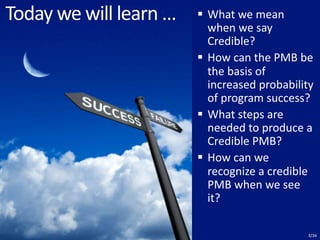
Today we will learn …
3/34
AQuickReview…
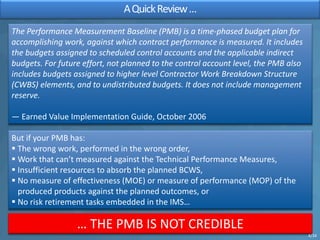
The Performance Measurement Baseline (PMB) is a time-phased budget plan for
accomplishing work, against which contract performance is measured. It includes
the budgets assigned to scheduled control accounts and the applicable indirect
budgets. For future effort, not planned to the control account level, the PMB also
includes budgets assigned to higher level Contractor Work Breakdown Structure
(CWBS) elements, and to undistributed budgets. It does not include management
reserve.
— Earned Value Implementation Guide, October 2006
But if your PMB has:
§ The wrong work, performed in the wrong order,
§ Work that can’t measured against the Technical Performance Measures,
§ Insufficient resources to absorb the planned BCWS,
§ No measure of effectiveness (MOE) or measure of performance (MOP) of the
produced products against the planned outcomes, or
§ No risk retirement tasks embedded in the IMS…
… THE PMB IS NOT CREDIBLE
4/34
5/34
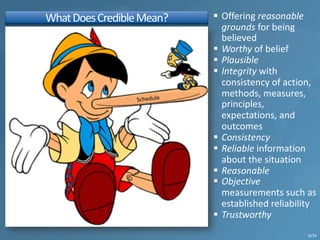
WhatDoesCredibleMean?
6/34
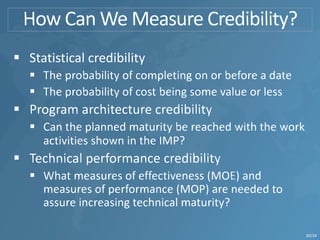
§ Lack of predictive
variance analysis
§ Untimely and unrealistic
Latest Revised Estimates
(LRE)
§ Progress not monitored
in a regular and
consistent manner
§ Lack of vertical and
horizontal traceability of
cost and schedule data
for corrective action
§ Lack of internal
surveillance and controls
§ Managerial actions not
demonstrated using
Earned Value
§ Inattention to budgetary
responsibilities
§ Work authorizations that
are not always followed
§ Issues with Budget and
data reconciliation
§ Lack of an integrated
management system
§ Baseline fluctuations and
frequent replanning
§ Current period and
retroactive changes
§ Improper use of
management reserve
§ EV techniques that do
not reflect actual
performance
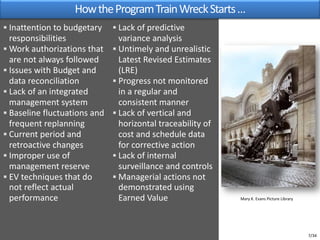
HowtheProgramTrainWreckStarts…
Mary K. Evans Picture Library
7/34
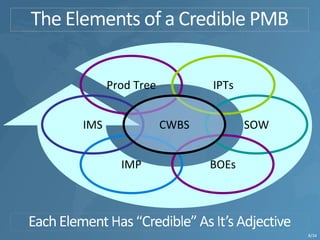
Prod Tree
SOW
IPTs
IMP
IMS
BOEs
CWBS
8/34
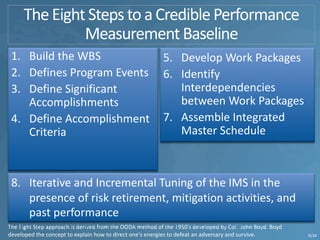
1. Build the WBS
2. Defines Program Events
3. Define Significant
Accomplishments
4. Define Accomplishment
Criteria
5. Develop Work Packages
6. Identify
Interdependencies
between Work Packages
7. Assemble Integrated
Master Schedule
8. Iterative and Incremental Tuning of the IMS in the
presence of risk retirement, mitigation activities, and
past performance
9/34
Boyd
developed the concept to explain how to direct one's energies to defeat an adversary and survive.
Continuous Risk
Management
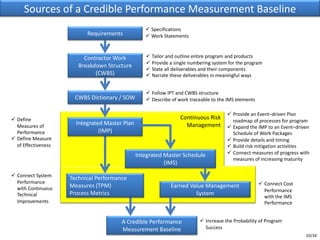
Requirements
Contractor Work
Breakdown Structure
(CWBS)
CWBS Dictionary / SOW
Integrated Master Schedule
(IMS)
Earned Value Management
System
A Credible Performance
Measurement Baseline
Technical Performance
Measures (TPM)
Process Metrics
ü Specifications
ü Work Statements
ü Tailor and outline entire program and products
ü Provide a single numbering system for the program
ü State all deliverables and their components
ü Narrate these deliverables in meaningful ways
ü Follow IPT and CWBS structure
ü Describe of work traceable to the IMS elements
ü Provide an Event–driven Plan
roadmap of processes for program
ü Expand the IMP to an Event–driven
Schedule of Work Packages
ü Provide details and timing
ü Build risk mitigation activities
ü Connect measures of progress with
measures of increasing maturity
ü Connect System
Performance
with Continuous
Technical
Improvements
ü Connect Cost
Performance
with the IMS
Performance
ü Increase the Probability of Program
Success
Integrated Master Plan
(IMP)
Sources of a Credible Performance Measurement Baseline
10/34
ü Define
Measures of
Performance
ü Define Measure
of Effectiveness
11/34
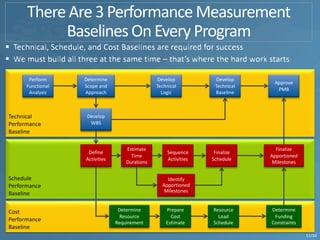
Cost
Performance
Baseline
Schedule
Performance
Baseline
Technical
Performance
Baseline
Perform
Functional
Analysis
Determine
Scope and
Approach
Develop
Technical
Logic
Develop
Technical
Baseline
Develop
WBS
Define
Activities
Estimate
Time
Durations
Sequence
Activities
Finalize
Schedule
Identify
Apportioned
Milestones
Determine
Resource
Requirement
Prepare
Cost
Estimate
Resource
Load
Schedule
Finalize
Apportioned
Milestones
Determine
Funding
Constraints
Approve
PMB
Let’s Build the Performance
Measurement Baseline Using The
Eight Steps
12/34http://www.softwaretechnews.com/images/STN_April_09_lores_Page_29_Image_0001.jpg
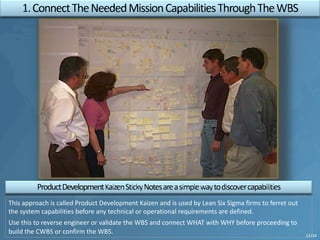
This approach is called Product Development Kaizen and is used by Lean Six Sigma firms to ferret out
the system capabilities before any technical or operational requirements are defined.
Use this to reverse engineer or validate the WBS and connect WHAT with WHY before proceeding to
build the CWBS or confirm the WBS. 13/34
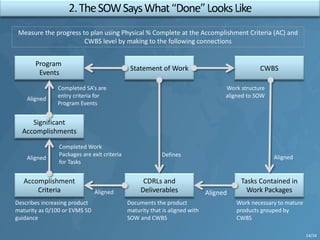
Program
Events
Statement of Work CWBS
Significant
Accomplishments
Accomplishment
Criteria
CDRLs and
Deliverables
Tasks Contained in
Work Packages
Measure the progress to plan using Physical % Complete at the Accomplishment Criteria (AC) and
CWBS level by making to the following connections
Defines
Aligned Aligned
AlignedAligned
Aligned
Completed SA’s are
entry criteria for
Program Events
Completed Work
Packages are exit criteria
for Tasks
Describes increasing product
maturity as 0/100 or EVMS SD
guidance
Documents the product
maturity that is aligned with
SOW and CWBS
Work necessary to mature
products grouped by
CWBS
Work structure
aligned to SOW
14/34
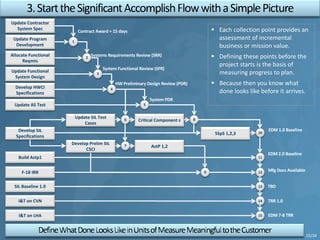
Update Contractor
System Spec
Update Program
Development
Allocate Functional
Reqmts
Update Functional
System Design
Develop HWCI
Specifications
Develop SIL
Specifications
Build Astp1
F-18 IRR
SIL Baseline 1.0
Update SIL Test
Cases
Develop Prelim SIL
CSCI
Critical Component s
AstP 1,2
SSpS 1,2,3
1
2
3
4
6
7
5
8
10
9
11
13
14
15
Update AS Test
I&T on CVN
I&T on LHA
12
Contract Award + 15 days
Systems Requirements Review (SRR)
System Functional Review (SFR)
HW Preliminary Design Review (PDR)
System PDR
EDM 1.0 Baseline
EDM 2.0 Baseline
Mfg Docs Available
TBD
TRR 1.0
EDM 7-8 TRR
15/34
§ Each collection point provides an
assessment of incremental
business or mission value.
§ Defining these points before the
project starts is the basis of
measuring progress to plan.
§ Because then you know what
done looks like before it arrives.
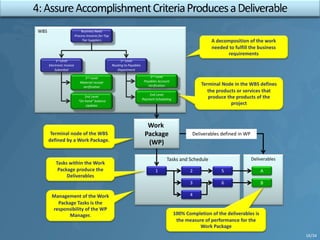
Deliverables
WBS
Tasks and Schedule
Business Need
Process Invoices for Top
Tier Suppliers
1st Level
Electronic Invoice
Submittal
1st Level
Routing to Payables
Department
2nd Level
Payables Account
Verification
2nd Level
Payment Scheduling
2nd Level
Material receipt
verification
2nd Level
“On hand” balance
Updates
Work
Package
(WP)
1 2
3
4
6
5 A
B
Deliverables defined in WP
Terminal Node in the WBS defines
the products or services that
produce the products of the
project
Terminal node of the WBS
defined by a Work Package.
Tasks within the Work
Package produce the
Deliverables
100% Completion of the deliverables is
the measure of performance for the
Work Package
Management of the Work
Package Tasks is the
responsibility of the WP
Manager.
A decomposition of the work
needed to fulfill the business
requirements
16/34
17/34
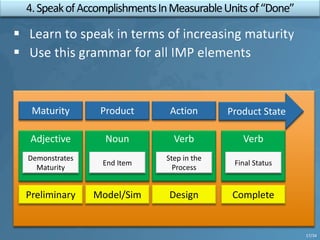
Maturity ActionProduct Product State
Adjective VerbNoun Verb
CompleteDesignModel/SimPreliminary
Program Events
Define the availability
of a Capability at a point in
time.
Accomplishments
Represent requirements
that enable Capabilities.
Criteria
Represent Work Packages that
fulfill Requirements.
Work
Package
Work
Package
Work
Package
Work
Package
Work
Package
Work
Package
Work
Package
Work
Package
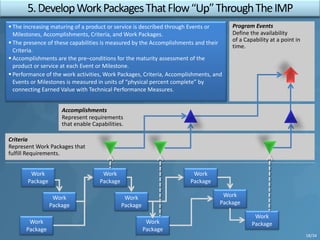
§ The increasing maturing of a product or service is described through Events or
Milestones, Accomplishments, Criteria, and Work Packages.
§ The presence of these capabilities is measured by the Accomplishments and their
Criteria.
§ Accomplishments are the pre–conditions for the maturity assessment of the
product or service at each Event or Milestone.
§ Performance of the work activities, Work Packages, Criteria, Accomplishments, and
Events or Milestones is measured in units of “physical percent complete” by
connecting Earned Value with Technical Performance Measures.
Work
Package
18/34
19/34
20/34
AC: 005
Task
Task
Task
Task
AC
AC:023
Task
Task
Task
Task
AC
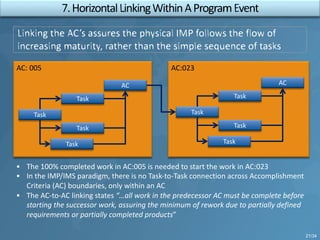
§ The 100% completed work in AC:005 is needed to start the work in AC:023
§ In the IMP/IMS paradigm, there is no Task-to-Task connection across Accomplishment
Criteria (AC) boundaries, only within an AC
§ The AC-to-AC linking states “…all work in the predecessor AC must be complete before
starting the successor work, assuring the minimum of rework due to partially defined
requirements or partially completed products”
21/34
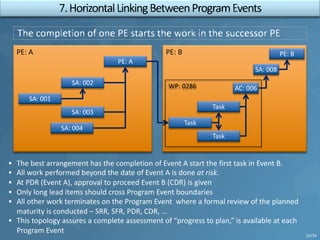
PE: BPE: A
SA: 001
SA: 002
SA: 003
SA: 004
PE: A
Task
Task
Task
AC: 006
§ The best arrangement has the completion of Event A start the first task in Event B.
§ All work performed beyond the date of Event A is done at risk.
§ At PDR (Event A), approval to proceed Event B (CDR) is given
§ Only long lead items should cross Program Event boundaries
§ All other work terminates on the Program Event where a formal review of the planned
maturity is conducted – SRR, SFR, PDR, CDR, …
§ This topology assures a complete assessment of “progress to plan,” is available at each
Program Event
22/34
SA: 008
PE: B
23/34
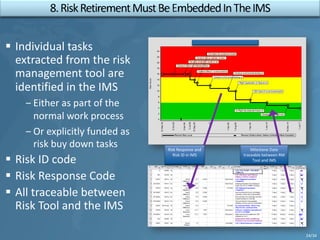
Risk: CEV-037 - Loss of Critical Functions During Descent
Planned Risk Level Planned (Solid=Linked, Hollow =Unlinked, Filled=Complete)
RiskScore
24
22
20
18
16
14
12
10
8
6
4
2
0
Conduct Force and Moment Wind
Develop analytical model to de
Conduct focus splinter review
Conduct Block 1 w ind tunnel te
Correlate the analytical model
Conduct w ind tunnel testing of
Flight Application of Spacecra
CEV block 5 w ind tunnel testin
In-Flight development tests of
Damaged TPS flight test
31.Mar.05
5.Oct.05
3.Apr.06
3.Jul.06
15.Sep.06
1.Jun.07
1.Apr.08
1.Aug.08
1.Apr.09
1.Jan.10
16.Dec.10
1.Jul.11
Risk Response and
Risk ID in IMS
Milestone Date
traceable between RM
Tool and IMS
24/34
25/34
26/34
Attribute Beneficial Outcome from this Attribute
Maturity Flows through
Program Events
§ Performance measurement is in units of increasing maturity
of the Technical Performance Measures
§ Each event is a mini authorization to proceed
Single outcome for each
work package (AC)
§ Measure Physical Percent Complete at the WP level
§ Use 0/100 for tasks for the vast majority of work
Technical Performance
Measures are explicitly
visible
§ Connect Cost, Schedule, and Technical Performance
§ EV does not provide a means of adjust for “off TPM,” but
make your own adjustments to the risk numbers for now
Risk retirement explicitly
visible
§ Risk retirement is embedded in the IMS
§ Risk mitigation means waiting until the risk happens
IMS flows vertically 1st and
horizontally 2nd
§ All work supports the assessment of maturity
§ Isolate tasks dependencies within a Work Package
No Event linkage except
for long lead items
§ 0/100 requires not partial completion
Decoupled dependences
improves risk
responsiveness
§ 1st round IMS defines a free flowing process
§ Maintaining this decoupling is key to a “dynamic” IMS that
can respond to the natural changes in the program
27/34
28/34
Statistical thinking will one day be as necessary for efficient citizenship as the ability to
read and write. – H.G. Wells
29/34
30/34
So Where’s The EV Discussion?
31/34
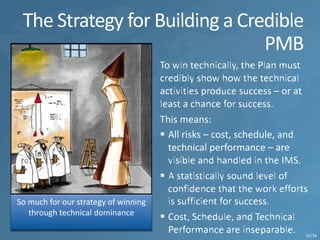
§ With the PMB
established, the BCWS
baseline comes for free
§ The cost of executing
of the EV based PMB is
not free, but most of
the investment has
been made
§ Earning value from EV
comes from cost
avoidance and
increased utilization of
allocated funds.
So much for our strategy of winning
through technical dominance
32/34
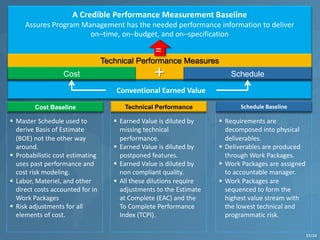
A Credible Performance Measurement Baseline
Assures Program Management has the needed performance information to deliver
on‒time, on‒budget, and on‒specification
Technical Performance Measures
Cost Schedule
Conventional Earned Value
+
=
§ Master Schedule used to
derive Basis of Estimate
(BOE) not the other way
around.
§ Probabilistic cost estimating
uses past performance and
cost risk modeling.
§ Labor, Materiel, and other
direct costs accounted for in
Work Packages
§ Risk adjustments for all
elements of cost.
Cost Baseline
§ Earned Value is diluted by
missing technical
performance.
§ Earned Value is diluted by
postponed features.
§ Earned Value is diluted by
non compliant quality.
§ All these dilutions require
adjustments to the Estimate
at Complete (EAC) and the
To Complete Performance
Index (TCPI).
Technical Performance
§ Requirements are
decomposed into physical
deliverables.
§ Deliverables are produced
through Work Packages.
§ Work Packages are assigned
to accountable manager.
§ Work Packages are
sequenced to form the
highest value stream with
the lowest technical and
programmatic risk.
Schedule Baseline
33/34
How to build a credible performance measurement baseline (v5)

How to build a credible performance measurement baseline (v5)

  • 1.
  • 2.
    Eight Easy Steps To Building a Credible Performance Measurement Baseline GlenB. Alleman Lewis and Fowler www.lewisandfowler.com galleman@lewisandfowler.com Eight 2/34
  • 3.
    Today we willlearn … 3/34
  • 4.
    AQuickReview… The Performance MeasurementBaseline (PMB) is a time-phased budget plan for accomplishing work, against which contract performance is measured. It includes the budgets assigned to scheduled control accounts and the applicable indirect budgets. For future effort, not planned to the control account level, the PMB also includes budgets assigned to higher level Contractor Work Breakdown Structure (CWBS) elements, and to undistributed budgets. It does not include management reserve. — Earned Value Implementation Guide, October 2006 But if your PMB has: § The wrong work, performed in the wrong order, § Work that can’t measured against the Technical Performance Measures, § Insufficient resources to absorb the planned BCWS, § No measure of effectiveness (MOE) or measure of performance (MOP) of the produced products against the planned outcomes, or § No risk retirement tasks embedded in the IMS… … THE PMB IS NOT CREDIBLE 4/34
  • 5.
  • 6.
  • 7.
    § Lack ofpredictive variance analysis § Untimely and unrealistic Latest Revised Estimates (LRE) § Progress not monitored in a regular and consistent manner § Lack of vertical and horizontal traceability of cost and schedule data for corrective action § Lack of internal surveillance and controls § Managerial actions not demonstrated using Earned Value § Inattention to budgetary responsibilities § Work authorizations that are not always followed § Issues with Budget and data reconciliation § Lack of an integrated management system § Baseline fluctuations and frequent replanning § Current period and retroactive changes § Improper use of management reserve § EV techniques that do not reflect actual performance HowtheProgramTrainWreckStarts… Mary K. Evans Picture Library 7/34
  • 8.
  • 9.
    1. Build theWBS 2. Defines Program Events 3. Define Significant Accomplishments 4. Define Accomplishment Criteria 5. Develop Work Packages 6. Identify Interdependencies between Work Packages 7. Assemble Integrated Master Schedule 8. Iterative and Incremental Tuning of the IMS in the presence of risk retirement, mitigation activities, and past performance 9/34 Boyd developed the concept to explain how to direct one's energies to defeat an adversary and survive.
  • 10.
    Continuous Risk Management Requirements Contractor Work BreakdownStructure (CWBS) CWBS Dictionary / SOW Integrated Master Schedule (IMS) Earned Value Management System A Credible Performance Measurement Baseline Technical Performance Measures (TPM) Process Metrics ü Specifications ü Work Statements ü Tailor and outline entire program and products ü Provide a single numbering system for the program ü State all deliverables and their components ü Narrate these deliverables in meaningful ways ü Follow IPT and CWBS structure ü Describe of work traceable to the IMS elements ü Provide an Event–driven Plan roadmap of processes for program ü Expand the IMP to an Event–driven Schedule of Work Packages ü Provide details and timing ü Build risk mitigation activities ü Connect measures of progress with measures of increasing maturity ü Connect System Performance with Continuous Technical Improvements ü Connect Cost Performance with the IMS Performance ü Increase the Probability of Program Success Integrated Master Plan (IMP) Sources of a Credible Performance Measurement Baseline 10/34 ü Define Measures of Performance ü Define Measure of Effectiveness
  • 11.
  • 12.
    Let’s Build thePerformance Measurement Baseline Using The Eight Steps 12/34http://www.softwaretechnews.com/images/STN_April_09_lores_Page_29_Image_0001.jpg
  • 13.
    This approach iscalled Product Development Kaizen and is used by Lean Six Sigma firms to ferret out the system capabilities before any technical or operational requirements are defined. Use this to reverse engineer or validate the WBS and connect WHAT with WHY before proceeding to build the CWBS or confirm the WBS. 13/34
  • 14.
    Program Events Statement of WorkCWBS Significant Accomplishments Accomplishment Criteria CDRLs and Deliverables Tasks Contained in Work Packages Measure the progress to plan using Physical % Complete at the Accomplishment Criteria (AC) and CWBS level by making to the following connections Defines Aligned Aligned AlignedAligned Aligned Completed SA’s are entry criteria for Program Events Completed Work Packages are exit criteria for Tasks Describes increasing product maturity as 0/100 or EVMS SD guidance Documents the product maturity that is aligned with SOW and CWBS Work necessary to mature products grouped by CWBS Work structure aligned to SOW 14/34
  • 15.
    Update Contractor System Spec UpdateProgram Development Allocate Functional Reqmts Update Functional System Design Develop HWCI Specifications Develop SIL Specifications Build Astp1 F-18 IRR SIL Baseline 1.0 Update SIL Test Cases Develop Prelim SIL CSCI Critical Component s AstP 1,2 SSpS 1,2,3 1 2 3 4 6 7 5 8 10 9 11 13 14 15 Update AS Test I&T on CVN I&T on LHA 12 Contract Award + 15 days Systems Requirements Review (SRR) System Functional Review (SFR) HW Preliminary Design Review (PDR) System PDR EDM 1.0 Baseline EDM 2.0 Baseline Mfg Docs Available TBD TRR 1.0 EDM 7-8 TRR 15/34 § Each collection point provides an assessment of incremental business or mission value. § Defining these points before the project starts is the basis of measuring progress to plan. § Because then you know what done looks like before it arrives.
  • 16.
    Deliverables WBS Tasks and Schedule BusinessNeed Process Invoices for Top Tier Suppliers 1st Level Electronic Invoice Submittal 1st Level Routing to Payables Department 2nd Level Payables Account Verification 2nd Level Payment Scheduling 2nd Level Material receipt verification 2nd Level “On hand” balance Updates Work Package (WP) 1 2 3 4 6 5 A B Deliverables defined in WP Terminal Node in the WBS defines the products or services that produce the products of the project Terminal node of the WBS defined by a Work Package. Tasks within the Work Package produce the Deliverables 100% Completion of the deliverables is the measure of performance for the Work Package Management of the Work Package Tasks is the responsibility of the WP Manager. A decomposition of the work needed to fulfill the business requirements 16/34
  • 17.
    17/34 Maturity ActionProduct ProductState Adjective VerbNoun Verb CompleteDesignModel/SimPreliminary
  • 18.
    Program Events Define theavailability of a Capability at a point in time. Accomplishments Represent requirements that enable Capabilities. Criteria Represent Work Packages that fulfill Requirements. Work Package Work Package Work Package Work Package Work Package Work Package Work Package Work Package § The increasing maturing of a product or service is described through Events or Milestones, Accomplishments, Criteria, and Work Packages. § The presence of these capabilities is measured by the Accomplishments and their Criteria. § Accomplishments are the pre–conditions for the maturity assessment of the product or service at each Event or Milestone. § Performance of the work activities, Work Packages, Criteria, Accomplishments, and Events or Milestones is measured in units of “physical percent complete” by connecting Earned Value with Technical Performance Measures. Work Package 18/34
  • 19.
  • 20.
  • 21.
    AC: 005 Task Task Task Task AC AC:023 Task Task Task Task AC § The100% completed work in AC:005 is needed to start the work in AC:023 § In the IMP/IMS paradigm, there is no Task-to-Task connection across Accomplishment Criteria (AC) boundaries, only within an AC § The AC-to-AC linking states “…all work in the predecessor AC must be complete before starting the successor work, assuring the minimum of rework due to partially defined requirements or partially completed products” 21/34
  • 22.
    PE: BPE: A SA:001 SA: 002 SA: 003 SA: 004 PE: A Task Task Task AC: 006 § The best arrangement has the completion of Event A start the first task in Event B. § All work performed beyond the date of Event A is done at risk. § At PDR (Event A), approval to proceed Event B (CDR) is given § Only long lead items should cross Program Event boundaries § All other work terminates on the Program Event where a formal review of the planned maturity is conducted – SRR, SFR, PDR, CDR, … § This topology assures a complete assessment of “progress to plan,” is available at each Program Event 22/34 SA: 008 PE: B
  • 23.
  • 24.
    Risk: CEV-037 -Loss of Critical Functions During Descent Planned Risk Level Planned (Solid=Linked, Hollow =Unlinked, Filled=Complete) RiskScore 24 22 20 18 16 14 12 10 8 6 4 2 0 Conduct Force and Moment Wind Develop analytical model to de Conduct focus splinter review Conduct Block 1 w ind tunnel te Correlate the analytical model Conduct w ind tunnel testing of Conduct w ind tunnel testing of Flight Application of Spacecra CEV block 5 w ind tunnel testin In-Flight development tests of Damaged TPS flight test 31.Mar.05 5.Oct.05 3.Apr.06 3.Jul.06 15.Sep.06 1.Jun.07 1.Apr.08 1.Aug.08 1.Apr.09 1.Jan.10 16.Dec.10 1.Jul.11 Risk Response and Risk ID in IMS Milestone Date traceable between RM Tool and IMS 24/34
  • 25.
  • 26.
  • 27.
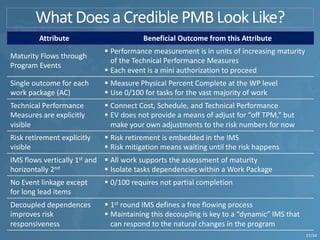
    Attribute Beneficial Outcomefrom this Attribute Maturity Flows through Program Events § Performance measurement is in units of increasing maturity of the Technical Performance Measures § Each event is a mini authorization to proceed Single outcome for each work package (AC) § Measure Physical Percent Complete at the WP level § Use 0/100 for tasks for the vast majority of work Technical Performance Measures are explicitly visible § Connect Cost, Schedule, and Technical Performance § EV does not provide a means of adjust for “off TPM,” but make your own adjustments to the risk numbers for now Risk retirement explicitly visible § Risk retirement is embedded in the IMS § Risk mitigation means waiting until the risk happens IMS flows vertically 1st and horizontally 2nd § All work supports the assessment of maturity § Isolate tasks dependencies within a Work Package No Event linkage except for long lead items § 0/100 requires not partial completion Decoupled dependences improves risk responsiveness § 1st round IMS defines a free flowing process § Maintaining this decoupling is key to a “dynamic” IMS that can respond to the natural changes in the program 27/34
  • 28.
  • 29.
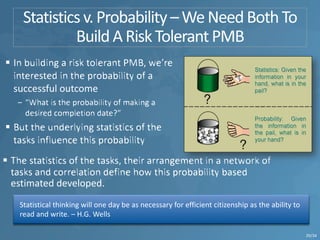
    Statistical thinking willone day be as necessary for efficient citizenship as the ability to read and write. – H.G. Wells 29/34
  • 30.
  • 31.
    So Where’s TheEV Discussion? 31/34 § With the PMB established, the BCWS baseline comes for free § The cost of executing of the EV based PMB is not free, but most of the investment has been made § Earning value from EV comes from cost avoidance and increased utilization of allocated funds.
  • 32.
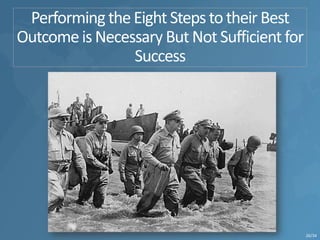
    So much forour strategy of winning through technical dominance 32/34
  • 33.
    A Credible PerformanceMeasurement Baseline Assures Program Management has the needed performance information to deliver on‒time, on‒budget, and on‒specification Technical Performance Measures Cost Schedule Conventional Earned Value + = § Master Schedule used to derive Basis of Estimate (BOE) not the other way around. § Probabilistic cost estimating uses past performance and cost risk modeling. § Labor, Materiel, and other direct costs accounted for in Work Packages § Risk adjustments for all elements of cost. Cost Baseline § Earned Value is diluted by missing technical performance. § Earned Value is diluted by postponed features. § Earned Value is diluted by non compliant quality. § All these dilutions require adjustments to the Estimate at Complete (EAC) and the To Complete Performance Index (TCPI). Technical Performance § Requirements are decomposed into physical deliverables. § Deliverables are produced through Work Packages. § Work Packages are assigned to accountable manager. § Work Packages are sequenced to form the highest value stream with the lowest technical and programmatic risk. Schedule Baseline 33/34