Introduction to
Art as
Representation
Learning
Intentions
You will develop an understanding of the concept, Art
as Representation and the structure of assessment
for Senior Visual Art.
Concept &
Assessment
You will develop an understanding of the inquiry
learning model and how this applies to the processes
of creating artworks in Senior Visual Art.
Inquiry
Learning
Model
You will understand how personal, contemporary,
cultural and formal contexts provide frames of
reference that inform concepts, focuses, and how
subject matter is represented in artworks.
Contexts
Unit Concept: Art as Representation
In Unit 1, you will explore the concept, through consideration of how different ways of seeing and representing can
change the meaning of subject matter to communicate personal, contemporary and/ or cultural viewpoints through
the art language you use (art conventions, aesthetic styles, symbols and imagery).
As an artist, you will respond to one selected focus from the two available: ‘Beauty and Aesthetics’ or ‘Statistically
Speaking’. The artworks you create in this unit will respond to the unit concept, and your chosen focus and stimulus.
The stimulus will inspire and inform the subject matter you choose to include in your artworks (e.g. a stimulus might
be a personal object, a family member, a place you have visited, a set of data or statistical information).
You will explore and apply personal, contemporary, cultural and/ or formal contexts (frames of reference/ influences
on the way you see and think) to analyse and interpret visual communication and meaning in artworks. You will be
exposed to multiple viewpoints by examining artists’ value systems that underpin or influence the way subject matter
is perceived and represented.
You will experiment with a range of approaches to improve technical skills, foster curiosity and creative thinking, and
inspire innovative art practices. You will be guided through the inquiry learning process to develop, research, reflect
and resolve responses through learning experiences that facilitate investigation and experimentation.
As audience, you will consider the ways representation is affected by personal, cultural and contemporary influences.
You will decode artworks to read and interpret meaning communicated through visual language.
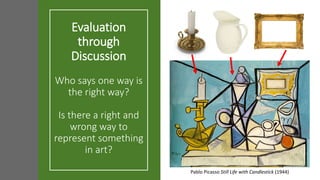
Evaluation
through
Discussion
Who says one way is
the right way?
Is there a right and
wrong way to
represent something
in art?
Pablo Picasso Still Life with Candlestick (1944)
A Demonstration of Different Artistic Representations
The Lab: Decoy — A Portrait https://vimeo.com/144816506
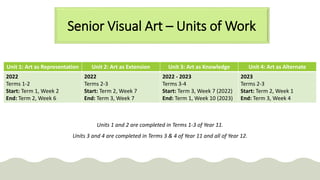
Senior Visual Art – Units of Work
Unit 1: Art as Representation Unit 2: Art as Extension Unit 3: Art as Knowledge Unit 4: Art as Alternate
2022
Terms 1-2
Start: Term 1, Week 2
End: Term 2, Week 6
2022
Terms 2-3
Start: Term 2, Week 7
End: Term 3, Week 7
2022 - 2023
Terms 3-4
Start: Term 3, Week 7 (2022)
End: Term 1, Week 10 (2023)
2023
Terms 2-3
Start: Term 2, Week 1
End: Term 3, Week 4
Units 1 and 2 are completed in Terms 1-3 of Year 11.
Units 3 and 4 are completed in Terms 3 & 4 of Year 11 and all of Year 12.
Types of Assessment
Making
In Senior Visual Art, tasks that are primarily art
making are called Projects.
Responding
In Senior Visual Art, tasks that are primarily
responding are called Investigations.
In Units 1 and 2, assessment is formative and is assigned the acronym FA for Formative Assessment.
In Units 3 and 4, assessment is summative (it will count towards your ATAR score) and is assigned the acronym IA for
Internal Assessment (class assessment) and EA for External Assessment (external exam).
From this point onward, assessment that you complete will be INTEGRATED (combined).
This means that when you are creating a project, there will be a responding component and when you are undertaking
an investigation, there will be a making component.
In Unit 1, you will complete an investigation and a project.
Projects will include:
 Artworks (experimental and/ or resolved)
 Visual Journal (with supporting documentation)
 PowerPoint (photographs of displayed artworks,
evidence of supporting documentation – i.e.
scanned journal pages – and Artist Statement)
Investigations will include:
 Written Report (scaffold and exemplars provided)
 Experimental Artworks (responding to/
supporting written report)
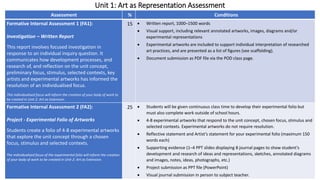
Unit 1: Art as Representation Assessment
Assessment % Conditions
Formative Internal Assessment 1 (FA1):
Investigation – Written Report
This report involves focused investigation in
response to an individual inquiry question. It
communicates how development processes, and
research of, and reflection on the unit concept,
preliminary focus, stimulus, selected contexts, key
artists and experimental artworks has informed the
resolution of an individualised focus.
This individualised focus will inform the creation of your body of work to
be created in Unit 2: Art as Extension.
15  Written report, 1000–1500 words
 Visual support, including relevant annotated artworks, images, diagrams and/or
experimental representations
 Experimental artworks are included to support individual interpretation of researched
art practices, and are presented as a list of figures (see scaffolding).
 Document submission as PDF file via the POD class page.
Formative Internal Assessment 2 (FA2):
Project - Experimental Folio of Artworks
Students create a folio of 4-8 experimental artworks
that explore the unit concept through a chosen
focus, stimulus and selected contexts.
The individualised focus of the experimental folio will inform the creation
of your body of work to be created in Unit 2: Art as Extension.
25  Students will be given continuous class time to develop their experimental folio but
must also complete work outside of school hours.
 4-8 experimental artworks that respond to the unit concept, chosen focus, stimulus and
selected contexts. Experimental artworks do not require resolution.
 Reflective statement and Artist’s statement for your experimental folio (maximum 150
words each)
 Supporting evidence (1–4 PPT slides displaying 8 journal pages to show student’s
development and research of ideas and representations, sketches, annotated diagrams
and images, notes, ideas, photographs, etc.)
 Project submission as PPT file (PowerPoint)
 Visual journal submission in person to subject teacher.
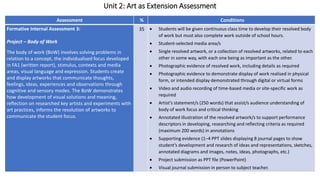
Unit 2: Art as Extension Assessment
Assessment % Conditions
Formative Internal Assessment 3:
Project – Body of Work
The body of work (BoW) involves solving problems in
relation to a concept, the individualised focus developed
in FA1 (written report), stimulus, contexts and media
areas, visual language and expression. Students create
and display artworks that communicate thoughts,
feelings, ideas, experiences and observations through
cognitive and sensory modes. The BoW demonstrates
how development of visual solutions and meaning,
reflection on researched key artists and experiments with
art practices, informs the resolution of artworks to
communicate the student focus.
35  Students will be given continuous class time to develop their resolved body
of work but must also complete work outside of school hours.
 Student-selected media area/s
 Single resolved artwork, or a collection of resolved artworks, related to each
other in some way, with each one being as important as the other.
 Photographic evidence of resolved work, including details as required
 Photographic evidence to demonstrate display of work realised in physical
form, or intended display demonstrated through digital or virtual forms
 Video and audio recording of time-based media or site-specific work as
required
 Artist’s statement/s (250 words) that assist/s audience understanding of
body of work focus and critical thinking
 Annotated illustration of the resolved artwork/s to support performance
descriptors in developing, researching and reflecting criteria as required
(maximum 200 words) in annotations
 Supporting evidence (1–4 PPT slides displaying 8 journal pages to show
student’s development and research of ideas and representations, sketches,
annotated diagrams and images, notes, ideas, photographs, etc.)
 Project submission as PPT file (PowerPoint)
 Visual journal submission in person to subject teacher.
Unit 1: Art as Representation
Investigation - Written Report Draft (FA1):
Term 1, Tuesday Week 7 (8th of March)
Investigation - Written Report Final (FA1):
Term 1, Thursday Week 9 (24th of March)
Project - Experimental Folio of Artworks (FA2):
Term 2, Monday Week 6 (23rd of May)
Unit 2: Art as Extension
Project - Body of Work (FA3):
Term 3, Monday Week 7 (22nd of August)
Due Dates
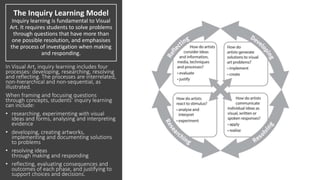
The Inquiry Learning Model
Inquiry learning is fundamental to Visual
Art. It requires students to solve problems
through questions that have more than
one possible resolution, and emphasises
the process of investigation when making
and responding.
In Visual Art, inquiry learning includes four
processes: developing, researching, resolving
and reflecting. The processes are interrelated,
non-hierarchical and non-sequential, as
illustrated.
When framing and focusing questions
through concepts, students’ inquiry learning
can include:
• researching, experimenting with visual
ideas and forms, analysing and interpreting
evidence
• developing, creating artworks,
implementing and documenting solutions
to problems
• resolving ideas
through making and responding
• reflecting, evaluating consequences and
outcomes of each phase, and justifying to
support choices and decisions.
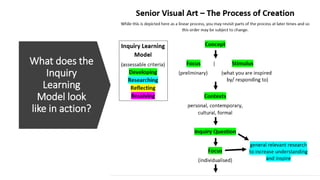
What does the
Inquiry
Learning
Model look
like in action?
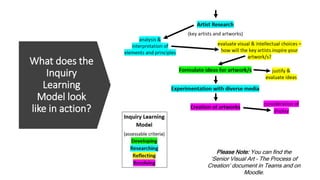
What does the
Inquiry
Learning
Model look
like in action?
Please Note: You can find the
‘Senior Visual Art – The Process of
Creation’ document in Teams and on
Moodle.
The Inquiry
Learning
Model
The processes of researching, developing,
resolving and reflecting must inform all art
making processes in Years 11 and 12 Visual
Art. It is essential that you document your
progression through the inquiry learning
phases (with clear annotations and
supporting images) as your artwork/s
evolve.
As a class we will view example visual
diaries to observe those students’
documentation of the inquiry learning
phases.
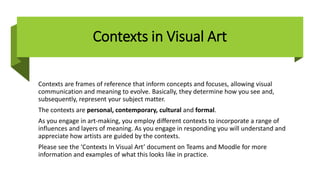
Contexts in Visual Art
Contexts are frames of reference that inform concepts and focuses, allowing visual
communication and meaning to evolve. Basically, they determine how you see and,
subsequently, represent your subject matter.
The contexts are personal, contemporary, cultural and formal.
As you engage in art-making, you employ different contexts to incorporate a range of
influences and layers of meaning. As you engage in responding you will understand and
appreciate how artists are guided by the contexts.
Please see the ‘Contexts In Visual Art’ document on Teams and Moodle for more
information and examples of what this looks like in practice.
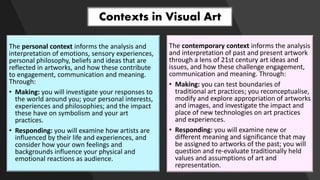
The personal context informs the analysis and
interpretation of emotions, sensory experiences,
personal philosophy, beliefs and ideas that are
reflected in artworks, and how these contribute
to engagement, communication and meaning.
Through:
• Making: you will investigate your responses to
the world around you; your personal interests,
experiences and philosophies; and the impact
these have on symbolism and your art
practices.
• Responding: you will examine how artists are
influenced by their life and experiences, and
consider how your own feelings and
backgrounds influence your physical and
emotional reactions as audience.
The contemporary context informs the analysis
and interpretation of past and present artwork
through a lens of 21st century art ideas and
issues, and how these challenge engagement,
communication and meaning. Through:
• Making: you can test boundaries of
traditional art practices; you reconceptualise,
modify and explore appropriation of artworks
and images, and investigate the impact and
place of new technologies on art practices
and experiences.
• Responding: you will examine new or
different meaning and significance that may
be assigned to artworks of the past; you will
question and re-evaluate traditionally held
values and assumptions of art and
representation.
Contexts in Visual Art
The cultural context informs the analysis and
interpretation of the social influences and
representations of time, place, politics, purpose,
ethnicity, gender and spiritual and secular beliefs on
artwork, and how these contribute to engagement,
communication and meaning. Through:
• Making: students explore cultural values, historical
or current events, social pressures, and attitudes
that impact on them and others, and determine the
origins of social meaning communicated in artwork
• Responding: students consider indigenous
perspectives; regional, national, international, social
and cultural identity of artists and audiences; and
how artists use their work as a vehicle to invite
change and provoke conversation.
*Culture refers to the ideas, customs and learned
behaviours of a society or group of people
The formal context informs the analysis and
interpretation of formal visual art elements and
principles, the application of materials and
techniques, the stylistic qualities relative to
historical periods or iconology seen in artworks, and
how these contribute to engagement,
communication and meaning. Through:
• Making: students focus on the formal
organisation and placement of visual
components, experimenting with codes, symbols,
and art conventions, and the communicative
value of art materials, techniques and processes
• Responding: students decode artworks by
reading the relationships between specific visual
language, signs, symbols, codes, and conventions
that are used to transmit information and ideas in
artworks.
Contexts in Visual Art

Introduction to Art as Representation 2022.pptx

  • 1.
  • 2.
    Learning Intentions You will developan understanding of the concept, Art as Representation and the structure of assessment for Senior Visual Art. Concept & Assessment You will develop an understanding of the inquiry learning model and how this applies to the processes of creating artworks in Senior Visual Art. Inquiry Learning Model You will understand how personal, contemporary, cultural and formal contexts provide frames of reference that inform concepts, focuses, and how subject matter is represented in artworks. Contexts
  • 3.
    Unit Concept: Artas Representation In Unit 1, you will explore the concept, through consideration of how different ways of seeing and representing can change the meaning of subject matter to communicate personal, contemporary and/ or cultural viewpoints through the art language you use (art conventions, aesthetic styles, symbols and imagery). As an artist, you will respond to one selected focus from the two available: ‘Beauty and Aesthetics’ or ‘Statistically Speaking’. The artworks you create in this unit will respond to the unit concept, and your chosen focus and stimulus. The stimulus will inspire and inform the subject matter you choose to include in your artworks (e.g. a stimulus might be a personal object, a family member, a place you have visited, a set of data or statistical information). You will explore and apply personal, contemporary, cultural and/ or formal contexts (frames of reference/ influences on the way you see and think) to analyse and interpret visual communication and meaning in artworks. You will be exposed to multiple viewpoints by examining artists’ value systems that underpin or influence the way subject matter is perceived and represented. You will experiment with a range of approaches to improve technical skills, foster curiosity and creative thinking, and inspire innovative art practices. You will be guided through the inquiry learning process to develop, research, reflect and resolve responses through learning experiences that facilitate investigation and experimentation. As audience, you will consider the ways representation is affected by personal, cultural and contemporary influences. You will decode artworks to read and interpret meaning communicated through visual language.
  • 4.
    Evaluation through Discussion Who says oneway is the right way? Is there a right and wrong way to represent something in art? Pablo Picasso Still Life with Candlestick (1944)
  • 5.
    A Demonstration ofDifferent Artistic Representations The Lab: Decoy — A Portrait https://vimeo.com/144816506
  • 6.
    Senior Visual Art– Units of Work Unit 1: Art as Representation Unit 2: Art as Extension Unit 3: Art as Knowledge Unit 4: Art as Alternate 2022 Terms 1-2 Start: Term 1, Week 2 End: Term 2, Week 6 2022 Terms 2-3 Start: Term 2, Week 7 End: Term 3, Week 7 2022 - 2023 Terms 3-4 Start: Term 3, Week 7 (2022) End: Term 1, Week 10 (2023) 2023 Terms 2-3 Start: Term 2, Week 1 End: Term 3, Week 4 Units 1 and 2 are completed in Terms 1-3 of Year 11. Units 3 and 4 are completed in Terms 3 & 4 of Year 11 and all of Year 12.
  • 7.
    Types of Assessment Making InSenior Visual Art, tasks that are primarily art making are called Projects. Responding In Senior Visual Art, tasks that are primarily responding are called Investigations. In Units 1 and 2, assessment is formative and is assigned the acronym FA for Formative Assessment. In Units 3 and 4, assessment is summative (it will count towards your ATAR score) and is assigned the acronym IA for Internal Assessment (class assessment) and EA for External Assessment (external exam). From this point onward, assessment that you complete will be INTEGRATED (combined). This means that when you are creating a project, there will be a responding component and when you are undertaking an investigation, there will be a making component. In Unit 1, you will complete an investigation and a project. Projects will include:  Artworks (experimental and/ or resolved)  Visual Journal (with supporting documentation)  PowerPoint (photographs of displayed artworks, evidence of supporting documentation – i.e. scanned journal pages – and Artist Statement) Investigations will include:  Written Report (scaffold and exemplars provided)  Experimental Artworks (responding to/ supporting written report)
  • 8.
    Unit 1: Artas Representation Assessment Assessment % Conditions Formative Internal Assessment 1 (FA1): Investigation – Written Report This report involves focused investigation in response to an individual inquiry question. It communicates how development processes, and research of, and reflection on the unit concept, preliminary focus, stimulus, selected contexts, key artists and experimental artworks has informed the resolution of an individualised focus. This individualised focus will inform the creation of your body of work to be created in Unit 2: Art as Extension. 15  Written report, 1000–1500 words  Visual support, including relevant annotated artworks, images, diagrams and/or experimental representations  Experimental artworks are included to support individual interpretation of researched art practices, and are presented as a list of figures (see scaffolding).  Document submission as PDF file via the POD class page. Formative Internal Assessment 2 (FA2): Project - Experimental Folio of Artworks Students create a folio of 4-8 experimental artworks that explore the unit concept through a chosen focus, stimulus and selected contexts. The individualised focus of the experimental folio will inform the creation of your body of work to be created in Unit 2: Art as Extension. 25  Students will be given continuous class time to develop their experimental folio but must also complete work outside of school hours.  4-8 experimental artworks that respond to the unit concept, chosen focus, stimulus and selected contexts. Experimental artworks do not require resolution.  Reflective statement and Artist’s statement for your experimental folio (maximum 150 words each)  Supporting evidence (1–4 PPT slides displaying 8 journal pages to show student’s development and research of ideas and representations, sketches, annotated diagrams and images, notes, ideas, photographs, etc.)  Project submission as PPT file (PowerPoint)  Visual journal submission in person to subject teacher.
  • 9.
    Unit 2: Artas Extension Assessment Assessment % Conditions Formative Internal Assessment 3: Project – Body of Work The body of work (BoW) involves solving problems in relation to a concept, the individualised focus developed in FA1 (written report), stimulus, contexts and media areas, visual language and expression. Students create and display artworks that communicate thoughts, feelings, ideas, experiences and observations through cognitive and sensory modes. The BoW demonstrates how development of visual solutions and meaning, reflection on researched key artists and experiments with art practices, informs the resolution of artworks to communicate the student focus. 35  Students will be given continuous class time to develop their resolved body of work but must also complete work outside of school hours.  Student-selected media area/s  Single resolved artwork, or a collection of resolved artworks, related to each other in some way, with each one being as important as the other.  Photographic evidence of resolved work, including details as required  Photographic evidence to demonstrate display of work realised in physical form, or intended display demonstrated through digital or virtual forms  Video and audio recording of time-based media or site-specific work as required  Artist’s statement/s (250 words) that assist/s audience understanding of body of work focus and critical thinking  Annotated illustration of the resolved artwork/s to support performance descriptors in developing, researching and reflecting criteria as required (maximum 200 words) in annotations  Supporting evidence (1–4 PPT slides displaying 8 journal pages to show student’s development and research of ideas and representations, sketches, annotated diagrams and images, notes, ideas, photographs, etc.)  Project submission as PPT file (PowerPoint)  Visual journal submission in person to subject teacher.
  • 10.
    Unit 1: Artas Representation Investigation - Written Report Draft (FA1): Term 1, Tuesday Week 7 (8th of March) Investigation - Written Report Final (FA1): Term 1, Thursday Week 9 (24th of March) Project - Experimental Folio of Artworks (FA2): Term 2, Monday Week 6 (23rd of May) Unit 2: Art as Extension Project - Body of Work (FA3): Term 3, Monday Week 7 (22nd of August) Due Dates
  • 11.
    The Inquiry LearningModel Inquiry learning is fundamental to Visual Art. It requires students to solve problems through questions that have more than one possible resolution, and emphasises the process of investigation when making and responding. In Visual Art, inquiry learning includes four processes: developing, researching, resolving and reflecting. The processes are interrelated, non-hierarchical and non-sequential, as illustrated. When framing and focusing questions through concepts, students’ inquiry learning can include: • researching, experimenting with visual ideas and forms, analysing and interpreting evidence • developing, creating artworks, implementing and documenting solutions to problems • resolving ideas through making and responding • reflecting, evaluating consequences and outcomes of each phase, and justifying to support choices and decisions.
  • 12.
  • 13.
    What does the Inquiry Learning Modellook like in action? Please Note: You can find the ‘Senior Visual Art – The Process of Creation’ document in Teams and on Moodle.
  • 14.
    The Inquiry Learning Model The processesof researching, developing, resolving and reflecting must inform all art making processes in Years 11 and 12 Visual Art. It is essential that you document your progression through the inquiry learning phases (with clear annotations and supporting images) as your artwork/s evolve. As a class we will view example visual diaries to observe those students’ documentation of the inquiry learning phases.
  • 15.
    Contexts in VisualArt Contexts are frames of reference that inform concepts and focuses, allowing visual communication and meaning to evolve. Basically, they determine how you see and, subsequently, represent your subject matter. The contexts are personal, contemporary, cultural and formal. As you engage in art-making, you employ different contexts to incorporate a range of influences and layers of meaning. As you engage in responding you will understand and appreciate how artists are guided by the contexts. Please see the ‘Contexts In Visual Art’ document on Teams and Moodle for more information and examples of what this looks like in practice.
  • 16.
    The personal contextinforms the analysis and interpretation of emotions, sensory experiences, personal philosophy, beliefs and ideas that are reflected in artworks, and how these contribute to engagement, communication and meaning. Through: • Making: you will investigate your responses to the world around you; your personal interests, experiences and philosophies; and the impact these have on symbolism and your art practices. • Responding: you will examine how artists are influenced by their life and experiences, and consider how your own feelings and backgrounds influence your physical and emotional reactions as audience. The contemporary context informs the analysis and interpretation of past and present artwork through a lens of 21st century art ideas and issues, and how these challenge engagement, communication and meaning. Through: • Making: you can test boundaries of traditional art practices; you reconceptualise, modify and explore appropriation of artworks and images, and investigate the impact and place of new technologies on art practices and experiences. • Responding: you will examine new or different meaning and significance that may be assigned to artworks of the past; you will question and re-evaluate traditionally held values and assumptions of art and representation. Contexts in Visual Art
  • 17.
    The cultural contextinforms the analysis and interpretation of the social influences and representations of time, place, politics, purpose, ethnicity, gender and spiritual and secular beliefs on artwork, and how these contribute to engagement, communication and meaning. Through: • Making: students explore cultural values, historical or current events, social pressures, and attitudes that impact on them and others, and determine the origins of social meaning communicated in artwork • Responding: students consider indigenous perspectives; regional, national, international, social and cultural identity of artists and audiences; and how artists use their work as a vehicle to invite change and provoke conversation. *Culture refers to the ideas, customs and learned behaviours of a society or group of people The formal context informs the analysis and interpretation of formal visual art elements and principles, the application of materials and techniques, the stylistic qualities relative to historical periods or iconology seen in artworks, and how these contribute to engagement, communication and meaning. Through: • Making: students focus on the formal organisation and placement of visual components, experimenting with codes, symbols, and art conventions, and the communicative value of art materials, techniques and processes • Responding: students decode artworks by reading the relationships between specific visual language, signs, symbols, codes, and conventions that are used to transmit information and ideas in artworks. Contexts in Visual Art

Editor's Notes

  • #4 For example, if you were painting a portrait of an Indigenous Australian war veteran, you might wish to represent his connections to Australia and his indigenous heritage. In this case, you would be being inspired by cultural influences. To represent this cultural connection in your artwork, you might use red-brown colours to symbolise the red dirt of the Australian landscape. Your visual choice of colour shows a representation inspired by cultural understanding.