STRATEGIES
TO ASSESS THE
CURRICULUM
#STRATEGIES TO ASSESS THE CURRICULUM
PAPER-AND-PENCIL STRATEGY
This strategy focuses in assessing the student’s
understanding and how well the students learn from
the topic that the teacher has been discussed. This
strategy is more on the cognitive domain where a
student constructs a response to a question, topic , or
brief statement and it also provides the student with
opportunity to show what he has learn in the topic
that the teacher discussed.
#STRATEGIES TO ASSESS THE CURRICULUM
- is a writing sample used to assess
student understanding and/or how well
students can analyze and synthesize
information
#STRATEGIES TO ASSESS THE CURRICULUM
Characteristics
• Measures student’s ability
• Directly measures the performance
• Includes a scoring plan
• Affords the student a chance to
construct his/her own answers
#STRATEGIES TO ASSESS THE CURRICULUM
- is a pencil-and-paper assessment in
which the student is to identify the one
correct answer.
#STRATEGIES TO ASSESS THE CURRICULUM
Characteristics
• Can be administered to a large
number of students at the same time
• Can be scored very quickly
• Stated in clear, simple language
#STRATEGIES TO ASSESS THE CURRICULUM
PERFORMANCE-BASED STRATEGY
This strategy is an assessment which requires
students to demonstrate a skill by asking
them to create, produce, or perform. This
strategy is more on the psychomotor domain
where a student enables to demonstrate
abilities and skills.
#STRATEGIES TO ASSESS THE CURRICULUM
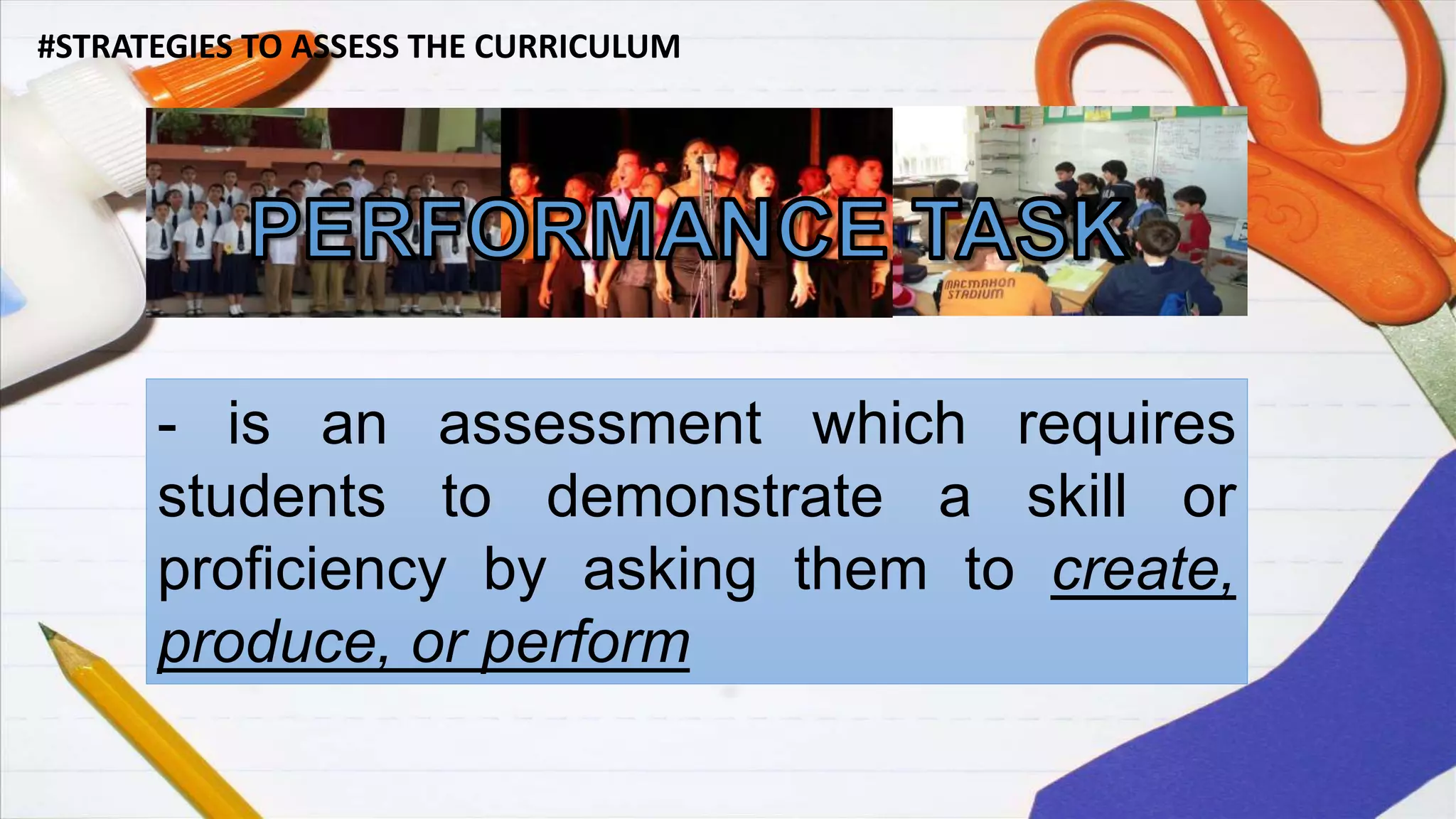
- is an assessment which requires
students to demonstrate a skill or
proficiency by asking them to create,
produce, or perform
#STRATEGIES TO ASSESS THE CURRICULUM
Characteristics
• Can be diagnostic, formative or
summative
• Allows most learners to participate
successfully in varying degree
• Provides opportunities to work
individually, as well as in small groups
• Focuses on process as well as
products
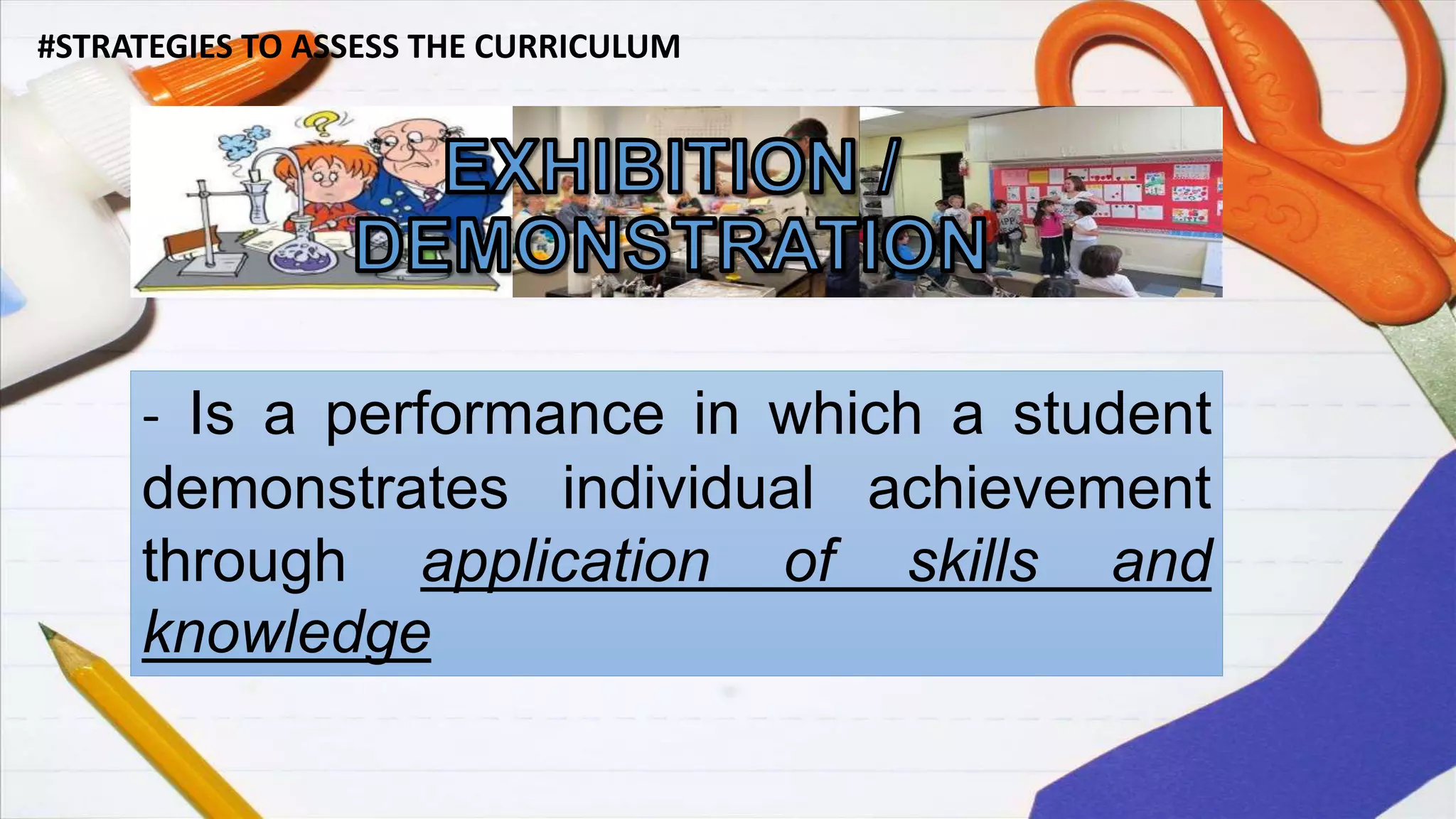
#STRATEGIES TO ASSESS THE CURRICULUM
- Is a performance in which a student
demonstrates individual achievement
through application of skills and
knowledge
#STRATEGIES TO ASSESS THE CURRICULUM
Characteristics
• Either actual situation or simulation
• Often used in Arts
• Accompanied by a list of performance
attributes as well as assessment
criteria
• Frequently organized in assessment
stations
#STRATEGIES TO ASSESS THE CURRICULUM
OBSERVATIONAL STRATEGY
- it is the active acquisition of information from
a primary source. In real life, observation
employs the senses. This strategy is a process
of systematically viewing and recording
student behavior for the purpose of getting
the weaknesses and strength of the student
for the teacher to make a good decision in
effective teaching.
#STRATEGIES TO ASSESS THE CURRICULUM
ORAL STRATEGY
- this strategy lets the students voice out there ideas
and respond to a question by the teacher rather
than writing. It also boosts up the confidence of the
child to stand up and voice out his ideas about the
question that the teacher asked to him. It also help
teachers and students clarify their purpose for
learning and link previous information with new
understanding.
#STRATEGIES TO ASSESS THE CURRICULUM
REFLECTIVE STRATEGY
- is the process of gathering information and
reflecting in one’s own learning. It assists
students to take more responsibility and
ownership of their learning and it also motivates
the child if he sees his performance is high or
low. It can help students to witness personal
growth through comparison with their own
previous work.
TOOLS
TO ASSESS THE
CURRICULUM
#TOOLS TO ASSESS THE CURRICULUM
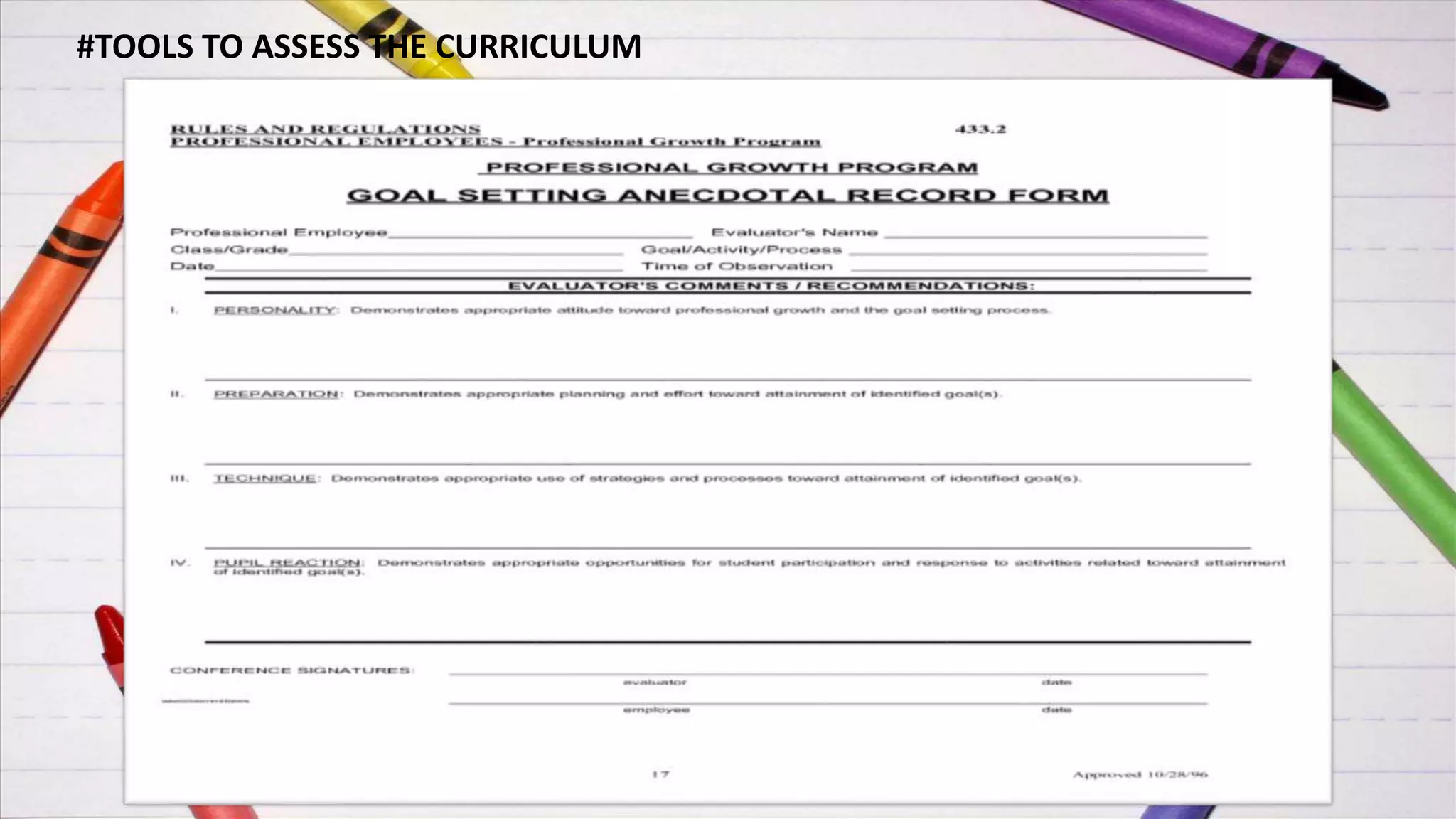
ANECDOTAL RECORD
- are the written observations, word for word, and action for
action of exactly what a child is doing and saying. A transcript,
if you will, on an event, series of events or even throughout the
day.
- the anecdotal record provide an ongoing record of written
observations of student progress for the teacher to easily
understand what are the likes and dislikes of that student or the
strengths and weaknesses of that student and it also helps the
teacher to improve his way of teaching his student
#TOOLS TO ASSESS THE CURRICULUM
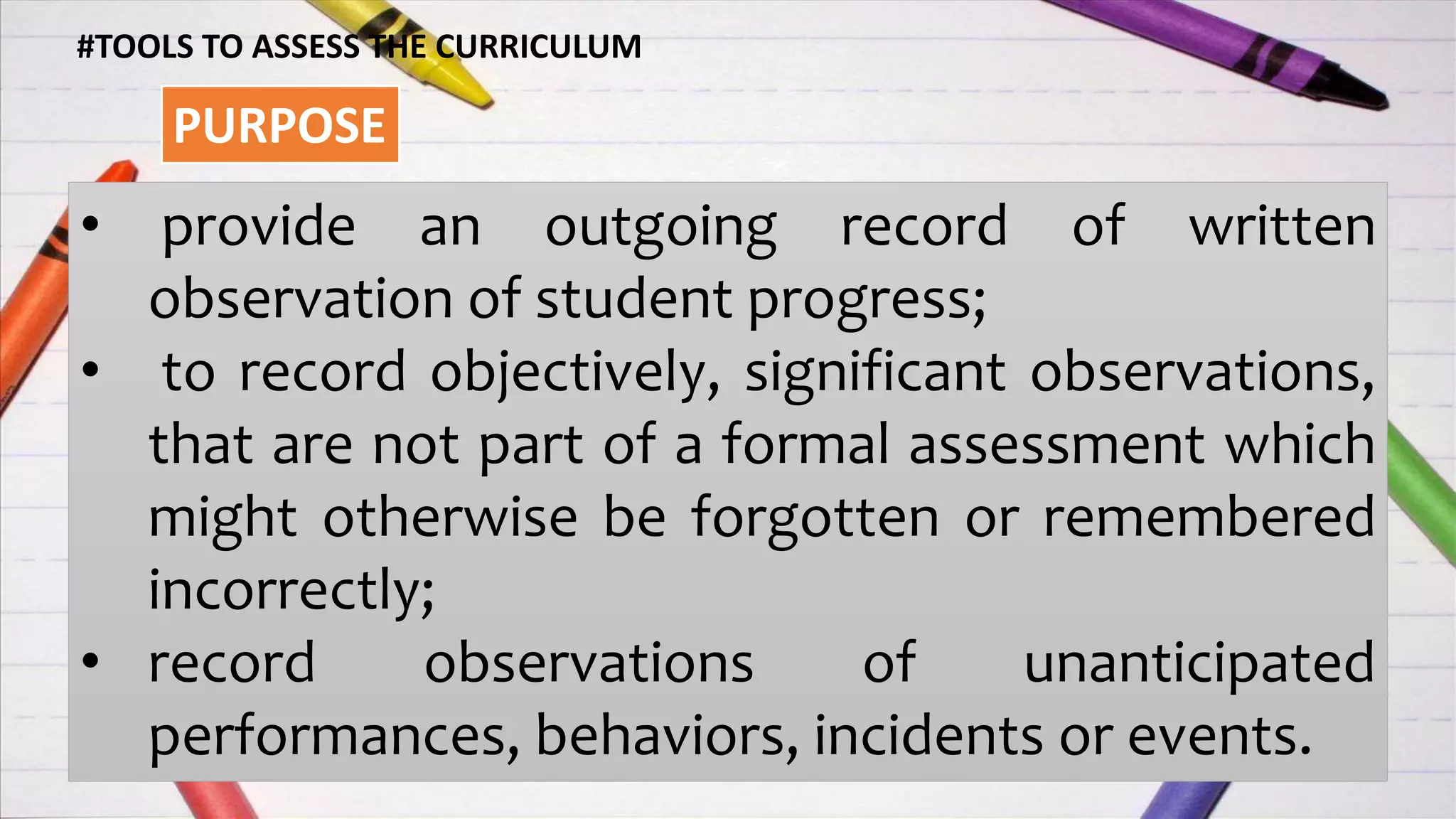
PURPOSE
• provide an outgoing record of written
observation of student progress;
• to record objectively, significant observations,
that are not part of a formal assessment which
might otherwise be forgotten or remembered
incorrectly;
• record observations of unanticipated
performances, behaviors, incidents or events.
#TOOLS TO ASSESS THE CURRICULUM
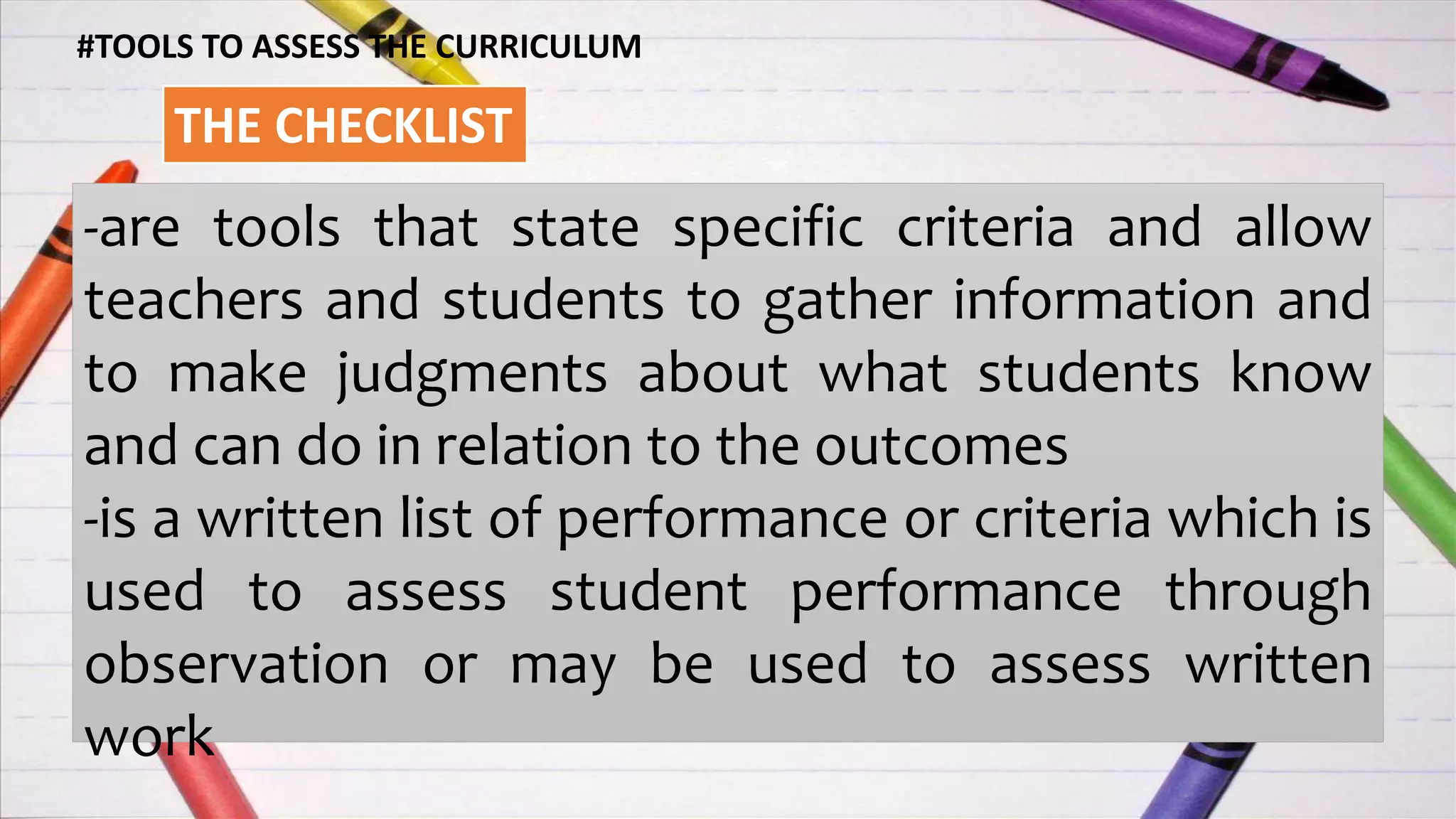
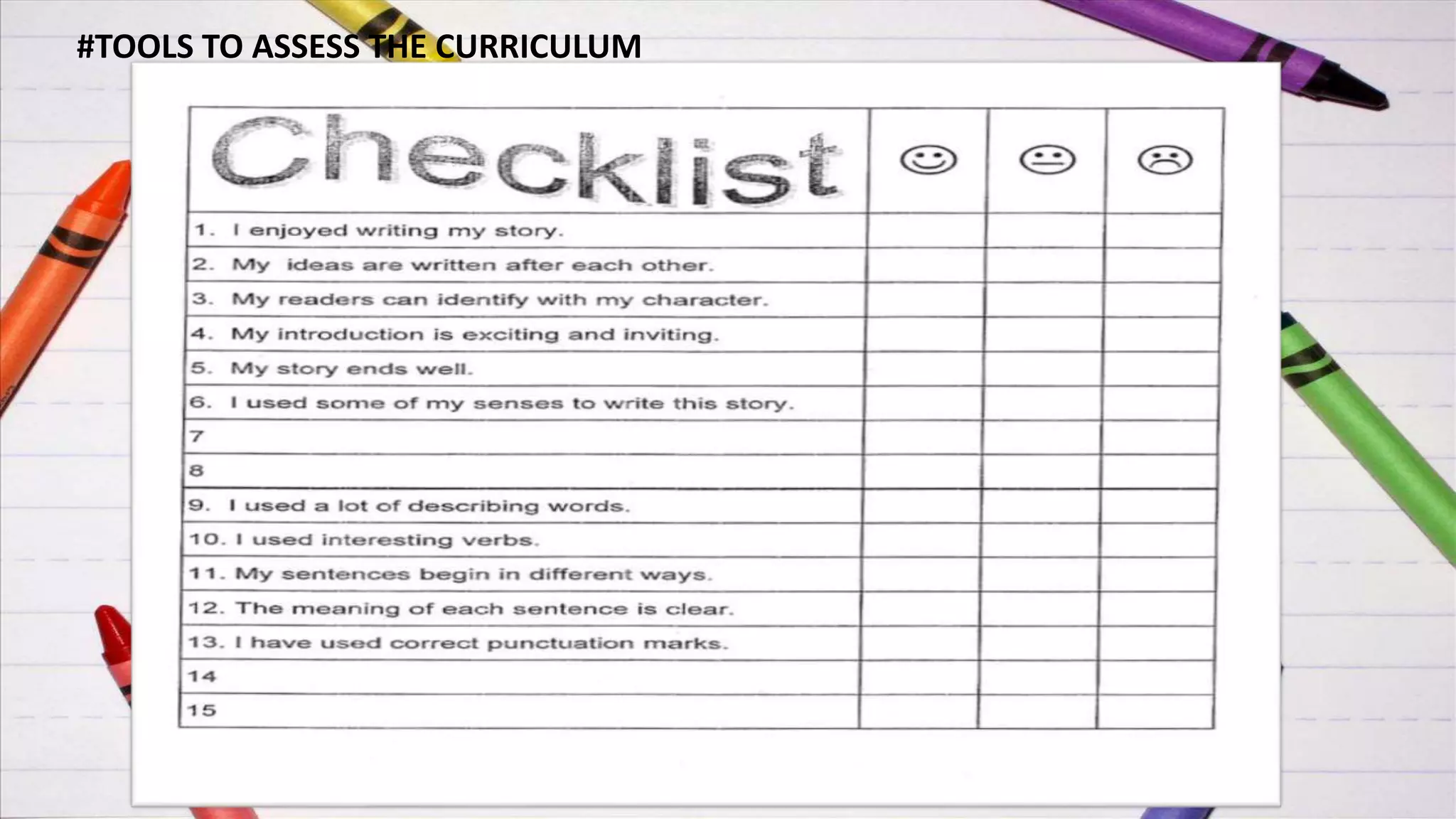
THE CHECKLIST
-are tools that state specific criteria and allow
teachers and students to gather information and
to make judgments about what students know
and can do in relation to the outcomes
-is a written list of performance or criteria which is
used to assess student performance through
observation or may be used to assess written
work
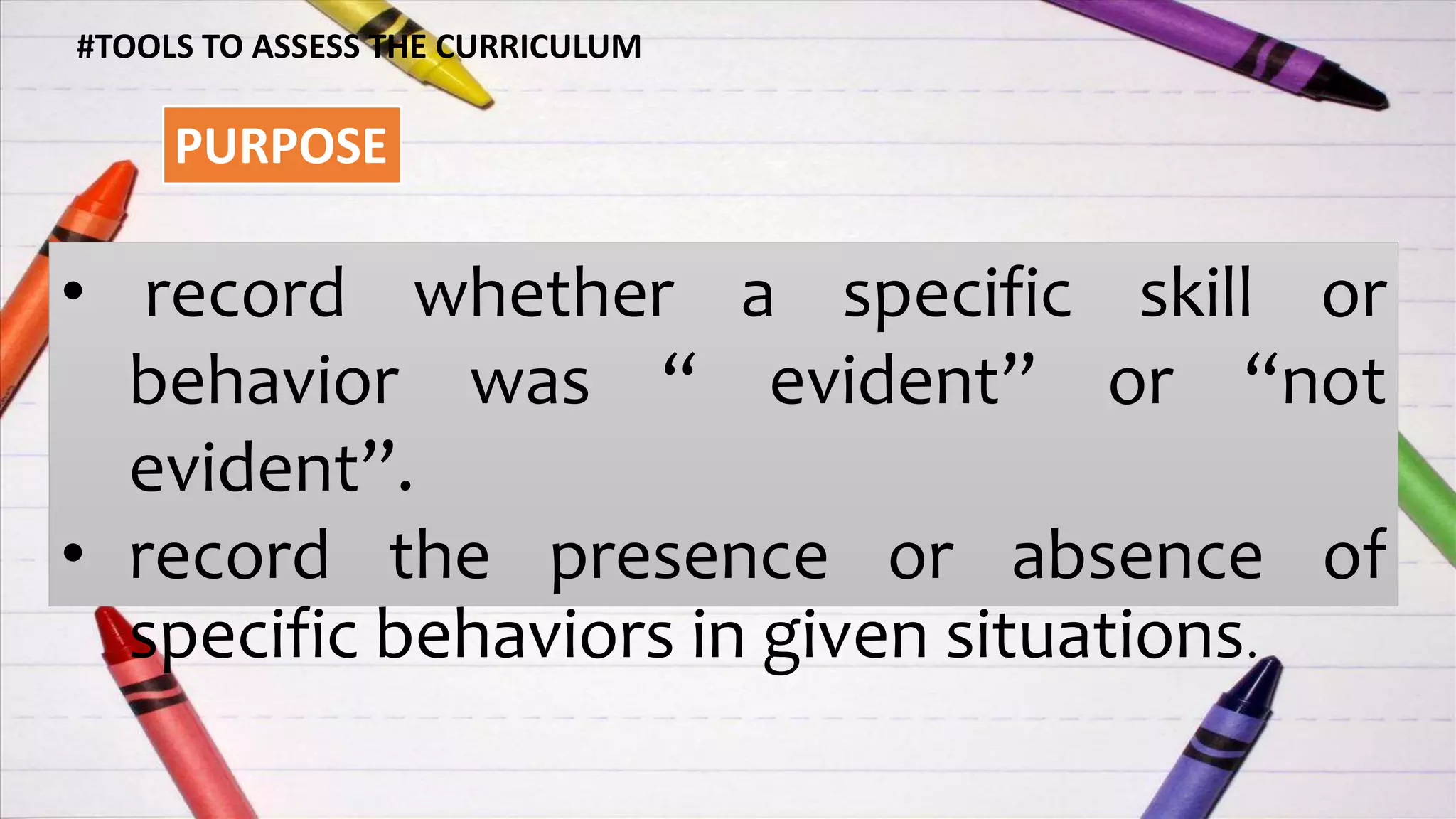
PURPOSE
#TOOLS TO ASSESS THE CURRICULUM
• record whether a specific skill or
behavior was “ evident” or “not
evident”.
• record the presence or absence of
specific behaviors in given situations.
#TOOLS TO ASSESS THE CURRICULUM
RATING SCALE
- A rating scale is a set of categories designed to elicit
information about a quantitative or a qualitative
attribute. In the social sciences, particularly psychology,
common examples are the Likert scale and 1-10 rating
scales in which a person selects the number which is
considered to reflect the perceived quality of a
product. It provide detailed diagnostic information on a
student’s performance, product, attitude, behavior in
reference to a stated criteria.
#TOOLS TO ASSESS THE CURRICULUM
PURPOSE
• record the frequency or even the
degree to which a student exhibits
a characteristic;
• record the range of a student
achievement in relation to specific
behaviors
#TOOLS TO ASSESS THE CURRICULUM
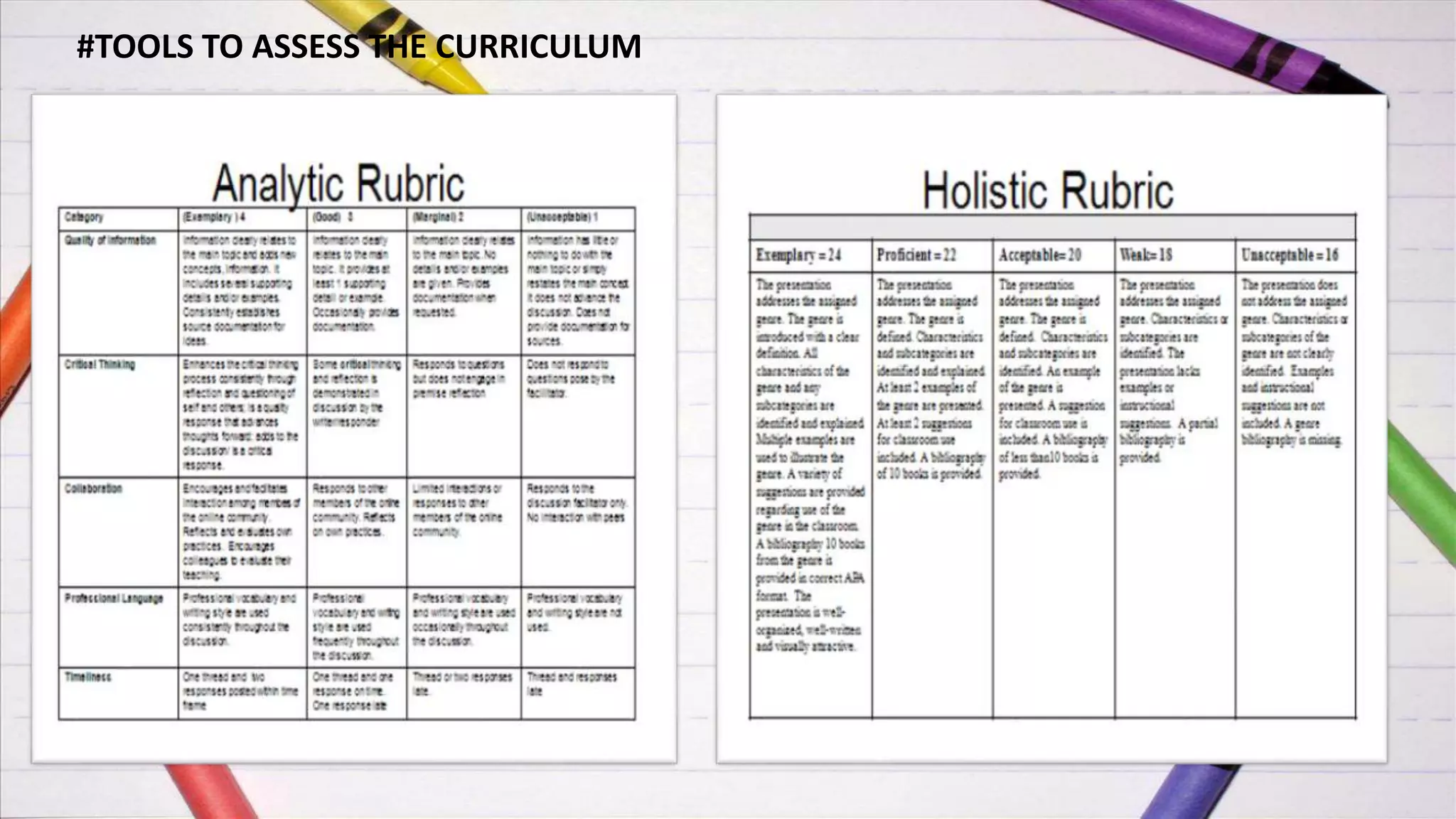
RUBRICS
-contains brief, written descriptions of
the different levels of student
performance;
- is a descriptive rating scale which
requires the rater to choose among
the different levels.
#TOOLS TO ASSESS THE CURRICULUM
PURPOSE
• summarize both student
performance and product against
pre-stated criteria;
• make scoring of student
performance more precise than
using a list of items.
#TOOLS TO ASSESS THE CURRICULUM
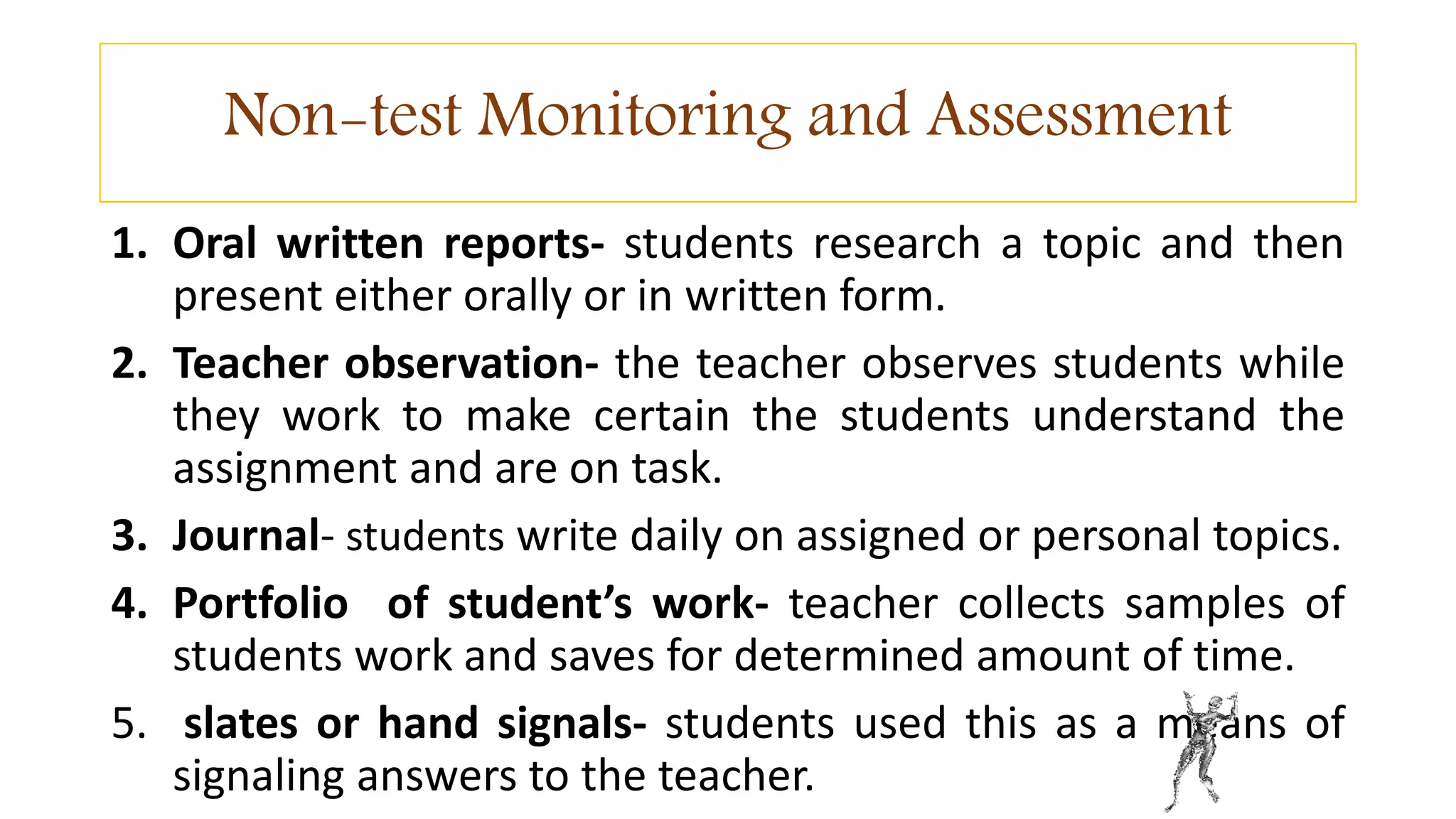
Non-test Monitoring and Assessment
1. Oral written reports- students research a topic and then
present either orally or in written form.
2. Teacher observation- the teacher observes students while
they work to make certain the students understand the
assignment and are on task.
3. Journal- students write daily on assigned or personal topics.
4. Portfolio of student’s work- teacher collects samples of
students work and saves for determined amount of time.
5. slates or hand signals- students used this as a means of
signaling answers to the teacher.
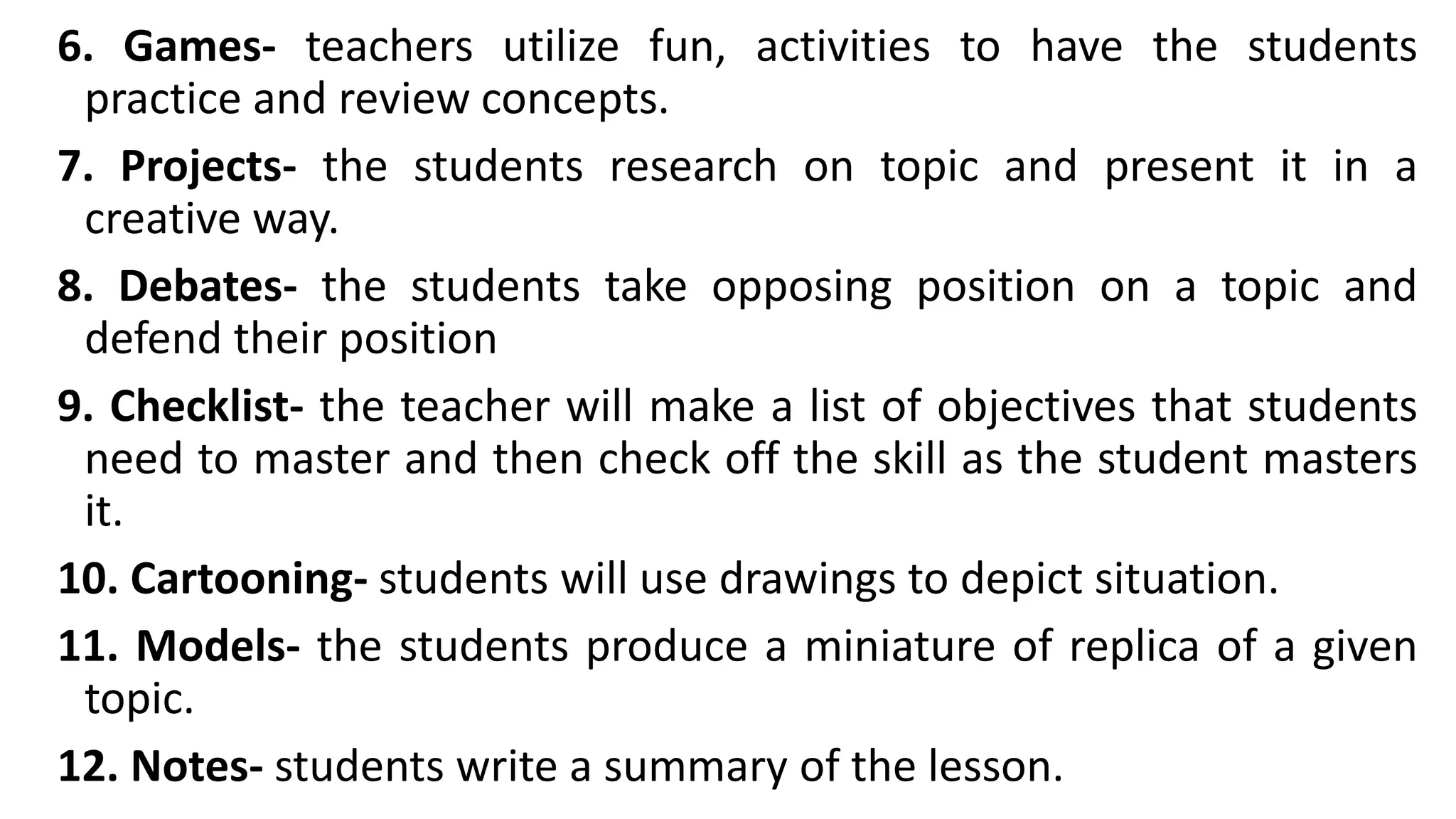
6. Games- teachers utilize fun, activities to have the students
practice and review concepts.
7. Projects- the students research on topic and present it in a
creative way.
8. Debates- the students take opposing position on a topic and
defend their position
9. Checklist- the teacher will make a list of objectives that students
need to master and then check off the skill as the student masters
it.
10. Cartooning- students will use drawings to depict situation.
11. Models- the students produce a miniature of replica of a given
topic.
12. Notes- students write a summary of the lesson.
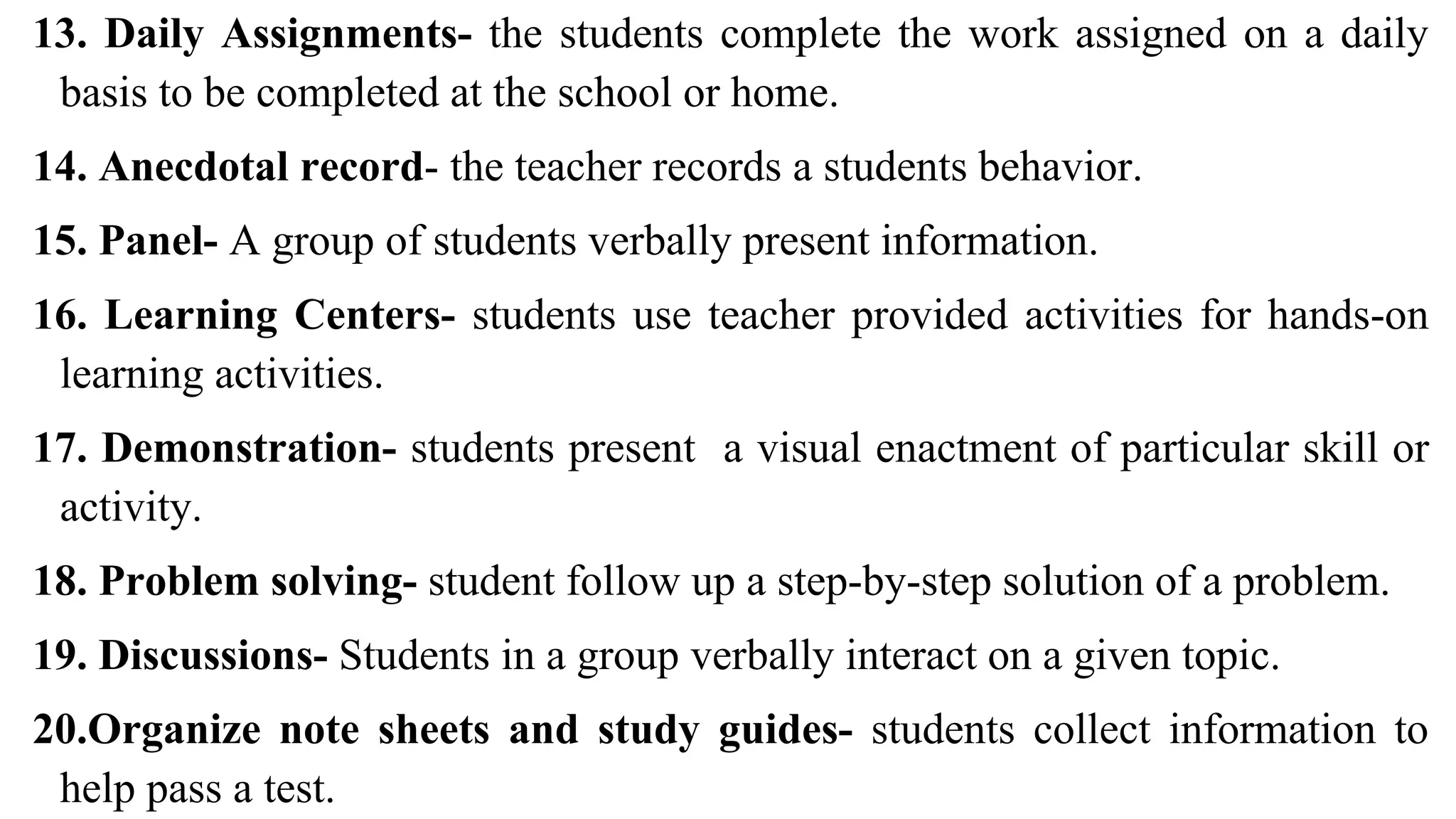
13. Daily Assignments- the students complete the work assigned on a daily
basis to be completed at the school or home.
14. Anecdotal record- the teacher records a students behavior.
15. Panel- A group of students verbally present information.
16. Learning Centers- students use teacher provided activities for hands-on
learning activities.
17. Demonstration- students present a visual enactment of particular skill or
activity.
18. Problem solving- student follow up a step-by-step solution of a problem.
19. Discussions- Students in a group verbally interact on a given topic.
20.Organize note sheets and study guides- students collect information to
help pass a test.
Tools and Strategies to assess the curriculum

Tools and Strategies to assess the curriculum

  • 2.
  • 3.
    #STRATEGIES TO ASSESSTHE CURRICULUM PAPER-AND-PENCIL STRATEGY This strategy focuses in assessing the student’s understanding and how well the students learn from the topic that the teacher has been discussed. This strategy is more on the cognitive domain where a student constructs a response to a question, topic , or brief statement and it also provides the student with opportunity to show what he has learn in the topic that the teacher discussed.
  • 4.
    #STRATEGIES TO ASSESSTHE CURRICULUM - is a writing sample used to assess student understanding and/or how well students can analyze and synthesize information
  • 5.
    #STRATEGIES TO ASSESSTHE CURRICULUM Characteristics • Measures student’s ability • Directly measures the performance • Includes a scoring plan • Affords the student a chance to construct his/her own answers
  • 6.
    #STRATEGIES TO ASSESSTHE CURRICULUM - is a pencil-and-paper assessment in which the student is to identify the one correct answer.
  • 7.
    #STRATEGIES TO ASSESSTHE CURRICULUM Characteristics • Can be administered to a large number of students at the same time • Can be scored very quickly • Stated in clear, simple language
  • 8.
    #STRATEGIES TO ASSESSTHE CURRICULUM PERFORMANCE-BASED STRATEGY This strategy is an assessment which requires students to demonstrate a skill by asking them to create, produce, or perform. This strategy is more on the psychomotor domain where a student enables to demonstrate abilities and skills.
  • 9.
    #STRATEGIES TO ASSESSTHE CURRICULUM - is an assessment which requires students to demonstrate a skill or proficiency by asking them to create, produce, or perform
  • 10.
    #STRATEGIES TO ASSESSTHE CURRICULUM Characteristics • Can be diagnostic, formative or summative • Allows most learners to participate successfully in varying degree • Provides opportunities to work individually, as well as in small groups • Focuses on process as well as products
  • 11.
    #STRATEGIES TO ASSESSTHE CURRICULUM - Is a performance in which a student demonstrates individual achievement through application of skills and knowledge
  • 12.
    #STRATEGIES TO ASSESSTHE CURRICULUM Characteristics • Either actual situation or simulation • Often used in Arts • Accompanied by a list of performance attributes as well as assessment criteria • Frequently organized in assessment stations
  • 13.
    #STRATEGIES TO ASSESSTHE CURRICULUM OBSERVATIONAL STRATEGY - it is the active acquisition of information from a primary source. In real life, observation employs the senses. This strategy is a process of systematically viewing and recording student behavior for the purpose of getting the weaknesses and strength of the student for the teacher to make a good decision in effective teaching.
  • 14.
    #STRATEGIES TO ASSESSTHE CURRICULUM ORAL STRATEGY - this strategy lets the students voice out there ideas and respond to a question by the teacher rather than writing. It also boosts up the confidence of the child to stand up and voice out his ideas about the question that the teacher asked to him. It also help teachers and students clarify their purpose for learning and link previous information with new understanding.
  • 15.
    #STRATEGIES TO ASSESSTHE CURRICULUM REFLECTIVE STRATEGY - is the process of gathering information and reflecting in one’s own learning. It assists students to take more responsibility and ownership of their learning and it also motivates the child if he sees his performance is high or low. It can help students to witness personal growth through comparison with their own previous work.
  • 16.
  • 17.
    #TOOLS TO ASSESSTHE CURRICULUM ANECDOTAL RECORD - are the written observations, word for word, and action for action of exactly what a child is doing and saying. A transcript, if you will, on an event, series of events or even throughout the day. - the anecdotal record provide an ongoing record of written observations of student progress for the teacher to easily understand what are the likes and dislikes of that student or the strengths and weaknesses of that student and it also helps the teacher to improve his way of teaching his student
  • 18.
    #TOOLS TO ASSESSTHE CURRICULUM PURPOSE • provide an outgoing record of written observation of student progress; • to record objectively, significant observations, that are not part of a formal assessment which might otherwise be forgotten or remembered incorrectly; • record observations of unanticipated performances, behaviors, incidents or events.
  • 19.
    #TOOLS TO ASSESSTHE CURRICULUM
  • 20.
    #TOOLS TO ASSESSTHE CURRICULUM THE CHECKLIST -are tools that state specific criteria and allow teachers and students to gather information and to make judgments about what students know and can do in relation to the outcomes -is a written list of performance or criteria which is used to assess student performance through observation or may be used to assess written work
  • 21.
    PURPOSE #TOOLS TO ASSESSTHE CURRICULUM • record whether a specific skill or behavior was “ evident” or “not evident”. • record the presence or absence of specific behaviors in given situations.
  • 22.
    #TOOLS TO ASSESSTHE CURRICULUM
  • 23.
    #TOOLS TO ASSESSTHE CURRICULUM RATING SCALE - A rating scale is a set of categories designed to elicit information about a quantitative or a qualitative attribute. In the social sciences, particularly psychology, common examples are the Likert scale and 1-10 rating scales in which a person selects the number which is considered to reflect the perceived quality of a product. It provide detailed diagnostic information on a student’s performance, product, attitude, behavior in reference to a stated criteria.

  • 24.
    #TOOLS TO ASSESSTHE CURRICULUM PURPOSE • record the frequency or even the degree to which a student exhibits a characteristic; • record the range of a student achievement in relation to specific behaviors
  • 25.
    #TOOLS TO ASSESSTHE CURRICULUM RUBRICS -contains brief, written descriptions of the different levels of student performance; - is a descriptive rating scale which requires the rater to choose among the different levels.
  • 26.
    #TOOLS TO ASSESSTHE CURRICULUM PURPOSE • summarize both student performance and product against pre-stated criteria; • make scoring of student performance more precise than using a list of items.
  • 27.
    #TOOLS TO ASSESSTHE CURRICULUM
  • 28.
    Non-test Monitoring andAssessment 1. Oral written reports- students research a topic and then present either orally or in written form. 2. Teacher observation- the teacher observes students while they work to make certain the students understand the assignment and are on task. 3. Journal- students write daily on assigned or personal topics. 4. Portfolio of student’s work- teacher collects samples of students work and saves for determined amount of time. 5. slates or hand signals- students used this as a means of signaling answers to the teacher.
  • 29.
    6. Games- teachersutilize fun, activities to have the students practice and review concepts. 7. Projects- the students research on topic and present it in a creative way. 8. Debates- the students take opposing position on a topic and defend their position 9. Checklist- the teacher will make a list of objectives that students need to master and then check off the skill as the student masters it. 10. Cartooning- students will use drawings to depict situation. 11. Models- the students produce a miniature of replica of a given topic. 12. Notes- students write a summary of the lesson.
  • 30.
    13. Daily Assignments-the students complete the work assigned on a daily basis to be completed at the school or home. 14. Anecdotal record- the teacher records a students behavior. 15. Panel- A group of students verbally present information. 16. Learning Centers- students use teacher provided activities for hands-on learning activities. 17. Demonstration- students present a visual enactment of particular skill or activity. 18. Problem solving- student follow up a step-by-step solution of a problem. 19. Discussions- Students in a group verbally interact on a given topic. 20.Organize note sheets and study guides- students collect information to help pass a test.