Meaning and Nature of SPED
Prepared by:
Junarie Ramirez BSED-3
Japhet Banagudos BEED-3
Remo Cyril Estorco BSED-3
Leahbelle Solinap BSED-3
JesuAlabado BEED-3
Catherine Oracion BEED-3
Ruby Jenn Ombi-on BEED-3
Aiza Rodriguez BEED-3
Ma. Theresa Tawing BEED-3
What is Special
Education?
• a classroom or private instruction involving
techniques, exercises, and subject matter
designed for students whose learning needs
cannot be met by a standard school
curriculum
• an education modified for those with
disabilities or exceptional needs as
handicapped people or gifted children
Specially Designed
Instruction
• it means that a student’s progress in
learning is monitored frequently, often
several times per week
Specially Designed
Instruction
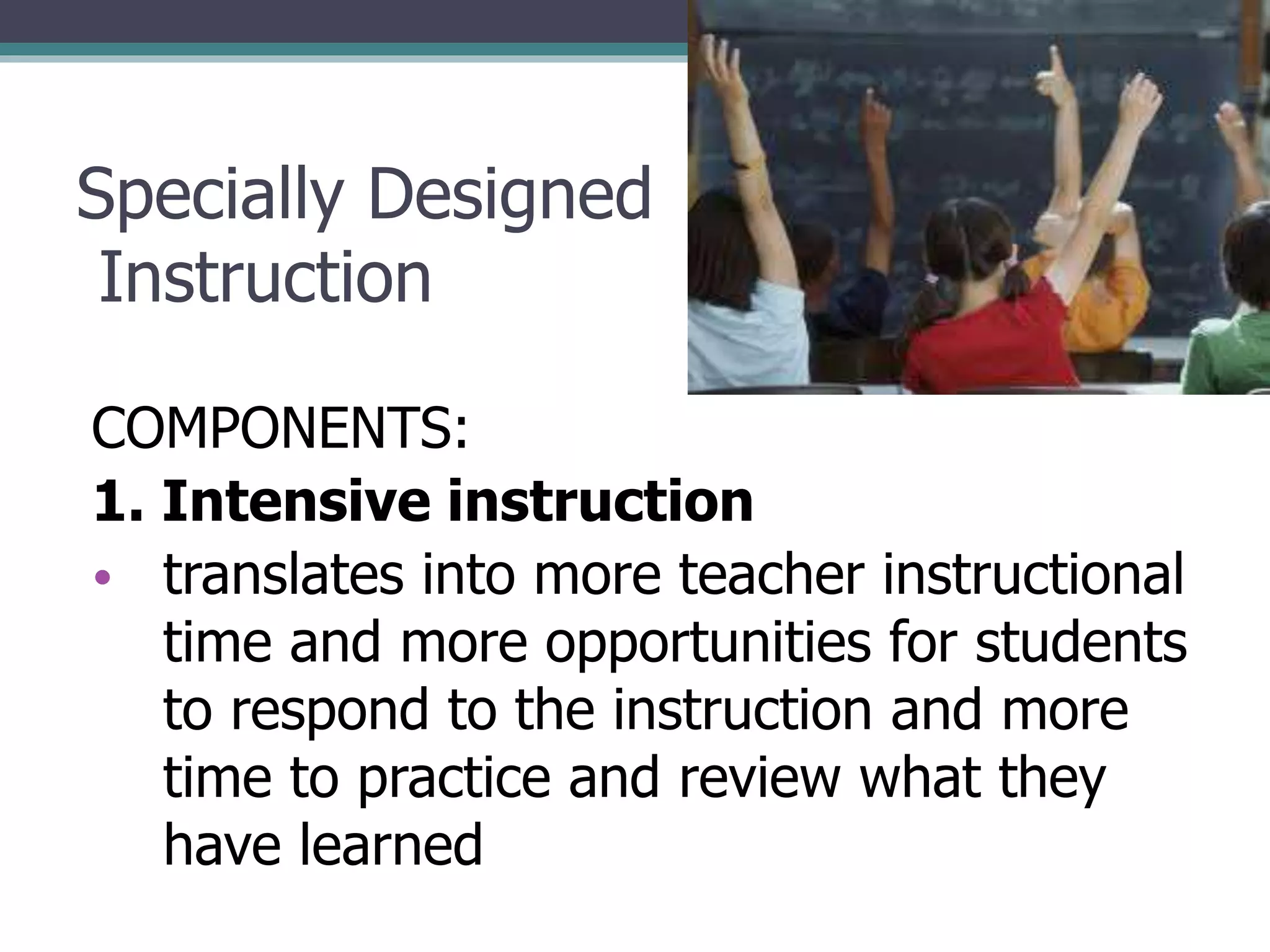
COMPONENTS:
1. Intensive instruction
• translates into more teacher instructional
time and more opportunities for students
to respond to the instruction and more
time to practice and review what they
have learned
Specially Designed
Instruction
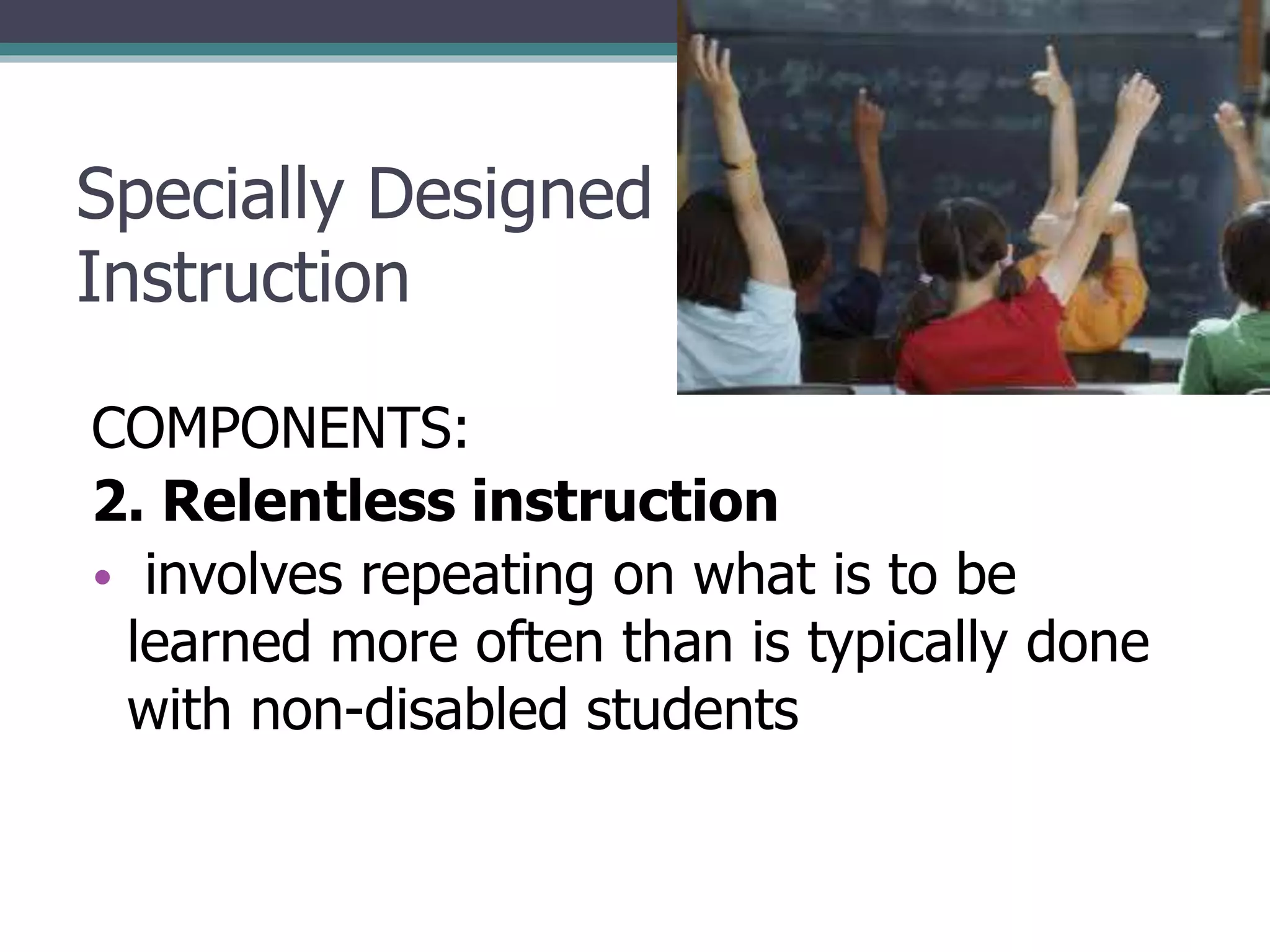
COMPONENTS:
2. Relentless instruction
• involves repeating on what is to be
learned more often than is typically done
with non-disabled students
Specially Designed
Instruction
COMPONENTS:
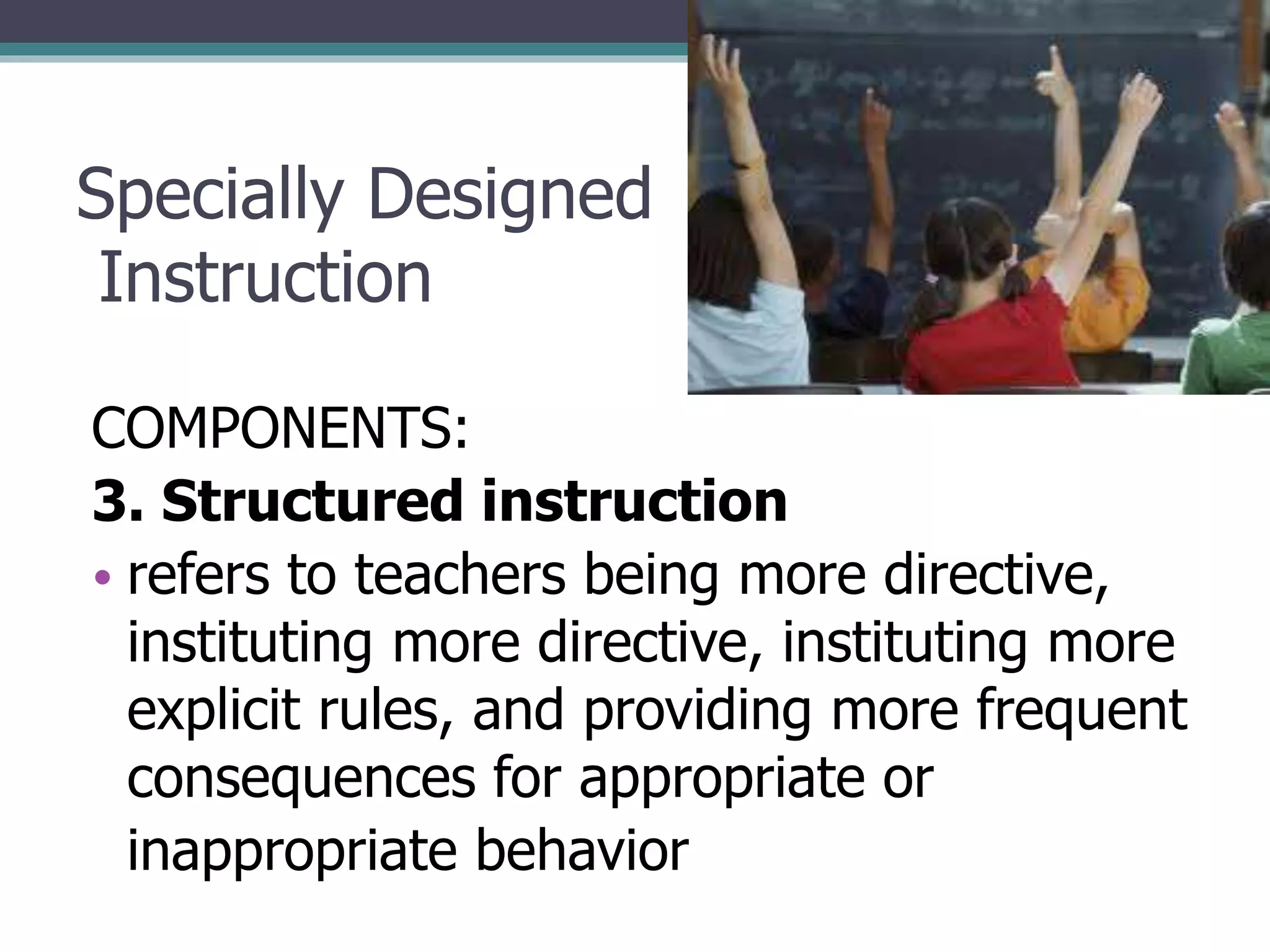
3. Structured instruction
• refers to teachers being more directive,
instituting more directive, instituting more
explicit rules, and providing more frequent
consequences for appropriate or
inappropriate behavior
Specially Designed
Instruction
COMPONENTS:
4. Pace of the instruction
• is tailored more to the needs of students
and is often slower, with teachers waiting
for a longer period of time for a response
after querying the student
Specially Designed
Instruction
COMPONENTS:
5. Instruction in small groups
• facilitates the intensity, relentlessness,
structured nature, and individualized pace
of instruction
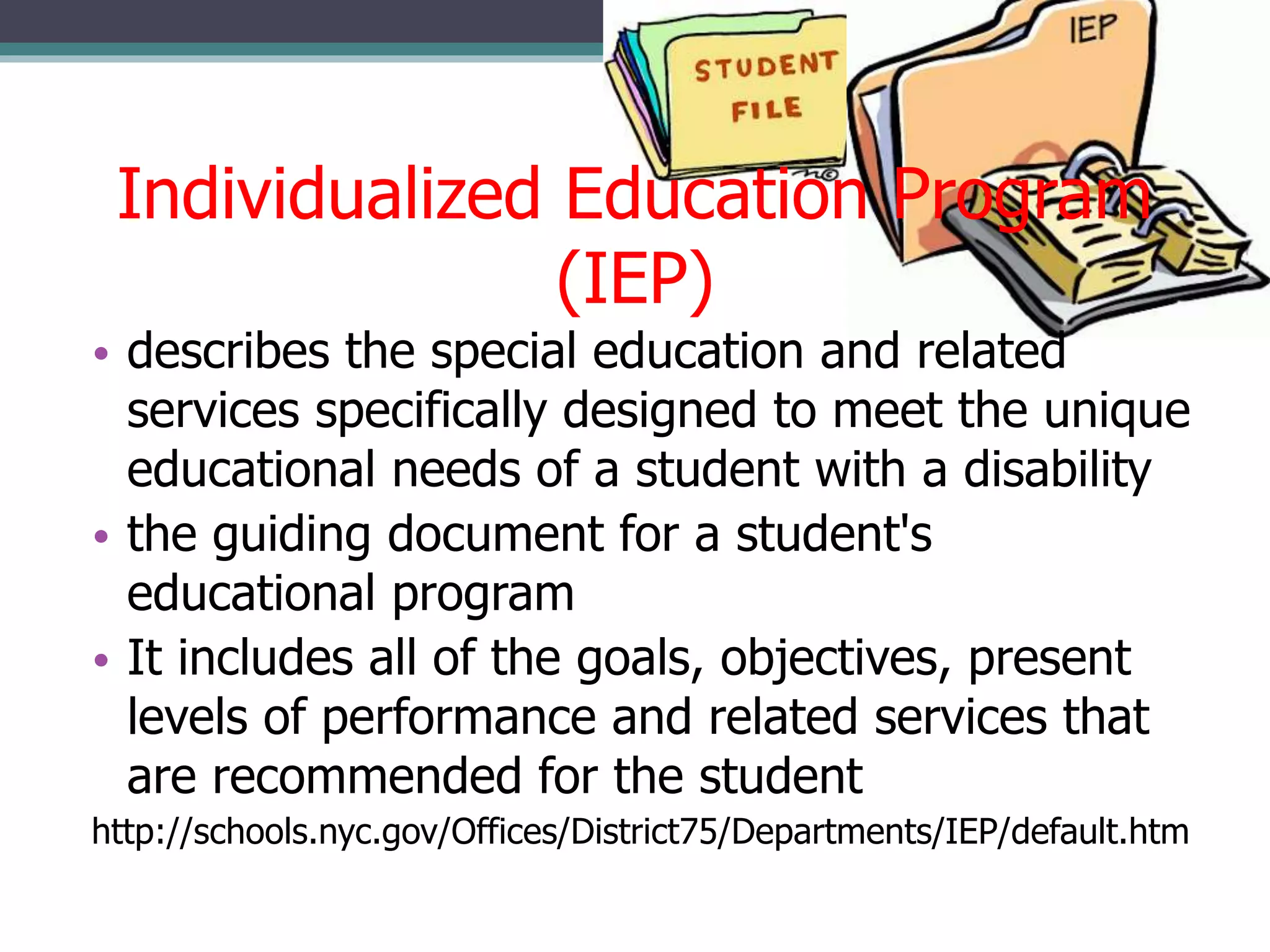
Individualized Education Program
(IEP)
• describes the special education and related
services specifically designed to meet the unique
educational needs of a student with a disability
• the guiding document for a student's
educational program
• It includes all of the goals, objectives, present
levels of performance and related services that
are recommended for the student
http://schools.nyc.gov/Offices/District75/Departments/IEP/default.htm
What Is Inclusive Education?
• inclusive education is provided by Lipsky &
Gartner (1996, 1999), who described it as students
with disabilities having full membership in ageappropriate classes in their neighborhood schools,
with appropriate supplementary aids and support
services
• to Antia et al. (2002), inclusion denotes a student
with a disability unconditionally belonging to and
having full membership of a regular classroom in a
regular school and its community
What Is Inclusive Education?
• inclusive education is a process where by the
school systems, strategic plans, and policies
adapt and change to include teaching strategies
for a wider more diverse range of children

http://www.seneseinclusiveedu.ws/index.php?option=com_cont
ent&view=article&id=86:defin
Inclusive Education in the
Philippines
POLICY:
• Provides "all children and youth with special needs
must receive an appropriate education and
everything within the system and they should get
education along with other children regardless of
human differences“
This requires fundamental changes in philosophy,
curriculum, teaching strategies and structural
organization and above all changes in human
attitudes and behaviors of all those involved in the
education of the children with special needs
SPED CENTER AS RESOURCE
CENTER FOR INCLUSION:
PHILIPPINE MODEL
By
Yolanda S. Quijano
Chief, Special Education Division,
Bureau of Elementary Education, Dept. of
Education
Philippines
http://www.acid2011korea.org/kaidd_abs/pds/20110600293_15
th_A_28.pdf
SPED CENTER AS RESOURCE CENTER
FOR INCLUSION:
PHILIPPINE MODEL
The Child with Special Needs: The Vision
• The State, community and the family hold a common
vision for the Filipino child with special needs
• This education should fully realize his/her own potentials
for development and productivity as well as being
capable of self-expression of his/her rights in the society
• It is envisioned that the child with special needs will get
full parental and community support for his/her
education without discrimination of any kind
• This special child should also be provided with a healthy
environment along with leisure and recreational and
social security measures
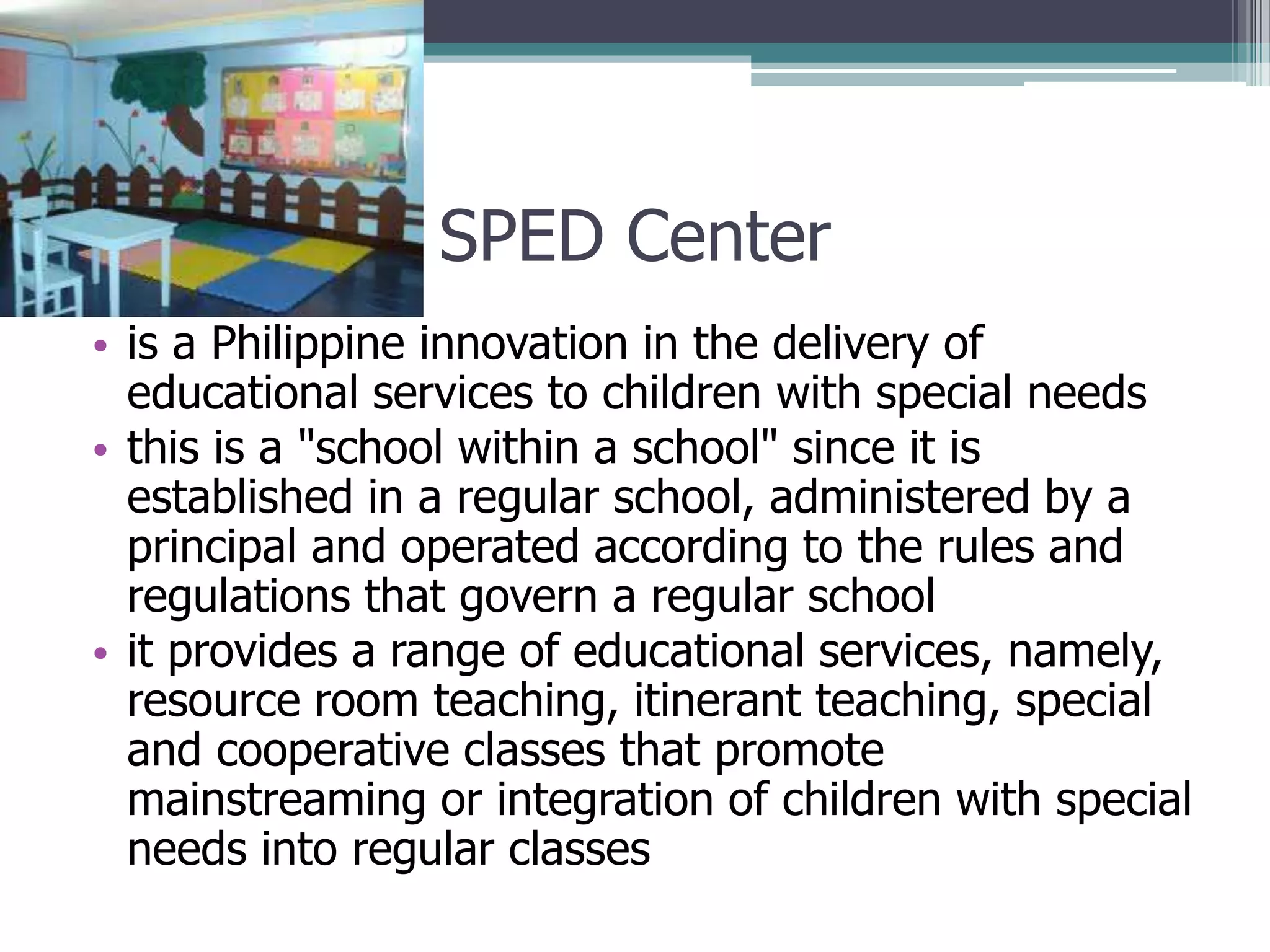
SPED Center
• is a Philippine innovation in the delivery of
educational services to children with special needs
• this is a "school within a school" since it is
established in a regular school, administered by a
principal and operated according to the rules and
regulations that govern a regular school
• it provides a range of educational services, namely,
resource room teaching, itinerant teaching, special
and cooperative classes that promote
mainstreaming or integration of children with special
needs into regular classes
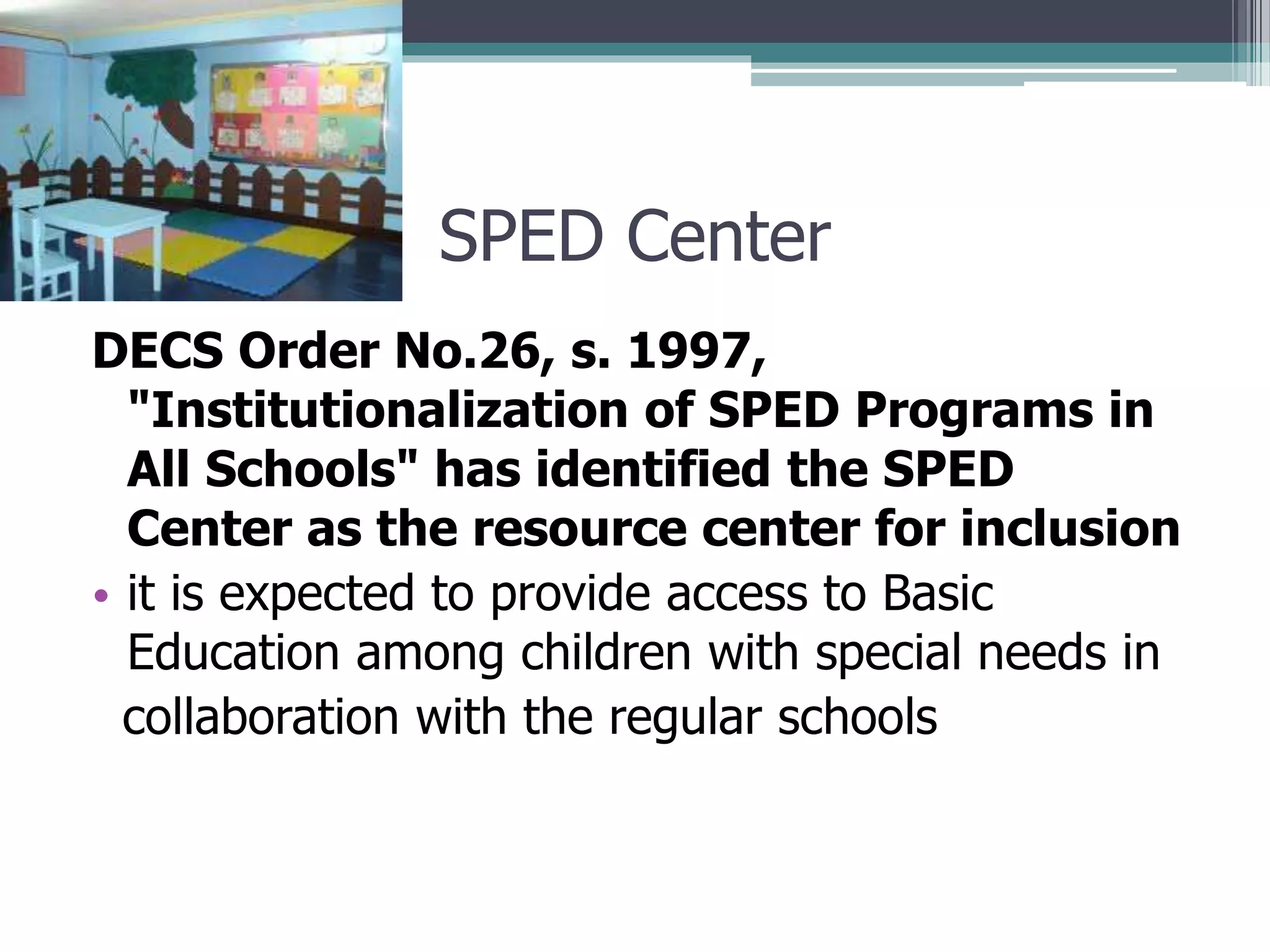
SPED Center
DECS Order No.26, s. 1997,
"Institutionalization of SPED Programs in
All Schools" has identified the SPED
Center as the resource center for inclusion
• it is expected to provide access to Basic
Education among children with special needs in
collaboration with the regular schools
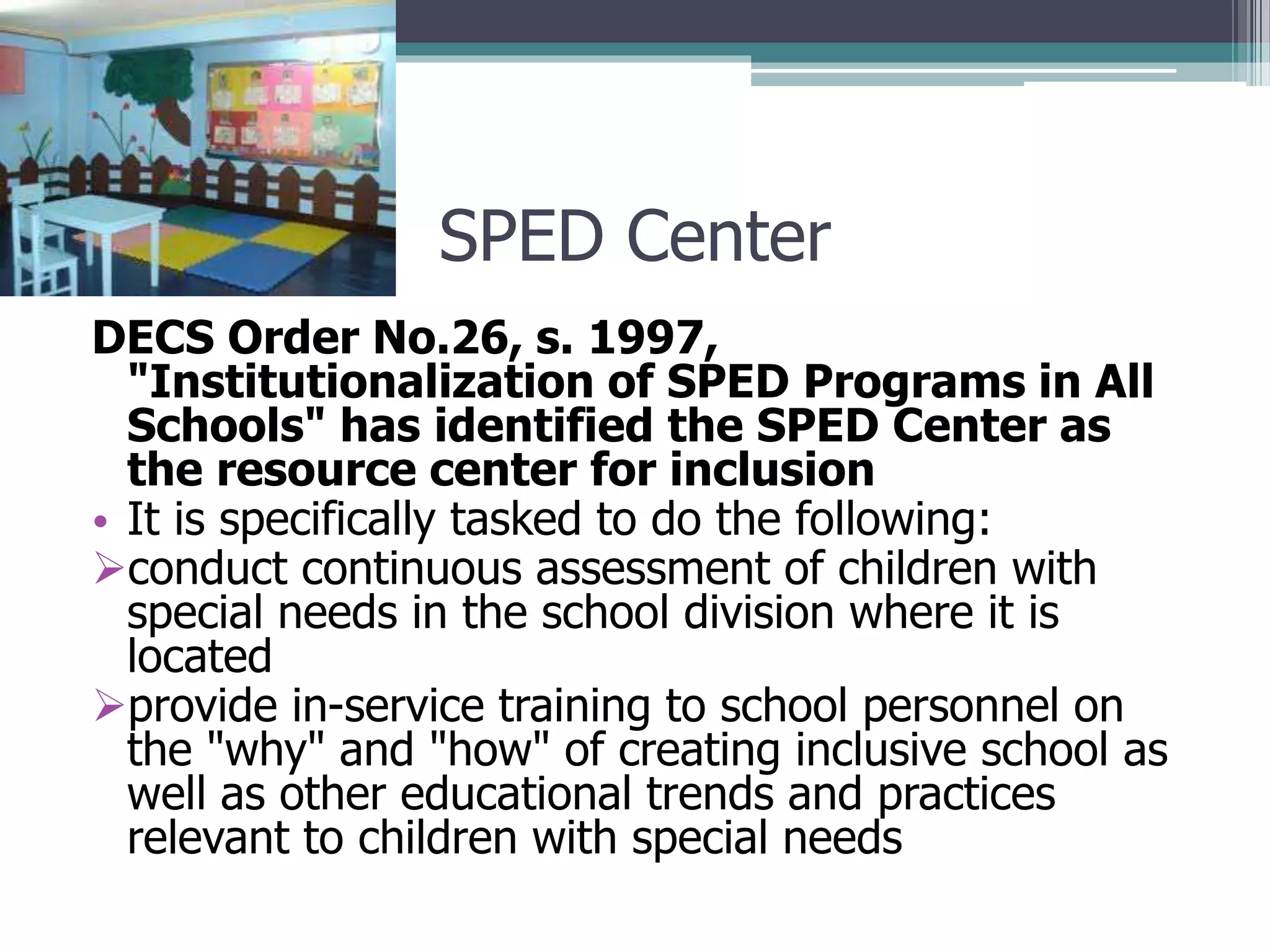
SPED Center
DECS Order No.26, s. 1997,
"Institutionalization of SPED Programs in All
Schools" has identified the SPED Center as
the resource center for inclusion
• It is specifically tasked to do the following:
conduct continuous assessment of children with
special needs in the school division where it is
located
provide in-service training to school personnel on
the "why" and "how" of creating inclusive school as
well as other educational trends and practices
relevant to children with special needs
SPED Center
DECS Order No.26, s. 1997,
"Institutionalization of SPED Programs in All
Schools" has identified the SPED Center as
the resource center for inclusion
• It is specifically tasked to do the following:
provide these children with appropriate equipment
and produce appropriate teaching materials
support children with special needs included in the
regular classroom in collaboration with the regular
teachers
provide educational services that promote inclusion
13 Special Education
Categories/Disability Categories

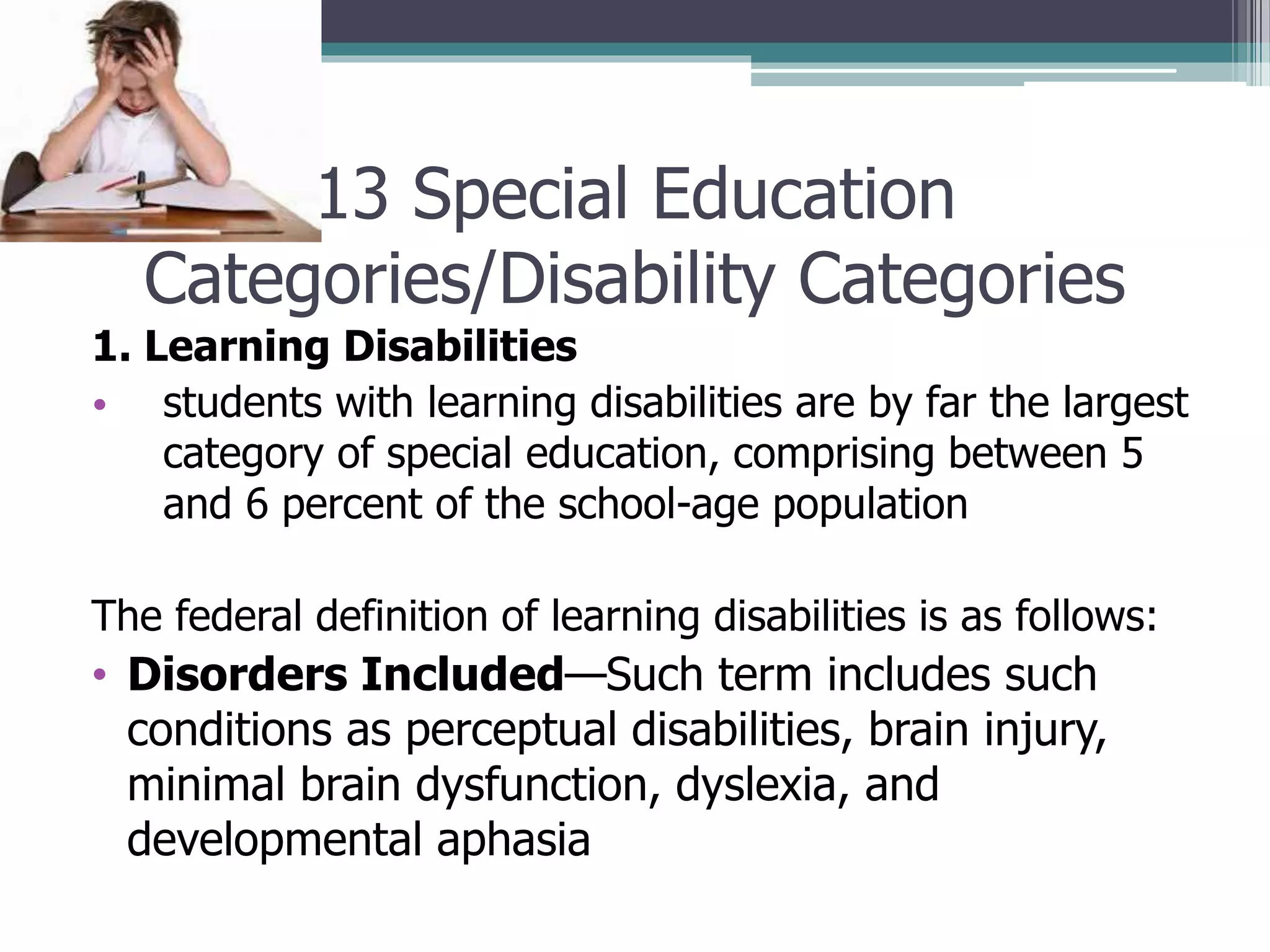
1. Learning Disabilities
• students with learning disabilities are by far the largest
category of special education, comprising between 5
and 6 percent of the school-age population
The federal definition of learning disabilities is as follows:
• General—The term “specific learning disability” means a
disorder in one or more of the basic psychological
processes involved in understanding or in using
language, spoken or written, which disorder may
manifest itself in an imperfect ability to listen, think,
speak, read, write, spell, or do mathematical
calculations.
13 Special Education
Categories/Disability Categories
1. Learning Disabilities
• students with learning disabilities are by far the largest
category of special education, comprising between 5
and 6 percent of the school-age population
The federal definition of learning disabilities is as follows:

• Disorders Included—Such term includes such
conditions as perceptual disabilities, brain injury,
minimal brain dysfunction, dyslexia, and
developmental aphasia
13 Special Education
Categories/Disability Categories

1. Learning Disabilities
• students with learning disabilities are by far the largest
category of special education, comprising between 5
and 6 percent of the school-age population
The federal definition of learning disabilities is as follows:

• Disorders Not Included—Such term does not
include a learning problem that is primarily the
result of visual, hearing, or motor disabilities, of
mental retardation, of emotional disturbance, or of
environmental, cultural, or economic disadvantage
13 Special Education
Categories/Disability Categories
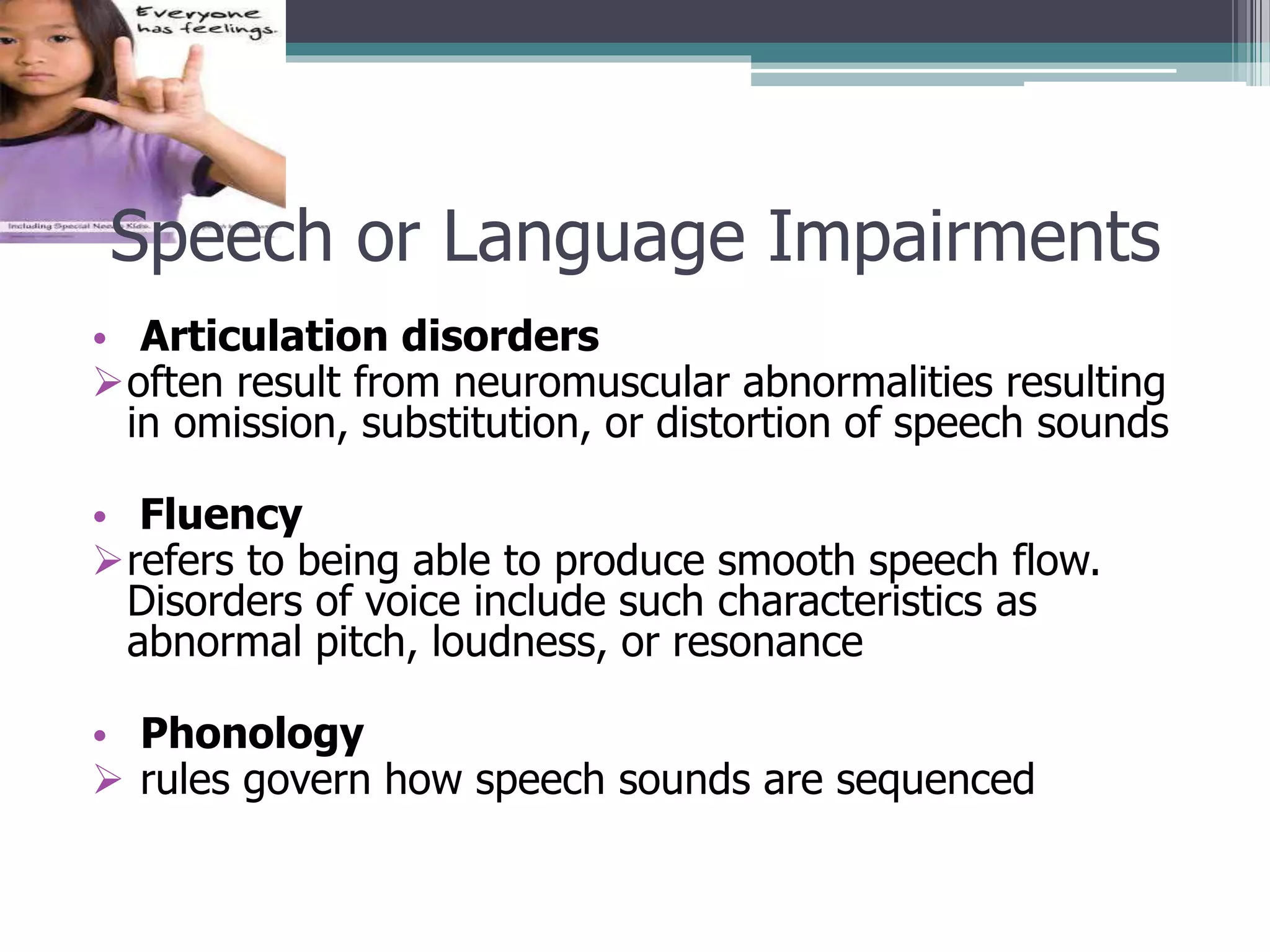
2. Speech or Language Impairments
• Speech impairments include disorders of
articulation, fluency, and/or voice
Speech or Language Impairments
• Articulation disorders
often result from neuromuscular abnormalities resulting
in omission, substitution, or distortion of speech sounds

• Fluency
refers to being able to produce smooth speech flow.
Disorders of voice include such characteristics as
abnormal pitch, loudness, or resonance
• Phonology
 rules govern how speech sounds are sequenced
Speech or Language Impairments
• Morphology
refers to parts of words that indicate such factors as
verb tense and plurals
• Syntax
involves word order that reflects proper grammar

• Semantics
refers to the meanings of words and sentences, and
pragmatics involves using language for social
purposes
13 Special Education
Categories/Disability Categories
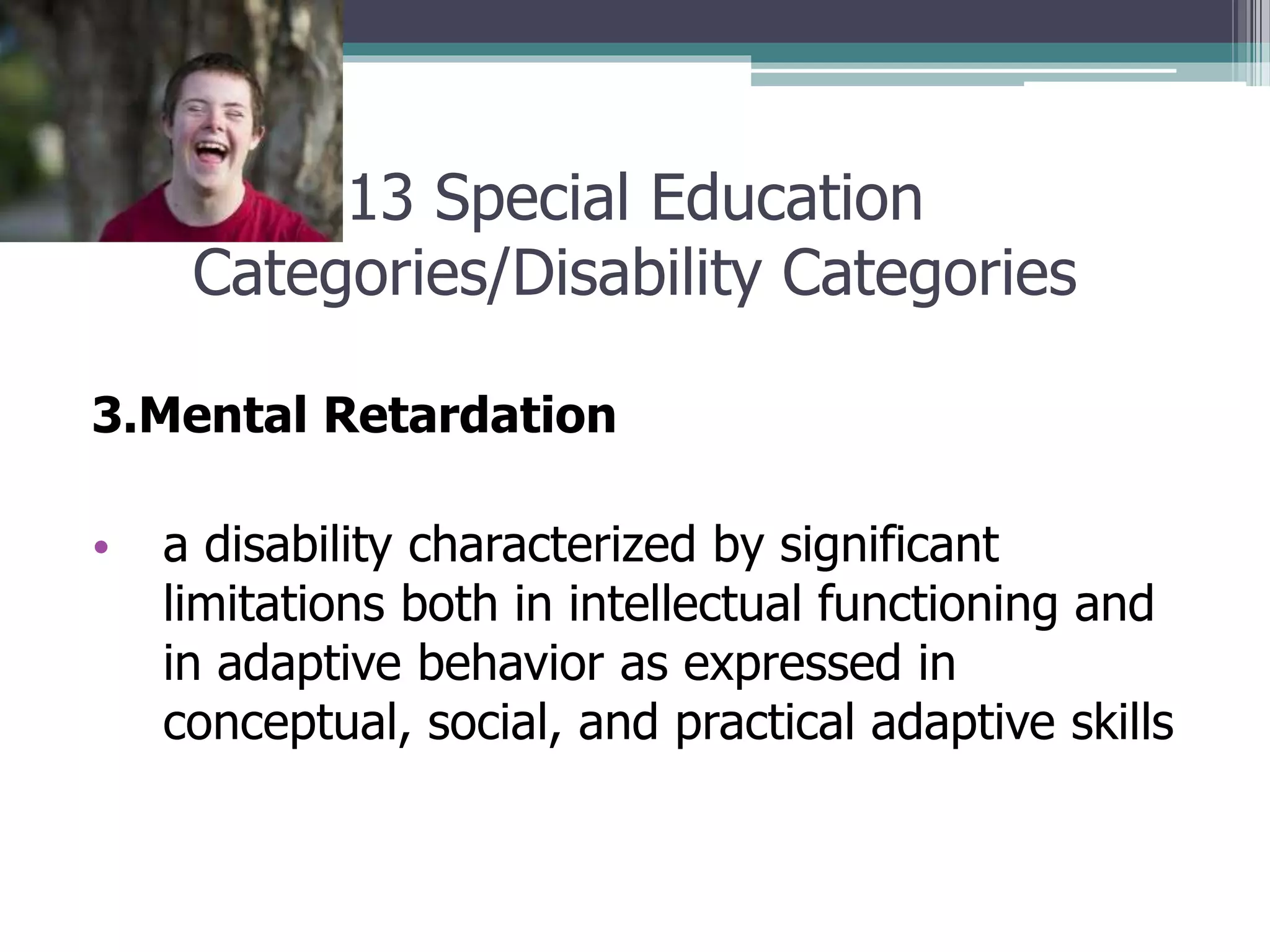
3.Mental Retardation
•

a disability characterized by significant
limitations both in intellectual functioning and
in adaptive behavior as expressed in
conceptual, social, and practical adaptive skills
13 Special Education
Categories/Disability Categories

4. Emotional Disturbance
• With respect to definition, many authorities agree
on the following three features of emotional or
behavioral disorders:
• Behavior that goes to an extreme—that is not just
slightly different from the usual;
• A problem that is chronic—one that does not quickly
disappear; and
• Behavior that is unacceptable because of social or
cultural expectations
13 Special Education
Categories/Disability Categories

5. Other Health Impairments
• According to the federal definition, other health
impairments (OHIs) are medical conditions, such as
asthma, diabetes, epilepsy, sickle cell anemia, which
impair to such a degree that they adversely affect a
student's educational performance

• The key to the definition is that the condition must
interfere with the student's educational performance
• For example, not all students who have asthma have it
to such a degree that it affects their ability to function in
school
13 Special Education
Categories/Disability Categories
6. Multiple Disabilities
• consists of students who have two or more
disabilities, “the combination of which causes
such severe educational problems that they
cannot be accommodated in special education
programs solely for one of the impairments”
13 Special Education
Categories/Disability Categories

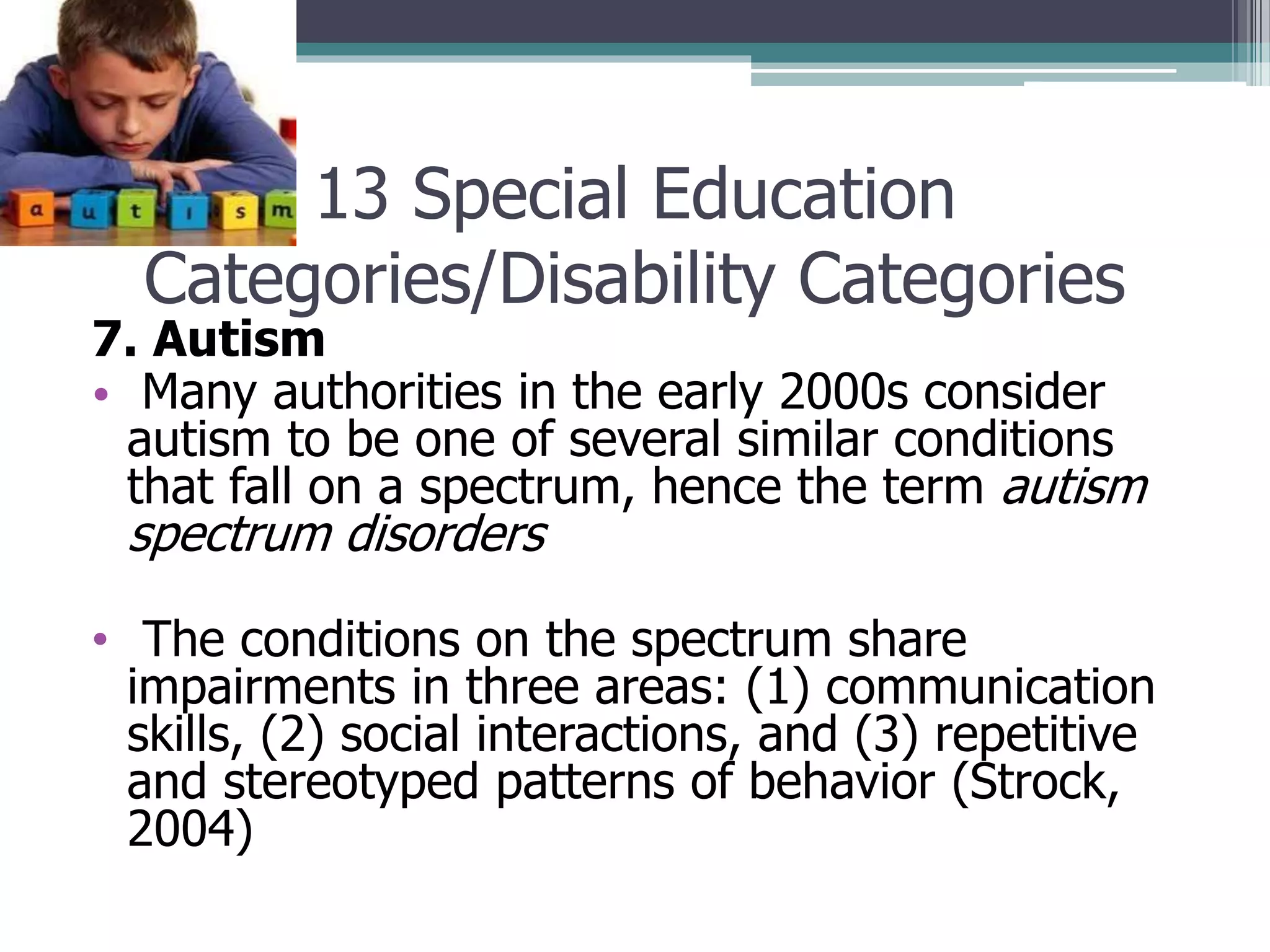
7. Autism
• Many authorities in the early 2000s consider
autism to be one of several similar conditions
that fall on a spectrum, hence the term autism

spectrum disorders

• The conditions on the spectrum share
impairments in three areas: (1) communication
skills, (2) social interactions, and (3) repetitive
and stereotyped patterns of behavior (Strock,
2004)
13 Special Education
Categories/Disability Categories

7. Autism

• Classic autism and Asperger syndrome are the
most common conditions
• Whereas students with autism have relatively
severe deficits in all three areas plus severe
cognitive deficits, those with Asperger syndrome
generally have less severe deficits in all three
areas, with their major problem lying in the area
of social interactions and some having very high
intelligence
13 Special Education
Categories/Disability Categories
8. Orthopedic Impairments
• include physical disabilities of the muscles
and/or bones that negatively affect school
learning
• Two examples are muscular dystrophy (a
hereditary condition resulting in muscle fiber
degeneration) and juvenile rheumatoid arthritis
13 Special Education
Categories/Disability Categories

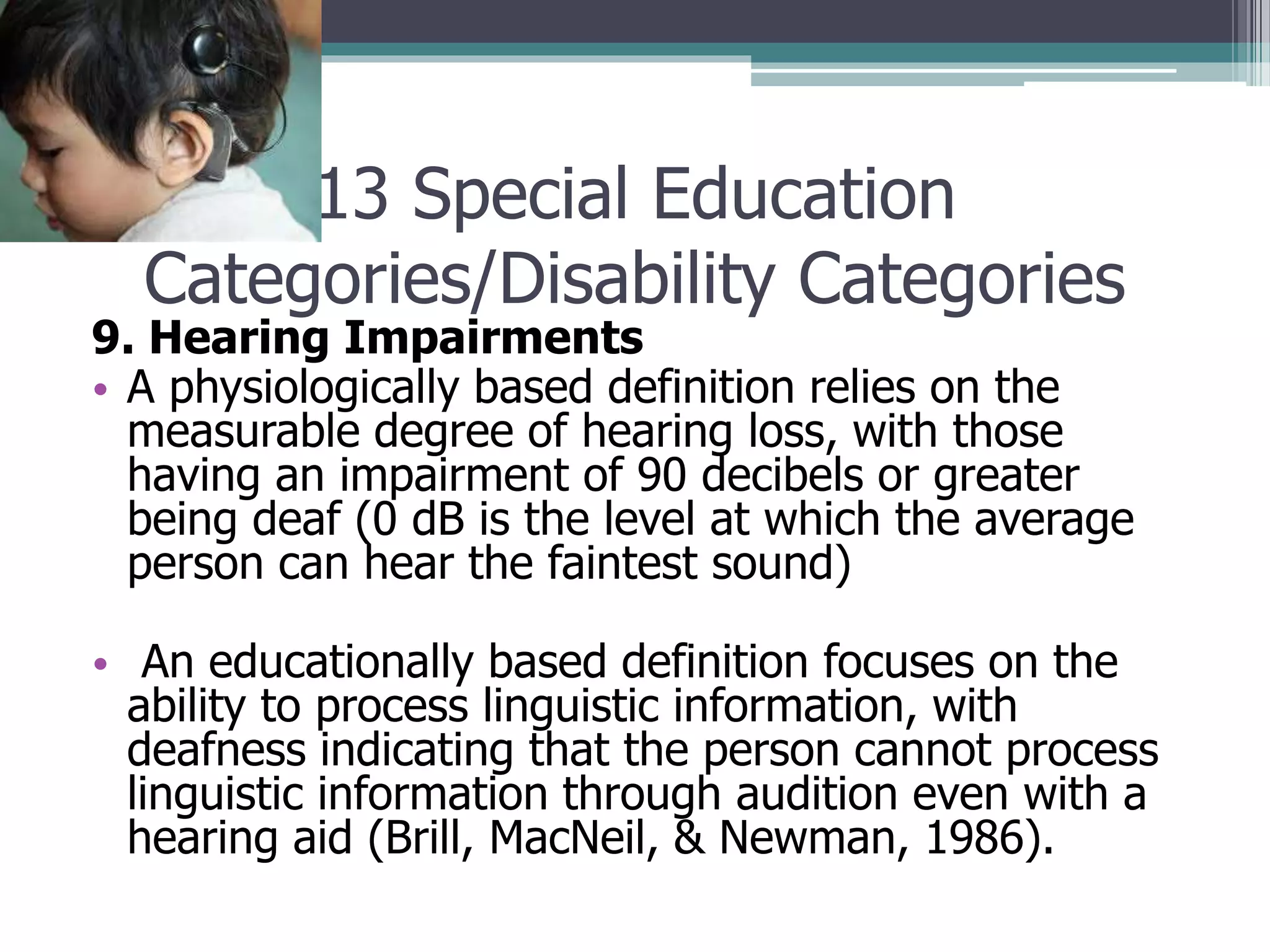
9. Hearing Impairments
• Students with hearing impairments fall into
two categories:
those who are deaf and;
those who are hard of hearing

• How one differentiates between the two
depends on whether one adopts a
physiological or an educational orientation
13 Special Education
Categories/Disability Categories

9. Hearing Impairments
• A physiologically based definition relies on the
measurable degree of hearing loss, with those
having an impairment of 90 decibels or greater
being deaf (0 dB is the level at which the average
person can hear the faintest sound)
• An educationally based definition focuses on the
ability to process linguistic information, with
deafness indicating that the person cannot process
linguistic information through audition even with a
hearing aid (Brill, MacNeil, & Newman, 1986).
13 Special Education
Categories/Disability Categories
10. Developmental Delay
• For many infants and preschoolers, it is often
difficult to determine whether they have a true
disability or have a temporary delay in maturation
• In addition, it is sometimes difficult to determine the
exact nature of very young children's disability
• For these reasons, professionals are often reluctant
to make a clinical diagnosis and, instead, refer to
them as having a developmental delay
13 Special Education
Categories/Disability Categories

11. Visual Impairments
• visual impairments are divided into two groups based on
severity: blindness and low vision
• Additionally, like hearing impairments, these two groups
are defined differently according to whether one uses a
physiological versus an educational approach

• A physiological orientation (also referred to as the legal
definition because it is used to determine certain
government benefits) relies on measurement of visual
acuity and field of vision
13 Special Education
Categories/Disability Categories

11. Visual Impairments

• Like hearing impairments, visual impairments are divided
into two groups based on severity: blindness and low
vision
• Visual acuity of 20/200 (normal acuity is 20/20, being
able to see at 20 feet what a person with normal vision
sees at 20 feet) or less in the better eye, even with
correction (e.g., eyeglasses), or visual field of less than
20 degrees qualifies an individual as legally blind
• Those having visual acuity between 20/70 and 20/200
are referred to as having low vision or being partially
sighted
13 Special Education
Categories/Disability Categories

11. Visual Impairments
• Like hearing impairments, visual impairments
are divided into two groups based on severity:
blindness and low vision
• The educational definition focuses on mode of
reading, with those needing to use Braille being
considered blind, and those who can read print,
even with magnifying devices or large-print
books, being considered as having low vision or
being partially sighted
13 Special Education
Categories/Disability Categories
12. Traumatic Brain Injury
• In 1990, the federal government added
students with traumatic brain injury (TBI) to the
list of those eligible for special education
services

• This decision was in recognition of the fact that
TBI occurs much more frequently than was
previously thought
13 Special Education
Categories/Disability Categories

12. Traumatic Brain Injury
• For example, estimates are that about one million
children and adolescents receive head injuries each year,
with 15,000 to 20,000 incurring lasting effects (Council
for Exceptional Children, 2001)
TBI refers to trauma to the brain caused by an external
force that results in behavioral dysfunction
• Such injuries can be open head injuries (i.e.,
penetrating head wounds) or closed head injuries (i.e.,
damage caused by internal compression or shearing
motion inside the head) (Adelson&Kochanek, 1998)
13 Special Education
Categories/Disability Categories

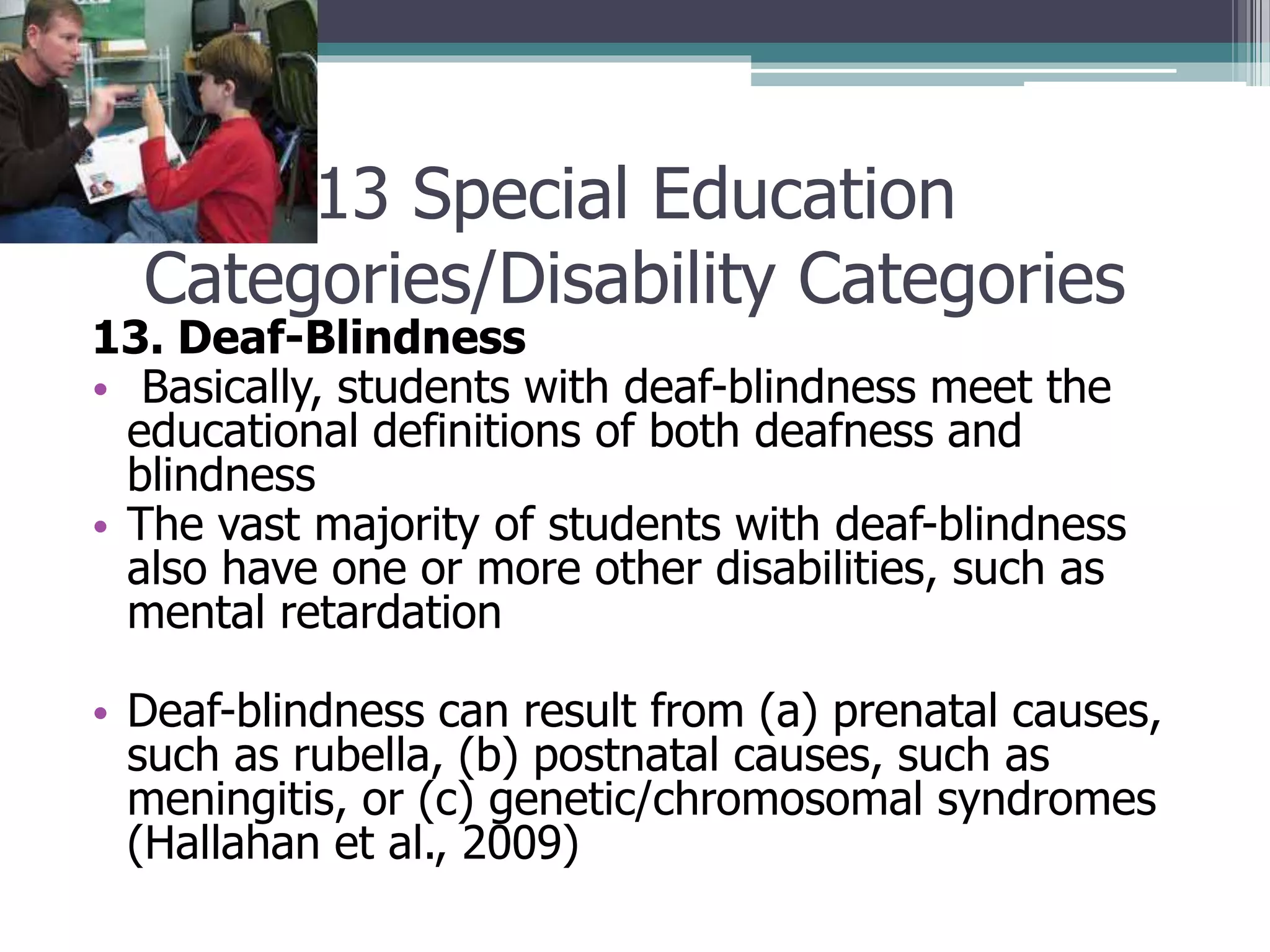
13. Deaf-Blindness
• Basically, students with deaf-blindness meet the
educational definitions of both deafness and
blindness
• The vast majority of students with deaf-blindness
also have one or more other disabilities, such as
mental retardation

• Deaf-blindness can result from (a) prenatal causes,
such as rubella, (b) postnatal causes, such as
meningitis, or (c) genetic/chromosomal syndromes
(Hallahan et al., 2009)
CURRENT ISSUES IN
GUIDANCE AND
COUNSELING
Among the many issues facing the
school counseling profession are the
following three:
1. Professional title
• Some professional in the field are prefer to be
called guidance counselor, while an increasing
number prefer the term school counselor
2. Evaluation
• A major trend in education is the demand for
accountability and evaluation
Among the many issues facing the
school counseling profession are the
following three:
3. Prevention versus remediation
• A growing trend in the field of counseling is
the focus prevention instead of remediation
•

In the past it was not uncommon for counselor
to have interaction with students only after
some crisis had occurred
Among the many issues facing the
school counseling profession are the
following three:
3. Prevention versus remediation

•

There is now a shift for school counselor to
intercede prior to any incidents and to become
more proactive in developing and enacting
school wide prevention plans
Among the many issues facing the
school counseling profession are the
following three:
3. Prevention versus remediation
• The school, community and families are
requesting assistance in preventing students from
being involve in many difficulties, such as:
Gangs
Substance abused
Child abused
Dropouts
School violence
Terrorism
Teen pregnancy
Diversity
Dropping out of school youth
Thank You for Listening!

Meaning and nature of sped

  • 1.
    Meaning and Natureof SPED Prepared by: Junarie Ramirez BSED-3 Japhet Banagudos BEED-3 Remo Cyril Estorco BSED-3 Leahbelle Solinap BSED-3 JesuAlabado BEED-3 Catherine Oracion BEED-3 Ruby Jenn Ombi-on BEED-3 Aiza Rodriguez BEED-3 Ma. Theresa Tawing BEED-3
  • 2.
    What is Special Education? •a classroom or private instruction involving techniques, exercises, and subject matter designed for students whose learning needs cannot be met by a standard school curriculum • an education modified for those with disabilities or exceptional needs as handicapped people or gifted children
  • 3.
    Specially Designed Instruction • itmeans that a student’s progress in learning is monitored frequently, often several times per week
  • 4.
    Specially Designed Instruction COMPONENTS: 1. Intensiveinstruction • translates into more teacher instructional time and more opportunities for students to respond to the instruction and more time to practice and review what they have learned
  • 5.
    Specially Designed Instruction COMPONENTS: 2. Relentlessinstruction • involves repeating on what is to be learned more often than is typically done with non-disabled students
  • 6.
    Specially Designed Instruction COMPONENTS: 3. Structuredinstruction • refers to teachers being more directive, instituting more directive, instituting more explicit rules, and providing more frequent consequences for appropriate or inappropriate behavior
  • 7.
    Specially Designed Instruction COMPONENTS: 4. Paceof the instruction • is tailored more to the needs of students and is often slower, with teachers waiting for a longer period of time for a response after querying the student
  • 8.
    Specially Designed Instruction COMPONENTS: 5. Instructionin small groups • facilitates the intensity, relentlessness, structured nature, and individualized pace of instruction
  • 9.
    Individualized Education Program (IEP) •describes the special education and related services specifically designed to meet the unique educational needs of a student with a disability • the guiding document for a student's educational program • It includes all of the goals, objectives, present levels of performance and related services that are recommended for the student http://schools.nyc.gov/Offices/District75/Departments/IEP/default.htm
  • 10.
    What Is InclusiveEducation? • inclusive education is provided by Lipsky & Gartner (1996, 1999), who described it as students with disabilities having full membership in ageappropriate classes in their neighborhood schools, with appropriate supplementary aids and support services • to Antia et al. (2002), inclusion denotes a student with a disability unconditionally belonging to and having full membership of a regular classroom in a regular school and its community
  • 11.
    What Is InclusiveEducation? • inclusive education is a process where by the school systems, strategic plans, and policies adapt and change to include teaching strategies for a wider more diverse range of children http://www.seneseinclusiveedu.ws/index.php?option=com_cont ent&view=article&id=86:defin
  • 12.
    Inclusive Education inthe Philippines POLICY: • Provides "all children and youth with special needs must receive an appropriate education and everything within the system and they should get education along with other children regardless of human differences“ This requires fundamental changes in philosophy, curriculum, teaching strategies and structural organization and above all changes in human attitudes and behaviors of all those involved in the education of the children with special needs
  • 13.
    SPED CENTER ASRESOURCE CENTER FOR INCLUSION: PHILIPPINE MODEL By Yolanda S. Quijano Chief, Special Education Division, Bureau of Elementary Education, Dept. of Education Philippines http://www.acid2011korea.org/kaidd_abs/pds/20110600293_15 th_A_28.pdf
  • 14.
    SPED CENTER ASRESOURCE CENTER FOR INCLUSION: PHILIPPINE MODEL The Child with Special Needs: The Vision • The State, community and the family hold a common vision for the Filipino child with special needs • This education should fully realize his/her own potentials for development and productivity as well as being capable of self-expression of his/her rights in the society • It is envisioned that the child with special needs will get full parental and community support for his/her education without discrimination of any kind • This special child should also be provided with a healthy environment along with leisure and recreational and social security measures
  • 15.
    SPED Center • isa Philippine innovation in the delivery of educational services to children with special needs • this is a "school within a school" since it is established in a regular school, administered by a principal and operated according to the rules and regulations that govern a regular school • it provides a range of educational services, namely, resource room teaching, itinerant teaching, special and cooperative classes that promote mainstreaming or integration of children with special needs into regular classes
  • 16.
    SPED Center DECS OrderNo.26, s. 1997, "Institutionalization of SPED Programs in All Schools" has identified the SPED Center as the resource center for inclusion • it is expected to provide access to Basic Education among children with special needs in collaboration with the regular schools
  • 17.
    SPED Center DECS OrderNo.26, s. 1997, "Institutionalization of SPED Programs in All Schools" has identified the SPED Center as the resource center for inclusion • It is specifically tasked to do the following: conduct continuous assessment of children with special needs in the school division where it is located provide in-service training to school personnel on the "why" and "how" of creating inclusive school as well as other educational trends and practices relevant to children with special needs
  • 18.
    SPED Center DECS OrderNo.26, s. 1997, "Institutionalization of SPED Programs in All Schools" has identified the SPED Center as the resource center for inclusion • It is specifically tasked to do the following: provide these children with appropriate equipment and produce appropriate teaching materials support children with special needs included in the regular classroom in collaboration with the regular teachers provide educational services that promote inclusion
  • 19.
    13 Special Education Categories/DisabilityCategories 1. Learning Disabilities • students with learning disabilities are by far the largest category of special education, comprising between 5 and 6 percent of the school-age population The federal definition of learning disabilities is as follows: • General—The term “specific learning disability” means a disorder in one or more of the basic psychological processes involved in understanding or in using language, spoken or written, which disorder may manifest itself in an imperfect ability to listen, think, speak, read, write, spell, or do mathematical calculations.
  • 20.
    13 Special Education Categories/DisabilityCategories 1. Learning Disabilities • students with learning disabilities are by far the largest category of special education, comprising between 5 and 6 percent of the school-age population The federal definition of learning disabilities is as follows: • Disorders Included—Such term includes such conditions as perceptual disabilities, brain injury, minimal brain dysfunction, dyslexia, and developmental aphasia
  • 21.
    13 Special Education Categories/DisabilityCategories 1. Learning Disabilities • students with learning disabilities are by far the largest category of special education, comprising between 5 and 6 percent of the school-age population The federal definition of learning disabilities is as follows: • Disorders Not Included—Such term does not include a learning problem that is primarily the result of visual, hearing, or motor disabilities, of mental retardation, of emotional disturbance, or of environmental, cultural, or economic disadvantage
  • 22.
    13 Special Education Categories/DisabilityCategories 2. Speech or Language Impairments • Speech impairments include disorders of articulation, fluency, and/or voice
  • 23.
    Speech or LanguageImpairments • Articulation disorders often result from neuromuscular abnormalities resulting in omission, substitution, or distortion of speech sounds • Fluency refers to being able to produce smooth speech flow. Disorders of voice include such characteristics as abnormal pitch, loudness, or resonance • Phonology  rules govern how speech sounds are sequenced
  • 24.
    Speech or LanguageImpairments • Morphology refers to parts of words that indicate such factors as verb tense and plurals • Syntax involves word order that reflects proper grammar • Semantics refers to the meanings of words and sentences, and pragmatics involves using language for social purposes
  • 25.
    13 Special Education Categories/DisabilityCategories 3.Mental Retardation • a disability characterized by significant limitations both in intellectual functioning and in adaptive behavior as expressed in conceptual, social, and practical adaptive skills
  • 26.
    13 Special Education Categories/DisabilityCategories 4. Emotional Disturbance • With respect to definition, many authorities agree on the following three features of emotional or behavioral disorders: • Behavior that goes to an extreme—that is not just slightly different from the usual; • A problem that is chronic—one that does not quickly disappear; and • Behavior that is unacceptable because of social or cultural expectations
  • 27.
    13 Special Education Categories/DisabilityCategories 5. Other Health Impairments • According to the federal definition, other health impairments (OHIs) are medical conditions, such as asthma, diabetes, epilepsy, sickle cell anemia, which impair to such a degree that they adversely affect a student's educational performance • The key to the definition is that the condition must interfere with the student's educational performance • For example, not all students who have asthma have it to such a degree that it affects their ability to function in school
  • 28.
    13 Special Education Categories/DisabilityCategories 6. Multiple Disabilities • consists of students who have two or more disabilities, “the combination of which causes such severe educational problems that they cannot be accommodated in special education programs solely for one of the impairments”
  • 29.
    13 Special Education Categories/DisabilityCategories 7. Autism • Many authorities in the early 2000s consider autism to be one of several similar conditions that fall on a spectrum, hence the term autism spectrum disorders • The conditions on the spectrum share impairments in three areas: (1) communication skills, (2) social interactions, and (3) repetitive and stereotyped patterns of behavior (Strock, 2004)
  • 30.
    13 Special Education Categories/DisabilityCategories 7. Autism • Classic autism and Asperger syndrome are the most common conditions • Whereas students with autism have relatively severe deficits in all three areas plus severe cognitive deficits, those with Asperger syndrome generally have less severe deficits in all three areas, with their major problem lying in the area of social interactions and some having very high intelligence
  • 31.
    13 Special Education Categories/DisabilityCategories 8. Orthopedic Impairments • include physical disabilities of the muscles and/or bones that negatively affect school learning • Two examples are muscular dystrophy (a hereditary condition resulting in muscle fiber degeneration) and juvenile rheumatoid arthritis
  • 32.
    13 Special Education Categories/DisabilityCategories 9. Hearing Impairments • Students with hearing impairments fall into two categories: those who are deaf and; those who are hard of hearing • How one differentiates between the two depends on whether one adopts a physiological or an educational orientation
  • 33.
    13 Special Education Categories/DisabilityCategories 9. Hearing Impairments • A physiologically based definition relies on the measurable degree of hearing loss, with those having an impairment of 90 decibels or greater being deaf (0 dB is the level at which the average person can hear the faintest sound) • An educationally based definition focuses on the ability to process linguistic information, with deafness indicating that the person cannot process linguistic information through audition even with a hearing aid (Brill, MacNeil, & Newman, 1986).
  • 34.
    13 Special Education Categories/DisabilityCategories 10. Developmental Delay • For many infants and preschoolers, it is often difficult to determine whether they have a true disability or have a temporary delay in maturation • In addition, it is sometimes difficult to determine the exact nature of very young children's disability • For these reasons, professionals are often reluctant to make a clinical diagnosis and, instead, refer to them as having a developmental delay
  • 35.
    13 Special Education Categories/DisabilityCategories 11. Visual Impairments • visual impairments are divided into two groups based on severity: blindness and low vision • Additionally, like hearing impairments, these two groups are defined differently according to whether one uses a physiological versus an educational approach • A physiological orientation (also referred to as the legal definition because it is used to determine certain government benefits) relies on measurement of visual acuity and field of vision
  • 36.
    13 Special Education Categories/DisabilityCategories 11. Visual Impairments • Like hearing impairments, visual impairments are divided into two groups based on severity: blindness and low vision • Visual acuity of 20/200 (normal acuity is 20/20, being able to see at 20 feet what a person with normal vision sees at 20 feet) or less in the better eye, even with correction (e.g., eyeglasses), or visual field of less than 20 degrees qualifies an individual as legally blind • Those having visual acuity between 20/70 and 20/200 are referred to as having low vision or being partially sighted
  • 37.
    13 Special Education Categories/DisabilityCategories 11. Visual Impairments • Like hearing impairments, visual impairments are divided into two groups based on severity: blindness and low vision • The educational definition focuses on mode of reading, with those needing to use Braille being considered blind, and those who can read print, even with magnifying devices or large-print books, being considered as having low vision or being partially sighted
  • 38.
    13 Special Education Categories/DisabilityCategories 12. Traumatic Brain Injury • In 1990, the federal government added students with traumatic brain injury (TBI) to the list of those eligible for special education services • This decision was in recognition of the fact that TBI occurs much more frequently than was previously thought
  • 39.
    13 Special Education Categories/DisabilityCategories 12. Traumatic Brain Injury • For example, estimates are that about one million children and adolescents receive head injuries each year, with 15,000 to 20,000 incurring lasting effects (Council for Exceptional Children, 2001) TBI refers to trauma to the brain caused by an external force that results in behavioral dysfunction • Such injuries can be open head injuries (i.e., penetrating head wounds) or closed head injuries (i.e., damage caused by internal compression or shearing motion inside the head) (Adelson&Kochanek, 1998)
  • 40.
    13 Special Education Categories/DisabilityCategories 13. Deaf-Blindness • Basically, students with deaf-blindness meet the educational definitions of both deafness and blindness • The vast majority of students with deaf-blindness also have one or more other disabilities, such as mental retardation • Deaf-blindness can result from (a) prenatal causes, such as rubella, (b) postnatal causes, such as meningitis, or (c) genetic/chromosomal syndromes (Hallahan et al., 2009)
  • 41.
  • 42.
    Among the manyissues facing the school counseling profession are the following three: 1. Professional title • Some professional in the field are prefer to be called guidance counselor, while an increasing number prefer the term school counselor 2. Evaluation • A major trend in education is the demand for accountability and evaluation
  • 43.
    Among the manyissues facing the school counseling profession are the following three: 3. Prevention versus remediation • A growing trend in the field of counseling is the focus prevention instead of remediation • In the past it was not uncommon for counselor to have interaction with students only after some crisis had occurred
  • 44.
    Among the manyissues facing the school counseling profession are the following three: 3. Prevention versus remediation • There is now a shift for school counselor to intercede prior to any incidents and to become more proactive in developing and enacting school wide prevention plans
  • 45.
    Among the manyissues facing the school counseling profession are the following three: 3. Prevention versus remediation • The school, community and families are requesting assistance in preventing students from being involve in many difficulties, such as: Gangs Substance abused Child abused Dropouts School violence Terrorism Teen pregnancy Diversity Dropping out of school youth
  • 46.
    Thank You forListening!