Embracing Special
Education
RA 7277
(Magna Carta for Disabled
Persons)
Described person with
disabilities are part of
Philippine Society and so the
state shall give full support to
the improvement of the total
well-being of disabled persons
and their integration into the
mainstream of society.
What is Special
Education?
• An individually planned and systematically
implemented and carefully evaluated
instruction to help exceptional children
achieve the greatest possible personal self-
sufficiency and success in present and future
environments.
(Inciong, 2007)
• A teacher must employ effective strategies
that will lead the Children with Special Needs
(CSNs) to embark into a quality of life making
them independent, integrated and
contributing members of society.
Terms used in special education as
defined in Section 4 of Republic Act
7277:
• Disabled persons – are those suffering from
restriction or different disabilities, as a result
of mental, physical, sensory impairment, to
perform an activity in the manner or within
the range considered normal for a human
being.
• Individualized Education Program – commonly
called IEP, is a legal document collaboratively
prepared by the special education team of
professionals (including child’s parents)
describing the child’s academic assessment,
progress, instructional plans and procedures
and necessary interventions.
• Mainstreaming – or Least Restrictive
Environment to the maximum extent for the
child to participate with non-disabled peers in
conjunction with the general education
curriculum.
• Rehabilitation – is an integrated approach to
physical, social, cultural, spiritual, educational
and vocational measures that create
conditions for the individual to attain the
highest possible level of functional ability.
• Reasonable accommodation – includes:
(1) Improvement of existing facilities used by
employees in order to render these readily
accessible to and usable by disabled persons, (2)
modifications of works and schedules,
reassignment to a vacant position, acquisition or
modification of equipment or devices,
appropriate adjustment or modifications or
examinations and other similar accommodations
for disabled persons.
• Sheltered Employment – the provision of
productive work for disabled persons through
workshop providing special facilities, income-
producing projects or homework schemes
view to give the opportunity to earn living
thus enabling them to acquire a working
capacity required in industry.
• Social barriers – refers to the characteristics of
institutions, whether legal, economic, cultural,
recreational, human group, community, or
society which limit the fullest possible
participation of disabled persons in the life of
the group.
• Zero defect – specifying that all the children,
regardless of ability, are guaranteed a free
public education.
What are the types of disabilities?
1. Autism
2. ADD/ADHD
3. Learning disabilities
a. Dyslexia
b. Dysgraphia
c. Dyscalcula
d. Non – verbal
e. Mental retardation
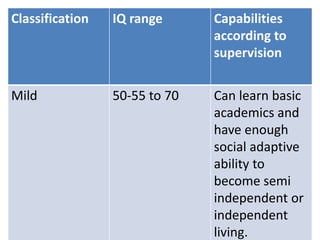
Classification IQ range Capabilities
according to
supervision
Mild 50-55 to 70 Can learn basic
academics and
have enough
social adaptive
ability to
become semi
independent or
independent
living.
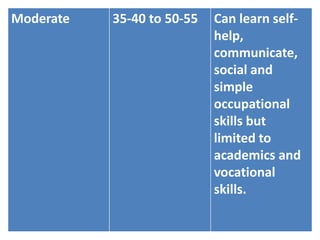
Moderate 35-40 to 50-55 Can learn self-
help,
communicate,
social and
simple
occupational
skills but
limited to
academics and
vocational
skills.
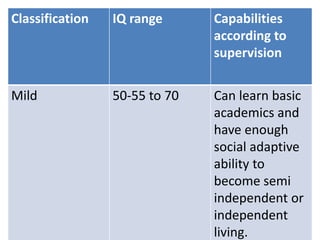
Classification IQ range Capabilities
according to
supervision
Mild 50-55 to 70 Can learn basic
academics and
have enough
social adaptive
ability to
become semi
independent or
independent
living.
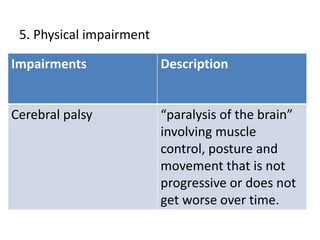
5. Physical impairment
Impairments Description
Cerebral palsy “paralysis of the brain”
involving muscle
control, posture and
movement that is not
progressive or does not
get worse over time.
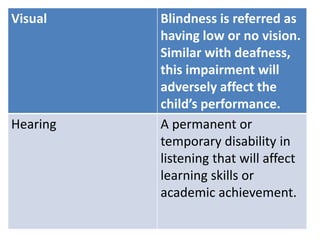
Visual Blindness is referred as
having low or no vision.
Similar with deafness,
this impairment will
adversely affect the
child’s performance.
Hearing A permanent or
temporary disability in
listening that will affect
learning skills or
academic achievement.
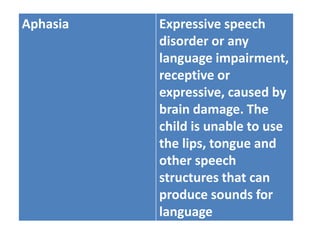
Aphasia Expressive speech
disorder or any
language impairment,
receptive or
expressive, caused by
brain damage. The
child is unable to use
the lips, tongue and
other speech
structures that can
produce sounds for
language
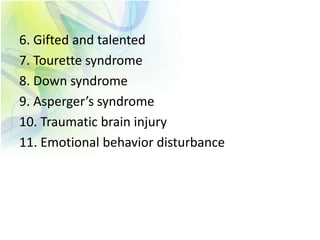
6. Gifted and talented
7. Tourette syndrome
8. Down syndrome
9. Asperger’s syndrome
10. Traumatic brain injury
11. Emotional behavior disturbance
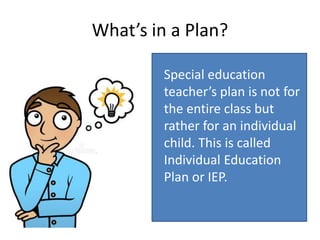
What’s in a Plan?
Special education
teacher’s plan is not for
the entire class but
rather for an individual
child. This is called
Individual Education
Plan or IEP.
• It is a legal document made through with
special educational assessment, eligibility, and
instructional planning procedures (Friend,
2008)
• Based on the child’s disability, a pool of
professionals administer the procedures with
the consent and knowledge of the parents or
guardians.
• IEP’s are effectively deployed – support
curriculum and assessment and organizational
flexibility are observed to ensure that
provision and assessment take place and
relate to activities that are additional to or
different from the usual (Farrell, 2004)
The special education
• Bauzon (2001) emphazised the necessity of
the curriculum. Curriculum is very viewed as
the very heart of all educational systems. The
issues, problems, and prospects of an
educational institution are intimately
intertwined with the issues problems, and
prospects of the curriculum.
Two approaches relevant to the teaching
education:
1. Integrative or activity – Centered Curriculum
Approach
2. Child – Centered Curriculum Approach
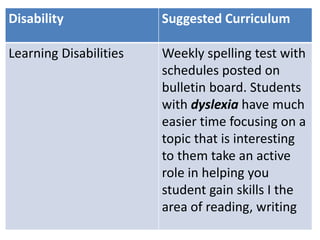
Disability Suggested Curriculum
Learning Disabilities Weekly spelling test with
schedules posted on
bulletin board. Students
with dyslexia have much
easier time focusing on a
topic that is interesting
to them take an active
role in helping you
student gain skills I the
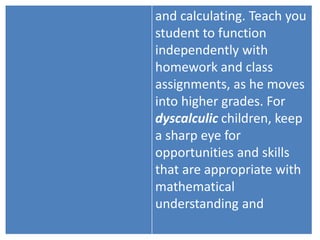
area of reading, writing
and calculating. Teach you
student to function
independently with
homework and class
assignments, as he moves
into higher grades. For
dyscalculic children, keep
a sharp eye for
opportunities and skills
that are appropriate with
mathematical
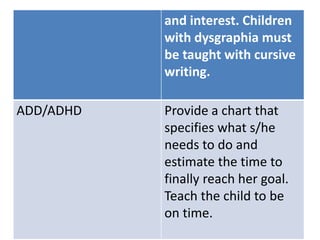
understanding and
and interest. Children
with dysgraphia must
be taught with cursive
writing.
ADD/ADHD Provide a chart that
specifies what s/he
needs to do and
estimate the time to
finally reach her goal.
Teach the child to be
on time.
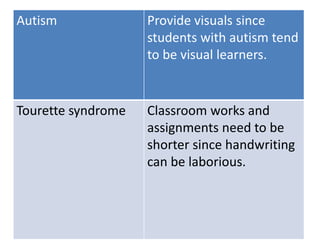
Autism Provide visuals since
students with autism tend
to be visual learners.
Tourette syndrome Classroom works and
assignments need to be
shorter since handwriting
can be laborious.
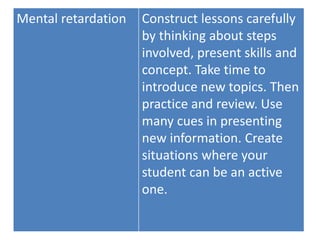
Mental retardation Construct lessons carefully
by thinking about steps
involved, present skills and
concept. Take time to
introduce new topics. Then
practice and review. Use
many cues in presenting
new information. Create
situations where your
student can be an active
one.
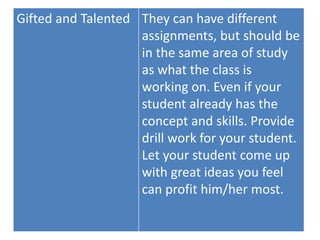
Gifted and Talented They can have different
assignments, but should be
in the same area of study
as what the class is
working on. Even if your
student already has the
concept and skills. Provide
drill work for your student.
Let your student come up
with great ideas you feel
can profit him/her most.
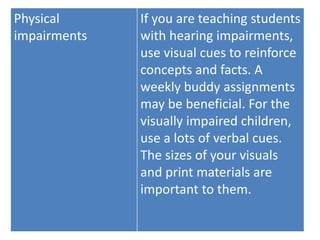
Physical
impairments
If you are teaching students
with hearing impairments,
use visual cues to reinforce
concepts and facts. A
weekly buddy assignments
may be beneficial. For the
visually impaired children,
use a lots of verbal cues.
The sizes of your visuals
and print materials are
important to them.
Embracing special children in the
mainstream of regular education is the
call of the times. A Special Education
teacher knows how to design and
innovate to suit to the needs of special
childrens.
Teacher touch lives, but special education
teachers “reach and touch” lives of children
under their care.
(rule-teacher.com)

Embracing special-education (1)

  • 1.
  • 2.
    RA 7277 (Magna Cartafor Disabled Persons) Described person with disabilities are part of Philippine Society and so the state shall give full support to the improvement of the total well-being of disabled persons and their integration into the mainstream of society.
  • 3.
  • 4.
    • An individuallyplanned and systematically implemented and carefully evaluated instruction to help exceptional children achieve the greatest possible personal self- sufficiency and success in present and future environments. (Inciong, 2007)
  • 5.
    • A teachermust employ effective strategies that will lead the Children with Special Needs (CSNs) to embark into a quality of life making them independent, integrated and contributing members of society.
  • 6.
    Terms used inspecial education as defined in Section 4 of Republic Act 7277: • Disabled persons – are those suffering from restriction or different disabilities, as a result of mental, physical, sensory impairment, to perform an activity in the manner or within the range considered normal for a human being.
  • 7.
    • Individualized EducationProgram – commonly called IEP, is a legal document collaboratively prepared by the special education team of professionals (including child’s parents) describing the child’s academic assessment, progress, instructional plans and procedures and necessary interventions.
  • 8.
    • Mainstreaming –or Least Restrictive Environment to the maximum extent for the child to participate with non-disabled peers in conjunction with the general education curriculum. • Rehabilitation – is an integrated approach to physical, social, cultural, spiritual, educational and vocational measures that create conditions for the individual to attain the highest possible level of functional ability.
  • 9.
    • Reasonable accommodation– includes: (1) Improvement of existing facilities used by employees in order to render these readily accessible to and usable by disabled persons, (2) modifications of works and schedules, reassignment to a vacant position, acquisition or modification of equipment or devices, appropriate adjustment or modifications or examinations and other similar accommodations for disabled persons.
  • 10.
    • Sheltered Employment– the provision of productive work for disabled persons through workshop providing special facilities, income- producing projects or homework schemes view to give the opportunity to earn living thus enabling them to acquire a working capacity required in industry.
  • 11.
    • Social barriers– refers to the characteristics of institutions, whether legal, economic, cultural, recreational, human group, community, or society which limit the fullest possible participation of disabled persons in the life of the group. • Zero defect – specifying that all the children, regardless of ability, are guaranteed a free public education.
  • 12.
    What are thetypes of disabilities? 1. Autism 2. ADD/ADHD 3. Learning disabilities a. Dyslexia b. Dysgraphia c. Dyscalcula d. Non – verbal e. Mental retardation
  • 13.
    Classification IQ rangeCapabilities according to supervision Mild 50-55 to 70 Can learn basic academics and have enough social adaptive ability to become semi independent or independent living.
  • 14.
    Moderate 35-40 to50-55 Can learn self- help, communicate, social and simple occupational skills but limited to academics and vocational skills.
  • 15.
    Classification IQ rangeCapabilities according to supervision Mild 50-55 to 70 Can learn basic academics and have enough social adaptive ability to become semi independent or independent living.
  • 16.
    5. Physical impairment ImpairmentsDescription Cerebral palsy “paralysis of the brain” involving muscle control, posture and movement that is not progressive or does not get worse over time.
  • 17.
    Visual Blindness isreferred as having low or no vision. Similar with deafness, this impairment will adversely affect the child’s performance. Hearing A permanent or temporary disability in listening that will affect learning skills or academic achievement.
  • 18.
    Aphasia Expressive speech disorderor any language impairment, receptive or expressive, caused by brain damage. The child is unable to use the lips, tongue and other speech structures that can produce sounds for language
  • 19.
    6. Gifted andtalented 7. Tourette syndrome 8. Down syndrome 9. Asperger’s syndrome 10. Traumatic brain injury 11. Emotional behavior disturbance
  • 20.
    What’s in aPlan? Special education teacher’s plan is not for the entire class but rather for an individual child. This is called Individual Education Plan or IEP.
  • 21.
    • It isa legal document made through with special educational assessment, eligibility, and instructional planning procedures (Friend, 2008) • Based on the child’s disability, a pool of professionals administer the procedures with the consent and knowledge of the parents or guardians.
  • 22.
    • IEP’s areeffectively deployed – support curriculum and assessment and organizational flexibility are observed to ensure that provision and assessment take place and relate to activities that are additional to or different from the usual (Farrell, 2004)
  • 23.
    The special education •Bauzon (2001) emphazised the necessity of the curriculum. Curriculum is very viewed as the very heart of all educational systems. The issues, problems, and prospects of an educational institution are intimately intertwined with the issues problems, and prospects of the curriculum.
  • 24.
    Two approaches relevantto the teaching education: 1. Integrative or activity – Centered Curriculum Approach 2. Child – Centered Curriculum Approach
  • 25.
    Disability Suggested Curriculum LearningDisabilities Weekly spelling test with schedules posted on bulletin board. Students with dyslexia have much easier time focusing on a topic that is interesting to them take an active role in helping you student gain skills I the area of reading, writing
  • 26.
    and calculating. Teachyou student to function independently with homework and class assignments, as he moves into higher grades. For dyscalculic children, keep a sharp eye for opportunities and skills that are appropriate with mathematical understanding and
  • 27.
    and interest. Children withdysgraphia must be taught with cursive writing. ADD/ADHD Provide a chart that specifies what s/he needs to do and estimate the time to finally reach her goal. Teach the child to be on time.
  • 28.
    Autism Provide visualssince students with autism tend to be visual learners. Tourette syndrome Classroom works and assignments need to be shorter since handwriting can be laborious.
  • 29.
    Mental retardation Constructlessons carefully by thinking about steps involved, present skills and concept. Take time to introduce new topics. Then practice and review. Use many cues in presenting new information. Create situations where your student can be an active one.
  • 30.
    Gifted and TalentedThey can have different assignments, but should be in the same area of study as what the class is working on. Even if your student already has the concept and skills. Provide drill work for your student. Let your student come up with great ideas you feel can profit him/her most.
  • 31.
    Physical impairments If you areteaching students with hearing impairments, use visual cues to reinforce concepts and facts. A weekly buddy assignments may be beneficial. For the visually impaired children, use a lots of verbal cues. The sizes of your visuals and print materials are important to them.
  • 32.
    Embracing special childrenin the mainstream of regular education is the call of the times. A Special Education teacher knows how to design and innovate to suit to the needs of special childrens.
  • 33.
    Teacher touch lives,but special education teachers “reach and touch” lives of children under their care. (rule-teacher.com)