The document discusses several key aspects of special education including:
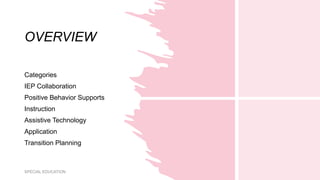
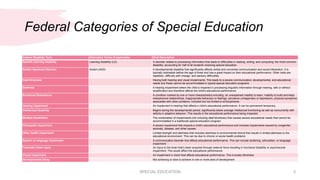
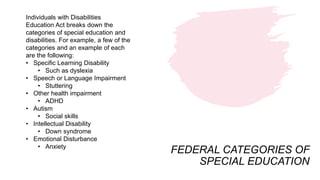
1) The federal categories of special education disabilities and examples like specific learning disability, speech impairment, and autism.
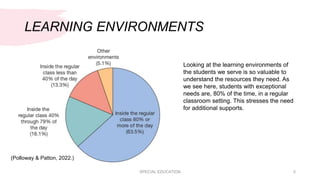
2) The learning environments of students with special needs, with 80% typically in regular classrooms requiring additional supports.
3) The individuals involved in IEP development including parents, teachers, representatives and the student.
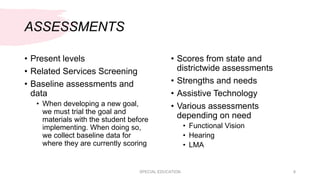
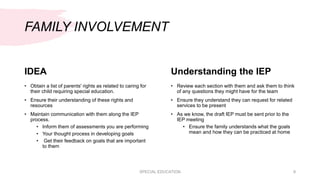
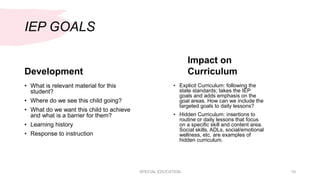
4) Elements of IEPs like present levels, goals, family involvement and instructional implications.
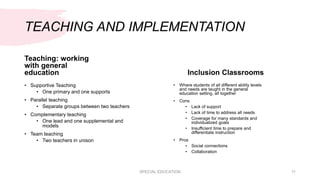
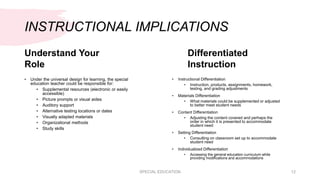
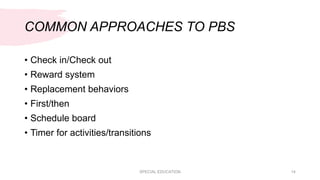
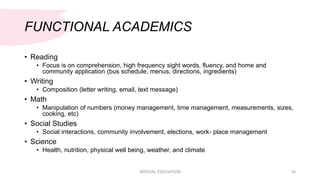
5) Approaches to support students such as positive behavior supports, differentiated instruction, study skills and functional academics.




![References
Polloway, E., & Patton, J. (2022). Strategies for Teaching Learners
with Special Needs (12th ed.) [Review of Strategies for
Teaching Learners with Special Needs]. Pearson. (Original
work published 2013)
U.S. Department of Education. (2018). Individuals with
Disabilities Education Act. Individuals with Disabilities
Education Act. https://sites.ed.gov/idea/regs/b/a/300.8/c](https://image.slidesharecdn.com/specialeducation-230320162659-3c9c3287/85/SPECIAL-EDUCATION-pptx-19-320.jpg)


![Sped 410 final project [autosaved]](https://cdn.slidesharecdn.com/ss_thumbnails/sped410finalprojectautosaved-150504074640-conversion-gate02-thumbnail.jpg?width=640&height=640&fit=bounds)


