Integrated livestock feed interventions
Ben Lukuyu1, Leonard Marwa1, Chrispinus Rubanza2, Anthony Kimaro3, Christopher Mutungi4
1International Livestock Research Institute (ILRI), 2Dodoma University, 3World Agroforestry
Center (ICRAF), 4International Institute of Tropical Agriculture (IITA)
Africa RISING ESA Project review and planning meeting
11 – 12 September 2019, Dar es Salaam, Tanzania
Rationale
• Planting of improved planted forages, fodder trees and shrubs, grasses,
in the landscapes may have beneficial effects to provide feed and on
reducing nutrient losses and water pollution
• Crop residues, such as dry or green maize stover and bean haulms, are
commonly fed to livestock but are also of low quality and they are
poorly used by farmers
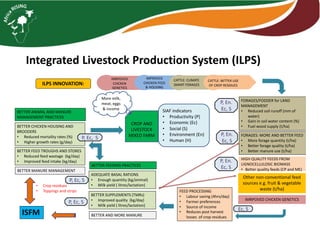
An Integrated Livestock Production System (ILPS)
• How can we optimize feeds, forages and improved chicken nutrition and
genetics for improved livestock and whole farm productivity, and for
enhancing livelihood of rural households?
• Innovation:
• Improved chickens genetics (UDOM)
• Improved chicken feeds and housing
• Improved forages for feeds and land management
• Better use of crop residues
Integrated Livestock Production System (ILPS)
IMRPOVED
CHICKEN
GENETICS
IMPROVED
CHICKEN FEED
& HOUSING
CATTLE: CLIMATE
SMART FORAGES
CATTLE: BETTER USE
OF CROP RESIDUESILPS INNOVATION:
FORAGES/FODDER for LAND
MANAGEMENT
• Reduced soil runoff (mm of
water)
• Gain in soil water content (%)
• Fuel wood supply (t/ha)
FORAGES: MORE AND BETTER FEED
• More forage quantity (t/ha)
• Better forage quality (t/ha)
• Better manure use (t/ha)
HIGH QUALITY FEEDS FROM
LIGNOCELLULOSIC BIOMASS
• Better quality feeds (CP and ME)
Other non-conventional feed
sources e.g. fruit & vegetable
waste (t/ha)
IMRPOVED CHICKEN GENETICS
BETTER FEEDING PRACTICES
ADEQUATE BASAL RATIONS
• Enough quantity (kg/animal)
• Milk yield ( litres/lactation)
BETTER SUPPLEMENTS (TMRs)
• Improved quality (kg/day)
• Milk yield ( litres/lactation)
BETTER AND MORE MANURE
BETTER ANIMAL AND MANURE
MANAGEMENT PRACTICES
BETTER CHICKEN HOUSING AND
BROODERS
• Reduced mortality rates (%)
• Higher growth rates (g/day)
BETTER FEED TROUGHS AND STORES
• Reduced feed wastage (kg/day)
• Improved feed intake (kg/day)
BETTER MANURE MANAGEMENT
FEED PROCESSING
• Labour saving (4hrs/day)
• Farmer preferences
• Source of income
• Reduces post harvest
losses of crop residues
SIAF indicators
• Productivity (P)
• Economic (Ec)
• Social (S)
• Environment (En)
• Human (H)
CROP AND
LIVESTOCK
MIXED FARM
More milk,
meat, eggs
& income
P, En.
Ec, S
P, En.
Ec, S
P, En.
Ec, S
P, Ec, S
P, Ec, S
P, Ec, S
Ec, S
ISFM
• Crop residues
• Toppings and strips
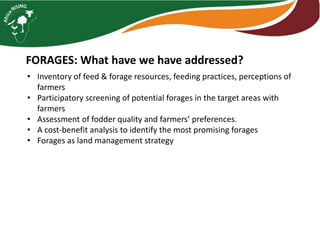
FORAGES: What have we have addressed?
• Inventory of feed & forage resources, feeding practices, perceptions of
farmers
• Participatory screening of potential forages in the target areas with
farmers
• Assessment of fodder quality and farmers’ preferences.
• A cost-benefit analysis to identify the most promising forages
• Forages as land management strategy
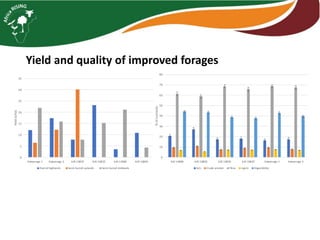
Yield and quality of improved forages
0
10
20
30
40
50
60
70
80
ILRI 14984 ILRI 16803 ILRI 16835 ILRI 16837 Kakamega 1 Kakamega 2
%ofnutrients
Ash Crude protein Fibre Lignin Digestibility
0
5
10
15
20
25
30
35
Kakamega 1 Kakamega 2 ILRI 16837 ILRI 16835 ILRI 14984 ILRI 16803
Yield(t/ha)
Humidhighlands Semi-humid uplands Semi-humid midlands
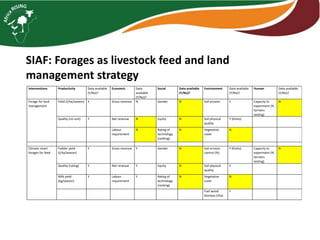
SIAF: Forages as livestock feed and land
management strategy
Interventions Productivity Data available
(Y/No)?
Economic Data
available
(Y/No)?
Social Data available
(Y/No)?
Environment Data available
(Y/No)?
Human Data available
(Y/No)?
Forage for land
management
Yield (t/ha/season) Y Gross revenue N Gender N Soil erosion Y Capacity to
experiment (%
farmers
testing)
N
Quality (no unit) Y Net revenue N Equity N Soil physical
quality
Y (Kizito)
Labour
requirement
N Rating of
technology
(ranking)
N Vegetative
cover
N
Climate smart
forages for feed
Fodder yield
(t/ha/season)
Y Gross revenue Y Gender N Soil erosion
control (%)
Y (Kizito) Capacity to
experiment (%
farmers
testing)
N
Quality (rating) Y Net revenue Y Equity N Soil physical
quality
Y
Milk yield
(kg/season)
Y Labour
requirement
Y Rating of
technology
(ranking)
N Vegetative
cover
N
Fuel wood
biomass t/ha)
Y
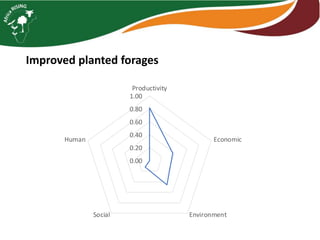
Improved planted forages
0.00
0.20
0.40
0.60
0.80
1.00
Productivity
Economic
EnvironmentSocial
Human
Proposed research to fill the gaps in the integrated
livestock production package
• A survey study to asses drivers of adoption of improved forages of
different farm typologies and farmers criteria for targeting forages to
different niches of farms.
• An analysis of different uses of fodder – as livestock feed, for soil fertility
improvement (mulching, composting), fencing or for sale – on some
selected farms with a SIAF lens
BETTER USE OF CROP RESIDUES: What have we
addressed?
• Took inventory of types and use crop residues in all production systems
• Quantified stover yield on farm (ISM).
• Conducted a participatory evaluation of techniques to improve the
utilization of crop residues by farm households
• Introduced and evaluated feed chopping technology with farmers
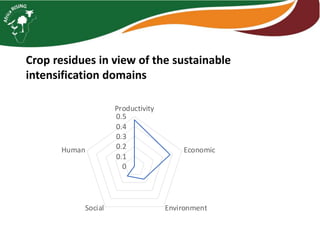
Crop residues in view of the sustainable
intensification domains
0
0.1
0.2
0.3
0.4
0.5
Productivity
Economic
EnvironmentSocial
Human
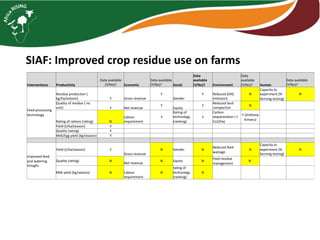
SIAF: Improved crop residue use on farms
Interventions Productivity
Data available
(Y/No)? Economic
Data available
(Y/No)? Social
Data
available
(Y/No)? Environment
Data
available
(Y/No)? Human
Data available
(Y/No)?
Feed processing
technology
Residue production (
kg/ha/season) Y Gross revenue
Y
Gender
Y Reduced GHG
emissions
N
Capacity to
experiment (%
farming testing)
N
Quality of residue ( no
unit) Y Net revenue
Y
Equity
Y
Reduced land
compaction
N
Rating of rations (rating) N
Labour
requirement
Y
Rating of
technology
(ranking)
Y
Carbon
sequestration ( t
Co2/ha)
Y (Anthony
Kimaru)
Yield (t/ha/season) Y
Quality (rating) Y
Milk/Egg yield (kg/season) Y
Improved feed
and watering
troughs
Yield (t/ha/season) Y
Gross revenue
N Gender N
Reduced feed
wastage
N
Capacity to
experiment (%
farming testing)
N
Quality (rating) N
Net revenue
N Equity N
Feed residue
management
N
Milk yield (kg/season) N Labour
requirement
N
rating of
technology
(ranking)
N
Proposed research to fill the gaps in the integrated
livestock production package
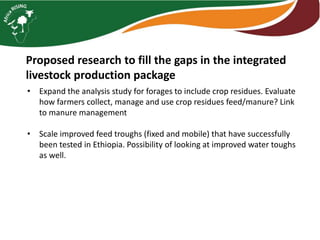
• Expand the analysis study for forages to include crop residues. Evaluate
how farmers collect, manage and use crop residues feed/manure? Link
to manure management
• Scale improved feed troughs (fixed and mobile) that have successfully
been tested in Ethiopia. Possibility of looking at improved water toughs
as well.
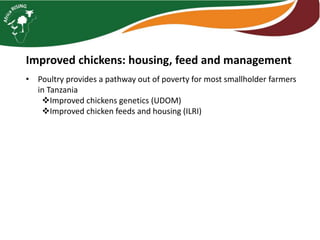
Improved chickens: housing, feed and management
• Poultry provides a pathway out of poverty for most smallholder farmers
in Tanzania
Improved chickens genetics (UDOM)
Improved chicken feeds and housing (ILRI)
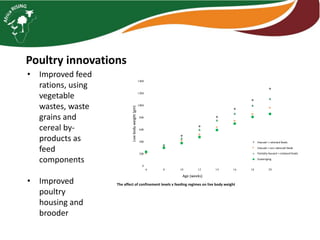
Poultry innovations
• Improved feed
rations, using
vegetable
wastes, waste
grains and
cereal by-
products as
feed
components
• Improved
poultry
housing and
brooder
0
200
400
600
800
1000
1200
1400
6 8 10 12 14 16 18 20
Livebodyweight(gm)
Age (weeks)
Housed + rationed feeds
Housed + non rationed feeds
Partially housed + rationedfeeds
Scavenging
The affect of confinement levels x feeding regimes on live body weight
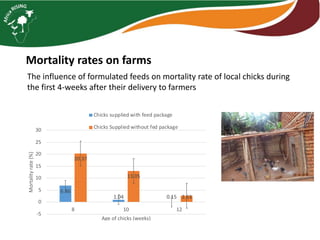
Mortality rates on farms
6.86
1.04 0.15
20.37
13.05
2.63
-5
0
5
10
15
20
25
30
8 10 12
Mortalityrate(%)
Age of chicks (weeks)
Chicks supplied with feed package
Chicks Supplied without fed package
The influence of formulated feeds on mortality rate of local chicks during the first 4-weeks after their delivery to farmers
The influence of formulated feeds on mortality rate of local chicks during
the first 4-weeks after their delivery to farmers
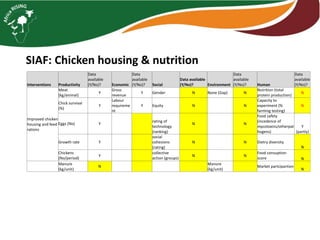
SIAF: Chicken housing & nutrition
Interventions Productivity
Data
available
(Y/No)? Economic
Data
available
(Y/No)? Social
Data available
(Y/No)? Environment
Data
available
(Y/No)? Human
Data
available
(Y/No)?
Improved chicken
housing and feed
rations
Meat
(kg/animal)
Y
Gross
revenue
Y Gender N None (Gap) N
Nutrition (total
protein production)
N
Chick survival
(%)
Y
Labour
requireme
nt
Y Equity N N
Capacity to
experiment (%
farming testing)
N
Eggs (No) Y
rating of
technology
(ranking)
N N
Food safety
(incedence of
mycotoxins/otherpat
hogens)
Y
(partly)
Growth rate Y
social
cohesions
(rating)
N N Dietry diversity
N
Chickens
(No/period)
Y
collective
action (groups)
N N
Food consuption
score N
Manure
(kg/unit)
N
Manure
(kg/unit)
Market partcipartion
N
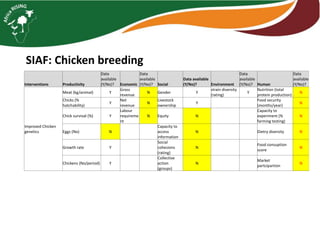
SIAF: Chicken breeding
Interventions Productivity
Data
available
(Y/No)? Economic
Data
available
(Y/No)? Social
Data available
(Y/No)? Environment
Data
available
(Y/No)? Human
Data
available
(Y/No)?
Improved Chicken
genetics
Meat (kg/animal) Y
Gross
revenue
N Gender Y
strain diversity
(rating)
Y
Nutrition (total
protein production)
N
Chicks (%
hatchability)
Y
Net
revenue
N
Livestock
ownership
Y
Food security
(months/year)
N
Chick survival (%) Y
Labour
requireme
nt
N Equity N
Capacity to
experiment (%
farming testing)
N
Eggs (No) N
Capacity to
access
information
N Dietry diversity N
Growth rate Y
Social
cohesions
(rating)
N
Food consuption
score
N
Chickens (No/period) Y
Collective
action
(groups)
N
Market
partcipartion
N
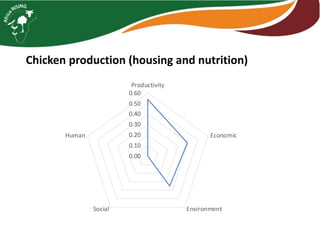
Chicken production (housing and nutrition)
0.00
0.10
0.20
0.30
0.40
0.50
0.60
Productivity
Economic
EnvironmentSocial
Human
Proposed research to fill the gaps in the integrated
livestock production package
• Scale the improved housing and brooder but focusing on the social,
economic and human domains. What are the drivers of adoption? What is
making farmers modify the design? e.g. gender issues, economics and
benefits of the technology etc.
Africa Research in Sustainable Intensification for the Next Generation
africa-rising.net
This presentation is licensed for use under the Creative Commons Attribution 4.0 International Licence.
Thank You

Integrated livestock feed interventions

  • 1.
    Integrated livestock feedinterventions Ben Lukuyu1, Leonard Marwa1, Chrispinus Rubanza2, Anthony Kimaro3, Christopher Mutungi4 1International Livestock Research Institute (ILRI), 2Dodoma University, 3World Agroforestry Center (ICRAF), 4International Institute of Tropical Agriculture (IITA) Africa RISING ESA Project review and planning meeting 11 – 12 September 2019, Dar es Salaam, Tanzania
  • 2.
    Rationale • Planting ofimproved planted forages, fodder trees and shrubs, grasses, in the landscapes may have beneficial effects to provide feed and on reducing nutrient losses and water pollution • Crop residues, such as dry or green maize stover and bean haulms, are commonly fed to livestock but are also of low quality and they are poorly used by farmers
  • 3.
    An Integrated LivestockProduction System (ILPS) • How can we optimize feeds, forages and improved chicken nutrition and genetics for improved livestock and whole farm productivity, and for enhancing livelihood of rural households? • Innovation: • Improved chickens genetics (UDOM) • Improved chicken feeds and housing • Improved forages for feeds and land management • Better use of crop residues
  • 4.
    Integrated Livestock ProductionSystem (ILPS) IMRPOVED CHICKEN GENETICS IMPROVED CHICKEN FEED & HOUSING CATTLE: CLIMATE SMART FORAGES CATTLE: BETTER USE OF CROP RESIDUESILPS INNOVATION: FORAGES/FODDER for LAND MANAGEMENT • Reduced soil runoff (mm of water) • Gain in soil water content (%) • Fuel wood supply (t/ha) FORAGES: MORE AND BETTER FEED • More forage quantity (t/ha) • Better forage quality (t/ha) • Better manure use (t/ha) HIGH QUALITY FEEDS FROM LIGNOCELLULOSIC BIOMASS • Better quality feeds (CP and ME) Other non-conventional feed sources e.g. fruit & vegetable waste (t/ha) IMRPOVED CHICKEN GENETICS BETTER FEEDING PRACTICES ADEQUATE BASAL RATIONS • Enough quantity (kg/animal) • Milk yield ( litres/lactation) BETTER SUPPLEMENTS (TMRs) • Improved quality (kg/day) • Milk yield ( litres/lactation) BETTER AND MORE MANURE BETTER ANIMAL AND MANURE MANAGEMENT PRACTICES BETTER CHICKEN HOUSING AND BROODERS • Reduced mortality rates (%) • Higher growth rates (g/day) BETTER FEED TROUGHS AND STORES • Reduced feed wastage (kg/day) • Improved feed intake (kg/day) BETTER MANURE MANAGEMENT FEED PROCESSING • Labour saving (4hrs/day) • Farmer preferences • Source of income • Reduces post harvest losses of crop residues SIAF indicators • Productivity (P) • Economic (Ec) • Social (S) • Environment (En) • Human (H) CROP AND LIVESTOCK MIXED FARM More milk, meat, eggs & income P, En. Ec, S P, En. Ec, S P, En. Ec, S P, Ec, S P, Ec, S P, Ec, S Ec, S ISFM • Crop residues • Toppings and strips
  • 5.
    FORAGES: What havewe have addressed? • Inventory of feed & forage resources, feeding practices, perceptions of farmers • Participatory screening of potential forages in the target areas with farmers • Assessment of fodder quality and farmers’ preferences. • A cost-benefit analysis to identify the most promising forages • Forages as land management strategy
  • 6.
    Yield and qualityof improved forages 0 10 20 30 40 50 60 70 80 ILRI 14984 ILRI 16803 ILRI 16835 ILRI 16837 Kakamega 1 Kakamega 2 %ofnutrients Ash Crude protein Fibre Lignin Digestibility 0 5 10 15 20 25 30 35 Kakamega 1 Kakamega 2 ILRI 16837 ILRI 16835 ILRI 14984 ILRI 16803 Yield(t/ha) Humidhighlands Semi-humid uplands Semi-humid midlands
  • 7.
    SIAF: Forages aslivestock feed and land management strategy Interventions Productivity Data available (Y/No)? Economic Data available (Y/No)? Social Data available (Y/No)? Environment Data available (Y/No)? Human Data available (Y/No)? Forage for land management Yield (t/ha/season) Y Gross revenue N Gender N Soil erosion Y Capacity to experiment (% farmers testing) N Quality (no unit) Y Net revenue N Equity N Soil physical quality Y (Kizito) Labour requirement N Rating of technology (ranking) N Vegetative cover N Climate smart forages for feed Fodder yield (t/ha/season) Y Gross revenue Y Gender N Soil erosion control (%) Y (Kizito) Capacity to experiment (% farmers testing) N Quality (rating) Y Net revenue Y Equity N Soil physical quality Y Milk yield (kg/season) Y Labour requirement Y Rating of technology (ranking) N Vegetative cover N Fuel wood biomass t/ha) Y
  • 8.
  • 9.
    Proposed research tofill the gaps in the integrated livestock production package • A survey study to asses drivers of adoption of improved forages of different farm typologies and farmers criteria for targeting forages to different niches of farms. • An analysis of different uses of fodder – as livestock feed, for soil fertility improvement (mulching, composting), fencing or for sale – on some selected farms with a SIAF lens
  • 10.
    BETTER USE OFCROP RESIDUES: What have we addressed? • Took inventory of types and use crop residues in all production systems • Quantified stover yield on farm (ISM). • Conducted a participatory evaluation of techniques to improve the utilization of crop residues by farm households • Introduced and evaluated feed chopping technology with farmers
  • 11.
    Crop residues inview of the sustainable intensification domains 0 0.1 0.2 0.3 0.4 0.5 Productivity Economic EnvironmentSocial Human
  • 12.
    SIAF: Improved cropresidue use on farms Interventions Productivity Data available (Y/No)? Economic Data available (Y/No)? Social Data available (Y/No)? Environment Data available (Y/No)? Human Data available (Y/No)? Feed processing technology Residue production ( kg/ha/season) Y Gross revenue Y Gender Y Reduced GHG emissions N Capacity to experiment (% farming testing) N Quality of residue ( no unit) Y Net revenue Y Equity Y Reduced land compaction N Rating of rations (rating) N Labour requirement Y Rating of technology (ranking) Y Carbon sequestration ( t Co2/ha) Y (Anthony Kimaru) Yield (t/ha/season) Y Quality (rating) Y Milk/Egg yield (kg/season) Y Improved feed and watering troughs Yield (t/ha/season) Y Gross revenue N Gender N Reduced feed wastage N Capacity to experiment (% farming testing) N Quality (rating) N Net revenue N Equity N Feed residue management N Milk yield (kg/season) N Labour requirement N rating of technology (ranking) N
  • 13.
    Proposed research tofill the gaps in the integrated livestock production package • Expand the analysis study for forages to include crop residues. Evaluate how farmers collect, manage and use crop residues feed/manure? Link to manure management • Scale improved feed troughs (fixed and mobile) that have successfully been tested in Ethiopia. Possibility of looking at improved water toughs as well.
  • 14.
    Improved chickens: housing,feed and management • Poultry provides a pathway out of poverty for most smallholder farmers in Tanzania Improved chickens genetics (UDOM) Improved chicken feeds and housing (ILRI)
  • 15.
    Poultry innovations • Improvedfeed rations, using vegetable wastes, waste grains and cereal by- products as feed components • Improved poultry housing and brooder 0 200 400 600 800 1000 1200 1400 6 8 10 12 14 16 18 20 Livebodyweight(gm) Age (weeks) Housed + rationed feeds Housed + non rationed feeds Partially housed + rationedfeeds Scavenging The affect of confinement levels x feeding regimes on live body weight
  • 16.
    Mortality rates onfarms 6.86 1.04 0.15 20.37 13.05 2.63 -5 0 5 10 15 20 25 30 8 10 12 Mortalityrate(%) Age of chicks (weeks) Chicks supplied with feed package Chicks Supplied without fed package The influence of formulated feeds on mortality rate of local chicks during the first 4-weeks after their delivery to farmers The influence of formulated feeds on mortality rate of local chicks during the first 4-weeks after their delivery to farmers
  • 17.
    SIAF: Chicken housing& nutrition Interventions Productivity Data available (Y/No)? Economic Data available (Y/No)? Social Data available (Y/No)? Environment Data available (Y/No)? Human Data available (Y/No)? Improved chicken housing and feed rations Meat (kg/animal) Y Gross revenue Y Gender N None (Gap) N Nutrition (total protein production) N Chick survival (%) Y Labour requireme nt Y Equity N N Capacity to experiment (% farming testing) N Eggs (No) Y rating of technology (ranking) N N Food safety (incedence of mycotoxins/otherpat hogens) Y (partly) Growth rate Y social cohesions (rating) N N Dietry diversity N Chickens (No/period) Y collective action (groups) N N Food consuption score N Manure (kg/unit) N Manure (kg/unit) Market partcipartion N
  • 18.
    SIAF: Chicken breeding InterventionsProductivity Data available (Y/No)? Economic Data available (Y/No)? Social Data available (Y/No)? Environment Data available (Y/No)? Human Data available (Y/No)? Improved Chicken genetics Meat (kg/animal) Y Gross revenue N Gender Y strain diversity (rating) Y Nutrition (total protein production) N Chicks (% hatchability) Y Net revenue N Livestock ownership Y Food security (months/year) N Chick survival (%) Y Labour requireme nt N Equity N Capacity to experiment (% farming testing) N Eggs (No) N Capacity to access information N Dietry diversity N Growth rate Y Social cohesions (rating) N Food consuption score N Chickens (No/period) Y Collective action (groups) N Market partcipartion N
  • 19.
    Chicken production (housingand nutrition) 0.00 0.10 0.20 0.30 0.40 0.50 0.60 Productivity Economic EnvironmentSocial Human
  • 20.
    Proposed research tofill the gaps in the integrated livestock production package • Scale the improved housing and brooder but focusing on the social, economic and human domains. What are the drivers of adoption? What is making farmers modify the design? e.g. gender issues, economics and benefits of the technology etc.
  • 21.
    Africa Research inSustainable Intensification for the Next Generation africa-rising.net This presentation is licensed for use under the Creative Commons Attribution 4.0 International Licence. Thank You