Feeds and Forages Flagship: Initial
ideas for Integrated Core Project
Michael Peters, CIAT
Livestock CRP Priority Countries Planning Meeting
26 – 27 March 2019
Nairobi, Kenya
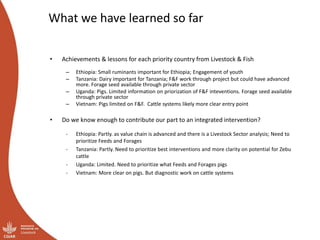
What we have learned so far
• Achievements & lessons for each priority country from Livestock & Fish
– Ethiopia: Small ruminants important for Ethiopia; Engagement of youth
– Tanzania: Dairy important for Tanzania; F&F work through project but could have advanced
more. Forage seed available through private sector
– Uganda: Pigs. Limited information on priorization of F&F inteventions. Forage seed available
through private sector
– Vietnam: Pigs limited on F&F. Cattle systems likely more clear entry point
• Do we know enough to contribute our part to an integrated intervention?
- Ethiopia: Partly. as value chain is advanced and there is a Livestock Sector analysis; Need to
prioritize Feeds and Forages
- Tanzania: Partly. Need to prioritize best interventions and more clarity on potential for Zebu
cattle
- Uganda: Limited. Need to prioritize what Feeds and Forages pigs
- Vietnam: More clear on pigs. But diagnostic work on cattle systems
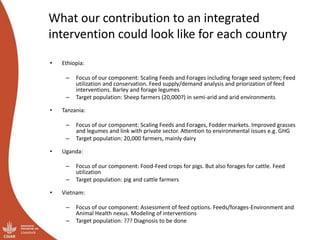
What our contribution to an integrated
intervention could look like for each country
• Ethiopia:
– Focus of our component: Scaling Feeds and Forages including forage seed system; Feed
utilization and conservation. Feed supply/demand analysis and priorization of feed
interventions. Barley and forage legumes
– Target population: Sheep farmers (20,000?) in semi-arid and arid environments
• Tanzania:
– Focus of our component: Scaling Feeds and Forages, Fodder markets. Improved grasses
and legumes and link with private sector. Attention to environmental issues e.g. GHG
– Target population: 20,000 farmers, mainly dairy
• Uganda:
– Focus of our component: Food-Feed crops for pigs. But also forages for cattle. Feed
utilization
– Target population: pig and cattle farmers
• Vietnam:
– Focus of our component: Assessment of feed options. Feeds/forages-Environment and
Animal Health nexus. Modeling of interventions
– Target population: ??? Diagnosis to be done
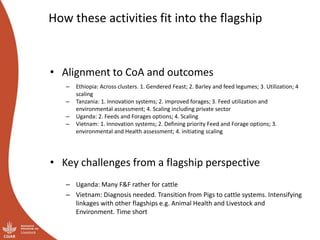
How these activities fit into the flagship
• Alignment to CoA and outcomes
– Ethiopia: Across clusters. 1. Gendered Feast; 2. Barley and feed legumes; 3. Utilization; 4
scaling
– Tanzania: 1. Innovation systems; 2. improved forages; 3. Feed utilization and
environmental assessment; 4. Scaling including private sector
– Uganda: 2. Feeds and Forages options; 4. Scaling
– Vietnam: 1. Innovation systems; 2. Defining priority Feed and Forage options; 3.
environmental and Health assessment; 4. initiating scaling
• Key challenges from a flagship perspective
– Uganda: Many F&F rather for cattle
– Vietnam: Diagnosis needed. Transition from Pigs to cattle systems. Intensifying
linkages with other flagships e.g. Animal Health and Livestock and
Environment. Time short
CGIAR Research Program on Livestock
livestock.cgiar.org
The CGIAR Research Program on Livestock aims to increase the productivity and profitability of livestock agri-food
systems in sustainable ways, making meat, milk and eggs more available and affordable across the developing world.
This presentation is licensed for use under the Creative Commons Attribution 4.0 International Licence.
The program thanks all donors and organizations which globally support its work through their contributions to the CGIAR system

Feeds and Forages Flagship: Initial ideas for integrated core project

  • 1.
    Feeds and ForagesFlagship: Initial ideas for Integrated Core Project Michael Peters, CIAT Livestock CRP Priority Countries Planning Meeting 26 – 27 March 2019 Nairobi, Kenya
  • 2.
    What we havelearned so far • Achievements & lessons for each priority country from Livestock & Fish – Ethiopia: Small ruminants important for Ethiopia; Engagement of youth – Tanzania: Dairy important for Tanzania; F&F work through project but could have advanced more. Forage seed available through private sector – Uganda: Pigs. Limited information on priorization of F&F inteventions. Forage seed available through private sector – Vietnam: Pigs limited on F&F. Cattle systems likely more clear entry point • Do we know enough to contribute our part to an integrated intervention? - Ethiopia: Partly. as value chain is advanced and there is a Livestock Sector analysis; Need to prioritize Feeds and Forages - Tanzania: Partly. Need to prioritize best interventions and more clarity on potential for Zebu cattle - Uganda: Limited. Need to prioritize what Feeds and Forages pigs - Vietnam: More clear on pigs. But diagnostic work on cattle systems
  • 3.
    What our contributionto an integrated intervention could look like for each country • Ethiopia: – Focus of our component: Scaling Feeds and Forages including forage seed system; Feed utilization and conservation. Feed supply/demand analysis and priorization of feed interventions. Barley and forage legumes – Target population: Sheep farmers (20,000?) in semi-arid and arid environments • Tanzania: – Focus of our component: Scaling Feeds and Forages, Fodder markets. Improved grasses and legumes and link with private sector. Attention to environmental issues e.g. GHG – Target population: 20,000 farmers, mainly dairy • Uganda: – Focus of our component: Food-Feed crops for pigs. But also forages for cattle. Feed utilization – Target population: pig and cattle farmers • Vietnam: – Focus of our component: Assessment of feed options. Feeds/forages-Environment and Animal Health nexus. Modeling of interventions – Target population: ??? Diagnosis to be done
  • 4.
    How these activitiesfit into the flagship • Alignment to CoA and outcomes – Ethiopia: Across clusters. 1. Gendered Feast; 2. Barley and feed legumes; 3. Utilization; 4 scaling – Tanzania: 1. Innovation systems; 2. improved forages; 3. Feed utilization and environmental assessment; 4. Scaling including private sector – Uganda: 2. Feeds and Forages options; 4. Scaling – Vietnam: 1. Innovation systems; 2. Defining priority Feed and Forage options; 3. environmental and Health assessment; 4. initiating scaling • Key challenges from a flagship perspective – Uganda: Many F&F rather for cattle – Vietnam: Diagnosis needed. Transition from Pigs to cattle systems. Intensifying linkages with other flagships e.g. Animal Health and Livestock and Environment. Time short
  • 5.
    CGIAR Research Programon Livestock livestock.cgiar.org The CGIAR Research Program on Livestock aims to increase the productivity and profitability of livestock agri-food systems in sustainable ways, making meat, milk and eggs more available and affordable across the developing world. This presentation is licensed for use under the Creative Commons Attribution 4.0 International Licence. The program thanks all donors and organizations which globally support its work through their contributions to the CGIAR system

Editor's Notes

  • #3 Page title minimum of 30 points and maximum of two lines Main point 6 point smaller than slide title Bullet points 4 point less than main point Font type is Calibri It is advised in one slide maximum 6 bullets We recommend you use images on slides You can change partner logos on front page You have to duplicate this slide for more inside pages
  • #4 Page title minimum of 30 points and maximum of two lines Main point 6 point smaller than slide title Bullet points 4 point less than main point Font type is Calibri It is advised in one slide maximum 6 bullets We recommend you use images on slides You can change partner logos on front page You have to duplicate this slide for more inside pages
  • #5 Page title minimum of 30 points and maximum of two lines Main point 6 point smaller than slide title Bullet points 4 point less than main point Font type is Calibri It is advised in one slide maximum 6 bullets We recommend you use images on slides You can change partner logos on front page You have to duplicate this slide for more inside pages