
ResearchandDevelopmentDivision
LivestockResearchandImprovementUnit
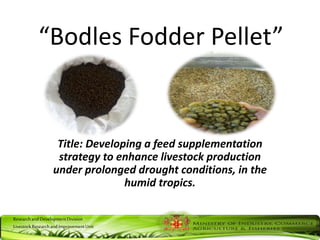
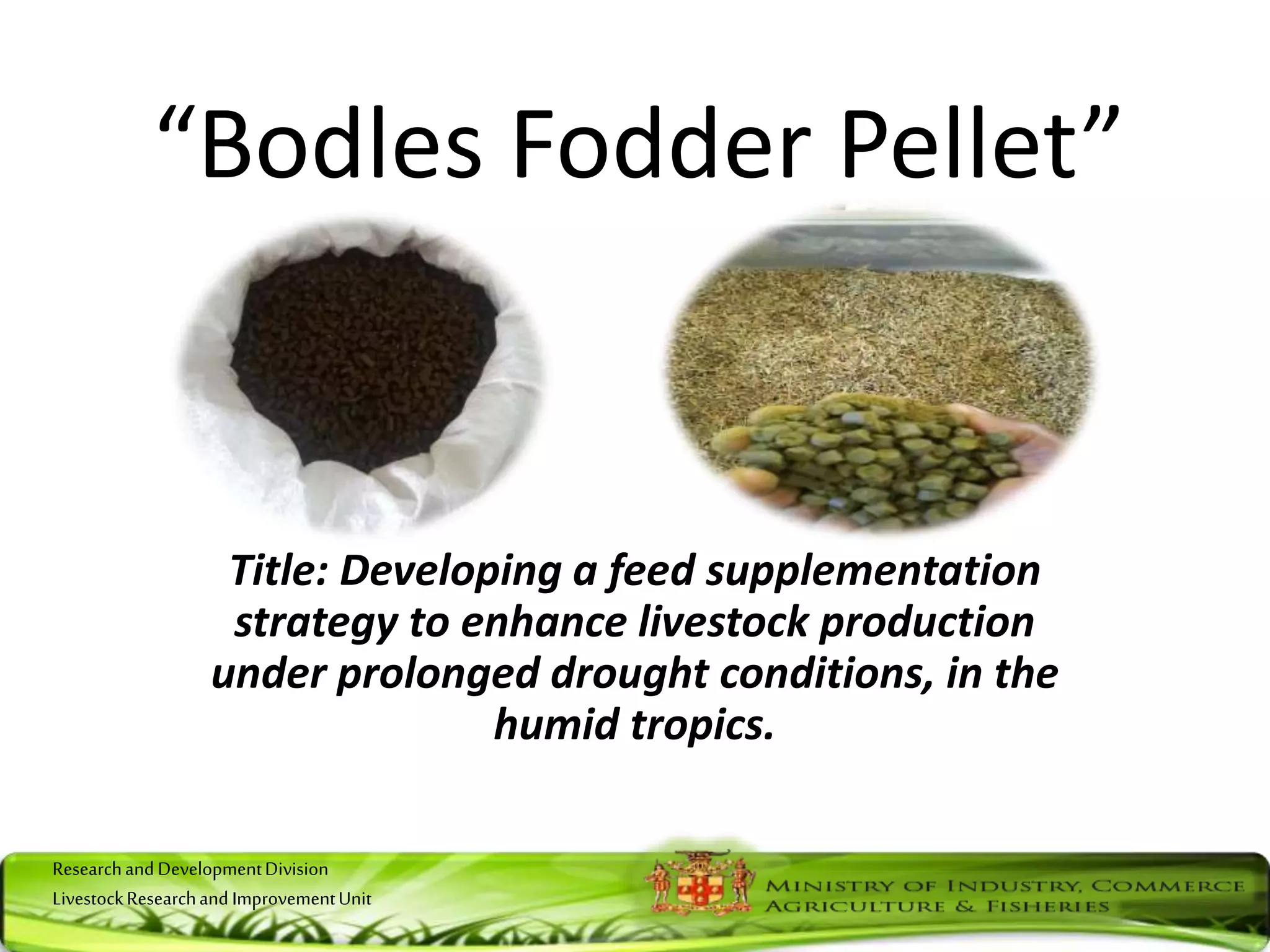
“Bodles Fodder Pellet”
Title: Developing a feed supplementation
strategy to enhance livestock production
under prolonged drought conditions, in the
humid tropics.
ResearchandDevelopmentDivision
LivestockResearchandImprovementUnit
Research and Development Division:
Livestock Research and Improvement Unit
• Objective- Unlock potential through
developing technology and Innovation
• Current Research (feeding trials, forage
studies, by product processing, genetic
conservation)
• Projects (Silvopastoral, Hay, CFC, NZ)
ResearchandDevelopmentDivision
LivestockResearchandImprovementUnit
Impact of Climate Change on Livestock
Production
• Problems Identified: Impacts on animal
physiology and impact on forage-based
feeding systems.
• Focus: Interventions to mitigate against
fluctuating forage quality and availability
ResearchandDevelopmentDivision
LivestockResearchandImprovementUnit
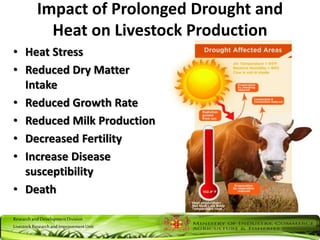
Impact of Prolonged Drought and
Heat on Livestock Production
• Heat Stress
• Reduced Dry Matter
Intake
• Reduced Growth Rate
• Reduced Milk Production
• Decreased Fertility
• Increase Disease
susceptibility
• Death
ResearchandDevelopmentDivision
LivestockResearchandImprovementUnit
Climate Smart Strategies for
Implementation
Awareness Strategies
• Pay attention to : 1. Weather Forecast
2. Animal Behavior
Mitigation Strategies
• Silvopastoral System
• Ventilation
• Water
• Increase feed digestibility and quality
• Increase Vitamin C or Niacin level
• Selective Breeding for improved resistance
ResearchandDevelopmentDivision
LivestockResearchandImprovementUnit
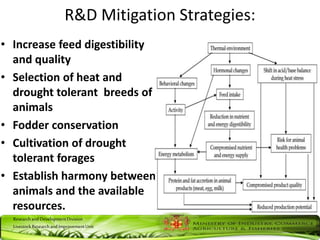
R&D Mitigation Strategies:
• Increase feed digestibility
and quality
• Selection of heat and
drought tolerant breeds of
animals
• Fodder conservation
• Cultivation of drought
tolerant forages
• Establish harmony between
animals and the available
resources.
ResearchandDevelopmentDivision
LivestockResearchandImprovementUnit
Research Specific Strategies
• Measure specific impacts on livestock systems
• Future research into the nature of animal responses
to changes in the environment.
• Very little can be done to change the environment
BUT!!!!
• Management interventions can minimize the
impact of changing climate on livestock productivity
ResearchandDevelopmentDivision
LivestockResearchandImprovementUnit
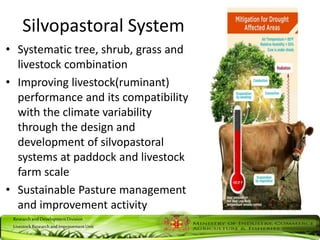
Silvopastoral System
• Systematic tree, shrub, grass and
livestock combination
• Improving livestock(ruminant)
performance and its compatibility
with the climate variability
through the design and
development of silvopastoral
systems at paddock and livestock
farm scale
• Sustainable Pasture management
and improvement activity
ResearchandDevelopmentDivision
LivestockResearchandImprovementUnit
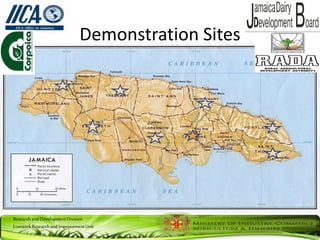
Demonstration Sites
ResearchandDevelopmentDivision
LivestockResearchandImprovementUnit
Project and Research Scope
• Design site specific systems for farmers
• Increase, diversify fodder availability and income
• Promotion of a simple sustainable pasture
management system
• Measure the impact on production and animal
performance
• Measure cost benefits to assess the impacts on the
socio-economic climate that affects the livestock
producer ($$).
ResearchandDevelopmentDivision
LivestockResearchandImprovementUnit
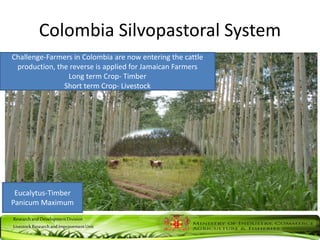
Colombia Silvopastoral System
Eucalytus-Timber
Panicum Maximum
Challenge-Farmers in Colombia are now entering the cattle
production, the reverse is applied for Jamaican Farmers
Long term Crop- Timber
Short term Crop- Livestock
ResearchandDevelopmentDivision
LivestockResearchandImprovementUnit
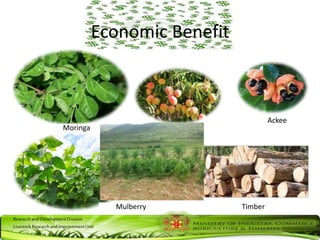
Economic Benefit
Mulberry
Moringa
Timber
Ackee
Mango
ResearchandDevelopmentDivision
LivestockResearchandImprovementUnit
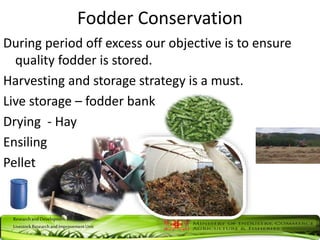
Fodder Conservation
During period off excess our objective is to ensure
quality fodder is stored.
Harvesting and storage strategy is a must.
Live storage – fodder bank
Drying - Hay
Ensiling
Pellet
ResearchandDevelopmentDivision
LivestockResearchandImprovementUnit
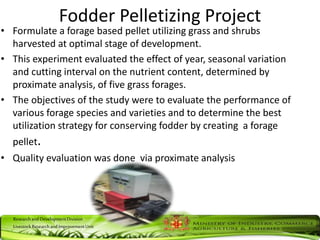
Fodder Pelletizing Project
• Formulate a forage based pellet utilizing grass and shrubs
harvested at optimal stage of development.
• This experiment evaluated the effect of year, seasonal variation
and cutting interval on the nutrient content, determined by
proximate analysis, of five grass forages.
• The objectives of the study were to evaluate the performance of
various forage species and varieties and to determine the best
utilization strategy for conserving fodder by creating a forage
pellet.
• Quality evaluation was done via proximate analysis
ResearchandDevelopmentDivision
LivestockResearchandImprovementUnit
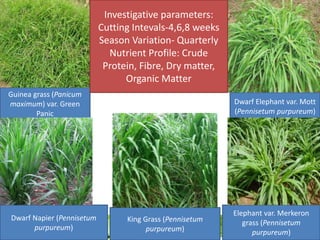
Dwarf Napier (Pennisetum
purpureum)
Guinea grass (Panicum
maximum) var. Green
Panic
Dwarf Elephant var. Mott
(Pennisetum purpureum)
Elephant var. Merkeron
grass (Pennisetum
purpureum)
King Grass (Pennisetum
purpureum)
Investigative parameters:
Cutting Intevals-4,6,8 weeks
Season Variation- Quarterly
Nutrient Profile: Crude
Protein, Fibre, Dry matter,
Organic Matter
ResearchandDevelopmentDivision
LivestockResearchandImprovementUnit
Results
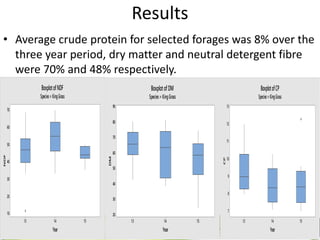
• Average crude protein for selected forages was 8% over the
three year period, dry matter and neutral detergent fibre
were 70% and 48% respectively.
151413
70
60
50
40
30
20
10
Year
NDF
BoxplotofNDF
Species=KingGrass
151413
90
80
70
60
50
40
30
20
Year
DM
BoxplotofDM
Species=KingGrass
151413
13
12
11
10
9
8
7
Year
CP
BoxplotofCP
Species=KingGrass
ResearchandDevelopmentDivision
LivestockResearchandImprovementUnit
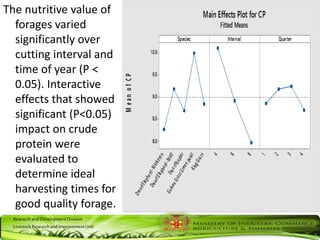
The nutritive value of
forages varied
significantly over
cutting interval and
time of year (P <
0.05). Interactive
effects that showed
significant (P<0.05)
impact on crude
protein were
evaluated to
determine ideal
harvesting times for
good quality forage.
ResearchandDevelopmentDivision
LivestockResearchandImprovementUnit
Benefits of Fodder Pellet
• Increases dry matter intake
• Increase utilization of ingredients
• Reduce storage capacity
• Sustainable Practice – Raw
materials are available
ResearchandDevelopmentDivision
LivestockResearchandImprovementUnit
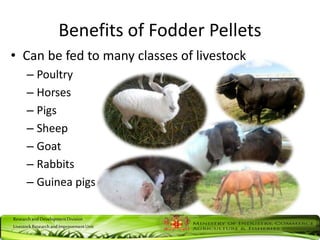
Benefits of Fodder Pellets
• Can be fed to many classes of livestock
– Poultry
– Horses
– Pigs
– Sheep
– Goat
– Rabbits
– Guinea pigs
ResearchandDevelopmentDivision
LivestockResearchandImprovementUnit
Conclusion
• The “Bodles Fodder Pellet” is a viable option for
feeding livestock in the tropics.
• Optimal harvesting strategies can maximize the
quality of forage obtained for pelletizing.
• Cost benefits of feed cost as well as alternative
products from silvo-pastoral system realized.
• Further research into in cooperating high protein
plants into the fodder pellet.
ResearchandDevelopmentDivision
LivestockResearchandImprovementUnit
Thank you !!!!!

CSA Symposium 2016 - Khalil Brown - Day 2 Session 1B

Editor's Notes

  • #7 Feeding system aim to maximize use of good quality forage Animal genetics must be characterized to determine levels of adaptability . Moving forward we targeting the two biggest Animal production limitations ; NUTRITION and GENETICS
  • #10 Multilocational trials – collect data in all parishes to accurately assess the performance of the recommended forages.
  • #12 Diversification of existing system vs introducing a NEW system. This system seeks to enhance the profitability of existing pastoral systems providing economic spin offs.
  • #13 Combinations of species are directly curtailed to suit the needs of the location. BEING VERY SPECIFIC!!!!