Feeds and forage research and development under
SIMLESA project: Achievements and lessons
Endalkachew Wolde-Meskel, Aberra Adie, Melkamu Bezabih and Peter Thorne
Africa RISING Ethiopian Highlands Project Review and Planning Meeting
Addis Ababa, 21–22 May 2019
Presentation Outline
Background
Approaches and methods
Feed and forage interventions
Main achievements/results
Ways forward
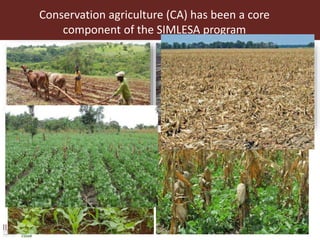
Conservation agriculture (CA) has been a core
component of the SIMLESA program
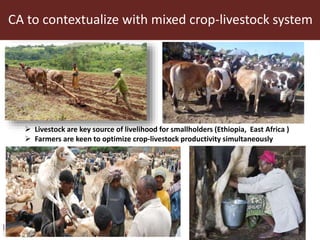
CA to contextualize with mixed crop-livestock system
 Livestock are key source of livelihood for smallholders (Ethiopia, East Africa )
 Farmers are keen to optimize crop-livestock productivity simultaneously
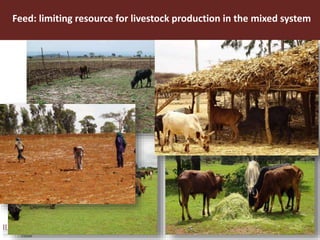
Grass weeds fill
the feed
shortage gaps
during the wet
season
Feed: limiting resource for livestock production in the mixed system
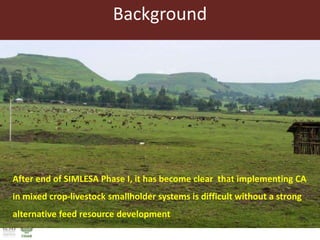
After end of SIMLESA Phase I, it has become clear that implementing CA
in mixed crop-livestock smallholder systems is difficult without a strong
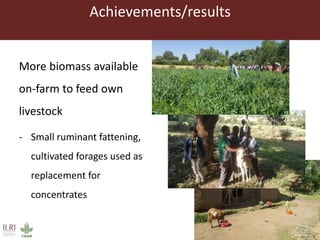
alternative feed resource development
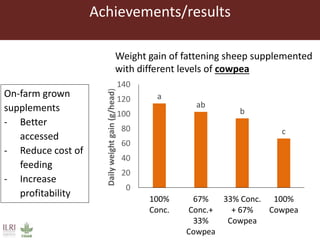
Background
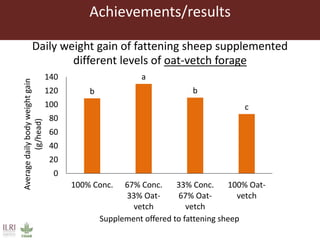
Background
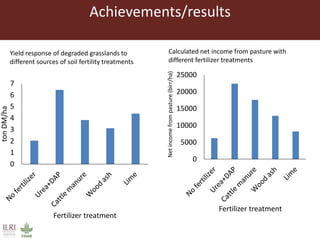
• ILRI came on board during SIMLESA phase two in 2015 to lead
the feed and forage research and development
• Increase feed biomass production at farm level through
better integration of cultivated forages in the system
• Improve utilization of available feed resources
Approaches
• Site selections by aligning with ongoing SIMLESA
agronomic interventions
o SNNPRS, Oromia, Amhara, Arusha (7 districts, 5 in Eth & 2 in TZ)
Partnerships
• System diagnosis using FEAST tool to describe the
system in relation to livestock production and
prioritize feed technology options that best work
under the local context
FEAST
Approaches
Approaches
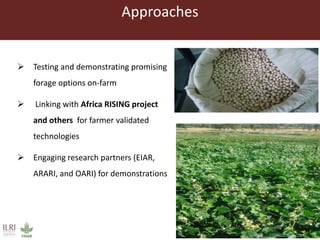
 Testing and demonstrating promising
forage options on-farm
 Linking with Africa RISING project
and others for farmer validated
technologies
 Engaging research partners (EIAR,
ARARI, and OARI) for demonstrations
Approaches
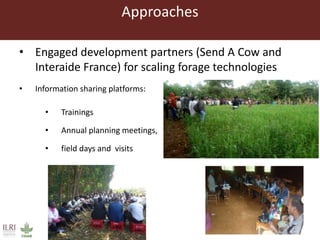
• Engaged development partners (Send A Cow and
Interaide France) for scaling forage technologies
• Information sharing platforms:
• Trainings
• Annual planning meetings,
• field days and visits
0.0
0.5
1.0
1.5
2.0
2.5
3.0
3.5
4.0
4.5
5.0
0
1
2
3
4
5
6
7
8
9
10
Rainfall(0-5)
AvailabilityofFeed(0-10)
Cereal Crop Residues Concentrates
Grazing Leguminous Crop Residues
Green Forage (e.g., weeds, fodder crops, leaves) Sum of rainfall
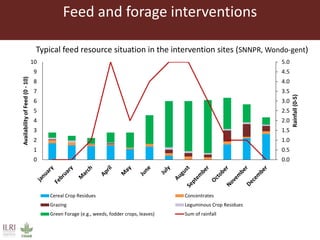
Typical feed resource situation in the intervention sites (SNNPR, Wondo-gent)
Feed and forage interventions
Results of FEAST assessment in the intervention sites:
• Farmers put feed shortage as a major constraint for
livestock production
• High seasonality in the availability and quality of
feed resources;
• Farmers are willing to invest/allocate land and
labor for forage
Feed and forage interventions
Based on the results of the initial assessment,
technology interventions prioritized and demonstrated
• Grass forages
• Legume forages
• Fodder trees
• Improved postharvest feed utilization techniques
Feed and forage interventions
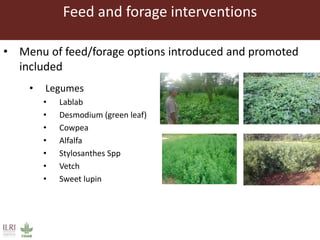
• Menu of feed/forage options introduced and promoted
included
• Legumes
• Lablab
• Desmodium (green leaf)
• Cowpea
• Alfalfa
• Stylosanthes Spp
• Vetch
• Sweet lupin
Feed and forage interventions
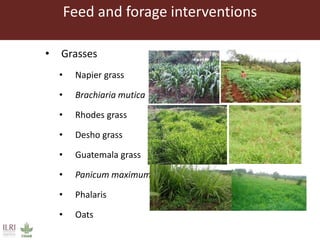
• Grasses
• Napier grass
• Brachiaria mutica
• Rhodes grass
• Desho grass
• Guatemala grass
• Panicum maximum
• Phalaris
• Oats
Feed and forage interventions
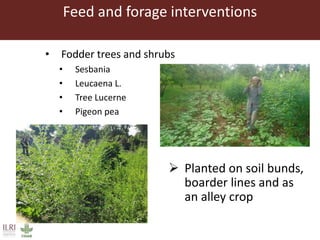
• Fodder trees and shrubs
• Sesbania
• Leucaena L.
• Tree Lucerne
• Pigeon pea
 Planted on soil bunds,
boarder lines and as
an alley crop
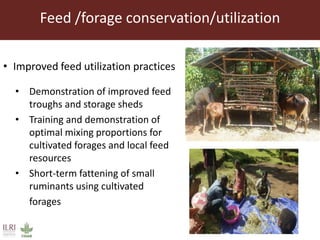
Feed /forage conservation/utilization
• Improved feed utilization practices
• Demonstration of improved feed
troughs and storage sheds
• Training and demonstration of
optimal mixing proportions for
cultivated forages and local feed
resources
• Short-term fattening of small
ruminants using cultivated
forages
Feed and forage interventions
• Grassland improvement work
• Testing the feasibility of alternative fertilizer
sources for grassland improvement
• Over-sowing
• Evaluating productivity, forage quality and species
diversity
Main achievements
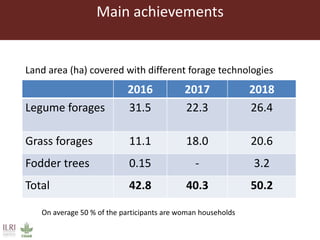
Land area (ha) covered with different forage technologies
2016 2017 2018
Legume forages 31.5 22.3 26.4
Grass forages 11.1 18.0 20.6
Fodder trees 0.15 - 3.2
Total 42.8 40.3 50.2
On average 50 % of the participants are woman households
Main achievements
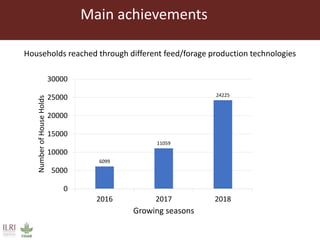
Households reached through different feed/forage production technologies
6099
11059
24225
0
5000
10000
15000
20000
25000
30000
2016 2017 2018
NumberofHouseHolds
Growing seasons
Main achievements
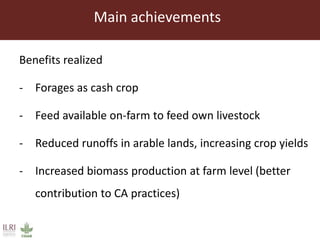
Benefits realized
- Forages as cash crop
- Feed available on-farm to feed own livestock
- Reduced runoffs in arable lands, increasing crop yields
- Increased biomass production at farm level (better
contribution to CA practices)
Main achievements
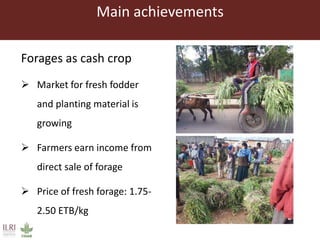
Forages as cash crop
 Market for fresh fodder
and planting material is
growing
 Farmers earn income from
direct sale of forage
 Price of fresh forage: 1.75-
2.50 ETB/kg
Achievements/results
More biomass available
on-farm to feed own
livestock
- Small ruminant fattening,
cultivated forages used as
replacement for
concentrates
Achievements/results
a
ab
b
c
0
20
40
60
80
100
120
140
100%
Conc.
67%
Conc.+
33%
Cowpea
33% Conc.
+ 67%
Cowpea
100%
Cowpea
Dailyweightgain(g/head)
Weight gain of fattening sheep supplemented
with different levels of cowpea
On-farm grown
supplements
- Better
accessed
- Reduce cost of
feeding
- Increase
profitability
Achievements/results
b
a
b
c
0
20
40
60
80
100
120
140
100% Conc. 67% Conc.
33% Oat-
vetch
33% Conc.
67% Oat-
vetch
100% Oat-
vetch
Averagedailybodyweightgain
(g/head)
Supplement offered to fattening sheep
Daily weight gain of fattening sheep supplemented
different levels of oat-vetch forage
Achievements/results
0
1
2
3
4
5
6
7
tonDM/ha
Fertilizer treatment
Yield response of degraded grasslands to
different sources of soil fertility treatments
0
5000
10000
15000
20000
25000
Netincomefrompasture(birr/ha)
Fertilizer treatment
Calculated net income from pasture with
different fertilizer treatments
Achievements/results
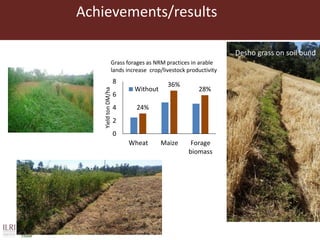
24%
36%
28%
0
2
4
6
8
Wheat Maize Forage
biomass
YieldtonDM/ha
Without
Desho grass on soil bund
Grass forages as NRM practices in arable
lands increase crop/livestock productivity
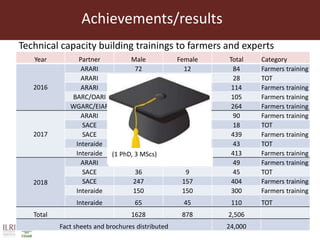
Technical capacity building trainings to farmers and experts
Year Partner Male Female Total Category
2016
ARARI 72 12 84 Farmers training
ARARI 24 4 28 TOT
ARARI 104 10 114 Farmers training
BARC/OARI 62 43 105 Farmers training
WGARC/EIAR 171 93 264 Farmers training
2017
ARARI 75 15 90 Farmers training
SACE 12 6 18 TOT
SACE 280 159 439 Farmers training
Interaide 27 16 43 TOT
Interaide 263 150 413 Farmers training
2018
ARARI 40 9 49 Farmers training
SACE 36 9 45 TOT
SACE 247 157 404 Farmers training
Interaide 150 150 300 Farmers training
Interaide 65 45 110 TOT
Total 1628 878 2,506
Fact sheets and brochures distributed 24,000
(1 PhD, 3 MScs)
Achievements/results
Conclusion
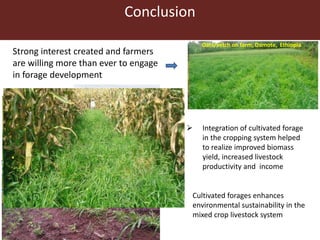
Strong interest created and farmers
are willing more than ever to engage
in forage development
 Integration of cultivated forage
in the cropping system helped
to realize improved biomass
yield, increased livestock
productivity and income
 Cultivated forages enhances
environmental sustainability in the
mixed crop livestock system
Oats/vetch on farm, Damote, Ethiopia
Desho on bunds
Forage at the backyard
Conclusion
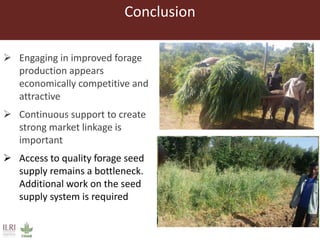
 Engaging in improved forage
production appears
economically competitive and
attractive
 Continuous support to create
strong market linkage is
important
 Access to quality forage seed
supply remains a bottleneck.
Additional work on the seed
supply system is required
Conclusion
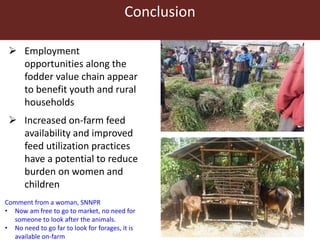
 Employment
opportunities along the
fodder value chain appear
to benefit youth and rural
households
 Increased on-farm feed
availability and improved
feed utilization practices
have a potential to reduce
burden on women and
children
Comment from a woman, SNNPR
• Now am free to go to market, no need for
someone to look after the animals.
• No need to go far to look for forages, it is
available on-farm
Acknowledgement
The presentation has a Creative Commons licence. You are free to re-use or distribute this work, provided credit is given to ILRI.
better lives through livestock
ilri.org

Feeds and forage research and development under SIMLESA project: Achievements and lessons

  • 1.
    Feeds and forageresearch and development under SIMLESA project: Achievements and lessons Endalkachew Wolde-Meskel, Aberra Adie, Melkamu Bezabih and Peter Thorne Africa RISING Ethiopian Highlands Project Review and Planning Meeting Addis Ababa, 21–22 May 2019
  • 2.
    Presentation Outline Background Approaches andmethods Feed and forage interventions Main achievements/results Ways forward
  • 3.
    Conservation agriculture (CA)has been a core component of the SIMLESA program
  • 4.
    CA to contextualizewith mixed crop-livestock system  Livestock are key source of livelihood for smallholders (Ethiopia, East Africa )  Farmers are keen to optimize crop-livestock productivity simultaneously
  • 5.
    Grass weeds fill thefeed shortage gaps during the wet season Feed: limiting resource for livestock production in the mixed system
  • 6.
    After end ofSIMLESA Phase I, it has become clear that implementing CA in mixed crop-livestock smallholder systems is difficult without a strong alternative feed resource development Background
  • 7.
    Background • ILRI cameon board during SIMLESA phase two in 2015 to lead the feed and forage research and development • Increase feed biomass production at farm level through better integration of cultivated forages in the system • Improve utilization of available feed resources
  • 8.
    Approaches • Site selectionsby aligning with ongoing SIMLESA agronomic interventions o SNNPRS, Oromia, Amhara, Arusha (7 districts, 5 in Eth & 2 in TZ) Partnerships
  • 9.
    • System diagnosisusing FEAST tool to describe the system in relation to livestock production and prioritize feed technology options that best work under the local context FEAST Approaches
  • 10.
    Approaches  Testing anddemonstrating promising forage options on-farm  Linking with Africa RISING project and others for farmer validated technologies  Engaging research partners (EIAR, ARARI, and OARI) for demonstrations
  • 11.
    Approaches • Engaged developmentpartners (Send A Cow and Interaide France) for scaling forage technologies • Information sharing platforms: • Trainings • Annual planning meetings, • field days and visits
  • 12.
    0.0 0.5 1.0 1.5 2.0 2.5 3.0 3.5 4.0 4.5 5.0 0 1 2 3 4 5 6 7 8 9 10 Rainfall(0-5) AvailabilityofFeed(0-10) Cereal Crop ResiduesConcentrates Grazing Leguminous Crop Residues Green Forage (e.g., weeds, fodder crops, leaves) Sum of rainfall Typical feed resource situation in the intervention sites (SNNPR, Wondo-gent) Feed and forage interventions
  • 13.
    Feed and forageinterventions Results of FEAST assessment in the intervention sites: • Farmers put feed shortage as a major constraint for livestock production • High seasonality in the availability and quality of feed resources; • Farmers are willing to invest/allocate land and labor for forage
  • 14.
    Feed and forageinterventions Based on the results of the initial assessment, technology interventions prioritized and demonstrated • Grass forages • Legume forages • Fodder trees • Improved postharvest feed utilization techniques
  • 15.
    Feed and forageinterventions • Menu of feed/forage options introduced and promoted included • Legumes • Lablab • Desmodium (green leaf) • Cowpea • Alfalfa • Stylosanthes Spp • Vetch • Sweet lupin
  • 16.
    Feed and forageinterventions • Grasses • Napier grass • Brachiaria mutica • Rhodes grass • Desho grass • Guatemala grass • Panicum maximum • Phalaris • Oats
  • 17.
    Feed and forageinterventions • Fodder trees and shrubs • Sesbania • Leucaena L. • Tree Lucerne • Pigeon pea  Planted on soil bunds, boarder lines and as an alley crop
  • 18.
    Feed /forage conservation/utilization •Improved feed utilization practices • Demonstration of improved feed troughs and storage sheds • Training and demonstration of optimal mixing proportions for cultivated forages and local feed resources • Short-term fattening of small ruminants using cultivated forages
  • 19.
    Feed and forageinterventions • Grassland improvement work • Testing the feasibility of alternative fertilizer sources for grassland improvement • Over-sowing • Evaluating productivity, forage quality and species diversity
  • 20.
    Main achievements Land area(ha) covered with different forage technologies 2016 2017 2018 Legume forages 31.5 22.3 26.4 Grass forages 11.1 18.0 20.6 Fodder trees 0.15 - 3.2 Total 42.8 40.3 50.2 On average 50 % of the participants are woman households
  • 21.
    Main achievements Households reachedthrough different feed/forage production technologies 6099 11059 24225 0 5000 10000 15000 20000 25000 30000 2016 2017 2018 NumberofHouseHolds Growing seasons
  • 22.
    Main achievements Benefits realized -Forages as cash crop - Feed available on-farm to feed own livestock - Reduced runoffs in arable lands, increasing crop yields - Increased biomass production at farm level (better contribution to CA practices)
  • 23.
    Main achievements Forages ascash crop  Market for fresh fodder and planting material is growing  Farmers earn income from direct sale of forage  Price of fresh forage: 1.75- 2.50 ETB/kg
  • 24.
    Achievements/results More biomass available on-farmto feed own livestock - Small ruminant fattening, cultivated forages used as replacement for concentrates
  • 25.
    Achievements/results a ab b c 0 20 40 60 80 100 120 140 100% Conc. 67% Conc.+ 33% Cowpea 33% Conc. + 67% Cowpea 100% Cowpea Dailyweightgain(g/head) Weightgain of fattening sheep supplemented with different levels of cowpea On-farm grown supplements - Better accessed - Reduce cost of feeding - Increase profitability
  • 26.
    Achievements/results b a b c 0 20 40 60 80 100 120 140 100% Conc. 67%Conc. 33% Oat- vetch 33% Conc. 67% Oat- vetch 100% Oat- vetch Averagedailybodyweightgain (g/head) Supplement offered to fattening sheep Daily weight gain of fattening sheep supplemented different levels of oat-vetch forage
  • 27.
    Achievements/results 0 1 2 3 4 5 6 7 tonDM/ha Fertilizer treatment Yield responseof degraded grasslands to different sources of soil fertility treatments 0 5000 10000 15000 20000 25000 Netincomefrompasture(birr/ha) Fertilizer treatment Calculated net income from pasture with different fertilizer treatments
  • 28.
    Achievements/results 24% 36% 28% 0 2 4 6 8 Wheat Maize Forage biomass YieldtonDM/ha Without Deshograss on soil bund Grass forages as NRM practices in arable lands increase crop/livestock productivity
  • 29.
    Technical capacity buildingtrainings to farmers and experts Year Partner Male Female Total Category 2016 ARARI 72 12 84 Farmers training ARARI 24 4 28 TOT ARARI 104 10 114 Farmers training BARC/OARI 62 43 105 Farmers training WGARC/EIAR 171 93 264 Farmers training 2017 ARARI 75 15 90 Farmers training SACE 12 6 18 TOT SACE 280 159 439 Farmers training Interaide 27 16 43 TOT Interaide 263 150 413 Farmers training 2018 ARARI 40 9 49 Farmers training SACE 36 9 45 TOT SACE 247 157 404 Farmers training Interaide 150 150 300 Farmers training Interaide 65 45 110 TOT Total 1628 878 2,506 Fact sheets and brochures distributed 24,000 (1 PhD, 3 MScs) Achievements/results
  • 30.
    Conclusion Strong interest createdand farmers are willing more than ever to engage in forage development  Integration of cultivated forage in the cropping system helped to realize improved biomass yield, increased livestock productivity and income  Cultivated forages enhances environmental sustainability in the mixed crop livestock system Oats/vetch on farm, Damote, Ethiopia Desho on bunds Forage at the backyard
  • 31.
    Conclusion  Engaging inimproved forage production appears economically competitive and attractive  Continuous support to create strong market linkage is important  Access to quality forage seed supply remains a bottleneck. Additional work on the seed supply system is required
  • 32.
    Conclusion  Employment opportunities alongthe fodder value chain appear to benefit youth and rural households  Increased on-farm feed availability and improved feed utilization practices have a potential to reduce burden on women and children Comment from a woman, SNNPR • Now am free to go to market, no need for someone to look after the animals. • No need to go far to look for forages, it is available on-farm
  • 33.
  • 34.
    The presentation hasa Creative Commons licence. You are free to re-use or distribute this work, provided credit is given to ILRI. better lives through livestock ilri.org

Editor's Notes

  • #2 Mention SIMILESA is closing this June, and it is time to report achievements and hand over to projects and partners to further scaling up
  • #3 This is a presentation of the achievements and lessons of ILRIIS contribution for the SIMLESA feed/forage components 2015 – 2018 and the closing and handing of the activities to sister projects and partners .