© 2015 Pearson Education Ltd.
Matter and Minerals
Chapter 2 Lecture
Jennifer Mangan
James Madison University
Earth Science
Fourteenth Edition, Global Edition
© 2015 Pearson Education Ltd.
• Definition of a mineral
– Natural
– Inorganic
– Solid
– Possess an orderly internal structure of atoms
– Have a definite chemical composition
• Rock – any naturally occurring solid mass of mineral
or mineral-like matter
Minerals: Building Blocks of Rocks
© 2015 Pearson Education Ltd.
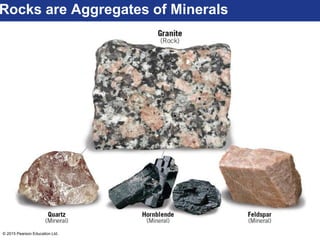
Rocks are Aggregates of Minerals
© 2015 Pearson Education Ltd.
• Atoms
– Smallest particles of matter
Atoms: Building Blocks of Minerals
© 2015 Pearson Education Ltd.
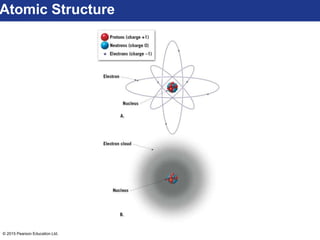
• Nucleus – central part of an atom that contains
– Protons – positive electrical charges
– Neutrons – neutral electrical charges
• Electron shells
– Surround nucleus
– Contain electrons – negative electrical charges
Atomic Structure
© 2015 Pearson Education Ltd.
Atomic Structure
© 2015 Pearson Education Ltd.
• Atomic number
– Number of protons in an atom’s nucleus.
• Ions
– Positively or negatively charged atoms due to electron gain
or loss
Atoms
© 2015 Pearson Education Ltd.
• Elements
– Basic building blocks of minerals
– Over 100 are known
– Defined by their number of protons
– Groups of the same type of atoms
Composition and Structure of Minerals
© 2015 Pearson Education Ltd.
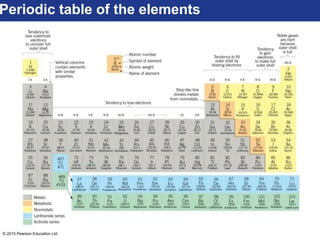
Periodic table of the elements
© 2015 Pearson Education Ltd.
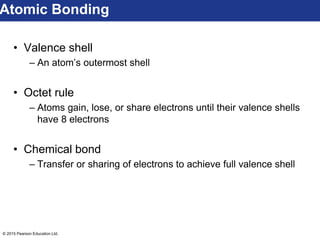
• Valence shell
– An atom’s outermost shell
• Octet rule
– Atoms gain, lose, or share electrons until their valence shells
have 8 electrons
• Chemical bond
– Transfer or sharing of electrons to achieve full valence shell
Atomic Bonding
© 2015 Pearson Education Ltd.
Atomic Bonding
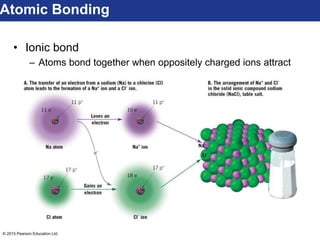
• Ionic bond
– Atoms bond together when oppositely charged ions attract
© 2015 Pearson Education Ltd.
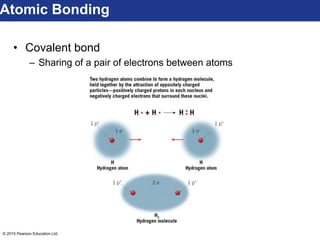
• Covalent bond
– Sharing of a pair of electrons between atoms
Atomic Bonding
© 2015 Pearson Education Ltd.
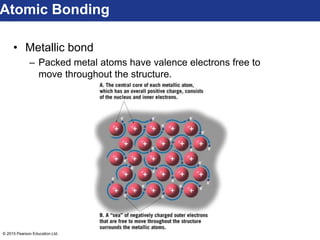
• Metallic bond
– Packed metal atoms have valence electrons free to
move throughout the structure.
Atomic Bonding
© 2015 Pearson Education Ltd.
• Physical properties of minerals
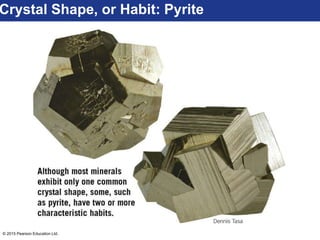
– Habit – common crystal shape
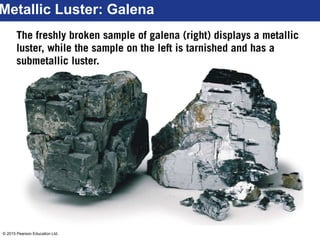
– Luster – appearance in reflected light
– Color
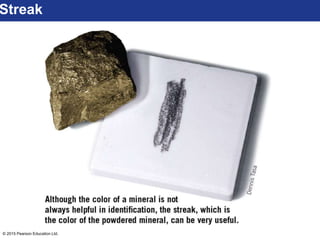
– Streak – color of mineral in powdered form
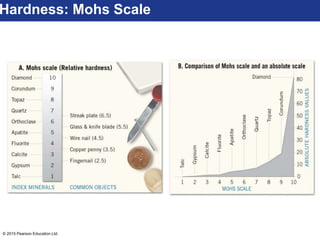
– Hardness – ability to resist scratching or abrasion
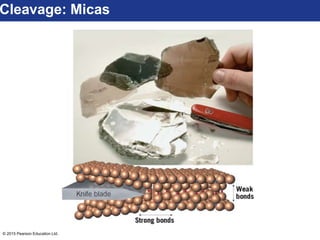
– Cleavage – tendency to break along planes of weak bonding
Minerals
© 2015 Pearson Education Ltd.
Metallic Luster: Galena
© 2015 Pearson Education Ltd.
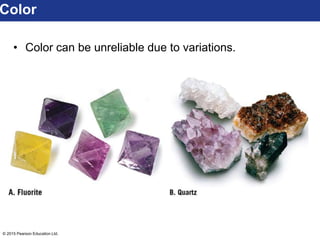
Color
• Color can be unreliable due to variations.
© 2015 Pearson Education Ltd.
Streak
© 2015 Pearson Education Ltd.
Crystal Shape, or Habit: Pyrite
© 2015 Pearson Education Ltd.
Hardness: Mohs Scale
© 2015 Pearson Education Ltd.
Cleavage: Micas
© 2015 Pearson Education Ltd.
• Physical properties of minerals
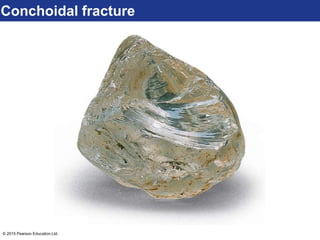
– Fracture – random pattern of breakage
– Specific gravity – mineral density
– Tenacity – resistance to cutting, breaking, bending, and
deformation
Minerals
© 2015 Pearson Education Ltd.
Conchoidal fracture
© 2015 Pearson Education Ltd.
• Other properties
– Taste
– Smell
– Elasticity
– Malleability
– Double refraction
– Magnetism
– Feel
– Reaction with hydrochloric acid
Minerals
© 2015 Pearson Education Ltd.
• Rock-forming minerals
– Only a few dozen
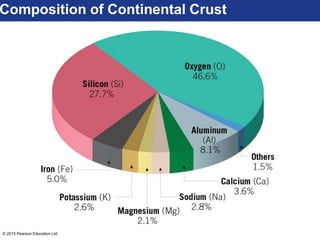
– Most abundant atoms in Earth’s crust are oxygen (46.6% by
weight) and silicon (27.7% by weight)
Mineral Groups
© 2015 Pearson Education Ltd.
• Eight elements compose most rock-forming minerals:
– oxygen (O),
– silicon (Si),
– aluminum (Al)
– iron (Fe)
– calcium (Ca)
– sodium (Na)
– potassium (K)
– magnesium (Mg)
Mineral Groups
© 2015 Pearson Education Ltd.
Composition of Continental Crust
© 2015 Pearson Education Ltd.
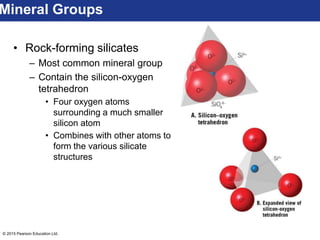
• Rock-forming silicates
– Most common mineral group
– Contain the silicon-oxygen
tetrahedron
• Four oxygen atoms
surrounding a much smaller
silicon atom
• Combines with other atoms to
form the various silicate
structures
Mineral Groups
© 2015 Pearson Education Ltd.
• Rock-forming silicates
– Groups based upon tetrahedral arrangement
• Olivine – independent tetrahedra
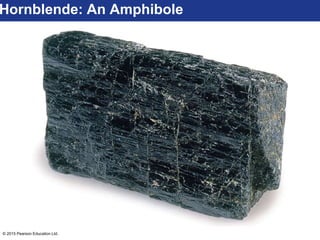
• Pyroxene group – tetrahedra are arranged in chains
• Amphibole group – tetrahedra are arranged in double chains
Mineral Groups
© 2015 Pearson Education Ltd.
Hornblende: An Amphibole
© 2015 Pearson Education Ltd.
• Rock-forming silicates
– Groups based upon tetrahedral arrangement
• Micas – tetrahedra are arranged in sheets
– Two types of mica are biotite (dark) and muscovite (light)
• Feldspars – Three-dimensional network of tetrahedra
Mineral Groups
© 2015 Pearson Education Ltd.
• Rock-forming silicates
– Groups based upon tetrahedral arrangement
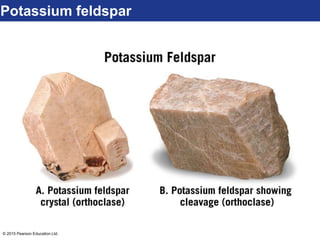
• Feldspars – most abundant group of minerals in Earth’s crust
• Quartz – three-dimensional network of tetrahedra
Mineral Groups
© 2015 Pearson Education Ltd.
Potassium feldspar
© 2015 Pearson Education Ltd.
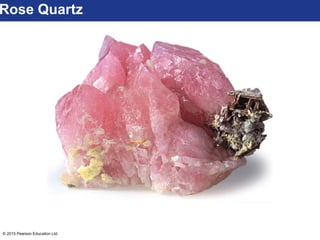
Rose Quartz
© 2015 Pearson Education Ltd.
• Nonsilicate minerals – major groups
– Oxides
– Sulfides
– Carbonates
– Halides
– Native elements
Mineral Groups
© 2015 Pearson Education Ltd.
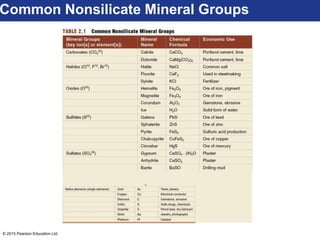
Common Nonsilicate Mineral Groups
© 2015 Pearson Education Ltd.
• Mineral groups
– Nonsilicate minerals
• Carbonates
– A major rock-forming group
– Found in the rocks limestone and marble
• Halite and gypsum are found in sedimentary rocks
• Many have economic value
Minerals
© 2015 Pearson Education Ltd.
• Renewable
– Can be replenished in relatively short time spans
• Corn, wind, water, etc.
• Nonrenewable
– Earth has fixed quantities
• Oil, aluminum, natural gas, coal
Natural Resources
© 2015 Pearson Education Ltd.
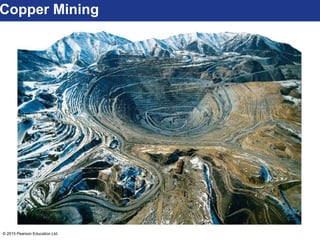
• Mineral resources
– Mineral resources are occurrences of useful minerals that
will eventually be extracted
– Ore deposits are concentrations of metallic minerals that can
be mined at a profit
– Economic factors may change and influence a resource
Natural Resources
© 2015 Pearson Education Ltd.
Copper Mining

Es 14e lecture_ch02

  • 1.
    © 2015 PearsonEducation Ltd. Matter and Minerals Chapter 2 Lecture Jennifer Mangan James Madison University Earth Science Fourteenth Edition, Global Edition
  • 2.
    © 2015 PearsonEducation Ltd. • Definition of a mineral – Natural – Inorganic – Solid – Possess an orderly internal structure of atoms – Have a definite chemical composition • Rock – any naturally occurring solid mass of mineral or mineral-like matter Minerals: Building Blocks of Rocks
  • 3.
    © 2015 PearsonEducation Ltd. Rocks are Aggregates of Minerals
  • 4.
    © 2015 PearsonEducation Ltd. • Atoms – Smallest particles of matter Atoms: Building Blocks of Minerals
  • 5.
    © 2015 PearsonEducation Ltd. • Nucleus – central part of an atom that contains – Protons – positive electrical charges – Neutrons – neutral electrical charges • Electron shells – Surround nucleus – Contain electrons – negative electrical charges Atomic Structure
  • 6.
    © 2015 PearsonEducation Ltd. Atomic Structure
  • 7.
    © 2015 PearsonEducation Ltd. • Atomic number – Number of protons in an atom’s nucleus. • Ions – Positively or negatively charged atoms due to electron gain or loss Atoms
  • 8.
    © 2015 PearsonEducation Ltd. • Elements – Basic building blocks of minerals – Over 100 are known – Defined by their number of protons – Groups of the same type of atoms Composition and Structure of Minerals
  • 9.
    © 2015 PearsonEducation Ltd. Periodic table of the elements
  • 10.
    © 2015 PearsonEducation Ltd. • Valence shell – An atom’s outermost shell • Octet rule – Atoms gain, lose, or share electrons until their valence shells have 8 electrons • Chemical bond – Transfer or sharing of electrons to achieve full valence shell Atomic Bonding
  • 11.
    © 2015 PearsonEducation Ltd. Atomic Bonding • Ionic bond – Atoms bond together when oppositely charged ions attract
  • 12.
    © 2015 PearsonEducation Ltd. • Covalent bond – Sharing of a pair of electrons between atoms Atomic Bonding
  • 13.
    © 2015 PearsonEducation Ltd. • Metallic bond – Packed metal atoms have valence electrons free to move throughout the structure. Atomic Bonding
  • 14.
    © 2015 PearsonEducation Ltd. • Physical properties of minerals – Habit – common crystal shape – Luster – appearance in reflected light – Color – Streak – color of mineral in powdered form – Hardness – ability to resist scratching or abrasion – Cleavage – tendency to break along planes of weak bonding Minerals
  • 15.
    © 2015 PearsonEducation Ltd. Metallic Luster: Galena
  • 16.
    © 2015 PearsonEducation Ltd. Color • Color can be unreliable due to variations.
  • 17.
    © 2015 PearsonEducation Ltd. Streak
  • 18.
    © 2015 PearsonEducation Ltd. Crystal Shape, or Habit: Pyrite
  • 19.
    © 2015 PearsonEducation Ltd. Hardness: Mohs Scale
  • 20.
    © 2015 PearsonEducation Ltd. Cleavage: Micas
  • 21.
    © 2015 PearsonEducation Ltd. • Physical properties of minerals – Fracture – random pattern of breakage – Specific gravity – mineral density – Tenacity – resistance to cutting, breaking, bending, and deformation Minerals
  • 22.
    © 2015 PearsonEducation Ltd. Conchoidal fracture
  • 23.
    © 2015 PearsonEducation Ltd. • Other properties – Taste – Smell – Elasticity – Malleability – Double refraction – Magnetism – Feel – Reaction with hydrochloric acid Minerals
  • 24.
    © 2015 PearsonEducation Ltd. • Rock-forming minerals – Only a few dozen – Most abundant atoms in Earth’s crust are oxygen (46.6% by weight) and silicon (27.7% by weight) Mineral Groups
  • 25.
    © 2015 PearsonEducation Ltd. • Eight elements compose most rock-forming minerals: – oxygen (O), – silicon (Si), – aluminum (Al) – iron (Fe) – calcium (Ca) – sodium (Na) – potassium (K) – magnesium (Mg) Mineral Groups
  • 26.
    © 2015 PearsonEducation Ltd. Composition of Continental Crust
  • 27.
    © 2015 PearsonEducation Ltd. • Rock-forming silicates – Most common mineral group – Contain the silicon-oxygen tetrahedron • Four oxygen atoms surrounding a much smaller silicon atom • Combines with other atoms to form the various silicate structures Mineral Groups
  • 28.
    © 2015 PearsonEducation Ltd. • Rock-forming silicates – Groups based upon tetrahedral arrangement • Olivine – independent tetrahedra • Pyroxene group – tetrahedra are arranged in chains • Amphibole group – tetrahedra are arranged in double chains Mineral Groups
  • 29.
    © 2015 PearsonEducation Ltd. Hornblende: An Amphibole
  • 30.
    © 2015 PearsonEducation Ltd. • Rock-forming silicates – Groups based upon tetrahedral arrangement • Micas – tetrahedra are arranged in sheets – Two types of mica are biotite (dark) and muscovite (light) • Feldspars – Three-dimensional network of tetrahedra Mineral Groups
  • 31.
    © 2015 PearsonEducation Ltd. • Rock-forming silicates – Groups based upon tetrahedral arrangement • Feldspars – most abundant group of minerals in Earth’s crust • Quartz – three-dimensional network of tetrahedra Mineral Groups
  • 32.
    © 2015 PearsonEducation Ltd. Potassium feldspar
  • 33.
    © 2015 PearsonEducation Ltd. Rose Quartz
  • 34.
    © 2015 PearsonEducation Ltd. • Nonsilicate minerals – major groups – Oxides – Sulfides – Carbonates – Halides – Native elements Mineral Groups
  • 35.
    © 2015 PearsonEducation Ltd. Common Nonsilicate Mineral Groups
  • 36.
    © 2015 PearsonEducation Ltd. • Mineral groups – Nonsilicate minerals • Carbonates – A major rock-forming group – Found in the rocks limestone and marble • Halite and gypsum are found in sedimentary rocks • Many have economic value Minerals
  • 37.
    © 2015 PearsonEducation Ltd. • Renewable – Can be replenished in relatively short time spans • Corn, wind, water, etc. • Nonrenewable – Earth has fixed quantities • Oil, aluminum, natural gas, coal Natural Resources
  • 38.
    © 2015 PearsonEducation Ltd. • Mineral resources – Mineral resources are occurrences of useful minerals that will eventually be extracted – Ore deposits are concentrations of metallic minerals that can be mined at a profit – Economic factors may change and influence a resource Natural Resources
  • 39.
    © 2015 PearsonEducation Ltd. Copper Mining