© 2015 Pearson Education Ltd.
Rocks: Materials
of the Solid Earth
Chapter 3 Lecture
Jennifer Mangan
James Madison University
Earth Science
Fourteenth Edition, Global Edition
© 2015 Pearson Education Ltd.
• Shows the interrelationships among the three rock
types
• Earth as a system: the rock cycle
– Magma
• Crystallization
– Igneous rock
• Weathering, transportation, and deposition
Rock Cycle
© 2015 Pearson Education Ltd.
• Earth as a system: the rock cycle
– Sediment
• Lithification
– Sedimentary rock
• Metamorphism
– Metamorphic rock
• Melting
– Magma
Rock Cycle
© 2015 Pearson Education Ltd.
• Earth as a system: the rock cycle
– Full cycle does not always take place due to “shortcuts” or
interruptions
• e.g., Sedimentary rock melts
• e.g., Igneous rock is metamorphosed
• e.g., Sedimentary rock is weathered
• e.g., Metamorphic rock weathers
Rock Cycle
© 2015 Pearson Education Ltd.
The Rock Cycle
© 2015 Pearson Education Ltd.
• Form as magma cools and crystallizes
– Rocks formed inside Earth are called plutonic or intrusive
rocks
– Rocks formed on the surface
• Formed from lava (a material similar to magma, but without gas
• Called volcanic or extrusive rocks
Igneous Rocks
© 2015 Pearson Education Ltd.
• Crystallization of magma
– Ions are arranged into orderly patterns
– Crystal size is determined by the rate of cooling
• Slow rate forms large crystals
• Fast rate forms microscopic crystals
• Very fast rate forms glass
Igneous Rocks
© 2015 Pearson Education Ltd.
• Classification is based on the rock’s texture and
mineral constituents
– Texture
• Size and arrangement of crystals
Igneous Rocks
© 2015 Pearson Education Ltd.
• Types of igneous textures
– Fine-grained – fast rate of cooling
– Coarse-grained – slow rate of cooling
– Porphyritic (two crystal sizes) – two rates of cooling
– Glassy – very fast rate of cooling
– Vesicular – contains hole left by gas bubbles
– Pyroclastic – fragmented; produced by consolidation of
volcanic fragments
Igneous Rocks
© 2015 Pearson Education Ltd.
Fine-Grained Igneous Texture
© 2015 Pearson Education Ltd.
Coarse-Grained Igneous Texture
© 2015 Pearson Education Ltd.
Porphyritic Igneous Texture
© 2015 Pearson Education Ltd.
Glassy Igneous Texture
© 2015 Pearson Education Ltd.
Vesicular Igneous Texture
© 2015 Pearson Education Ltd.
Pyroclastic Igneous Texture
© 2015 Pearson Education Ltd.
• Classification is based on the rock’s texture and
mineral constituents
– Mineral composition
• Explained by Bowen’s reaction series which shows the order of
mineral crystallization
• Influenced by crystal settling in the magma
Igneous Rocks
© 2015 Pearson Education Ltd.
Bowen’s Reaction Series
© 2015 Pearson Education Ltd.
Classification of Igneous Rocks
© 2015 Pearson Education Ltd.
• Naming igneous rocks
– Granitic rocks
• Composed almost entirely of light-colored silicates – quartz and
feldspar
• Also referred to as felsic: feldspar and silica (quartz)
• High silica content (about 70 percent)
• Common rock is granite
Igneous Rocks
© 2015 Pearson Education Ltd.
Granite and Granitic Rock
© 2015 Pearson Education Ltd.
• Naming igneous rocks
– Basaltic rocks
• Contain substantial dark silicate minerals and calcium-rich
plagioclase feldspar
• Also referred to as mafic: magnesium and ferrum (iron)
• Common rock is basalt
Igneous Rocks
© 2015 Pearson Education Ltd.
Basaltic Lava
© 2015 Pearson Education Ltd.
• Naming igneous rocks
– Other compositional groups
• Andesitic (or intermediate)
• Ultramafic
Igneous Rocks
© 2015 Pearson Education Ltd.
• Form from sediment (weathered products)
• About 75 percent of all rock outcrops on the continents
• Used to reconstruct much of Earth’s history
– Clues to past environments
– Provide information about sediment transport
– Rocks often contain fossils
Sedimentary Rocks
© 2015 Pearson Education Ltd.
• Economic importance
– Coal
– Petroleum and natural gas
– Sources of iron and aluminum
Sedimentary Rocks
© 2015 Pearson Education Ltd.
• Classifying sedimentary rocks
– Two groups based on the source of the material
• Detrital
• Chemical
Sedimentary Rocks
© 2015 Pearson Education Ltd.
• Detrital rocks
– Material is solid particles
– Classified by particle size
– Common rocks include
• Shale (most abundant)
• Sandstone
• Conglomerate
Sedimentary Rocks
© 2015 Pearson Education Ltd.
Detrital Sedimentary Rocks
© 2015 Pearson Education Ltd.
• Chemical sedimentary rocks
– Derived from material that was once in solution and
precipitates to form sediment
• Directly precipitated as the result of physical processes, or
• Through life processes (biochemical origin)
Sedimentary Rocks
© 2015 Pearson Education Ltd.
• Common chemical sedimentary rocks
– Limestone – the most abundant chemical rock
– Microcrystalline quartz (precipitated quartz) known as chert,
flint, jasper, or agate
– Evaporites such as rock salt or gypsum
– Coal – compressed plant material
Sedimentary Rocks
© 2015 Pearson Education Ltd.
Chemical, Biochemical, and Organic
Sedimentary Rocks
© 2015 Pearson Education Ltd.
• Sedimentary rocks are produced through lithification
– Loose sediments are transformed into solid rock
– Lithification processes
• Compaction
• Cementation by
– Calcite
– Silica
– Iron Oxide
Sedimentary Rocks
© 2015 Pearson Education Ltd.
• Features of sedimentary rocks
– Strata, or beds (most characteristic)
– Bedding planes separate strata
– Fossils
• Traces or remains of prehistoric life
• Are the most important inclusions
• Help determine past environments
• Used as time indicators
• Used for matching rocks from different places
Sedimentary Rocks
© 2015 Pearson Education Ltd.
• “Changed form” rocks
• Produced from preexisting
– Igneous rocks
– Sedimentary rocks
– Other metamorphic rocks
Metamorphic Rocks
© 2015 Pearson Education Ltd.
• Metamorphism
– Takes place where preexisting rock is subjected to
temperatures and pressures unlike those in which it formed
– Degrees of metamorphism
• Exhibited by rock texture and mineralogy
• Low-grade (e.g., shale becomes slate)
• High-grade (obliteration of original features)
Metamorphic Rocks
© 2015 Pearson Education Ltd.
Metamorphic Grade
© 2015 Pearson Education Ltd.
• Metamorphic settings
– Contact, or thermal, metamorphism
• Occurs near a body of magma
• Changes are driven by a rise in temperature
– Regional metamorphism
• Directed pressures and high temperatures during mountain
building
• Produces the greatest volume of metamorphic rock
Metamorphic Rocks
© 2015 Pearson Education Ltd.
• Metamorphic agents
– Heat
– Pressure (stress)
• Confining pressure – from burial
• Differential stress – occurs during mountain building
– Chemically active fluids
• Mainly water and other volatiles
• Promote recrystallization by enhancing ion migration
Metamorphic Rocks
© 2015 Pearson Education Ltd.
Confining Pressure and Differential Stress
© 2015 Pearson Education Ltd.
• Metamorphic textures
– Foliated texture
• Minerals are in a parallel alignment
• Minerals are perpendicular to the compressional force
– Nonfoliated texture
• Contain equidimensional crystals
• Resembles a coarse-grained igneous rock
Metamorphic Rocks
© 2015 Pearson Education Ltd.
Development of Foliation due to Directed
Pressure
© 2015 Pearson Education Ltd.
• Common metamorphic rocks
– Foliated rocks
• Slate
– Fine-grained
– Splits easily
• Schist
– Strongly foliated
– “Platy”
– Types based on composition (e.g., mica schist)
Metamorphic Rocks
© 2015 Pearson Education Ltd.
Common Metamorphic Rocks
© 2015 Pearson Education Ltd.
• Common metamorphic rocks
– Foliated rocks
• Gneiss
– Strong segregation of silicate minerals
– “Banded” texture
– Nonfoliated rocks
• Marble
– Parent rock is limestone
– Large, interlocking calcite crystals
Metamorphic Rocks
© 2015 Pearson Education Ltd.
• Common metamorphic rocks
– Nonfoliated rocks
• Marble
– Used as a building stone
– Variety of colors
• Quartzite
– Parent rock – quartz sandstone
– Quartz grains are fused
Metamorphic Rocks
© 2015 Pearson Education Ltd.
• Metallic mineral resources
– Gold, silver, copper, mercury, lead, etc.
– Concentrations of desirable materials are produced by
• Igneous processes
• Metamorphic processes
Resources from Rocks and Minerals
© 2015 Pearson Education Ltd.
• Metallic mineral resources
– Most important ore deposits are generated from
hydrothermal (hot-water) solutions
• Hot
• Contain metal-rich fluids
• Associated with cooling magma bodies
Resources from Rocks and Minerals
© 2015 Pearson Education Ltd.
Resources from Rocks and Minerals
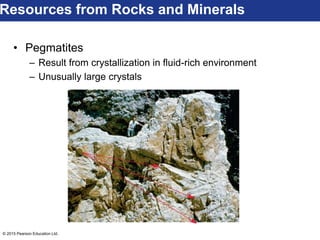
• Pegmatites
– Result from crystallization in fluid-rich environment
– Unusually large crystals
© 2015 Pearson Education Ltd.
Resources from Rocks and Minerals
• Types of deposits include
– Vein deposits in fractures or bedding planes, and
– Disseminated deposits which are distributed throughout
the rock
© 2015 Pearson Education Ltd.
Metallic Resources
© 2015 Pearson Education Ltd.
• Nonmetallic mineral resources
– Make use of the material’s
• Nonmetallic elements
• Physical or chemical properties
– Two broad groups
• Building materials (e.g., limestone, gypsum)
• Industrial minerals (e.g., fluorite, corundum, sylvite)
Resources from Rocks and Minerals
© 2015 Pearson Education Ltd.
Energy Resources: Fossil Fuels
• Coal
– Burns energy stored by plants millions of years ago
– Air pollution
– Surface scarring
© 2015 Pearson Education Ltd.
• Oil and Natural Gas
– More than 60% of U.S.-consumed energy
– Remains of marine plants and animals
– Source rock – where oil and natural gas originate
– Oil trap – geologic environment allowing oil and gas to
accumulate
Energy Resources: Fossil Fuels
© 2015 Pearson Education Ltd.
• Oil trap – two basic features
– Reservoir rock
• Porous and permeable
• Yields oil and gas in significant quantities
– Cap rock
• Impermeable
• Keeps oil and gas from surface escape
Energy Resources: Fossil Fuels
© 2015 Pearson Education Ltd.
• Common oil and natural gas traps
– Anticline – up-arched sedimentary strata
– Fault trap – displaced strata
– Salt dome – includes layers of rock salt
– Stratigraphic (pinchout) trap – original sedimentation pattern
Energy Resources: Fossil Fuels
© 2015 Pearson Education Ltd.
Common Oil Traps
© 2015 Pearson Education Ltd.
• Hydraulic Fracturing
– “Fracking”
– Shatters shale with significant gas and petroleum reserves
– Pumping liquids into rock at very high pressure
– Can include toxic chemicals
Energy Resources: Fossil Fuels

Es 14e lecture_ch03

  • 1.
    © 2015 PearsonEducation Ltd. Rocks: Materials of the Solid Earth Chapter 3 Lecture Jennifer Mangan James Madison University Earth Science Fourteenth Edition, Global Edition
  • 2.
    © 2015 PearsonEducation Ltd. • Shows the interrelationships among the three rock types • Earth as a system: the rock cycle – Magma • Crystallization – Igneous rock • Weathering, transportation, and deposition Rock Cycle
  • 3.
    © 2015 PearsonEducation Ltd. • Earth as a system: the rock cycle – Sediment • Lithification – Sedimentary rock • Metamorphism – Metamorphic rock • Melting – Magma Rock Cycle
  • 4.
    © 2015 PearsonEducation Ltd. • Earth as a system: the rock cycle – Full cycle does not always take place due to “shortcuts” or interruptions • e.g., Sedimentary rock melts • e.g., Igneous rock is metamorphosed • e.g., Sedimentary rock is weathered • e.g., Metamorphic rock weathers Rock Cycle
  • 5.
    © 2015 PearsonEducation Ltd. The Rock Cycle
  • 6.
    © 2015 PearsonEducation Ltd. • Form as magma cools and crystallizes – Rocks formed inside Earth are called plutonic or intrusive rocks – Rocks formed on the surface • Formed from lava (a material similar to magma, but without gas • Called volcanic or extrusive rocks Igneous Rocks
  • 7.
    © 2015 PearsonEducation Ltd. • Crystallization of magma – Ions are arranged into orderly patterns – Crystal size is determined by the rate of cooling • Slow rate forms large crystals • Fast rate forms microscopic crystals • Very fast rate forms glass Igneous Rocks
  • 8.
    © 2015 PearsonEducation Ltd. • Classification is based on the rock’s texture and mineral constituents – Texture • Size and arrangement of crystals Igneous Rocks
  • 9.
    © 2015 PearsonEducation Ltd. • Types of igneous textures – Fine-grained – fast rate of cooling – Coarse-grained – slow rate of cooling – Porphyritic (two crystal sizes) – two rates of cooling – Glassy – very fast rate of cooling – Vesicular – contains hole left by gas bubbles – Pyroclastic – fragmented; produced by consolidation of volcanic fragments Igneous Rocks
  • 10.
    © 2015 PearsonEducation Ltd. Fine-Grained Igneous Texture
  • 11.
    © 2015 PearsonEducation Ltd. Coarse-Grained Igneous Texture
  • 12.
    © 2015 PearsonEducation Ltd. Porphyritic Igneous Texture
  • 13.
    © 2015 PearsonEducation Ltd. Glassy Igneous Texture
  • 14.
    © 2015 PearsonEducation Ltd. Vesicular Igneous Texture
  • 15.
    © 2015 PearsonEducation Ltd. Pyroclastic Igneous Texture
  • 16.
    © 2015 PearsonEducation Ltd. • Classification is based on the rock’s texture and mineral constituents – Mineral composition • Explained by Bowen’s reaction series which shows the order of mineral crystallization • Influenced by crystal settling in the magma Igneous Rocks
  • 17.
    © 2015 PearsonEducation Ltd. Bowen’s Reaction Series
  • 18.
    © 2015 PearsonEducation Ltd. Classification of Igneous Rocks
  • 19.
    © 2015 PearsonEducation Ltd. • Naming igneous rocks – Granitic rocks • Composed almost entirely of light-colored silicates – quartz and feldspar • Also referred to as felsic: feldspar and silica (quartz) • High silica content (about 70 percent) • Common rock is granite Igneous Rocks
  • 20.
    © 2015 PearsonEducation Ltd. Granite and Granitic Rock
  • 21.
    © 2015 PearsonEducation Ltd. • Naming igneous rocks – Basaltic rocks • Contain substantial dark silicate minerals and calcium-rich plagioclase feldspar • Also referred to as mafic: magnesium and ferrum (iron) • Common rock is basalt Igneous Rocks
  • 22.
    © 2015 PearsonEducation Ltd. Basaltic Lava
  • 23.
    © 2015 PearsonEducation Ltd. • Naming igneous rocks – Other compositional groups • Andesitic (or intermediate) • Ultramafic Igneous Rocks
  • 24.
    © 2015 PearsonEducation Ltd. • Form from sediment (weathered products) • About 75 percent of all rock outcrops on the continents • Used to reconstruct much of Earth’s history – Clues to past environments – Provide information about sediment transport – Rocks often contain fossils Sedimentary Rocks
  • 25.
    © 2015 PearsonEducation Ltd. • Economic importance – Coal – Petroleum and natural gas – Sources of iron and aluminum Sedimentary Rocks
  • 26.
    © 2015 PearsonEducation Ltd. • Classifying sedimentary rocks – Two groups based on the source of the material • Detrital • Chemical Sedimentary Rocks
  • 27.
    © 2015 PearsonEducation Ltd. • Detrital rocks – Material is solid particles – Classified by particle size – Common rocks include • Shale (most abundant) • Sandstone • Conglomerate Sedimentary Rocks
  • 28.
    © 2015 PearsonEducation Ltd. Detrital Sedimentary Rocks
  • 29.
    © 2015 PearsonEducation Ltd. • Chemical sedimentary rocks – Derived from material that was once in solution and precipitates to form sediment • Directly precipitated as the result of physical processes, or • Through life processes (biochemical origin) Sedimentary Rocks
  • 30.
    © 2015 PearsonEducation Ltd. • Common chemical sedimentary rocks – Limestone – the most abundant chemical rock – Microcrystalline quartz (precipitated quartz) known as chert, flint, jasper, or agate – Evaporites such as rock salt or gypsum – Coal – compressed plant material Sedimentary Rocks
  • 31.
    © 2015 PearsonEducation Ltd. Chemical, Biochemical, and Organic Sedimentary Rocks
  • 32.
    © 2015 PearsonEducation Ltd. • Sedimentary rocks are produced through lithification – Loose sediments are transformed into solid rock – Lithification processes • Compaction • Cementation by – Calcite – Silica – Iron Oxide Sedimentary Rocks
  • 33.
    © 2015 PearsonEducation Ltd. • Features of sedimentary rocks – Strata, or beds (most characteristic) – Bedding planes separate strata – Fossils • Traces or remains of prehistoric life • Are the most important inclusions • Help determine past environments • Used as time indicators • Used for matching rocks from different places Sedimentary Rocks
  • 34.
    © 2015 PearsonEducation Ltd. • “Changed form” rocks • Produced from preexisting – Igneous rocks – Sedimentary rocks – Other metamorphic rocks Metamorphic Rocks
  • 35.
    © 2015 PearsonEducation Ltd. • Metamorphism – Takes place where preexisting rock is subjected to temperatures and pressures unlike those in which it formed – Degrees of metamorphism • Exhibited by rock texture and mineralogy • Low-grade (e.g., shale becomes slate) • High-grade (obliteration of original features) Metamorphic Rocks
  • 36.
    © 2015 PearsonEducation Ltd. Metamorphic Grade
  • 37.
    © 2015 PearsonEducation Ltd. • Metamorphic settings – Contact, or thermal, metamorphism • Occurs near a body of magma • Changes are driven by a rise in temperature – Regional metamorphism • Directed pressures and high temperatures during mountain building • Produces the greatest volume of metamorphic rock Metamorphic Rocks
  • 38.
    © 2015 PearsonEducation Ltd. • Metamorphic agents – Heat – Pressure (stress) • Confining pressure – from burial • Differential stress – occurs during mountain building – Chemically active fluids • Mainly water and other volatiles • Promote recrystallization by enhancing ion migration Metamorphic Rocks
  • 39.
    © 2015 PearsonEducation Ltd. Confining Pressure and Differential Stress
  • 40.
    © 2015 PearsonEducation Ltd. • Metamorphic textures – Foliated texture • Minerals are in a parallel alignment • Minerals are perpendicular to the compressional force – Nonfoliated texture • Contain equidimensional crystals • Resembles a coarse-grained igneous rock Metamorphic Rocks
  • 41.
    © 2015 PearsonEducation Ltd. Development of Foliation due to Directed Pressure
  • 42.
    © 2015 PearsonEducation Ltd. • Common metamorphic rocks – Foliated rocks • Slate – Fine-grained – Splits easily • Schist – Strongly foliated – “Platy” – Types based on composition (e.g., mica schist) Metamorphic Rocks
  • 43.
    © 2015 PearsonEducation Ltd. Common Metamorphic Rocks
  • 44.
    © 2015 PearsonEducation Ltd. • Common metamorphic rocks – Foliated rocks • Gneiss – Strong segregation of silicate minerals – “Banded” texture – Nonfoliated rocks • Marble – Parent rock is limestone – Large, interlocking calcite crystals Metamorphic Rocks
  • 45.
    © 2015 PearsonEducation Ltd. • Common metamorphic rocks – Nonfoliated rocks • Marble – Used as a building stone – Variety of colors • Quartzite – Parent rock – quartz sandstone – Quartz grains are fused Metamorphic Rocks
  • 46.
    © 2015 PearsonEducation Ltd. • Metallic mineral resources – Gold, silver, copper, mercury, lead, etc. – Concentrations of desirable materials are produced by • Igneous processes • Metamorphic processes Resources from Rocks and Minerals
  • 47.
    © 2015 PearsonEducation Ltd. • Metallic mineral resources – Most important ore deposits are generated from hydrothermal (hot-water) solutions • Hot • Contain metal-rich fluids • Associated with cooling magma bodies Resources from Rocks and Minerals
  • 48.
    © 2015 PearsonEducation Ltd. Resources from Rocks and Minerals • Pegmatites – Result from crystallization in fluid-rich environment – Unusually large crystals
  • 49.
    © 2015 PearsonEducation Ltd. Resources from Rocks and Minerals • Types of deposits include – Vein deposits in fractures or bedding planes, and – Disseminated deposits which are distributed throughout the rock
  • 50.
    © 2015 PearsonEducation Ltd. Metallic Resources
  • 51.
    © 2015 PearsonEducation Ltd. • Nonmetallic mineral resources – Make use of the material’s • Nonmetallic elements • Physical or chemical properties – Two broad groups • Building materials (e.g., limestone, gypsum) • Industrial minerals (e.g., fluorite, corundum, sylvite) Resources from Rocks and Minerals
  • 52.
    © 2015 PearsonEducation Ltd. Energy Resources: Fossil Fuels • Coal – Burns energy stored by plants millions of years ago – Air pollution – Surface scarring
  • 53.
    © 2015 PearsonEducation Ltd. • Oil and Natural Gas – More than 60% of U.S.-consumed energy – Remains of marine plants and animals – Source rock – where oil and natural gas originate – Oil trap – geologic environment allowing oil and gas to accumulate Energy Resources: Fossil Fuels
  • 54.
    © 2015 PearsonEducation Ltd. • Oil trap – two basic features – Reservoir rock • Porous and permeable • Yields oil and gas in significant quantities – Cap rock • Impermeable • Keeps oil and gas from surface escape Energy Resources: Fossil Fuels
  • 55.
    © 2015 PearsonEducation Ltd. • Common oil and natural gas traps – Anticline – up-arched sedimentary strata – Fault trap – displaced strata – Salt dome – includes layers of rock salt – Stratigraphic (pinchout) trap – original sedimentation pattern Energy Resources: Fossil Fuels
  • 56.
    © 2015 PearsonEducation Ltd. Common Oil Traps
  • 57.
    © 2015 PearsonEducation Ltd. • Hydraulic Fracturing – “Fracking” – Shatters shale with significant gas and petroleum reserves – Pumping liquids into rock at very high pressure – Can include toxic chemicals Energy Resources: Fossil Fuels