ERROR DETECTION AND CORRECTION
ERROR DETECTION AND CORRECTION   Types of Errors Detection Correction
Data can be corrupted during transmission. For reliable communication, errors must be detected and corrected.
Types of Error Single-Bit Error Burst Error
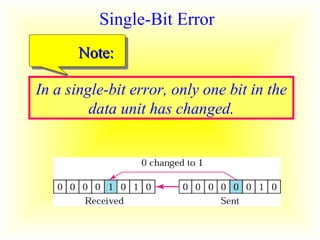
In a single-bit error, only one bit in the data unit has changed. Note: Single-Bit Error
A burst error means that 2 or more bits in the data unit have changed. Note: Burst Error
Error   Detection Redundancy Parity Check Longitudinal Redundancy Check Cyclic Redundancy Check (CRC) Checksum
Error detection uses the concept of redundancy, which means adding extra bits for detecting errors at the destination. Note:
Redundancy
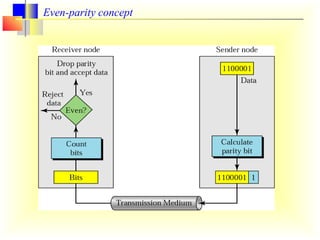
Even-parity concept
VERTICAL REDUNDANCY CHECK (VRC)
In parity check, a parity bit is added to every data unit so that the total number of 1s is even  (or odd for odd-parity). Note:
Example 1 Suppose the sender wants to send the word  world . In ASCII the five characters are coded as  1110111  1101111  1110010  1101100  1100100 The following shows the actual bits sent 1110111 0   1101111 0   1110010 0   1101100 0   1100100 1
Example 2 Now suppose the word world in Example 1 is received by the receiver without being corrupted in transmission.  11101110  11011110  11100100  11011000  11001001 The receiver counts the 1s in each character and comes up with even numbers (6, 6, 4, 4, 4). The data are accepted.
Example 3 Now suppose the word world in Example 1 is corrupted during transmission.  11111110  11011110  11101100  11011000  11001001 The receiver counts the 1s in each character and comes up with even and odd numbers (7, 6, 5, 4, 4). The receiver knows that the data are corrupted, discards them, and asks for retransmission.
Simple parity check can detect all single-bit errors. It can detect burst errors only if the total number of errors in each data unit is odd. Note:
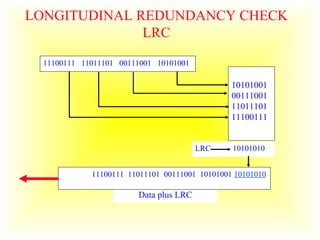
LONGITUDINAL REDUNDANCY CHECK LRC LRC  10101010 Data plus LRC 11100111  11011101  00111001  10101001 10101001 00111001 11011101 11100111 11100111  11011101  00111001  10101001  10101010
Two-dimensional parity
CRC generator and checker
Data unit and checksum Sender Receiver T -T
The sender follows these steps: The unit is divided into k sections, each of n bits. All sections are added  get the sum. The sum is complemented and becomes the checksum. The checksum is sent with the data. Note:
The receiver follows these steps: The unit is divided into k sections, each of n bits. All sections are added  to get the sum. The sum is complemented. If the result is zero, the data are accepted: otherwise, rejected. Note:
Example 4 Suppose the following block of 16 bits is to be sent using a checksum of 8 bits.  10101001  00111001  The numbers are added as: 10101001  00111001   ------------ Sum   11100010 Checksum  00011101 The pattern sent is  10101001  00111001  00011101
Example 5 Now suppose the receiver receives the pattern sent in Example 7 and there is no error.  10101001  00111001  00011101 When the receiver adds the three sections, it will get all 1s, which, after complementing, is all 0s and shows that there is no error.  10101001 00111001  00011101  Sum 11111111  Complement  00000000   means that the pattern is OK.
Example 6 Now suppose there is a burst error of length 5 that affects 4 bits.  10101 111  11 111001  00011101 When the receiver adds the three sections, it gets  10101111 11111001  00011101  Partial Sum  1  11000101 Carry   1 Sum 11000110  Complement  00111001   the pattern is corrupted.
Correction Stop and wait Go Back N Sliding Window Hamming Code
Hamming Code
Data and redundancy bits Number of data bits m Number of  redundancy bits r Total  bits m + r 1 2 3 2 3 5 3 3 6 4 3 7 5 4 9 6 4 10 7 4 11
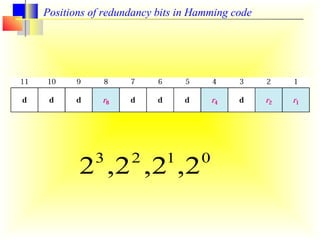
Positions of redundancy bits in Hamming code
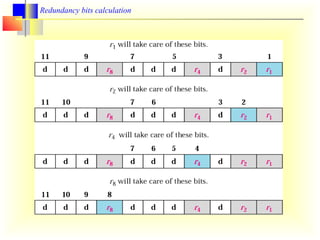
Redundancy bits calculation
Example of redundancy bit calculation
Error detection using Hamming code
Burst error correction example

Lecture 5

  • 1.
    ERRORDETECTION AND CORRECTION
  • 2.
    ERROR DETECTION ANDCORRECTION Types of Errors Detection Correction
  • 3.
    Data can becorrupted during transmission. For reliable communication, errors must be detected and corrected.
  • 4.
    Types of ErrorSingle-Bit Error Burst Error
  • 5.
    In a single-biterror, only one bit in the data unit has changed. Note: Single-Bit Error
  • 6.
    A burst errormeans that 2 or more bits in the data unit have changed. Note: Burst Error
  • 7.
    Error Detection Redundancy Parity Check Longitudinal Redundancy Check Cyclic Redundancy Check (CRC) Checksum
  • 8.
    Error detection usesthe concept of redundancy, which means adding extra bits for detecting errors at the destination. Note:
  • 9.
  • 10.
  • 11.
  • 12.
    In parity check,a parity bit is added to every data unit so that the total number of 1s is even (or odd for odd-parity). Note:
  • 13.
    Example 1 Supposethe sender wants to send the word world . In ASCII the five characters are coded as 1110111 1101111 1110010 1101100 1100100 The following shows the actual bits sent 1110111 0 1101111 0 1110010 0 1101100 0 1100100 1
  • 14.
    Example 2 Nowsuppose the word world in Example 1 is received by the receiver without being corrupted in transmission. 11101110 11011110 11100100 11011000 11001001 The receiver counts the 1s in each character and comes up with even numbers (6, 6, 4, 4, 4). The data are accepted.
  • 15.
    Example 3 Nowsuppose the word world in Example 1 is corrupted during transmission. 11111110 11011110 11101100 11011000 11001001 The receiver counts the 1s in each character and comes up with even and odd numbers (7, 6, 5, 4, 4). The receiver knows that the data are corrupted, discards them, and asks for retransmission.
  • 16.
    Simple parity checkcan detect all single-bit errors. It can detect burst errors only if the total number of errors in each data unit is odd. Note:
  • 17.
    LONGITUDINAL REDUNDANCY CHECKLRC LRC 10101010 Data plus LRC 11100111 11011101 00111001 10101001 10101001 00111001 11011101 11100111 11100111 11011101 00111001 10101001 10101010
  • 18.
  • 19.
  • 20.
    Data unit andchecksum Sender Receiver T -T
  • 21.
    The sender followsthese steps: The unit is divided into k sections, each of n bits. All sections are added get the sum. The sum is complemented and becomes the checksum. The checksum is sent with the data. Note:
  • 22.
    The receiver followsthese steps: The unit is divided into k sections, each of n bits. All sections are added to get the sum. The sum is complemented. If the result is zero, the data are accepted: otherwise, rejected. Note:
  • 23.
    Example 4 Supposethe following block of 16 bits is to be sent using a checksum of 8 bits. 10101001 00111001 The numbers are added as: 10101001 00111001 ------------ Sum 11100010 Checksum 00011101 The pattern sent is 10101001 00111001 00011101
  • 24.
    Example 5 Nowsuppose the receiver receives the pattern sent in Example 7 and there is no error. 10101001 00111001 00011101 When the receiver adds the three sections, it will get all 1s, which, after complementing, is all 0s and shows that there is no error. 10101001 00111001 00011101 Sum 11111111 Complement 00000000 means that the pattern is OK.
  • 25.
    Example 6 Nowsuppose there is a burst error of length 5 that affects 4 bits. 10101 111 11 111001 00011101 When the receiver adds the three sections, it gets 10101111 11111001 00011101 Partial Sum 1 11000101 Carry 1 Sum 11000110 Complement 00111001 the pattern is corrupted.
  • 26.
    Correction Stop andwait Go Back N Sliding Window Hamming Code
  • 27.
  • 28.
    Data and redundancybits Number of data bits m Number of redundancy bits r Total bits m + r 1 2 3 2 3 5 3 3 6 4 3 7 5 4 9 6 4 10 7 4 11
  • 29.
    Positions of redundancybits in Hamming code
  • 30.
  • 31.
    Example of redundancybit calculation
  • 32.
  • 33.