

Mahesh VallampatiMahesh Vallampati
About the Speaker
Mahesh Vallampati
Career
Director, Oracle Applications and Technologies at Coach America
Senior Practice Manager at SmartDog Services
Senior Sales Consulting Manager at Hotsos (2 years)Senior Sales Consulting Manager at Hotsos (2 years)
Director of DBA Services at Eagle Global Logistics (2 years)
Practice Manager at Oracle in Consulting(9 years)
Papers
Several papers presented at Collaborate and at 3 Oracle Open
Worlds
Published in Oracle Magazine
Education
Master’s in Electrical Engineering, Texas A&M University
Contact Information
Mahesh Vallampati
mvallamp@yahoo.com
Agenda
The Solution Perspective
ERP Manager Challenges
SDLC Overview
ERP Manager to SDLC MappingERP Manager to SDLC Mapping
CMMI Overview
ERP Manager to CMMI Mapping
Adapting to SDLC and CMMI
Defining Complexity
Next Steps
Q&A
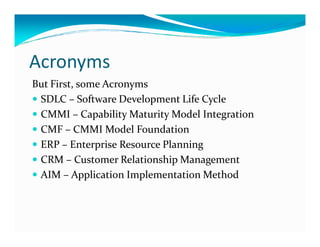
Acronyms
But First, some Acronyms
SDLC – Software Development Life Cycle
CMMI – Capability Maturity Model Integration
CMF – CMMI Model FoundationCMF – CMMI Model Foundation
ERP – Enterprise Resource Planning
CRM – Customer Relationship Management
AIM – Application Implementation Method
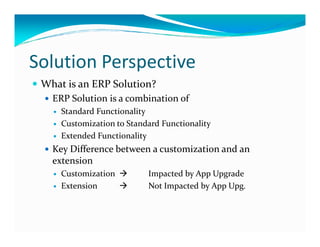
Solution Perspective
What is an ERP Solution?
ERP Solution is a combination of
Standard Functionality
Customization to Standard FunctionalityCustomization to Standard Functionality
Extended Functionality
Key Difference between a customization and an
extension
Customization Impacted by App Upgrade
Extension Not Impacted by App Upg.
Ownership Challenge
The Biggest Challenge – Ownership
Who owns the solution
Is it the
Software VendorSoftware Vendor
Implementation Partner
ERP Manager
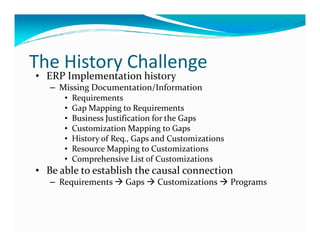
The History Challenge
• ERP Implementation history
– Missing Documentation/Information
• Requirements
• Gap Mapping to Requirements
• Business Justification for the Gaps
• Customization Mapping to Gaps• Customization Mapping to Gaps
• History of Req., Gaps and Customizations
• Resource Mapping to Customizations
• Comprehensive List of Customizations
• Be able to establish the causal connection
– Requirements Gaps Customizations Programs
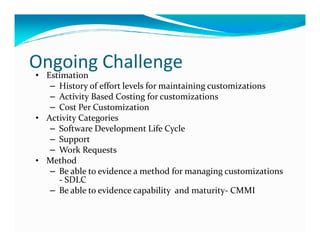
Ongoing Challenge
• Estimation
– History of effort levels for maintaining customizations
– Activity Based Costing for customizations
– Cost Per Customization
• Activity Categories
– Software Development Life Cycle– Software Development Life Cycle
– Support
– Work Requests
• Method
– Be able to evidence a method for managing customizations
- SDLC
– Be able to evidence capability and maturity- CMMI
What is SDLC?
SDLC – Software Development Life Cycle
Process for creating or altering software
Used in
System Engineering
Information SystemsInformation Systems
Software Engineering
Outcome of SDLC
A high quality system
Meets or Exceed customer expectation
Focus
Development only historically
Includes Maintenance also
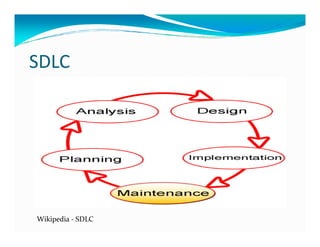
SDLC
Wikipedia - SDLC
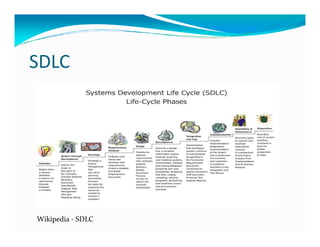
SDLC
Wikipedia - SDLC
SDLC
Any SDLC Method is usually Comprehensive
SDLC is usually “tailored” for each organization
A new focus on Maintenance and Support
SDLC traditionally ended with deploymentSDLC traditionally ended with deployment
Uses the waterfall method of software development
AIM and SDLC
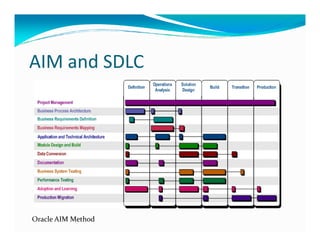
Oracle AIM Method
AIM and SDLC
Again AIM is usually tailored for an implementation
Important documents in the implementation are
usually identified ahead of time
These documents are maintained during the course ofThese documents are maintained during the course of
the project
Iterative CRP and Flows Approach
Even Oracle AIM which is focused on Oracle ERP can
be quite cumbersome.
Oracle AIM is a waterfall method based on traditional
SDLCSDLC
Waterfall method can be time consuming and
expensive
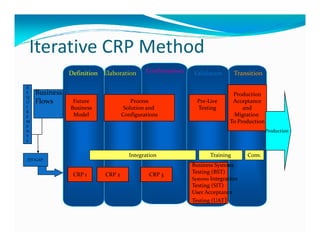
Iterative CRP Method has become a de-facto method
Flows based implementation which mimic an entire
business process has become the norm
Iterative CRP Method– Define Resolutions
to Exceptions
– Revise
Configurations
– Revise Test Scripts
– Revise Process
Documents
– Identify Test Data
– Define Resolutions
to Exceptions
– Revise
Configurations
– Revise Test Scripts
– Revise Process
Documents
– Identify Conversion
Data
– Project Team
Training
– Define Instance
– Business Flow
Review
Pre-CRP
Activities
– Project Team
Familiarized
– Exceptions Identified
– Process Decisions
Made
– Configurations
and Processes
Unit Tested
– Remaining
Exceptions Identified
– Integrated Testing of
Configurations and
Processes
Completed
– Production-Ready
Configuration
Identified
CRP 1 –
Familiarization
and Exception
Identification
CRP 2 –
Unit
Testing
CRP 3 –
Integration
Testing
CRP
Outcomes
Iterative CRP Method
ConfirmationDefinition TransitionValidationElaboration
Process
Solution and
Configurations
Pre-Live
Testing
Production
Acceptance
and
Migration
To Production
Future
Business
Model
Business
Flows
R
E
Q
U
I
R
E
M To Production
Production
Integration Training Conv.
CRP 2 CRP 3CRP 1
M
E
N
T
S
FIT/GAP
Business Systems
Testing (BST)
Systems Integration
Testing (SIT)
User Acceptance
Testing (UAT)
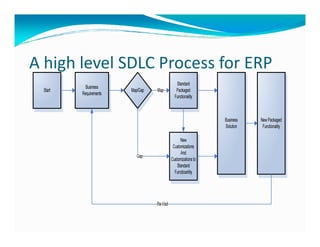
A high level SDLC Process for ERP
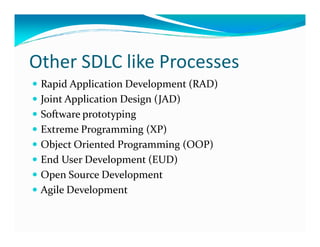
Other SDLC like Processes
Rapid Application Development (RAD)
Joint Application Design (JAD)
Software prototyping
Extreme Programming (XP)Extreme Programming (XP)
Object Oriented Programming (OOP)
End User Development (EUD)
Open Source Development
Agile Development
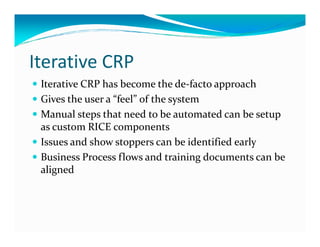
Iterative CRP
Iterative CRP has become the de-facto approach
Gives the user a “feel” of the system
Manual steps that need to be automated can be setup
as custom RICE componentsas custom RICE components
Issues and show stoppers can be identified early
Business Process flows and training documents can be
aligned
A note on O&M
Operations and Maintenance have become important
Cost reduction and efficiencies are getting a renewed
focus
Success criteria has begun to include these costs asSuccess criteria has begun to include these costs as
well
A system that meets expectations but add significant
O&M costs is now deemed a failure
SDLC Summary
ERP Implementations have evolved into an iterative
CRP Approach with select AIM/SDLC deliverables
If you are not implementing iterative CRP, you will
have cost overrunshave cost overruns
Operations and Maintenance costs have a renewed
focus
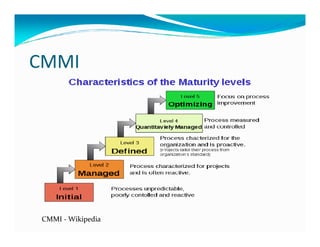
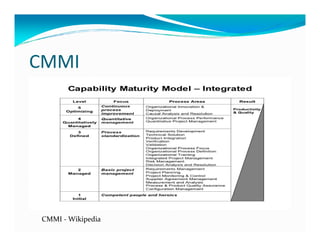
CMMI
CMMI
A process improvement Approach
Used mostly in software engineering
Enables organization to identify where they areEnables organization to identify where they are
Provide a roadmap to get to a higher level of
performance or competence or capability
CMMI
CMMI - Wikipedia
CMMI
CMMI - Wikipedia
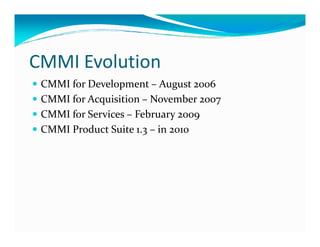
CMMI Evolution
CMMI for Development – August 2006
CMMI for Acquisition – November 2007
CMMI for Services – February 2009
CMMI Product Suite 1.3 – in 2010CMMI Product Suite 1.3 – in 2010
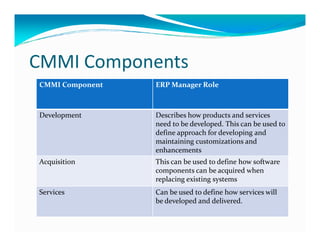
CMMI Components
CMMI Component ERP Manager Role
Development Describes how products and services
need to be developed. This can be used toneed to be developed. This can be used to
define approach for developing and
maintaining customizations and
enhancements
Acquisition This can be used to define how software
components can be acquired when
replacing existing systems
Services Can be used to define how services will
be developed and delivered.
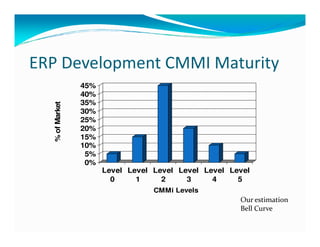
ERP Development CMMI Maturity
25%
30%
35%
40%
45%
%ofMarket
0%
5%
10%
15%
20%
25%
%ofMarket
Level
0
Level
1
Level
2
Level
3
Level
4
Level
5
CMMi Levels
Our estimation
Bell Curve
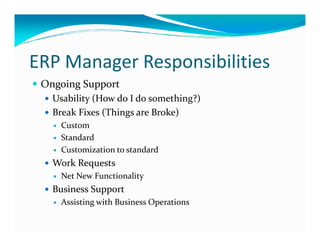
ERP Manager Responsibilities
Ongoing Support
Usability (How do I do something?)
Break Fixes (Things are Broke)
CustomCustom
Standard
Customization to standard
Work Requests
Net New Functionality
Business Support
Assisting with Business Operations
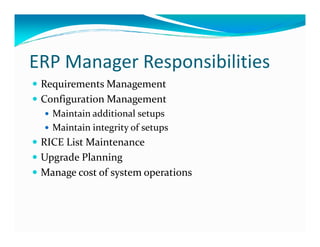
ERP Manager Responsibilities
Requirements Management
Configuration Management
Maintain additional setups
Maintain integrity of setupsMaintain integrity of setups
RICE List Maintenance
Upgrade Planning
Manage cost of system operations
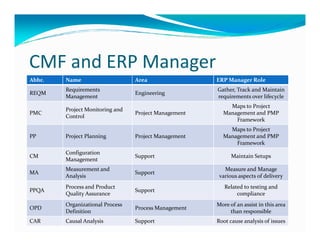
CMF and ERP Manager
Abbr. Name Area ERP Manager Role
REQM
Requirements
Management
Engineering
Gather, Track and Maintain
requirements over lifecycle
PMC
Project Monitoring and
Control
Project Management
Maps to Project
Management and PMP
Framework
PP Project Planning Project Management
Maps to Project
Management and PMP
Framework
CM
Configuration
Management
Support Maintain Setups
MA
Measurement and
Analysis
Support
Measure and Manage
various aspects of delivery
PPQA
Process and Product
Quality Assurance
Support
Related to testing and
compliance
OPD
Organizational Process
Definition
Process Management
More of an assist in this area
than responsible
CAR Causal Analysis Support Root cause analysis of issues
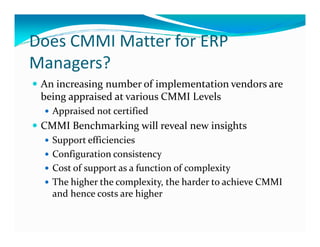
Does CMMI Matter for ERP
Managers?
An increasing number of implementation vendors are
being appraised at various CMMI Levels
Appraised not certified
CMMI Benchmarking will reveal new insightsCMMI Benchmarking will reveal new insights
Support efficiencies
Configuration consistency
Cost of support as a function of complexity
The higher the complexity, the harder to achieve CMMI
and hence costs are higher
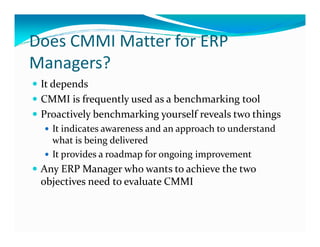
Does CMMI Matter for ERP
Managers?
It depends
CMMI is frequently used as a benchmarking tool
Proactively benchmarking yourself reveals two things
It indicates awareness and an approach to understandIt indicates awareness and an approach to understand
what is being delivered
It provides a roadmap for ongoing improvement
Any ERP Manager who wants to achieve the two
objectives need to evaluate CMMI
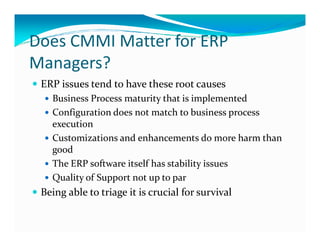
Does CMMI Matter for ERP
Managers?
ERP issues tend to have these root causes
Business Process maturity that is implemented
Configuration does not match to business process
executionexecution
Customizations and enhancements do more harm than
good
The ERP software itself has stability issues
Quality of Support not up to par
Being able to triage it is crucial for survival
Why complexity matters
SDLC and CMMI seems rational and tends to make
sense
However measuring an ERP System without the
complexity perspective would be sub-optimalcomplexity perspective would be sub-optimal
Complexity can characterize an implementation in
many ways and impact
Schedule
Success
ROI
Maturity as perceived by SDLC and CMMI
Complexity of ERP Systems
Factors that impact complexity of ERP Systems
Maturity of ERP Software
User willingness to adopt new processes
Capability of implementation partnerCapability of implementation partner
Maturity of the IT organization supporting it
Business Operations Management capability to adopt
new processes
Completeness of solution
Interface t o other systems
Customization to the ERP System
Why Complexity matters
Before embarking on SDLC and CMMI, understanding
the complexity is important
The underlying symptoms will have to be addressed
Applying SDLC and CMMI to unhappy users,Applying SDLC and CMMI to unhappy users,
incomplete solutions, immature implementation,
software that is not ready but yet being used could be
an exercise in travesty
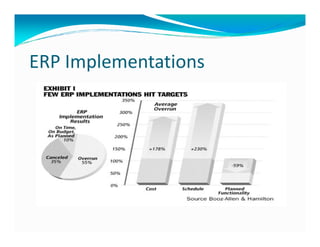
ERP Implementations
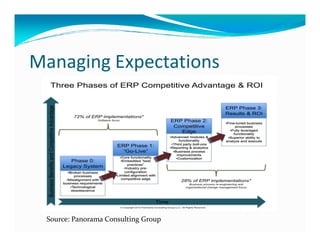
Managing Expectations
Source: Panorama Consulting Group
Next Steps
Understand the complexity of the system
Perform activity based costing of the work performed
App UI Support
App SupportApp Support
Data Fixes
Work Request
Trouble Tickets
More categories
Strive for a Level 2 CMMI which will provide a basic
level of sanity if chaotic
Next Steps
Adopt the SDLC method that makes most sense to
your organization
Traditional SDLC is simply just not possible
Iterative CRP adoption will be keyIterative CRP adoption will be key
Pragmatism is key in the whole approach
Good luck!!
ERP Manager meets SDLC and CMMI

ERP Manager meets SDLC and CMMI

  • 1.
  • 2.
    About the Speaker MaheshVallampati Career Director, Oracle Applications and Technologies at Coach America Senior Practice Manager at SmartDog Services Senior Sales Consulting Manager at Hotsos (2 years)Senior Sales Consulting Manager at Hotsos (2 years) Director of DBA Services at Eagle Global Logistics (2 years) Practice Manager at Oracle in Consulting(9 years) Papers Several papers presented at Collaborate and at 3 Oracle Open Worlds Published in Oracle Magazine Education Master’s in Electrical Engineering, Texas A&M University
  • 3.
  • 4.
    Agenda The Solution Perspective ERPManager Challenges SDLC Overview ERP Manager to SDLC MappingERP Manager to SDLC Mapping CMMI Overview ERP Manager to CMMI Mapping Adapting to SDLC and CMMI Defining Complexity Next Steps Q&A
  • 5.
    Acronyms But First, someAcronyms SDLC – Software Development Life Cycle CMMI – Capability Maturity Model Integration CMF – CMMI Model FoundationCMF – CMMI Model Foundation ERP – Enterprise Resource Planning CRM – Customer Relationship Management AIM – Application Implementation Method
  • 7.
    Solution Perspective What isan ERP Solution? ERP Solution is a combination of Standard Functionality Customization to Standard FunctionalityCustomization to Standard Functionality Extended Functionality Key Difference between a customization and an extension Customization Impacted by App Upgrade Extension Not Impacted by App Upg.
  • 9.
    Ownership Challenge The BiggestChallenge – Ownership Who owns the solution Is it the Software VendorSoftware Vendor Implementation Partner ERP Manager
  • 10.
    The History Challenge •ERP Implementation history – Missing Documentation/Information • Requirements • Gap Mapping to Requirements • Business Justification for the Gaps • Customization Mapping to Gaps• Customization Mapping to Gaps • History of Req., Gaps and Customizations • Resource Mapping to Customizations • Comprehensive List of Customizations • Be able to establish the causal connection – Requirements Gaps Customizations Programs
  • 11.
    Ongoing Challenge • Estimation –History of effort levels for maintaining customizations – Activity Based Costing for customizations – Cost Per Customization • Activity Categories – Software Development Life Cycle– Software Development Life Cycle – Support – Work Requests • Method – Be able to evidence a method for managing customizations - SDLC – Be able to evidence capability and maturity- CMMI
  • 13.
    What is SDLC? SDLC– Software Development Life Cycle Process for creating or altering software Used in System Engineering Information SystemsInformation Systems Software Engineering Outcome of SDLC A high quality system Meets or Exceed customer expectation Focus Development only historically Includes Maintenance also
  • 14.
  • 15.
  • 16.
    SDLC Any SDLC Methodis usually Comprehensive SDLC is usually “tailored” for each organization A new focus on Maintenance and Support SDLC traditionally ended with deploymentSDLC traditionally ended with deployment Uses the waterfall method of software development
  • 18.
  • 19.
    AIM and SDLC AgainAIM is usually tailored for an implementation Important documents in the implementation are usually identified ahead of time These documents are maintained during the course ofThese documents are maintained during the course of the project
  • 20.
    Iterative CRP andFlows Approach Even Oracle AIM which is focused on Oracle ERP can be quite cumbersome. Oracle AIM is a waterfall method based on traditional SDLCSDLC Waterfall method can be time consuming and expensive Iterative CRP Method has become a de-facto method Flows based implementation which mimic an entire business process has become the norm
  • 21.
    Iterative CRP Method–Define Resolutions to Exceptions – Revise Configurations – Revise Test Scripts – Revise Process Documents – Identify Test Data – Define Resolutions to Exceptions – Revise Configurations – Revise Test Scripts – Revise Process Documents – Identify Conversion Data – Project Team Training – Define Instance – Business Flow Review Pre-CRP Activities – Project Team Familiarized – Exceptions Identified – Process Decisions Made – Configurations and Processes Unit Tested – Remaining Exceptions Identified – Integrated Testing of Configurations and Processes Completed – Production-Ready Configuration Identified CRP 1 – Familiarization and Exception Identification CRP 2 – Unit Testing CRP 3 – Integration Testing CRP Outcomes
  • 22.
    Iterative CRP Method ConfirmationDefinitionTransitionValidationElaboration Process Solution and Configurations Pre-Live Testing Production Acceptance and Migration To Production Future Business Model Business Flows R E Q U I R E M To Production Production Integration Training Conv. CRP 2 CRP 3CRP 1 M E N T S FIT/GAP Business Systems Testing (BST) Systems Integration Testing (SIT) User Acceptance Testing (UAT)
  • 23.
    A high levelSDLC Process for ERP
  • 24.
    Other SDLC likeProcesses Rapid Application Development (RAD) Joint Application Design (JAD) Software prototyping Extreme Programming (XP)Extreme Programming (XP) Object Oriented Programming (OOP) End User Development (EUD) Open Source Development Agile Development
  • 25.
    Iterative CRP Iterative CRPhas become the de-facto approach Gives the user a “feel” of the system Manual steps that need to be automated can be setup as custom RICE componentsas custom RICE components Issues and show stoppers can be identified early Business Process flows and training documents can be aligned
  • 26.
    A note onO&M Operations and Maintenance have become important Cost reduction and efficiencies are getting a renewed focus Success criteria has begun to include these costs asSuccess criteria has begun to include these costs as well A system that meets expectations but add significant O&M costs is now deemed a failure
  • 27.
    SDLC Summary ERP Implementationshave evolved into an iterative CRP Approach with select AIM/SDLC deliverables If you are not implementing iterative CRP, you will have cost overrunshave cost overruns Operations and Maintenance costs have a renewed focus
  • 29.
    CMMI CMMI A process improvementApproach Used mostly in software engineering Enables organization to identify where they areEnables organization to identify where they are Provide a roadmap to get to a higher level of performance or competence or capability
  • 30.
  • 31.
  • 32.
    CMMI Evolution CMMI forDevelopment – August 2006 CMMI for Acquisition – November 2007 CMMI for Services – February 2009 CMMI Product Suite 1.3 – in 2010CMMI Product Suite 1.3 – in 2010
  • 33.
    CMMI Components CMMI ComponentERP Manager Role Development Describes how products and services need to be developed. This can be used toneed to be developed. This can be used to define approach for developing and maintaining customizations and enhancements Acquisition This can be used to define how software components can be acquired when replacing existing systems Services Can be used to define how services will be developed and delivered.
  • 34.
    ERP Development CMMIMaturity 25% 30% 35% 40% 45% %ofMarket 0% 5% 10% 15% 20% 25% %ofMarket Level 0 Level 1 Level 2 Level 3 Level 4 Level 5 CMMi Levels Our estimation Bell Curve
  • 36.
    ERP Manager Responsibilities OngoingSupport Usability (How do I do something?) Break Fixes (Things are Broke) CustomCustom Standard Customization to standard Work Requests Net New Functionality Business Support Assisting with Business Operations
  • 37.
    ERP Manager Responsibilities RequirementsManagement Configuration Management Maintain additional setups Maintain integrity of setupsMaintain integrity of setups RICE List Maintenance Upgrade Planning Manage cost of system operations
  • 38.
    CMF and ERPManager Abbr. Name Area ERP Manager Role REQM Requirements Management Engineering Gather, Track and Maintain requirements over lifecycle PMC Project Monitoring and Control Project Management Maps to Project Management and PMP Framework PP Project Planning Project Management Maps to Project Management and PMP Framework CM Configuration Management Support Maintain Setups MA Measurement and Analysis Support Measure and Manage various aspects of delivery PPQA Process and Product Quality Assurance Support Related to testing and compliance OPD Organizational Process Definition Process Management More of an assist in this area than responsible CAR Causal Analysis Support Root cause analysis of issues
  • 39.
    Does CMMI Matterfor ERP Managers? An increasing number of implementation vendors are being appraised at various CMMI Levels Appraised not certified CMMI Benchmarking will reveal new insightsCMMI Benchmarking will reveal new insights Support efficiencies Configuration consistency Cost of support as a function of complexity The higher the complexity, the harder to achieve CMMI and hence costs are higher
  • 40.
    Does CMMI Matterfor ERP Managers? It depends CMMI is frequently used as a benchmarking tool Proactively benchmarking yourself reveals two things It indicates awareness and an approach to understandIt indicates awareness and an approach to understand what is being delivered It provides a roadmap for ongoing improvement Any ERP Manager who wants to achieve the two objectives need to evaluate CMMI
  • 41.
    Does CMMI Matterfor ERP Managers? ERP issues tend to have these root causes Business Process maturity that is implemented Configuration does not match to business process executionexecution Customizations and enhancements do more harm than good The ERP software itself has stability issues Quality of Support not up to par Being able to triage it is crucial for survival
  • 43.
    Why complexity matters SDLCand CMMI seems rational and tends to make sense However measuring an ERP System without the complexity perspective would be sub-optimalcomplexity perspective would be sub-optimal Complexity can characterize an implementation in many ways and impact Schedule Success ROI Maturity as perceived by SDLC and CMMI
  • 44.
    Complexity of ERPSystems Factors that impact complexity of ERP Systems Maturity of ERP Software User willingness to adopt new processes Capability of implementation partnerCapability of implementation partner Maturity of the IT organization supporting it Business Operations Management capability to adopt new processes Completeness of solution Interface t o other systems Customization to the ERP System
  • 45.
    Why Complexity matters Beforeembarking on SDLC and CMMI, understanding the complexity is important The underlying symptoms will have to be addressed Applying SDLC and CMMI to unhappy users,Applying SDLC and CMMI to unhappy users, incomplete solutions, immature implementation, software that is not ready but yet being used could be an exercise in travesty
  • 46.
  • 47.
  • 49.
    Next Steps Understand thecomplexity of the system Perform activity based costing of the work performed App UI Support App SupportApp Support Data Fixes Work Request Trouble Tickets More categories Strive for a Level 2 CMMI which will provide a basic level of sanity if chaotic
  • 50.
    Next Steps Adopt theSDLC method that makes most sense to your organization Traditional SDLC is simply just not possible Iterative CRP adoption will be keyIterative CRP adoption will be key Pragmatism is key in the whole approach Good luck!!