Software Development Life
       Cycle (SDLC)
“You’ve got to be very careful if you don’t know
where you’re going, because you might not get
                    there.”

                 SDLC Models
SDLC Model
A framework that describes the activities
performed at each stage of a software
development project.


   Click to Read More – SDLC Models.
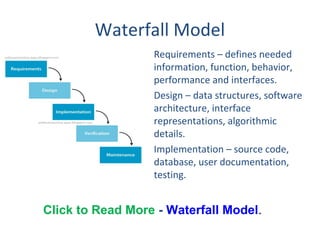
Waterfall Model
                • Requirements – defines needed
                  information, function, behavior,
                  performance and interfaces.
                • Design – data structures, software
                  architecture, interface
                  representations, algorithmic
                  details.
                • Implementation – source code,
                  database, user documentation,
                  testing.


Click to Read More - Waterfall Model.
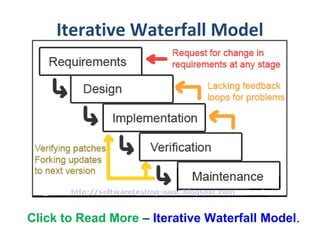
Iterative Waterfall Model


Click to Read More – Iterative Waterfall Model.
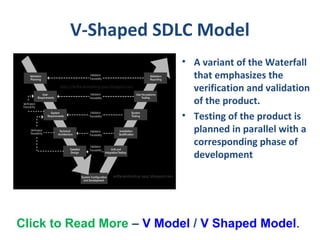
V-Shaped SDLC Model
                          • A variant of the Waterfall
                            that emphasizes the
                            verification and validation
                            of the product.
                          • Testing of the product is
                            planned in parallel with a
                            corresponding phase of
                            development


Click to Read More – V Model / V Shaped Model.
RAD Model


Click to Read More – RAD Model.
Incremental SDLC Model
                       •   Construct a partial
                           implementation of a total
                           system
                       •   Then slowly add increased
                           functionality
                       •   The incremental model
                           prioritizes requirements of the
                           system and then implements
                           them in groups.
                       •   Each subsequent release of the
                           system adds function to the
                           previous release, until all
                           designed functionality has been
                           implemented.


Click to Read More – Incremental Model.
Spiral SDLC Model
                    • Adds risk analysis, and
                      4gl RAD prototyping to
                      the waterfall model
                    • Each cycle involves the
                      same sequence of steps
                      as the waterfall process
                      model


Click to Read More – Spiral Model.
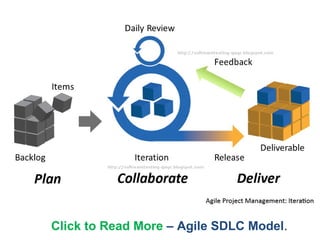
Agile SDLC’s
• Speed up or bypass one or more life cycle
  phases
• Usually less formal and reduced scope
• Used for time-critical applications
• Used in organizations that employ disciplined
  methods


    Click to Read More – Agile SDLC Model.
Click to Read More – Agile SDLC Model.
Some Agile Methods
•   Adaptive Software Development (ASD)
•   Feature Driven Development (FDD)
•   Crystal Clear
•   Dynamic Software Development Method (DSDM)
•   Rapid Application Development (RAD)
•   Scrum
•   Extreme Programming (XP)
•   Rational Unify Process (RUP)
Adaptive SDLC
Combines RAD with software engineering best
  practices
• Project initiation
• Adaptive cycle planning
• Concurrent component engineering
• Quality review
• Final QA and release
Capability Maturity Model (CMM)
• A bench-mark for measuring the maturity of
  an organization’s software process
• CMM defines 5 levels of process maturity
  based on certain Key Process Areas (KPA)
CMM Levels
Level 5 – Optimizing (< 1%)
      -- process change management
      -- technology change management
      -- defect prevention
Level 4 – Managed (< 5%)
      -- software quality management
      -- quantitative process management
Level 3 – Defined      (< 10%)
      -- peer reviews
      -- intergroup coordination
      -- software product engineering
      -- integrated software management
      -- training program
      -- organization process definition
      -- organization process focus
Level 2 – Repeatable (~ 15%)
      -- software configuration management
      -- software quality assurance
      -- software project tracking and oversight
      -- software project planning
      -- requirements management
Level 1 – Initial     (~ 70%)

SDLC Models

  • 1.
    Software Development Life Cycle (SDLC) “You’ve got to be very careful if you don’t know where you’re going, because you might not get there.” SDLC Models
  • 2.
    SDLC Model A frameworkthat describes the activities performed at each stage of a software development project. Click to Read More – SDLC Models.
  • 3.
    Waterfall Model • Requirements – defines needed information, function, behavior, performance and interfaces. • Design – data structures, software architecture, interface representations, algorithmic details. • Implementation – source code, database, user documentation, testing. Click to Read More - Waterfall Model.
  • 4.
    Iterative Waterfall Model Clickto Read More – Iterative Waterfall Model.
  • 5.
    V-Shaped SDLC Model • A variant of the Waterfall that emphasizes the verification and validation of the product. • Testing of the product is planned in parallel with a corresponding phase of development Click to Read More – V Model / V Shaped Model.
  • 7.
    RAD Model Click toRead More – RAD Model.
  • 8.
    Incremental SDLC Model • Construct a partial implementation of a total system • Then slowly add increased functionality • The incremental model prioritizes requirements of the system and then implements them in groups. • Each subsequent release of the system adds function to the previous release, until all designed functionality has been implemented. Click to Read More – Incremental Model.
  • 9.
    Spiral SDLC Model • Adds risk analysis, and 4gl RAD prototyping to the waterfall model • Each cycle involves the same sequence of steps as the waterfall process model Click to Read More – Spiral Model.
  • 10.
    Agile SDLC’s • Speedup or bypass one or more life cycle phases • Usually less formal and reduced scope • Used for time-critical applications • Used in organizations that employ disciplined methods Click to Read More – Agile SDLC Model.
  • 11.
    Click to ReadMore – Agile SDLC Model.
  • 12.
    Some Agile Methods • Adaptive Software Development (ASD) • Feature Driven Development (FDD) • Crystal Clear • Dynamic Software Development Method (DSDM) • Rapid Application Development (RAD) • Scrum • Extreme Programming (XP) • Rational Unify Process (RUP)
  • 13.
    Adaptive SDLC Combines RADwith software engineering best practices • Project initiation • Adaptive cycle planning • Concurrent component engineering • Quality review • Final QA and release
  • 14.
    Capability Maturity Model(CMM) • A bench-mark for measuring the maturity of an organization’s software process • CMM defines 5 levels of process maturity based on certain Key Process Areas (KPA)
  • 15.
    CMM Levels Level 5– Optimizing (< 1%) -- process change management -- technology change management -- defect prevention Level 4 – Managed (< 5%) -- software quality management -- quantitative process management Level 3 – Defined (< 10%) -- peer reviews -- intergroup coordination -- software product engineering -- integrated software management -- training program -- organization process definition -- organization process focus Level 2 – Repeatable (~ 15%) -- software configuration management -- software quality assurance -- software project tracking and oversight -- software project planning -- requirements management Level 1 – Initial (~ 70%)