


Mahesh Vallampati
   Mahesh Vallampati
    ◦ Career
      Director of Oracle Applications and Technologies at Coach
       America, the Bus Company.
      Sales and Consulting at Hotsos and SmartDog
      Director of IT Database Services at Ceva Logistics
      Sales and Consulting at Oracle for 9 years
    ◦ Education
      Courses in Business at Houston Community College
      Master’s in EE from Texas A&M University
   Career Focus
    ◦ Used to be DBA
    ◦ Now Techno-Functional (Fechnical)
   White Papers
    ◦ http://www.slideshare.net/mvallamp

   Email: mvallamp@yahoo.com

   Blog: http://mvallamp.blogspot.com

   Linked in Group Leader: DBA Manager

   Oracle Alumni Admin for content: 5000
    members
   Performance Issues
   Blame
   Blame The Business
   Blame the Functional Team
   Blame the Developer
   Blame the DBA
   Conclusions
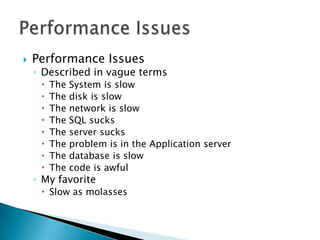
   Performance Issues
    ◦ Described in vague terms
        The   System is slow
        The   disk is slow
        The   network is slow
        The   SQL sucks
        The   server sucks
        The   problem is in the Application server
        The   database is slow
        The   code is awful
    ◦ My favorite
      Slow as molasses
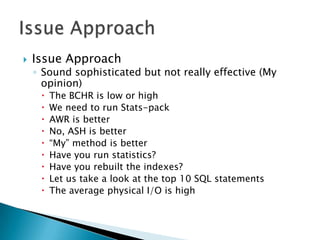
   Issue Approach
    ◦ Sound sophisticated but not really effective (My
      opinion)
        The BCHR is low or high
        We need to run Stats-pack
        AWR is better
        No, ASH is better
        “My” method is better
        Have you run statistics?
        Have you rebuilt the indexes?
        Let us take a look at the top 10 SQL statements
        The average physical I/O is high
   Let us Blame somebody
   Let us not leave anybody out
   Let us Blame
    ◦   The   Business People
    ◦   The   Functional Team
    ◦   The   Developers
    ◦   The   DBA’s
   Manufacturing Company
   In the Midwest
   Migrated from Mainframe to Oracle
    Applications (11.5.10)
   Did Big Bang implementation of
    Manufacturing, Order Management and
    Financials
   System was barely usable
   Flew there the day they went live after
    receiving panic calls
   Implementation vendor was there
   Another “expert” vendor was there
    ◦ BCHR and Block Size changes were being discussed
   Every theory possible was floating around
   Listened for an hour to the issues
   Asked a basic question
    ◦ Are you losing money and if so why?
   $$$$
    ◦ We are losing money
    ◦ We can’t take orders
    ◦ Order Management is not able to take orders
   It is taking 10 minutes to enter a 6 line order
   It used to take less than a minute in the
    mainframe
   Good place to start
   They can pay my bills if only they make
    money
   Traced the Order Management process
    ◦ Entering a header
    ◦ Entering a line
   Line Trace
    ◦ Entering a line was taking 1 minute and a half
   Most of the time was spent on calculating the
    price of an item
   Enter “Advanced” Pricing
   Query was 9 pages long
   Query executed 319,000 Logical I/O’s
   Why are you using advanced pricing?
   We can make more money
   Let us try Simple Pricing
   Turned off Advanced Pricing
   6 line Order with Simple Pricing took 1
    minute
   Interesting!!!
   Advanced Pricing
   Parameters for determining price
    ◦   Checks   Overall credit Limit (AR)
    ◦   Checks   outstanding balances (AR)
    ◦   Checks   inventory levels (Inv)
    ◦   Checks   overall order totals (Current Order)
    ◦   Checks   payment history (AR)
   Can we use Simple Pricing instead of
    Advanced Pricing?
   Enter the “Business”
   Discussion with COO
    ◦ Why are you using Advanced Pricing?
      We can make more money.
    ◦ How much more money can you make with
      Advanced Pricing instead of Simple Pricing?
      Don’t know
   Potential Upside on a 1billion USD in revenue
    ◦ 4 million a year if we are lucky
   Investment required to make the system
    perform at acceptable levels
    ◦ Cost – 10 to 15 million dollars
        Standby Reporting
        Archive/Purge
        Hardware Investments
        Software Investments
        Investments in people, processes etc.
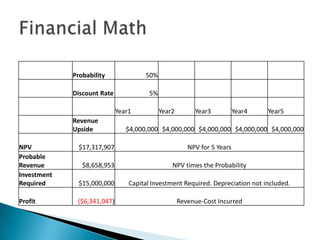
Probability              50%

             Discount Rate              5%

                             Year1           Year2        Year3           Year4   Year5
             Revenue
             Upside             $4,000,000 $4,000,000 $4,000,000 $4,000,000 $4,000,000

NPV            $17,317,907                              NPV for 5 Years
Probable
Revenue         $8,658,953                       NPV times the Probability
Investment
Required       $15,000,000       Capital Investment Required. Depreciation not included.

Profit        ($6,341,047)                           Revenue-Cost Incurred
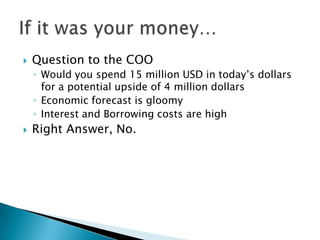
   Question to the COO
    ◦ Would you spend 15 million USD in today’s dollars
      for a potential upside of 4 million dollars
    ◦ Economic forecast is gloomy
    ◦ Interest and Borrowing costs are high
   Right Answer, No.
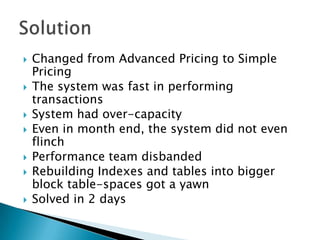
   Changed from Advanced Pricing to Simple
    Pricing
   The system was fast in performing
    transactions
   System had over-capacity
   Even in month end, the system did not even
    flinch
   Performance team disbanded
   Rebuilding Indexes and tables into bigger
    block table-spaces got a yawn
   Solved in 2 days
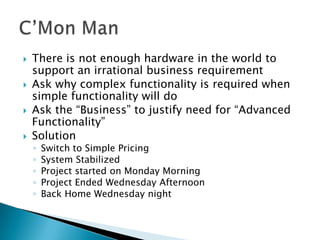
   There is not enough hardware in the world to
    support an irrational business requirement
   Ask why complex functionality is required when
    simple functionality will do
   Ask the “Business” to justify need for “Advanced
    Functionality”
   Solution
    ◦   Switch to Simple Pricing
    ◦   System Stabilized
    ◦   Project started on Monday Morning
    ◦   Project Ended Wednesday Afternoon
    ◦   Back Home Wednesday night
   Manufacturing Company in Ohio
   Migrated to Oracle Applications
   Severe Performance Issues
   Order Management is slow
   Call center for customers is just horrific
   Each call taking 10-15 minutes when before
    each call during the mainframe was taking 2-
    3 minutes
   Customer was using Configurator and BOM
   Method-R
   Traced the Order Management Process which
    uses the Configurator
   Identified the SQL Statement that was taking
    a long time
   SQL statement was performing close to
    900,000 Logical I/O’s per execution
   SQL Statement was getting executed for every
    item in the BOM that makes up an order line
   The more complex the BOM, the more items
    in the BOM, the slower the process
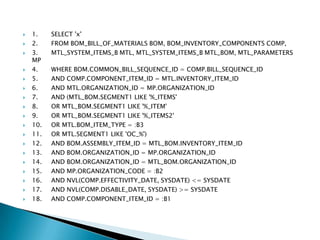
   The SQL Statement was determining whether
    the item needed to be displayed in the
    invoice for the customer and in the packing
    slip
   1.    SELECT 'x'
   2.    FROM BOM_BILL_OF_MATERIALS BOM, BOM_INVENTORY_COMPONENTS COMP,
   3.    MTL_SYSTEM_ITEMS_B MTL, MTL_SYSTEM_ITEMS_B MTL_BOM, MTL_PARAMETERS
    MP
   4.    WHERE BOM.COMMON_BILL_SEQUENCE_ID = COMP.BILL_SEQUENCE_ID
   5.    AND COMP.COMPONENT_ITEM_ID = MTL.INVENTORY_ITEM_ID
   6.    AND MTL.ORGANIZATION_ID = MP.ORGANIZATION_ID
   7.    AND (MTL_BOM.SEGMENT1 LIKE '%_ITEMS'
   8.    OR MTL_BOM.SEGMENT1 LIKE '%_ITEM'
   9.    OR MTL_BOM.SEGMENT1 LIKE '%_ITEMS2'
   10.   OR MTL.BOM_ITEM_TYPE = :B3
   11.   OR MTL.SEGMENT1 LIKE 'OC_%')
   12.   AND BOM.ASSEMBLY_ITEM_ID = MTL_BOM.INVENTORY_ITEM_ID
   13.   AND BOM.ORGANIZATION_ID = MP.ORGANIZATION_ID
   14.   AND BOM.ORGANIZATION_ID = MTL_BOM.ORGANIZATION_ID
   15.   AND MP.ORGANIZATION_CODE = :B2
   16.   AND NVL(COMP.EFFECTIVITY_DATE, SYSDATE) <= SYSDATE
   17.   AND NVL(COMP.DISABLE_DATE, SYSDATE) >= SYSDATE
   18.   AND COMP.COMPONENT_ITEM_ID = :B1
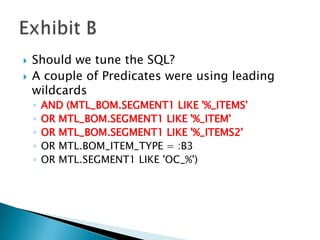
   Should we tune the SQL?
   A couple of Predicates were using leading
    wildcards
    ◦   AND (MTL_BOM.SEGMENT1 LIKE '%_ITEMS'
    ◦   OR MTL_BOM.SEGMENT1 LIKE '%_ITEM'
    ◦   OR MTL_BOM.SEGMENT1 LIKE '%_ITEMS2'
    ◦   OR MTL.BOM_ITEM_TYPE = :B3
    ◦   OR MTL.SEGMENT1 LIKE 'OC_%')
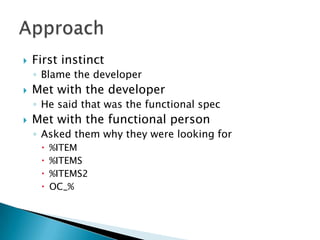
   First instinct
    ◦ Blame the developer
   Met with the developer
    ◦ He said that was the functional spec
   Met with the functional person
    ◦ Asked them why they were looking for
        %ITEM
        %ITEMS
        %ITEMS2
        OC_%
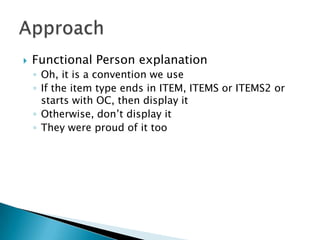
   Functional Person explanation
    ◦ Oh, it is a convention we use
    ◦ If the item type ends in ITEM, ITEMS or ITEMS2 or
      starts with OC, then display it
    ◦ Otherwise, don’t display it
    ◦ They were proud of it too
   Should we create a reverse string functional
    index and switch the predicates?
   Umm..No
   Called a meeting
    ◦   Business Users
    ◦   Functional Team
    ◦   Developers
    ◦   DBA’s
   Took a dictionary to the meeting
    ◦ Asked them to find words that ended with M or S
      quickly
    ◦ Everybody was looking as if I was not sane
   I explained that was what they were asking
    the system
   Created a flexfield with a Y or N at the
    inventory item level
   Updated the field to indicate the status
   Rewrote the SQL Statement to use the flag
    instead of the convention
   SQL now used 40 Logical I/O’s
   System speed was so fast that the
    productivity of the call center was up.
   Try to answer the SQL statement yourself as if
    you did not have a system
   Would it make sense?
   If no, then the system is probably going to be
    bad at it too and will be slow
   Systems can process and automate irrational
    requests
   The cost and pain is going to be high
   System can do dumb but slow (Exadata
    anybody?)
   Manufacturing Company in Illinois
   Customer had implemented Oracle
    Applications
   Shipping Application is slow
   SR with Oracle Support going nowhere
   Cannot determine if it is custom or standard
   Method-R
   Traced the Shipping Process
   Each Line in the shipping screen was taking
    20-25 seconds
   Identified the SQL Statement that was taking
    a long time
   Each execution was taking 650,000 Logical
    I/O’s.
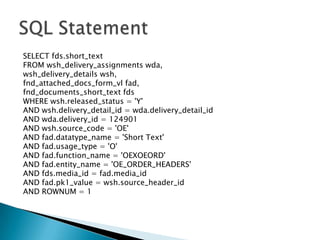
SELECT fds.short_text
FROM wsh_delivery_assignments wda,
wsh_delivery_details wsh,
fnd_attached_docs_form_vl fad,
fnd_documents_short_text fds
WHERE wsh.released_status = 'Y'
AND wsh.delivery_detail_id = wda.delivery_detail_id
AND wda.delivery_id = 124901
AND wsh.source_code = 'OE'
AND fad.datatype_name = 'Short Text'
AND fad.usage_type = 'O'
AND fad.function_name = 'OEXOEORD'
AND fad.entity_name = 'OE_ORDER_HEADERS'
AND fds.media_id = fad.media_id
AND fad.pk1_value = wsh.source_header_id
AND ROWNUM = 1
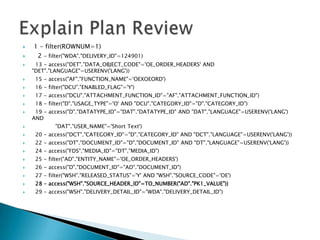
   1 - filter(ROWNUM=1)
    2 - filter("WDA"."DELIVERY_ID"=124901)
    13 - access("DET"."DATA_OBJECT_CODE"='OE_ORDER_HEADERS' AND
    "DET"."LANGUAGE"=USERENV('LANG'))
    15 - access("AF"."FUNCTION_NAME"='OEXOEORD')
    16 - filter("DCU"."ENABLED_FLAG"='Y')
    17 - access("DCU"."ATTACHMENT_FUNCTION_ID"="AF"."ATTACHMENT_FUNCTION_ID")
    18 - filter("D"."USAGE_TYPE"='O' AND "DCU"."CATEGORY_ID"="D"."CATEGORY_ID")
    19 - access("D"."DATATYPE_ID"="DAT"."DATATYPE_ID" AND "DAT"."LANGUAGE"=USERENV('LANG')
    AND
           "DAT"."USER_NAME"='Short Text')
    20 - access("DCT"."CATEGORY_ID"="D"."CATEGORY_ID" AND "DCT"."LANGUAGE"=USERENV('LANG'))
    22 - access("DT"."DOCUMENT_ID"="D"."DOCUMENT_ID" AND "DT"."LANGUAGE"=USERENV('LANG'))
    24 - access("FDS"."MEDIA_ID"="DT"."MEDIA_ID")
    25 - filter("AD"."ENTITY_NAME"='OE_ORDER_HEADERS')
    26 - access("D"."DOCUMENT_ID"="AD"."DOCUMENT_ID")
    27 - filter("WSH"."RELEASED_STATUS"='Y' AND "WSH"."SOURCE_CODE"='OE')
    28 - access("WSH"."SOURCE_HEADER_ID"=TO_NUMBER("AD"."PK1_VALUE"))
    29 - access("WSH"."DELIVERY_DETAIL_ID"="WDA"."DELIVERY_DETAIL_ID")
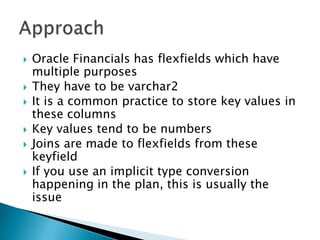
   Oracle Financials has flexfields which have
    multiple purposes
   They have to be varchar2
   It is a common practice to store key values in
    these columns
   Key values tend to be numbers
   Joins are made to flexfields from these
    keyfield
   If you use an implicit type conversion
    happening in the plan, this is usually the
    issue
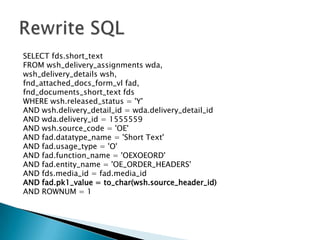
SELECT fds.short_text
FROM wsh_delivery_assignments wda,
wsh_delivery_details wsh,
fnd_attached_docs_form_vl fad,
fnd_documents_short_text fds
WHERE wsh.released_status = 'Y'
AND wsh.delivery_detail_id = wda.delivery_detail_id
AND wda.delivery_id = 1555559
AND wsh.source_code = 'OE'
AND fad.datatype_name = 'Short Text'
AND fad.usage_type = 'O'
AND fad.function_name = 'OEXOEORD'
AND fad.entity_name = 'OE_ORDER_HEADERS'
AND fds.media_id = fad.media_id
AND fad.pk1_value = to_char(wsh.source_header_id)
AND ROWNUM = 1
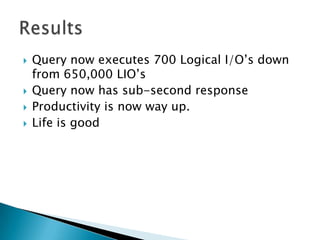
   Query now executes 700 Logical I/O’s down
    from 650,000 LIO’s
   Query now has sub-second response
   Productivity is now way up.
   Life is good
   Known he was joining a varchar to a number
    field
   Recognize that it could be an issue
   Checked the number of Logical I/O’s it was
    doing
   Examined the explain plan
   Can we have a “lint” for SQL?
   Customer was a food distributor in Illinois
   They were going live on Oracle Financials
   They had several customizations which they
    were rolling out
   Customizations were released as a series of
    scripts
   The scripts were rolled out at 2:30 PM
   Testing would start
   Performance was horrible
   Find Customers, Find Orders and Find
    Shipment forms would take forever
   The next day the system performance was
    fine
   Everything was fast
   Everybody were stunned
    ◦ Client DBA team
    ◦ Oracle Consulting Team
   Traced the processes using 10046
   A lot of joins to custom temporary tables
    were observed for queries with poor
    performance
   A little bit more digging and almost all
    performance issues were related to the
    temporary tables
   So what is that with these temporary tables
    that performed well the day after they were
    deployed
   After a few hours of searching, did a quick
    explain plan in SQL Developer
   Noticed the “Rule” in the explain plan
   Wait a minute – we should be using CBO.
   This is the 9i database
   Hmm..Let us look at the temporary tables
   Aaah..ah
   Stats on temporary tables were not being
    collected as a part of the code deployment
   A nightly process that gathered stats on all
    objects that did not have statistics gathered
    the rest
   That explained why performance was poor
    the day the code was deployed and better the
    day after
   This was interesting
   Whose job was it to have the stats gathering
    script as a part of the deployment
   Was it the DBA?
   Or the developer?
   It is a moot point when IT is on the line
   Is it the linebacker or the safety’s fault in a
    busted play?
   Who cares if you lose?
   Use Method-R to get to the root cause
   Use other methods to confirm the problem
    ◦ Statspack
    ◦ Grid Control
    ◦ Homegrown scripts
   Avoid your first instinct
   First Instinct
    ◦ Try to tune the SQL
    ◦ Try to solve the problem
    ◦ Wrong Approach
   Correct Approach
    ◦   Identify blame
    ◦   Assign Blame (Important)
    ◦   Ask the “makes sense” question
    ◦   Will it make us money?
    ◦   If not, don’t do it
 Eliminate the problem
 Train the user not to create the
  problem
 Reschedule the problem
 Tune/Optimize the problem
 Relocate the problem
Enough Blame for System Performance Issues

Enough Blame for System Performance Issues

  • 1.
  • 2.
    Mahesh Vallampati ◦ Career  Director of Oracle Applications and Technologies at Coach America, the Bus Company.  Sales and Consulting at Hotsos and SmartDog  Director of IT Database Services at Ceva Logistics  Sales and Consulting at Oracle for 9 years ◦ Education  Courses in Business at Houston Community College  Master’s in EE from Texas A&M University  Career Focus ◦ Used to be DBA ◦ Now Techno-Functional (Fechnical)
  • 3.
    White Papers ◦ http://www.slideshare.net/mvallamp  Email: mvallamp@yahoo.com  Blog: http://mvallamp.blogspot.com  Linked in Group Leader: DBA Manager  Oracle Alumni Admin for content: 5000 members
  • 4.
    Performance Issues  Blame  Blame The Business  Blame the Functional Team  Blame the Developer  Blame the DBA  Conclusions
  • 6.
    Performance Issues ◦ Described in vague terms  The System is slow  The disk is slow  The network is slow  The SQL sucks  The server sucks  The problem is in the Application server  The database is slow  The code is awful ◦ My favorite  Slow as molasses
  • 7.
    Issue Approach ◦ Sound sophisticated but not really effective (My opinion)  The BCHR is low or high  We need to run Stats-pack  AWR is better  No, ASH is better  “My” method is better  Have you run statistics?  Have you rebuilt the indexes?  Let us take a look at the top 10 SQL statements  The average physical I/O is high
  • 9.
    Let us Blame somebody  Let us not leave anybody out  Let us Blame ◦ The Business People ◦ The Functional Team ◦ The Developers ◦ The DBA’s
  • 11.
    Manufacturing Company  In the Midwest  Migrated from Mainframe to Oracle Applications (11.5.10)  Did Big Bang implementation of Manufacturing, Order Management and Financials  System was barely usable  Flew there the day they went live after receiving panic calls
  • 12.
    Implementation vendor was there  Another “expert” vendor was there ◦ BCHR and Block Size changes were being discussed  Every theory possible was floating around  Listened for an hour to the issues  Asked a basic question ◦ Are you losing money and if so why?
  • 13.
    $$$$ ◦ We are losing money ◦ We can’t take orders ◦ Order Management is not able to take orders  It is taking 10 minutes to enter a 6 line order  It used to take less than a minute in the mainframe  Good place to start  They can pay my bills if only they make money
  • 14.
    Traced the Order Management process ◦ Entering a header ◦ Entering a line  Line Trace ◦ Entering a line was taking 1 minute and a half  Most of the time was spent on calculating the price of an item  Enter “Advanced” Pricing
  • 15.
    Query was 9 pages long  Query executed 319,000 Logical I/O’s
  • 16.
    Why are you using advanced pricing?  We can make more money  Let us try Simple Pricing  Turned off Advanced Pricing  6 line Order with Simple Pricing took 1 minute  Interesting!!!
  • 17.
    Advanced Pricing  Parameters for determining price ◦ Checks Overall credit Limit (AR) ◦ Checks outstanding balances (AR) ◦ Checks inventory levels (Inv) ◦ Checks overall order totals (Current Order) ◦ Checks payment history (AR)
  • 18.
    Can we use Simple Pricing instead of Advanced Pricing?  Enter the “Business”  Discussion with COO ◦ Why are you using Advanced Pricing?  We can make more money. ◦ How much more money can you make with Advanced Pricing instead of Simple Pricing?  Don’t know
  • 19.
    Potential Upside on a 1billion USD in revenue ◦ 4 million a year if we are lucky  Investment required to make the system perform at acceptable levels ◦ Cost – 10 to 15 million dollars  Standby Reporting  Archive/Purge  Hardware Investments  Software Investments  Investments in people, processes etc.
  • 20.
    Probability 50% Discount Rate 5% Year1 Year2 Year3 Year4 Year5 Revenue Upside $4,000,000 $4,000,000 $4,000,000 $4,000,000 $4,000,000 NPV $17,317,907 NPV for 5 Years Probable Revenue $8,658,953 NPV times the Probability Investment Required $15,000,000 Capital Investment Required. Depreciation not included. Profit ($6,341,047) Revenue-Cost Incurred
  • 21.
    Question to the COO ◦ Would you spend 15 million USD in today’s dollars for a potential upside of 4 million dollars ◦ Economic forecast is gloomy ◦ Interest and Borrowing costs are high  Right Answer, No.
  • 22.
    Changed from Advanced Pricing to Simple Pricing  The system was fast in performing transactions  System had over-capacity  Even in month end, the system did not even flinch  Performance team disbanded  Rebuilding Indexes and tables into bigger block table-spaces got a yawn  Solved in 2 days
  • 23.
    There is not enough hardware in the world to support an irrational business requirement  Ask why complex functionality is required when simple functionality will do  Ask the “Business” to justify need for “Advanced Functionality”  Solution ◦ Switch to Simple Pricing ◦ System Stabilized ◦ Project started on Monday Morning ◦ Project Ended Wednesday Afternoon ◦ Back Home Wednesday night
  • 25.
    Manufacturing Company in Ohio  Migrated to Oracle Applications  Severe Performance Issues  Order Management is slow  Call center for customers is just horrific  Each call taking 10-15 minutes when before each call during the mainframe was taking 2- 3 minutes  Customer was using Configurator and BOM
  • 26.
    Method-R  Traced the Order Management Process which uses the Configurator  Identified the SQL Statement that was taking a long time
  • 27.
    SQL statement was performing close to 900,000 Logical I/O’s per execution  SQL Statement was getting executed for every item in the BOM that makes up an order line  The more complex the BOM, the more items in the BOM, the slower the process  The SQL Statement was determining whether the item needed to be displayed in the invoice for the customer and in the packing slip
  • 28.
    1. SELECT 'x'  2. FROM BOM_BILL_OF_MATERIALS BOM, BOM_INVENTORY_COMPONENTS COMP,  3. MTL_SYSTEM_ITEMS_B MTL, MTL_SYSTEM_ITEMS_B MTL_BOM, MTL_PARAMETERS MP  4. WHERE BOM.COMMON_BILL_SEQUENCE_ID = COMP.BILL_SEQUENCE_ID  5. AND COMP.COMPONENT_ITEM_ID = MTL.INVENTORY_ITEM_ID  6. AND MTL.ORGANIZATION_ID = MP.ORGANIZATION_ID  7. AND (MTL_BOM.SEGMENT1 LIKE '%_ITEMS'  8. OR MTL_BOM.SEGMENT1 LIKE '%_ITEM'  9. OR MTL_BOM.SEGMENT1 LIKE '%_ITEMS2'  10. OR MTL.BOM_ITEM_TYPE = :B3  11. OR MTL.SEGMENT1 LIKE 'OC_%')  12. AND BOM.ASSEMBLY_ITEM_ID = MTL_BOM.INVENTORY_ITEM_ID  13. AND BOM.ORGANIZATION_ID = MP.ORGANIZATION_ID  14. AND BOM.ORGANIZATION_ID = MTL_BOM.ORGANIZATION_ID  15. AND MP.ORGANIZATION_CODE = :B2  16. AND NVL(COMP.EFFECTIVITY_DATE, SYSDATE) <= SYSDATE  17. AND NVL(COMP.DISABLE_DATE, SYSDATE) >= SYSDATE  18. AND COMP.COMPONENT_ITEM_ID = :B1
  • 29.
    Should we tune the SQL?  A couple of Predicates were using leading wildcards ◦ AND (MTL_BOM.SEGMENT1 LIKE '%_ITEMS' ◦ OR MTL_BOM.SEGMENT1 LIKE '%_ITEM' ◦ OR MTL_BOM.SEGMENT1 LIKE '%_ITEMS2' ◦ OR MTL.BOM_ITEM_TYPE = :B3 ◦ OR MTL.SEGMENT1 LIKE 'OC_%')
  • 30.
    First instinct ◦ Blame the developer  Met with the developer ◦ He said that was the functional spec  Met with the functional person ◦ Asked them why they were looking for  %ITEM  %ITEMS  %ITEMS2  OC_%
  • 31.
    Functional Person explanation ◦ Oh, it is a convention we use ◦ If the item type ends in ITEM, ITEMS or ITEMS2 or starts with OC, then display it ◦ Otherwise, don’t display it ◦ They were proud of it too
  • 32.
    Should we create a reverse string functional index and switch the predicates?  Umm..No
  • 33.
    Called a meeting ◦ Business Users ◦ Functional Team ◦ Developers ◦ DBA’s  Took a dictionary to the meeting ◦ Asked them to find words that ended with M or S quickly ◦ Everybody was looking as if I was not sane  I explained that was what they were asking the system
  • 34.
    Created a flexfield with a Y or N at the inventory item level  Updated the field to indicate the status  Rewrote the SQL Statement to use the flag instead of the convention  SQL now used 40 Logical I/O’s  System speed was so fast that the productivity of the call center was up.
  • 35.
    Try to answer the SQL statement yourself as if you did not have a system  Would it make sense?  If no, then the system is probably going to be bad at it too and will be slow  Systems can process and automate irrational requests  The cost and pain is going to be high  System can do dumb but slow (Exadata anybody?)
  • 37.
    Manufacturing Company in Illinois  Customer had implemented Oracle Applications  Shipping Application is slow  SR with Oracle Support going nowhere  Cannot determine if it is custom or standard
  • 38.
    Method-R  Traced the Shipping Process  Each Line in the shipping screen was taking 20-25 seconds  Identified the SQL Statement that was taking a long time  Each execution was taking 650,000 Logical I/O’s.
  • 40.
    SELECT fds.short_text FROM wsh_delivery_assignmentswda, wsh_delivery_details wsh, fnd_attached_docs_form_vl fad, fnd_documents_short_text fds WHERE wsh.released_status = 'Y' AND wsh.delivery_detail_id = wda.delivery_detail_id AND wda.delivery_id = 124901 AND wsh.source_code = 'OE' AND fad.datatype_name = 'Short Text' AND fad.usage_type = 'O' AND fad.function_name = 'OEXOEORD' AND fad.entity_name = 'OE_ORDER_HEADERS' AND fds.media_id = fad.media_id AND fad.pk1_value = wsh.source_header_id AND ROWNUM = 1
  • 41.
    1 - filter(ROWNUM=1)  2 - filter("WDA"."DELIVERY_ID"=124901)  13 - access("DET"."DATA_OBJECT_CODE"='OE_ORDER_HEADERS' AND "DET"."LANGUAGE"=USERENV('LANG'))  15 - access("AF"."FUNCTION_NAME"='OEXOEORD')  16 - filter("DCU"."ENABLED_FLAG"='Y')  17 - access("DCU"."ATTACHMENT_FUNCTION_ID"="AF"."ATTACHMENT_FUNCTION_ID")  18 - filter("D"."USAGE_TYPE"='O' AND "DCU"."CATEGORY_ID"="D"."CATEGORY_ID")  19 - access("D"."DATATYPE_ID"="DAT"."DATATYPE_ID" AND "DAT"."LANGUAGE"=USERENV('LANG') AND  "DAT"."USER_NAME"='Short Text')  20 - access("DCT"."CATEGORY_ID"="D"."CATEGORY_ID" AND "DCT"."LANGUAGE"=USERENV('LANG'))  22 - access("DT"."DOCUMENT_ID"="D"."DOCUMENT_ID" AND "DT"."LANGUAGE"=USERENV('LANG'))  24 - access("FDS"."MEDIA_ID"="DT"."MEDIA_ID")  25 - filter("AD"."ENTITY_NAME"='OE_ORDER_HEADERS')  26 - access("D"."DOCUMENT_ID"="AD"."DOCUMENT_ID")  27 - filter("WSH"."RELEASED_STATUS"='Y' AND "WSH"."SOURCE_CODE"='OE')  28 - access("WSH"."SOURCE_HEADER_ID"=TO_NUMBER("AD"."PK1_VALUE"))  29 - access("WSH"."DELIVERY_DETAIL_ID"="WDA"."DELIVERY_DETAIL_ID")
  • 42.
    Oracle Financials has flexfields which have multiple purposes  They have to be varchar2  It is a common practice to store key values in these columns  Key values tend to be numbers  Joins are made to flexfields from these keyfield  If you use an implicit type conversion happening in the plan, this is usually the issue
  • 43.
    SELECT fds.short_text FROM wsh_delivery_assignmentswda, wsh_delivery_details wsh, fnd_attached_docs_form_vl fad, fnd_documents_short_text fds WHERE wsh.released_status = 'Y' AND wsh.delivery_detail_id = wda.delivery_detail_id AND wda.delivery_id = 1555559 AND wsh.source_code = 'OE' AND fad.datatype_name = 'Short Text' AND fad.usage_type = 'O' AND fad.function_name = 'OEXOEORD' AND fad.entity_name = 'OE_ORDER_HEADERS' AND fds.media_id = fad.media_id AND fad.pk1_value = to_char(wsh.source_header_id) AND ROWNUM = 1
  • 44.
    Query now executes 700 Logical I/O’s down from 650,000 LIO’s  Query now has sub-second response  Productivity is now way up.  Life is good
  • 45.
    Known he was joining a varchar to a number field  Recognize that it could be an issue  Checked the number of Logical I/O’s it was doing  Examined the explain plan  Can we have a “lint” for SQL?
  • 47.
    Customer was a food distributor in Illinois  They were going live on Oracle Financials  They had several customizations which they were rolling out  Customizations were released as a series of scripts  The scripts were rolled out at 2:30 PM  Testing would start
  • 48.
    Performance was horrible  Find Customers, Find Orders and Find Shipment forms would take forever  The next day the system performance was fine  Everything was fast  Everybody were stunned ◦ Client DBA team ◦ Oracle Consulting Team
  • 49.
    Traced the processes using 10046  A lot of joins to custom temporary tables were observed for queries with poor performance  A little bit more digging and almost all performance issues were related to the temporary tables  So what is that with these temporary tables that performed well the day after they were deployed
  • 50.
    After a few hours of searching, did a quick explain plan in SQL Developer  Noticed the “Rule” in the explain plan  Wait a minute – we should be using CBO.  This is the 9i database  Hmm..Let us look at the temporary tables  Aaah..ah
  • 51.
    Stats on temporary tables were not being collected as a part of the code deployment  A nightly process that gathered stats on all objects that did not have statistics gathered the rest  That explained why performance was poor the day the code was deployed and better the day after
  • 52.
    This was interesting  Whose job was it to have the stats gathering script as a part of the deployment  Was it the DBA?  Or the developer?  It is a moot point when IT is on the line  Is it the linebacker or the safety’s fault in a busted play?  Who cares if you lose?
  • 54.
    Use Method-R to get to the root cause  Use other methods to confirm the problem ◦ Statspack ◦ Grid Control ◦ Homegrown scripts  Avoid your first instinct
  • 55.
    First Instinct ◦ Try to tune the SQL ◦ Try to solve the problem ◦ Wrong Approach  Correct Approach ◦ Identify blame ◦ Assign Blame (Important) ◦ Ask the “makes sense” question ◦ Will it make us money? ◦ If not, don’t do it
  • 56.
     Eliminate theproblem  Train the user not to create the problem  Reschedule the problem  Tune/Optimize the problem  Relocate the problem