

Mob Sec Mobile Security Conference 4/11/2010 Herzliya
Danny Lieberman – Software Associates.
v6
Agenda
 Mobile medical is hot
 Applications
 Threat scenarios
 A threat model framework for secure code
 Summary
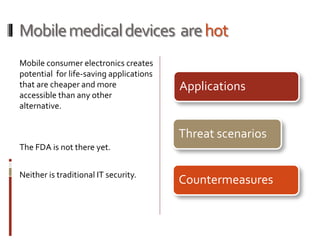
Mobilemedicaldevices arehot
Mobile consumer electronics creates
potential for life-saving applications
that are cheaper and more
accessible than any other
alternative.
The FDA is not there yet.
Neither is traditional IT security.
Applications
Threat scenarios
Countermeasures
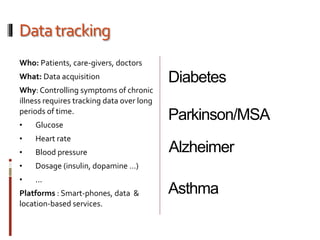
Datatracking
Who: Patients, care-givers, doctors
What: Data acquisition
Why: Controlling symptoms of chronic
illness requires tracking data over long
periods of time.
• Glucose
• Heart rate
• Blood pressure
• Dosage (insulin, dopamine …)
• ...
Platforms : Smart-phones, data &
location-based services.
Diabetes
Parkinson/MSA
Alzheimer
Asthma
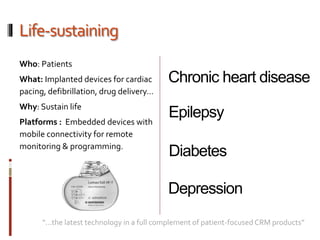
Life-sustaining
Who: Patients
What: Implanted devices for cardiac
pacing, defibrillation, drug delivery…
Why: Sustain life
Platforms : Embedded devices with
mobile connectivity for remote
monitoring & programming.
Chronic heart disease
Epilepsy
Diabetes
Depression
“…the latest technology in a full complement of patient-focused CRM products”
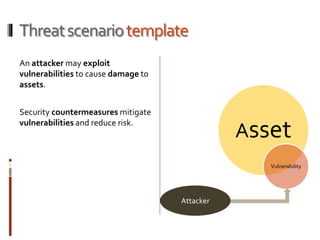
Threatscenariotemplate
An attacker may exploit
vulnerabilities to cause damage to
assets.
Security countermeasures mitigate
vulnerabilities and reduce risk.
Asset
Vulnerability
Attacker
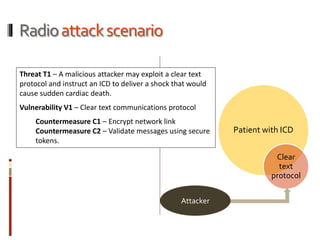
Radioattackscenario
Patient with ICD
Clear
text
protocol
Threat T1 – A malicious attacker may exploit a clear text
protocol and instruct an ICD to deliver a shock that would
cause sudden cardiac death.
Vulnerability V1 – Clear text communications protocol
Countermeasure C1 – Encrypt network link
Countermeasure C2 – Validate messages using secure
tokens.
Attacker
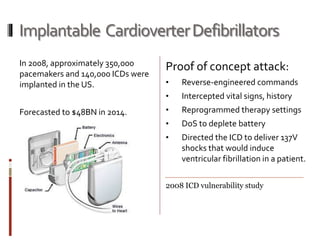
Implantable CardioverterDefibrillators
In 2008, approximately 350,000
pacemakers and 140,000 ICDs were
implanted in the US.
Forecasted to $48BN in 2014.
Proof of concept attack:
• Reverse-engineered commands
• Intercepted vital signs, history
• Reprogrammed therapy settings
• DoS to deplete battery
• Directed the ICD to deliver 137V
shocks that would induce
ventricular fibrillation in a patient.
2008 ICD vulnerability study
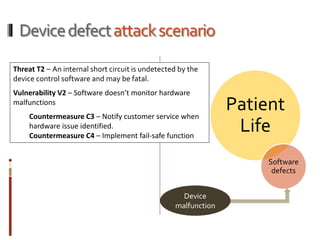
Devicedefectattackscenario
Patient
Life
Software
defects
Device
malfunction
Threat T2 – An internal short circuit is undetected by the
device control software and may be fatal.
Vulnerability V2 – Software doesn’t monitor hardware
malfunctions
Countermeasure C3 – Notify customer service when
hardware issue identified.
Countermeasure C4 – Implement fail-safe function
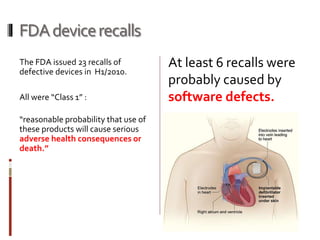
FDAdevicerecalls
The FDA issued 23 recalls of
defective devices in H1/2010.
All were “Class 1” :
“reasonable probability that use of
these products will cause serious
adverse health consequences or
death.”
At least 6 recalls were
probably caused by
software defects.
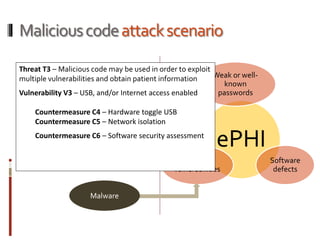
Maliciouscodeattackscenario
ePHI
Weak or well-
known
passwords
Software
defects
OS
vulnerabilities
Malware
Threat T3 – Malicious code may be used in order to exploit
multiple vulnerabilities and obtain patient information
Vulnerability V3 – USB, and/or Internet access enabled
Countermeasure C4 – Hardware toggle USB
Countermeasure C5 – Network isolation
Countermeasure C6 – Software security assessment
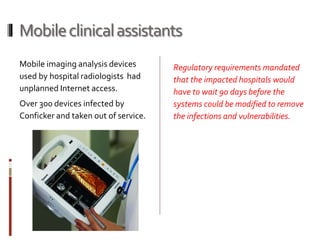
Mobileclinicalassistants
Mobile imaging analysis devices
used by hospital radiologists had
unplanned Internet access.
Over 300 devices infected by
Conficker and taken out of service.
Regulatory requirements mandated
that the impacted hospitals would
have to wait 90 days before the
systems could be modified to remove
the infections and vulnerabilities.
WhereistheFDA?
The FDA has refocused regulation
from patient safety to auditing
manufacturers’ compliance with
their own standards.
If the FDA has approved a medical
device, consumers cannot sue.
“Riegel v. Medtronic “, 2008
Athreatmodelsecurityframework
Objectives
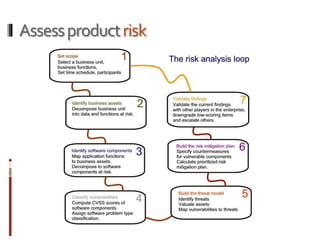
 Assess product risk
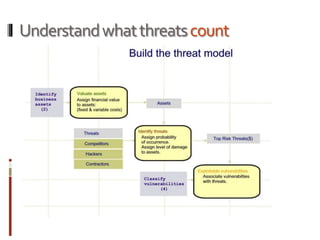
 Understand what
threats count
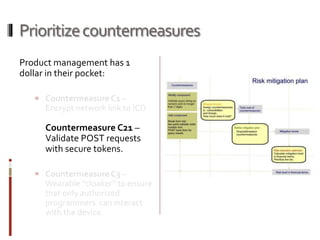
 Prioritize
countermeasures.
 Drive profits
Audit medical device
manufacturer
safety/security standards.
Assessproductrisk
Understandwhatthreatscount
Prioritizecountermeasures
Product management has 1
dollar in their pocket:
 Countermeasure C1 –
Encrypt network link to ICD
Countermeasure C21 –
Validate POST requests
with secure tokens.
 Countermeasure C3 –
Wearable “cloaker” to ensure
that only authorized
programmers can interact
with the device.
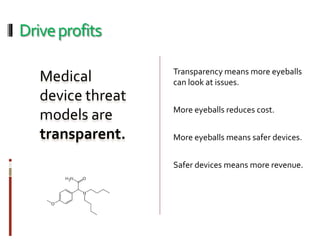
Driveprofits
Transparency means more eyeballs
can look at issues.
More eyeballs reduces cost.
More eyeballs means safer devices.
Safer devices means more revenue.
Medical
device threat
models are
transparent.
Sources
 Riegel v. Medtronic, Inc.
http://www.law.cornell.edu/supct/html/06-179.ZS.html
 Pacemakers and implantable cardiac defibrillators: Software radio
attacks and zero-power defenses.
Daniel Halperin et al.
Proceedings of the 29th Annual IEEE Symposium on Security and
Privacy, May 2008.
http://www.secure-medicine.org/icd-study/icd-study.pdf
 Software transparency in imbedded medical devices
http://www.softwarefreedom.org/resources/2010/transparent-medical-
devices.html
 Prof. Nir Giladi,Tel Aviv Souraski Hospital Neurology Department,
personal communication on data tracking for MSA patients
 Biotronik – cellular pacemaker, http://www.biotronik.com/en/us/19412

Killed by code - mobile medical devices

  • 1.
    Mob Sec MobileSecurity Conference 4/11/2010 Herzliya Danny Lieberman – Software Associates. v6
  • 2.
    Agenda  Mobile medicalis hot  Applications  Threat scenarios  A threat model framework for secure code  Summary
  • 3.
    Mobilemedicaldevices arehot Mobile consumerelectronics creates potential for life-saving applications that are cheaper and more accessible than any other alternative. The FDA is not there yet. Neither is traditional IT security. Applications Threat scenarios Countermeasures
  • 5.
    Datatracking Who: Patients, care-givers,doctors What: Data acquisition Why: Controlling symptoms of chronic illness requires tracking data over long periods of time. • Glucose • Heart rate • Blood pressure • Dosage (insulin, dopamine …) • ... Platforms : Smart-phones, data & location-based services. Diabetes Parkinson/MSA Alzheimer Asthma
  • 6.
    Life-sustaining Who: Patients What: Implanteddevices for cardiac pacing, defibrillation, drug delivery… Why: Sustain life Platforms : Embedded devices with mobile connectivity for remote monitoring & programming. Chronic heart disease Epilepsy Diabetes Depression “…the latest technology in a full complement of patient-focused CRM products”
  • 8.
    Threatscenariotemplate An attacker mayexploit vulnerabilities to cause damage to assets. Security countermeasures mitigate vulnerabilities and reduce risk. Asset Vulnerability Attacker
  • 9.
    Radioattackscenario Patient with ICD Clear text protocol ThreatT1 – A malicious attacker may exploit a clear text protocol and instruct an ICD to deliver a shock that would cause sudden cardiac death. Vulnerability V1 – Clear text communications protocol Countermeasure C1 – Encrypt network link Countermeasure C2 – Validate messages using secure tokens. Attacker
  • 10.
    Implantable CardioverterDefibrillators In 2008,approximately 350,000 pacemakers and 140,000 ICDs were implanted in the US. Forecasted to $48BN in 2014. Proof of concept attack: • Reverse-engineered commands • Intercepted vital signs, history • Reprogrammed therapy settings • DoS to deplete battery • Directed the ICD to deliver 137V shocks that would induce ventricular fibrillation in a patient. 2008 ICD vulnerability study
  • 11.
    Devicedefectattackscenario Patient Life Software defects Device malfunction Threat T2 –An internal short circuit is undetected by the device control software and may be fatal. Vulnerability V2 – Software doesn’t monitor hardware malfunctions Countermeasure C3 – Notify customer service when hardware issue identified. Countermeasure C4 – Implement fail-safe function
  • 12.
    FDAdevicerecalls The FDA issued23 recalls of defective devices in H1/2010. All were “Class 1” : “reasonable probability that use of these products will cause serious adverse health consequences or death.” At least 6 recalls were probably caused by software defects.
  • 13.
    Maliciouscodeattackscenario ePHI Weak or well- known passwords Software defects OS vulnerabilities Malware ThreatT3 – Malicious code may be used in order to exploit multiple vulnerabilities and obtain patient information Vulnerability V3 – USB, and/or Internet access enabled Countermeasure C4 – Hardware toggle USB Countermeasure C5 – Network isolation Countermeasure C6 – Software security assessment
  • 14.
    Mobileclinicalassistants Mobile imaging analysisdevices used by hospital radiologists had unplanned Internet access. Over 300 devices infected by Conficker and taken out of service. Regulatory requirements mandated that the impacted hospitals would have to wait 90 days before the systems could be modified to remove the infections and vulnerabilities.
  • 15.
    WhereistheFDA? The FDA hasrefocused regulation from patient safety to auditing manufacturers’ compliance with their own standards. If the FDA has approved a medical device, consumers cannot sue. “Riegel v. Medtronic “, 2008
  • 16.
  • 17.
    Objectives  Assess productrisk  Understand what threats count  Prioritize countermeasures.  Drive profits Audit medical device manufacturer safety/security standards.
  • 18.
  • 19.
  • 20.
    Prioritizecountermeasures Product management has1 dollar in their pocket:  Countermeasure C1 – Encrypt network link to ICD Countermeasure C21 – Validate POST requests with secure tokens.  Countermeasure C3 – Wearable “cloaker” to ensure that only authorized programmers can interact with the device.
  • 21.
    Driveprofits Transparency means moreeyeballs can look at issues. More eyeballs reduces cost. More eyeballs means safer devices. Safer devices means more revenue. Medical device threat models are transparent.
  • 22.
    Sources  Riegel v.Medtronic, Inc. http://www.law.cornell.edu/supct/html/06-179.ZS.html  Pacemakers and implantable cardiac defibrillators: Software radio attacks and zero-power defenses. Daniel Halperin et al. Proceedings of the 29th Annual IEEE Symposium on Security and Privacy, May 2008. http://www.secure-medicine.org/icd-study/icd-study.pdf  Software transparency in imbedded medical devices http://www.softwarefreedom.org/resources/2010/transparent-medical- devices.html  Prof. Nir Giladi,Tel Aviv Souraski Hospital Neurology Department, personal communication on data tracking for MSA patients  Biotronik – cellular pacemaker, http://www.biotronik.com/en/us/19412