Ergonomics in Welding An overview of WMSDs* hazardous exposures and solutions *Work-related musculoskeletal disorders
What will You learn Identify WMSDs hazardous exposures in welding jobs Propose solutions for hazardous exposures Find further information about ergonomics in welding operations
Hazards  Welding operations are necessary in many industries such as construction, manufacturing, maintenance, etc. Welding has several hazardous conditions for women and men in these jobs.
Hazards  Common hazards found in welding are:  inhaling metals fumes,  eye exposure to welding arc light (UV, visible), foreign objects in eyes,  burns,  noise, cuts, bruises, etc.
WMSD Hazards Welding also includes musculoskeletal disorders (WMSD) hazards such as: awkward body postures,  lifting heavy equipment or materials,  static postures for prolonged periods,  awkward postures of the wrist, etc.
WA State-funded compensable claims 1994-2004 Welders, Cutters, Solderers By Nature of Injury Sprains account for more than 1/3 of the compensable claims among welders in the State of Washington. Some of those could be caused by hazardous WMSD exposures.
WA State-funded compensable claims 1994-2004 Welders, Cutters, Solderers By Body Part The back, neck and shoulder together with the arm and hand regions make up more than one half of the injuries among welders in Washington State. Preventive efforts should therefore focus on those body parts among welders at your workplace. Welding is a strenuous occupation involving work in awkward postures and handling heavy equipment, usually with a high degree of sustained stress to arm and shoulders.
Absences due to injury or illness and the transfer of welders to other tasks Overtime for replacement workers. Welders are skilled employees High employee turnover Increased training and supervisory time Reduced productivity and quality Consequences of a poor working environment
Rigorous manual precision requirements High degree of uniformity Awkward and static postures Difficult work position Heavy lifting, difficult material handling Heavy objects, heavy welding equipment Repetition High work intensity WMDS hazards most common in welding  OFTEN, MORE THAN 1 RISK FACTOR IS PRESENT 
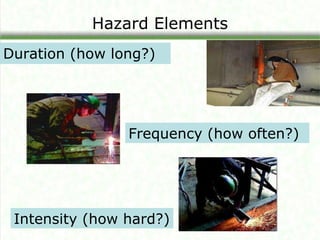
Duration (how long?) Hazard Elements Frequency (how often?) Intensity (how hard?)
Common postures adopted in welding Working in front Working at ground level Working  above the shoulders Working at ground level, precision work Working at ground level, confined space Working above shoulders, confined space ‡ From: Torner et al, 1991
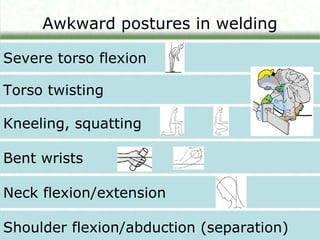
Awkward postures in welding Torso twisting Severe torso flexion Kneeling, squatting Bent wrists Neck flexion/extension Shoulder flexion/abduction (separation)
To simplify the welding performance for the welder and reduce the physical load during the work  Automate physically demanding or repetitive jobs Expand the work content of welders (provide flexibility between jobs) Multi-skilled workers who are able to perform different tasks within a group) The goal of a healthy work environment
Often cost, ease of maintenance, space considerations drive the design process When hazards can’t be engineered out, using best practices is the alternative Examples of good design: providing opportunities for adjustments, providing different sizes, using good planning to eliminate unnecessary work  The Real World
Possible Ergonomic Improvements Heavy Lifting Manipulators Lighter welding equipment, easier to handle Using lighter cables with low stiffness Use cable supporting devices (balancers) Utilize overhead hoists Utilize lifting and turning tables
Ergonomic improvements Awkward Postures Position work between waist and shoulder, when possible  Lifting tables Motorized positioning devices Use welding guns with swivels and designed for use in both hands Work stool
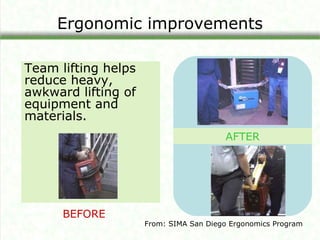
Ergonomic improvements Team lifting helps reduce heavy, awkward lifting of equipment and materials. AFTER From: SIMA San Diego Ergonomics Program BEFORE
Ergonomic improvements To reduce working with the back bent at ground level, any work table will help to adopt a safer posture AFTER From: Shipyard Ergonomics, 2003 BEFORE
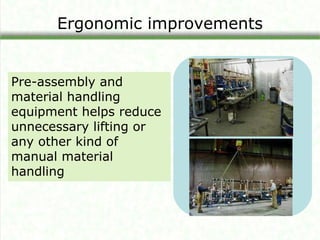
Ergonomic improvements Pre-assembly and material handling equipment helps reduce unnecessary lifting or any other kind of manual material handling
Ergonomic improvements This rotational clamp for pipe helps reduce awkward postures for the neck, shoulders and arms.
Ergonomic improvements Tables for welding and transport reduce manual lifting, carrying of heavy materials.  The tables also have wheels.
Ergonomic improvements Welding leads on pulleys help reduce heavy and awkward lifting, static postures for long periods.
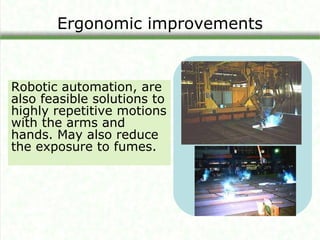
Ergonomic improvements Robotic automation, are also feasible solutions to highly repetitive motions with the arms and hands. May also reduce the exposure to fumes.
Not implementing  some or all these  ergonomics guidelines  may result in the  following… Possible Consequences
Work-related musculoskeletal disorders Often occur when the physical demands of work cause wear and tear Involve soft tissues such as muscles, tendons, ligaments, joints, nerves, blood vessels They are cumulative  (occur over time and not a result of a single incident):
Work-related musculoskeletal disorders Broken bones Cuts Slips Falls Trips Motor vehicle accidents Being struck by or caught with objects They are  not  acute injuries such as:
Back injuries Shoulder pain/loss of range of motion Tendinitis/Bursitis Reduced muscle strength Carpal tunnel syndrome White finger Knee joint diseases Common disorders among welders
The Ergonomics Cycle The ergonomics cycle provides with an organized way to start your ergonomics effort. Employee Involvement Evaluate progress Management  Support Problem Identification Solution Implementation Address  Injuries Training
Credits  The technical contents of this slideshow are based upon the presentation developed by  Ninica Howard, MS, CPE, research ergonomist with the SHARP program at the Washington state Dept. of Labor and Industries.
More resources Shipyard Ergonomics for purchase at Shipbuilders Council of America at  www.Shipbuilders.org NIOSH’s Ergonomic Interventions in the Building, Repair, and Dismantling of Ships   SHARP Program Easy Ergonomics .  A practical approach for improving the workplace  OR OSHA & CAL OSHA Services.  www.cbs.state.or.us/osha/pdf/pubs/3347.pdf On WMSD hazardous exposures visit the WISHA webpage at: www.lni.wa.gov/Safety/Topics/Ergonomics Example Template of an accident prevention program : www.lni.wa.gov/Safety/Basics/Programs/Accident Ideas to reduce hazardous exposures can be found at the  Ergonomics Ideas Bank You may also write us at: [email_address]
Thank you

Ergonomics 6

  • 1.
    Ergonomics in WeldingAn overview of WMSDs* hazardous exposures and solutions *Work-related musculoskeletal disorders
  • 2.
    What will Youlearn Identify WMSDs hazardous exposures in welding jobs Propose solutions for hazardous exposures Find further information about ergonomics in welding operations
  • 3.
    Hazards Weldingoperations are necessary in many industries such as construction, manufacturing, maintenance, etc. Welding has several hazardous conditions for women and men in these jobs.
  • 4.
    Hazards Commonhazards found in welding are: inhaling metals fumes, eye exposure to welding arc light (UV, visible), foreign objects in eyes, burns, noise, cuts, bruises, etc.
  • 5.
    WMSD Hazards Weldingalso includes musculoskeletal disorders (WMSD) hazards such as: awkward body postures, lifting heavy equipment or materials, static postures for prolonged periods, awkward postures of the wrist, etc.
  • 6.
    WA State-funded compensableclaims 1994-2004 Welders, Cutters, Solderers By Nature of Injury Sprains account for more than 1/3 of the compensable claims among welders in the State of Washington. Some of those could be caused by hazardous WMSD exposures.
  • 7.
    WA State-funded compensableclaims 1994-2004 Welders, Cutters, Solderers By Body Part The back, neck and shoulder together with the arm and hand regions make up more than one half of the injuries among welders in Washington State. Preventive efforts should therefore focus on those body parts among welders at your workplace. Welding is a strenuous occupation involving work in awkward postures and handling heavy equipment, usually with a high degree of sustained stress to arm and shoulders.
  • 8.
    Absences due toinjury or illness and the transfer of welders to other tasks Overtime for replacement workers. Welders are skilled employees High employee turnover Increased training and supervisory time Reduced productivity and quality Consequences of a poor working environment
  • 9.
    Rigorous manual precisionrequirements High degree of uniformity Awkward and static postures Difficult work position Heavy lifting, difficult material handling Heavy objects, heavy welding equipment Repetition High work intensity WMDS hazards most common in welding  OFTEN, MORE THAN 1 RISK FACTOR IS PRESENT 
  • 10.
    Duration (how long?)Hazard Elements Frequency (how often?) Intensity (how hard?)
  • 11.
    Common postures adoptedin welding Working in front Working at ground level Working above the shoulders Working at ground level, precision work Working at ground level, confined space Working above shoulders, confined space ‡ From: Torner et al, 1991
  • 12.
    Awkward postures inwelding Torso twisting Severe torso flexion Kneeling, squatting Bent wrists Neck flexion/extension Shoulder flexion/abduction (separation)
  • 13.
    To simplify thewelding performance for the welder and reduce the physical load during the work Automate physically demanding or repetitive jobs Expand the work content of welders (provide flexibility between jobs) Multi-skilled workers who are able to perform different tasks within a group) The goal of a healthy work environment
  • 14.
    Often cost, easeof maintenance, space considerations drive the design process When hazards can’t be engineered out, using best practices is the alternative Examples of good design: providing opportunities for adjustments, providing different sizes, using good planning to eliminate unnecessary work The Real World
  • 15.
    Possible Ergonomic ImprovementsHeavy Lifting Manipulators Lighter welding equipment, easier to handle Using lighter cables with low stiffness Use cable supporting devices (balancers) Utilize overhead hoists Utilize lifting and turning tables
  • 16.
    Ergonomic improvements AwkwardPostures Position work between waist and shoulder, when possible Lifting tables Motorized positioning devices Use welding guns with swivels and designed for use in both hands Work stool
  • 17.
    Ergonomic improvements Teamlifting helps reduce heavy, awkward lifting of equipment and materials. AFTER From: SIMA San Diego Ergonomics Program BEFORE
  • 18.
    Ergonomic improvements Toreduce working with the back bent at ground level, any work table will help to adopt a safer posture AFTER From: Shipyard Ergonomics, 2003 BEFORE
  • 19.
    Ergonomic improvements Pre-assemblyand material handling equipment helps reduce unnecessary lifting or any other kind of manual material handling
  • 20.
    Ergonomic improvements Thisrotational clamp for pipe helps reduce awkward postures for the neck, shoulders and arms.
  • 21.
    Ergonomic improvements Tablesfor welding and transport reduce manual lifting, carrying of heavy materials. The tables also have wheels.
  • 22.
    Ergonomic improvements Weldingleads on pulleys help reduce heavy and awkward lifting, static postures for long periods.
  • 23.
    Ergonomic improvements Roboticautomation, are also feasible solutions to highly repetitive motions with the arms and hands. May also reduce the exposure to fumes.
  • 24.
    Not implementing some or all these ergonomics guidelines may result in the following… Possible Consequences
  • 25.
    Work-related musculoskeletal disordersOften occur when the physical demands of work cause wear and tear Involve soft tissues such as muscles, tendons, ligaments, joints, nerves, blood vessels They are cumulative (occur over time and not a result of a single incident):
  • 26.
    Work-related musculoskeletal disordersBroken bones Cuts Slips Falls Trips Motor vehicle accidents Being struck by or caught with objects They are not acute injuries such as:
  • 27.
    Back injuries Shoulderpain/loss of range of motion Tendinitis/Bursitis Reduced muscle strength Carpal tunnel syndrome White finger Knee joint diseases Common disorders among welders
  • 28.
    The Ergonomics CycleThe ergonomics cycle provides with an organized way to start your ergonomics effort. Employee Involvement Evaluate progress Management Support Problem Identification Solution Implementation Address Injuries Training
  • 29.
    Credits Thetechnical contents of this slideshow are based upon the presentation developed by Ninica Howard, MS, CPE, research ergonomist with the SHARP program at the Washington state Dept. of Labor and Industries.
  • 30.
    More resources ShipyardErgonomics for purchase at Shipbuilders Council of America at www.Shipbuilders.org NIOSH’s Ergonomic Interventions in the Building, Repair, and Dismantling of Ships SHARP Program Easy Ergonomics . A practical approach for improving the workplace OR OSHA & CAL OSHA Services. www.cbs.state.or.us/osha/pdf/pubs/3347.pdf On WMSD hazardous exposures visit the WISHA webpage at: www.lni.wa.gov/Safety/Topics/Ergonomics Example Template of an accident prevention program : www.lni.wa.gov/Safety/Basics/Programs/Accident Ideas to reduce hazardous exposures can be found at the Ergonomics Ideas Bank You may also write us at: [email_address]
  • 31.

Editor's Notes

  • #18 Hazard: Manual wire welding is a primary element in ship construction and repair.  The use of standard straight welding "whips" forces the worker to flex the wrist towards the little finger side.  Carpal Tunnel Syndrome may also be associated with the use of straight welding whips. Solution: A bent-tip wire-welding handle (see photo) allows the worker to maintain a more natural or neutral wrist posture than straight "whips."  In this manner, the tool, not the wrist is bent.
  • #26 Most think of workplace injuries as those that are immediate and have a visible, physical effect (e.g. broken bone, cut) and the causes are tangible, concrete (e.g. slip, hit by object) But injuries can develop over time and not be a result of a single incident. The effects are less visible (tingling, numbness, swelling) which can become more disruptive (pain, loss of function, loss of range of motion).
  • #27 Most think of workplace injuries as those that are immediate and have a visible, physical effect (e.g. broken bone, cut) and the causes are tangible, concrete (e.g. slip, hit by object) But injuries can develop over time and not be a result of a single incident. The effects are less visible (tingling, numbness, swelling) which can become more disruptive (pain, loss of function, loss of range of motion).