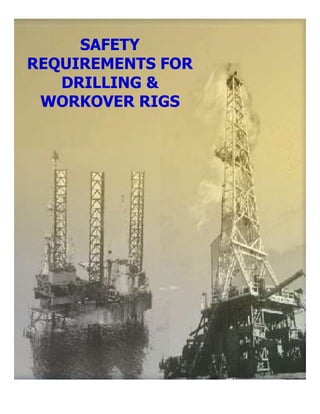
SAFETY
REQUIREMENTS FOR
   DRILLING &
 WORKOVER RIGS
SAFETY REQUIREMENTS FOR
     DRILLING & WORKOVER RIGS


                          © COPYRIGHT 1996, 1999, 2004

              SAUDI ARABIAN OIL COMPANY (SAUDI ARAMCO)


All rights reserved. No part of this book may be reproduced or transmitted in any form
or by any means, electronic or mechanical, including photocopying, recording, or any
information storage and retrieval system, without permission in writing from the Saudi
Arabian Oil Company (Saudi Aramco).
TABLE OF CONTENTS


                                                                Page #
DRILLING & WORKOVER MANAGEMENT
LOSS PREVENTION POLICY STATEMENT …………………………….. 00


SECTION A-INTRODUCTION
A-1    Objectives of this Safety Manual …………………………………….… 01
A-2    Definitions ……………………………………………………………….. 01
A-3    Reference Material ……………………………………………………… 02
A-4    Glossary of Abbreviations ……………………………………………… 05
A-5    Rig Operator’s Responsibilities for Loss Prevention ………….……… 06
A-6    Inspection and Preventive Maintenance ………………………………. 07


SECTION B-GENERAL
B-1    Medical …………………………………………………………………… 08
B-2    Communications ………………………………………………………… 09
B-3    Use of Cellular Phones…………………………………………………… 10
B-4    Personal Protective Equipment ………………………………………… 11
B-5    Clothing ………………………………………………………………….. 12
B-6    Respiratory Protection ………………………………………………….. 13
B-7    Hydrogen Sulfide Safety ……………………………………………….. 19
B-8    Housekeeping ……………………………………………………………. 30
B-9    Rig Camps: Kitchens and Accommodations …………………………. 31
B-10   Fire Extinguishing Equipment …………………………………………. 31
B-11   Truck Loading and Unloading ………………………………………… 35
B-12   Fuel Tanks ……………………………………………………………… 35
B-13   Bulk Storage Tanks..……………………………………………………. 36
B-14   Control of Static Electricity ……………………………………………. 36
B-15   Handling and Storage of Compressed Gas Cylinders ………………… 36
B-16   Electric Wiring and Equipment ……………………………………….. 37
B-17   Illumination..……………………………………………………………                           38
B-18   Tools -- Hand and Power …………………………………………..…… 39
B-19   Abrasive Wheel Machinery …………………………………………….. 40
B-20   Welding and Cutting ……………………………………………………. 41
B-21   Air Compressors ………………………………………………………… 44
B-22   Work Permit System………………………………………………………44
B-23   Lockouts and Tagging …………………………………………………... 46
B-24   Use of Potentially Hazardous Materials……………………………….. 47


SECTION C-RIG EQUIPMENT AND PROCEDURES
C-1    Spudding In and Rig/Location Release…………………….……….…... 50
C-2    Pre-Tour Checklist / Driller Handover Form……………………………50
C-3    Derricks and Masts ……………………………………………………... 51
C-4    Anchoring – Alterations ………………………………………………… 52
C-5    Crown Blocks …………………………………………………………… 52
C-6    Traveling Blocks . ………………………………………………………. 53
C-7    Auxiliary Escape ………………………………………………………… 53
C-8    Guards …………………………………………………………………… 54
C-9    Derrick Exits, Ladders, Stairways, Floors, and Platforms …………... 54
C-10 Scaffolding……………………………………………………………….. 57
C-11 Pipe Racks ………………………………………………………………. 57
C-12 Pipe Handling …………………………………………………………… 57
C-13 Drawworks Controls. …………………………………………………... 58
C-14 Brake …………………………………………………………………….. 59
C-15 Rotary Table ….…………………………………………………………. 59
C-16 Cathead Lines and Spinning Chains ………………………………….. 60
C-17 TDS / Hoisting and Rotary Operations ………………………………. 60
C-18 Slips ……………………………………………………………………… 61
C-19 Hoisting Lines …………………………………………………………... 61
C-20 Riding Hoisting Equipment ……………………………………………. 63
C-21 Elevators ………………………………………………………………… 64
C-22 Manual Tongs …………………………………………………………… 65
C-23 Tong Counterweights …………………………………………………… 65
C-24 Making Up and Breaking Joints ……………………………………….. 66
C-25 Mud Bucket or Saver …………………………………………………… 66
C-26 Power Tongs …………………………………………………………….. 66
C-27 Racking Pipe in Derricks ……………………………………………….. 66
C-28 Finger Boards. ………………………………………………………….. 67
C-29 Stabbing Platforms and Boards ………………………………………... 67
C-30 Safety Belts and Harnesses ……………………………………………... 68
C-31 Blowout Preventors ……………………………………………………… 69
C-32 Safety Valves ……………………………………………………………. 71
C-33 Weight Indicators ………………………………………………………. 71
C-34 Test Plugs ………………………………………………………………… 71
C-35 Rig Tanks or Pit Enclosures …………………………………………… 71
C-36 Pressure Relief Devices, Rig Mud Pumps, Piping, and Hoses.………   72
C-37 Cellars …………………………………………………………………… 73
C-38 Big Bag Handling Systems ……………………………………………... 73
C-39 Chiksans, Straight Joints and Low Torque Valves…………………… 75
      Appendix I & II (Checklist)…………………...………………………..               76
SECTION D-SPECIAL OPERATIONS
D-1   Crane Operations ……………………………………………………….. 79
D-2   Rigging, Material Handling and Slings ……………………………….. 81
D-3   Drill Stem Testing ………………………………………………………..82
D-4   Swabbing ………………………………………………………………… 83
D-5   Cementing ……………………………………………………………….. 83
D-6   Well Servicing and Well Stimulation ………………………………….. 83
D-7   Stripping and Snubbing ……………………………………………….. 84
D-8   Flare Pits and Flare Lines ……………………………………..………. 85
D-9   Journey Management ………………………………………………….. 85
D-10 Coil Tubing Safety………………………………………………………. 86
D-11 Service Company Operations……………………………………………86


SECTION E-OFFSHORE
E-1   Overwater Operations ………………………………………………… 88

E-2   Life Saving Equipment -- Offshore Rigs …………………………….. 89

E-3   Heliports and Helicopter Operations ………………………………… 92

E-4   Personnel Transfer: Boat and Rig …………………………………..… 95
SAUDI ARABIAN OIL COMPANY
apgruullgS.ol ' .                        (SAUDI ARAMCO)
 SaudiArom<o


                     DRILLING & WORKOVER OPERATIONS DEPARTMENTS

                              LOSS PREVENTION POLICY STATEMENT


      The Drilling & Workover organization is committed to the protection of Saudi Aramco resources,
      including employees and physical assets, against human distress and financial loss resulting from
      accidental occurrences.

      In fulfilling this commitment, which is essential to and equally important as operational objectives,
      we will provide and maintain a safe and healthy work environment and protect the public against
      foreseeable hazards resulting from our operations. Reduced drilling I workover efficiency and
      property losses resulting from accidental occurrences can be controlled through good management.
      Loss prevention is one aspect of this process and is the direct responsibility of line management.

      All Saudi Aramco drilling and workover activities and functions, including onshore and offshore
      activities, will comply with Saudi Arab Government and Saudi Aramco loss prevention requirements
      as applied to the design, operation and maintenance of facilities and equipment. When conformity
      with any of these requirements would not be practical or cost effective, a waiver will be sought.
      Reviews for compliance with this policy will be performed on a selective basis.

      Risks to personnel and property will be minimized through application of the best petroleum
      industry loss control programs.    By applying these programs, the Drilling and Workover
      organization will achieve the main objectives of the Saudi Aramco Corporate Loss Prevention
      program.

      To fulfill this commitment, the dedication and cooperation of all Saudi Aramco and Contractor
      personnel associated with drilling and workover are required and expected.


          W.H. TURK!,Manager                              K.E. AL BARRY,Manager (AA)
          Gas Drilling & Workover Department              S.A. Oil Drilling & Workover Department


          K.A. AL BURAIK,Manager (AA)
          N.A. Oil Drilling & Workover Department


                                                           eneral Manager
SECTION A: INTRODUCTION
A-1      OBJECTIVES OF THIS SAFETY MANUAL

          The objectives of this manual are to:

1.    Establish Saudi Aramco safety rules directly applicable to drilling and workover
      activities, and

2.    Establish a uniform and comprehensive set of safety requirements that are
      equally applicable to Contractor and Company-owned drilling and workover
      rigs.

A-2     DEFINITIONS

        RIG OPERATOR: In this document, the term "RIG OPERATOR" means the
        agency or company responsible for operating any drilling or workover rig,
        and/or providing any drilling or workover rig services on behalf of the Saudi
        Arabian Oil Company (Saudi Aramco).

        COMPANY: The term, "COMPANY", as used throughout this document,
        shall be understood to mean the Saudi Arabian Oil Company (Saudi Aramco).
        It shall include the management of the Drilling and Workover Operations
        Departments of Article but can also include all other of management of Saudi
        Aramco.

        LOSS PREVENTION: The definition of the term, "LOSS PREVENTION," as
        used in these “Safety Requirements” is stated in the Saudi Aramco
        Corporate Loss Prevention Manual”:      “Loss in productivity and property
        resulting from accidental occurrences that can be controlled through good
        management. Loss prevention is one aspect of this process and is the direct
        responsibility of line management.”    The Dhahran Area Loss Prevention
        Division, Exploration &, Development Unit (E&DU) has the responsibility for
        Loss prevention Department (LPD) technical assistance to the COMPANY,
        Drilling and Workover, Exploration and Petroleum Engineering organizations
        throughout the Kingdom of Saudi Arabia.


REV. JUNE 2004                                                     Safety Requirement for
                                                                  Drilling & Workover Rigs
                                    -- Page 1 of 95 --
A-3              REFERENCE MATERIAL

In addition to this publication, the RIG OPERATOR shall have readily available for
reference to drilling or workover personnel the most recent publications as follows:-
IADC                  Drilling Manual
IADC                  Accident Prevention
API SPEC 4A           Steel Derricks
API SPEC 4E           Drilling and Well Servicing Structures
API BULL 5C2          Performance Properties of Casing, Tubing, and Drill Pipe
API BULL 5C4          Round Thread Casing Joint Strength With Combined Internal
                      Pressure and Bending
API SPEC 6A           Wellhead Equipment
API SPEC 7            Rotary Drilling Equipment
API SPEC 7 B-11C      Internal Combustion Reciprocating Engines For Oil Field
                      Service
API RP 7G             Drill Stem Design And Operating Limits
API RP 7H             Drilling Machinery
API SPEC 8            Drilling and Production Hoisting Equipment
API RP 8B             Hoisting Tool Inspection and Maintenance Procedures
API SPEC 9A           Wire Rope
API RP 9B             Application, Care and Use of Wire Rope For Oil Fields
API SPEC 13A          Oil Well Drilling Fluid Materials
API BULL 13C          Drilling Fluid Processing Equipment
API RP 49             Recommended Practice for Drilling and Well Servicing
                      Operations involving Hydrogen Sulfide
API RP 52             Recommended Land Drilling           Operating      Practices     for
                      Protection of the Environment
API RP 54             Recommended Practices for Occupational Safety and Health
                      for Oil and Gas Drilling and Servicing Operation
API RP 500            Recommended Practice for Classification of Location for
                      Electrical Installation at Petroleum Facilities.
API 510               Pressure Vessel Inspection Code


REV. JUNE 2004                                                      Safety Requirement for
                                                                   Drilling & Workover Rigs
                                    -- Page 2 of 95 --
API RP 2020      Safe Practices in Drilling Operations
ANSI Z88.2       American National         Standard       Practices     for    Respiratory
                 Protection
ANSI Z89.1       Protective Head ware for Industrial Workers - Requirements
ANSI Z41.83      Protective Footwear
ANSI NFPA-70     Grounding Separately Derived Alternating-Current Systems
NACE MR0175      Metals for Sulfide Stress Cracking and Stress Corrosion
                 Cracking Resistance in Sour Oilfield Environments
G.I. 2.100       Work Permit System
G.I. 2.104       Leak and Spill Reporting - Arabian Gulf
G.I. 2.400       Offshore Oil (Spill) Contingency Plan
G.I. 2.401       Inland Oil Spill Contingency Plan
G.I. 6.012       Isolation, Lockout and Use of Hold Tags
G.I. 6.020       Personal Flotation Devices (PFDS) for Work On, Over or Near
                 Water
G.I. 6.025       Control of     Remote         Area     Travel    and    Search/Rescue
                 Procedures
G.I. 7.024       Marine and Offshore Crane, Hoist, and Rigging Operations
G.I. 7.025       Mobile Heavy Equipment Operator Testing and Certification
G.I. 7.026       Cranes and Heavy Equipment Accident Reporting Procedures
G.I. 7.027       Crane Suspended Personnel Platform Operations (Manbasket)
G.I. 7.028       Crane Lift: Types and Procedures
G.I. 7.029       Inspection Use and Maintenance of Below-the-Hook Lifting
                 Equipment for Cranes
G.I. 7.030       Inspection &     Testing       Requirements       of   Elevating/Lifting
                 Equipment
G.I. 8.001       Safety Requirements for Scaffolds
G.I. 151.006     Implementing the Saudi Aramco Sanitary Code
G.I. 1780.001    Atmosphere-Supplying Respirators
G.I. 1781.001    Inspection, Testing       &        Maintenance   of    Fire    Protection
                 Equipment


REV. JUNE 2004                                                      Safety Requirement for
                                                                   Drilling & Workover Rigs
                               -- Page 3 of 95 --
G.I. 1850.001     Onshore Contingency Plan
G.I. 1851.001     Offshore Contingency Plan
G.I. 1852.001     Rig site Flare Gun and Communication Equipment
G.I. 1853.001     Isolation Barriers for Wells During Drilling & Workover
                  Operations (With and Without Rig) Rig & Equipment Operations
                  and Maintenance Manuals for the Drilling Rig Manufacturers
                  and Other Major Equipment Items
Saudi Aramco      Crane Safety Handbook
Saudi Aramco      Construction Safety Manual
Saudi Aramco      Drilling & Workover Drilling Manual
Saudi Aramco      Land Based Remote Travel Control (Supplement to GI 6.025)
Saudi Aramco      Marine Instruction Manual
Schedule „D”      Contractor‟s Safety & Loss Prevention Requirements

SAES-A-103        Discharges to the Marine Environment

SAES-A-105        Noise Control
SAES-B-019        Portable, Mobile and Special Fixed Firefighting Equipment
SAES-B-062        Onshore Wellsite Safety
SAES-B-063        Aviation Obstruction Marking and Lighting
SAES-B-067        Safety Identification and Safety Colors Coding
SAES-B-068        Electrical Area Classification
SAES-B-069        Emergency Eyewashes and Showers

SAES-J-505        Combustible Gas and Hydrogen Sulfide in Air Detection
                  Systems

SAES-P-111        Grounding

SAES-W-010        Welding Requirements for Pressure Vessels

12-SAMSS-023      Fiber-Reinforced Plastic (FRP) Grating and FRP Components
NOTE: Assistance in obtaining copies of Saudi Aramco documents is provided by
the Dhahran area Loss Prevention Division - Westpark 3, Room 244A, Telephone
874-8419, and Dhahran. Saudi Aramco cannot copy or distribute non-Saudi Aramco
documents such as ANSI, API or IADC copyrighted documents.


REV. JUNE 2004                                                 Safety Requirement for
                                                              Drilling & Workover Rigs
                                  -- Page 4 of 95 --
A-4          GLOSSARY OF ABBREVIATIONS
SAES             Saudi Aramco Engineering Standards
SAG              Saudi Arabian Government

SAMSS            Saudi Aramco Material System Specification
ANSI             American National Standards Institute

API              American Petroleum Institute

BOP              Blowout Preventor

G.I.             (Saudi Aramco) General Instruction

IADC             International Association of Drilling Contractors
MODU             Mobile Offshore Drilling Unit

NACE             National Association of Corrosion Engineers

NEC              (American) National Electrical Code

NFPA             (American) National Fire Protection Association

SCR              Silicon Controlled Rectifier

SWL              Safe Working Load (Limit)

UKDOT            United Kingdom Department of Trade

USCG             United States Coast Guard


REV. JUNE 2004                                                        Safety Requirement for
                                                                     Drilling & Workover Rigs
                                         -- Page 5 of 95 --
A-5     RIG OPERATORS' RESPONSIBILITIES FOR LOSS PREVENTION

Throughout all phases of any drilling or workover operation the RIG OPERATOR will
be held accountable for the prevention of accidental losses, the protection of
COMPANY interests and resources, and the avoidance of any contamination of the
environment.

The following minimum guidelines are provided to aid the RIG OPERATOR in
meeting this responsibility. Assistance in complying with the requirements set forth
in these guidelines is available from Drilling and Workover Management or from the
Loss Prevention Department of the COMPANY.

1.    The RIG OPERATOR shall establish a written loss prevention program that
      fulfills all the requirements stated in this Manual including permit to work system
      for RIG OPERATOR and all third party rig ups.

2.    Any loss prevention program of the RIG OPERATOR shall provide for frequent
      and regular inspections of the rig equipment, materials, and accommodations
      by competent persons designated by the RIG OPERATOR. This inspection
      shall be completed on a monthly basis and submitted to the COMPANY Drilling
      Superintendent with responsibility for the oversight of each rig.

3.    The RIG OPERATOR shall provide at each drilling and workover rig a copy of
      the reference materials (listed earlier on page 10) necessary for the safe
      operation of the rig.

4.    The RIG OPERATOR is responsible to ensure that all personnel arriving on
      location, register and receive a general safety & H2S orientation as directed by
      the rig foreman.

5.    The RIG OPERATOR shall be thoroughly familiar with the drilling or workover
      program. He shall inform the rig crew of any potential adverse conditions (i.e.,
      lost circulation zones, high reservoir pressure, high H2S concentrations, etc.)
      that require special safety precautions, training, equipment, or additional
      personnel.

6.    The RIG OPERATOR shall clearly indicate the "SMOKING PERMITTED" areas
      around each rig location. All other areas on the location will be considered as
      "NO SMOKING" areas and shall be marked accordingly. Smoking shall be
      closely controlled throughout the rig location.

7.    The RIG OPERATOR shall take all reasonable safety precautions to prevent oil
      spills or pollution both onshore and offshore. If an accidental spill or discharge
      does occur, every effort shall be made to (a) protect human life, including both
      employees and the public, and (b) minimize the impact on the environment.
      Should an accidental spill occur, it shall be reported immediately to the
      COMPANY representative so that he can take the necessary steps to contain
      the spill and implement the applicable reporting requirements of G.I. 2.104, G.I.
      2.400, or G.I. 2.401.
8.    The RIG OPERATOR shall adequately train each of his employees in the
      recognition and avoidance of unsafe conditions and in all COMPANY loss
      prevention standards applicable to his work environment. He shall also

REV. JUNE 2004                                                      Safety Requirement for
                                                                   Drilling & Workover Rigs
                                     -- Page 6 of 95 --
adequately train his employees in methods to control or eliminate any hazards
     or other exposures resulting in injury or illness.

9.   The RIG OPERATOR's employees, who are required to handle or use poisons,
     caustics, acids and other harmful substances, shall be adequately trained
     regarding their safe handling and use. The RIG OPERATOR's supervisors
     shall discuss the potential hazards, personal hygiene, and necessary personal
     protective equipment prior to their employees handling any harmful materials.
     The RIG OPERATOR will maintain water stations for washing chemicals spills
     and Material Safety Data Sheets for all potentially hazardous chemicals the RIG
     OPERATOR orders onto the rig. Note: Saudi Aramco will supply MSDS for
     materials Saudi Aramco orders.

10. The RIG OPERATOR shall allow only those personnel qualified by training
    and/or experience to operate equipment and machinery. The RIG OPERATOR
    shall also ensure that any personnel requiring operator's certificates have them,
    or copies thereof, in their possession and have completed any training which
    may be required by the laws of the Kingdom of Saudi Arabia or by the
    COMPANY.

11. RIG OPERATORS providing offshore rigs shall ensure that their rigs are kept in
    compliance with all applicable maritime/MODU standards of the country in
    which the rig is registered as well as any applicable laws and regulations of the
    Kingdom of Saudi Arabia or the COMPANY.

12. A RIG OPERATOR providing offshore rigs shall ensure that all required
    certifications are current and that re-certification inspections are completed by
    an approved certification authority prior to the expiration of the existing
    certificate.

13. On all offshore rigs, a copy of the Barge Marine Operations Manual shall be
    kept readily available in the control room for consultation and use. The manual
    shall include a complete set of operating instructions, control systems diagrams,
    and stability characteristics.

14.. Any special or unusual towing characteristics of an offshore rig shall be
     included in the operating instructions and communicated to the towing vessel
     operators before towing operations begin.
15. A RIG OPERATOR providing offshore rigs shall ensure that all navigation and
    transit lights are operable and used as required by International Rules and
    Regulations for Aids to Navigation.

16. Should a conflict arise between a RIG OPERATOR's safety requirement and a
    COMPANY requirement, the most restrictive requirement shall apply.

A-6 INSPECTION AND PREVENTIVE MAINTENANCE

The RIG OPERATOR is responsible for providing drilling or workover rig(s),
including all auxiliary equipment that is structurally and mechanically capable of
performing according to the agreement between the RIG OPERATOR and the
COMPANY. In order to assure the COMPANY that all equipment is in good working

REV. JUNE 2004                                                   Safety Requirement for
                                                                Drilling & Workover Rigs
                                   -- Page 7 of 95 --
condition, the RIG OPERATOR shall conduct a physical inspection of its rig and all
auxiliary equipment on a regular basis – no less than once per month.

The RIG OPERATOR will implement a comprehensive preventive maintenance
program to keep equipment in good working condition.

SECTION B: GENERAL
B-1    MEDICAL

1.      Each RIG OPERATOR shall comply with the Saudi Arabian Ministry of Labor
        and Social Affairs Decision Number 404, dated 7 July 1974, entitled "First Aid
        Facilities at Work Sites". A copy of this document or an English language
        translation is available from the Drilling and Workover Operations Manager or
        from Dhahran Area Loss Prevention.

2.     The RIG OPERATOR, with the assistance of the COMPANY as required,
       prior to the start of drilling or workover operations, shall identify the nearest
       trauma clinic or physician or hospital and shall make provisions for the
       PROMPT transportation of a victim of injury or sudden illness to the
       physician, hospital or clinic or to summon emergency medical personnel to
       the location. Also, prior to the start of operations, the COMPANY shall
       provide an effective communication system for contacting necessary medical
       and emergency agencies with written posted procedures for medical
       evacuation [Medivac].

3.     The RIG OPERATOR, with the assistance of the COMPANY as required,
       shall furnish to any person injured in his employment who is in need of
       medical attention immediate transportation to a hospital, physician, or clinic
       for the purpose of treatment.

4.      Telephone numbers of the physician, hospital, ambulance, and helicopter
        services shall be conspicuously posted by the COMPANY in the
        Representative‟s office, Rig Manager's office, the rig medic station, and the
        radio room. These numbers are to be posted as soon as possible after
        moving to a new location.

5.     The vehicle or conveyance used for transport of the injured shall in addition to
       contractual requirements:

        (a)      Be of sufficient size and suitable to accommodate a stretcher and
                 accompanying person entirely within the body of the vehicle or
                 conveyance.

        (b)      Be clean and well maintained.

        (c)      Protect the injured worker and the accompanying person.


REV. JUNE 2004                                                     Safety Requirement for
                                                                  Drilling & Workover Rigs
                                      -- Page 8 of 95 --
(d)      Be designed and equipped such that verbal communication between
                 the operator of the vehicle or conveyance and the injured worker or
                 accompanying person is possible.

6.      When immediate transport of the injured is necessary and circumstances do
        not allow compliance with Item #5 (above), the senior supervisor at the site
        shall use any available means of suitable transportation.

7.     A reliable means of communication shall be provided by the COMPANY from
       the rig site to base of operations and other outside locations.

8.     The RIG OPERATOR shall provide at each rig, qualified medic on the rig,
       adequate first aid equipment and emergency treatment facilities.

9.     Each rig shall be equipped with two stretchers (Stokes, Navy, Scoop) with
       blankets and securing straps that are capable of being carried on the
       helicopter or transportation serving the rig.

10.     While being transported, all victims shall be accompanied by the rig medic in
        addition to the driver or pilot. If a rig medic is not available, the accompanying
        person shall have valid up-to-date first aid certification.

11.     The RIG OPERATOR shall complete Saudi Arabian Government Form 11 for
        each of his injured employees requiring medical treatment and submit the
        completed form(s) within three days to the nearest Social Insurance Office.
        The RIG OPERATOR shall also comply with any other reports or
        investigations required by the laws of the Kingdom of Saudi Arabia. He shall
        advise the responsible Aramco Government Affairs Office of all pertinent
        information on a timely basis.

12.     All RIG OPERATOR employee injuries shall be reported promptly to the
        COMPANY Representative. A RIG OPERATOR accident/injury form will be
        completed at the rig site, reviewed by the COMPANY Representative and
        sent to the appropriate COMPANY Superintendent within 24 hours.

13.     Conduct Disaster Drills as specified in the procedures published by the
        COMPANY.


B-2     COMMUNICATIONS

1.     Reliable communications, radio and/or telephone, shall be maintained at all
       times between the rig and operations base. Offshore rigs must also be able
       to communicate with other rigs, helicopters, and vessels in the vicinity.

2.      On all offshore rigs, on-site communication shall be done using an intercom

REV. JUNE 2004                                                       Safety Requirement for
                                                                    Drilling & Workover Rigs
                                     -- Page 9 of 95 --
type system and necessary in an emergency must be provided by the RIG
        OPERATOR.

3.     Every rig shall be equipped with a general alarm system capable of providing
       an alarm audible throughout the entire installation. In areas of high noise
       levels, visual warning signals such as flashing lights shall be provided in
       addition to the audible alarms. The RIG OPERATOR shall ensure that visual
       warning signals are not screened or hidden by equipment, machinery, or
       structure.

4.     Each rig shall be equipped with a public address system capable of clearly
       transmitting emergency instructions.

5.      Both the general alarm system and the public address system shall be
        operable from the main control room and from other control positions on the
        installation.

6.     The general alarm and public address system shall be supplied with power
       from both the normal and emergency power supply.

B-3     CELLULAR TELEPHONE USE ON DRILLING RIGS

1.     Cellular telephones are prohibited on all Saudi Aramco drilling & workover rig
       work sites.

         Work site is defined as anywhere on the rig location except as specified in
        sections 2.1 to 2.4 below

        Cellular telephones are not classified as safe to operate in a potentially
        flammable atmosphere, in addition to distracting personnel from their jobs at
        hand. They therefore pose an unacceptable safety risk on a drilling or
        workover rig work site

2.     All persons entering a Saudi Aramco drilling & workover rig work site must
       leave their cellular telephones in one of the following places:

                 2.1.   In their room at camp (or in offshore accommodations).

                 2.2.   In the Drilling Foreman‟s office.

                 2.3.   With the rig Medic as the rig site Medic‟s office (or offshore rig
                        infirmary)

3.      Service company employees may leave their cellular telephones in their
        vehicles, provided the vehicles are properly parked on the edge of the
        location.

REV. JUNE 2004                                                        Safety Requirement for
                                                                     Drilling & Workover Rigs
                                       -- Page 10 of 95 --
4.      Persons expecting a critical call must make arrangements with either the rig
        Medic or the Saudi Aramco Drilling Foreman to alert them to an incoming call.

        Note, however that it is not Saudi Aramco‟s responsibility to field such calls.
        Depending on the task at hand the Drilling Foreman or Medic may not be able
        to field calls. Anyone found with a cellular telephone on a Saudi Aramco
        drilling & workover rig work site will be removed from the site and a letter will
        be sent to their employer.

5.     Saudi Aramco reserves the right to bar repeat offenders from entering a
       drilling & workover rig work site.


B-4     PERSONAL PROTECTIVE EQUIPMENT

Personal protective equipment can never prevent an accident. It does, however,
serve to minimize the effects of an accident if an accident does occur. The RIG
OPERATOR is responsible to require the wearing of approved personal protective
equipment at all times where its use could protect personnel.

1.     The RIG OPERATOR shall post warning signs in areas where the use of
       personal protective equipment is required.

2.      Protective headgear, boots, eye protection and gloves shall be worn by all
        personnel working at a drilling or workover well site.

3.      Protective headgear shall meet or exceed the requirements of ANSI Z89.1.
        Note: Metal hard hats are forbidden per Saudi Aramco Construction Safety
        Manual.

4.     Properly fitting goggles, face-shields, or other eye protection equipment
       appropriate to the work being done, shall be worn by all personnel who are
       handling or exposed to any material capable of causing injury or irritation to
       the eyes, or engaged in any work in which there is an eye hazard from flying
       objects, injurious light, heat rays, or radiation.

5.     Safety steel-toe boots or shoes shall be worn by all personnel when working
       on or about a drilling or workover rig as per ANSI Z41.83.

6.     The RIG OPERATOR shall provide, and all personnel will wear, suitable
       protective clothing and equipment including appropriate respiratory protection,
       when handling acids, caustics, or other harmful substances which are
       potentially harmful or hazardous to the skin. Any rig employee handling dry
       mud material must wear adequate personal protective clothing, including
       proper eye and face protection.

REV. JUNE 2004                                                      Safety Requirement for
                                                                   Drilling & Workover Rigs
                                     -- Page 11 of 95 --
7.     The RIG OPERATOR shall ensure that, when the clothing or skin of any
       personnel becomes contaminated with any flammable or harmful substance,
       those exposed shall get in the shower and then remove their clothing and
       wash the affected part of the body. The clothing shall be decontaminated
       before re-use.

8.     The RIG OPERATOR shall provide hearing protection in areas where the
       noise levels are above 90 DBA. RIG OPERATOR shall post warning signs
       informing all personnel that hearing protection is required while working in
       that area.

9.      Hearing protection equipment, including head phone type hearing protection
        or soft ear plugs, shall be readily available to personnel working in high noise
        level areas.

10.     All personal protective equipment shall be kept in a sanitary condition and
        maintained to perform satisfactorily the function for which it was designed.

11.    The RIG OPERATOR shall provide emergency eye wash and or shower
       stations where necessary to provide immediate relief to any personnel who
       may be contaminated with a harmful substance. The eye wash stations shall
       be capable of providing a minimum of 15 minutes of fresh, clean water to
       irrigate eyes that have been contaminated by some hazardous material.
       Where hard piping systems are not practical, self contained units shall be
       used with a suitably buffered solution. These units are to be shaded and or
       insulated to minimize temperature variations. The delivered water
       temperature at the eyewash and or shower stations shall range between 15°C
       and 38°C. The RIG OPERATOR shall maintain these eye wash stations in
       good condition continually ready for use per SAES-B-69, “Eye Wash Station
       and Showers”.

12.    The RIG OPERATOR shall post identification signs to mark the location of all
       emergency equipment such as emergency eye wash stations.

WORK SMART
Your Personal Protective Equipment (PPE) is your final protection against
accidents and injuries. Your special skills and safety attitude is your primary
protection against accidents and injuries.

B-5              CLOTHING

1.      The RIG OPERATOR shall ensure that all his personnel wear clothing
        suitable for the existing conditions and the work being performed. The RIG
        OPERATOR shall specifically prohibit his personnel from working without
        shirts or in short trousers.


REV. JUNE 2004                                                      Safety Requirement for
                                                                   Drilling & Workover Rigs
                                     -- Page 12 of 95 --
2.     RIG OPERATOR personnel shall not unnecessarily expose any part of the
       body to substances which may be harmful or hazardous to the skin.

3.     Where there is danger of contact with moving parts of machinery or in any
       work process where a similar hazard exists:

        (a)      Close fitted clothing shall be worn,

        (b)      Head and facial hair shall be completely confined or cut short, and

        (c)      Dangling neckwear, jewelry, or other similar items shall not be worn.

B-6     RESPIRATORY PROTECTION

1.     The RIG OPERATOR shall ensure that all respiratory protection equipment,
       needed by or reasonably anticipated to be needed by his employees, is
       provided. Those employees required to use this equipment must be trained
       in its effective use. This training MUST include practice in the maintenance
       and use of this equipment. This equipment may be provided by the
       Contractor or by the COMPANY, depending upon the terms and conditions of
       the contract.

2.      The RIG OPERATOR shall ensure that the required respiratory protection
        equipment is maintained and used as intended, and that it provides all
        personnel with adequate protection against all anticipated hazardous
        atmospheres.

3.     Such respiratory protection equipment shall be readily available, maintained
       in good working order, in a sanitary condition, and inspected every 30 days
       per GI-1780.001.

4.     Unless protected by respiratory protection equipment, no personnel shall be
       allowed to enter any area:

        (a)      Where the oxygen content of the atmosphere is less than 20 per cent
                 by volume, or

        (b)      Where the atmosphere is contaminated or in danger of being
                 contaminated by any airborne substance that may be considered to be
                 harmful.

5.     All respiratory protection equipment shall be a supplied air apparatus in the
       form of:

        (a)      Self-Contained Breathing Apparatus (SCBA), or


REV. JUNE 2004                                                       Safety Requirement for
                                                                    Drilling & Workover Rigs
                                       -- Page 13 of 95 --
(b)      Hose-line work masks, including an emergency escape cylinder.

6.      On all drilling and workover rigs operating in known hydrogen sulfide areas or
        on any rig drilling a wildcat well, there shall be on each rig at least the
        minimum amount of respiratory protection equipment required in the
        drilling/workover contract.

7.      Where respiratory protection equipment is or may be required to be worn in
        areas which are or may be contaminated with substances immediately
        dangerous to life or health, RIG OPERATOR shall ensure that excessive
        facial hair which prevents effective sealing of the face shall be removed.

     8. Refer to Section B-5, Appendix I for further information regarding Respiratory
        Protective Equipment.


                              Section B-6 Appendix I:

        REQUIREMENTS FOR MINIMAL ACCEPTABLE RESPIRATORY
        PROTECTION PROGRAM

        Each RIG OPERATOR shall develop and put into practice a respiratory
        protection program that meets or exceeds the following criteria as per G.I.
        1780.001.

1.      Written standard operating procedures governing the selection and use of
        respiratory protective equipment.

2.      Respiratory protective equipment shall be selected on the basis of the
        hazards to which the worker is exposed. The airborne hazards most likely to
        be encountered in drilling and Workover operations are:

        (a)      Immediately dangerous to life or health (IDLH) atmospheres that
                 require the use of supplied-air respiratory protection equipment. This
                 equipment includes the hose-line work masks, including an escape
                 cylinder, and self-contained breathing apparatus (SCBA). The most
                 likely IDLH atmospheres that may be encountered at drilling and
                 workover locations are:

                 (1)   Toxic vapors and gases, such as H2S.

                 (2)    Atmospheres containing less than 20 per cent oxygen, by
                        volume.

        (b)      Corrosive or irritating particulate matter for which full-face filter mask
                 protection is required. It is very important the proper filters be used.

REV. JUNE 2004                                                        Safety Requirement for
                                                                     Drilling & Workover Rigs
                                       -- Page 14 of 95 --
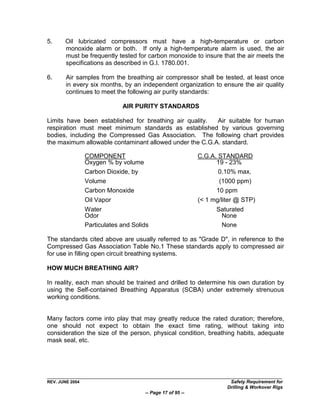
3.     The user shall be instructed and trained by the RIG OPERATOR in the proper
       use of respiratory protective equipment and their limitations. This training
       must include:

        (a)      Instructions on the selection of the proper respiratory protection
                 equipment for each potential hazard an employee may encounter.

        (b)      Instructions in the wearing and use of this equipment. This training
                 MUST include drills in which the equipment is used and worn under
                 simulated emergency conditions.     (BOP drills while wearing work
                 masks, for instance.)

        (c)   Proper cleaning and sanitizing of the equipment after it is worn and
              used. It is very important each user of this equipment understands
              how important it is to properly clean and sanitize this equipment after
              each wearing, even for equipment that may be permanently assigned
              to him.
4.     Where possible, respiratory protective equipment should be assigned to
       individual workers for their exclusive use.

5.     Respiratory protective equipment shall be regularly cleaned and disinfected.
       Those issued for the exclusive use of one worker are to be cleaned after each
       day's use, or more often if necessary. Those used by more than one worker
       are to be thoroughly cleaned and disinfected after each use. Cleaning this
       equipment must be included in the training and use of the equipment. Aside
       from understanding how to use the equipment for maximum possible
       protection, cleaning is of paramount importance.

6.     A log shall be maintained by the RIG OPERATOR that documents the
       cleaning and maintenance of respiratory protective equipment.

7.     Respiratory protective equipment shall be stored in a convenient, clean and
       sanitary location. One practical method for keeping this equipment clean and
       ready for use is to cover the storage cases with a tear-away plastic trash
       bags. This equipment must always be ready for immediate emergency use.
       This is possible only if it is stored properly.

8.     Respiratory protective equipment shall be inspected during cleaning. Worn or
       deteriorated parts shall be replaced. Respiratory protective equipment for
       emergency use, such as self-contained devices, shall be thoroughly
       inspected by the RIG OPERATOR at least once a month and after each use.
       Every rig inspection must include a careful inspection of all respiratory
       protection equipment.

9.     Appropriate surveillance of work area conditions and the degree of employee
       exposure or stress shall be maintained. The RIG OPERATOR is responsible

REV. JUNE 2004                                                    Safety Requirement for
                                                                 Drilling & Workover Rigs
                                     -- Page 15 of 95 --
for knowing what respiratory exposures may be present and must alert all
        personnel when protective equipment is required. The level of exposure to a
        given substance is determined by continuous area monitoring, personal
        monitoring and warning devices, or from studying the Material Safety Data
        Sheets (MSDS) for each substance used on the location,            The RIG
        OPERATOR is responsible for requiring the use of the proper equipment at all
        times when exposure limits exceed acceptable limits.

10.     There shall be regular inspection and evaluation to determine the continued
        effectiveness of the program. The RIG OPERATOR is responsible for his
        respiratory protection program.      In meeting that responsibility a RIG
        OPERATOR must know that all equipment is in good condition and is ready
        for use when needed. A part of every LOSS PREVENTION inspection will be
        to evaluate the state of the entire respiratory protection program of each
        location visited.

11.     Persons should not be assigned to tasks requiring the use of respiratory
        protective equipment unless it has been determined that they are physically
        able to work while wearing the equipment. Any employee who may, in the
        course of his employment, be required to wear respiratory protection
        equipment must pass an annual examination by a competent medical staff.
        This examination must include a pulmonary function test.

12.     Compressed air used for breathing purposes shall comply with the standards
        recommended in G.I. 1780.001.

                                  COMPRESSORS

        THE COMPRESSOR FOR SUPPLYING BREATHING AIR SHOULD MEET
        THE REQUIREMENTS OF G.I. 1780.001.

1.     Breathing air compressors should be equipped with necessary safety and
       standby devices.

2.     Breathing air compressors should be situated so as to avoid entry of
       contaminated air.

3.     They should be equipped with purifying sorbet beds and filters to further
       assure greater air quality.

4.     They must be equipped with alarms to indicate compressor failure and/or
       overheating.


REV. JUNE 2004                                                   Safety Requirement for
                                                                Drilling & Workover Rigs
                                   -- Page 16 of 95 --
5.     Oil lubricated compressors must have a high-temperature or carbon
       monoxide alarm or both. If only a high-temperature alarm is used, the air
       must be frequently tested for carbon monoxide to insure that the air meets the
       specifications as described in G.I. 1780.001.

6.      Air samples from the breathing air compressor shall be tested, at least once
        in every six months, by an independent organization to ensure the air quality
        continues to meet the following air purity standards:

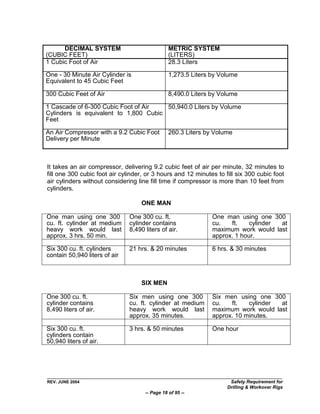
                              AIR PURITY STANDARDS

Limits have been established for breathing air quality.  Air suitable for human
respiration must meet minimum standards as established by various governing
bodies, including the Compressed Gas Association. The following chart provides
the maximum allowable contaminant allowed under the C.G.A. standard.

                 COMPONENT                                  C.G.A. STANDARD
                 Oxygen % by volume                               19 - 23%
                 Carbon Dioxide, by                                0.10% max.
                 Volume                                            (1000 ppm)
                 Carbon Monoxide                                  10 ppm
                 Oil Vapor                                  (< 1 mg/liter @ STP)
                 Water                                            Saturated
                 Odor                                              None
                 Particulates and Solids                           None

The standards cited above are usually referred to as "Grade D", in reference to the
Compressed Gas Association Table No.1 These standards apply to compressed air
for use in filling open circuit breathing systems.

HOW MUCH BREATHING AIR?

In reality, each man should be trained and drilled to determine his own duration by
using the Self-contained Breathing Apparatus (SCBA) under extremely strenuous
working conditions.


Many factors come into play that may greatly reduce the rated duration; therefore,
one should not expect to obtain the exact time rating, without taking into
consideration the size of the person, physical condition, breathing habits, adequate
mask seal, etc.


REV. JUNE 2004                                                         Safety Requirement for
                                                                      Drilling & Workover Rigs
                                      -- Page 17 of 95 --
DECIMAL SYSTEM                            METRIC SYSTEM
(CUBIC FEET)                                    (LITERS)
1 Cubic Foot of Air                             28.3 Liters

One - 30 Minute Air Cylinder is                 1,273.5 Liters by Volume
Equivalent to 45 Cubic Feet

300 Cubic Feet of Air                           8,490.0 Liters by Volume

1 Cascade of 6-300 Cubic Foot of Air   50,940.0 Liters by Volume
Cylinders is equivalent to 1,800 Cubic
Feet

An Air Compressor with a 9.2 Cubic Foot         260.3 Liters by Volume
Delivery per Minute


It takes an air compressor, delivering 9.2 cubic feet of air per minute, 32 minutes to
fill one 300 cubic foot air cylinder, or 3 hours and 12 minutes to fill six 300 cubic foot
air cylinders without considering line fill time if compressor is more than 10 feet from
cylinders.

                                    ONE MAN

One man using one 300          One 300 cu. ft.                 One man using one 300
cu. ft. cylinder at medium     cylinder contains               cu.   ft.    cylinder at
heavy work would last          8,490 liters of air.            maximum work would last
approx. 3 hrs. 50 min.                                         approx. 1 hour.

Six 300 cu. ft. cylinders      21 hrs. & 20 minutes            6 hrs. & 30 minutes
contain 50,940 liters of air


                                    SIX MEN

One 300 cu. ft.                Six men using one 300           Six men using one 300
cylinder contains              cu. ft. cylinder at medium      cu.   ft.   cylinder at
8,490 liters of air.           heavy work would last           maximum work would last
                               approx. 35 minutes.             approx. 10 minutes.

Six 300 cu. ft.                3 hrs. & 50 minutes             One hour
cylinders contain
50,940 liters of air.


REV. JUNE 2004                                                       Safety Requirement for
                                                                    Drilling & Workover Rigs
                                     -- Page 18 of 95 --
B-7     HYDROGEN SULFIDE SAFETY

1.     All drilling and workover operations in known or suspect hydrogen sulfide
       areas shall be conducted according to API RP 49, "Recommended Practices
       for Safe Drilling of Wells Containing Hydrogen Sulfide" and with any
       COMPANY rules.        Also, these RIG OPERATORS shall comply with the
       requirements of the following Appendices to this Section:

(Appendix I)         SAUDI ARAMCO H2S CONTINGENCY PLAN
                      (For More Details, see chapter 8, section-C of the Drilling Manual.)

(Appendix II)       SAUDI ARAMCO STANDARD SAFETY EQUIPMENT FOR
                    H2S OPERATIONS ON ALL ONSHORE DRILLING AND
                    WORKOVER RIGS

(Appendix III)       SAUDI ARAMCO STANDARD SAFETY EQUIPMENT FOR
                     H2S OPERATIONS ON ALL OFFSHORE DRILLING AND
                     WORKOVER RIGS

2.     On all drilling and workover operations in known or suspect hydrogen sulfide
       areas, there shall also be some method for the passive monitoring of returns,
       both gaseous and liquid, to anticipate the likely need for wearing protective
       equipment. In all instances where there is no provision for adequately
       monitoring the returns to anticipate the likely need for wearing protective
       equipment, the ambient atmosphere shall be monitored:

        (a)      On the rig floor at the Driller's position and about 3 feet above the floor.

        (b)      At the top of the bell nipple.

        (c)      At the flowline opening to the shale shaker.

        (d)      The cellar or underneath the choke manifold, above the choke
                 manifold skid floor.


3.      Wind indicating devices, such as wind socks, shall be provided and
        maintained in good condition. They shall be conspicuously located so they
        are visible from anywhere on the location.

4.     The RIG OPERATOR shall adequately train all his personnel in the basic
       fundamentals of hydrogen sulfide safety. This training must include:

        (a)      Characteristics of hydrogen sulfide and its toxicity.

        (b)      Detection and warning systems peculiar to the location.

REV. JUNE 2004                                                            Safety Requirement for
                                                                         Drilling & Workover Rigs
                                        -- Page 19 of 95 --
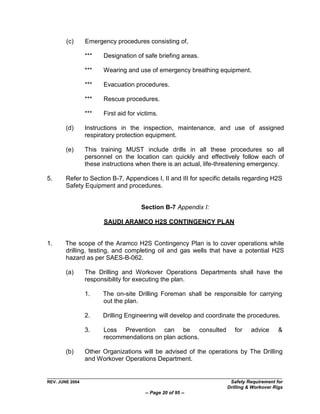
(c)      Emergency procedures consisting of,

                 ***   Designation of safe briefing areas.

                 ***   Wearing and use of emergency breathing equipment.

                 ***   Evacuation procedures.

                 ***   Rescue procedures.

                 ***   First aid for victims.

        (d)      Instructions in the inspection, maintenance, and use of assigned
                 respiratory protection equipment.

        (e)      This training MUST include drills in all these procedures so all
                 personnel on the location can quickly and effectively follow each of
                 these instructions when there is an actual, life-threatening emergency.

5.      Refer to Section B-7, Appendices I, II and III for specific details regarding H2S
        Safety Equipment and procedures.


                                      Section B-7 Appendix I:

                       SAUDI ARAMCO H2S CONTINGENCY PLAN


1.     The scope of the Aramco H2S Contingency Plan is to cover operations while
       drilling, testing, and completing oil and gas wells that have a potential H2S
       hazard as per SAES-B-062.

        (a)      The Drilling and Workover Operations Departments shall have the
                 responsibility for executing the plan.

                 1.    The on-site Drilling Foreman shall be responsible for carrying
                       out the plan.

                 2.    Drilling Engineering will develop and coordinate the procedures.

                 3.    Loss Prevention can be consulted                for    advice      &
                       recommendations on plan actions.

        (b)      Other Organizations will be advised of the operations by The Drilling
                 and Workover Operations Department.


REV. JUNE 2004                                                       Safety Requirement for
                                                                    Drilling & Workover Rigs
                                       -- Page 20 of 95 --
1.    Camp Management will be notified prior to starting operations.
                 2.    Government Relations will be given a map covering the
                       surrounding area that might be affected in the event of an
                       emergency.

                 3.    Government Relations may notify any possibly interested Saudi
                       Arabian Government (SAG) Authorities.

                 4.    Drilling Engineering will coordinate this notification.

                 5.    The Medical Department will be notified by the Drilling
                       Operations Department.

                 6.    The Fire Department will be notified by the Drilling Operations
                       Department.

                 7.    All installations within the area of Operations shall be noted and
                       the Management of possibly affected installations notified.

                 8.    A detailed evacuation plan will be developed for any residential
                       area that might be remotely endangered if an emergency
                       condition develops.

                       Note: Drilling Engineering will coordinate the development of
                       this plan with Government Relations as per Saudi Aramco
                       Drilling Manual.

        (c)      Flaring of sour gas wells at night must be done with extreme caution
                 because:

                 1.    Wind normally diminishes at sundown.

                 2.    With little or no wind, it is impossible to disperse any escaped
                       H2S or SO2 from flares.

2.     The BOP equipment, the wellhead equipment, the test equipment and the
       safety equipment shall all conform to presently developed standards.

        (a)      The Class A 10,000 psi and 5,000 BOP equipment shall meet current
                 NACE Standard MR-01-75 for sour service.

        (b)      The tree, wellhead and all fittings exposed to H2S shall meet current
                 NACE Standard MR-01-75 for sour service.

        (c)      The wellhead, chokes, manifolds and flow lines shall meet the
                 standards for sour service.

REV. JUNE 2004                                                          Safety Requirement for
                                                                       Drilling & Workover Rigs
                                       -- Page 21 of 95 --
(d)      The heater, test unit and all connections shall meet current NACE
                 Standard MR-01-75 for sour service.

        (e)      All flare lines and emergency blowdown lines will be staked or
                 otherwise secured gainst movement in the event of a mechanical
                 failure.

        (f)      The heater, if required, will be a minimum of 150 feet from the
                 wellhead and the test separator.

        (g)      Wellhead gas will not be used for controller gas, bottled nitrogen is
                 preferred over supply air for controls.

        (h)      During gas well production tests, two flare pits will be constructed
                 down wind from the location in the direction of prevailing wind and at
                 least 90º apart and 600 feet from the wellhead manifolds or any test
                 equipment. Minimum flare line size shall be two 3-1/2" J-55 lines to
                 each pit.

        (i)      Explosion-proof bug blowers shall be positioned to move air around
                 well and equipment.

3.      As part of the H2S contingency plan, Emergency Safety and First Aid
        Equipment shall be on location and conveniently located (in addition to
        contractual requirements) in compliance with the following:

        (a)      Self-contained breathing apparatus will be located for emergency work
                 and escape.

        (b)      Cascade systems for work and recharge will be set up on location.

        (c)      Resuscitators, safety harnesses, safety ropes, first aid kits, splints and
                 litters will be on location.

        (d)      An H2S monitor with alarm systems and sensors at various locations
                 will be installed.
        (e)      Personal electronic H2S monitors, explosive meters, spot checks,
                 hand pump type H2S - SO2 detectors will be used.

        (f)      Wind socks, warning signs and flags as well as streamers in localized
                 areas will be in use.


REV. JUNE 2004                                                        Safety Requirement for
                                                                     Drilling & Workover Rigs
                                       -- Page 22 of 95 --
Section B-7 Appendix II:

                 SAUDI ARAMCO STANDARD SAFETY EQUIPMENT
                 FOR H2S OPERATIONS ON ALL ONSHORE DRILLING
                 AND WORKOVER RIGS

1.      H2S and Combustible Gas Monitors. (See also SAES-J-505 Combustible Gas
        and Hydrogen Sulfide in Air Detection Systems). All personnel shall be
        informed by the RIG OPERATOR of the hazards relating to Hydrogen Sulfide
        and shall receive instruction in the correct use of any personal safety
        equipment, Hydrogen Sulfide detectors, and warning systems associated with
        the RIG OPERATOR‟S H2S equipment.

        A.       H2S Monitor and Alarm System

                 Two four channel H2S monitoring system with two visual-audio alarm
                 system shall be installed and fully operational on all land drilling rigs
                 operating on known or suspect H2S locations.

                 1.    The sensors shall be located as near as practical to:

                       a.     The top of the bell nipple.
                       b.     The flowline opening to the shale shaker.
                       c.     The Driller's position and about three feet above the floor.
                       d.     The cellar or underneath the choke manifold above the
                              choke manifold skid floor. This sensor should be easily
                              moveable so that it can be used around the BOP stack or
                              at the well testing equipment when necessary.

                 2.    The H2S alarm system (amber strobe lights and horn) shall be
                       set for first alarm at 10 ppm (visual) and high alarm at 20 ppm
                       (visual & audible). The alarm system shall be located in clearly
                       visible locations so that personnel in any work area can see
                       and/or hear at least one set. Audible alarms are to be included
                       inside the rig site living quarters.

                 3.    One monitor shall be located in the doghouse and the other
                       located in the Supervisor or Toolpushers office.

                 4.    There shall be minimum of one spare H2S sensor.

        B.       Combustible Gas Monitor and Alarm System

                 A continuous combustible gas monitor and alarm system with LEL
                 sensor, audible and visual alarms, and two continuous LEL monitors
                 shall be provided.

REV. JUNE 2004                                                        Safety Requirement for
                                                                     Drilling & Workover Rigs
                                       -- Page 23 of 95 --
1.    The sensor shall be located at either:

                       a.     The top of the bell nipple, or
                       b.     The flow line opening to the shale shaker when a rotating
                              head is in use.

                 2.    The alarm system (red strobe light and horn) shall be set at 20%
                       (visual) of the Lower Explosive Limit (LEL) for the low alarm and
                       50% (visual & audible) of the LEL for the high level alarm. The
                       alarm system shall be clearly visible from work areas on
                       location. The alarm system (light and horn) shall be located on
                       the rig floor above the doghouse. Note: This setting criteria
                       applies to cold work situations only.

                 3.    One monitor shall be located in the doghouse and the other
                       located in the Supervisor or Toolpushers office.

                 4.    There shall be a minimum of one spare LEL sensor.

        C.       Two personal portable H2S monitors, alarm to be set at 10 ppm.

        D.       Two portable H2S detectors (hand pump suction type) with high level
                 and low level H2S and SO2 tubes.

        E.       Two portable combustible gas or vapor monitors.

        F.       Test Kit for checking H2S concentrations in water base & oil base mud.

2.     Required Breathing Apparatus

        A.       Hose-line work units, with emergency escape cylinders, shall be
                 provided as follows:
                 1.    Rig floor - six
                 2.    On handrail near shale shaker - two
                 3.    On rack near mud mixing area - two
                 4.    Near choke manifold - one
                 5.     In derrick for Derrickman (at monkey board) – two

                       Note: Derrick cascade supplied air hoses, shall be rigged in a
                       manner to allow continuous supply of air while ascending or
                       descending the derrick ladder.

        B.       Self contained breathing apparatus (30 min SCBA's) shall be provided
                 as follows:


REV. JUNE 2004                                                       Safety Requirement for
                                                                    Drilling & Workover Rigs
                                      -- Page 24 of 95 --
1.    Toolpusher's office/quarters - two
                 2.    Company Foreman's office/quarters - two
                 3.    Logging Unit (when used) - two
                 4.    SCR room - one
                 5.    Rig Floor - three

        C.       At least one fully-charged spare cylinder shall be provided for each unit
                 of all type listed.

3.     Emergency Safety Equipment

        A.       Three "Bug Blowers" explosion proof, high volume (40,000 cfm) and
                 moveable.

        B.       Three wind socks, two in service, plus streamers to be located so all
                 personnel will know wind direction. One wind sock is to be held as a
                 spare.

        C.       Flare line ignition system (Alex-500 or equivalent) with backup flare
                 gun and supply of 24 long self life cartridge.

        D.       Two portable oxygen resuscitator units, each with a spare oxygen
                 cylinder.

        E.       Two 25 man First Aid Kits, one at rig site and one at camp site.

        F.       Four eye wash stations located in the following areas:

                 1.    On the rig floor or in the rig floor doghouse.
                 2.    In the mud mixing area.
                 3.    In the rig medic's office or the rig supervisor's office.
                 4.    In the rig camp mess hall.
                 5.    Water is to be potable and between 15 and 380C

        G.       Two safety harnesses with two 250 foot retrieval ropes to be worn by
                 search team for search and rescue operations under limited visibility.

        H.       Two basket-type stretchers (Stokes or Navy type litter) with blankets,
                 securing straps and lifting harnesses.

        I.       Two Quick-Air splint kits.

        J.       One portable bull horn with extra battery pack.

        K.       Six small chalk boards with clamps for mounting with an adequate
                 supply of chalk and erasers. Boards can be utilized as visual means of

REV. JUNE 2004                                                           Safety Requirement for
                                                                        Drilling & Workover Rigs
                                       -- Page 25 of 95 --
coordinating activities when working under a SCBA. [Note: Dry eraser
                 boards may be substituted for chalk boards].

        L.       Flashlights - explosion proof with an extra set of batteries and extra
                 bulb for each (number to be at least one for each two persons in the
                 operation but not less than five).

                 NOTE:

                 All safety equipment with rubber, plastic or other parts likely to
                 deteriorate shall be stored in a dark air conditioned room near the
                 Foremen's office. Adequate supplies of sanitizing materials shall be
                 available for sanitizing face masks and other body contact equipment.

                              Section B-7 Appendix III:

        SAUDI ARAMCO STANDARD SAFETY EQUIPMENT FOR H2S
        OPERATIONS ON ALL OFFSHORE DRILLING AND WORKOVER RIGS


1.      A continuous monitoring system with eight sensors and six beacon
        lights/siren alarm systems, each with conductor cable, shall be provided. All
        personnel shall be informed by the RIG OPERATOR of the hazards relating
        to Hydrogen Sulphide and shall receive instruction in the correct use of any
        personal safety equipment, Hydrogen Sulphide detectors, and warning
        systems associated with the RIG OPERATOR‟S H2S equipment.

        (a)      All sensors must have protective housings capable of protecting the
                 sensor from accidental spray from rig wash down hoses and accidental
                 mud and/or oil splashes.

        (b)      Sensors shall be located as near as practical to:

                 1.    The top of the bell nipple.
                 2.    The flowline opening to the shale shaker.
                 3.    The Drillers position and about three feet above the rig floor.
                 4.    The mud pit in the pump area.
                 5.    The motorman's work area in the motor room.
                 6.    The living quarters area nearest the most likely source of
                       hydrogen sulfide.
                 7.    The breathing apparatus compressor package, near the rig
                       floor.
                 8.    A spare sensor system with 200 feet of cable on portable reel
                       shall be extra and will be used to monitor any other potential
                       source of hydrogen sulfide or kept on standby in designated
                       safety equipment storage area.

REV. JUNE 2004                                                        Safety Requirement for
                                                                     Drilling & Workover Rigs
                                       -- Page 26 of 95 --
(c)      There shall be at least four spare H2S sensors.

        (d)      The H2S alarm system (amber strobe lights and horn) shall be set for
                 first alarm at 10 ppm (visual) and high alarm at 20 ppm (visual &
                 audible).

        (e)      The combustible gas alarm system (red strobe light and horn) shall be
                 set at 20% (visual) of the Lower Explosive Limit (LEL) for the low alarm
                 and 50% (visual & audible) of the LEL for the high level alarm.
                 Note: This setting criteria applies to cold work situations only.

        (f)      The H2S and LEL alarm system shall be located in a clearly visible
                 area so that personnel in any work area can see and/or hear at least
                 one set. They shall be located:

                 1.    On the rig floor and at least eight feet above the floor.
                 2.    On the port side at the corner of and above the quarters.
                 3.    On the starboard side at the corner of and above the quarters.
                 4.    Below deck in the pump-motor room area.
                 5.    In crew quarters.
                 6.    In the galley area.

        (g)      The monitor shall be located in the Supervisor's office, Control Room
                 or Radio Room.

2.     A minimum of one hundred 30 minute SCBA's will be located on any offshore
       rig     operating in known or suspected H2S areas. There shall always be at
       least 25% more SCBA onboard than the number of personnel.

        (a)      The 30 minute SCBA's shall be stored ready for use as follows:

                 1.    There shall be one SCBA assigned to each person on board,
                       regardless of his affiliation, contractor, service contractor,
                       Aramco, or any visitor. These will be stored under the head-end
                       of the assigned bunk when the person is in the bunk and during
                       any period considered safe by the Supervisor. (If there is no
                       bunk assignment, the person will be assigned a SCBA and a
                       designated area for storage during his time on board.) Before
                       assignment of a SCBA to any person, he will demonstrate that
                       he is capable of donning it, adjusting the face piece, and turning
                       on the pressure demand air. This requirement shall be waived
                       for any personnel with documentation from his employer that he
                       has received training within the past 12 months in H2S safety,
                       including practice in donning respiratory protection equipment.
                 2.    Ten SCBA's shall be stored in the dining area.
                 3.    Four SCBA's shall be stored in the motor room or pump area.

REV. JUNE 2004                                                       Safety Requirement for
                                                                    Drilling & Workover Rigs
                                      -- Page 27 of 95 --
4.    Four SCBA's, each with clip-on communication device. Two
                       shall be in the Saudi Aramco Foreman's office and two in the
                       Rig Supervisor‟s office.
                 5.    All remaining SCBA's and extra cylinders will be stored in an air
                       conditioned designated safety equipment storage area near the
                       Supervisor's office.

        (b)      The hose-line work units with escape cylinders shall be stored as
                 follows:

                 1.    Six work units (three with clip-on communication devices) on the
                       rig floor in a convenient location.
                 2.    Two work units each with a clip-on communication device in the
                       Supervisor's office.
                 3.    Two work units each with a clip-on communication device in the
                       Saudi Aramco Foreman's office.
                 4.    Two work units shall be located in the derrick at the
                       Derrickman's position, finger board or stabbing board.

                       Note: Derrick cascade supplied air hoses shall be rigged in a
                       manner to allow continuous supply of air while ascending or
                       descending the derrick ladder.

                 5.    Five work units and 16 spare cylinders shall be stored in an air-
                       conditioned designated safety equipment storage area near the
                       Rig Supervisor's office.
                 6.    Nine spare-clip communication device units with supply of spare
                       batteries will be stored with the five work units as above in #4.

3.      Three cascade systems with 12 - 300 cubic foot cylinders each or equivalent
        capacity; three air compressors each with purification system and capacity of
        26 scfm at 2400 psi; one 3 outlet manifold and three 12 outlet manifolds; two
        200 foot hoses; two - 150 foot hoses; twelve - 50 foot hoses; two 5000 psi
        working pressure hoses (250 foot and 300 foot respectively).

        (a)      One cascade system with air compressor powered by an explosion
                 proof electric motor will be located near the rig floor

                 1.    There shall be two six outlet manifold on the derrick floor.
                 2.    There shall be a three outlet manifold at the Derrickman's
                       position.
                 3.    There shall be a three outlet manifold in the mud room.
                 4.    There shall be a three outlet manifold in the motor room.
                 5.    There shall be a one six outlet manifold for recharging portable
                       cylinders, one at each cascade system.
                 6.    There shall be a double tee with check valves for tying in either

REV. JUNE 2004                                                      Safety Requirement for
                                                                   Drilling & Workover Rigs
                                      -- Page 28 of 95 --
or both of the other two systems.
        (b)      There shall be two cascade systems with diesel powered air
                 compressors, located as remotely from the rig floor as practical, one on
                 the upper starboard deck, the other on the upper port deck

                 1.    There shall be one, six outlet manifold for recharging portable
                       cylinders at each cascade system, as well as regulators and low
                       pressure manifolds for hose line units.
                 2.    There shall be a double tee with check valves for tying in either
                       or both of the other two systems.

        (c)      There shall be one 250 foot of 5000 psi w.p. hose; one 300 foot of
                 5000 psi w.p. hose; two 150 foot and twelve 50 foot hoses stored and
                 ready for immediate use in an air conditioned designated storage area.

4.     Five personal portable H2S monitors, as well as stock of lead acetate
       sampling devices.

5.      A hydrogen sulfide calibrator suitable for the purpose of calibrating the fixed
        and/or portable monitoring system.

6.     Continuous H2S mud monitoring system. Garret Gas Train Sulfides Analysis
       unit with supply of accessory equipment for testing water & oil based mud‟s
       for H2S levels. A Drager Test Kit will be used to perform quantitative sulfide
       analysis in conjunction with the Gas train system.

7.     Four portable oxygen resuscitators with eight spare oxygen cylinders.

8.     Four portable H2S - SO2 detectors, (suction type) with H2S and SO2 tubes.

9.     Four portable combustible gas detectors - hand pump suction type.

10.    Six bug blowers, explosion proof, high volume (25,000 cfm or larger) and
       movable.

11.     Wind socks (4 minimum), streamers, and flags to be located on various
        places on rig so all personnel will know the wind direction.

12.     Remote flare line ignition system (Alex-500 or equivalent).

13.     One emergency flare gun with a supply of 24 cartridges will long shelf life will
        be stored in a locked-up wooden box in the Company Foreman‟s office.

14.     Four safety harnesses and four 250 feet retrieval ropes for search and rescue
        operations under limited visibility.


REV. JUNE 2004                                                         Safety Requirement for
                                                                      Drilling & Workover Rigs
                                      -- Page 29 of 95 --
15.     Four stretchers (Stokes litter - Navy type basket or equivalent) with blankets
        and securing straps.

16.     Four first aid kits (each 25 man size).

17.     Four Quick-Air splint kits or equivalent.

18.    Six portable electronic bull horn speakers with six extra battery packs.

19.    Six small chalk boards with clamps for mounting with an adequate supply of
       chalk and erasers. Boards can be utilized as visual means of coordinating
       activities when working under a SCBA. [Note: Dry eraser boards may be
       substituted for chalk boards.]

20.     Flashlights - explosion proof with extra set of batteries and extra bulb for each
        (minimum number shall be 10 flashlights).

        Note: All safety equipment with rubber, plastic or other parts like to
        deteriorate shall be stored in an air conditioned, dark and designated area,
        near the Supervisor's office. Adequate supplies of sanitizing material shall be
        available for sanitizing face masks and other body contact equipment.

B-8    HOUSEKEEPING

1.     Work areas, stairs and walkways shall not be obstructed by debris or stored
       materials.

2.     All walking and working surfaces shall be kept in good repair and free from
       oil, mud, and other potentially slippery material.

3.     The area around the base of the derrick ladder shall be kept clear to provide
       unhampered access to the ladder.

4.     The area around the rotary table shall be kept clear of obstacles; clean, and
       free of tools, materials and any accumulation of oil, water, or circulating fluids.

5.     Storage of material shall not create a hazard. Bags, containers, bundles, etc.,
       stored in tiers shall be stacked, blocked, and limited in height so they are
       stable and secure against sliding or collapse.

6.      Storage areas shall be kept free from accumulation of materials that
        constitute hazards from tripping, fire, or explosion.

7.     Combustible materials, such as oily rags and waste, shall be stored in
       approved covered metal containers.


REV. JUNE 2004                                                       Safety Requirement for
                                                                    Drilling & Workover Rigs
                                      -- Page 30 of 95 --
8.     The Area around the BOP controls shall be clear of materials to allow
       unobstructed access.

B-9     RIG CAMPS: KITCHENS AND ACCOMMODATIONS (See Also G.I.
        151.006 Implementing the Saudi Aramco Sanitary Code)

1.     In addition to complying with applicable requirements for housekeeping and
       fire extinguishing equipment, the RIG OPERATOR shall ensure that:
       (a)     Exhaust fans, hoods, filters, grease trays, and ductwork are cleaned
               regularly to prevent a buildup of cooking grease and other flammable
               material.

        (b)      Blades of exhaust and ventilation fans, if within 2.1 meters (7 feet) of
                 the floor, are equipped with proper guards to prevent employee
                 exposure.

        (c)      Each walk-in freezer is equipped with a working audible alarm to alert
                 other personnel should the door become stuck.

        (d)      Sanitation requirements published by the Saudi Aramco Preventive
                 Medicine Department are fully complied with.

2.     Each cooking, sleeping, washing and toilet facility shall be kept clean and
       sanitary.

3.     The plumbing and mechanical appliances shall be kept in good working order.

4.     Industrial Hygiene and Environmental Health inspections are required every 6
       months to be performed by Saudi Aramco‟s Environmental Compliance
       Department.

B-10 FIRE EXTINGUISHING EQUIPMENT

1.     On every drilling or workover rig, the RIG OPERATOR shall have readily
       accessible not less than the fire extinguishing equipment specified in the
       Drilling/Workover Contract.

2.     The RIG OPERATOR shall inspect fire extinguishers monthly, or more
       frequently if necessary to ensure they are fully charged, kept in their
       designated locations, and free from any obstructions. Inspection shall be
       documented in an inspection log.

3.     Fire fighting equipment shall not be tampered with and shall not be removed
       for other than for fire fighting or for servicing. Extinguishers removed from the
       premises to be recharged shall be replaced by spare extinguishers during the
       period they are missing.

REV. JUNE 2004                                                       Safety Requirement for
                                                                    Drilling & Workover Rigs
                                      -- Page 31 of 95 --
4.     Carbon tetrachloride and other toxic vaporizing liquid fire extinguishers are
       prohibited.

5.     For each rig, the RIG OPERATOR shall prepare a fire control plan and the
       plan shall be permanently exhibited on the rig.

6.      Fixed fire extinguishing systems for each offshore rigs (including water,
        carbon dioxide, dry powder, or foam) shall be kept in good working order and
        available for immediate use at all times while engaged in drilling operations or
        in transit.

7.      Manual fire alarm stations shall be conspicuously located on each deck level
        of offshore rigs.

8.     A fire hose shall not be used for any purpose other than fire fighting, fire drills,
       and testing.

9.     Each fire hose shall be completely unrolled and inspected by the RIG
       OPERATOR once each month and defective parts should be replaced. Fire
       hoses shall be pressure-tested annually. (Refer to G.I. 1781.001-1 and
       SAES-B-19).

10.    The access to any fire hydrant shall not be blocked.

11.     Each fire hydrant shall be equipped with a spanner wrench.

12.     Each fire hose shall be properly stored on a rack or reel when not in use.

13.    Each fire nozzle shall either be attached to the hose or stored next to the fire
       hydrant to which the fire hose is attached.

14.     Each hose water nozzle provided shall be of an approved dual purpose type
        (i.e. spray jet type) incorporating a shutoff.

15.    Each hose on a helicopter deck that discharges foam shall have a nozzle that
       has a foam stream, foam spray, and off position.

16.     Each fire station on an offshore rig shall be properly identified by marking:
        "FIRE STATION NO.        " next to the station in letters at least 5 centimeters
        (2 inches) high.

17.     On each offshore rig, there shall be, at all times at least two RIG OPERATOR
        personnel who are trained in the use of a Fire Fighter Aircraft Crash Rescue
        Equipment.

18.    A crash rescue box is to be permanently located in an area readily accessible

REV. JUNE 2004                                                        Safety Requirement for
                                                                     Drilling & Workover Rigs
                                     -- Page 32 of 95 --
to the heliport. This box is to be highly visible and designated exclusively for
        crash equipment. The minimum required contents shall comply with the Saudi
        Aramco Aviation Department‟s “Helideck Crash Box Inventory List”. (Section
        B-10 Appendix II)

19.     Additional information on requirements is available in specific Rig Contracts
        (See Schedule „G‟ Attachment 1) and the following Section B-10 Appendix I
        & II
                                   Section B-10 (Appendix I)

                       FIRE PROTECTION AND CONTROL EQUIPMENT

1.      Nine 30-lb dry chemical „UL‟ listed per (GI 1981 & SAES-B-19) BC
        extinguishers provided for extinguishing of localized fires located and
        mounted as follows, in compliance with or addition to contractual
        requirements:

                 (a)   Two on rig floor at control station.
                 (b)   One in shaker area.
                 (c)    One on mud pump skid.
                 (d)    Two in drawworks area.
                 (e)   One on generator trailer.
                 (f)   One inside tool room.
                 (g)   One in the area of the gasoline fuel tank.

2.       Two 10-lb carbon dioxide extinguishers located and mounted on the
         generator trailer.

3.       One 150-lb wide wheel type „UL‟ Listed BC type "Purple K" dry chemical fire
         extinguisher located at a minimum of 75 feet from the wellhead and/or mud,
         diesel tanks.

4.      One fixed 1-1/4" live hose reel with 125 feet of 1-1/4" hose for delivery of
        water to the rig floor, cellar and mud tank area. The unit should be centrally
        mounted to adequately cover the rig and associated equipment.

5.     One Type 2A 10 BC extinguisher located in Foreman‟s trailer.

6.     2 each complete fire protection suits.

7.     Suitable connection to allow fire truck to take water from the rig water supply.


REV. JUNE 2004                                                       Safety Requirement for
                                                                    Drilling & Workover Rigs
                                      -- Page 33 of 95 --
Section B-10 (AppendixII)

                 HELIDECK CRASH BOX EQUIPMENT INVENTORY LIST


1.    Rubber Safety Boots………………..…………………….                  3 pairs
2.    Fireman‟s coat……………………………………………..                     3 each
3.    Fireman‟s Helmet with eye shield………………………..           3 each
4.    Bolt cutter 36”…………………………………………….                     1 each
5.    Pick-headed Axe…………………………………………..                     2 each
6.    Nylon Rope, ½”…………………………………………….                      1 roll 50‟ & 1 roll 100‟
7.    Safety Goggles…………………………………………….                      1roll 50‟ & 1 roll 100‟
8.    Hacksaw 12”……………….………………………………                        2 each
9.    Hacksaw blades…………………………………………...                     4 each
10.   Fire Blanket………………………………………………...                     2 each
11.   Large first aid kit…………………………………………...                1 each
12.   “Hooligan” tool, 36”………………………………………..                 1 each
13.   Firemen‟s Crowbar, 51”…………………………………..                 1 each
14.   Safety Rescue Knife………………………………………                    1 each
15.   Grapnel Hook………………………………………………                        1 each
16.   Water-Jet Fire Blanket (72” x 60”)……………………….          2 each
17.   Water-Jet mini-wrap (18” x 8a”)………………………….            2 boxes (5each/box)
18.   Fireman‟s (Fire craft) Gloves (fingered) size L…………   3 pairs
19.   Handheld Spotlight lantern (explosive proof)…………..    3 each
20.   Hand Tool/Utilities Bag……………………………………                 3 each


REV. JUNE 2004                                                  Safety Requirement for
                                                               Drilling & Workover Rigs
                                  -- Page 34 of 95 --
B-11 TRUCK LOADING AND UNLOADING

1.     Before pumping hydrocarbons between two units, the units shall first be
       electrically bonded together and grounded.

2.      The bonding connector and the grounding conductor from the unit to earth
        shall remain effectively attached until all pumping connections have been
        removed.

3.     While tank trucks containing flammable, vaporizing liquids are being
       connected or disconnected, no vehicle shall start up or have its motor running
       in the loading area.

4.     When liquid in a tank contains or is likely to contain hydrogen sulfide,
       personnel required to gauge the liquid are required to wear proper respiratory
       protective equipment.


B-12     FUEL TANKS

1.     Except for diesel fuel and the fuel in the tanks of operating equipment, no
       gasoline or other liquid fuel shall be stored within 22.9 meters (75 feet) of a rig
       or its auxiliary equipment that could be a potential ignition source.

2.     The RIG OPERATOR shall ensure that all fuel tanks are conspicuously
       marked as to contents.

3.     The RIG OPERATOR shall ensure that neither smoking, open flame or cell
       phones are allowed within 7.6 meters (25 feet) of the handling of flammable
       liquids. A notice shall be conspicuously posted.

4.     Dispensing nozzles and valves shall be of the self-closing type. Drip pans
       shall be provided and used when needed.

5.     Fuel tanks shall be located where they are not subject to physical damage
       from vehicles. Where this is not possible, barrier protection shall be provided.

6.      Drainage from any fuel storage shall be in a direction away from the rig. Rig
        "day tanks" may be located on the level well site but they must be so located
        that, should they rupture, the resulting fuel spillage will not drain toward the
        well.

7.      A fire extinguisher, approved for extinguishing petroleum fires, shall be readily
        accessible at a safe permanently designated and highly visible location, in
        close proximity to each fuel storage tank.


REV. JUNE 2004                                                       Safety Requirement for
                                                                    Drilling & Workover Rigs
                                     -- Page 35 of 95 --
8.     Label Emergency fuel shut off.

9.     All valves on fuel tank are to be (1/4 turn) Ball Type.

10.    Fuel tanks should be supplied with appropriate vents without any bends.


B-13    BULK STORAGE TANKS

1.     All bulk storage tanks shall be equipped with safety relief valves and/or
       rupture discs so as to prevent excess pressure. Rupture discs can only be
       used for bulk storage tanks in open areas where drainage is to a safe area.

2.     Bulk storage tanks in enclosed areas shall be equipped with testable safety
       relief valves which can be vented out of the area. Such enclosed areas shall
       be ventilated so that a pressure build-up will not occur if a break or a leak in
       the air supply system occurs.

3.     All safety relief valves shall be function tested at least every three months.

4.     A proper means of access shall be provided to each bulk storage tank.

5.     Each bulk storage tank shall be clearly marked as to contents.


B-14 CONTROL OF STATIC ELECTRICITY

1.     When transferring flammable liquids or finely divided flammable or explosive
       materials from one container to another the containers shall be in firm contact
       with each other or be continuously electrically bonded throughout the transfer
       so as to prevent the accumulation of a static charge.

2.     When tanks, mixers, or processing vessels are used for flammable liquids or
       flammable or explosive compounds, they shall be electrically bonded and
       grounded while being filled or emptied.

B-15 HANDLING AND STORAGE OF COMPRESSED GAS CYLINDERS

1.     Gas cylinders shall be secured in an upright position and shall be separated
       in storage as to full and empty cylinders. All oxidizers shall be separated from
       fuel gases by at least 6.1 meters (20 feet).

2.     Valve protection caps shall be installed on all cylinders at any time a regulator
       is not attached.

3.     When gas cylinders are hoisted, they shall be secured on a cradle, sling

REV. JUNE 2004                                                       Safety Requirement for
                                                                    Drilling & Workover Rigs
                                     -- Page 36 of 95 --
board, or pallet. They shall not be hoisted or transported by means of
        magnets or choker slings applied directly to the cylinders.

4.     When gas cylinders are transported by powered vehicles they shall be
       secured and protected in such a manner to prevent physical damage.
       Cylinders that contain acetylene must be transported, used, and stored
       vertically to prevent the liquid acetone collecting in the neck of the cylinder.

5.     Valve protection caps shall not be used for lifting gas cylinders.

6.     Damaged or defective gas cylinders must not be used. Since these cylinders
       can be especially hazardous, it is important to exercise great care when
       removing them from the rig area.

7.     Freon cylinders shall be stored in an area protected from the direct rays of the
       sun.


B-16 ELECTRICAL WIRING AND EQUIPMENT

1.     The installation, use, and maintenance of any fixed or portable electric wiring
       or equipment shall comply with the provisions of NFPA 70, "National Electrical
       Code", API RP 500, "Classification of Areas for Electrical Installations at
       Drilling Rigs and Production Facilities on Land and on Marine Fixed and
       Mobile Platforms" and SAES-B-68.

2.     All diesel engines used to generate electrical or mechanical power on a rig
       shall be equipped with spark arresting devices or water sprays. The exhaust
       stacks shall be directed so that hot exhaust gases and noise will not
       endanger nearby personnel.

3.     Warning signs that prohibit unauthorized access shall be conspicuously
       displayed on the housing or other enclosure around high voltage electrical
       equipment.

4.     Lead-in cables from the generators to the derrick shall be placed in trays,
       suitcased, or adequately protected from physical damage by other means. In
       those instances where these methods are impossible or impractical, all wiring
       must be bundled and secured to fixed structural members.

5.     A non-conductive floor mat shall be provided in front of each switch panel in
       the generator or SCR room.

6.     Each SCR room shall be equipped with emergency lighting for at least two of
       the exits from the room.


REV. JUNE 2004                                                       Safety Requirement for
                                                                    Drilling & Workover Rigs
                                     -- Page 37 of 95 --
7.     All switch box, junction box, and connector box covers shall be in place and
       properly labeled.

8.     Each onshore generator skid shall be grounded/bonded together with all rig
       components to a steel well cellar or casing. Refer to National Electrical Code
       ANSI/NFPA 70 (latest edition) Article 250-26, “Grounding Separately Derived
       Alternating-Current Systems” and SAES-P-111, “Grounding”.

                 “A separately derived system is a premises wiring system where power
                 is derived from a generator, a transformer, or converter windings, and
                 there is no direct electrical connection, including a solidly grounded
                 circuit conductor, to supply conductors originating in another system.”

9.     Each onshore generator skid shall be equipped with a secure system for
       pinning the doors open. It shall also have warning signs posted to alert
       workers of the high voltage.

10.     Auxiliary/emergency standby generators for offshore rigs shall be installed so
        they will start automatically when "auto start" circuits are activated. The RIG
        OPERATOR shall test "auto start" circuits on at least a weekly basis. A sign
        that says “DANGER – AUTOSTART.” must be posted in Arabic and English.

11.    The power available from the emergency generator shall be sufficient to
       supply, simultaneously, all those services that are essential for safety in an
       emergency.

12.     Auxiliary and emergency standby generators shall be run at full load for a
        minimum of two hours every week and logged.

B-17 ILLUMINATION

1.     Rig lighting shall at all times provide a minimum illumination of:

            a)    53.8 lux (5 foot-candle) power on the entire derrick floor,
            b)    53.8 lux (5 foot-candle) power at the monkey board, mud pumps, &
                  catwalk.
            c)    21.5 lux (2 foot-candle) power at the shale shaker, stairways and
                  other working areas.

2.     The installation of the rig lights shall be according to NFPA requirements for
       electrical installations in classified areas (see API RP-500).

3.     Each lighting fixture in a derrick shall be independently attached to the derrick
       by a safety cable to prevent it from falling to the rig floor should it be torn
       loose.


REV. JUNE 2004                                                       Safety Requirement for
                                                                    Drilling & Workover Rigs
                                      -- Page 38 of 95 --
4.     Lighting fixtures shall be kept sufficiently clean, adjusted, and repaired so as
       to provide the illumination required for the safety of RIG OPERATOR
       personnel.

5.     Light beams shall be directed toward the objects to be illuminated and away
       from the eyes of rig personnel.
6.     Except in an emergency, vehicle lights shall not be used for the lighting of
       onshore rig operations.

7.     All Emergency lighting shall be kept in good repair and ready for immediate
       emergency use. It shall be tested on a regular (Recommended Weekly) basis
       to be certain it will function properly in an emergency.

8.     All derrick lighting shall comply with SAES-B-063 “Aviation Obstruction
       Marking and Lighting”

B-18 TOOLS -- HAND AND POWER

1.      All tools, hand and power, and similar equipment, whether furnished by Saudi
        Aramco or by a contractor, shall be kept in good operating condition.

2.     All hand-held power tools shall be equipped with a constant pressure ("dead-
       man") switch that will shut off the power when the pressure on it is released.
       Switches or triggers which can be locked in the "ON" position are
       expressly forbidden. Note: Such locks are very common on power tools and
       must be disabled before use on a Saudi Aramco Company or Contract Rig.

3.      Impact tools, such as drift pins, wedges, and chisels, shall be kept free of
        mushroomed heads.

4.     Sledge hammers having a square face shall not be used.

5.     Wooden handles of tools shall be kept free from splinters or cracks and shall
       be kept tight in the tool.

6.     Electric power operated tools shall be either of the approved types: Double-
       insulated or grounded. 120V AC Max Voltage with Ground Fault Circuit
       Interrupter (GFCI) (See construction Safety Manual 10.6.1.1,2).

7.     Pneumatic power tools shall be secured to the hose or whip to prevent the
       tool being accidentally disconnected.

8.     Safety clips or retainers shall be securely installed and maintained on
       pneumatic impact (percussion) tools to prevent attachments from being
       accidentally expelled.


REV. JUNE 2004                                                     Safety Requirement for
                                                                  Drilling & Workover Rigs
                                    -- Page 39 of 95 --
9.     The manufacturer's safe operating pressure for hoses, pipes, valves, filters,
       and other fittings shall not be exceeded.

10.     The use of hoses or electrical cords for hoisting or lowering tools is prohibited.

11.    All hoses exceeding 12.7 millimeters (1/2 inch) inside diameter with a
       pressure greater than 1034 kilopascals (150 pounds per square inch) shall
       have a safety device at the source of supply or branch line to reduce pressure
       if a hose fails.

12.    The fluid used in hydraulic powered tools shall be fire resistant and shall
       retain its operating characteristics at the most extreme temperature to which it
       will be exposed.

B-19 ABRASIVE WHEEL MACHINERY

1.     Abrasive wheels used on bench or pedestal mounted grinding machines shall
       have spindle-end, tongue, and work rest guards.

2.     Work rests shall be kept adjusted closely to the wheel face with a maximum
       opening of 3.2 millimeters (1/8 inch) to prevent the work from being jammed
       between the wheel and the rest, causing possible wheel damage.

3.     Tongue guards shall be kept adjusted so the distance between the wheel
       periphery and the adjustable tongue guard never exceeds 6.4 millimeters (1/4
       inch).

4.     All contact surfaces of grinding wheels shall be kept properly dressed and
       free of foreign material.
5.     Before installing a new grinding wheel, the maximum approved speed
       stamped on the wheel blotter shall be checked against the arbor speed of the
       machine to ensure that the safe peripheral speed is not exceeded. A grinding
       wheel shall not be operated at peripheral speeds that exceed the
       manufacturer's recommendations.

6.     Mounting blotters supplied by the grinding wheel manufacturer shall always
       be used when mounting a new wheel.

7.     Bench grinders shall be securely mounted to a bench in order to prevent
       vibration and movement.

8.     All abrasive wheel machinery that is electrically powered shall be adequately
       grounded or of the approved double-insulated type.

9.     Safety guards used on machines known as right angle head or vertical
       portable grinders shall have a maximum exposure angle of 180 degrees, and

REV. JUNE 2004                                                        Safety Requirement for
                                                                     Drilling & Workover Rigs
                                      -- Page 40 of 95 --
the guard shall be located so as to be between the operator and the wheel
        during use.

10.     Wheel rotation on bench or pedestal mounted grinding machines shall direct
        debris downward away from user‟s face.

11.     Eye and face protection must be worn while using grinders.


B-20 WELDING AND CUTTING

1.     No welding or cutting shall be done:

        (a)      On any pipe or vessel containing pressurized fluid or gas.

        (b)      On any tank or container which contains or has previously contained
                 flammable fluids or gases until such containers or vessels have been
                 filled with water or are otherwise suitably purged. Used 55 gallon
                 drums are specifically included in this instruction.

        (c)      In a confined space and until a properly trained person has first tested
                 the atmosphere with proper instrumentation to ensure it is free from
                 combustible gases (i.e. 0% LEL) and contains at least 20% oxygen, all
                 requirements for confined tank entry shall be strictly followed. (refer to
                 section B-24)

        (d)      On any automobile or truck wheel rim upon which a tire is mounted.

2.     Welding, cutting, or brazing shall only be done as per API-510, on any
       certified pressure vessel Welding procedures and welders must be qualified
       based on the same Saudi Aramco requirements used for new constructions
       as stated in SAES-W-010.

3.     No field welding shall be performed on any load handling tools or equipment.

4.     Welders and cutters must be trained in all the Rig Operator‟s safe operating
       procedures and equipment that are applicable to their line of work on the rig.

5.     Welding, cutting, or brazing shall not be done in the presence of explosive
       gas or fumes, or combustible materials.

6.     Suitable eye protection shall be worn by welders and helpers when welding or
       cutting operations are being performed or scale is being cleaned from welds.
       Ref CSM Figure 1.4 & 1.4A.

7.      Acetylene cylinder valves shall not be opened more than one and one-half

REV. JUNE 2004                                                        Safety Requirement for
                                                                     Drilling & Workover Rigs
                                       -- Page 41 of 95 --
turns. The wrench must be left on the stem. The maximum optional gauge
        pressure for acetylene cylinders must not exceed 103 kilopascals (15 pounds
        per square inch).

8.     All gauges and regulators shall be maintained in good condition. Regulator
       gauges shall not be used if the glass cover is broken or cracked.

9.     A friction lighter, not matches or hot work, shall be used to light a torch.

10.     Hoses showing leaks, burns, worn places, or other defects rendering them
        unfit for service shall be repaired or replaced.

11.    When gas welding equipment is not in use, the cylinder valves shall be closed
       and the pressure in the hoses released.

12.    Arc welding cables with damaged insulation or exposed bare conductors shall
       be replaced.

13.     Cables with splices within 3 meters (10 feet) of the electrode holder shall not
        be used.

14.     When in use, electrode holders shall be placed so that they cannot make
        electrical contact with persons, conducting objects, fuel tanks, or compressed
        gas tanks.

15.    Portable arc welding machines shall have the frames properly grounded as
       per CSM 5.2.2.3.

16.    Welders shall place welding cable and other equipment so that it presents no
       obstruction of passageways, ladders, and stairways. The ground lead should
       be placed as close to the work as practical.

17.     Welding helmets shall be worn by all welders during arc welding operations.
        Personnel shall not be permitted to observe arc welding operations unless
        they are wearing proper eye protection.

18.    When arc welding under wet conditions, special insulating protection shall be
       supplied in order to prevent an electrical shock.

19.     After welding operations are completed, the welder shall mark the hot metal
        or provide some other means to warn people of the hazard.


REV. JUNE 2004                                                        Safety Requirement for
                                                                     Drilling & Workover Rigs
                                     -- Page 42 of 95 --
SECTION B-20 (Appendix I)

PROTECTIVE GOGGLES, SPECTACLES, FACE SHIELDS AND HELMETS

TYPICAL EYE PROTECTION APPLICATIONS
       Operation              Hazards                                            Protection
    Acetylene-welding cutting        Sparks, molten metal, harmful                 D, E, F
            burning                       rays, flying particles
      Electric arc welding           Sparks, molten metal, intense                    I
                                          rays, flying particles
       Chemical handling               Splash, acid burns, fumes           G, H (Severe +C)
            Chipping                        Flying particles                A, B, C, E, F, G
       Furnace operations              Glare, heat, molten metal                 D, E, F
         Grinding (light)                   Flying particles                   A, B, C, G
        Grinding (heavy)                    Flying particles                   C, D, E, G
           Laboratory               Chemical splash, glass breakage         G, H (A or B +C)
           Machining                        Flying particles                   A, B, C, G
         Molten metals                Heat, glare, sparks, splash        D, E (A or B tinted +C)
          Spot welding                  Flying particles, sparks               A, B, C, G

Protection against Radiant Energy
Protection against radiant energy requires the selection and use of the proper
shades of welding filter lens or plate. The table below shall be used as a guide for
the selection of the proper shade numbers of filter lenses or plates used in welding.
Shades more dense than those listed may be used to suit the individual‟s needs.

                  Welding Operation                              Comfort Shade Number
Shielded metal-arc welding 1/16-, 3/32, 1/8-, 5/32-                       10
              inch diameter electrodes.
   Gas-tungsten are welding and gas-metal arc                             11
 welding (nonferrous) 1/16-, 3/32-, 1/8-, 5/32- inch
                 diameter electrodes.
   Gas-tungsten arc welding and gas-metal arc                             12
   welding (ferrous) 1/16-, 3/32-, 1/8-, 5/32-inch
                 diameter electrodes
 Shielded metal-arc welding 3/16-, 7/32-, ¼- inch                         12
                 diameter electrodes
Shielded metal-arc welding 5/16-, 3/8-inch diameter                       14
                      electrodes
              Atomic hydrogen welding                                   10-14
                 Carbon-arc welding                                       14
                      Soldering                                            2
                    Torch brazing                                       3 or 4
       Light oxy fuel gas cutting, up to 1 inch                         3 or 4
  Medium oxy fuel gas cutting, 1 inch to 6 inches                       4 or 5
       Heavy oxy fuel cutting, over 6 inches                            5 or 6
         Gas welding (light), up to 1/8- inch                           4 or 5
     Gas welding (medium), 1/8-inch to ½ inch                           5 or 6
         Gas welding (heavy), over ½- inch                              6 or 8
                Air-carbon arc cutting                                    12

REV. JUNE 2004                                                            Safety Requirement for
                                                                         Drilling & Workover Rigs
                                          -- Page 43 of 95 --
B-21 AIR COMPRESSORS

1.     All air compressors shall have at least one air pressure regulator to control
       proper air flow.

2.     The safety relief valve on the main air tank shall be removed and tested at
       least every three months and kept in proper working order. A record of the
       last test date should be attached to the valve.

3.     No valves shall be allowed upstream or downstream from any safety relief
       valve.

4.      The piping connected to the pressure side and discharge side of a safety
        relief valve shall not be smaller than normal pipe size openings of the device.

5.     The piping from the discharge side of the safety relief device shall be securely
       anchored to prevent any movement of the pipe when venting air.

6.     All valves and pressure control devices shall be kept in proper working order
       and inspected as required.


B-22 WORK PERMIT SYSTEMS

As part of each RIG OPERATOR‟S Loss Prevention Program, a work permit system
shall be established based on G.I. 2.100. The system is intended to be applied to
those jobs which represent a potential hazard to operations, personnel, or
equipment. Contractors may use existing internal forms developed as part of their
loss prevention programs, consistent with the following topics.

Release of Hazardous liquids or gases

1.     The actual or possible release of low flash point liquids (130° F or 54° C) or
       injurious materials in amounts which would create a hazard.

Hot Work

1.      No hot work, welding or cutting, open flames, smoking or other potential
        source of ignition will be allowed within any electrically classified areas, as
        defined in API RP 500, until the measured lower explosive limit (LEL) of the
        ambient atmosphere is zero.

2.     Before the hot work begins and as it continues, all potential sources of
       ignitable material - liquids or gases - shall be prevented by some positive
       means from entering into the work area. When possible all such sources
       shall be locked and tagged to prevent their being opened.

REV. JUNE 2004                                                     Safety Requirement for
                                                                  Drilling & Workover Rigs
                                    -- Page 44 of 95 --
3.     Monitoring of the LEL shall be continuous until the hot work is completed.

4.     All electrically classified areas shall be marked, with signs in Arabic and
       English: "NO SMOKING". "NO WELDING, CUTTING, OR OTHER SOURCE
       OF IGNITION EXCEPT UNDER THE DIRECT SUPERVISION OF THE
       WORK PERMIT ISSUER.

Cold Work

1.      Work that will not produce              sufficient    energy   to    ignite    flammable
        atmosphere/materials.

Confined Space Entry

1.      DEFINITION OF A CONFINED SPACE: A confined space is any space that
        can be entered by personnel that:

        (a)      has limited openings for entry or exit.

        (b)      has inadequate ventilation or the presence of a harmful atmosphere is
                 likely, or

        (c)      Is not designed for personnel occupancy.

Note: "confined space" includes, but is not limited to, tanks, vessels, cellars,
compartments, piping geometry, or building and facility

2.      Whenever possible, work shall be planned so as to prevent entry into a
        confined space.

3.     The RIG OPERATOR must never allow any person to enter a confined space
       until ALL the following criteria have been met:

        (a)      The atmosphere in the confined space must be sampled by a
                 supervisor for the presence of harmful or toxic materials, for the
                 likelihood of a flammable atmosphere during the time the space is
                 entered, and for a minimum 20% oxygen concentration.

        (b)      In confined spaces where toxic materials such as hydrogen sulfide are
                 present, those entering the space shall be required to wear the proper
                 respiratory protective equipment as prescribed in Section B-6,
                 "Hydrogen Sulfide Safety", of this Manual.

        (c)      If a potentially flammable atmosphere (a reading of anything above
                 "zero percent" of the lower explosive limit) is encountered, the
                 flammable material shall be removed from the area or all work shall be
                 done with non-sparking hand tools and pneumatic power tools. If
                 pneumatic tools are not available the electromotive force to the tools
                 shall not exceed 32 volts.

REV. JUNE 2004                                                               Safety Requirement for
                                                                            Drilling & Workover Rigs
                                        -- Page 45 of 95 --
(d)      If the oxygen level inside the confined space is less than 20% the area
                 shall be adequately ventilated or the persons entering the area shall
                 wear respiratory protective equipment (as required in Section B-5,
                 "Respiratory Protection", of this Manual).

        (e)      No personnel shall be allowed to enter a confined space until positive
                 means are established to prevent all energy sources from entering the
                 confined space area or causing associated equipment to operate while
                 work continues.

4.     Each person entering the confined space shall wear a safety harness with an
       attached life-line, except in those rare cases where a life line would increase
       risk. Such cases must be approved by the Toolpusher & Drilling Foreman.

5.     A stand-by man shall be assigned the duty of watching the persons working
       inside the confined space during the time they are inside. This duties of the
       stand-by man are:
        (a)      He shall have no responsibilities other than to continually watch those
                 inside the confined space and observe their condition and, also, be
                 alert to any need for rescue or other assistance by those inside.

        (b)      He shall be in such a position as to physically observe the condition of
                 every person inside the confined space.

        (c)      He shall have the means (winching equipment or adequate nearby
                 personnel) to rescue any personnel from inside the space.

        (d)      He shall have adequate personal protective equipment available so if it
                 should become necessary to aid those inside the confined space, he
                 can enter the area safely.

These are minimum requirements which must always be met any time personnel are
required to enter a confined space (see Item #1) for ANY length of time.

B-23 LOCKOUTS AND TAGGING

1.      Where there is danger of machinery being started or electrical circuits being
        energized while repairs or maintenance work is being done the RIG
        OPERATOR shall ensure that the electrical circuits are locked open and
        tagged. Where there is danger of machinery being started or of compressed
        gases creating a hazard to RIG OPERATOR personnel while repairs or
        maintenance work is being done, the RIG OPERATOR shall:

        (a)      Disconnect the lines, or

        (b)      Lock and tag the main valve closed, or


REV. JUNE 2004                                                       Safety Requirement for
                                                                    Drilling & Workover Rigs
                                       -- Page 46 of 95 --
(c)      Blank the lines on all hydraulic or air driven machinery, pressurized
                 lines, or any lines connected to such equipment if they could create a
                 hazard to personnel.

        (d)      The craftsman doing the actual work must have the lock out key in his
                 possession.

B-24 USE OF POTENTIALLY HAZARDOUS MATERIALS

All safe handling procedures are to comply with Saudi Aramco‟s Drilling Manual
Chapter 8, HEALTH, SAFETY & ENVIRONMENTAL ISSUES              Section E “Safe
Handling Procedures

CHEMICALS
1.     Rig personnel must be informed by the COMPANY regarding the potential
       harmful effects of all chemicals used in drilling and workover operations by
       means of current material safety data sheets (MSDS). The COMPANY will
       ensure that the least hazardous chemicals are used in Company operations.

2.     Before requesting any chemicals that are potentially hazardous (low flash
       point, strong oxidizers, corrosives, toxic, highly flammable, etc.) the
       COMPANY will research the available chemicals to determine if it is possible
       to use chemicals that may be safer. The COMPANY shall utilize the safest
       possible chemicals available that will adequately perform according to the
       operations requirements.

3.     The COMPANY shall ensure that current material safety data sheets (MSDS)
       are available at the rig site for all chemicals that are used.
4.     For unusually hazardous chemicals, those for which extraordinary safety
       measures are necessary, the MSDS must be in the hands of the rig operator
       at the location where it will be used at least 24 hours prior to delivery of that
       chemical. This is important in instances of chemical use where protective
       gear, special handling and storage requirements, or other preparations must
       be made before the chemicals arrive at the location.

5.     The RIG OPERATOR will be responsible to ensure that the proper protective
       equipment and first aid measures are available, when necessary, at the
       location. Also, the RIG OPERATOR will ensure the proper protective
       equipment is used properly and consistently in order to properly protect rig
       personnel.

6.     All hazardous materials shall be segregated from normal stores and clearly
       identified. Hazardous materials labels shall not be removed from containers

        NOTE: All empty hazardous containers shall be removed and properly
        disposed of. These containers are never to be buried, left in the desert or
        thrown overboard on offshore rigs.


REV. JUNE 2004                                                      Safety Requirement for
                                                                   Drilling & Workover Rigs
                                      -- Page 47 of 95 --
ACIDS

1.     On third party contracted acid jobs, only the acid contractor crew will handle
       acid tanks and pump equipment.

2.     Hot work is prohibited in acid storage or handling areas.

3.     Rig crews must stay outside security-taped area or clear of acid tanks and
       pumps at all times.

4.      Flush pumping lines with water after acid is pumped.

5.     Treat displaced acid with caustic or soda ash before disposal.
6.     Never add/mix water to acid.


RADIOACTIVE MATERIALS
1.     A well site radiation survey is to be performed by the radioactive tool
       operators, prior to and after arrival of radioactive sources. RA tool operators
       must be able to produce a current leak test certificate, Source Certification
       Certificate and MSDS or ERG for the radioactive sources being shipped.

2.     An announcement concerning radioactive materials, must be made on the
       rigs public address system prior to handling and use of radioactive sources
       and tools.

3.      Only radioactive tool operators, responsible for the radioactive material, are to
        handle the RA sources and tools. Rig crews are to keep far away at all times
        radioactive sources or tools are being handled.

4.      Only radioactive tool operators are allowed to be present in the rig floor during
        radioactive source handling.

5.     Radioactive sources must be stored locked in their proper lead sheild and in a
       locked radioactive shielded box.

6.     All radioactive materials should be stored in an isolated area of the rig, far
       away from normal rig activities. Florescent security tape with warning signs
       are to be posted in English and Arabic a safe distance from the storage box,
       as determined by a daily radiation survey.

7.      Safe boundary limits are to be determined after each site survey is completed
        prior to handling radioactive sources.
8.     Radioactive source storage must be at least 4 ft from any explosives storage.


REV. JUNE 2004                                                      Safety Requirement for
                                                                   Drilling & Workover Rigs
                                     -- Page 48 of 95 --
EXPLOSIVES

1.     Only the explosives contractor engineer and crew are permitted to handle
       explosives at the rig site.

2.      All crew members must stay 50m (recommended) away during all explosives
        operations.

3.     Preparation of explosive devices must be done in an area marked with red
       and white tape. Warning signs in English and Arabic stating “EXPLOSIVES-
       NO SMOKING –RADIO SILENCE - KEEP OUT”.

4.     To eliminate stray electric currents, all non-essential equipment including
       mobile phones must be turned off during explosive operations.
5.      No welding is allowed during explosive operations.

6.     All mobile and fixed radios must be switched off or disabled.

7.     Radio Silence warning signs must be posted on access roads 200 meters
       from the rig.


REV. JUNE 2004                                                     Safety Requirement for
                                                                  Drilling & Workover Rigs
                                    -- Page 49 of 95 --
SECTION C: RIG EQUIPMENT AND PROCEDURES
C-1     SPUDDING IN AND RIG/LOCATION RELEASE

1.     A completed Rig/Location Release Checklist (Section C, Appendix I) for the
       previous well is required prior to Spudding-in on a new location. This checklist
       is located at the end Section C in Appendix I.

2.     Spudding-in shall not commence until a Pre-Spud Inspection is conducted by
       the RIG OPERATOR and COMPANY representatives.             A recommended
       checklist is located at the end Section C in Appendix II.

C-2     PRE-TOUR CHECKLIST / DRILLER HANDOVER FORM

1.     A Pre-Tour checklist / Driller Handover form should be created to ensure
       basic well control and/or safety devices are present, checked and in the
       proper working order. Current operations including any outstanding downhole
       conditions should also be discussed and noted on the form.

2.     The checklist items should cover a minimum of the following points:

        a)       Accumulator unit oil level checked and recorded.

        b)       Control hoses checked for damage and leaks. Unused hoses plugged.

        c)       Accumulator, manifold and annular pressures recorded.

        d)       Type and size of rams posted on main and remote control units.

        e)       BOP and well head measurements posted on rig floor with correct pipe
                 space out noted.

        f)       BOP stack and choke manifold alignments checked.

        g)       Remote chokes functioned and left closed.

        h)       M.A.A.S.P. posted on the choke manifold and the remote choke panel.

        i)       Rig floor SCBA‟s and cascade system units pressures checked.

        j)       Pit level, flow show indicators / recorders on & functioning properly.

        k)       Crown-O-Matic set and adjusted properly.

        l)       Drilling recorder – all channels working properly.

REV. JUNE 2004                                                           Safety Requirement for
                                                                        Drilling & Workover Rigs
                                         -- Page 50 of 95 --
m)       F.O.S.V. open and counter balanced with operating wrench available
                 near driller‟s console.

        n)       IBOP valve available on rig floor functioned and locked open.

        o)       Safety valves cross over subs available on rig floor for all connections in
                 the hole.

        p)       Current drilling and/or tripping parameters in use listed.

        q)       Current drilling fluid properties posted.

        r)       List of unusual down hole conditions observed during previous tour.

3.      The completed form should be signed by both drillers and tool pusher each
        tour.


C-3     DERRICKS AND MASTS

1.     Derricks and masts shall have a permanent nameplate either attached to the
       structure or available at the site indicating the following:

        (a)       Name of manufacturer.

        (b)       Model number and serial number.

        (c)       Load rating including hook load capacity with number of lines and wind
                  load rating both with and without pipe standing in the derrick.

        (d)       Whether external guying is required and, if so, the recommended
                  guying pattern.
2.     The derrick or mast shall not be loaded beyond its design capacity.

3.     All girts, legs, and braces shall be maintained in good condition, properly
       secured, and free from damage, bowing, or deflection.

4.     Chain hoists and snatch blocks shall not be fastened to girts and braces. Any
       bending of the girts and braces weakens the derrick or mast.

5.     Any girt, brace, or derrick member having enlarged or distorted bolt holes
       shall be replaced.

6.     Girts, braces, and other members of the derrick or mast shall never be
       removed while the derrick or mast is under a load.

7.     To withstand operating vibration, the mud standpipe shall be attached to the
       derrick leg rather than the girts and braces, unless the derrick is specifically
       designed otherwise by the manufacturer.
REV. JUNE 2004                                                           Safety Requirement for
                                                                        Drilling & Workover Rigs
                                          -- Page 51 of 95 --
8.      All substructure members shall be free from damage and all securing bolts,
        nuts, pins, and safety pins shall be in place.

9.      Before subjecting the derrick or mast to unusually heavy loads, connecting
        pins and keepers, bolts, and nuts shall be checked to ensure that they have
        not been loosened or worn excessively by vibration.

10.    Before raising or lowering a mast, bridle lines and sheaves shall be inspected
       for wear. A maintenance log book shall be made available including
       individual line usage history.

11.     A drilling or workover mast cannot be raised nor lowered at NIGHT over an
        existing well head.

12.    The weep holes in the "A" legs of the derrick or mast shall be kept clear of
       dirt, debris, gloves, rags, etc., that could block the drain holes and permit
       water to accumulate resulting in corrosion of the legs.

13.     An aircraft warning light on the crown shall be provided in compliance with
        SAES-B-063 and shall be maintained in satisfactory operating condition.

C-4     ANCHORING -- ALTERATIONS

1.     Derrick or mast guy lines, when required, shall be installed according to the
       manufacturer's specifications and shall be properly fastened to adequate
       ground anchors.

2.     No structural change or addition to a derrick or mast shall be made unless
       approved in writing beforehand by the manufacturer of the equipment or the
       manufacturer's representative.

3.     No holes shall be drilled, punched, or burned in a load carrying member of a
       derrick, mast, or substructure.

C-5     CROWN BLOCKS

1.     There shall be no opening between the beams of main support members or
       frame work of the crown large enough to permit a worker to fall through.

2.     Where wood bumper blocks are attached to the underside of crown block
       beams, a wire rope safety line or wire mesh shall be fastened along the beam
       and attached to the derrick at both ends, thereby safely retaining the wood
       bumper blocks should a crown-out occur.

3.     When the crown block is to be lubricated, the drawworks shall be shut down,
       and the brake chained down.


REV. JUNE 2004                                                   Safety Requirement for
                                                                Drilling & Workover Rigs
                                   -- Page 52 of 95 --
C-6     TRAVELING BLOCKS

1.     Traveling blocks shall be equipped with securely attached sheave guards.
       Any traveling block hook to which equipment is directly or indirectly attached
       shall be equipped with a safety latch or a wire rope safety line.

2.      Safety latches on hooks shall be maintained rigid so that a jar from the
        elevator links will not drive the latch aside and unhook the line.

3.      All traveling blocks, hooks, elevators, elevator links, and traveling equipment
        shall be free of projecting bolts, nuts, pins, or parts.

4.     Two upward travel limiting devices (crown protector, such as a Crown-O-
       Matic, electro/pneumatic crown saver or anti two-block system) shall be
       installed, properly adjusted, and used on all drilling and Workover rigs.

5.     The upward travel limiting devices shall disengage all power to the hoisting
       drum and apply the brakes to prevent the traveling blocks from contacting the
       crown structure.

6.     Testing and setting procedures are to be put in place by the RIG
       CONTRACTOR and posted clearly on the drill floor. The limiting devices
       testing and setting procedures are to be performed by the Driller at the
       beginning of each tour and immediately after drill line slip and cut operations.
       These checks are to be reported in the IADC tour book for each 12 hours.
C-7     AUXILIARY ESCAPE

1.     On every drilling and workover derrick or mast an auxiliary means of escape
       shall be provided by the installation of a specially rigged and securely
       anchored escape line attached to the derrick. (Offshore rigs are exempt from
       this requirement until an escape device becomes available that meets the
       criteria contained in Requirement Number 2, below.)

2.      The emergency means of escape shall be located in such a manner that the
        escape line itself does not create a hazard to helicopter rotors, crane booms,
        or other moving equipment. The rate of descent of any safety buggy must be
        controllable by the rider.
3.     An escape line shall consist of a wire rope not less than 12.7 millimeters (1/2
       inch) in diameter and shall be free from kinks, splices, and broken wires.

4.     On land-based rigs, all escape lines shall be securely anchored with either an
       iron stake or deadman that will withstand a 1361 kilogram (3000 pound) static
       cable pull. The ground end of the escape line shall be staked out so that the
       escape route and landing area are unobstructed. If space limitations are such
       that the escape line is, or may be, exposed to motorized traffic, it shall be
       conspicuously marked at eye level with a visible flag or streamer.

5.     Tension on an escape line and configuration of the landing area shall be such
       that a worker sitting in a safety buggy will touch the ground, deck, or water
       approximately 6.1 meters (20 feet) from the anchor.


REV. JUNE 2004                                                     Safety Requirement for
                                                                  Drilling & Workover Rigs
                                    -- Page 53 of 95 --
6.      The length of an escape line for onshore rigs shall be at least double the
        vertical distance between the ground and the point at which it is attached to
        the derrick (normally the first girt above the monkey board).

7.     An approved safety buggy shall be properly installed on the escape line and
       kept at the derrickman's principal working platform for instant emergency use.
       It shall be inspected by a qualified person at least once each week.

8.     The escape buggy shall be secured to the monkey board in a manner to
       ensure easy release in an emergency.
C-8    GUARDS

1.      Sturdy machinery guards shall be installed on all drawworks and rotary table
        drives to prevent personnel being injured by rotating machinery or by
        disintegrated or broken parts.
2.     A metal guard not less than 3.2 millimeters (1/8 inch) thick shall enclose the
       tops and outer sides of all hoisting drum brake flanges.

3.     Every rotary table shall have a substantially constructed metal guard with a
       non-skid surface that adequately covers the outer edge of the table and
       extends downward to completely cover all of the exposed rotating sides of the
       table, including the pinion gear.

4.     Guards shall be installed on all hoisting drums to prevent personnel coming in
       contact with the rotating drum.

5.      Rig machinery shall not be operated unless all guards are properly
        maintained and in position, except during maintenance, repair, or rig-up work,
        or when limited testing is being performed by an authorized and qualified
        person.

6.     If it is necessary to remove guards to reach lubrication fittings for oiling and
       greasing, machinery shall be fully stopped. All guards shall be replaced prior
       to resuming operations.
7.     Air hoists shall be equipped with a guard and a line guide.

8.     All V-belt drives shall be guarded.

9.     All engine fan blades shall be equipped with shrouds to protect against
       personnel injury.

10.     All hot surfaces of equipment shall be suitably guarded or insulated to prevent
        possible injury to personnel.
C-9    DERRICK EXITS, LADDERS, STAIRWAYS, FLOORS, AND PLATFORMS

1.     Safe exits shall be provided directly to the outside on at least two sides of the
       derrick floor. An exit that leads directly to the mud pits prior to reaching
       ground level shall not be counted as one of the required exits.

REV. JUNE 2004                                                        Safety Requirement for
                                                                     Drilling & Workover Rigs
                                     -- Page 54 of 95 --
2.      Exit doors from the doghouse shall open outward or shall be of a sliding
        nature and shall not be held closed with a lock or outside latch when RIG
        OPERATOR personnel are working on the derrick floor.

3.     Floors, stairways, and platforms shall be free from dangerous projections and
       obstructions and shall be maintained in good repair, clean, and free from oil,
       grease, water, or other materials of similar nature.      Where any type of
       operation necessitates working on slippery floor areas, such surfaces shall be
       protected against slipping by use of mats, grates, cleats, or other means to
       provide reasonable protection.

4.     Every flight of stairs having four or more risers shall be equipped with
       standard stair railings on open sides.

5.     Standard guardrails shall be installed on the outer perimeter of all working
       platforms and walkways that are over 1.2 meters (4 feet) above ground level.
       A standard guard rail consists of a top rail 1.1 meters (42 inches) in height, a
       mid-rail, located an even distance between the top rail and the floor, and a
       10.2 centimeter (4 inch), toe board mounted flush with the floor.           The
       guardrails shall be mounted on centers and designed to withstand the weight
       of a 90.7 kilogram (200 pound) person.

6.     When it is not possible, during a temporary condition to provide adequate
       railing all personnel working within 3.1 meters (10 feet) of the edge must be
       tied off with a safety harness.

7.     On drilling and workover rigs, a stairway shall be installed beside the pipe
       ramp which shall extend from the ground to the derrick floor at the V-door.

8.      A sturdy guard rail shall be provided at the V-door. It shall be in place at all
        times except when the pipe ramp is being used. The use of chains on wide
        spans, such as V-doors, is NOT ALLOWED.

9.     Every opening in a derrick floor shall be covered or guarded when not being
       used.
10.     Unless the rathole or mousehole extends at least 30.5 centimeters (12
        inches) above the rig floor, the opening in the floor above the pipe shall be
        covered when a kelly or joint of pipe is not in the hole.
11.    Catwalks shall be provided with a stairway at the outer end.

12.    Guardrails shall be installed on both sides of walkways located over open
       mud tanks.

13.     When a chain or wire rope is used as a temporary substitute for a guardrail on
        mud tank walkways, the chain or wire rope shall be adequately secured and
        kept taut.
14.     Cages having hoop type back supports shall be provided on all fixed ladders
        of more than 3.1 meters (10 feet) unless a climbing device is used. When a

REV. JUNE 2004                                                      Safety Requirement for
                                                                   Drilling & Workover Rigs
                                     -- Page 55 of 95 --
cage is used, the maximum unbroken length between resting points shall be
        6.1 meters (20 feet).
15.    The area around the base of the derrick ladder shall be kept clear to provide
       unhampered access to the ladder.

16.    Ladder safety devices may be used on ladders over 3.1 meters (10 feet) in
       unbroken length in lieu of cage protection. All ladder safety devices, such as
       those that incorporate climbing belts, sheaves, and sliding counterweight
       attachments shall be properly installed to meet the design requirements of the
       ladders which they serve. Where possible, the sliding counterweight shall be
       installed on the off-ladder side of the derrick.

17.     Climbing devices, when used in lieu of caged ladders, shall be properly rigged
        with a minimum of three cable clips. The counterweights should approximate
        the weight of the derrickman.
18.     Derrickmen shall always use the climbing device. They must climb or
        descend the ladder rung by rung and not "ride" the climbing device.

19.    No personnel shall slide down any pipe, kelly hose, cable, or rope line except
       in an extreme emergency.

20.    Platforms shall be located at the monkey board, tubing board, and crown of
       all drilling and workover rigs. The requirement for a platform at the crown
       may be deleted for masts which are frequently lowered as a normal part of
       operations (i.e., carrier-mounted workover rigs).

21.     All landing platforms shall be equipped with standard railings and toe boards,
        so arranged as to give safe access to the ladder. The step-across distance
        from the nearest edge of the ladder to the nearest edge of equipment or
        structure shall not be more than 30.5 centimeters (12 inches).

22.    The side rails of a ladder shall extend at least 91.5 centimeters (3 feet) above
       a landing platform.

23.    All ladders, fixed or portable, shall be maintained in good condition with no
       bent, broken, or damaged siderails or steps.
24.     Defective ladders shall be immediately removed from service and repaired or
        replaced.

25.     When portable ladders are used, they shall be secured against slippage by
        the use of safety feet and tied-off.

26.     Portable aluminum ladders shall not be used by electricians or by any other
        personnel where they may come into contact with electrical circuits.

27      Tools or other materials shall not be carried up or down a ladder unless
        properly secured to the body.


REV. JUNE 2004                                                     Safety Requirement for
                                                                  Drilling & Workover Rigs
                                    -- Page 56 of 95 --
C-10 Scaffolding

1.     The components used to assemble scaffolds shall be inspected before each
          use.

2.      Scaffolding components manufactured by different manufacturers shall not be
        intermixed unless components are compatible (fit together without mechanical
        force) and the scaffold‟s structural integrity is maintained. Scaffolding
        components manufactured by different manufacturers shall not be modified in
        order to intermix them.

3.      Scaffolding components shall be free from detrimental corrosion and
        exposure to corrosive substances.
4.     Scaffolding components shall be properly stored to prevent damage.

5.     All scaffolding used on Saudi Aramco drilling & workover sites shall comply
       with Loss Prevention Department‟s Scaffold Safety Handbook.

C-11 PIPE RACKS

1.     Pipe racks shall be level and firmly butted and secured together with no gaps
       or elevation differences between each rack or the catwalk.
2.     Outer ends of each pipe rack shall have sturdy stop pins in place to prevent
       pipe from rolling off the rack. Pins should be permanently attached to the
       rack to prevent loss.

3.      The catwalk shall be level and free from tripping hazards with a stairway to
        the ground at each end.
4.     Every pipe rack shall be flush at top and bottom to prevent pipe hang-up.

5.      When pipe is to be stored in layers on the rack, spacers shall be used
        between the layers and each layer shall be choked.
6.     Provision shall be made for the storage of thread protectors.

7.     Thread protectors shall be lowered from the rig floor in a container or lashed
       together. They shall not be dropped or rolled down the pipe ramp.

C-12 PIPE HANDLING

1.     Tag lines must be used when transferring tubulars with cranes.

2.     When pipe is being transferred between pipe racks, catwalks, or trucks, the
       temporary supports or skids shall be so constructed, placed, and anchored
       that they will support the load placed upon them.

3.     All driveways alongside pipe racks shall be level so that the truck bed is
       parallel and even with the racks.

REV. JUNE 2004                                                     Safety Requirement for
                                                                  Drilling & Workover Rigs
                                    -- Page 57 of 95 --
4.     During loading, unloading, and transferring of pipe or other similar tubular
       goods, no workers shall be required or permitted to be on top of the load, or
       between the load and the pipe racks.

5.     Manual pipe loading, unloading, and transferring operations shall be done
       only from the pipe ends, and pipe shall be loaded or unloaded from trucks
       one layer at a time.

6.     When transferring drill collars, tubular goods, or other similar materials which
       are not provided with shoulders, pickup subs shall be used during the transfer
       of those materials into the derrick. Subs shall be secured completely into the
       drill collars before the collars are lifted.

7.      Thread protectors shall be left on tubular goods and downhole equipment
        when it is being pulled up the pipe ramp. A lifting bail, sub or nubbin screwed
        into the box end is acceptable in lieu of a thread protector.
8.     A multi-purpose safety clamp (dog collar) shall always be available for use on
       the rig floor.

9.     When a lift sub is used as a lift point in handling drill collars or other tubular
       goods, it shall be made up with positive torque Lift subs installed “hand tight”
       are not sufficient.   All lift subs must be bored full "ID" and have a box
       connection to accept a stabbing valve. The use of Lift Nubbins is
       prohibited.

10.     Trailers used for transporting pipe or as a pipe rack during drilling, workover,
        or pipe salvaging operations shall be equipped with a guard the full length of
        both sides of the trailer.

11.     Trailers used for transporting pipe shall be equipped with side stakes
        adequate to prevent the pipe from rolling off. Also, the entire load of pipe
        shall be secured with chains or straps that are sufficient to hold the pipe in
        place on the trailer if there is a complete failure of the stakes. All pipe trailers
        shall use stakes and adequate binding.

12.    Guards on trailer sides shall be so designed and constructed to ensure that
       when pipe is being hoisted into the derrick the lower end of the pipe will not
       roll off the trailer.

13.    Provision shall always be made to prevent pipe, tubular goods, or similar
       round material from accidentally rolling off a pipe rack.

C-13 DRAWWORKS CONTROLS
1.     Each automatic cathead on the drawworks shall have a separate control.
       Dual controls may be used only where a locking device is installed to prevent
       one automatic cathead from being accidentally engaged while the other is in
       operation.
2.     All drilling controls on the console shall be clearly identified.

REV. JUNE 2004                                                         Safety Requirement for
                                                                      Drilling & Workover Rigs
                                      -- Page 58 of 95 --
3.     Except during drilling with automatic driller engaged, drawworks controls shall
       not be left unattended while the hoisting drum is in motion. When drilling with
       an automatic driller, it is permissible for the driller to step out of arms reach of
       the controls; however, he must always be in a position to simultaneously see
       the drilling controls, associated gauges, and drill floor.

4.     Before putting the drawworks in motion, the worker in charge of the
       drawworks shall ensure that all other workers are clear of the machinery and
       lines.

5.     When there is a danger of the controls being engaged by accidental contact
       with catlines or other equipment, the controls shall be protected by a guard.

6.     There shall be an emergency kill switch at the driller's console for the
       emergency shutdown of the rig motors and mud pumps. This switch shall be
       checked periodically by the rig electrician and functioned quarterly to ensure
       that it is ready for immediate use.
7.     All instrumentation at the driller's console, including pit level indicator, mud
       rate return flow, and pump stroke counter, shall be installed, used and
       maintained according to its manufacturer's specifications. All warning alarms
       shall be kept turned on and noted daily on the pre-tour checklists.
C-14 BRAKES

1.     The RIG OPERATOR shall ensure that the brakes on the drawworks of every
       drilling rig are tested by each driller when he comes on tour to determine
       whether they are in good working order. Both the mechanical brake and the
       auxiliary brake shall also be examined by the toolpusher at weekly intervals to
       determine the condition of the brake blocks, linkage, seals, and other
       operating parts.

2.     Unless the drawworks is equipped with an automatic driller, the brake shall
       not be left unattended without first being tied down. [Note: Meaning of
       "unattended" in context of automatic usage]

3.     Where a hold down chain is used in securing the drawworks brake handle,
       the slot for holding the chain shall be provided with a seat or, where a side lug
       is provided, it shall be curved upwards to prevent accidental disengagement
       of the hold down chain.
C-15 ROTARY TABLE

1.     Water hoses, lines, or chains shall not be handled or used near a rotary table
       while it is in motion.

2.     When visibility on a rig floor is obscured, personnel shall not be required or
       permitted to work on the rig floor while the rotary table is in motion.

3.     The rotary table shall not be engaged until all personnel and materials are
       clear of it.


REV. JUNE 2004                                                        Safety Requirement for
                                                                     Drilling & Workover Rigs
                                     -- Page 59 of 95 --
4.     During tripping operations, personnel setting the slips shall be cautioned to
       keep their feet well clear of the rotary table and the rotating slip handles.

5.     When the Kelly bushing drive, pipe, or other tubular equipment is not in it the
       opening in the rotary table shall be covered with a metal plate.
C-16 CATHEAD LINES AND SPINNING CHAINS

1.     Cathead Lines (catlines) and Spinning Chains are NOT to be utilized in Saudi
       Aramco drilling and workover operations.
2.     The use of properly cold shucked make-up chains are allowed on make-up
       tongs. The cold shucks are to be frequently inspected.

3.     The tong end of the break-out lines shall be secured by the required number
       of wire rope clips, properly installed, or other equivalent fittings. (Refer to
       Section C-19 on "HOISTING LINES").           A slip type attachment device is
       allowed on the cathead end.

C-17 TDS / HOISTING AND ROTARY OPERATIONS

1.     A driller going off duty shall inform his relief of any special hazards or ongoing
       work that may affect the safety of the crew. Oncoming tour personnel shall
       be alerted by the driller to ongoing work that could affect their safety. These
       items shall be included on the pre-tour checklist.

2.     The driller shall never engage the rotary clutch unless he is watching the
       rotary table. The rotary clutch shall not be engaged until the turntable is clear
       of personnel and material.

3.     Top drive control systems are to be positioned so that the driller has easy
       access to all emergency stops and limits.

4.     While the top drive is made up, the driller is never to attempt to break out a
       connection with the motor brake on.

5.      The top drive torque limiter should be set within acceptable torque range of
        the weakest tubular connected to the drillstring

6.     The top drive link tilt system should never be tied back for full extension when
       picking up higher than one length of drill pipe.

7.     Floormen are never to stand behind the tongs on the opposite side of the
       snub line while making up the top drive.

8.     All devices used for through tubular operations are to be delivered to the
       derrickman by means of a carrying holder. NEVER TIED TO THE
       ELEVATOR HORNS.

9.      Drill pipe or casing shall not be picked up suddenly so that the bottom end
        whips about, endangering employees working on the floor.


REV. JUNE 2004                                                      Safety Requirement for
                                                                   Drilling & Workover Rigs
                                    -- Page 60 of 95 --
10.     The driller shall never begin hoisting drill pipe until he has ascertained that the
        pipe is latched in the elevator or the derrickman has signaled that he may
        safely hoist the drill pipe.

11.    The derrickman shall ensure that the elevators are properly clamped onto all
       pipe joints and locked prior to signaling the driller to engage the load.

12.    During instances of unusual loading of the derrick or mast, such as when
       making an unusually hard pull, only the driller and other essential supervisory
       personnel shall be allowed on the rig floor; and as well, no one shall be
       allowed in the derrick or mast. Such precautions shall always be undertaken
       when loading exceeds ninety percent (90%) of the manufacturer's rated load
       for the derrick or mast or any component of the hoisting gear, or attached
       drilling or casing string.

13.    Personnel shall never be permitted to stand in front of hoisting drums or line
       spoolers; slack line may form and entangle the personnel standing there.
14.    Personnel shall never stand near the well bore when any wireline device is
       being run.

15.    Hoisting control stations shall be kept clean and the controls labeled as to
       their function.
C-18 SLIPS

1.     All slip handles shall be in place, in good condition, and not project beyond
       the rotating top of the turntable.

2.     Slips shall be inspected by RIG OPERATOR personnel before each trip to
       check for worn dies, keeper pins, presence of retaining ring, worn hinge pins,
       rib cracks, and segment deformation.

3.     The tapered side of the slips shall always be lubricated to facilitate slip
       removal.
4.     No one shall be allowed to kick the slips into place when tripping.

5.     Slips shall not be allowed to ride the pipe while tripping out.

6.     The RIG OPERATOR must not, for any reason, allow other than the proper
       size slips to be used.

7.     No field welding shall be permitted on slips which have been heat treated.

C-19 HOISTING LINES

1.     The working load on hoisting lines, chains, slings, and fittings shall not
       exceed the safe working load recommended by the manufacturers.

2.     Ton-mile records shall be maintained by the Toolpusher for all drilling lines.
       Drilling lines shall be slipped and cut according to established RIG

REV. JUNE 2004                                                        Safety Requirement for
                                                                     Drilling & Workover Rigs
                                      -- Page 61 of 95 --
OPERATOR policy unless the line develops unusual wear, damage, or
        wickering before it is due to be slipped and cut. When the wire rope is slipped
        and cut, it shall be recorded on the tour report as to date and length of wire
        rope removed.

3.     In no event shall the hoisting line or sand line be allowed to remain in service
       if it shows evidence of kinking, crushing, cutting, wearing, bird caging, or
       unstranding.

4.     Hoisting lines shall be securely fastened to every winding drum and at least
       five full wraps of wire rope shall remain on a drum when the traveling block is
       in its lowest position.

5.     Knots or cable clips shall not be used as stoppers on rope ends which pass
       through an opening in a winding drum.

6.      Before the hoisting line is removed from a drum, the traveling block shall be
        laid on the derrick floor or held suspended by means of a separate wire rope
        adequate to support the load.

7.     A hoisting line under load shall never be allowed to come in direct contact
       with any derrick member, stationary equipment, or material in the derrick
       unless specifically designed or intended for line contact.

8.     A dead-line anchor for a drilling line shall be so constructed, installed, and
       maintained that its strength shall at least equal the working strength of the
       hoisting line.

9.     All safety pins shall be kept in place at the outer periphery of the drilling line
       anchor to prevent the line from jumping off the anchor during slack loading.
10.    Excess drilling line shall always be kept properly protected and spooled.

11.     A cable cutter shall be available on the rig for cutting the drilling line. The use
        of a cutting torch for cutting the drilling line is prohibited.

12.     Making loops or eyes in wire rope for the purpose of hoisting is prohibited,
        use only manufactured slings for hoisting. If used for purposes other than
        hoisting, clips shall be installed with U-bolts on the dead or short end of the
        rope.

13.    The number of cable clips shall be according to the following table. The
       minimum spacing between clips shall be six times the diameter of the wire
       rope.


REV. JUNE 2004                                                        Safety Requirement for
                                                                     Drilling & Workover Rigs
                                      -- Page 62 of 95 --
CABLE CLIPS


             ROPE DIAMETER          ROPE DIAMETER               NUMBER
               (Millimeters)            (Inches)                OF CLIPS

                  11 to 15.9            7/16 to 5/8                3
                  19 to 25.4              3/4 to 1                 4

                 28.6 to 31.7          1 1/8 to 1 1/4               6


                 34.9 to 44.4          1 3/8 to 1 3/4               7

                  50.8 to 57.2
                                         2 to 2 1/4                 8

                     63.5                   2 1/2                   9


14.      All clip bolts shall be retorqued after new clips have been in use one hour.

15.      The use of "Flemish eye", "farmer's eye", or "rig operator's standby", or any
         other knot shall not be permitted in any wire rope. Knots in wire rope often
         lead to premature failure.
C-20 RIDING HOISTING EQUIPMENT

      1. Derrickman and other personnel required to work in the derrick or mast shall
         ascend and descend the derrick or mast by means of the ladder provided.
         Riding the pipe hoisting gear is forbidden.

      2. No personnel shall slide down any pipe, Kelly hose, cable, or rope line other
         than the escape line in an emergency.
      3. In an emergency, personnel may be lowered from the derrick by means of the
         traveling blocks or air hoist. In this case the rotary table shall be stopped and
         an experienced person, designated by the RIG OPERATOR, shall operate
         the controls.
      4. The use of boatswain‟s chairs is prohibited. The use of riding type safety
         belts is permissible for duties, such as inspection or lubrication that require a
         person to work in an elevated position. This is allowed if, in the judgment of
         the senior RIG OPERATOR supervisor, a higher risk of personnel injury
         would be incurred by workers erecting and working on scaffolding than by
         hoisting or lowering a man in a riding belt. When a person is to be hoisted or
         lowered in a riding belt, the following conditions must all be met:


REV. JUNE 2004                                                           Safety Requirement for
                                                                        Drilling & Workover Rigs
                                       -- Page 63 of 95 --
(a)      Any personnel to be hoisted must be familiar with the task to be
                 performed and be willing to perform the task. No person can be
                 compelled to ride or work from a belt.

        (b)      The riding belt used must be of such design that no effort is required
                 by the person being hoisted to remain inside the belt and in an upright
                 position.

        (c)      The hoisting mechanism must have controls which allow the speed of
                 ascent or descent to be controlled by the hoist operator, have a
                 positive brake or lock that will automatically stop and suspend a load at
                 any instant the hoist controls are released, and the hoist operator must
                 be experienced in the operation of the hoist. Use of a cathead to hoist
                 personnel is specifically prohibited.

        (d)      A meeting shall be held immediately prior to the hoisting operation to
                 review the task to be accomplished. A means of communication must
                 be established between the person being suspended in the riding belt
                 and the hoist control operator. All lifting and lowering shall be at the
                 direction of the person suspended in the riding belt, NOT the hoist
                 control operator.

        (e)      All hand tools carried by the person suspended in the riding belt shall
                 be attached to the riding belt by safety lines to prevent them from
                 falling should they be dropped.

        (f)      All other operations on the rig, such as the rotation of the kelly, must
                 be suspended while personnel are working from a hoisting line.
C-21 ELEVATORS

1.      Elevators shall be equipped with a positive latch or safety latch combination
        designed to prevent drill pipe or other tubular goods from prematurely
        disengaging.

2.     Drill pipe, casing, and tubing elevators shall be provided with a complimentary
       (to the elevator latch) collar or protrusion designed to prevent elevator links or
       latches from becoming accidentally disengaged.
3.     With the exception of the latch handles, elevators shall be free of projections
       that could catch on the derrick structure or rigging equipment.

4.     Elevators shall be inspected by RIG OPERATOR personnel before each trip
       to ensure that they are in good operating condition. If defects are found,
       elevators shall be removed from service until repaired or replaced.

5.     When the Kelly is in the rathole, the swivel bail shall be positioned so that it
       does not interfere with or damage the elevators during tripping operations.


REV. JUNE 2004                                                        Safety Requirement for
                                                                     Drilling & Workover Rigs
                                       -- Page 64 of 95 --
C-22 MANUAL TONGS

1.     Each rotary tong shall be attached to the derrick or a backup post by means
       of a wire rope snub line. The breaking strength of the snub line shall be
       above the capacity of the pull that is exerted on the tongs by means of the
       automatic cathead. Both ends of the snub line shall be secured by the
       required number of wire rope clips, properly installed, or other equivalent
       fittings. (Refer to Section C-19 on "HOISTING LINES")

2.      Tong backup posts, kelly pull-back posts, tong backup lines, and safety lines
        shall not be secured to derrick or mast girts or to derrick or mast legs unless
        the legs are so constructed and the lines so attached that the stresses
        imposed will not result in structural damage to the legs.

3.     The wire rope and connections on tongs shall be frequently inspected for
       wear, broken wires, and wire rope rot, and shall be replaced when necessary.
4.     Tong dies shall be inspected regularly by RIG OPERATOR personnel and
       replaced as they become damaged or worn, using proper die removal tools to
       avoid die shatter or splintering. Use of proper PPE is required.

5.     Die keepers shall always be kept in place to prevent dies from becoming
       displaced from the retainer grooves.
6.     All threaded hinge pins shall be equipped with a nut and cotter pin.

7.     Tongs shall be inspected and greased by RIG OPERATOR personnel before
       each trip.

8.     Tongs that fail to latch properly because of worn jaws, hinge pins, or other
       defects shall be removed from service until either repaired, rebuilt, or
       replaced.
9.     No field welding shall be done on tongs which have been heat treated.

10.    RIG OPERATOR personnel shall handle the tongs only by the appropriate
       handles.
11.     When not in use, tongs shall be hooked back on the rig floor in such a
        manner as to present no obstruction to personnel passing between the tongs
        and the rotary table.
C-23 TONG/SAFETY VALVE COUNTERWEIGHTS

1.      A counterweight above a derrick floor, when not fully encased or running in
        permanent guides, shall be held to the frame of the derrick with a wire rope
        safety line, not less than 15.9 millimeters (5/8 inch) in diameter, which will
        prevent the counterweight from coming within 2.4 meters (8 feet) of the floor.

2.      The wire rope connecting the tong/safety valve to a counterweight shall have
        a minimum diameter of 12.7 millimeters (1/2 inch).


REV. JUNE 2004                                                     Safety Requirement for
                                                                  Drilling & Workover Rigs
                                    -- Page 65 of 95 --
C-24 MAKING UP AND BREAKING JOINTS

1.     Spinning chains shall not be used.

2.      The rotary table shall not be used for the final making up or initial breaking out
        of a pipe connection. The potential forces that can be delivered by the rotary
        table far exceed the breaking strength of the safety or snub lines used to
        restrain the tong handles. When the snub or safety line breaks, the contained
        energies are suddenly released and the tong handles whip around the drill
        pipe.

3.      The snapping up of a tool joint by using an automatic cathead or pipe joint
        breaker of the jaw-clutch type, which automatically disengages its clutch at
        the completion of the fixed stroke, shall not be permitted.

4.      No combination of two or more methods of pipe rotation shall be used to spin
        up or back out tubulars. Pipe spinners shall never be used to re-position
        elevators.

5.     Hydraulic or pneumatic power tongs/spinners shall never be attached to free
       hanging tubulars, suspended in spider/elevators for the purpose of re-
       positioning elevators with a hanging load or disengaging stuck power tong
       jaws.

C-25 MUD BUCKET OR SAVER
1.     Whenever a wet joint or stand of pipe or tubing is being broken and
       disconnected above a derrick floor, a mud bucket or mud saver shall be used
       to carry all liquids away from the rig floor to the mud tanks or sump.

2.     The mud bucket or mud saver shall be checked regularly to ensure that the
       rubber seals are in good condition, latches are working properly, and that it is
       safely suspended in the derrick in such a manner that it can be easily moved
       to and from the drill pipe.
C-26 POWER TONGS

1.     The control device on power tongs shall be either designed or guarded to
       prevent accidental activation.

2.     The discharge end of hoses used on power tongs shall be disconnected
       before any repair, replacement, or other similar work is done on tongs,
       chains, dies, or other component parts.

3.     High pressure lines (hydraulic or air) shall have a safety pressure relief valve
       that shall never be set higher than the manufacturer's specifications for the
       working pressure of the lines or valve.


REV. JUNE 2004                                                       Safety Requirement for
                                                                    Drilling & Workover Rigs
                                     -- Page 66 of 95 --
C-27 RACKING PIPE IN DERRICKS

1.     Whenever drill pipe, drill collars, or tubing are racked in a derrick, provision
       shall be made for the complete drainage of any fluids or gases in the stands.

2.      Drill pipe, collars, or tubing shall be racked to safely distribute the load in the
        finger boards.

3.     Stands of drill pipe, drill collars, tubing, casing, and rods shall be secured at
       the top ends by means of a tie-back rope or an equivalent device to prevent
       them from falling out of or across the derrick.

4.     A pipe hook or tag line shall be available for use by the derrickman to assist in
       maneuvering, stacking, and securing pipe in the derrick.

5.     If pipe hooks are used above the derrick floor, the pipe hook shall be secured
       to the derrick in a manner that will prevent the hook from falling.

C-28 FINGER BOARDS

1.     Fingers, finger boards, and finger braces shall be installed in the derrick or
       mast in a workmanlike manner to safely withstand the stresses imposed on
       them by pipe or other tubular equipment racked in the derrick or mast.
       Fingers shall be kept in good repair, free from bending, cracks, or other
       defects.
2.     The unsupported ends of the monkey board fingers shall be connected to the
       monkey board frame with a wire rope or chain of sufficient strength to hold the
       weight of the fingers in case of failure.

C-29 STABBING PLATFORMS AND BOARDS

1.     The RIG OPERATOR shall ensure that each drilling rig is equipped with a
       safe stabbing platform for the stabber to use when running casing, tubing, or
       during well servicing operations.
2.     The stabbing platform shall not be located opposite the V-door if there is a
       likelihood that either the stabber or the platform could be struck by a joint of
       casing as it is being pulled into the derrick.

3.     Before casing is to be run, the stabbing platform shall be inspected by the rig
       mechanic to ensure that the platform is in good operating condition, free from
       damage, lubricated, and all safety devices working.

4.     Each fold down extension platform shall be either counterbalanced so that a
       minimum amount of force is required to lift the platform, or the platform must
       be powered.

5.     Every pneumatic or electric powered stabbing platform shall be equipped
       with:


REV. JUNE 2004                                                        Safety Requirement for
                                                                     Drilling & Workover Rigs
                                      -- Page 67 of 95 --
(a)      An automatic fail-safe brake.

        (b)      Shock absorbers at the bottom of the track that will withstand
                 maximum speed descent into the stop without damage.
        (c)      The safe working load (SWL) marked on the platform.

        (d)      Upper and lower travel limit switches.

        (e)      Standard guard rail, intermediate rail, and toeboard protection on each
                 side and back of the platform.
        (f)      A non-skid floor surface.

        (g)      A rail assembly that is securely fastened to the rig structure.

        (h)      A platform control lever that automatically returns to the neutral
                 position when released.

        (i)      A secondary safety system to support the carriage if the winch or
                 winch cable fails.
        (j)      A belly-belt for the stabber on the platform.

        (k)      A fixed ladder for access to and exit from the platform.

6.     Any electrically operated stabbing platform shall meet the requirements of the
       electrical classification for the area in which it is located.

7.     Each stabbing platform on a rig shall be installed, used, and maintained
       according to the manufacturer's instructions.

8.     In those areas where hydrogen sulfide is a possible hazard, breathing air
       shall be available for personnel on the stabbing platform.

9.     On onshore workover rigs where only a stabbing board can be used, the
       board shall consist of at least one 7.6 centimeters (3 inches) by 30.5
       centimeter (12 inch) construction grade lumber or metal plank of the same
       width or and strength.

10.     When lumber is used for a stabbing board, expanded metal or a wire rope
        shall be fastened to the underside of the plank across its full width.

11.     Each end of a stabbing board shall be fastened to the derrick or mast with a
        wire rope at least 12.7 millimeters (1/2 inch) in diameter.

12.    On single stand rigs where there is insufficient room for 30.5 centimeter (12
       inch) wide stabbing boards, a special stabbing board shall be designed and
       used.
13.     Personnel shall not be allowed to stand on the girts to stab casing.


REV. JUNE 2004                                                          Safety Requirement for
                                                                       Drilling & Workover Rigs
                                        -- Page 68 of 95 --
C-30 SAFETY BELTS AND HARNESSES

1.     When working 1.8 meters (6 feet) or more above the derrick floor, personnel
       shall use a safety harness attached to a lifeline adequately secured to the
       structure, unless they are protected by another approved method.

2.      Personnel engaged in racking pipe at the monkey board, rod board, or other
        platform shall be provided with and shall wear a safety harness fitted with
        shoulder straps, and the shoulder straps shall be in place at all times.

3.     Lifelines attached to safety harnesses shall conform to ANSI requirements,
       construction and testing as per the CSM.

4.     The safety harness lifeline at the stabbing board shall be securely attached to
       the derrick structure.

5.     Safety harnesses and lifelines shall be maintained in good condition.
       Damaged harnesses or lines shall be replaced immediately.
6.     A spare safety harness in good condition shall be available for use on every
       rig.

C-31 BLOWOUT PREVENTERS

1.     Blowout preventors and ancillary equipment shall be installed, used,
       maintained, and tested as prescribed in the "ARAMCO BLOWOUT
       PREVENTION STANDARDS" unless specified differently in the approved
       drilling or workover program for the work in progress.

2.     During the installation of the blowout preventor assembly, no personnel shall
       be permitted or required to be in an area where they may be injured due to
       the swinging or dropping of the blowout preventor assembly. Tag lines shall
       be used for initial alignment and control until the BOP and wellhead flange are
       within 2.5 centimeters (1 inch) of mating. In those cases where the structural
       arrangement of the rig and wellhead are such that the exact position of the
       BOP stack relative to the wellhead can only be determined by an observer, it
       is permissible for a single observer to approach the wellhead for the purpose
       of directing the movement of the BOP. All other personnel are to remain clear
       of the BOP stack until directed by the person in charge to rest the stack on
       the wellhead.

3.     When removing blowout preventors from the wellhead, either tag lines, tugger
       lines, or other equipment shall be utilized to control BOP stack movement.
       Until the stack is securely at rest, all personnel shall remain a safe distance
       from it in case it should suddenly rotate or fall.

4.     Wire rope, not chains, shall be used to sling preventors, diverters, and stack
       assemblies.     Individual BOP component weights shall be posted in the
       doghouse and/or cellar area.


REV. JUNE 2004                                                    Safety Requirement for
                                                                 Drilling & Workover Rigs
                                   -- Page 69 of 95 --
5.     To avoid sudden overturning of the equipment when being moved lifting lines
       shall be attached well above the center of gravity of the BOP.

6.     When BOP stacks are installed on a wellhead, they shall be braced to prevent
       lateral or vertical movement that could impair the integrity of the wellhead
       structure; four turnbuckles attached to the rig substructure are normally
       required.

7.      The accumulator unit shall be regularly inspected by RIG OPERATOR
        personnel to ensure that the required pressure is being maintained, the
        gauges are in good working order, and the unit is free from leaks and spills.

8.     Areas around the blowout preventor controls shall always be kept clear,
       unobstructed, and well-lighted.

9.     The accumulator shall be located at least 100 feet from the well bore for
       exploratory and Khuff gas wells and 60 feet from the wellbore for
       development oil wells. Also, it should be shielded using corrugated metal, or
       equivalent, to provide protection for the accumulator and its operator, not only
       from the wellhead and other operations around the rig but from raining liquids
       as well.

10.     There shall be at least two sets of remote controls for operating the
        accumulator in addition to the main unit. The master controls shall be at the
        accumulator. One set of remote controls shall be located on the rig floor
        where they are accessible to, and visible by, the driller. The other set shall be
        in close proximity to the Rig Operator office / accommodations.

11.     All operating controls shall be clearly marked according to their function and
        ram sizes. Accumulator controls shall be in either the open or closed
        position, not in the neutral position. This shall be noted daily on the pre-tour
        checklists. No obstruction to handle movement or locking devices shall be
        allowed on the master controls that would interfere with or prevent remote
        activation.
12.     Welding is not permitted on BOP's.

13.     Hydraulic lines from the accumulator to the BOP's and shear ram booster
        control lines shall be either steel pipe or approved equivalent armored hose.

14.    The RIG OPERATOR shall train all crew personnel in the proper operation of
       BOP equipment in emergencies. Such training shall be according to the
       "ARAMCO BLOWOUT PREVENTION STANDARDS", plus any additional
       training the RIG OPERATOR may direct. The RIG OPERATOR shall also
       ensure that all its floor personnel are capable of timely response to situations
       requiring the use of BOP equipment, and that emergency procedures for drills
       and actual emergencies are conspicuously posted in the doghouse.

15.    The RIG OPERATOR will conduct BOP drills on each rig often enough for
       each member of each crew to experience one drill per month. These drills
       shall be entered into the driller's log.


REV. JUNE 2004                                                      Safety Requirement for
                                                                   Drilling & Workover Rigs
                                     -- Page 70 of 95 --
16.    Pad eyes on annular preventors are designed to lift the annular only. DO
       NOT ATTEMPT TO LIFT THE ANNULAR BY THIS MEANS IF IT IS
       ATTACHED TO ANY OTHER BOP COMPONENT.

17.     Third party inspection and certification to OEM specifications of cellar area
        BOP lifting systems is required on a semi-annual basis.

C-32 SAFETY VALVES

1.      All required safety valves (ball type) and inside BOP's (check valve type) with
        tool joint O.D. and the largest available bore plus any necessary subs to fit
        drill collars, drill pipe, or tubing in use, shall be kept on the rig floor at all
        times.

2.     All safety valves, inside BOP, and subs, as well as closing wrenches and
       setting tools, shall be stored (valves open) in a highly visible and convenient
       permanent location.

3.      An additional small size safety valve and inside BOP shall be required with a
        tapered drill string. THE SAFETY VALVE SHALL ALWAYS BE INSTALLED
        FIRST, PROPERLY TORQUED AND CLOSED, BEFORE INSTALLING THE
        INSIDE BOP.

C-33 WEIGHT INDICATORS

1.     Every drilling rig shall be equipped with a reliable weight indicator that is
       readily visible to the driller.

2.     When the weight indicator is hung above the rig floor, it shall be secured by
       means of a wire rope safety line.

C-34 TEST PLUGS

1.     Every test plug used above a derrick floor shall be attached to the links by a
       wire rope safety line.

C-35 RIG TANKS OR PIT ENCLOSURES

1.     Rig tanks or pits used for the circulation of drilling fluids containing flammable
       material shall be protected from sources of ignition.

2.     When rig mud tanks or pits are enclosed, adequate mechanical ventilation
       shall be provided.

3.     Any rig tank including void tanks, ballast tanks, bilge tanks, etc., are enclosed
       spaces and no personnel shall be required or permitted to enter without
       following established procedures for confined tank entry. (Refer to Section B-
       32, "WORK PERMIT SYSTEMS")


REV. JUNE 2004                                                       Safety Requirement for
                                                                    Drilling & Workover Rigs
                                     -- Page 71 of 95 --
C-36 PRESSURE RELIEF DEVICES, RIG MUD PUMPS, PIPING AND HOSES

1.     A pressure relief device shall be installed on all power driven rig mud pumps
       that directly service the drilling or maintenance of the well. There shall be no
       valve between the rig mud pump and the pressure relief device.

2.     The pressure relief device shall be set to discharge at a pressure not in
       excess of the manufacturer's recommended maximum working pressure of
       the rig mud pumps and all connecting pipes and fittings.

3.     Shear pins used in pressure relief devices shall be those specified by the
       manufacturer. Tools, welding rod tips, etc., shall not be used for shear pins.

4.     All pressure relief devices of the shear pin type shall be provided with guard
       or barrier placed around the shear pin and spindle of the device.

5.     All fluids or materials discharged through a pressure relief device shall be
       piped in a direction that will not endanger workers.

6.     There shall be no valve in the discharge opening of a pressure relief device or
       in the discharge pipe connected to it.

7.     The piping connected to the pressure side and discharge side of a pressure
       relief device shall not be smaller than the normal pipe size openings of the
       device.

8.      The piping on the discharge side of the pressure relief device shall be
        adequately secured to prevent movement during discharge.

9.      The pressure relief devices lines shall be flushed at the beginning of each
        well or on a monthly basis.

10.     The piping from the discharge side of the pressure relief device shall be
        continuously sloped downward to the suction pit in order to drain liquids.
11.    All mud guns used for jetting shall be securely anchored.

12.    Quick-closing valves shall not be used on the discharge line from a positive
       displacement type mud pump.

13.    Clamps and wire rope safety lines or chains shall be used to fasten a kelly
       hose at the stand-pipe end to the derrick and at the swivel end to the swivel
       housing. The safety chains shall never be attached to the goosenecks as
       they are subject to washing out and may be the point of failure.

14.     Mud line system hoses, which may be subject to whipping in case of failure,
        shall be equipped with clamps and wire rope safety lines or chains of
        sufficient strength and secured to an adequate support.


REV. JUNE 2004                                                      Safety Requirement for
                                                                   Drilling & Workover Rigs
                                    -- Page 72 of 95 --
C-37 CELLARS

1.      Cellars for onshore rigs that are 1 meter (39.4 inches) or more in depth shall
        be provided with a safe means of access and exit, (i.e. ladder, stairs, ramp,
        etc.). Barrier protection shall be provided around open cellars.

2.      Every cellar and means of entry and exit shall be soundly constructed and
        shall be kept in a safe condition.

3.      Because of the hazards of hydrogen sulfide, flammable gases, and oxygen
        deficiency, the atmosphere of the cellar for onshore rigs shall be tested by a
        competent person designated by the RIG OPERATOR before any personnel
        are permitted to enter.

4.      When personnel are required to work in a cellar, the cellar and the exits from
        it shall be kept reasonably free from water, oil, drilling fluid, and other
        substances that may endanger the personnel.
5.      Cellar cover grating shall be sturdy and sufficiently supported.                 Fiber-
        Reinforced Plastic (FRP) Grating should comply with 12-SAMSS-023.

        (a)      The minimum design load of grating shall be 200 lb./ft² uniform load.

        (b)      The maximum mid-span deflection of grating in the span direction shall
                 not exceed 0.2 inches for the 1.5 inch-thick grating with a minimum
                 acceptable open span of 44 inches.

        (c)      Grating joints shall occur only at supports.

        (d)      Grating shall have 1-inch (25mm) minimum bearing on supporting
                 steel.

C-38 “BIG BAG” HANDLING SYSTEMS

     1. Material selection, design and construction of the Big Bag handling system, Big Bag
        cradle and hoisting system shall be approved through Aramco Consulting Services
        Department (CSD). Final construction inspection shall also be preformed by CSD.
        Any future modification to the approved system will require prior approval from
        CSD.

     2. Semi-annual third party load test shall be witnessed by Aramco Crane Inspection
        Department.

     3. The Big Bag lifting rings and the three leg lifting slings on each location must be
        OEM equipment (Structure-flex LTD). Each location is required to have three (3)
        inspected and certified ring assemblies on location. The OEM original certification
        and inspection certificates shall be kept on file at the rig location.


REV. JUNE 2004                                                           Safety Requirement for
                                                                        Drilling & Workover Rigs
                                       -- Page 73 of 95 --
4. The Big Bag lifting rings and lifting slings are required to be visually inspected
      prior to each use.

   5. The Big Bag lifting rings must be subjected to a Magnetic Particle Inspection
      (MPI) every six (6) months to verify condition of welds.

   6. Each RIG OPERATOR shall provide and keep on location a machined gauge
      ring to check for “out of roundness” on a weekly basis.

   7. Rings shall be immediately taken out of service and replaced if any one or
      more of the following is present:

           a. 20 mm (3/4 in) or more deformation (out of round)
           b. Swinging arm section cannot be properly closed (arm deformed) or the
              lynch-pin cannot be inserted.
           c. Loose sloppy hinge on the swinging arm section.
           d. Any cracks are detected when the MPI is performed.
           e. Any visual signs of damage are present. Any abrasion, cuts, dents, etc.
           f. Missing or broken lynch-pin.
           g. Lifting pad eyes angle on the ring is +- 2 deg from 15 deg OEM
              specification. This causes uneven loading on the three sling assembly.

   8. Inspection of the three slings should center around the shackles as well as
      their locating position on the ring, steel lifting wire and master link assembly.
      The sling should be replaced immediately if any signs of obvious damage
      such as degradation, broken wire, or deformed sections are present.

   9. Each employee that handles, inspects and repairs Big Bags must be trained
      according to the SSW provided by Structure-flex LTD. This training must be
      documented and maintained. Each rig is required to have a copy of training
      materials on location.

   10. Each rig is required to develop a JSA for working with Big Bags and include
       the minimum following statements:

           a. When a Big Bag is lifted, never walk or work under a suspended load.
           b. The Big Bags are only to be opened in a cradled position.
           c. Ensure the lifting ring hangs horizontally prior to inserting it into the
              bag.
           d. When lifting Big Bags, all necessary precautions should be taken to
              limit the clearance height above work areas to no more than six feet.
           e. A caution area is to be defined and marked by some means when
              lifting Big Bags higher than six feet. i.e.: when lifting from the ground to
              the top of mud tanks.


REV. JUNE 2004                                                        Safety Requirement for
                                                                     Drilling & Workover Rigs
                                     -- Page 74 of 95 --
C-39 CHIKSANS, STRAIGHT JOINTS & LOW TORQUE VALVES

1.     Each chiksan, straight joint and low torque valve must me identified with a
       unique serial number.

2.     The RIG OPERATOR is responsible to set up and administer a periodic
       maintenance schedule for visual inspection and greasing of chiksans and
       valves. These records are to be kept on the rig for viewing.

3.      The RIG OPERATOR is responsible to have an annual third party inspection
        of chiksans, straight joints and low torque valves. The minimum requirements
        for this inspection will include:

                 a.   Visual inspection

                 b.   Wall thickness test

                 c.   Union inspection

                 d.   Identification of the component

                 e.   Pressure test – 300 psi low & full working pressure high test

                 f.   Documentation of inspection results.

        The annual inspection results are to be kept at the rig for viewing.


REV. JUNE 2004                                                       Safety Requirement for
                                                                    Drilling & Workover Rigs
                                     -- Page 75 of 95 --
Section C:                                      Appendix I

                             Rig/Location Release Checklist
1.        Is cellar/cellar deck cleaned out to its lowest level?

2.        Is cellar areas clean and free of all debris?

3.        Are all bolts installed in casing spools?

4.        Are all bolts proper size for flanges?

5.        Are all valve and flange bolts installed?

6.        Are all valve handles installed and secured?

7.        Are all valves fully closed?

8.        Are all blind flanges installed on annulus valves?

9.        Are all TCA/CCA valves clear of cement?

10.       Is TCA/CCA pressure reported on the last morning report?

11.       Is the top of tubing spool 2” below top of concrete cellar wall or
          6” above ground level for metal cellars? (Land Gas Ops only)
12.       Is the well name and number secured to the tree?

13.       Are barriers erected around cellar?

14.       Is trash removed and properly disposed from location .

15.       No empty / toxic drums or cans left unattended?
          Note: Buried toxic items are forbidden!
16.       Are rat hole and mouse hole filled in and location leveled?

ADDITIONAL OFFSHORE CONSIDERATIONS

1.      Is platform properly cleaned?

2.     Are all platform handrails in place.

3.     If necessary, has the workover Gin Pole been replaced?

4.     Has the platform helideck netting been reinstalled?

5.      Has the platform inspection permit been signed?


REV. JUNE 2004                                                        Safety Requirement for
                                                                     Drilling & Workover Rigs
                                         -- Page 76 of 95 --
Section C:                             Appendix II

                       Pre-Spud Safety Inspection Checklist

    1.      Are all floor plates installed properly?

    2.      Are all hand rails in place throughout the rig?

    3.      Are catwalk and pipe racks set?

    4.      Are all safety hobbles connected? Ie; mud lines, stand pipe ect.

    5.      Are all steps set in place and secured?

    6.      Are all ground cables connected where applicable?

    7.      Are all raising lines, yokes and bridle lines properly secured and
            protected?
    8.      Are all fire extinguishers set in correct place and checked?

    9.      Are all lights working and properly installed?

    10.     Are all hand tools in their proper place?

    11.     Are adequate drainage ditches dug where required?

    12.     Do all derrick, sub-base and carriage pins have safety pins installed?

    13.     Are all electrical cables laid in their proper place?

    14.     Are all electrical plugs properly fitted or have covers on them?

    15.     Have all surface high pressure mud lines been tested?
    16.     Are there any leaks on the low pressure system?

    17.     Has the crown-o-matic been properly set and tested?

    18.     Are there any leaks on diesel lines?

    19.     Are the mud tanks clear of trip hazards & rubbish?

    20.     Are the cement lines to the drill floor connected and pressure tested?

    21.     Are transfer lines to the cement pre-mix tanks hooked up and ready?

    22.     Are fire fighting systems hooked up and ready?
    23.     Is all unnecessary soft line removed form the rig.

REV. JUNE 2004                                                       Safety Requirement for
                                                                    Drilling & Workover Rigs
                                       -- Page 77 of 95 --
24.     Are there any leaks in the water tank system?

    25.     Is the Geronimo escape line adequately secured and free of obstructions?

    26.     Is derrick climber line properly rigged up?

    27.     Is instrumentation hooked up and functioning properly? I.e.; alarms set
            and tested.
    28.     Is rig sub-base/mast level?

    29.    Is flow line properly secured / snubbed off?

    30.     If diverter is being used at spud, is diverter properly secured / snubbed
            off?
    31.     Is the Koomey unit functional and checked?

    32.    Are there any hydraulic leaks?

    33.     Has diverter & diverter valves been function tested?

    34.    Are wind socks installed?

    35.     Is the rig‟s internal communications functioning properly?

    36.     Have the primary and secondary muster points been established?

    37.    Has all rig and camp signs been properly posted?

    38.    Has all emergency contact phone numbers been updated and posted?

    39.    Has all safety signage been posted? I.e.; PPE, SWL, MSDS, WARNINGS

    40.    Has Pre-Spud meeting been held?


REV. JUNE 2004                                                      Safety Requirement for
                                                                   Drilling & Workover Rigs
                                      -- Page 78 of 95 --
SECTION D: SPECIAL OPERATIONS
D-1     CRANE OPERATIONS

1.     The RIG OPERATOR is responsible for crane operations at Saudi Aramco
       drilling and workover locations. This responsibility includes, but is not limited
       to, ensuring the following:

        (a)      Each operator of a crane or other hoisting device must be thoroughly
                 trained and properly licensed to operate that equipment. The required
                 licenses are (1) a valid Saudi Arabian Government crane operator's
                 license for the type equipment being operated, and (2) a Saudi Aramco
                 crane operator's license.

        (b)      Each crane, mechanical hoisting device, or other associated
                 equipment, must have a current Saudi Aramco inspection sticker.
                 Using a crane that has received a "REJECTED" sticker from a Saudi
                 Aramco crane inspector shall be considered as placing any personnel
                 on that location into an IMMINENT DANGER situation.

        (c)      All crane operations shall be directly supervised by the RIG
                 OPERATOR supervisor in charge at the location. The direction of
                 sitting the crane on a stable bed, rigging of the load, movement of the
                 load, and landing of the load shall be the responsibility of the RIG
                 OPERATOR supervisor in charge. The RIG OPERATOR supervisor in
                 charge can delegate this responsibility but he shall be accountable for
                 any mishap that may occur due to error such as improper rigging,
                 faulty direction, or operator miscalculation.

2.     The RIG OPERATOR supervisor in charge shall read and be completely
       familiar with the requirements of all Saudi Aramco written safe crane
       operations procedures and general instructions. This material consists of G.I.
       7.025, G.I. 7.026, G.I. 7.027, G.I. 7.028, G.I. 7.029, and G.I. 7.030, plus the
       Saudi Aramco Crane Safety Handbook and the Saudi Aramco Construction
       Safety Manual Section III. Copies of this material is available through Saudi
       Aramco Drilling and Workover Operations or Dhahran Area Loss Prevention
       Division.
3.      Rated load capacities, recommended operating speeds, special hazard
        warnings, and any instructions such as those describing use of outriggers,
        shall be in a language readily understood by the crane operator and
        conspicuously posted on all equipment. Instructions or warnings shall be
        visible to the operator while he is at this control station.
4.     All crane controls shall be properly marked to show their function.

5.     Crane operators shall follow lifting directions ONLY from assigned signalers.
       However, an "emergency stop" signal from anyone on the location must be
       obeyed immediately.
6.     The crane directors shall use the international standard hand signals.


REV. JUNE 2004                                                      Safety Requirement for
                                                                   Drilling & Workover Rigs
                                      -- Page 79 of 95 --
7.     A durable chart showing these hand signals shall be conspicuously posted in
       the cab of each crane.

8.     Crane windows shall be kept clean and free from defects that could affect
       visibility.

9.     All safety devices provided on cranes such as boom stops, boom angle
       indicators, and anti-two-blocking switches shall be kept in proper working
       order.

10.     All lighting installed on a crane by the manufacturer, including boom lights,
        travel lights, instrument panel lights, and warning lights shall be properly
        maintained and used.

11.    All offshore cargo shall be weight manifested as per Saudi Aramco Marine
       Instruction Manual.
12.    Pre-slung loads shall be in accordance with the Saudi Aramco Marine
       Instruction Manual 1198.002 6.2 and comply with Saudi Aramco‟s lifting gear
       color code.

11.    Before attempting any lift with a crane, RIG OPERATOR shall first determine
       the weight of the load. No lift shall be attempted if load is beyond crane‟s
       rated lifting capacity as listed on chart for current boom angle, radius,
       configuration, and position of outriggers.

12.    Onshore mobile cranes shall not be permitted on any drill site if the fully
       extended crane boom or load line can contact an electric power line FROM
       ANY POINT ON THE DRILL SITE.

13.     Until SCECO authorities indicate that a line is not an energized line, and it
        has been visibly grounded, any overhead wire shall be considered to be
        energized.
14.     Cranes shall not be used for dragging loads sideways.

15.    Each crane hook shall be provided with a safety latch.

16.     All cranes shall be equipped with a horn. Offshore cranes shall also be
        equipped with a two-way means of communication.
17.    Personnel shall never be permitted to ride the hook or ball of a crane.

18.    Tag lines shall be used to guide and steady equipment being loaded or
       unloaded.

19.    Floating cranes and floating derricks shall meet the applicable requirements
       for design, construction, installation, testing, maintenance, and operation as
       prescribed by the manufacturer.

20.    An approved life vest shall be worn by the operator of any crane operating
       over water.


REV. JUNE 2004                                                     Safety Requirement for
                                                                  Drilling & Workover Rigs
                                    -- Page 80 of 95 --
21.     Deck cranes shall be shut down and cradled when wind speeds exceed 32
        knots (20 mph). Use of a crane in wind speeds shall be restricted to
        emergency operations only and the proposed use shall be thoroughly
        reviewed and approved by the senior on-site RIG OPERATOR‟s supervisor.

22.     Winds speeds shall be monitored at all times by the control room operator on
        offshore rigs.

23.    All crane operations shall be suspended during any helicopter movement on
       or around an offshore rig.


D-2     RIGGING, MATERIAL HANDLING AND SLINGS
        SEE ALSO: CONSTRUCTION SAFETY MANUAL, SECTION III, PART 2.0
        „SLINGS AND LIFTING GEAR‟
1.     The operator of any vehicle, such as cranes, loaders, bulldozers, forklifts, or
       tractors, shall not move the vehicle or otherwise manipulate its equipment
       until signaled to do so by the designated signalman.

2.     The signalman shall ensure that no personnel are in the path of the vehicle or
       load.

3.     For any equipment that may slide or roll off a loaded truck or trailor, the lifting
       slings and hoist line must be attached and the slack taken out before the tie
       down securing devices are removed.

4.     Personnel shall not ride on any load or part of a load being raised or lowered.

5.     A tag line shall be used to control the movement of a load being raised or
       lowered.

6.     A tag line shall be long enough for the worker controlling it to avoid being
       struck by any movement of the load.

7.     Personnel shall not be required or permitted to work, stand, or pass under a
       suspended load.
8.     Personnel shall not be permitted to work, stand, or pass between the winch
       mechanism and a load being winched, nor in an area where the worker may
       be injured due to winch line or winch line mechanism failure.

9.     Personnel shall not be required or permitted to work, stand, or pass within the
       length of a cable under tension.

10.     The working load on winch mechanisms, gin poles, hoists, lines, slings,
        grommets, hooks, and fittings shall not exceed the safe working load (SWL)
        recommended by the manufacturer. SWL shall be displayed on each device.

11.     Winch mechanisms, lines, slings, grommets, hooks, and fittings shall be
        thoroughly inspected by the operator of the equipment before use for
        evidence of overloading, excessive wear, or damage.       Any rigging

REV. JUNE 2004                                                        Safety Requirement for
                                                                     Drilling & Workover Rigs
                                      -- Page 81 of 95 --
equipment found to be defective shall be immediately removed from
        service and either repaired or destroyed.

12.    The safe working load (SWL) of a sling shall be marked on the sling as per
       G.I.7.024. If the SWL is exceeded the sling shall be taken out of service and
       destroyed per G.I. 7.029.

13.     When using slings, softeners shall be provided between the sling and sharp
        unyielding surfaces of the load to be lifted.

14.    A sling shall not be pulled from under a load when the load is resting on the
       sling. Cribbing consisting of cut drill line, lumber, etc., shall be used to
       support the load and provide a space for sling removal.

15.    In order to eliminate shock loading, all slack in the sling shall be taken up
       carefully by the crane operator before beginning the lift.
16.     When using other than single leg slings for straight vertical lifts, the rigger
        shall be aware of the loading changes that occur when different hitches are
        used (i.e., basket, choker, etc.) or when the angle of loading is changed in
        multiple leg bridle slings.

17.     When using a choker hitch, the sling shall be equipped with either a protective
        thimble, protector arc or sliding choker hook in order to reduce wear and
        abrasion at the point where the loop contacts the sling body.

18.     When not in use, slings shall be stored in such a manner that will protect the
        slings from damage by moisture, extreme heat, corrosion, or physical abuse.

D-3     DRILL STEM TESTING

1.     Initial flowing of formation fluids to surface during a drill stem test shall be
       restricted to daylight hours only.

2.     During drill stem testing or the removal of pipe after a drill stem test, the Rig
       Supervisor or some other equally qualified person shall remain on the rig and
       shall exercise continuous supervision over all operations.

3.     When oil or gas or both have been encountered during a drill stem test, the
       drill stem contents should be replaced with drilling fluid. Fluid recovered from
       the mud saver shall flow back to the tanks or to a reserve pit.

4.      During drill stem testing, motors and engines not required in the operation
        shall be shut off. All engine exhausts shall be equipped with water sprays or
        spark arrestors for spark suppression. The RIG OPERATOR shall ensure
        that water on engine exhausts is shut off when engines are not operating.

5.      During drill stem testing, no motor vehicle shall be permitted within 22.9
        meters (75 feet) of the well bore.


REV. JUNE 2004                                                     Safety Requirement for
                                                                  Drilling & Workover Rigs
                                    -- Page 82 of 95 --
D-4     SWABBING

1.     Swabbing operations shall not be carried out during the hours of darkness.

2.     Auxiliary swabbing units shall be anchored securely during swabbing
       operations.

3.     Where swabbing tanks are not provided with an external means of gauging,
       any personnel physically gauging the tanks shall be provided with, and shall
       wear, approved respiratory protective equipment. In addition, they shall be
       continuously monitored during this procedure by another person.

4.     Oil savers shall be equipped with controls which can be readily operated from
       the rig floor.

5.     During swabbing operations, the fluids shall be piped directly to a battery,
       flare pit, skid tank, or mobile trailer tank located 45.7 meters (150 feet) or
       more from the well bore.

6.     The air intake and exhaust of the pump engine shall be located 7.6 meters
       (25 feet) or more from the rig tank when a well is being circulated with
       hydrocarbon or hydrocarbon based fluid.

7.     During loading or unloading, the tank truck exhaust shall be located at a
       distance of not less than 7.6 meters (25 feet) from the rig fuel tank and a
       minimum of 22.9 meters (75 feet) away from the well bore.

8.     Fluids used in or as a result of swabbing operations shall not be piped to a
       tank truck under any circumstances.

D-5     CEMENTING

1.     During cementing all piping systems which will be exposed to either pump or
       well pressure shall be securely staked down or secured in such a manner as
       to prevent any undue whipping or flailing of the pipe if a failure occurs.

2.     The cementing head shall be secured to the elevator links (bales) with a wire
       rope safety line.

3.     The leadoff chicksan from the cementing head shall be secured to either the
       head or elevators with a wire rope safety line.

4.      After completion of cementing work, all cementing lines shall be flushed with
        fresh water.
D-6     WELL SERVICING AND WELL STIMULATION

1.      During drill stem testing and well stimulation, all piping systems, which will be
        exposed to either pump or well pressure, shall be securely staked down or
        secured in such a manner as to prevent any undue whipping or flailing of the
        pipe should a failure occur.


REV. JUNE 2004                                                      Safety Requirement for
                                                                   Drilling & Workover Rigs
                                     -- Page 83 of 95 --
2.     Swivel joints provided with lugs for hammer tightening shall not be used in a
       well servicing operation unless they are manufactured from steel.

3.     Hammering or tightening of unions or connections while under pressure shall
       not be permitted.

4.     Any tool or equipment other than normal drilling equipment, which is
       connected to the top of the drill string, casing, or tubing while it is in the hole,
       shall be secured against falling by means of a wire rope safety line or safety
       chain.

5.     All piping, pumps, valves, and fittings used in servicing operations shall be
       hydraulically pressure-tested prior to the commencement of each well
       cementing or servicing operation. Subsequent pumping pressure shall not
       exceed the test pressure.

6.     On any well service job involving pressure only the minimum number of
       people necessary to perform the task shall be exposed to the equipment
       under pressure.

7.      Before transferring hydrocarbons, all pumps, tanks, and trucks shall be
        bonded together and electrically grounded.
8.     No vehicle shall be allowed to cross surface flowlines on a location.


D-7     STRIPPING AND SNUBBING

1.     An emergency escape system shall be provided for personnel working atop
       hydraulic snubbing equipment.

2.     Prior to starting snubbing operations, the snubbing tower shall be guyed
       according to the manufacturer's specifications to prevent it from collapse or
       turnover.

3.     Flow lines or bleed-off lines shall be located away from areas frequented by
       personnel and adequately secured to prevent whipping or flailing if these lines
       should burst.

4.     Gasoline engines shall not be used on snubbing operations.

5.     Diesel engines used for snubbing operations shall be equipped with spark
       arrestors and located a sufficient distance away from the wellhead to ensure
       that any inadvertently released well fluids do not come in contact with the
       engines.

6.     Two-way communications shall be provided between the snubbing operator
       and the pump operator. This may be accomplished by hand signals, voice
       communication, or other effective means.
7.     A safe means of access shall be provided to the tower platforms.

REV. JUNE 2004                                                        Safety Requirement for
                                                                     Drilling & Workover Rigs
                                     -- Page 84 of 95 --
8.      Well surface pressure shall be monitored at all times during stripping and
        snubbing operations.

9.      All personnel involved in a stripping operation shall be informed of the
        maximum working pressure that is safe for the work. The RIG OPERATOR
        shall provide blowdown lines with remote control valves as needed to relieve
        pressure from the wellhead equipment if the working pressure exceeds the
        established limit.
D-8     FLARE PITS AND FLARE LINES

1.      A reliable and safe means of remote ignition shall be provided when
        hydrocarbon gases are released to the atmosphere through a flare system.

2.      No personnel shall enter a flare pit to light the flare or any waste material
        therein.
3.      When lighting a flare pit, the lighting shall be done from the upwind side.

4.      When there is no wind or when the wind direction is uncertain, no attempt
        shall be made to light the pit unless the man can locate himself in a position
        known to be free of flammable concentrations of gases or vapors.

5       All sources of ignition in the flare pit and surrounding areas shall be
        extinguished while any vessel is being completely drained to the flare pit,
        unless the system is designed and constructed to prevent flashback.

6.      All lines connecting any vessel to a flare pit shall be blanked off before any
        work is performed within the vessel.
D-9     JOURNEY MANAGEMENT

All land based travel in remote areas of Saudi Arabia is covered in Saudi Aramco‟s
Drilling & Workover Standards, “Land Based Remote Travel Control” Document.
The responsibilities listed below are the minimum requirements.

     1. Drilling & Workover Operations, Drilling & Workover Services, and Driling &
        Workover Engineering Department management is responsible for ensuring
        employees follow departmental travel control procedures. They are also
        responsible to ensure all contractors and service companies under their
        departments‟ supervision have adequate travel control procedures in place
        and implemented.

     2. Contractor management is responsible for ensuring all their employees follow
        their own travel control procedures. As well, they are responsible for ensuring
        all sub-contractors and service companies working directly for them follow
        adequate travel control procedures consistently.

     3. All drivers are required to follow remote travel procedures developed by their
        employer at all times. Drivers shall stay on the planned or designated route
        while traveling and remain with the vehicle, if stranded for any reason, until
        help arrives.

REV. JUNE 2004                                                       Safety Requirement for
                                                                    Drilling & Workover Rigs
                                      -- Page 85 of 95 --
D-10 COIL TUBING SAFETY

1.     The layout of equipment should take into account safe access and egress for
       personnel. This should be considered for both normal operations and
       emergency situations.

2.      Ensure that the crane is capable of lifting all of the equipment within safe
        working limits prior to equipment arriving location.

3.     RIG OPERATOR supplied lifting slings must comply with the requirements
       listed in section D-2: Rigging, Material Handling and Slings.

4.     Once the injector head is connected to the work string and prior to running
       coil, it must be secured with chains or wire rope at a minimum of three points
       to ensure stability and resistance to bending moments caused by reel tension
       during the operation.

5.     Cranes should not be allowed to lift loads across high pressure lines, the
       tubing or in the vicinity of the tubing reel.

6.      Heavy equipment and/or light duty vehicles shall not be allowed to cross over
        any treatment lines at any time.

7.     Stand-by nitrogen storage units should be kept at a minimum safe distance
       whenever possible.

8.     Non-essential personnel should be restricted from the rig floor and coil tubing
       equipment areas during rig up, operation and rig down.


D-11 WORKING WITH SERVICE COMPANIES

1.     Upon arriving to location, the service company‟s representative should report
       directly to the COMPANY office. They will be re-directed to the appropriate
       place for safety orientation and assignment of accommodations. The safety
       orientation shall include PPE requirements, cell phone policy, muster station
       identification, smoking policy, etc.

2.     A combined pre-job safety meeting will be conducted with all service & rig
       personnel in the primary work environment. This meeting shall include
       discussions of responsibilities, hand signals or other means of
       communication, potential pinch points, and hazardous chemicals/materials to
       be used, etc.


REV. JUNE 2004                                                       Safety Requirement for
                                                                    Drilling & Workover Rigs
                                     -- Page 86 of 95 --
3.      A “safe distance” area should be cordoned off to indicate potentially high
        danger zones such as pressurized lines, danger from overhead falling
        objects, opened cellar grating, etc.

4.     It is recommended that a joint operational procedural meeting be conducted
       with all service companies concerned to review the task at hand and to
       coordinate their combined efforts. This should be conducted immediately prior
       to the job.

5.     Special operations requiring the use of BOP equipment must conform to
       design and testing procedures in “Section J: Equipment Requirements, Saudi
       Aramco Well Control” manual. This includes coil tubing, snubbing and electric
       line operations.


REV. JUNE 2004                                                      Safety Requirement for
                                                                   Drilling & Workover Rigs
                                     -- Page 87 of 95 --
SECTION E: OFFSHORE
E-1    OVERWATER OPERATIONS

1.     When work is performed over water, the RIG OPERATOR shall instruct all
       personnel in the proper water entry and survival procedures to be used.

2.     While working over water an emergency means of escape from platforms
       shall be provided.

3.      U.S.C.G. or U.K.D.I.T. approved life preservers and buoyant work vests
        (personal flotation devices (PFD's)) shall be readily available on an offshore
        rig or platform.

4.      Oil-soaked or otherwise damaged personal flotation devices (PFD's) shall be
        removed from service and destroyed.
5.     Approved PFD's shall be worn:

        (a)      When being transported by personnel basket between an offshore
                 drilling rig or platform and a crew boat.

        (b)      When performing work from a work basket that is suspended over
                 water.

        (c)      When moving either a blowout preventor or a diverter stack on or off
                 the wellhead where the suspended work platform on which personnel
                 are working is over open water.

        (d)      When being lowered to the water in a davit-launched life raft, life boat,
                 survival craft, rescue craft, or inspection boat.

        (e)      When being transported by helicopter over water.

6.     Employees wearing PFD's shall keep them snugly fitted and securely
       fastened.

7.     Decks of all rig platforms shall be kept clean of oil, grease, debris, and free of
       all excess equipment that poses a tripping or fire hazard.

8.      Wireline units, power packs, tool boxes, and other equipment to be
        transported to or from offshore water locations shall be securely tied down
        once the cargo has been loaded on a vessel.

9.     It shall be the responsibility of the person skippering a vessel to determine
       when it is safe or unsafe to tie up or jack up on a well site.

10.     Fire drills, abandon rig drills, hydrogen sulfide drills, and man overboard drills
        shall be held by the RIG OPERATOR at least twice each month and recorded
        on the log or tour report. The RIG OPERATOR shall brief all newly arriving
        personnel on all emergency procedures.

REV. JUNE 2004                                                        Safety Requirement for
                                                                     Drilling & Workover Rigs
                                       -- Page 88 of 95 --
E-2     LIFE SAVING EQUIPMENT -- OFFSHORE RIGS

1.     There shall always be enough personal flotation devices (PFD's) aboard to
       provide 125% coverage of persons on board at any time.

2.     The PFD's shall be maintained in good condition, U.S.C.G. or U.K.D.I.T.
       approved, and labeled with the name of the rig.
3.     Spare PFD's shall be stored in marked containers throughout the rig.

4.     Each cabin shall be equipped with the proper number of PFD's stored on top
       of the lockers.

5.     PFD's shall be equipped with salt water activated lights,            whistles and
       reflector tape.

6.     Each offshore rig shall be equipped with at least eight ring life buoys
       maintained in satisfactory condition, and mounted so that they are easily
       removable from their brackets.

7.      At least one ring life buoy on each side of the offshore rig shall have attached
        to the ring a buoyant life line that is at least 1-1/2 times the distance from the
        deck of stowage to the waterline at low tide and maximum air gap of 27.4
        meters (90 feet), whichever is greater. The end of the line must not be
        secured to the rig.

8.      At least four of the ring buoys on an offshore rig shall have a water light
        attached to the ring, and two of those rings must also be equipped with a
        smoke signal.

9.     All ring life buoys shall be in their proper location, and each shall be marked
       with the rig name and port of registry.
10.     Escape ladders shall be provided and maintained.

11.     Inflatable life rafts and their containers shall be intact and not damaged,
        rubber seals shall be free of breakage or damage, and the container bands
        intact.
12.     Operating instructions shall be posted at each life raft.

13.    Annual certification by an authorized third party and servicing inspections
       shall be required for all life rafts and containers.

14.     All life raft containers shall be kept clean and free of oil and gas, and shall be
        clearly marked with "inflatable life raft", date of next servicing, and capacity.

15.     Access to each raft shall be free of obstructions that would interfere with
        launching.

16.     The cradle for each raft shall be of proper size and the release mechanism
        kept free of rust and corrosion.


REV. JUNE 2004                                                       Safety Requirement for
                                                                    Drilling & Workover Rigs
                                      -- Page 89 of 95 --
17.    Inflatable life raft containers shall be stored with the top straight up so the
       drain holes on the bottom are properly positioned for drainage of any
       moisture.

18.     Temporary lashing bands used in transporting the inflatable life raft containers
        shall be removed before stowage on the rig.

19.     The RIG OPERATOR shall ensure that the length of the painter line for each
        manually launched inflatable life raft is greater than the distance from the
        deck of stowage to the waterline at low tide and maximum air gap.

20.     The exit point for the painter line shall be pointed aft of the rig when possible
        to protect it from the on-coming water during towing.

21.     The painter line for each inflatable life raft which is not davit-launched shall
        have its external end secured to a strong point on the platform.
22.    Each life raft station shall be clearly marked to conform to the Station Bill.

23.     Station Bills shall be kept current and posted in conspicuous locations.

24.    The launching equipment for davit-launched inflatable life rafts must include:

        (a)      A means to hold it securely while personnel enter the life raft.

        (b)      A means to rapidly retrieve the falls if the station has more than one life
                 raft.
        (c)      The capability of being operated from either the life raft or from the rig.

        (d)      Winch controls located where the operator can observe the life raft
                 launching.
        (e)      A system whereby a loaded life raft does not have to be lifted before it
                 is lowered.

25.    Not more than two davit-launched life rafts may be launched from the same
       launching equipment.
26.     Survival craft and life rafts shall be manufactured to a recognized international
        standard.

27.     The access route and launching platform from which survival craft are to be
        launched shall be kept clear of any obstruction that interferes with the
        immediate launching of the craft.

28.     Emergency lighting shall be provided at the launching area and it shall be
        maintained in good working order.

29.     Each survival craft shall be marked with the number of the craft, name of the
        rig, port of registry, and the number of persons allowed in the craft. This
        marking shall be with letters at least 7.6 centimeters (3 inches) high and in a
        color that contrasts to the background color of the craft (international orange).

REV. JUNE 2004                                                          Safety Requirement for
                                                                       Drilling & Workover Rigs
                                        -- Page 90 of 95 --
30.     Davit release mechanisms are to be clearly labeled in a manner to prevent
        premature release.

31.    The watertight doors of all survival craft shall seal properly in order to
       maintain watertight integrity.
32.    Spare life preservers shall be stored in a storage box outside both lifeboats.

33.    A compass shall be mounted in the craft where it will be readily visible to the
       operator. It shall be maintained in good working order.

34.     The gear shift and throttle control shall always be kept in the neutral position
        until made ready for starting the engines.

35.     The salt water inlet valve and fuel shut-off valve shall always be in the open
        position.
36.    The fuel tank shall be kept full. The fuel shall be changed out annually.

37.     All survival craft shall be checked weekly and recorded in a log book by a
        qualified mechanic to ensure that:
        (a)      Compressed air tanks are full.

        (b)      Drain plug is in place.

        (c)      Battery and battery connections are in good condition.
        (d)      Belts and hoses are in good condition.

        (e)      Transmission fluid, hydraulic fluid, and oil levels are in the full range of
                 the dipstick.

38.     Emergency lifeboat drills, including launching all motorized survival craft and
        starting their engines, shall be conducted monthly.

39.     All survival craft engines shall be started weekly and run for no longer than
        five minutes (or until the engine becomes warm) if the craft is not placed in
        the water.

40.    All emergency supplies required in the survival craft shall be visually
       inspected weekly to ensure that they are still safely stored in the craft.

41.     Emergency food rations and drinking water in each survival craft shall be
        replaced prior to their expiration date. They shall be replaced sooner if the
        vacuum seal of the container is lost. Signal flares shall be replaced prior to
        their expiration date.

42.     The complete launching system for all survival craft shall be visually
        inspected weekly by a qualified mechanic to ensure that the hand stop, wire
        rope, U-clamps, motor and motor starter, supports, sheaves and blocks, falls,
        release pins, and limit switches are in good order.

REV. JUNE 2004                                                          Safety Requirement for
                                                                       Drilling & Workover Rigs
                                           -- Page 91 of 95 --
43.    When any survival craft is launched in the water during boat drills, the
       sprinkler system shall be checked to ensure that it works properly.

44.     A survival craft operator and alternate operator shall be assigned to each
        craft. Both shall be trained in the operation of the survival craft.

45.     Two Transponders (McMurdo Marine Model RT9-3 or equivalent) shall be
        available at each lifeboat.

46.    Each offshore rig will be inspected by representatives of Saudi Aramco
       organizations as required.

E-3     HELIPORTS AND HELICOPTER OPERATIONS

1.     The RIG OPERATOR shall ensure that a fully equipped fire equipment
       storage box is available at the heliport for fire fighting and rescue. The
       contents of this box are listed in, but not limited to, Saudi Aramco Aviation
       Department‟s “Helideck Crash Box Inventory List”. (Section B-10 Appendix II)

2.     Fire-fighting equipment,     adequate to control and extinguish the largest
       foreseeable fire, shall be   available at the heliport. In addition, a 30lb 120B:C
       UL Listed dry chemical       or equivalent, portable type extinguisher shall be
       located at each exit.         This equipment shall be properly maintained for
       emergency use.

3.     Unless the heliport is a continuous extension of a rig deck with unrestricted
       entry and exit to it, there shall be at least two exit routes from the heliport.
       One exit may be designated for emergency use only.

4.     Each access to the heliport area shall be marked with warning signs in Arabic
       and English saying "Beware of the Tail Rotor".

5.     The primary access should have a passenger waiting area at least seven feet
       below helideck level. This area should have a passenger briefing sign, a
       clear deck policy sign, and a scale for weighing passengers.

6.     Each shift must have a designated helicopter attendant to meet landing
       aircraft. The helideck attendant will wear an orange vest to identify himself.
       His duties include the following:

        (a)      Inform the crane operator to cease operations.

                 Note: Cranes should be cradled if possible before Hellicopter landings
                 &     takeoffs. If unable to cradle the boom, the crane operator should
                 stand next to the crane cab in full view of the pilot.
        (b)      Inform the fire and crash rescue team on helicopter operations.
        (c)      Check the helideck for loose objects.

REV. JUNE 2004                                                        Safety Requirement for
                                                                     Drilling & Workover Rigs
                                      -- Page 92 of 95 --
(d)      Obtain the exact weight of passengers, baggage, and cargo and log
                 this information on the passenger manifest for the pilot.

        (e)      Do not load any cargo until directed by the pilot.

        (f)      Assist passengers in loading and unloading baggage and entering and
                 exiting the aircraft. Assure life vests and seat belts are correctly worn.

        (g)      Any fluid/oil leakage found on the helideck after the helicopter has
                 taken off, must be immediately reported to the pilot.

7.     There shall be a minimum of eight perimeter lights, alternating blue and
       yellow. These lights should be not be frangible, and the upper portion of the
       light guard should be no greater than six inches above the helideck. Exits
       should be marked with red lights.

8.      If the highest points on the rig exceeds the elevation of the helideck by more
        than fifty feet, an Omni-directional red light should be fitted at that point, with
        additional such lights fitted at thirty five foot intervals down to the interval of
        the flight deck.

9.     An emergency power supply should provide power to the perimeter and
       obstruction lighting and lighting along heliport access and egress routes.

10.    A rotating or flashing beacon should be installed on the cab of any crane
       boom that can reach the helideck.      The beacon should be illuminated
       whenever the crane engine is operating.         Crane operators must be
       knowledgeable about proper procedures to use around helicopters.

11.     The helideck safety fence should be at least five feet wide. It should be
        attached six inches below the helideck and incline to the outer edge at one to
        ten. The outer edge must not protrude above the level of the flight deck.
12.    Each heliport shall have a minimum of four recessed tie-down points
       arranged to secure one helicopter in the middle of the deck.

13.     Each heliport shall be constructed so that rain or spilled fluids will drain from
        the   deck. All drain openings should be covered with secured perforated
        covers to    eliminate trip hazards.

14.    Each heliport should have a windsock that is easily visible to the pilot. It must
       be illuminated for night operations and not constitute an obstacle to helicopter
       operations.

15.     The heliport markings shall be in accordance with the Saudi Aramco Offshore
        Helideck Standard Drawing # AA-036248 (latest revision).
        a.       A sixteen inch wide stripe to mark the boundary of the load bearing
                 portion of the helideck surface.

REV. JUNE 2004                                                          Safety Requirement for
                                                                       Drilling & Workover Rigs
                                        -- Page 93 of 95 --
b.       A three foot wide rectangular red border to mark the primary stairway
                 opening designating a tail rotor hazard.

        c.       Aiming circle, twenty feet in diameter and using a sixteen inch wide
                 stripe containing the "H" designation to mark the center of the helideck.

        d.       A thirty six inch wide walkway should be marked from the aiming circle
                 to the primary access route.

        e.       The secondary access route will be used and marked in Arabic and
                 English as an "Emergency Exit'.
        f.       Limitation markings shall show the maximum allowable weight to the
                 nearest thousand pounds. The helideck dimension is shown to the
                 nearest foot.
        g.       The rig identification shall be marked on the heliport.

        h.       Obstruction markings are as follows:

                 1.     Any obstruction four feet or higher is a main rotor obstruction
                        and must have a solid red arc one third the rotor diameter of the
                        largest helicopter expected to land there.

                 2.     Any obstruction six inches or higher is a tail rotor obstruction
                        and must be marked with a three foot solid red rectangular
                        border.

                 3.     Any obstruction on the deck less than six inches high is a skid
                        hazard and must be marked with an eight inch red circular band.

16.     Painting requirements are as follows:

        a.       Flight deck - Non skid light gray

        b.       Flight deck border - Yellow

        c.       Aiming circle - Yellow
        d.       Walkways - Alternating yellow and light gray

        e.       "H" designation - Yellow

        f.       Limitations - Yellow numbers with black borders

        g.       Identification - Yellow letters with black borders

        h.       Stairway - Red border

        i.       Obstruction - Red arc, rectangle or circle

17.    The rig must be equipped with a VHF radio capable of reaching 138.25 and
       138.20 to allow for direct communications with the helicopter.
REV. JUNE 2004                                                          Safety Requirement for
                                                                       Drilling & Workover Rigs
                                          -- Page 94 of 95 --
E-4     PERSONNEL TRANSFER: BOAT AND RIG

1.     An offshore crane operator shall not be required or permitted to transfer
       personnel by personnel basket if the wind force is above 30 knots or the wave
       height above 1.8 meters (6 feet).

2.     Personnel shall be transferred by basket to or from a rig only when visibility is
       good.

3.     The lifting and lowering of personnel in a personnel basket shall be over open
       water whenever possible.

4.     A safety line shall be used on each personnel basket. The crane hook shall
       be equipped with a safety latch.

5.     Each personnel basket used for transferring personnel by crane between an
       offshore rig and crew boat shall be in good condition, provided with an
       adequate number of approved life preservers or buoyant work vests. It
       should be stored out of the way when not being used.

6.     The offshore crane operator shall not be required or permitted to transfer
       more than four persons by personnel basket each crane trip.

7.     When employees are transported by personnel basket, they shall wear
       approved life preservers or buoyant work vests. They shall stand on the outer
       rim of the basket facing inward.

8.     Only light hand luggage shall be permitted inside the personnel basket when
       the basket is occupied by personnel.
9.     Rig supplies shall not be transported by personnel basket at any time.


REV. JUNE 2004                                                     Safety Requirement for
                                                                  Drilling & Workover Rigs
                                    -- Page 95 of 95 --

Safety drilling slide show

  • 1.
    SAFETY REQUIREMENTS FOR DRILLING & WORKOVER RIGS
  • 2.
    SAFETY REQUIREMENTS FOR DRILLING & WORKOVER RIGS © COPYRIGHT 1996, 1999, 2004 SAUDI ARABIAN OIL COMPANY (SAUDI ARAMCO) All rights reserved. No part of this book may be reproduced or transmitted in any form or by any means, electronic or mechanical, including photocopying, recording, or any information storage and retrieval system, without permission in writing from the Saudi Arabian Oil Company (Saudi Aramco).
  • 3.
    TABLE OF CONTENTS Page # DRILLING & WORKOVER MANAGEMENT LOSS PREVENTION POLICY STATEMENT …………………………….. 00 SECTION A-INTRODUCTION A-1 Objectives of this Safety Manual …………………………………….… 01 A-2 Definitions ……………………………………………………………….. 01 A-3 Reference Material ……………………………………………………… 02 A-4 Glossary of Abbreviations ……………………………………………… 05 A-5 Rig Operator’s Responsibilities for Loss Prevention ………….……… 06 A-6 Inspection and Preventive Maintenance ………………………………. 07 SECTION B-GENERAL B-1 Medical …………………………………………………………………… 08 B-2 Communications ………………………………………………………… 09 B-3 Use of Cellular Phones…………………………………………………… 10 B-4 Personal Protective Equipment ………………………………………… 11 B-5 Clothing ………………………………………………………………….. 12 B-6 Respiratory Protection ………………………………………………….. 13 B-7 Hydrogen Sulfide Safety ……………………………………………….. 19 B-8 Housekeeping ……………………………………………………………. 30 B-9 Rig Camps: Kitchens and Accommodations …………………………. 31 B-10 Fire Extinguishing Equipment …………………………………………. 31 B-11 Truck Loading and Unloading ………………………………………… 35 B-12 Fuel Tanks ……………………………………………………………… 35 B-13 Bulk Storage Tanks..……………………………………………………. 36 B-14 Control of Static Electricity ……………………………………………. 36 B-15 Handling and Storage of Compressed Gas Cylinders ………………… 36
  • 4.
    B-16 Electric Wiring and Equipment ……………………………………….. 37 B-17 Illumination..…………………………………………………………… 38 B-18 Tools -- Hand and Power …………………………………………..…… 39 B-19 Abrasive Wheel Machinery …………………………………………….. 40 B-20 Welding and Cutting ……………………………………………………. 41 B-21 Air Compressors ………………………………………………………… 44 B-22 Work Permit System………………………………………………………44 B-23 Lockouts and Tagging …………………………………………………... 46 B-24 Use of Potentially Hazardous Materials……………………………….. 47 SECTION C-RIG EQUIPMENT AND PROCEDURES C-1 Spudding In and Rig/Location Release…………………….……….…... 50 C-2 Pre-Tour Checklist / Driller Handover Form……………………………50 C-3 Derricks and Masts ……………………………………………………... 51 C-4 Anchoring – Alterations ………………………………………………… 52 C-5 Crown Blocks …………………………………………………………… 52 C-6 Traveling Blocks . ………………………………………………………. 53 C-7 Auxiliary Escape ………………………………………………………… 53 C-8 Guards …………………………………………………………………… 54 C-9 Derrick Exits, Ladders, Stairways, Floors, and Platforms …………... 54 C-10 Scaffolding……………………………………………………………….. 57 C-11 Pipe Racks ………………………………………………………………. 57 C-12 Pipe Handling …………………………………………………………… 57 C-13 Drawworks Controls. …………………………………………………... 58 C-14 Brake …………………………………………………………………….. 59 C-15 Rotary Table ….…………………………………………………………. 59 C-16 Cathead Lines and Spinning Chains ………………………………….. 60 C-17 TDS / Hoisting and Rotary Operations ………………………………. 60 C-18 Slips ……………………………………………………………………… 61 C-19 Hoisting Lines …………………………………………………………... 61
  • 5.
    C-20 Riding HoistingEquipment ……………………………………………. 63 C-21 Elevators ………………………………………………………………… 64 C-22 Manual Tongs …………………………………………………………… 65 C-23 Tong Counterweights …………………………………………………… 65 C-24 Making Up and Breaking Joints ……………………………………….. 66 C-25 Mud Bucket or Saver …………………………………………………… 66 C-26 Power Tongs …………………………………………………………….. 66 C-27 Racking Pipe in Derricks ……………………………………………….. 66 C-28 Finger Boards. ………………………………………………………….. 67 C-29 Stabbing Platforms and Boards ………………………………………... 67 C-30 Safety Belts and Harnesses ……………………………………………... 68 C-31 Blowout Preventors ……………………………………………………… 69 C-32 Safety Valves ……………………………………………………………. 71 C-33 Weight Indicators ………………………………………………………. 71 C-34 Test Plugs ………………………………………………………………… 71 C-35 Rig Tanks or Pit Enclosures …………………………………………… 71 C-36 Pressure Relief Devices, Rig Mud Pumps, Piping, and Hoses.……… 72 C-37 Cellars …………………………………………………………………… 73 C-38 Big Bag Handling Systems ……………………………………………... 73 C-39 Chiksans, Straight Joints and Low Torque Valves…………………… 75 Appendix I & II (Checklist)…………………...……………………….. 76
  • 6.
    SECTION D-SPECIAL OPERATIONS D-1 Crane Operations ……………………………………………………….. 79 D-2 Rigging, Material Handling and Slings ……………………………….. 81 D-3 Drill Stem Testing ………………………………………………………..82 D-4 Swabbing ………………………………………………………………… 83 D-5 Cementing ……………………………………………………………….. 83 D-6 Well Servicing and Well Stimulation ………………………………….. 83 D-7 Stripping and Snubbing ……………………………………………….. 84 D-8 Flare Pits and Flare Lines ……………………………………..………. 85 D-9 Journey Management ………………………………………………….. 85 D-10 Coil Tubing Safety………………………………………………………. 86 D-11 Service Company Operations……………………………………………86 SECTION E-OFFSHORE E-1 Overwater Operations ………………………………………………… 88 E-2 Life Saving Equipment -- Offshore Rigs …………………………….. 89 E-3 Heliports and Helicopter Operations ………………………………… 92 E-4 Personnel Transfer: Boat and Rig …………………………………..… 95
  • 7.
    SAUDI ARABIAN OILCOMPANY apgruullgS.ol ' . (SAUDI ARAMCO) SaudiArom<o DRILLING & WORKOVER OPERATIONS DEPARTMENTS LOSS PREVENTION POLICY STATEMENT The Drilling & Workover organization is committed to the protection of Saudi Aramco resources, including employees and physical assets, against human distress and financial loss resulting from accidental occurrences. In fulfilling this commitment, which is essential to and equally important as operational objectives, we will provide and maintain a safe and healthy work environment and protect the public against foreseeable hazards resulting from our operations. Reduced drilling I workover efficiency and property losses resulting from accidental occurrences can be controlled through good management. Loss prevention is one aspect of this process and is the direct responsibility of line management. All Saudi Aramco drilling and workover activities and functions, including onshore and offshore activities, will comply with Saudi Arab Government and Saudi Aramco loss prevention requirements as applied to the design, operation and maintenance of facilities and equipment. When conformity with any of these requirements would not be practical or cost effective, a waiver will be sought. Reviews for compliance with this policy will be performed on a selective basis. Risks to personnel and property will be minimized through application of the best petroleum industry loss control programs. By applying these programs, the Drilling and Workover organization will achieve the main objectives of the Saudi Aramco Corporate Loss Prevention program. To fulfill this commitment, the dedication and cooperation of all Saudi Aramco and Contractor personnel associated with drilling and workover are required and expected. W.H. TURK!,Manager K.E. AL BARRY,Manager (AA) Gas Drilling & Workover Department S.A. Oil Drilling & Workover Department K.A. AL BURAIK,Manager (AA) N.A. Oil Drilling & Workover Department eneral Manager
  • 8.
    SECTION A: INTRODUCTION A-1 OBJECTIVES OF THIS SAFETY MANUAL The objectives of this manual are to: 1. Establish Saudi Aramco safety rules directly applicable to drilling and workover activities, and 2. Establish a uniform and comprehensive set of safety requirements that are equally applicable to Contractor and Company-owned drilling and workover rigs. A-2 DEFINITIONS RIG OPERATOR: In this document, the term "RIG OPERATOR" means the agency or company responsible for operating any drilling or workover rig, and/or providing any drilling or workover rig services on behalf of the Saudi Arabian Oil Company (Saudi Aramco). COMPANY: The term, "COMPANY", as used throughout this document, shall be understood to mean the Saudi Arabian Oil Company (Saudi Aramco). It shall include the management of the Drilling and Workover Operations Departments of Article but can also include all other of management of Saudi Aramco. LOSS PREVENTION: The definition of the term, "LOSS PREVENTION," as used in these “Safety Requirements” is stated in the Saudi Aramco Corporate Loss Prevention Manual”: “Loss in productivity and property resulting from accidental occurrences that can be controlled through good management. Loss prevention is one aspect of this process and is the direct responsibility of line management.” The Dhahran Area Loss Prevention Division, Exploration &, Development Unit (E&DU) has the responsibility for Loss prevention Department (LPD) technical assistance to the COMPANY, Drilling and Workover, Exploration and Petroleum Engineering organizations throughout the Kingdom of Saudi Arabia. REV. JUNE 2004 Safety Requirement for Drilling & Workover Rigs -- Page 1 of 95 --
  • 9.
    A-3 REFERENCE MATERIAL In addition to this publication, the RIG OPERATOR shall have readily available for reference to drilling or workover personnel the most recent publications as follows:- IADC Drilling Manual IADC Accident Prevention API SPEC 4A Steel Derricks API SPEC 4E Drilling and Well Servicing Structures API BULL 5C2 Performance Properties of Casing, Tubing, and Drill Pipe API BULL 5C4 Round Thread Casing Joint Strength With Combined Internal Pressure and Bending API SPEC 6A Wellhead Equipment API SPEC 7 Rotary Drilling Equipment API SPEC 7 B-11C Internal Combustion Reciprocating Engines For Oil Field Service API RP 7G Drill Stem Design And Operating Limits API RP 7H Drilling Machinery API SPEC 8 Drilling and Production Hoisting Equipment API RP 8B Hoisting Tool Inspection and Maintenance Procedures API SPEC 9A Wire Rope API RP 9B Application, Care and Use of Wire Rope For Oil Fields API SPEC 13A Oil Well Drilling Fluid Materials API BULL 13C Drilling Fluid Processing Equipment API RP 49 Recommended Practice for Drilling and Well Servicing Operations involving Hydrogen Sulfide API RP 52 Recommended Land Drilling Operating Practices for Protection of the Environment API RP 54 Recommended Practices for Occupational Safety and Health for Oil and Gas Drilling and Servicing Operation API RP 500 Recommended Practice for Classification of Location for Electrical Installation at Petroleum Facilities. API 510 Pressure Vessel Inspection Code REV. JUNE 2004 Safety Requirement for Drilling & Workover Rigs -- Page 2 of 95 --
  • 10.
    API RP 2020 Safe Practices in Drilling Operations ANSI Z88.2 American National Standard Practices for Respiratory Protection ANSI Z89.1 Protective Head ware for Industrial Workers - Requirements ANSI Z41.83 Protective Footwear ANSI NFPA-70 Grounding Separately Derived Alternating-Current Systems NACE MR0175 Metals for Sulfide Stress Cracking and Stress Corrosion Cracking Resistance in Sour Oilfield Environments G.I. 2.100 Work Permit System G.I. 2.104 Leak and Spill Reporting - Arabian Gulf G.I. 2.400 Offshore Oil (Spill) Contingency Plan G.I. 2.401 Inland Oil Spill Contingency Plan G.I. 6.012 Isolation, Lockout and Use of Hold Tags G.I. 6.020 Personal Flotation Devices (PFDS) for Work On, Over or Near Water G.I. 6.025 Control of Remote Area Travel and Search/Rescue Procedures G.I. 7.024 Marine and Offshore Crane, Hoist, and Rigging Operations G.I. 7.025 Mobile Heavy Equipment Operator Testing and Certification G.I. 7.026 Cranes and Heavy Equipment Accident Reporting Procedures G.I. 7.027 Crane Suspended Personnel Platform Operations (Manbasket) G.I. 7.028 Crane Lift: Types and Procedures G.I. 7.029 Inspection Use and Maintenance of Below-the-Hook Lifting Equipment for Cranes G.I. 7.030 Inspection & Testing Requirements of Elevating/Lifting Equipment G.I. 8.001 Safety Requirements for Scaffolds G.I. 151.006 Implementing the Saudi Aramco Sanitary Code G.I. 1780.001 Atmosphere-Supplying Respirators G.I. 1781.001 Inspection, Testing & Maintenance of Fire Protection Equipment REV. JUNE 2004 Safety Requirement for Drilling & Workover Rigs -- Page 3 of 95 --
  • 11.
    G.I. 1850.001 Onshore Contingency Plan G.I. 1851.001 Offshore Contingency Plan G.I. 1852.001 Rig site Flare Gun and Communication Equipment G.I. 1853.001 Isolation Barriers for Wells During Drilling & Workover Operations (With and Without Rig) Rig & Equipment Operations and Maintenance Manuals for the Drilling Rig Manufacturers and Other Major Equipment Items Saudi Aramco Crane Safety Handbook Saudi Aramco Construction Safety Manual Saudi Aramco Drilling & Workover Drilling Manual Saudi Aramco Land Based Remote Travel Control (Supplement to GI 6.025) Saudi Aramco Marine Instruction Manual Schedule „D” Contractor‟s Safety & Loss Prevention Requirements SAES-A-103 Discharges to the Marine Environment SAES-A-105 Noise Control SAES-B-019 Portable, Mobile and Special Fixed Firefighting Equipment SAES-B-062 Onshore Wellsite Safety SAES-B-063 Aviation Obstruction Marking and Lighting SAES-B-067 Safety Identification and Safety Colors Coding SAES-B-068 Electrical Area Classification SAES-B-069 Emergency Eyewashes and Showers SAES-J-505 Combustible Gas and Hydrogen Sulfide in Air Detection Systems SAES-P-111 Grounding SAES-W-010 Welding Requirements for Pressure Vessels 12-SAMSS-023 Fiber-Reinforced Plastic (FRP) Grating and FRP Components NOTE: Assistance in obtaining copies of Saudi Aramco documents is provided by the Dhahran area Loss Prevention Division - Westpark 3, Room 244A, Telephone 874-8419, and Dhahran. Saudi Aramco cannot copy or distribute non-Saudi Aramco documents such as ANSI, API or IADC copyrighted documents. REV. JUNE 2004 Safety Requirement for Drilling & Workover Rigs -- Page 4 of 95 --
  • 12.
    A-4 GLOSSARY OF ABBREVIATIONS SAES Saudi Aramco Engineering Standards SAG Saudi Arabian Government SAMSS Saudi Aramco Material System Specification ANSI American National Standards Institute API American Petroleum Institute BOP Blowout Preventor G.I. (Saudi Aramco) General Instruction IADC International Association of Drilling Contractors MODU Mobile Offshore Drilling Unit NACE National Association of Corrosion Engineers NEC (American) National Electrical Code NFPA (American) National Fire Protection Association SCR Silicon Controlled Rectifier SWL Safe Working Load (Limit) UKDOT United Kingdom Department of Trade USCG United States Coast Guard REV. JUNE 2004 Safety Requirement for Drilling & Workover Rigs -- Page 5 of 95 --
  • 13.
    A-5 RIG OPERATORS' RESPONSIBILITIES FOR LOSS PREVENTION Throughout all phases of any drilling or workover operation the RIG OPERATOR will be held accountable for the prevention of accidental losses, the protection of COMPANY interests and resources, and the avoidance of any contamination of the environment. The following minimum guidelines are provided to aid the RIG OPERATOR in meeting this responsibility. Assistance in complying with the requirements set forth in these guidelines is available from Drilling and Workover Management or from the Loss Prevention Department of the COMPANY. 1. The RIG OPERATOR shall establish a written loss prevention program that fulfills all the requirements stated in this Manual including permit to work system for RIG OPERATOR and all third party rig ups. 2. Any loss prevention program of the RIG OPERATOR shall provide for frequent and regular inspections of the rig equipment, materials, and accommodations by competent persons designated by the RIG OPERATOR. This inspection shall be completed on a monthly basis and submitted to the COMPANY Drilling Superintendent with responsibility for the oversight of each rig. 3. The RIG OPERATOR shall provide at each drilling and workover rig a copy of the reference materials (listed earlier on page 10) necessary for the safe operation of the rig. 4. The RIG OPERATOR is responsible to ensure that all personnel arriving on location, register and receive a general safety & H2S orientation as directed by the rig foreman. 5. The RIG OPERATOR shall be thoroughly familiar with the drilling or workover program. He shall inform the rig crew of any potential adverse conditions (i.e., lost circulation zones, high reservoir pressure, high H2S concentrations, etc.) that require special safety precautions, training, equipment, or additional personnel. 6. The RIG OPERATOR shall clearly indicate the "SMOKING PERMITTED" areas around each rig location. All other areas on the location will be considered as "NO SMOKING" areas and shall be marked accordingly. Smoking shall be closely controlled throughout the rig location. 7. The RIG OPERATOR shall take all reasonable safety precautions to prevent oil spills or pollution both onshore and offshore. If an accidental spill or discharge does occur, every effort shall be made to (a) protect human life, including both employees and the public, and (b) minimize the impact on the environment. Should an accidental spill occur, it shall be reported immediately to the COMPANY representative so that he can take the necessary steps to contain the spill and implement the applicable reporting requirements of G.I. 2.104, G.I. 2.400, or G.I. 2.401. 8. The RIG OPERATOR shall adequately train each of his employees in the recognition and avoidance of unsafe conditions and in all COMPANY loss prevention standards applicable to his work environment. He shall also REV. JUNE 2004 Safety Requirement for Drilling & Workover Rigs -- Page 6 of 95 --
  • 14.
    adequately train hisemployees in methods to control or eliminate any hazards or other exposures resulting in injury or illness. 9. The RIG OPERATOR's employees, who are required to handle or use poisons, caustics, acids and other harmful substances, shall be adequately trained regarding their safe handling and use. The RIG OPERATOR's supervisors shall discuss the potential hazards, personal hygiene, and necessary personal protective equipment prior to their employees handling any harmful materials. The RIG OPERATOR will maintain water stations for washing chemicals spills and Material Safety Data Sheets for all potentially hazardous chemicals the RIG OPERATOR orders onto the rig. Note: Saudi Aramco will supply MSDS for materials Saudi Aramco orders. 10. The RIG OPERATOR shall allow only those personnel qualified by training and/or experience to operate equipment and machinery. The RIG OPERATOR shall also ensure that any personnel requiring operator's certificates have them, or copies thereof, in their possession and have completed any training which may be required by the laws of the Kingdom of Saudi Arabia or by the COMPANY. 11. RIG OPERATORS providing offshore rigs shall ensure that their rigs are kept in compliance with all applicable maritime/MODU standards of the country in which the rig is registered as well as any applicable laws and regulations of the Kingdom of Saudi Arabia or the COMPANY. 12. A RIG OPERATOR providing offshore rigs shall ensure that all required certifications are current and that re-certification inspections are completed by an approved certification authority prior to the expiration of the existing certificate. 13. On all offshore rigs, a copy of the Barge Marine Operations Manual shall be kept readily available in the control room for consultation and use. The manual shall include a complete set of operating instructions, control systems diagrams, and stability characteristics. 14.. Any special or unusual towing characteristics of an offshore rig shall be included in the operating instructions and communicated to the towing vessel operators before towing operations begin. 15. A RIG OPERATOR providing offshore rigs shall ensure that all navigation and transit lights are operable and used as required by International Rules and Regulations for Aids to Navigation. 16. Should a conflict arise between a RIG OPERATOR's safety requirement and a COMPANY requirement, the most restrictive requirement shall apply. A-6 INSPECTION AND PREVENTIVE MAINTENANCE The RIG OPERATOR is responsible for providing drilling or workover rig(s), including all auxiliary equipment that is structurally and mechanically capable of performing according to the agreement between the RIG OPERATOR and the COMPANY. In order to assure the COMPANY that all equipment is in good working REV. JUNE 2004 Safety Requirement for Drilling & Workover Rigs -- Page 7 of 95 --
  • 15.
    condition, the RIGOPERATOR shall conduct a physical inspection of its rig and all auxiliary equipment on a regular basis – no less than once per month. The RIG OPERATOR will implement a comprehensive preventive maintenance program to keep equipment in good working condition. SECTION B: GENERAL B-1 MEDICAL 1. Each RIG OPERATOR shall comply with the Saudi Arabian Ministry of Labor and Social Affairs Decision Number 404, dated 7 July 1974, entitled "First Aid Facilities at Work Sites". A copy of this document or an English language translation is available from the Drilling and Workover Operations Manager or from Dhahran Area Loss Prevention. 2. The RIG OPERATOR, with the assistance of the COMPANY as required, prior to the start of drilling or workover operations, shall identify the nearest trauma clinic or physician or hospital and shall make provisions for the PROMPT transportation of a victim of injury or sudden illness to the physician, hospital or clinic or to summon emergency medical personnel to the location. Also, prior to the start of operations, the COMPANY shall provide an effective communication system for contacting necessary medical and emergency agencies with written posted procedures for medical evacuation [Medivac]. 3. The RIG OPERATOR, with the assistance of the COMPANY as required, shall furnish to any person injured in his employment who is in need of medical attention immediate transportation to a hospital, physician, or clinic for the purpose of treatment. 4. Telephone numbers of the physician, hospital, ambulance, and helicopter services shall be conspicuously posted by the COMPANY in the Representative‟s office, Rig Manager's office, the rig medic station, and the radio room. These numbers are to be posted as soon as possible after moving to a new location. 5. The vehicle or conveyance used for transport of the injured shall in addition to contractual requirements: (a) Be of sufficient size and suitable to accommodate a stretcher and accompanying person entirely within the body of the vehicle or conveyance. (b) Be clean and well maintained. (c) Protect the injured worker and the accompanying person. REV. JUNE 2004 Safety Requirement for Drilling & Workover Rigs -- Page 8 of 95 --
  • 16.
    (d) Be designed and equipped such that verbal communication between the operator of the vehicle or conveyance and the injured worker or accompanying person is possible. 6. When immediate transport of the injured is necessary and circumstances do not allow compliance with Item #5 (above), the senior supervisor at the site shall use any available means of suitable transportation. 7. A reliable means of communication shall be provided by the COMPANY from the rig site to base of operations and other outside locations. 8. The RIG OPERATOR shall provide at each rig, qualified medic on the rig, adequate first aid equipment and emergency treatment facilities. 9. Each rig shall be equipped with two stretchers (Stokes, Navy, Scoop) with blankets and securing straps that are capable of being carried on the helicopter or transportation serving the rig. 10. While being transported, all victims shall be accompanied by the rig medic in addition to the driver or pilot. If a rig medic is not available, the accompanying person shall have valid up-to-date first aid certification. 11. The RIG OPERATOR shall complete Saudi Arabian Government Form 11 for each of his injured employees requiring medical treatment and submit the completed form(s) within three days to the nearest Social Insurance Office. The RIG OPERATOR shall also comply with any other reports or investigations required by the laws of the Kingdom of Saudi Arabia. He shall advise the responsible Aramco Government Affairs Office of all pertinent information on a timely basis. 12. All RIG OPERATOR employee injuries shall be reported promptly to the COMPANY Representative. A RIG OPERATOR accident/injury form will be completed at the rig site, reviewed by the COMPANY Representative and sent to the appropriate COMPANY Superintendent within 24 hours. 13. Conduct Disaster Drills as specified in the procedures published by the COMPANY. B-2 COMMUNICATIONS 1. Reliable communications, radio and/or telephone, shall be maintained at all times between the rig and operations base. Offshore rigs must also be able to communicate with other rigs, helicopters, and vessels in the vicinity. 2. On all offshore rigs, on-site communication shall be done using an intercom REV. JUNE 2004 Safety Requirement for Drilling & Workover Rigs -- Page 9 of 95 --
  • 17.
    type system andnecessary in an emergency must be provided by the RIG OPERATOR. 3. Every rig shall be equipped with a general alarm system capable of providing an alarm audible throughout the entire installation. In areas of high noise levels, visual warning signals such as flashing lights shall be provided in addition to the audible alarms. The RIG OPERATOR shall ensure that visual warning signals are not screened or hidden by equipment, machinery, or structure. 4. Each rig shall be equipped with a public address system capable of clearly transmitting emergency instructions. 5. Both the general alarm system and the public address system shall be operable from the main control room and from other control positions on the installation. 6. The general alarm and public address system shall be supplied with power from both the normal and emergency power supply. B-3 CELLULAR TELEPHONE USE ON DRILLING RIGS 1. Cellular telephones are prohibited on all Saudi Aramco drilling & workover rig work sites. Work site is defined as anywhere on the rig location except as specified in sections 2.1 to 2.4 below Cellular telephones are not classified as safe to operate in a potentially flammable atmosphere, in addition to distracting personnel from their jobs at hand. They therefore pose an unacceptable safety risk on a drilling or workover rig work site 2. All persons entering a Saudi Aramco drilling & workover rig work site must leave their cellular telephones in one of the following places: 2.1. In their room at camp (or in offshore accommodations). 2.2. In the Drilling Foreman‟s office. 2.3. With the rig Medic as the rig site Medic‟s office (or offshore rig infirmary) 3. Service company employees may leave their cellular telephones in their vehicles, provided the vehicles are properly parked on the edge of the location. REV. JUNE 2004 Safety Requirement for Drilling & Workover Rigs -- Page 10 of 95 --
  • 18.
    4. Persons expecting a critical call must make arrangements with either the rig Medic or the Saudi Aramco Drilling Foreman to alert them to an incoming call. Note, however that it is not Saudi Aramco‟s responsibility to field such calls. Depending on the task at hand the Drilling Foreman or Medic may not be able to field calls. Anyone found with a cellular telephone on a Saudi Aramco drilling & workover rig work site will be removed from the site and a letter will be sent to their employer. 5. Saudi Aramco reserves the right to bar repeat offenders from entering a drilling & workover rig work site. B-4 PERSONAL PROTECTIVE EQUIPMENT Personal protective equipment can never prevent an accident. It does, however, serve to minimize the effects of an accident if an accident does occur. The RIG OPERATOR is responsible to require the wearing of approved personal protective equipment at all times where its use could protect personnel. 1. The RIG OPERATOR shall post warning signs in areas where the use of personal protective equipment is required. 2. Protective headgear, boots, eye protection and gloves shall be worn by all personnel working at a drilling or workover well site. 3. Protective headgear shall meet or exceed the requirements of ANSI Z89.1. Note: Metal hard hats are forbidden per Saudi Aramco Construction Safety Manual. 4. Properly fitting goggles, face-shields, or other eye protection equipment appropriate to the work being done, shall be worn by all personnel who are handling or exposed to any material capable of causing injury or irritation to the eyes, or engaged in any work in which there is an eye hazard from flying objects, injurious light, heat rays, or radiation. 5. Safety steel-toe boots or shoes shall be worn by all personnel when working on or about a drilling or workover rig as per ANSI Z41.83. 6. The RIG OPERATOR shall provide, and all personnel will wear, suitable protective clothing and equipment including appropriate respiratory protection, when handling acids, caustics, or other harmful substances which are potentially harmful or hazardous to the skin. Any rig employee handling dry mud material must wear adequate personal protective clothing, including proper eye and face protection. REV. JUNE 2004 Safety Requirement for Drilling & Workover Rigs -- Page 11 of 95 --
  • 19.
    7. The RIG OPERATOR shall ensure that, when the clothing or skin of any personnel becomes contaminated with any flammable or harmful substance, those exposed shall get in the shower and then remove their clothing and wash the affected part of the body. The clothing shall be decontaminated before re-use. 8. The RIG OPERATOR shall provide hearing protection in areas where the noise levels are above 90 DBA. RIG OPERATOR shall post warning signs informing all personnel that hearing protection is required while working in that area. 9. Hearing protection equipment, including head phone type hearing protection or soft ear plugs, shall be readily available to personnel working in high noise level areas. 10. All personal protective equipment shall be kept in a sanitary condition and maintained to perform satisfactorily the function for which it was designed. 11. The RIG OPERATOR shall provide emergency eye wash and or shower stations where necessary to provide immediate relief to any personnel who may be contaminated with a harmful substance. The eye wash stations shall be capable of providing a minimum of 15 minutes of fresh, clean water to irrigate eyes that have been contaminated by some hazardous material. Where hard piping systems are not practical, self contained units shall be used with a suitably buffered solution. These units are to be shaded and or insulated to minimize temperature variations. The delivered water temperature at the eyewash and or shower stations shall range between 15°C and 38°C. The RIG OPERATOR shall maintain these eye wash stations in good condition continually ready for use per SAES-B-69, “Eye Wash Station and Showers”. 12. The RIG OPERATOR shall post identification signs to mark the location of all emergency equipment such as emergency eye wash stations. WORK SMART Your Personal Protective Equipment (PPE) is your final protection against accidents and injuries. Your special skills and safety attitude is your primary protection against accidents and injuries. B-5 CLOTHING 1. The RIG OPERATOR shall ensure that all his personnel wear clothing suitable for the existing conditions and the work being performed. The RIG OPERATOR shall specifically prohibit his personnel from working without shirts or in short trousers. REV. JUNE 2004 Safety Requirement for Drilling & Workover Rigs -- Page 12 of 95 --
  • 20.
    2. RIG OPERATOR personnel shall not unnecessarily expose any part of the body to substances which may be harmful or hazardous to the skin. 3. Where there is danger of contact with moving parts of machinery or in any work process where a similar hazard exists: (a) Close fitted clothing shall be worn, (b) Head and facial hair shall be completely confined or cut short, and (c) Dangling neckwear, jewelry, or other similar items shall not be worn. B-6 RESPIRATORY PROTECTION 1. The RIG OPERATOR shall ensure that all respiratory protection equipment, needed by or reasonably anticipated to be needed by his employees, is provided. Those employees required to use this equipment must be trained in its effective use. This training MUST include practice in the maintenance and use of this equipment. This equipment may be provided by the Contractor or by the COMPANY, depending upon the terms and conditions of the contract. 2. The RIG OPERATOR shall ensure that the required respiratory protection equipment is maintained and used as intended, and that it provides all personnel with adequate protection against all anticipated hazardous atmospheres. 3. Such respiratory protection equipment shall be readily available, maintained in good working order, in a sanitary condition, and inspected every 30 days per GI-1780.001. 4. Unless protected by respiratory protection equipment, no personnel shall be allowed to enter any area: (a) Where the oxygen content of the atmosphere is less than 20 per cent by volume, or (b) Where the atmosphere is contaminated or in danger of being contaminated by any airborne substance that may be considered to be harmful. 5. All respiratory protection equipment shall be a supplied air apparatus in the form of: (a) Self-Contained Breathing Apparatus (SCBA), or REV. JUNE 2004 Safety Requirement for Drilling & Workover Rigs -- Page 13 of 95 --
  • 21.
    (b) Hose-line work masks, including an emergency escape cylinder. 6. On all drilling and workover rigs operating in known hydrogen sulfide areas or on any rig drilling a wildcat well, there shall be on each rig at least the minimum amount of respiratory protection equipment required in the drilling/workover contract. 7. Where respiratory protection equipment is or may be required to be worn in areas which are or may be contaminated with substances immediately dangerous to life or health, RIG OPERATOR shall ensure that excessive facial hair which prevents effective sealing of the face shall be removed. 8. Refer to Section B-5, Appendix I for further information regarding Respiratory Protective Equipment. Section B-6 Appendix I: REQUIREMENTS FOR MINIMAL ACCEPTABLE RESPIRATORY PROTECTION PROGRAM Each RIG OPERATOR shall develop and put into practice a respiratory protection program that meets or exceeds the following criteria as per G.I. 1780.001. 1. Written standard operating procedures governing the selection and use of respiratory protective equipment. 2. Respiratory protective equipment shall be selected on the basis of the hazards to which the worker is exposed. The airborne hazards most likely to be encountered in drilling and Workover operations are: (a) Immediately dangerous to life or health (IDLH) atmospheres that require the use of supplied-air respiratory protection equipment. This equipment includes the hose-line work masks, including an escape cylinder, and self-contained breathing apparatus (SCBA). The most likely IDLH atmospheres that may be encountered at drilling and workover locations are: (1) Toxic vapors and gases, such as H2S. (2) Atmospheres containing less than 20 per cent oxygen, by volume. (b) Corrosive or irritating particulate matter for which full-face filter mask protection is required. It is very important the proper filters be used. REV. JUNE 2004 Safety Requirement for Drilling & Workover Rigs -- Page 14 of 95 --
  • 22.
    3. The user shall be instructed and trained by the RIG OPERATOR in the proper use of respiratory protective equipment and their limitations. This training must include: (a) Instructions on the selection of the proper respiratory protection equipment for each potential hazard an employee may encounter. (b) Instructions in the wearing and use of this equipment. This training MUST include drills in which the equipment is used and worn under simulated emergency conditions. (BOP drills while wearing work masks, for instance.) (c) Proper cleaning and sanitizing of the equipment after it is worn and used. It is very important each user of this equipment understands how important it is to properly clean and sanitize this equipment after each wearing, even for equipment that may be permanently assigned to him. 4. Where possible, respiratory protective equipment should be assigned to individual workers for their exclusive use. 5. Respiratory protective equipment shall be regularly cleaned and disinfected. Those issued for the exclusive use of one worker are to be cleaned after each day's use, or more often if necessary. Those used by more than one worker are to be thoroughly cleaned and disinfected after each use. Cleaning this equipment must be included in the training and use of the equipment. Aside from understanding how to use the equipment for maximum possible protection, cleaning is of paramount importance. 6. A log shall be maintained by the RIG OPERATOR that documents the cleaning and maintenance of respiratory protective equipment. 7. Respiratory protective equipment shall be stored in a convenient, clean and sanitary location. One practical method for keeping this equipment clean and ready for use is to cover the storage cases with a tear-away plastic trash bags. This equipment must always be ready for immediate emergency use. This is possible only if it is stored properly. 8. Respiratory protective equipment shall be inspected during cleaning. Worn or deteriorated parts shall be replaced. Respiratory protective equipment for emergency use, such as self-contained devices, shall be thoroughly inspected by the RIG OPERATOR at least once a month and after each use. Every rig inspection must include a careful inspection of all respiratory protection equipment. 9. Appropriate surveillance of work area conditions and the degree of employee exposure or stress shall be maintained. The RIG OPERATOR is responsible REV. JUNE 2004 Safety Requirement for Drilling & Workover Rigs -- Page 15 of 95 --
  • 23.
    for knowing whatrespiratory exposures may be present and must alert all personnel when protective equipment is required. The level of exposure to a given substance is determined by continuous area monitoring, personal monitoring and warning devices, or from studying the Material Safety Data Sheets (MSDS) for each substance used on the location, The RIG OPERATOR is responsible for requiring the use of the proper equipment at all times when exposure limits exceed acceptable limits. 10. There shall be regular inspection and evaluation to determine the continued effectiveness of the program. The RIG OPERATOR is responsible for his respiratory protection program. In meeting that responsibility a RIG OPERATOR must know that all equipment is in good condition and is ready for use when needed. A part of every LOSS PREVENTION inspection will be to evaluate the state of the entire respiratory protection program of each location visited. 11. Persons should not be assigned to tasks requiring the use of respiratory protective equipment unless it has been determined that they are physically able to work while wearing the equipment. Any employee who may, in the course of his employment, be required to wear respiratory protection equipment must pass an annual examination by a competent medical staff. This examination must include a pulmonary function test. 12. Compressed air used for breathing purposes shall comply with the standards recommended in G.I. 1780.001. COMPRESSORS THE COMPRESSOR FOR SUPPLYING BREATHING AIR SHOULD MEET THE REQUIREMENTS OF G.I. 1780.001. 1. Breathing air compressors should be equipped with necessary safety and standby devices. 2. Breathing air compressors should be situated so as to avoid entry of contaminated air. 3. They should be equipped with purifying sorbet beds and filters to further assure greater air quality. 4. They must be equipped with alarms to indicate compressor failure and/or overheating. REV. JUNE 2004 Safety Requirement for Drilling & Workover Rigs -- Page 16 of 95 --
  • 24.
    5. Oil lubricated compressors must have a high-temperature or carbon monoxide alarm or both. If only a high-temperature alarm is used, the air must be frequently tested for carbon monoxide to insure that the air meets the specifications as described in G.I. 1780.001. 6. Air samples from the breathing air compressor shall be tested, at least once in every six months, by an independent organization to ensure the air quality continues to meet the following air purity standards: AIR PURITY STANDARDS Limits have been established for breathing air quality. Air suitable for human respiration must meet minimum standards as established by various governing bodies, including the Compressed Gas Association. The following chart provides the maximum allowable contaminant allowed under the C.G.A. standard. COMPONENT C.G.A. STANDARD Oxygen % by volume 19 - 23% Carbon Dioxide, by 0.10% max. Volume (1000 ppm) Carbon Monoxide 10 ppm Oil Vapor (< 1 mg/liter @ STP) Water Saturated Odor None Particulates and Solids None The standards cited above are usually referred to as "Grade D", in reference to the Compressed Gas Association Table No.1 These standards apply to compressed air for use in filling open circuit breathing systems. HOW MUCH BREATHING AIR? In reality, each man should be trained and drilled to determine his own duration by using the Self-contained Breathing Apparatus (SCBA) under extremely strenuous working conditions. Many factors come into play that may greatly reduce the rated duration; therefore, one should not expect to obtain the exact time rating, without taking into consideration the size of the person, physical condition, breathing habits, adequate mask seal, etc. REV. JUNE 2004 Safety Requirement for Drilling & Workover Rigs -- Page 17 of 95 --
  • 25.
    DECIMAL SYSTEM METRIC SYSTEM (CUBIC FEET) (LITERS) 1 Cubic Foot of Air 28.3 Liters One - 30 Minute Air Cylinder is 1,273.5 Liters by Volume Equivalent to 45 Cubic Feet 300 Cubic Feet of Air 8,490.0 Liters by Volume 1 Cascade of 6-300 Cubic Foot of Air 50,940.0 Liters by Volume Cylinders is equivalent to 1,800 Cubic Feet An Air Compressor with a 9.2 Cubic Foot 260.3 Liters by Volume Delivery per Minute It takes an air compressor, delivering 9.2 cubic feet of air per minute, 32 minutes to fill one 300 cubic foot air cylinder, or 3 hours and 12 minutes to fill six 300 cubic foot air cylinders without considering line fill time if compressor is more than 10 feet from cylinders. ONE MAN One man using one 300 One 300 cu. ft. One man using one 300 cu. ft. cylinder at medium cylinder contains cu. ft. cylinder at heavy work would last 8,490 liters of air. maximum work would last approx. 3 hrs. 50 min. approx. 1 hour. Six 300 cu. ft. cylinders 21 hrs. & 20 minutes 6 hrs. & 30 minutes contain 50,940 liters of air SIX MEN One 300 cu. ft. Six men using one 300 Six men using one 300 cylinder contains cu. ft. cylinder at medium cu. ft. cylinder at 8,490 liters of air. heavy work would last maximum work would last approx. 35 minutes. approx. 10 minutes. Six 300 cu. ft. 3 hrs. & 50 minutes One hour cylinders contain 50,940 liters of air. REV. JUNE 2004 Safety Requirement for Drilling & Workover Rigs -- Page 18 of 95 --
  • 26.
    B-7 HYDROGEN SULFIDE SAFETY 1. All drilling and workover operations in known or suspect hydrogen sulfide areas shall be conducted according to API RP 49, "Recommended Practices for Safe Drilling of Wells Containing Hydrogen Sulfide" and with any COMPANY rules. Also, these RIG OPERATORS shall comply with the requirements of the following Appendices to this Section: (Appendix I) SAUDI ARAMCO H2S CONTINGENCY PLAN (For More Details, see chapter 8, section-C of the Drilling Manual.) (Appendix II) SAUDI ARAMCO STANDARD SAFETY EQUIPMENT FOR H2S OPERATIONS ON ALL ONSHORE DRILLING AND WORKOVER RIGS (Appendix III) SAUDI ARAMCO STANDARD SAFETY EQUIPMENT FOR H2S OPERATIONS ON ALL OFFSHORE DRILLING AND WORKOVER RIGS 2. On all drilling and workover operations in known or suspect hydrogen sulfide areas, there shall also be some method for the passive monitoring of returns, both gaseous and liquid, to anticipate the likely need for wearing protective equipment. In all instances where there is no provision for adequately monitoring the returns to anticipate the likely need for wearing protective equipment, the ambient atmosphere shall be monitored: (a) On the rig floor at the Driller's position and about 3 feet above the floor. (b) At the top of the bell nipple. (c) At the flowline opening to the shale shaker. (d) The cellar or underneath the choke manifold, above the choke manifold skid floor. 3. Wind indicating devices, such as wind socks, shall be provided and maintained in good condition. They shall be conspicuously located so they are visible from anywhere on the location. 4. The RIG OPERATOR shall adequately train all his personnel in the basic fundamentals of hydrogen sulfide safety. This training must include: (a) Characteristics of hydrogen sulfide and its toxicity. (b) Detection and warning systems peculiar to the location. REV. JUNE 2004 Safety Requirement for Drilling & Workover Rigs -- Page 19 of 95 --
  • 27.
    (c) Emergency procedures consisting of, *** Designation of safe briefing areas. *** Wearing and use of emergency breathing equipment. *** Evacuation procedures. *** Rescue procedures. *** First aid for victims. (d) Instructions in the inspection, maintenance, and use of assigned respiratory protection equipment. (e) This training MUST include drills in all these procedures so all personnel on the location can quickly and effectively follow each of these instructions when there is an actual, life-threatening emergency. 5. Refer to Section B-7, Appendices I, II and III for specific details regarding H2S Safety Equipment and procedures. Section B-7 Appendix I: SAUDI ARAMCO H2S CONTINGENCY PLAN 1. The scope of the Aramco H2S Contingency Plan is to cover operations while drilling, testing, and completing oil and gas wells that have a potential H2S hazard as per SAES-B-062. (a) The Drilling and Workover Operations Departments shall have the responsibility for executing the plan. 1. The on-site Drilling Foreman shall be responsible for carrying out the plan. 2. Drilling Engineering will develop and coordinate the procedures. 3. Loss Prevention can be consulted for advice & recommendations on plan actions. (b) Other Organizations will be advised of the operations by The Drilling and Workover Operations Department. REV. JUNE 2004 Safety Requirement for Drilling & Workover Rigs -- Page 20 of 95 --
  • 28.
    1. Camp Management will be notified prior to starting operations. 2. Government Relations will be given a map covering the surrounding area that might be affected in the event of an emergency. 3. Government Relations may notify any possibly interested Saudi Arabian Government (SAG) Authorities. 4. Drilling Engineering will coordinate this notification. 5. The Medical Department will be notified by the Drilling Operations Department. 6. The Fire Department will be notified by the Drilling Operations Department. 7. All installations within the area of Operations shall be noted and the Management of possibly affected installations notified. 8. A detailed evacuation plan will be developed for any residential area that might be remotely endangered if an emergency condition develops. Note: Drilling Engineering will coordinate the development of this plan with Government Relations as per Saudi Aramco Drilling Manual. (c) Flaring of sour gas wells at night must be done with extreme caution because: 1. Wind normally diminishes at sundown. 2. With little or no wind, it is impossible to disperse any escaped H2S or SO2 from flares. 2. The BOP equipment, the wellhead equipment, the test equipment and the safety equipment shall all conform to presently developed standards. (a) The Class A 10,000 psi and 5,000 BOP equipment shall meet current NACE Standard MR-01-75 for sour service. (b) The tree, wellhead and all fittings exposed to H2S shall meet current NACE Standard MR-01-75 for sour service. (c) The wellhead, chokes, manifolds and flow lines shall meet the standards for sour service. REV. JUNE 2004 Safety Requirement for Drilling & Workover Rigs -- Page 21 of 95 --
  • 29.
    (d) The heater, test unit and all connections shall meet current NACE Standard MR-01-75 for sour service. (e) All flare lines and emergency blowdown lines will be staked or otherwise secured gainst movement in the event of a mechanical failure. (f) The heater, if required, will be a minimum of 150 feet from the wellhead and the test separator. (g) Wellhead gas will not be used for controller gas, bottled nitrogen is preferred over supply air for controls. (h) During gas well production tests, two flare pits will be constructed down wind from the location in the direction of prevailing wind and at least 90º apart and 600 feet from the wellhead manifolds or any test equipment. Minimum flare line size shall be two 3-1/2" J-55 lines to each pit. (i) Explosion-proof bug blowers shall be positioned to move air around well and equipment. 3. As part of the H2S contingency plan, Emergency Safety and First Aid Equipment shall be on location and conveniently located (in addition to contractual requirements) in compliance with the following: (a) Self-contained breathing apparatus will be located for emergency work and escape. (b) Cascade systems for work and recharge will be set up on location. (c) Resuscitators, safety harnesses, safety ropes, first aid kits, splints and litters will be on location. (d) An H2S monitor with alarm systems and sensors at various locations will be installed. (e) Personal electronic H2S monitors, explosive meters, spot checks, hand pump type H2S - SO2 detectors will be used. (f) Wind socks, warning signs and flags as well as streamers in localized areas will be in use. REV. JUNE 2004 Safety Requirement for Drilling & Workover Rigs -- Page 22 of 95 --
  • 30.
    Section B-7 AppendixII: SAUDI ARAMCO STANDARD SAFETY EQUIPMENT FOR H2S OPERATIONS ON ALL ONSHORE DRILLING AND WORKOVER RIGS 1. H2S and Combustible Gas Monitors. (See also SAES-J-505 Combustible Gas and Hydrogen Sulfide in Air Detection Systems). All personnel shall be informed by the RIG OPERATOR of the hazards relating to Hydrogen Sulfide and shall receive instruction in the correct use of any personal safety equipment, Hydrogen Sulfide detectors, and warning systems associated with the RIG OPERATOR‟S H2S equipment. A. H2S Monitor and Alarm System Two four channel H2S monitoring system with two visual-audio alarm system shall be installed and fully operational on all land drilling rigs operating on known or suspect H2S locations. 1. The sensors shall be located as near as practical to: a. The top of the bell nipple. b. The flowline opening to the shale shaker. c. The Driller's position and about three feet above the floor. d. The cellar or underneath the choke manifold above the choke manifold skid floor. This sensor should be easily moveable so that it can be used around the BOP stack or at the well testing equipment when necessary. 2. The H2S alarm system (amber strobe lights and horn) shall be set for first alarm at 10 ppm (visual) and high alarm at 20 ppm (visual & audible). The alarm system shall be located in clearly visible locations so that personnel in any work area can see and/or hear at least one set. Audible alarms are to be included inside the rig site living quarters. 3. One monitor shall be located in the doghouse and the other located in the Supervisor or Toolpushers office. 4. There shall be minimum of one spare H2S sensor. B. Combustible Gas Monitor and Alarm System A continuous combustible gas monitor and alarm system with LEL sensor, audible and visual alarms, and two continuous LEL monitors shall be provided. REV. JUNE 2004 Safety Requirement for Drilling & Workover Rigs -- Page 23 of 95 --
  • 31.
    1. The sensor shall be located at either: a. The top of the bell nipple, or b. The flow line opening to the shale shaker when a rotating head is in use. 2. The alarm system (red strobe light and horn) shall be set at 20% (visual) of the Lower Explosive Limit (LEL) for the low alarm and 50% (visual & audible) of the LEL for the high level alarm. The alarm system shall be clearly visible from work areas on location. The alarm system (light and horn) shall be located on the rig floor above the doghouse. Note: This setting criteria applies to cold work situations only. 3. One monitor shall be located in the doghouse and the other located in the Supervisor or Toolpushers office. 4. There shall be a minimum of one spare LEL sensor. C. Two personal portable H2S monitors, alarm to be set at 10 ppm. D. Two portable H2S detectors (hand pump suction type) with high level and low level H2S and SO2 tubes. E. Two portable combustible gas or vapor monitors. F. Test Kit for checking H2S concentrations in water base & oil base mud. 2. Required Breathing Apparatus A. Hose-line work units, with emergency escape cylinders, shall be provided as follows: 1. Rig floor - six 2. On handrail near shale shaker - two 3. On rack near mud mixing area - two 4. Near choke manifold - one 5. In derrick for Derrickman (at monkey board) – two Note: Derrick cascade supplied air hoses, shall be rigged in a manner to allow continuous supply of air while ascending or descending the derrick ladder. B. Self contained breathing apparatus (30 min SCBA's) shall be provided as follows: REV. JUNE 2004 Safety Requirement for Drilling & Workover Rigs -- Page 24 of 95 --
  • 32.
    1. Toolpusher's office/quarters - two 2. Company Foreman's office/quarters - two 3. Logging Unit (when used) - two 4. SCR room - one 5. Rig Floor - three C. At least one fully-charged spare cylinder shall be provided for each unit of all type listed. 3. Emergency Safety Equipment A. Three "Bug Blowers" explosion proof, high volume (40,000 cfm) and moveable. B. Three wind socks, two in service, plus streamers to be located so all personnel will know wind direction. One wind sock is to be held as a spare. C. Flare line ignition system (Alex-500 or equivalent) with backup flare gun and supply of 24 long self life cartridge. D. Two portable oxygen resuscitator units, each with a spare oxygen cylinder. E. Two 25 man First Aid Kits, one at rig site and one at camp site. F. Four eye wash stations located in the following areas: 1. On the rig floor or in the rig floor doghouse. 2. In the mud mixing area. 3. In the rig medic's office or the rig supervisor's office. 4. In the rig camp mess hall. 5. Water is to be potable and between 15 and 380C G. Two safety harnesses with two 250 foot retrieval ropes to be worn by search team for search and rescue operations under limited visibility. H. Two basket-type stretchers (Stokes or Navy type litter) with blankets, securing straps and lifting harnesses. I. Two Quick-Air splint kits. J. One portable bull horn with extra battery pack. K. Six small chalk boards with clamps for mounting with an adequate supply of chalk and erasers. Boards can be utilized as visual means of REV. JUNE 2004 Safety Requirement for Drilling & Workover Rigs -- Page 25 of 95 --
  • 33.
    coordinating activities whenworking under a SCBA. [Note: Dry eraser boards may be substituted for chalk boards]. L. Flashlights - explosion proof with an extra set of batteries and extra bulb for each (number to be at least one for each two persons in the operation but not less than five). NOTE: All safety equipment with rubber, plastic or other parts likely to deteriorate shall be stored in a dark air conditioned room near the Foremen's office. Adequate supplies of sanitizing materials shall be available for sanitizing face masks and other body contact equipment. Section B-7 Appendix III: SAUDI ARAMCO STANDARD SAFETY EQUIPMENT FOR H2S OPERATIONS ON ALL OFFSHORE DRILLING AND WORKOVER RIGS 1. A continuous monitoring system with eight sensors and six beacon lights/siren alarm systems, each with conductor cable, shall be provided. All personnel shall be informed by the RIG OPERATOR of the hazards relating to Hydrogen Sulphide and shall receive instruction in the correct use of any personal safety equipment, Hydrogen Sulphide detectors, and warning systems associated with the RIG OPERATOR‟S H2S equipment. (a) All sensors must have protective housings capable of protecting the sensor from accidental spray from rig wash down hoses and accidental mud and/or oil splashes. (b) Sensors shall be located as near as practical to: 1. The top of the bell nipple. 2. The flowline opening to the shale shaker. 3. The Drillers position and about three feet above the rig floor. 4. The mud pit in the pump area. 5. The motorman's work area in the motor room. 6. The living quarters area nearest the most likely source of hydrogen sulfide. 7. The breathing apparatus compressor package, near the rig floor. 8. A spare sensor system with 200 feet of cable on portable reel shall be extra and will be used to monitor any other potential source of hydrogen sulfide or kept on standby in designated safety equipment storage area. REV. JUNE 2004 Safety Requirement for Drilling & Workover Rigs -- Page 26 of 95 --
  • 34.
    (c) There shall be at least four spare H2S sensors. (d) The H2S alarm system (amber strobe lights and horn) shall be set for first alarm at 10 ppm (visual) and high alarm at 20 ppm (visual & audible). (e) The combustible gas alarm system (red strobe light and horn) shall be set at 20% (visual) of the Lower Explosive Limit (LEL) for the low alarm and 50% (visual & audible) of the LEL for the high level alarm. Note: This setting criteria applies to cold work situations only. (f) The H2S and LEL alarm system shall be located in a clearly visible area so that personnel in any work area can see and/or hear at least one set. They shall be located: 1. On the rig floor and at least eight feet above the floor. 2. On the port side at the corner of and above the quarters. 3. On the starboard side at the corner of and above the quarters. 4. Below deck in the pump-motor room area. 5. In crew quarters. 6. In the galley area. (g) The monitor shall be located in the Supervisor's office, Control Room or Radio Room. 2. A minimum of one hundred 30 minute SCBA's will be located on any offshore rig operating in known or suspected H2S areas. There shall always be at least 25% more SCBA onboard than the number of personnel. (a) The 30 minute SCBA's shall be stored ready for use as follows: 1. There shall be one SCBA assigned to each person on board, regardless of his affiliation, contractor, service contractor, Aramco, or any visitor. These will be stored under the head-end of the assigned bunk when the person is in the bunk and during any period considered safe by the Supervisor. (If there is no bunk assignment, the person will be assigned a SCBA and a designated area for storage during his time on board.) Before assignment of a SCBA to any person, he will demonstrate that he is capable of donning it, adjusting the face piece, and turning on the pressure demand air. This requirement shall be waived for any personnel with documentation from his employer that he has received training within the past 12 months in H2S safety, including practice in donning respiratory protection equipment. 2. Ten SCBA's shall be stored in the dining area. 3. Four SCBA's shall be stored in the motor room or pump area. REV. JUNE 2004 Safety Requirement for Drilling & Workover Rigs -- Page 27 of 95 --
  • 35.
    4. Four SCBA's, each with clip-on communication device. Two shall be in the Saudi Aramco Foreman's office and two in the Rig Supervisor‟s office. 5. All remaining SCBA's and extra cylinders will be stored in an air conditioned designated safety equipment storage area near the Supervisor's office. (b) The hose-line work units with escape cylinders shall be stored as follows: 1. Six work units (three with clip-on communication devices) on the rig floor in a convenient location. 2. Two work units each with a clip-on communication device in the Supervisor's office. 3. Two work units each with a clip-on communication device in the Saudi Aramco Foreman's office. 4. Two work units shall be located in the derrick at the Derrickman's position, finger board or stabbing board. Note: Derrick cascade supplied air hoses shall be rigged in a manner to allow continuous supply of air while ascending or descending the derrick ladder. 5. Five work units and 16 spare cylinders shall be stored in an air- conditioned designated safety equipment storage area near the Rig Supervisor's office. 6. Nine spare-clip communication device units with supply of spare batteries will be stored with the five work units as above in #4. 3. Three cascade systems with 12 - 300 cubic foot cylinders each or equivalent capacity; three air compressors each with purification system and capacity of 26 scfm at 2400 psi; one 3 outlet manifold and three 12 outlet manifolds; two 200 foot hoses; two - 150 foot hoses; twelve - 50 foot hoses; two 5000 psi working pressure hoses (250 foot and 300 foot respectively). (a) One cascade system with air compressor powered by an explosion proof electric motor will be located near the rig floor 1. There shall be two six outlet manifold on the derrick floor. 2. There shall be a three outlet manifold at the Derrickman's position. 3. There shall be a three outlet manifold in the mud room. 4. There shall be a three outlet manifold in the motor room. 5. There shall be a one six outlet manifold for recharging portable cylinders, one at each cascade system. 6. There shall be a double tee with check valves for tying in either REV. JUNE 2004 Safety Requirement for Drilling & Workover Rigs -- Page 28 of 95 --
  • 36.
    or both ofthe other two systems. (b) There shall be two cascade systems with diesel powered air compressors, located as remotely from the rig floor as practical, one on the upper starboard deck, the other on the upper port deck 1. There shall be one, six outlet manifold for recharging portable cylinders at each cascade system, as well as regulators and low pressure manifolds for hose line units. 2. There shall be a double tee with check valves for tying in either or both of the other two systems. (c) There shall be one 250 foot of 5000 psi w.p. hose; one 300 foot of 5000 psi w.p. hose; two 150 foot and twelve 50 foot hoses stored and ready for immediate use in an air conditioned designated storage area. 4. Five personal portable H2S monitors, as well as stock of lead acetate sampling devices. 5. A hydrogen sulfide calibrator suitable for the purpose of calibrating the fixed and/or portable monitoring system. 6. Continuous H2S mud monitoring system. Garret Gas Train Sulfides Analysis unit with supply of accessory equipment for testing water & oil based mud‟s for H2S levels. A Drager Test Kit will be used to perform quantitative sulfide analysis in conjunction with the Gas train system. 7. Four portable oxygen resuscitators with eight spare oxygen cylinders. 8. Four portable H2S - SO2 detectors, (suction type) with H2S and SO2 tubes. 9. Four portable combustible gas detectors - hand pump suction type. 10. Six bug blowers, explosion proof, high volume (25,000 cfm or larger) and movable. 11. Wind socks (4 minimum), streamers, and flags to be located on various places on rig so all personnel will know the wind direction. 12. Remote flare line ignition system (Alex-500 or equivalent). 13. One emergency flare gun with a supply of 24 cartridges will long shelf life will be stored in a locked-up wooden box in the Company Foreman‟s office. 14. Four safety harnesses and four 250 feet retrieval ropes for search and rescue operations under limited visibility. REV. JUNE 2004 Safety Requirement for Drilling & Workover Rigs -- Page 29 of 95 --
  • 37.
    15. Four stretchers (Stokes litter - Navy type basket or equivalent) with blankets and securing straps. 16. Four first aid kits (each 25 man size). 17. Four Quick-Air splint kits or equivalent. 18. Six portable electronic bull horn speakers with six extra battery packs. 19. Six small chalk boards with clamps for mounting with an adequate supply of chalk and erasers. Boards can be utilized as visual means of coordinating activities when working under a SCBA. [Note: Dry eraser boards may be substituted for chalk boards.] 20. Flashlights - explosion proof with extra set of batteries and extra bulb for each (minimum number shall be 10 flashlights). Note: All safety equipment with rubber, plastic or other parts like to deteriorate shall be stored in an air conditioned, dark and designated area, near the Supervisor's office. Adequate supplies of sanitizing material shall be available for sanitizing face masks and other body contact equipment. B-8 HOUSEKEEPING 1. Work areas, stairs and walkways shall not be obstructed by debris or stored materials. 2. All walking and working surfaces shall be kept in good repair and free from oil, mud, and other potentially slippery material. 3. The area around the base of the derrick ladder shall be kept clear to provide unhampered access to the ladder. 4. The area around the rotary table shall be kept clear of obstacles; clean, and free of tools, materials and any accumulation of oil, water, or circulating fluids. 5. Storage of material shall not create a hazard. Bags, containers, bundles, etc., stored in tiers shall be stacked, blocked, and limited in height so they are stable and secure against sliding or collapse. 6. Storage areas shall be kept free from accumulation of materials that constitute hazards from tripping, fire, or explosion. 7. Combustible materials, such as oily rags and waste, shall be stored in approved covered metal containers. REV. JUNE 2004 Safety Requirement for Drilling & Workover Rigs -- Page 30 of 95 --
  • 38.
    8. The Area around the BOP controls shall be clear of materials to allow unobstructed access. B-9 RIG CAMPS: KITCHENS AND ACCOMMODATIONS (See Also G.I. 151.006 Implementing the Saudi Aramco Sanitary Code) 1. In addition to complying with applicable requirements for housekeeping and fire extinguishing equipment, the RIG OPERATOR shall ensure that: (a) Exhaust fans, hoods, filters, grease trays, and ductwork are cleaned regularly to prevent a buildup of cooking grease and other flammable material. (b) Blades of exhaust and ventilation fans, if within 2.1 meters (7 feet) of the floor, are equipped with proper guards to prevent employee exposure. (c) Each walk-in freezer is equipped with a working audible alarm to alert other personnel should the door become stuck. (d) Sanitation requirements published by the Saudi Aramco Preventive Medicine Department are fully complied with. 2. Each cooking, sleeping, washing and toilet facility shall be kept clean and sanitary. 3. The plumbing and mechanical appliances shall be kept in good working order. 4. Industrial Hygiene and Environmental Health inspections are required every 6 months to be performed by Saudi Aramco‟s Environmental Compliance Department. B-10 FIRE EXTINGUISHING EQUIPMENT 1. On every drilling or workover rig, the RIG OPERATOR shall have readily accessible not less than the fire extinguishing equipment specified in the Drilling/Workover Contract. 2. The RIG OPERATOR shall inspect fire extinguishers monthly, or more frequently if necessary to ensure they are fully charged, kept in their designated locations, and free from any obstructions. Inspection shall be documented in an inspection log. 3. Fire fighting equipment shall not be tampered with and shall not be removed for other than for fire fighting or for servicing. Extinguishers removed from the premises to be recharged shall be replaced by spare extinguishers during the period they are missing. REV. JUNE 2004 Safety Requirement for Drilling & Workover Rigs -- Page 31 of 95 --
  • 39.
    4. Carbon tetrachloride and other toxic vaporizing liquid fire extinguishers are prohibited. 5. For each rig, the RIG OPERATOR shall prepare a fire control plan and the plan shall be permanently exhibited on the rig. 6. Fixed fire extinguishing systems for each offshore rigs (including water, carbon dioxide, dry powder, or foam) shall be kept in good working order and available for immediate use at all times while engaged in drilling operations or in transit. 7. Manual fire alarm stations shall be conspicuously located on each deck level of offshore rigs. 8. A fire hose shall not be used for any purpose other than fire fighting, fire drills, and testing. 9. Each fire hose shall be completely unrolled and inspected by the RIG OPERATOR once each month and defective parts should be replaced. Fire hoses shall be pressure-tested annually. (Refer to G.I. 1781.001-1 and SAES-B-19). 10. The access to any fire hydrant shall not be blocked. 11. Each fire hydrant shall be equipped with a spanner wrench. 12. Each fire hose shall be properly stored on a rack or reel when not in use. 13. Each fire nozzle shall either be attached to the hose or stored next to the fire hydrant to which the fire hose is attached. 14. Each hose water nozzle provided shall be of an approved dual purpose type (i.e. spray jet type) incorporating a shutoff. 15. Each hose on a helicopter deck that discharges foam shall have a nozzle that has a foam stream, foam spray, and off position. 16. Each fire station on an offshore rig shall be properly identified by marking: "FIRE STATION NO. " next to the station in letters at least 5 centimeters (2 inches) high. 17. On each offshore rig, there shall be, at all times at least two RIG OPERATOR personnel who are trained in the use of a Fire Fighter Aircraft Crash Rescue Equipment. 18. A crash rescue box is to be permanently located in an area readily accessible REV. JUNE 2004 Safety Requirement for Drilling & Workover Rigs -- Page 32 of 95 --
  • 40.
    to the heliport.This box is to be highly visible and designated exclusively for crash equipment. The minimum required contents shall comply with the Saudi Aramco Aviation Department‟s “Helideck Crash Box Inventory List”. (Section B-10 Appendix II) 19. Additional information on requirements is available in specific Rig Contracts (See Schedule „G‟ Attachment 1) and the following Section B-10 Appendix I & II Section B-10 (Appendix I) FIRE PROTECTION AND CONTROL EQUIPMENT 1. Nine 30-lb dry chemical „UL‟ listed per (GI 1981 & SAES-B-19) BC extinguishers provided for extinguishing of localized fires located and mounted as follows, in compliance with or addition to contractual requirements: (a) Two on rig floor at control station. (b) One in shaker area. (c) One on mud pump skid. (d) Two in drawworks area. (e) One on generator trailer. (f) One inside tool room. (g) One in the area of the gasoline fuel tank. 2. Two 10-lb carbon dioxide extinguishers located and mounted on the generator trailer. 3. One 150-lb wide wheel type „UL‟ Listed BC type "Purple K" dry chemical fire extinguisher located at a minimum of 75 feet from the wellhead and/or mud, diesel tanks. 4. One fixed 1-1/4" live hose reel with 125 feet of 1-1/4" hose for delivery of water to the rig floor, cellar and mud tank area. The unit should be centrally mounted to adequately cover the rig and associated equipment. 5. One Type 2A 10 BC extinguisher located in Foreman‟s trailer. 6. 2 each complete fire protection suits. 7. Suitable connection to allow fire truck to take water from the rig water supply. REV. JUNE 2004 Safety Requirement for Drilling & Workover Rigs -- Page 33 of 95 --
  • 41.
    Section B-10 (AppendixII) HELIDECK CRASH BOX EQUIPMENT INVENTORY LIST 1. Rubber Safety Boots………………..……………………. 3 pairs 2. Fireman‟s coat…………………………………………….. 3 each 3. Fireman‟s Helmet with eye shield……………………….. 3 each 4. Bolt cutter 36”……………………………………………. 1 each 5. Pick-headed Axe………………………………………….. 2 each 6. Nylon Rope, ½”……………………………………………. 1 roll 50‟ & 1 roll 100‟ 7. Safety Goggles……………………………………………. 1roll 50‟ & 1 roll 100‟ 8. Hacksaw 12”……………….……………………………… 2 each 9. Hacksaw blades…………………………………………... 4 each 10. Fire Blanket………………………………………………... 2 each 11. Large first aid kit…………………………………………... 1 each 12. “Hooligan” tool, 36”……………………………………….. 1 each 13. Firemen‟s Crowbar, 51”………………………………….. 1 each 14. Safety Rescue Knife……………………………………… 1 each 15. Grapnel Hook……………………………………………… 1 each 16. Water-Jet Fire Blanket (72” x 60”)………………………. 2 each 17. Water-Jet mini-wrap (18” x 8a”)…………………………. 2 boxes (5each/box) 18. Fireman‟s (Fire craft) Gloves (fingered) size L………… 3 pairs 19. Handheld Spotlight lantern (explosive proof)………….. 3 each 20. Hand Tool/Utilities Bag…………………………………… 3 each REV. JUNE 2004 Safety Requirement for Drilling & Workover Rigs -- Page 34 of 95 --
  • 42.
    B-11 TRUCK LOADINGAND UNLOADING 1. Before pumping hydrocarbons between two units, the units shall first be electrically bonded together and grounded. 2. The bonding connector and the grounding conductor from the unit to earth shall remain effectively attached until all pumping connections have been removed. 3. While tank trucks containing flammable, vaporizing liquids are being connected or disconnected, no vehicle shall start up or have its motor running in the loading area. 4. When liquid in a tank contains or is likely to contain hydrogen sulfide, personnel required to gauge the liquid are required to wear proper respiratory protective equipment. B-12 FUEL TANKS 1. Except for diesel fuel and the fuel in the tanks of operating equipment, no gasoline or other liquid fuel shall be stored within 22.9 meters (75 feet) of a rig or its auxiliary equipment that could be a potential ignition source. 2. The RIG OPERATOR shall ensure that all fuel tanks are conspicuously marked as to contents. 3. The RIG OPERATOR shall ensure that neither smoking, open flame or cell phones are allowed within 7.6 meters (25 feet) of the handling of flammable liquids. A notice shall be conspicuously posted. 4. Dispensing nozzles and valves shall be of the self-closing type. Drip pans shall be provided and used when needed. 5. Fuel tanks shall be located where they are not subject to physical damage from vehicles. Where this is not possible, barrier protection shall be provided. 6. Drainage from any fuel storage shall be in a direction away from the rig. Rig "day tanks" may be located on the level well site but they must be so located that, should they rupture, the resulting fuel spillage will not drain toward the well. 7. A fire extinguisher, approved for extinguishing petroleum fires, shall be readily accessible at a safe permanently designated and highly visible location, in close proximity to each fuel storage tank. REV. JUNE 2004 Safety Requirement for Drilling & Workover Rigs -- Page 35 of 95 --
  • 43.
    8. Label Emergency fuel shut off. 9. All valves on fuel tank are to be (1/4 turn) Ball Type. 10. Fuel tanks should be supplied with appropriate vents without any bends. B-13 BULK STORAGE TANKS 1. All bulk storage tanks shall be equipped with safety relief valves and/or rupture discs so as to prevent excess pressure. Rupture discs can only be used for bulk storage tanks in open areas where drainage is to a safe area. 2. Bulk storage tanks in enclosed areas shall be equipped with testable safety relief valves which can be vented out of the area. Such enclosed areas shall be ventilated so that a pressure build-up will not occur if a break or a leak in the air supply system occurs. 3. All safety relief valves shall be function tested at least every three months. 4. A proper means of access shall be provided to each bulk storage tank. 5. Each bulk storage tank shall be clearly marked as to contents. B-14 CONTROL OF STATIC ELECTRICITY 1. When transferring flammable liquids or finely divided flammable or explosive materials from one container to another the containers shall be in firm contact with each other or be continuously electrically bonded throughout the transfer so as to prevent the accumulation of a static charge. 2. When tanks, mixers, or processing vessels are used for flammable liquids or flammable or explosive compounds, they shall be electrically bonded and grounded while being filled or emptied. B-15 HANDLING AND STORAGE OF COMPRESSED GAS CYLINDERS 1. Gas cylinders shall be secured in an upright position and shall be separated in storage as to full and empty cylinders. All oxidizers shall be separated from fuel gases by at least 6.1 meters (20 feet). 2. Valve protection caps shall be installed on all cylinders at any time a regulator is not attached. 3. When gas cylinders are hoisted, they shall be secured on a cradle, sling REV. JUNE 2004 Safety Requirement for Drilling & Workover Rigs -- Page 36 of 95 --
  • 44.
    board, or pallet.They shall not be hoisted or transported by means of magnets or choker slings applied directly to the cylinders. 4. When gas cylinders are transported by powered vehicles they shall be secured and protected in such a manner to prevent physical damage. Cylinders that contain acetylene must be transported, used, and stored vertically to prevent the liquid acetone collecting in the neck of the cylinder. 5. Valve protection caps shall not be used for lifting gas cylinders. 6. Damaged or defective gas cylinders must not be used. Since these cylinders can be especially hazardous, it is important to exercise great care when removing them from the rig area. 7. Freon cylinders shall be stored in an area protected from the direct rays of the sun. B-16 ELECTRICAL WIRING AND EQUIPMENT 1. The installation, use, and maintenance of any fixed or portable electric wiring or equipment shall comply with the provisions of NFPA 70, "National Electrical Code", API RP 500, "Classification of Areas for Electrical Installations at Drilling Rigs and Production Facilities on Land and on Marine Fixed and Mobile Platforms" and SAES-B-68. 2. All diesel engines used to generate electrical or mechanical power on a rig shall be equipped with spark arresting devices or water sprays. The exhaust stacks shall be directed so that hot exhaust gases and noise will not endanger nearby personnel. 3. Warning signs that prohibit unauthorized access shall be conspicuously displayed on the housing or other enclosure around high voltage electrical equipment. 4. Lead-in cables from the generators to the derrick shall be placed in trays, suitcased, or adequately protected from physical damage by other means. In those instances where these methods are impossible or impractical, all wiring must be bundled and secured to fixed structural members. 5. A non-conductive floor mat shall be provided in front of each switch panel in the generator or SCR room. 6. Each SCR room shall be equipped with emergency lighting for at least two of the exits from the room. REV. JUNE 2004 Safety Requirement for Drilling & Workover Rigs -- Page 37 of 95 --
  • 45.
    7. All switch box, junction box, and connector box covers shall be in place and properly labeled. 8. Each onshore generator skid shall be grounded/bonded together with all rig components to a steel well cellar or casing. Refer to National Electrical Code ANSI/NFPA 70 (latest edition) Article 250-26, “Grounding Separately Derived Alternating-Current Systems” and SAES-P-111, “Grounding”. “A separately derived system is a premises wiring system where power is derived from a generator, a transformer, or converter windings, and there is no direct electrical connection, including a solidly grounded circuit conductor, to supply conductors originating in another system.” 9. Each onshore generator skid shall be equipped with a secure system for pinning the doors open. It shall also have warning signs posted to alert workers of the high voltage. 10. Auxiliary/emergency standby generators for offshore rigs shall be installed so they will start automatically when "auto start" circuits are activated. The RIG OPERATOR shall test "auto start" circuits on at least a weekly basis. A sign that says “DANGER – AUTOSTART.” must be posted in Arabic and English. 11. The power available from the emergency generator shall be sufficient to supply, simultaneously, all those services that are essential for safety in an emergency. 12. Auxiliary and emergency standby generators shall be run at full load for a minimum of two hours every week and logged. B-17 ILLUMINATION 1. Rig lighting shall at all times provide a minimum illumination of: a) 53.8 lux (5 foot-candle) power on the entire derrick floor, b) 53.8 lux (5 foot-candle) power at the monkey board, mud pumps, & catwalk. c) 21.5 lux (2 foot-candle) power at the shale shaker, stairways and other working areas. 2. The installation of the rig lights shall be according to NFPA requirements for electrical installations in classified areas (see API RP-500). 3. Each lighting fixture in a derrick shall be independently attached to the derrick by a safety cable to prevent it from falling to the rig floor should it be torn loose. REV. JUNE 2004 Safety Requirement for Drilling & Workover Rigs -- Page 38 of 95 --
  • 46.
    4. Lighting fixtures shall be kept sufficiently clean, adjusted, and repaired so as to provide the illumination required for the safety of RIG OPERATOR personnel. 5. Light beams shall be directed toward the objects to be illuminated and away from the eyes of rig personnel. 6. Except in an emergency, vehicle lights shall not be used for the lighting of onshore rig operations. 7. All Emergency lighting shall be kept in good repair and ready for immediate emergency use. It shall be tested on a regular (Recommended Weekly) basis to be certain it will function properly in an emergency. 8. All derrick lighting shall comply with SAES-B-063 “Aviation Obstruction Marking and Lighting” B-18 TOOLS -- HAND AND POWER 1. All tools, hand and power, and similar equipment, whether furnished by Saudi Aramco or by a contractor, shall be kept in good operating condition. 2. All hand-held power tools shall be equipped with a constant pressure ("dead- man") switch that will shut off the power when the pressure on it is released. Switches or triggers which can be locked in the "ON" position are expressly forbidden. Note: Such locks are very common on power tools and must be disabled before use on a Saudi Aramco Company or Contract Rig. 3. Impact tools, such as drift pins, wedges, and chisels, shall be kept free of mushroomed heads. 4. Sledge hammers having a square face shall not be used. 5. Wooden handles of tools shall be kept free from splinters or cracks and shall be kept tight in the tool. 6. Electric power operated tools shall be either of the approved types: Double- insulated or grounded. 120V AC Max Voltage with Ground Fault Circuit Interrupter (GFCI) (See construction Safety Manual 10.6.1.1,2). 7. Pneumatic power tools shall be secured to the hose or whip to prevent the tool being accidentally disconnected. 8. Safety clips or retainers shall be securely installed and maintained on pneumatic impact (percussion) tools to prevent attachments from being accidentally expelled. REV. JUNE 2004 Safety Requirement for Drilling & Workover Rigs -- Page 39 of 95 --
  • 47.
    9. The manufacturer's safe operating pressure for hoses, pipes, valves, filters, and other fittings shall not be exceeded. 10. The use of hoses or electrical cords for hoisting or lowering tools is prohibited. 11. All hoses exceeding 12.7 millimeters (1/2 inch) inside diameter with a pressure greater than 1034 kilopascals (150 pounds per square inch) shall have a safety device at the source of supply or branch line to reduce pressure if a hose fails. 12. The fluid used in hydraulic powered tools shall be fire resistant and shall retain its operating characteristics at the most extreme temperature to which it will be exposed. B-19 ABRASIVE WHEEL MACHINERY 1. Abrasive wheels used on bench or pedestal mounted grinding machines shall have spindle-end, tongue, and work rest guards. 2. Work rests shall be kept adjusted closely to the wheel face with a maximum opening of 3.2 millimeters (1/8 inch) to prevent the work from being jammed between the wheel and the rest, causing possible wheel damage. 3. Tongue guards shall be kept adjusted so the distance between the wheel periphery and the adjustable tongue guard never exceeds 6.4 millimeters (1/4 inch). 4. All contact surfaces of grinding wheels shall be kept properly dressed and free of foreign material. 5. Before installing a new grinding wheel, the maximum approved speed stamped on the wheel blotter shall be checked against the arbor speed of the machine to ensure that the safe peripheral speed is not exceeded. A grinding wheel shall not be operated at peripheral speeds that exceed the manufacturer's recommendations. 6. Mounting blotters supplied by the grinding wheel manufacturer shall always be used when mounting a new wheel. 7. Bench grinders shall be securely mounted to a bench in order to prevent vibration and movement. 8. All abrasive wheel machinery that is electrically powered shall be adequately grounded or of the approved double-insulated type. 9. Safety guards used on machines known as right angle head or vertical portable grinders shall have a maximum exposure angle of 180 degrees, and REV. JUNE 2004 Safety Requirement for Drilling & Workover Rigs -- Page 40 of 95 --
  • 48.
    the guard shallbe located so as to be between the operator and the wheel during use. 10. Wheel rotation on bench or pedestal mounted grinding machines shall direct debris downward away from user‟s face. 11. Eye and face protection must be worn while using grinders. B-20 WELDING AND CUTTING 1. No welding or cutting shall be done: (a) On any pipe or vessel containing pressurized fluid or gas. (b) On any tank or container which contains or has previously contained flammable fluids or gases until such containers or vessels have been filled with water or are otherwise suitably purged. Used 55 gallon drums are specifically included in this instruction. (c) In a confined space and until a properly trained person has first tested the atmosphere with proper instrumentation to ensure it is free from combustible gases (i.e. 0% LEL) and contains at least 20% oxygen, all requirements for confined tank entry shall be strictly followed. (refer to section B-24) (d) On any automobile or truck wheel rim upon which a tire is mounted. 2. Welding, cutting, or brazing shall only be done as per API-510, on any certified pressure vessel Welding procedures and welders must be qualified based on the same Saudi Aramco requirements used for new constructions as stated in SAES-W-010. 3. No field welding shall be performed on any load handling tools or equipment. 4. Welders and cutters must be trained in all the Rig Operator‟s safe operating procedures and equipment that are applicable to their line of work on the rig. 5. Welding, cutting, or brazing shall not be done in the presence of explosive gas or fumes, or combustible materials. 6. Suitable eye protection shall be worn by welders and helpers when welding or cutting operations are being performed or scale is being cleaned from welds. Ref CSM Figure 1.4 & 1.4A. 7. Acetylene cylinder valves shall not be opened more than one and one-half REV. JUNE 2004 Safety Requirement for Drilling & Workover Rigs -- Page 41 of 95 --
  • 49.
    turns. The wrenchmust be left on the stem. The maximum optional gauge pressure for acetylene cylinders must not exceed 103 kilopascals (15 pounds per square inch). 8. All gauges and regulators shall be maintained in good condition. Regulator gauges shall not be used if the glass cover is broken or cracked. 9. A friction lighter, not matches or hot work, shall be used to light a torch. 10. Hoses showing leaks, burns, worn places, or other defects rendering them unfit for service shall be repaired or replaced. 11. When gas welding equipment is not in use, the cylinder valves shall be closed and the pressure in the hoses released. 12. Arc welding cables with damaged insulation or exposed bare conductors shall be replaced. 13. Cables with splices within 3 meters (10 feet) of the electrode holder shall not be used. 14. When in use, electrode holders shall be placed so that they cannot make electrical contact with persons, conducting objects, fuel tanks, or compressed gas tanks. 15. Portable arc welding machines shall have the frames properly grounded as per CSM 5.2.2.3. 16. Welders shall place welding cable and other equipment so that it presents no obstruction of passageways, ladders, and stairways. The ground lead should be placed as close to the work as practical. 17. Welding helmets shall be worn by all welders during arc welding operations. Personnel shall not be permitted to observe arc welding operations unless they are wearing proper eye protection. 18. When arc welding under wet conditions, special insulating protection shall be supplied in order to prevent an electrical shock. 19. After welding operations are completed, the welder shall mark the hot metal or provide some other means to warn people of the hazard. REV. JUNE 2004 Safety Requirement for Drilling & Workover Rigs -- Page 42 of 95 --
  • 50.
    SECTION B-20 (AppendixI) PROTECTIVE GOGGLES, SPECTACLES, FACE SHIELDS AND HELMETS TYPICAL EYE PROTECTION APPLICATIONS Operation Hazards Protection Acetylene-welding cutting Sparks, molten metal, harmful D, E, F burning rays, flying particles Electric arc welding Sparks, molten metal, intense I rays, flying particles Chemical handling Splash, acid burns, fumes G, H (Severe +C) Chipping Flying particles A, B, C, E, F, G Furnace operations Glare, heat, molten metal D, E, F Grinding (light) Flying particles A, B, C, G Grinding (heavy) Flying particles C, D, E, G Laboratory Chemical splash, glass breakage G, H (A or B +C) Machining Flying particles A, B, C, G Molten metals Heat, glare, sparks, splash D, E (A or B tinted +C) Spot welding Flying particles, sparks A, B, C, G Protection against Radiant Energy Protection against radiant energy requires the selection and use of the proper shades of welding filter lens or plate. The table below shall be used as a guide for the selection of the proper shade numbers of filter lenses or plates used in welding. Shades more dense than those listed may be used to suit the individual‟s needs. Welding Operation Comfort Shade Number Shielded metal-arc welding 1/16-, 3/32, 1/8-, 5/32- 10 inch diameter electrodes. Gas-tungsten are welding and gas-metal arc 11 welding (nonferrous) 1/16-, 3/32-, 1/8-, 5/32- inch diameter electrodes. Gas-tungsten arc welding and gas-metal arc 12 welding (ferrous) 1/16-, 3/32-, 1/8-, 5/32-inch diameter electrodes Shielded metal-arc welding 3/16-, 7/32-, ¼- inch 12 diameter electrodes Shielded metal-arc welding 5/16-, 3/8-inch diameter 14 electrodes Atomic hydrogen welding 10-14 Carbon-arc welding 14 Soldering 2 Torch brazing 3 or 4 Light oxy fuel gas cutting, up to 1 inch 3 or 4 Medium oxy fuel gas cutting, 1 inch to 6 inches 4 or 5 Heavy oxy fuel cutting, over 6 inches 5 or 6 Gas welding (light), up to 1/8- inch 4 or 5 Gas welding (medium), 1/8-inch to ½ inch 5 or 6 Gas welding (heavy), over ½- inch 6 or 8 Air-carbon arc cutting 12 REV. JUNE 2004 Safety Requirement for Drilling & Workover Rigs -- Page 43 of 95 --
  • 51.
    B-21 AIR COMPRESSORS 1. All air compressors shall have at least one air pressure regulator to control proper air flow. 2. The safety relief valve on the main air tank shall be removed and tested at least every three months and kept in proper working order. A record of the last test date should be attached to the valve. 3. No valves shall be allowed upstream or downstream from any safety relief valve. 4. The piping connected to the pressure side and discharge side of a safety relief valve shall not be smaller than normal pipe size openings of the device. 5. The piping from the discharge side of the safety relief device shall be securely anchored to prevent any movement of the pipe when venting air. 6. All valves and pressure control devices shall be kept in proper working order and inspected as required. B-22 WORK PERMIT SYSTEMS As part of each RIG OPERATOR‟S Loss Prevention Program, a work permit system shall be established based on G.I. 2.100. The system is intended to be applied to those jobs which represent a potential hazard to operations, personnel, or equipment. Contractors may use existing internal forms developed as part of their loss prevention programs, consistent with the following topics. Release of Hazardous liquids or gases 1. The actual or possible release of low flash point liquids (130° F or 54° C) or injurious materials in amounts which would create a hazard. Hot Work 1. No hot work, welding or cutting, open flames, smoking or other potential source of ignition will be allowed within any electrically classified areas, as defined in API RP 500, until the measured lower explosive limit (LEL) of the ambient atmosphere is zero. 2. Before the hot work begins and as it continues, all potential sources of ignitable material - liquids or gases - shall be prevented by some positive means from entering into the work area. When possible all such sources shall be locked and tagged to prevent their being opened. REV. JUNE 2004 Safety Requirement for Drilling & Workover Rigs -- Page 44 of 95 --
  • 52.
    3. Monitoring of the LEL shall be continuous until the hot work is completed. 4. All electrically classified areas shall be marked, with signs in Arabic and English: "NO SMOKING". "NO WELDING, CUTTING, OR OTHER SOURCE OF IGNITION EXCEPT UNDER THE DIRECT SUPERVISION OF THE WORK PERMIT ISSUER. Cold Work 1. Work that will not produce sufficient energy to ignite flammable atmosphere/materials. Confined Space Entry 1. DEFINITION OF A CONFINED SPACE: A confined space is any space that can be entered by personnel that: (a) has limited openings for entry or exit. (b) has inadequate ventilation or the presence of a harmful atmosphere is likely, or (c) Is not designed for personnel occupancy. Note: "confined space" includes, but is not limited to, tanks, vessels, cellars, compartments, piping geometry, or building and facility 2. Whenever possible, work shall be planned so as to prevent entry into a confined space. 3. The RIG OPERATOR must never allow any person to enter a confined space until ALL the following criteria have been met: (a) The atmosphere in the confined space must be sampled by a supervisor for the presence of harmful or toxic materials, for the likelihood of a flammable atmosphere during the time the space is entered, and for a minimum 20% oxygen concentration. (b) In confined spaces where toxic materials such as hydrogen sulfide are present, those entering the space shall be required to wear the proper respiratory protective equipment as prescribed in Section B-6, "Hydrogen Sulfide Safety", of this Manual. (c) If a potentially flammable atmosphere (a reading of anything above "zero percent" of the lower explosive limit) is encountered, the flammable material shall be removed from the area or all work shall be done with non-sparking hand tools and pneumatic power tools. If pneumatic tools are not available the electromotive force to the tools shall not exceed 32 volts. REV. JUNE 2004 Safety Requirement for Drilling & Workover Rigs -- Page 45 of 95 --
  • 53.
    (d) If the oxygen level inside the confined space is less than 20% the area shall be adequately ventilated or the persons entering the area shall wear respiratory protective equipment (as required in Section B-5, "Respiratory Protection", of this Manual). (e) No personnel shall be allowed to enter a confined space until positive means are established to prevent all energy sources from entering the confined space area or causing associated equipment to operate while work continues. 4. Each person entering the confined space shall wear a safety harness with an attached life-line, except in those rare cases where a life line would increase risk. Such cases must be approved by the Toolpusher & Drilling Foreman. 5. A stand-by man shall be assigned the duty of watching the persons working inside the confined space during the time they are inside. This duties of the stand-by man are: (a) He shall have no responsibilities other than to continually watch those inside the confined space and observe their condition and, also, be alert to any need for rescue or other assistance by those inside. (b) He shall be in such a position as to physically observe the condition of every person inside the confined space. (c) He shall have the means (winching equipment or adequate nearby personnel) to rescue any personnel from inside the space. (d) He shall have adequate personal protective equipment available so if it should become necessary to aid those inside the confined space, he can enter the area safely. These are minimum requirements which must always be met any time personnel are required to enter a confined space (see Item #1) for ANY length of time. B-23 LOCKOUTS AND TAGGING 1. Where there is danger of machinery being started or electrical circuits being energized while repairs or maintenance work is being done the RIG OPERATOR shall ensure that the electrical circuits are locked open and tagged. Where there is danger of machinery being started or of compressed gases creating a hazard to RIG OPERATOR personnel while repairs or maintenance work is being done, the RIG OPERATOR shall: (a) Disconnect the lines, or (b) Lock and tag the main valve closed, or REV. JUNE 2004 Safety Requirement for Drilling & Workover Rigs -- Page 46 of 95 --
  • 54.
    (c) Blank the lines on all hydraulic or air driven machinery, pressurized lines, or any lines connected to such equipment if they could create a hazard to personnel. (d) The craftsman doing the actual work must have the lock out key in his possession. B-24 USE OF POTENTIALLY HAZARDOUS MATERIALS All safe handling procedures are to comply with Saudi Aramco‟s Drilling Manual Chapter 8, HEALTH, SAFETY & ENVIRONMENTAL ISSUES Section E “Safe Handling Procedures CHEMICALS 1. Rig personnel must be informed by the COMPANY regarding the potential harmful effects of all chemicals used in drilling and workover operations by means of current material safety data sheets (MSDS). The COMPANY will ensure that the least hazardous chemicals are used in Company operations. 2. Before requesting any chemicals that are potentially hazardous (low flash point, strong oxidizers, corrosives, toxic, highly flammable, etc.) the COMPANY will research the available chemicals to determine if it is possible to use chemicals that may be safer. The COMPANY shall utilize the safest possible chemicals available that will adequately perform according to the operations requirements. 3. The COMPANY shall ensure that current material safety data sheets (MSDS) are available at the rig site for all chemicals that are used. 4. For unusually hazardous chemicals, those for which extraordinary safety measures are necessary, the MSDS must be in the hands of the rig operator at the location where it will be used at least 24 hours prior to delivery of that chemical. This is important in instances of chemical use where protective gear, special handling and storage requirements, or other preparations must be made before the chemicals arrive at the location. 5. The RIG OPERATOR will be responsible to ensure that the proper protective equipment and first aid measures are available, when necessary, at the location. Also, the RIG OPERATOR will ensure the proper protective equipment is used properly and consistently in order to properly protect rig personnel. 6. All hazardous materials shall be segregated from normal stores and clearly identified. Hazardous materials labels shall not be removed from containers NOTE: All empty hazardous containers shall be removed and properly disposed of. These containers are never to be buried, left in the desert or thrown overboard on offshore rigs. REV. JUNE 2004 Safety Requirement for Drilling & Workover Rigs -- Page 47 of 95 --
  • 55.
    ACIDS 1. On third party contracted acid jobs, only the acid contractor crew will handle acid tanks and pump equipment. 2. Hot work is prohibited in acid storage or handling areas. 3. Rig crews must stay outside security-taped area or clear of acid tanks and pumps at all times. 4. Flush pumping lines with water after acid is pumped. 5. Treat displaced acid with caustic or soda ash before disposal. 6. Never add/mix water to acid. RADIOACTIVE MATERIALS 1. A well site radiation survey is to be performed by the radioactive tool operators, prior to and after arrival of radioactive sources. RA tool operators must be able to produce a current leak test certificate, Source Certification Certificate and MSDS or ERG for the radioactive sources being shipped. 2. An announcement concerning radioactive materials, must be made on the rigs public address system prior to handling and use of radioactive sources and tools. 3. Only radioactive tool operators, responsible for the radioactive material, are to handle the RA sources and tools. Rig crews are to keep far away at all times radioactive sources or tools are being handled. 4. Only radioactive tool operators are allowed to be present in the rig floor during radioactive source handling. 5. Radioactive sources must be stored locked in their proper lead sheild and in a locked radioactive shielded box. 6. All radioactive materials should be stored in an isolated area of the rig, far away from normal rig activities. Florescent security tape with warning signs are to be posted in English and Arabic a safe distance from the storage box, as determined by a daily radiation survey. 7. Safe boundary limits are to be determined after each site survey is completed prior to handling radioactive sources. 8. Radioactive source storage must be at least 4 ft from any explosives storage. REV. JUNE 2004 Safety Requirement for Drilling & Workover Rigs -- Page 48 of 95 --
  • 56.
    EXPLOSIVES 1. Only the explosives contractor engineer and crew are permitted to handle explosives at the rig site. 2. All crew members must stay 50m (recommended) away during all explosives operations. 3. Preparation of explosive devices must be done in an area marked with red and white tape. Warning signs in English and Arabic stating “EXPLOSIVES- NO SMOKING –RADIO SILENCE - KEEP OUT”. 4. To eliminate stray electric currents, all non-essential equipment including mobile phones must be turned off during explosive operations. 5. No welding is allowed during explosive operations. 6. All mobile and fixed radios must be switched off or disabled. 7. Radio Silence warning signs must be posted on access roads 200 meters from the rig. REV. JUNE 2004 Safety Requirement for Drilling & Workover Rigs -- Page 49 of 95 --
  • 57.
    SECTION C: RIGEQUIPMENT AND PROCEDURES C-1 SPUDDING IN AND RIG/LOCATION RELEASE 1. A completed Rig/Location Release Checklist (Section C, Appendix I) for the previous well is required prior to Spudding-in on a new location. This checklist is located at the end Section C in Appendix I. 2. Spudding-in shall not commence until a Pre-Spud Inspection is conducted by the RIG OPERATOR and COMPANY representatives. A recommended checklist is located at the end Section C in Appendix II. C-2 PRE-TOUR CHECKLIST / DRILLER HANDOVER FORM 1. A Pre-Tour checklist / Driller Handover form should be created to ensure basic well control and/or safety devices are present, checked and in the proper working order. Current operations including any outstanding downhole conditions should also be discussed and noted on the form. 2. The checklist items should cover a minimum of the following points: a) Accumulator unit oil level checked and recorded. b) Control hoses checked for damage and leaks. Unused hoses plugged. c) Accumulator, manifold and annular pressures recorded. d) Type and size of rams posted on main and remote control units. e) BOP and well head measurements posted on rig floor with correct pipe space out noted. f) BOP stack and choke manifold alignments checked. g) Remote chokes functioned and left closed. h) M.A.A.S.P. posted on the choke manifold and the remote choke panel. i) Rig floor SCBA‟s and cascade system units pressures checked. j) Pit level, flow show indicators / recorders on & functioning properly. k) Crown-O-Matic set and adjusted properly. l) Drilling recorder – all channels working properly. REV. JUNE 2004 Safety Requirement for Drilling & Workover Rigs -- Page 50 of 95 --
  • 58.
    m) F.O.S.V. open and counter balanced with operating wrench available near driller‟s console. n) IBOP valve available on rig floor functioned and locked open. o) Safety valves cross over subs available on rig floor for all connections in the hole. p) Current drilling and/or tripping parameters in use listed. q) Current drilling fluid properties posted. r) List of unusual down hole conditions observed during previous tour. 3. The completed form should be signed by both drillers and tool pusher each tour. C-3 DERRICKS AND MASTS 1. Derricks and masts shall have a permanent nameplate either attached to the structure or available at the site indicating the following: (a) Name of manufacturer. (b) Model number and serial number. (c) Load rating including hook load capacity with number of lines and wind load rating both with and without pipe standing in the derrick. (d) Whether external guying is required and, if so, the recommended guying pattern. 2. The derrick or mast shall not be loaded beyond its design capacity. 3. All girts, legs, and braces shall be maintained in good condition, properly secured, and free from damage, bowing, or deflection. 4. Chain hoists and snatch blocks shall not be fastened to girts and braces. Any bending of the girts and braces weakens the derrick or mast. 5. Any girt, brace, or derrick member having enlarged or distorted bolt holes shall be replaced. 6. Girts, braces, and other members of the derrick or mast shall never be removed while the derrick or mast is under a load. 7. To withstand operating vibration, the mud standpipe shall be attached to the derrick leg rather than the girts and braces, unless the derrick is specifically designed otherwise by the manufacturer. REV. JUNE 2004 Safety Requirement for Drilling & Workover Rigs -- Page 51 of 95 --
  • 59.
    8. All substructure members shall be free from damage and all securing bolts, nuts, pins, and safety pins shall be in place. 9. Before subjecting the derrick or mast to unusually heavy loads, connecting pins and keepers, bolts, and nuts shall be checked to ensure that they have not been loosened or worn excessively by vibration. 10. Before raising or lowering a mast, bridle lines and sheaves shall be inspected for wear. A maintenance log book shall be made available including individual line usage history. 11. A drilling or workover mast cannot be raised nor lowered at NIGHT over an existing well head. 12. The weep holes in the "A" legs of the derrick or mast shall be kept clear of dirt, debris, gloves, rags, etc., that could block the drain holes and permit water to accumulate resulting in corrosion of the legs. 13. An aircraft warning light on the crown shall be provided in compliance with SAES-B-063 and shall be maintained in satisfactory operating condition. C-4 ANCHORING -- ALTERATIONS 1. Derrick or mast guy lines, when required, shall be installed according to the manufacturer's specifications and shall be properly fastened to adequate ground anchors. 2. No structural change or addition to a derrick or mast shall be made unless approved in writing beforehand by the manufacturer of the equipment or the manufacturer's representative. 3. No holes shall be drilled, punched, or burned in a load carrying member of a derrick, mast, or substructure. C-5 CROWN BLOCKS 1. There shall be no opening between the beams of main support members or frame work of the crown large enough to permit a worker to fall through. 2. Where wood bumper blocks are attached to the underside of crown block beams, a wire rope safety line or wire mesh shall be fastened along the beam and attached to the derrick at both ends, thereby safely retaining the wood bumper blocks should a crown-out occur. 3. When the crown block is to be lubricated, the drawworks shall be shut down, and the brake chained down. REV. JUNE 2004 Safety Requirement for Drilling & Workover Rigs -- Page 52 of 95 --
  • 60.
    C-6 TRAVELING BLOCKS 1. Traveling blocks shall be equipped with securely attached sheave guards. Any traveling block hook to which equipment is directly or indirectly attached shall be equipped with a safety latch or a wire rope safety line. 2. Safety latches on hooks shall be maintained rigid so that a jar from the elevator links will not drive the latch aside and unhook the line. 3. All traveling blocks, hooks, elevators, elevator links, and traveling equipment shall be free of projecting bolts, nuts, pins, or parts. 4. Two upward travel limiting devices (crown protector, such as a Crown-O- Matic, electro/pneumatic crown saver or anti two-block system) shall be installed, properly adjusted, and used on all drilling and Workover rigs. 5. The upward travel limiting devices shall disengage all power to the hoisting drum and apply the brakes to prevent the traveling blocks from contacting the crown structure. 6. Testing and setting procedures are to be put in place by the RIG CONTRACTOR and posted clearly on the drill floor. The limiting devices testing and setting procedures are to be performed by the Driller at the beginning of each tour and immediately after drill line slip and cut operations. These checks are to be reported in the IADC tour book for each 12 hours. C-7 AUXILIARY ESCAPE 1. On every drilling and workover derrick or mast an auxiliary means of escape shall be provided by the installation of a specially rigged and securely anchored escape line attached to the derrick. (Offshore rigs are exempt from this requirement until an escape device becomes available that meets the criteria contained in Requirement Number 2, below.) 2. The emergency means of escape shall be located in such a manner that the escape line itself does not create a hazard to helicopter rotors, crane booms, or other moving equipment. The rate of descent of any safety buggy must be controllable by the rider. 3. An escape line shall consist of a wire rope not less than 12.7 millimeters (1/2 inch) in diameter and shall be free from kinks, splices, and broken wires. 4. On land-based rigs, all escape lines shall be securely anchored with either an iron stake or deadman that will withstand a 1361 kilogram (3000 pound) static cable pull. The ground end of the escape line shall be staked out so that the escape route and landing area are unobstructed. If space limitations are such that the escape line is, or may be, exposed to motorized traffic, it shall be conspicuously marked at eye level with a visible flag or streamer. 5. Tension on an escape line and configuration of the landing area shall be such that a worker sitting in a safety buggy will touch the ground, deck, or water approximately 6.1 meters (20 feet) from the anchor. REV. JUNE 2004 Safety Requirement for Drilling & Workover Rigs -- Page 53 of 95 --
  • 61.
    6. The length of an escape line for onshore rigs shall be at least double the vertical distance between the ground and the point at which it is attached to the derrick (normally the first girt above the monkey board). 7. An approved safety buggy shall be properly installed on the escape line and kept at the derrickman's principal working platform for instant emergency use. It shall be inspected by a qualified person at least once each week. 8. The escape buggy shall be secured to the monkey board in a manner to ensure easy release in an emergency. C-8 GUARDS 1. Sturdy machinery guards shall be installed on all drawworks and rotary table drives to prevent personnel being injured by rotating machinery or by disintegrated or broken parts. 2. A metal guard not less than 3.2 millimeters (1/8 inch) thick shall enclose the tops and outer sides of all hoisting drum brake flanges. 3. Every rotary table shall have a substantially constructed metal guard with a non-skid surface that adequately covers the outer edge of the table and extends downward to completely cover all of the exposed rotating sides of the table, including the pinion gear. 4. Guards shall be installed on all hoisting drums to prevent personnel coming in contact with the rotating drum. 5. Rig machinery shall not be operated unless all guards are properly maintained and in position, except during maintenance, repair, or rig-up work, or when limited testing is being performed by an authorized and qualified person. 6. If it is necessary to remove guards to reach lubrication fittings for oiling and greasing, machinery shall be fully stopped. All guards shall be replaced prior to resuming operations. 7. Air hoists shall be equipped with a guard and a line guide. 8. All V-belt drives shall be guarded. 9. All engine fan blades shall be equipped with shrouds to protect against personnel injury. 10. All hot surfaces of equipment shall be suitably guarded or insulated to prevent possible injury to personnel. C-9 DERRICK EXITS, LADDERS, STAIRWAYS, FLOORS, AND PLATFORMS 1. Safe exits shall be provided directly to the outside on at least two sides of the derrick floor. An exit that leads directly to the mud pits prior to reaching ground level shall not be counted as one of the required exits. REV. JUNE 2004 Safety Requirement for Drilling & Workover Rigs -- Page 54 of 95 --
  • 62.
    2. Exit doors from the doghouse shall open outward or shall be of a sliding nature and shall not be held closed with a lock or outside latch when RIG OPERATOR personnel are working on the derrick floor. 3. Floors, stairways, and platforms shall be free from dangerous projections and obstructions and shall be maintained in good repair, clean, and free from oil, grease, water, or other materials of similar nature. Where any type of operation necessitates working on slippery floor areas, such surfaces shall be protected against slipping by use of mats, grates, cleats, or other means to provide reasonable protection. 4. Every flight of stairs having four or more risers shall be equipped with standard stair railings on open sides. 5. Standard guardrails shall be installed on the outer perimeter of all working platforms and walkways that are over 1.2 meters (4 feet) above ground level. A standard guard rail consists of a top rail 1.1 meters (42 inches) in height, a mid-rail, located an even distance between the top rail and the floor, and a 10.2 centimeter (4 inch), toe board mounted flush with the floor. The guardrails shall be mounted on centers and designed to withstand the weight of a 90.7 kilogram (200 pound) person. 6. When it is not possible, during a temporary condition to provide adequate railing all personnel working within 3.1 meters (10 feet) of the edge must be tied off with a safety harness. 7. On drilling and workover rigs, a stairway shall be installed beside the pipe ramp which shall extend from the ground to the derrick floor at the V-door. 8. A sturdy guard rail shall be provided at the V-door. It shall be in place at all times except when the pipe ramp is being used. The use of chains on wide spans, such as V-doors, is NOT ALLOWED. 9. Every opening in a derrick floor shall be covered or guarded when not being used. 10. Unless the rathole or mousehole extends at least 30.5 centimeters (12 inches) above the rig floor, the opening in the floor above the pipe shall be covered when a kelly or joint of pipe is not in the hole. 11. Catwalks shall be provided with a stairway at the outer end. 12. Guardrails shall be installed on both sides of walkways located over open mud tanks. 13. When a chain or wire rope is used as a temporary substitute for a guardrail on mud tank walkways, the chain or wire rope shall be adequately secured and kept taut. 14. Cages having hoop type back supports shall be provided on all fixed ladders of more than 3.1 meters (10 feet) unless a climbing device is used. When a REV. JUNE 2004 Safety Requirement for Drilling & Workover Rigs -- Page 55 of 95 --
  • 63.
    cage is used,the maximum unbroken length between resting points shall be 6.1 meters (20 feet). 15. The area around the base of the derrick ladder shall be kept clear to provide unhampered access to the ladder. 16. Ladder safety devices may be used on ladders over 3.1 meters (10 feet) in unbroken length in lieu of cage protection. All ladder safety devices, such as those that incorporate climbing belts, sheaves, and sliding counterweight attachments shall be properly installed to meet the design requirements of the ladders which they serve. Where possible, the sliding counterweight shall be installed on the off-ladder side of the derrick. 17. Climbing devices, when used in lieu of caged ladders, shall be properly rigged with a minimum of three cable clips. The counterweights should approximate the weight of the derrickman. 18. Derrickmen shall always use the climbing device. They must climb or descend the ladder rung by rung and not "ride" the climbing device. 19. No personnel shall slide down any pipe, kelly hose, cable, or rope line except in an extreme emergency. 20. Platforms shall be located at the monkey board, tubing board, and crown of all drilling and workover rigs. The requirement for a platform at the crown may be deleted for masts which are frequently lowered as a normal part of operations (i.e., carrier-mounted workover rigs). 21. All landing platforms shall be equipped with standard railings and toe boards, so arranged as to give safe access to the ladder. The step-across distance from the nearest edge of the ladder to the nearest edge of equipment or structure shall not be more than 30.5 centimeters (12 inches). 22. The side rails of a ladder shall extend at least 91.5 centimeters (3 feet) above a landing platform. 23. All ladders, fixed or portable, shall be maintained in good condition with no bent, broken, or damaged siderails or steps. 24. Defective ladders shall be immediately removed from service and repaired or replaced. 25. When portable ladders are used, they shall be secured against slippage by the use of safety feet and tied-off. 26. Portable aluminum ladders shall not be used by electricians or by any other personnel where they may come into contact with electrical circuits. 27 Tools or other materials shall not be carried up or down a ladder unless properly secured to the body. REV. JUNE 2004 Safety Requirement for Drilling & Workover Rigs -- Page 56 of 95 --
  • 64.
    C-10 Scaffolding 1. The components used to assemble scaffolds shall be inspected before each use. 2. Scaffolding components manufactured by different manufacturers shall not be intermixed unless components are compatible (fit together without mechanical force) and the scaffold‟s structural integrity is maintained. Scaffolding components manufactured by different manufacturers shall not be modified in order to intermix them. 3. Scaffolding components shall be free from detrimental corrosion and exposure to corrosive substances. 4. Scaffolding components shall be properly stored to prevent damage. 5. All scaffolding used on Saudi Aramco drilling & workover sites shall comply with Loss Prevention Department‟s Scaffold Safety Handbook. C-11 PIPE RACKS 1. Pipe racks shall be level and firmly butted and secured together with no gaps or elevation differences between each rack or the catwalk. 2. Outer ends of each pipe rack shall have sturdy stop pins in place to prevent pipe from rolling off the rack. Pins should be permanently attached to the rack to prevent loss. 3. The catwalk shall be level and free from tripping hazards with a stairway to the ground at each end. 4. Every pipe rack shall be flush at top and bottom to prevent pipe hang-up. 5. When pipe is to be stored in layers on the rack, spacers shall be used between the layers and each layer shall be choked. 6. Provision shall be made for the storage of thread protectors. 7. Thread protectors shall be lowered from the rig floor in a container or lashed together. They shall not be dropped or rolled down the pipe ramp. C-12 PIPE HANDLING 1. Tag lines must be used when transferring tubulars with cranes. 2. When pipe is being transferred between pipe racks, catwalks, or trucks, the temporary supports or skids shall be so constructed, placed, and anchored that they will support the load placed upon them. 3. All driveways alongside pipe racks shall be level so that the truck bed is parallel and even with the racks. REV. JUNE 2004 Safety Requirement for Drilling & Workover Rigs -- Page 57 of 95 --
  • 65.
    4. During loading, unloading, and transferring of pipe or other similar tubular goods, no workers shall be required or permitted to be on top of the load, or between the load and the pipe racks. 5. Manual pipe loading, unloading, and transferring operations shall be done only from the pipe ends, and pipe shall be loaded or unloaded from trucks one layer at a time. 6. When transferring drill collars, tubular goods, or other similar materials which are not provided with shoulders, pickup subs shall be used during the transfer of those materials into the derrick. Subs shall be secured completely into the drill collars before the collars are lifted. 7. Thread protectors shall be left on tubular goods and downhole equipment when it is being pulled up the pipe ramp. A lifting bail, sub or nubbin screwed into the box end is acceptable in lieu of a thread protector. 8. A multi-purpose safety clamp (dog collar) shall always be available for use on the rig floor. 9. When a lift sub is used as a lift point in handling drill collars or other tubular goods, it shall be made up with positive torque Lift subs installed “hand tight” are not sufficient. All lift subs must be bored full "ID" and have a box connection to accept a stabbing valve. The use of Lift Nubbins is prohibited. 10. Trailers used for transporting pipe or as a pipe rack during drilling, workover, or pipe salvaging operations shall be equipped with a guard the full length of both sides of the trailer. 11. Trailers used for transporting pipe shall be equipped with side stakes adequate to prevent the pipe from rolling off. Also, the entire load of pipe shall be secured with chains or straps that are sufficient to hold the pipe in place on the trailer if there is a complete failure of the stakes. All pipe trailers shall use stakes and adequate binding. 12. Guards on trailer sides shall be so designed and constructed to ensure that when pipe is being hoisted into the derrick the lower end of the pipe will not roll off the trailer. 13. Provision shall always be made to prevent pipe, tubular goods, or similar round material from accidentally rolling off a pipe rack. C-13 DRAWWORKS CONTROLS 1. Each automatic cathead on the drawworks shall have a separate control. Dual controls may be used only where a locking device is installed to prevent one automatic cathead from being accidentally engaged while the other is in operation. 2. All drilling controls on the console shall be clearly identified. REV. JUNE 2004 Safety Requirement for Drilling & Workover Rigs -- Page 58 of 95 --
  • 66.
    3. Except during drilling with automatic driller engaged, drawworks controls shall not be left unattended while the hoisting drum is in motion. When drilling with an automatic driller, it is permissible for the driller to step out of arms reach of the controls; however, he must always be in a position to simultaneously see the drilling controls, associated gauges, and drill floor. 4. Before putting the drawworks in motion, the worker in charge of the drawworks shall ensure that all other workers are clear of the machinery and lines. 5. When there is a danger of the controls being engaged by accidental contact with catlines or other equipment, the controls shall be protected by a guard. 6. There shall be an emergency kill switch at the driller's console for the emergency shutdown of the rig motors and mud pumps. This switch shall be checked periodically by the rig electrician and functioned quarterly to ensure that it is ready for immediate use. 7. All instrumentation at the driller's console, including pit level indicator, mud rate return flow, and pump stroke counter, shall be installed, used and maintained according to its manufacturer's specifications. All warning alarms shall be kept turned on and noted daily on the pre-tour checklists. C-14 BRAKES 1. The RIG OPERATOR shall ensure that the brakes on the drawworks of every drilling rig are tested by each driller when he comes on tour to determine whether they are in good working order. Both the mechanical brake and the auxiliary brake shall also be examined by the toolpusher at weekly intervals to determine the condition of the brake blocks, linkage, seals, and other operating parts. 2. Unless the drawworks is equipped with an automatic driller, the brake shall not be left unattended without first being tied down. [Note: Meaning of "unattended" in context of automatic usage] 3. Where a hold down chain is used in securing the drawworks brake handle, the slot for holding the chain shall be provided with a seat or, where a side lug is provided, it shall be curved upwards to prevent accidental disengagement of the hold down chain. C-15 ROTARY TABLE 1. Water hoses, lines, or chains shall not be handled or used near a rotary table while it is in motion. 2. When visibility on a rig floor is obscured, personnel shall not be required or permitted to work on the rig floor while the rotary table is in motion. 3. The rotary table shall not be engaged until all personnel and materials are clear of it. REV. JUNE 2004 Safety Requirement for Drilling & Workover Rigs -- Page 59 of 95 --
  • 67.
    4. During tripping operations, personnel setting the slips shall be cautioned to keep their feet well clear of the rotary table and the rotating slip handles. 5. When the Kelly bushing drive, pipe, or other tubular equipment is not in it the opening in the rotary table shall be covered with a metal plate. C-16 CATHEAD LINES AND SPINNING CHAINS 1. Cathead Lines (catlines) and Spinning Chains are NOT to be utilized in Saudi Aramco drilling and workover operations. 2. The use of properly cold shucked make-up chains are allowed on make-up tongs. The cold shucks are to be frequently inspected. 3. The tong end of the break-out lines shall be secured by the required number of wire rope clips, properly installed, or other equivalent fittings. (Refer to Section C-19 on "HOISTING LINES"). A slip type attachment device is allowed on the cathead end. C-17 TDS / HOISTING AND ROTARY OPERATIONS 1. A driller going off duty shall inform his relief of any special hazards or ongoing work that may affect the safety of the crew. Oncoming tour personnel shall be alerted by the driller to ongoing work that could affect their safety. These items shall be included on the pre-tour checklist. 2. The driller shall never engage the rotary clutch unless he is watching the rotary table. The rotary clutch shall not be engaged until the turntable is clear of personnel and material. 3. Top drive control systems are to be positioned so that the driller has easy access to all emergency stops and limits. 4. While the top drive is made up, the driller is never to attempt to break out a connection with the motor brake on. 5. The top drive torque limiter should be set within acceptable torque range of the weakest tubular connected to the drillstring 6. The top drive link tilt system should never be tied back for full extension when picking up higher than one length of drill pipe. 7. Floormen are never to stand behind the tongs on the opposite side of the snub line while making up the top drive. 8. All devices used for through tubular operations are to be delivered to the derrickman by means of a carrying holder. NEVER TIED TO THE ELEVATOR HORNS. 9. Drill pipe or casing shall not be picked up suddenly so that the bottom end whips about, endangering employees working on the floor. REV. JUNE 2004 Safety Requirement for Drilling & Workover Rigs -- Page 60 of 95 --
  • 68.
    10. The driller shall never begin hoisting drill pipe until he has ascertained that the pipe is latched in the elevator or the derrickman has signaled that he may safely hoist the drill pipe. 11. The derrickman shall ensure that the elevators are properly clamped onto all pipe joints and locked prior to signaling the driller to engage the load. 12. During instances of unusual loading of the derrick or mast, such as when making an unusually hard pull, only the driller and other essential supervisory personnel shall be allowed on the rig floor; and as well, no one shall be allowed in the derrick or mast. Such precautions shall always be undertaken when loading exceeds ninety percent (90%) of the manufacturer's rated load for the derrick or mast or any component of the hoisting gear, or attached drilling or casing string. 13. Personnel shall never be permitted to stand in front of hoisting drums or line spoolers; slack line may form and entangle the personnel standing there. 14. Personnel shall never stand near the well bore when any wireline device is being run. 15. Hoisting control stations shall be kept clean and the controls labeled as to their function. C-18 SLIPS 1. All slip handles shall be in place, in good condition, and not project beyond the rotating top of the turntable. 2. Slips shall be inspected by RIG OPERATOR personnel before each trip to check for worn dies, keeper pins, presence of retaining ring, worn hinge pins, rib cracks, and segment deformation. 3. The tapered side of the slips shall always be lubricated to facilitate slip removal. 4. No one shall be allowed to kick the slips into place when tripping. 5. Slips shall not be allowed to ride the pipe while tripping out. 6. The RIG OPERATOR must not, for any reason, allow other than the proper size slips to be used. 7. No field welding shall be permitted on slips which have been heat treated. C-19 HOISTING LINES 1. The working load on hoisting lines, chains, slings, and fittings shall not exceed the safe working load recommended by the manufacturers. 2. Ton-mile records shall be maintained by the Toolpusher for all drilling lines. Drilling lines shall be slipped and cut according to established RIG REV. JUNE 2004 Safety Requirement for Drilling & Workover Rigs -- Page 61 of 95 --
  • 69.
    OPERATOR policy unlessthe line develops unusual wear, damage, or wickering before it is due to be slipped and cut. When the wire rope is slipped and cut, it shall be recorded on the tour report as to date and length of wire rope removed. 3. In no event shall the hoisting line or sand line be allowed to remain in service if it shows evidence of kinking, crushing, cutting, wearing, bird caging, or unstranding. 4. Hoisting lines shall be securely fastened to every winding drum and at least five full wraps of wire rope shall remain on a drum when the traveling block is in its lowest position. 5. Knots or cable clips shall not be used as stoppers on rope ends which pass through an opening in a winding drum. 6. Before the hoisting line is removed from a drum, the traveling block shall be laid on the derrick floor or held suspended by means of a separate wire rope adequate to support the load. 7. A hoisting line under load shall never be allowed to come in direct contact with any derrick member, stationary equipment, or material in the derrick unless specifically designed or intended for line contact. 8. A dead-line anchor for a drilling line shall be so constructed, installed, and maintained that its strength shall at least equal the working strength of the hoisting line. 9. All safety pins shall be kept in place at the outer periphery of the drilling line anchor to prevent the line from jumping off the anchor during slack loading. 10. Excess drilling line shall always be kept properly protected and spooled. 11. A cable cutter shall be available on the rig for cutting the drilling line. The use of a cutting torch for cutting the drilling line is prohibited. 12. Making loops or eyes in wire rope for the purpose of hoisting is prohibited, use only manufactured slings for hoisting. If used for purposes other than hoisting, clips shall be installed with U-bolts on the dead or short end of the rope. 13. The number of cable clips shall be according to the following table. The minimum spacing between clips shall be six times the diameter of the wire rope. REV. JUNE 2004 Safety Requirement for Drilling & Workover Rigs -- Page 62 of 95 --
  • 70.
    CABLE CLIPS ROPE DIAMETER ROPE DIAMETER NUMBER (Millimeters) (Inches) OF CLIPS 11 to 15.9 7/16 to 5/8 3 19 to 25.4 3/4 to 1 4 28.6 to 31.7 1 1/8 to 1 1/4 6 34.9 to 44.4 1 3/8 to 1 3/4 7 50.8 to 57.2 2 to 2 1/4 8 63.5 2 1/2 9 14. All clip bolts shall be retorqued after new clips have been in use one hour. 15. The use of "Flemish eye", "farmer's eye", or "rig operator's standby", or any other knot shall not be permitted in any wire rope. Knots in wire rope often lead to premature failure. C-20 RIDING HOISTING EQUIPMENT 1. Derrickman and other personnel required to work in the derrick or mast shall ascend and descend the derrick or mast by means of the ladder provided. Riding the pipe hoisting gear is forbidden. 2. No personnel shall slide down any pipe, Kelly hose, cable, or rope line other than the escape line in an emergency. 3. In an emergency, personnel may be lowered from the derrick by means of the traveling blocks or air hoist. In this case the rotary table shall be stopped and an experienced person, designated by the RIG OPERATOR, shall operate the controls. 4. The use of boatswain‟s chairs is prohibited. The use of riding type safety belts is permissible for duties, such as inspection or lubrication that require a person to work in an elevated position. This is allowed if, in the judgment of the senior RIG OPERATOR supervisor, a higher risk of personnel injury would be incurred by workers erecting and working on scaffolding than by hoisting or lowering a man in a riding belt. When a person is to be hoisted or lowered in a riding belt, the following conditions must all be met: REV. JUNE 2004 Safety Requirement for Drilling & Workover Rigs -- Page 63 of 95 --
  • 71.
    (a) Any personnel to be hoisted must be familiar with the task to be performed and be willing to perform the task. No person can be compelled to ride or work from a belt. (b) The riding belt used must be of such design that no effort is required by the person being hoisted to remain inside the belt and in an upright position. (c) The hoisting mechanism must have controls which allow the speed of ascent or descent to be controlled by the hoist operator, have a positive brake or lock that will automatically stop and suspend a load at any instant the hoist controls are released, and the hoist operator must be experienced in the operation of the hoist. Use of a cathead to hoist personnel is specifically prohibited. (d) A meeting shall be held immediately prior to the hoisting operation to review the task to be accomplished. A means of communication must be established between the person being suspended in the riding belt and the hoist control operator. All lifting and lowering shall be at the direction of the person suspended in the riding belt, NOT the hoist control operator. (e) All hand tools carried by the person suspended in the riding belt shall be attached to the riding belt by safety lines to prevent them from falling should they be dropped. (f) All other operations on the rig, such as the rotation of the kelly, must be suspended while personnel are working from a hoisting line. C-21 ELEVATORS 1. Elevators shall be equipped with a positive latch or safety latch combination designed to prevent drill pipe or other tubular goods from prematurely disengaging. 2. Drill pipe, casing, and tubing elevators shall be provided with a complimentary (to the elevator latch) collar or protrusion designed to prevent elevator links or latches from becoming accidentally disengaged. 3. With the exception of the latch handles, elevators shall be free of projections that could catch on the derrick structure or rigging equipment. 4. Elevators shall be inspected by RIG OPERATOR personnel before each trip to ensure that they are in good operating condition. If defects are found, elevators shall be removed from service until repaired or replaced. 5. When the Kelly is in the rathole, the swivel bail shall be positioned so that it does not interfere with or damage the elevators during tripping operations. REV. JUNE 2004 Safety Requirement for Drilling & Workover Rigs -- Page 64 of 95 --
  • 72.
    C-22 MANUAL TONGS 1. Each rotary tong shall be attached to the derrick or a backup post by means of a wire rope snub line. The breaking strength of the snub line shall be above the capacity of the pull that is exerted on the tongs by means of the automatic cathead. Both ends of the snub line shall be secured by the required number of wire rope clips, properly installed, or other equivalent fittings. (Refer to Section C-19 on "HOISTING LINES") 2. Tong backup posts, kelly pull-back posts, tong backup lines, and safety lines shall not be secured to derrick or mast girts or to derrick or mast legs unless the legs are so constructed and the lines so attached that the stresses imposed will not result in structural damage to the legs. 3. The wire rope and connections on tongs shall be frequently inspected for wear, broken wires, and wire rope rot, and shall be replaced when necessary. 4. Tong dies shall be inspected regularly by RIG OPERATOR personnel and replaced as they become damaged or worn, using proper die removal tools to avoid die shatter or splintering. Use of proper PPE is required. 5. Die keepers shall always be kept in place to prevent dies from becoming displaced from the retainer grooves. 6. All threaded hinge pins shall be equipped with a nut and cotter pin. 7. Tongs shall be inspected and greased by RIG OPERATOR personnel before each trip. 8. Tongs that fail to latch properly because of worn jaws, hinge pins, or other defects shall be removed from service until either repaired, rebuilt, or replaced. 9. No field welding shall be done on tongs which have been heat treated. 10. RIG OPERATOR personnel shall handle the tongs only by the appropriate handles. 11. When not in use, tongs shall be hooked back on the rig floor in such a manner as to present no obstruction to personnel passing between the tongs and the rotary table. C-23 TONG/SAFETY VALVE COUNTERWEIGHTS 1. A counterweight above a derrick floor, when not fully encased or running in permanent guides, shall be held to the frame of the derrick with a wire rope safety line, not less than 15.9 millimeters (5/8 inch) in diameter, which will prevent the counterweight from coming within 2.4 meters (8 feet) of the floor. 2. The wire rope connecting the tong/safety valve to a counterweight shall have a minimum diameter of 12.7 millimeters (1/2 inch). REV. JUNE 2004 Safety Requirement for Drilling & Workover Rigs -- Page 65 of 95 --
  • 73.
    C-24 MAKING UPAND BREAKING JOINTS 1. Spinning chains shall not be used. 2. The rotary table shall not be used for the final making up or initial breaking out of a pipe connection. The potential forces that can be delivered by the rotary table far exceed the breaking strength of the safety or snub lines used to restrain the tong handles. When the snub or safety line breaks, the contained energies are suddenly released and the tong handles whip around the drill pipe. 3. The snapping up of a tool joint by using an automatic cathead or pipe joint breaker of the jaw-clutch type, which automatically disengages its clutch at the completion of the fixed stroke, shall not be permitted. 4. No combination of two or more methods of pipe rotation shall be used to spin up or back out tubulars. Pipe spinners shall never be used to re-position elevators. 5. Hydraulic or pneumatic power tongs/spinners shall never be attached to free hanging tubulars, suspended in spider/elevators for the purpose of re- positioning elevators with a hanging load or disengaging stuck power tong jaws. C-25 MUD BUCKET OR SAVER 1. Whenever a wet joint or stand of pipe or tubing is being broken and disconnected above a derrick floor, a mud bucket or mud saver shall be used to carry all liquids away from the rig floor to the mud tanks or sump. 2. The mud bucket or mud saver shall be checked regularly to ensure that the rubber seals are in good condition, latches are working properly, and that it is safely suspended in the derrick in such a manner that it can be easily moved to and from the drill pipe. C-26 POWER TONGS 1. The control device on power tongs shall be either designed or guarded to prevent accidental activation. 2. The discharge end of hoses used on power tongs shall be disconnected before any repair, replacement, or other similar work is done on tongs, chains, dies, or other component parts. 3. High pressure lines (hydraulic or air) shall have a safety pressure relief valve that shall never be set higher than the manufacturer's specifications for the working pressure of the lines or valve. REV. JUNE 2004 Safety Requirement for Drilling & Workover Rigs -- Page 66 of 95 --
  • 74.
    C-27 RACKING PIPEIN DERRICKS 1. Whenever drill pipe, drill collars, or tubing are racked in a derrick, provision shall be made for the complete drainage of any fluids or gases in the stands. 2. Drill pipe, collars, or tubing shall be racked to safely distribute the load in the finger boards. 3. Stands of drill pipe, drill collars, tubing, casing, and rods shall be secured at the top ends by means of a tie-back rope or an equivalent device to prevent them from falling out of or across the derrick. 4. A pipe hook or tag line shall be available for use by the derrickman to assist in maneuvering, stacking, and securing pipe in the derrick. 5. If pipe hooks are used above the derrick floor, the pipe hook shall be secured to the derrick in a manner that will prevent the hook from falling. C-28 FINGER BOARDS 1. Fingers, finger boards, and finger braces shall be installed in the derrick or mast in a workmanlike manner to safely withstand the stresses imposed on them by pipe or other tubular equipment racked in the derrick or mast. Fingers shall be kept in good repair, free from bending, cracks, or other defects. 2. The unsupported ends of the monkey board fingers shall be connected to the monkey board frame with a wire rope or chain of sufficient strength to hold the weight of the fingers in case of failure. C-29 STABBING PLATFORMS AND BOARDS 1. The RIG OPERATOR shall ensure that each drilling rig is equipped with a safe stabbing platform for the stabber to use when running casing, tubing, or during well servicing operations. 2. The stabbing platform shall not be located opposite the V-door if there is a likelihood that either the stabber or the platform could be struck by a joint of casing as it is being pulled into the derrick. 3. Before casing is to be run, the stabbing platform shall be inspected by the rig mechanic to ensure that the platform is in good operating condition, free from damage, lubricated, and all safety devices working. 4. Each fold down extension platform shall be either counterbalanced so that a minimum amount of force is required to lift the platform, or the platform must be powered. 5. Every pneumatic or electric powered stabbing platform shall be equipped with: REV. JUNE 2004 Safety Requirement for Drilling & Workover Rigs -- Page 67 of 95 --
  • 75.
    (a) An automatic fail-safe brake. (b) Shock absorbers at the bottom of the track that will withstand maximum speed descent into the stop without damage. (c) The safe working load (SWL) marked on the platform. (d) Upper and lower travel limit switches. (e) Standard guard rail, intermediate rail, and toeboard protection on each side and back of the platform. (f) A non-skid floor surface. (g) A rail assembly that is securely fastened to the rig structure. (h) A platform control lever that automatically returns to the neutral position when released. (i) A secondary safety system to support the carriage if the winch or winch cable fails. (j) A belly-belt for the stabber on the platform. (k) A fixed ladder for access to and exit from the platform. 6. Any electrically operated stabbing platform shall meet the requirements of the electrical classification for the area in which it is located. 7. Each stabbing platform on a rig shall be installed, used, and maintained according to the manufacturer's instructions. 8. In those areas where hydrogen sulfide is a possible hazard, breathing air shall be available for personnel on the stabbing platform. 9. On onshore workover rigs where only a stabbing board can be used, the board shall consist of at least one 7.6 centimeters (3 inches) by 30.5 centimeter (12 inch) construction grade lumber or metal plank of the same width or and strength. 10. When lumber is used for a stabbing board, expanded metal or a wire rope shall be fastened to the underside of the plank across its full width. 11. Each end of a stabbing board shall be fastened to the derrick or mast with a wire rope at least 12.7 millimeters (1/2 inch) in diameter. 12. On single stand rigs where there is insufficient room for 30.5 centimeter (12 inch) wide stabbing boards, a special stabbing board shall be designed and used. 13. Personnel shall not be allowed to stand on the girts to stab casing. REV. JUNE 2004 Safety Requirement for Drilling & Workover Rigs -- Page 68 of 95 --
  • 76.
    C-30 SAFETY BELTSAND HARNESSES 1. When working 1.8 meters (6 feet) or more above the derrick floor, personnel shall use a safety harness attached to a lifeline adequately secured to the structure, unless they are protected by another approved method. 2. Personnel engaged in racking pipe at the monkey board, rod board, or other platform shall be provided with and shall wear a safety harness fitted with shoulder straps, and the shoulder straps shall be in place at all times. 3. Lifelines attached to safety harnesses shall conform to ANSI requirements, construction and testing as per the CSM. 4. The safety harness lifeline at the stabbing board shall be securely attached to the derrick structure. 5. Safety harnesses and lifelines shall be maintained in good condition. Damaged harnesses or lines shall be replaced immediately. 6. A spare safety harness in good condition shall be available for use on every rig. C-31 BLOWOUT PREVENTERS 1. Blowout preventors and ancillary equipment shall be installed, used, maintained, and tested as prescribed in the "ARAMCO BLOWOUT PREVENTION STANDARDS" unless specified differently in the approved drilling or workover program for the work in progress. 2. During the installation of the blowout preventor assembly, no personnel shall be permitted or required to be in an area where they may be injured due to the swinging or dropping of the blowout preventor assembly. Tag lines shall be used for initial alignment and control until the BOP and wellhead flange are within 2.5 centimeters (1 inch) of mating. In those cases where the structural arrangement of the rig and wellhead are such that the exact position of the BOP stack relative to the wellhead can only be determined by an observer, it is permissible for a single observer to approach the wellhead for the purpose of directing the movement of the BOP. All other personnel are to remain clear of the BOP stack until directed by the person in charge to rest the stack on the wellhead. 3. When removing blowout preventors from the wellhead, either tag lines, tugger lines, or other equipment shall be utilized to control BOP stack movement. Until the stack is securely at rest, all personnel shall remain a safe distance from it in case it should suddenly rotate or fall. 4. Wire rope, not chains, shall be used to sling preventors, diverters, and stack assemblies. Individual BOP component weights shall be posted in the doghouse and/or cellar area. REV. JUNE 2004 Safety Requirement for Drilling & Workover Rigs -- Page 69 of 95 --
  • 77.
    5. To avoid sudden overturning of the equipment when being moved lifting lines shall be attached well above the center of gravity of the BOP. 6. When BOP stacks are installed on a wellhead, they shall be braced to prevent lateral or vertical movement that could impair the integrity of the wellhead structure; four turnbuckles attached to the rig substructure are normally required. 7. The accumulator unit shall be regularly inspected by RIG OPERATOR personnel to ensure that the required pressure is being maintained, the gauges are in good working order, and the unit is free from leaks and spills. 8. Areas around the blowout preventor controls shall always be kept clear, unobstructed, and well-lighted. 9. The accumulator shall be located at least 100 feet from the well bore for exploratory and Khuff gas wells and 60 feet from the wellbore for development oil wells. Also, it should be shielded using corrugated metal, or equivalent, to provide protection for the accumulator and its operator, not only from the wellhead and other operations around the rig but from raining liquids as well. 10. There shall be at least two sets of remote controls for operating the accumulator in addition to the main unit. The master controls shall be at the accumulator. One set of remote controls shall be located on the rig floor where they are accessible to, and visible by, the driller. The other set shall be in close proximity to the Rig Operator office / accommodations. 11. All operating controls shall be clearly marked according to their function and ram sizes. Accumulator controls shall be in either the open or closed position, not in the neutral position. This shall be noted daily on the pre-tour checklists. No obstruction to handle movement or locking devices shall be allowed on the master controls that would interfere with or prevent remote activation. 12. Welding is not permitted on BOP's. 13. Hydraulic lines from the accumulator to the BOP's and shear ram booster control lines shall be either steel pipe or approved equivalent armored hose. 14. The RIG OPERATOR shall train all crew personnel in the proper operation of BOP equipment in emergencies. Such training shall be according to the "ARAMCO BLOWOUT PREVENTION STANDARDS", plus any additional training the RIG OPERATOR may direct. The RIG OPERATOR shall also ensure that all its floor personnel are capable of timely response to situations requiring the use of BOP equipment, and that emergency procedures for drills and actual emergencies are conspicuously posted in the doghouse. 15. The RIG OPERATOR will conduct BOP drills on each rig often enough for each member of each crew to experience one drill per month. These drills shall be entered into the driller's log. REV. JUNE 2004 Safety Requirement for Drilling & Workover Rigs -- Page 70 of 95 --
  • 78.
    16. Pad eyes on annular preventors are designed to lift the annular only. DO NOT ATTEMPT TO LIFT THE ANNULAR BY THIS MEANS IF IT IS ATTACHED TO ANY OTHER BOP COMPONENT. 17. Third party inspection and certification to OEM specifications of cellar area BOP lifting systems is required on a semi-annual basis. C-32 SAFETY VALVES 1. All required safety valves (ball type) and inside BOP's (check valve type) with tool joint O.D. and the largest available bore plus any necessary subs to fit drill collars, drill pipe, or tubing in use, shall be kept on the rig floor at all times. 2. All safety valves, inside BOP, and subs, as well as closing wrenches and setting tools, shall be stored (valves open) in a highly visible and convenient permanent location. 3. An additional small size safety valve and inside BOP shall be required with a tapered drill string. THE SAFETY VALVE SHALL ALWAYS BE INSTALLED FIRST, PROPERLY TORQUED AND CLOSED, BEFORE INSTALLING THE INSIDE BOP. C-33 WEIGHT INDICATORS 1. Every drilling rig shall be equipped with a reliable weight indicator that is readily visible to the driller. 2. When the weight indicator is hung above the rig floor, it shall be secured by means of a wire rope safety line. C-34 TEST PLUGS 1. Every test plug used above a derrick floor shall be attached to the links by a wire rope safety line. C-35 RIG TANKS OR PIT ENCLOSURES 1. Rig tanks or pits used for the circulation of drilling fluids containing flammable material shall be protected from sources of ignition. 2. When rig mud tanks or pits are enclosed, adequate mechanical ventilation shall be provided. 3. Any rig tank including void tanks, ballast tanks, bilge tanks, etc., are enclosed spaces and no personnel shall be required or permitted to enter without following established procedures for confined tank entry. (Refer to Section B- 32, "WORK PERMIT SYSTEMS") REV. JUNE 2004 Safety Requirement for Drilling & Workover Rigs -- Page 71 of 95 --
  • 79.
    C-36 PRESSURE RELIEFDEVICES, RIG MUD PUMPS, PIPING AND HOSES 1. A pressure relief device shall be installed on all power driven rig mud pumps that directly service the drilling or maintenance of the well. There shall be no valve between the rig mud pump and the pressure relief device. 2. The pressure relief device shall be set to discharge at a pressure not in excess of the manufacturer's recommended maximum working pressure of the rig mud pumps and all connecting pipes and fittings. 3. Shear pins used in pressure relief devices shall be those specified by the manufacturer. Tools, welding rod tips, etc., shall not be used for shear pins. 4. All pressure relief devices of the shear pin type shall be provided with guard or barrier placed around the shear pin and spindle of the device. 5. All fluids or materials discharged through a pressure relief device shall be piped in a direction that will not endanger workers. 6. There shall be no valve in the discharge opening of a pressure relief device or in the discharge pipe connected to it. 7. The piping connected to the pressure side and discharge side of a pressure relief device shall not be smaller than the normal pipe size openings of the device. 8. The piping on the discharge side of the pressure relief device shall be adequately secured to prevent movement during discharge. 9. The pressure relief devices lines shall be flushed at the beginning of each well or on a monthly basis. 10. The piping from the discharge side of the pressure relief device shall be continuously sloped downward to the suction pit in order to drain liquids. 11. All mud guns used for jetting shall be securely anchored. 12. Quick-closing valves shall not be used on the discharge line from a positive displacement type mud pump. 13. Clamps and wire rope safety lines or chains shall be used to fasten a kelly hose at the stand-pipe end to the derrick and at the swivel end to the swivel housing. The safety chains shall never be attached to the goosenecks as they are subject to washing out and may be the point of failure. 14. Mud line system hoses, which may be subject to whipping in case of failure, shall be equipped with clamps and wire rope safety lines or chains of sufficient strength and secured to an adequate support. REV. JUNE 2004 Safety Requirement for Drilling & Workover Rigs -- Page 72 of 95 --
  • 80.
    C-37 CELLARS 1. Cellars for onshore rigs that are 1 meter (39.4 inches) or more in depth shall be provided with a safe means of access and exit, (i.e. ladder, stairs, ramp, etc.). Barrier protection shall be provided around open cellars. 2. Every cellar and means of entry and exit shall be soundly constructed and shall be kept in a safe condition. 3. Because of the hazards of hydrogen sulfide, flammable gases, and oxygen deficiency, the atmosphere of the cellar for onshore rigs shall be tested by a competent person designated by the RIG OPERATOR before any personnel are permitted to enter. 4. When personnel are required to work in a cellar, the cellar and the exits from it shall be kept reasonably free from water, oil, drilling fluid, and other substances that may endanger the personnel. 5. Cellar cover grating shall be sturdy and sufficiently supported. Fiber- Reinforced Plastic (FRP) Grating should comply with 12-SAMSS-023. (a) The minimum design load of grating shall be 200 lb./ft² uniform load. (b) The maximum mid-span deflection of grating in the span direction shall not exceed 0.2 inches for the 1.5 inch-thick grating with a minimum acceptable open span of 44 inches. (c) Grating joints shall occur only at supports. (d) Grating shall have 1-inch (25mm) minimum bearing on supporting steel. C-38 “BIG BAG” HANDLING SYSTEMS 1. Material selection, design and construction of the Big Bag handling system, Big Bag cradle and hoisting system shall be approved through Aramco Consulting Services Department (CSD). Final construction inspection shall also be preformed by CSD. Any future modification to the approved system will require prior approval from CSD. 2. Semi-annual third party load test shall be witnessed by Aramco Crane Inspection Department. 3. The Big Bag lifting rings and the three leg lifting slings on each location must be OEM equipment (Structure-flex LTD). Each location is required to have three (3) inspected and certified ring assemblies on location. The OEM original certification and inspection certificates shall be kept on file at the rig location. REV. JUNE 2004 Safety Requirement for Drilling & Workover Rigs -- Page 73 of 95 --
  • 81.
    4. The BigBag lifting rings and lifting slings are required to be visually inspected prior to each use. 5. The Big Bag lifting rings must be subjected to a Magnetic Particle Inspection (MPI) every six (6) months to verify condition of welds. 6. Each RIG OPERATOR shall provide and keep on location a machined gauge ring to check for “out of roundness” on a weekly basis. 7. Rings shall be immediately taken out of service and replaced if any one or more of the following is present: a. 20 mm (3/4 in) or more deformation (out of round) b. Swinging arm section cannot be properly closed (arm deformed) or the lynch-pin cannot be inserted. c. Loose sloppy hinge on the swinging arm section. d. Any cracks are detected when the MPI is performed. e. Any visual signs of damage are present. Any abrasion, cuts, dents, etc. f. Missing or broken lynch-pin. g. Lifting pad eyes angle on the ring is +- 2 deg from 15 deg OEM specification. This causes uneven loading on the three sling assembly. 8. Inspection of the three slings should center around the shackles as well as their locating position on the ring, steel lifting wire and master link assembly. The sling should be replaced immediately if any signs of obvious damage such as degradation, broken wire, or deformed sections are present. 9. Each employee that handles, inspects and repairs Big Bags must be trained according to the SSW provided by Structure-flex LTD. This training must be documented and maintained. Each rig is required to have a copy of training materials on location. 10. Each rig is required to develop a JSA for working with Big Bags and include the minimum following statements: a. When a Big Bag is lifted, never walk or work under a suspended load. b. The Big Bags are only to be opened in a cradled position. c. Ensure the lifting ring hangs horizontally prior to inserting it into the bag. d. When lifting Big Bags, all necessary precautions should be taken to limit the clearance height above work areas to no more than six feet. e. A caution area is to be defined and marked by some means when lifting Big Bags higher than six feet. i.e.: when lifting from the ground to the top of mud tanks. REV. JUNE 2004 Safety Requirement for Drilling & Workover Rigs -- Page 74 of 95 --
  • 82.
    C-39 CHIKSANS, STRAIGHTJOINTS & LOW TORQUE VALVES 1. Each chiksan, straight joint and low torque valve must me identified with a unique serial number. 2. The RIG OPERATOR is responsible to set up and administer a periodic maintenance schedule for visual inspection and greasing of chiksans and valves. These records are to be kept on the rig for viewing. 3. The RIG OPERATOR is responsible to have an annual third party inspection of chiksans, straight joints and low torque valves. The minimum requirements for this inspection will include: a. Visual inspection b. Wall thickness test c. Union inspection d. Identification of the component e. Pressure test – 300 psi low & full working pressure high test f. Documentation of inspection results. The annual inspection results are to be kept at the rig for viewing. REV. JUNE 2004 Safety Requirement for Drilling & Workover Rigs -- Page 75 of 95 --
  • 83.
    Section C: Appendix I Rig/Location Release Checklist 1. Is cellar/cellar deck cleaned out to its lowest level? 2. Is cellar areas clean and free of all debris? 3. Are all bolts installed in casing spools? 4. Are all bolts proper size for flanges? 5. Are all valve and flange bolts installed? 6. Are all valve handles installed and secured? 7. Are all valves fully closed? 8. Are all blind flanges installed on annulus valves? 9. Are all TCA/CCA valves clear of cement? 10. Is TCA/CCA pressure reported on the last morning report? 11. Is the top of tubing spool 2” below top of concrete cellar wall or 6” above ground level for metal cellars? (Land Gas Ops only) 12. Is the well name and number secured to the tree? 13. Are barriers erected around cellar? 14. Is trash removed and properly disposed from location . 15. No empty / toxic drums or cans left unattended? Note: Buried toxic items are forbidden! 16. Are rat hole and mouse hole filled in and location leveled? ADDITIONAL OFFSHORE CONSIDERATIONS 1. Is platform properly cleaned? 2. Are all platform handrails in place. 3. If necessary, has the workover Gin Pole been replaced? 4. Has the platform helideck netting been reinstalled? 5. Has the platform inspection permit been signed? REV. JUNE 2004 Safety Requirement for Drilling & Workover Rigs -- Page 76 of 95 --
  • 84.
    Section C: Appendix II Pre-Spud Safety Inspection Checklist 1. Are all floor plates installed properly? 2. Are all hand rails in place throughout the rig? 3. Are catwalk and pipe racks set? 4. Are all safety hobbles connected? Ie; mud lines, stand pipe ect. 5. Are all steps set in place and secured? 6. Are all ground cables connected where applicable? 7. Are all raising lines, yokes and bridle lines properly secured and protected? 8. Are all fire extinguishers set in correct place and checked? 9. Are all lights working and properly installed? 10. Are all hand tools in their proper place? 11. Are adequate drainage ditches dug where required? 12. Do all derrick, sub-base and carriage pins have safety pins installed? 13. Are all electrical cables laid in their proper place? 14. Are all electrical plugs properly fitted or have covers on them? 15. Have all surface high pressure mud lines been tested? 16. Are there any leaks on the low pressure system? 17. Has the crown-o-matic been properly set and tested? 18. Are there any leaks on diesel lines? 19. Are the mud tanks clear of trip hazards & rubbish? 20. Are the cement lines to the drill floor connected and pressure tested? 21. Are transfer lines to the cement pre-mix tanks hooked up and ready? 22. Are fire fighting systems hooked up and ready? 23. Is all unnecessary soft line removed form the rig. REV. JUNE 2004 Safety Requirement for Drilling & Workover Rigs -- Page 77 of 95 --
  • 85.
    24. Are there any leaks in the water tank system? 25. Is the Geronimo escape line adequately secured and free of obstructions? 26. Is derrick climber line properly rigged up? 27. Is instrumentation hooked up and functioning properly? I.e.; alarms set and tested. 28. Is rig sub-base/mast level? 29. Is flow line properly secured / snubbed off? 30. If diverter is being used at spud, is diverter properly secured / snubbed off? 31. Is the Koomey unit functional and checked? 32. Are there any hydraulic leaks? 33. Has diverter & diverter valves been function tested? 34. Are wind socks installed? 35. Is the rig‟s internal communications functioning properly? 36. Have the primary and secondary muster points been established? 37. Has all rig and camp signs been properly posted? 38. Has all emergency contact phone numbers been updated and posted? 39. Has all safety signage been posted? I.e.; PPE, SWL, MSDS, WARNINGS 40. Has Pre-Spud meeting been held? REV. JUNE 2004 Safety Requirement for Drilling & Workover Rigs -- Page 78 of 95 --
  • 86.
    SECTION D: SPECIALOPERATIONS D-1 CRANE OPERATIONS 1. The RIG OPERATOR is responsible for crane operations at Saudi Aramco drilling and workover locations. This responsibility includes, but is not limited to, ensuring the following: (a) Each operator of a crane or other hoisting device must be thoroughly trained and properly licensed to operate that equipment. The required licenses are (1) a valid Saudi Arabian Government crane operator's license for the type equipment being operated, and (2) a Saudi Aramco crane operator's license. (b) Each crane, mechanical hoisting device, or other associated equipment, must have a current Saudi Aramco inspection sticker. Using a crane that has received a "REJECTED" sticker from a Saudi Aramco crane inspector shall be considered as placing any personnel on that location into an IMMINENT DANGER situation. (c) All crane operations shall be directly supervised by the RIG OPERATOR supervisor in charge at the location. The direction of sitting the crane on a stable bed, rigging of the load, movement of the load, and landing of the load shall be the responsibility of the RIG OPERATOR supervisor in charge. The RIG OPERATOR supervisor in charge can delegate this responsibility but he shall be accountable for any mishap that may occur due to error such as improper rigging, faulty direction, or operator miscalculation. 2. The RIG OPERATOR supervisor in charge shall read and be completely familiar with the requirements of all Saudi Aramco written safe crane operations procedures and general instructions. This material consists of G.I. 7.025, G.I. 7.026, G.I. 7.027, G.I. 7.028, G.I. 7.029, and G.I. 7.030, plus the Saudi Aramco Crane Safety Handbook and the Saudi Aramco Construction Safety Manual Section III. Copies of this material is available through Saudi Aramco Drilling and Workover Operations or Dhahran Area Loss Prevention Division. 3. Rated load capacities, recommended operating speeds, special hazard warnings, and any instructions such as those describing use of outriggers, shall be in a language readily understood by the crane operator and conspicuously posted on all equipment. Instructions or warnings shall be visible to the operator while he is at this control station. 4. All crane controls shall be properly marked to show their function. 5. Crane operators shall follow lifting directions ONLY from assigned signalers. However, an "emergency stop" signal from anyone on the location must be obeyed immediately. 6. The crane directors shall use the international standard hand signals. REV. JUNE 2004 Safety Requirement for Drilling & Workover Rigs -- Page 79 of 95 --
  • 87.
    7. A durable chart showing these hand signals shall be conspicuously posted in the cab of each crane. 8. Crane windows shall be kept clean and free from defects that could affect visibility. 9. All safety devices provided on cranes such as boom stops, boom angle indicators, and anti-two-blocking switches shall be kept in proper working order. 10. All lighting installed on a crane by the manufacturer, including boom lights, travel lights, instrument panel lights, and warning lights shall be properly maintained and used. 11. All offshore cargo shall be weight manifested as per Saudi Aramco Marine Instruction Manual. 12. Pre-slung loads shall be in accordance with the Saudi Aramco Marine Instruction Manual 1198.002 6.2 and comply with Saudi Aramco‟s lifting gear color code. 11. Before attempting any lift with a crane, RIG OPERATOR shall first determine the weight of the load. No lift shall be attempted if load is beyond crane‟s rated lifting capacity as listed on chart for current boom angle, radius, configuration, and position of outriggers. 12. Onshore mobile cranes shall not be permitted on any drill site if the fully extended crane boom or load line can contact an electric power line FROM ANY POINT ON THE DRILL SITE. 13. Until SCECO authorities indicate that a line is not an energized line, and it has been visibly grounded, any overhead wire shall be considered to be energized. 14. Cranes shall not be used for dragging loads sideways. 15. Each crane hook shall be provided with a safety latch. 16. All cranes shall be equipped with a horn. Offshore cranes shall also be equipped with a two-way means of communication. 17. Personnel shall never be permitted to ride the hook or ball of a crane. 18. Tag lines shall be used to guide and steady equipment being loaded or unloaded. 19. Floating cranes and floating derricks shall meet the applicable requirements for design, construction, installation, testing, maintenance, and operation as prescribed by the manufacturer. 20. An approved life vest shall be worn by the operator of any crane operating over water. REV. JUNE 2004 Safety Requirement for Drilling & Workover Rigs -- Page 80 of 95 --
  • 88.
    21. Deck cranes shall be shut down and cradled when wind speeds exceed 32 knots (20 mph). Use of a crane in wind speeds shall be restricted to emergency operations only and the proposed use shall be thoroughly reviewed and approved by the senior on-site RIG OPERATOR‟s supervisor. 22. Winds speeds shall be monitored at all times by the control room operator on offshore rigs. 23. All crane operations shall be suspended during any helicopter movement on or around an offshore rig. D-2 RIGGING, MATERIAL HANDLING AND SLINGS SEE ALSO: CONSTRUCTION SAFETY MANUAL, SECTION III, PART 2.0 „SLINGS AND LIFTING GEAR‟ 1. The operator of any vehicle, such as cranes, loaders, bulldozers, forklifts, or tractors, shall not move the vehicle or otherwise manipulate its equipment until signaled to do so by the designated signalman. 2. The signalman shall ensure that no personnel are in the path of the vehicle or load. 3. For any equipment that may slide or roll off a loaded truck or trailor, the lifting slings and hoist line must be attached and the slack taken out before the tie down securing devices are removed. 4. Personnel shall not ride on any load or part of a load being raised or lowered. 5. A tag line shall be used to control the movement of a load being raised or lowered. 6. A tag line shall be long enough for the worker controlling it to avoid being struck by any movement of the load. 7. Personnel shall not be required or permitted to work, stand, or pass under a suspended load. 8. Personnel shall not be permitted to work, stand, or pass between the winch mechanism and a load being winched, nor in an area where the worker may be injured due to winch line or winch line mechanism failure. 9. Personnel shall not be required or permitted to work, stand, or pass within the length of a cable under tension. 10. The working load on winch mechanisms, gin poles, hoists, lines, slings, grommets, hooks, and fittings shall not exceed the safe working load (SWL) recommended by the manufacturer. SWL shall be displayed on each device. 11. Winch mechanisms, lines, slings, grommets, hooks, and fittings shall be thoroughly inspected by the operator of the equipment before use for evidence of overloading, excessive wear, or damage. Any rigging REV. JUNE 2004 Safety Requirement for Drilling & Workover Rigs -- Page 81 of 95 --
  • 89.
    equipment found tobe defective shall be immediately removed from service and either repaired or destroyed. 12. The safe working load (SWL) of a sling shall be marked on the sling as per G.I.7.024. If the SWL is exceeded the sling shall be taken out of service and destroyed per G.I. 7.029. 13. When using slings, softeners shall be provided between the sling and sharp unyielding surfaces of the load to be lifted. 14. A sling shall not be pulled from under a load when the load is resting on the sling. Cribbing consisting of cut drill line, lumber, etc., shall be used to support the load and provide a space for sling removal. 15. In order to eliminate shock loading, all slack in the sling shall be taken up carefully by the crane operator before beginning the lift. 16. When using other than single leg slings for straight vertical lifts, the rigger shall be aware of the loading changes that occur when different hitches are used (i.e., basket, choker, etc.) or when the angle of loading is changed in multiple leg bridle slings. 17. When using a choker hitch, the sling shall be equipped with either a protective thimble, protector arc or sliding choker hook in order to reduce wear and abrasion at the point where the loop contacts the sling body. 18. When not in use, slings shall be stored in such a manner that will protect the slings from damage by moisture, extreme heat, corrosion, or physical abuse. D-3 DRILL STEM TESTING 1. Initial flowing of formation fluids to surface during a drill stem test shall be restricted to daylight hours only. 2. During drill stem testing or the removal of pipe after a drill stem test, the Rig Supervisor or some other equally qualified person shall remain on the rig and shall exercise continuous supervision over all operations. 3. When oil or gas or both have been encountered during a drill stem test, the drill stem contents should be replaced with drilling fluid. Fluid recovered from the mud saver shall flow back to the tanks or to a reserve pit. 4. During drill stem testing, motors and engines not required in the operation shall be shut off. All engine exhausts shall be equipped with water sprays or spark arrestors for spark suppression. The RIG OPERATOR shall ensure that water on engine exhausts is shut off when engines are not operating. 5. During drill stem testing, no motor vehicle shall be permitted within 22.9 meters (75 feet) of the well bore. REV. JUNE 2004 Safety Requirement for Drilling & Workover Rigs -- Page 82 of 95 --
  • 90.
    D-4 SWABBING 1. Swabbing operations shall not be carried out during the hours of darkness. 2. Auxiliary swabbing units shall be anchored securely during swabbing operations. 3. Where swabbing tanks are not provided with an external means of gauging, any personnel physically gauging the tanks shall be provided with, and shall wear, approved respiratory protective equipment. In addition, they shall be continuously monitored during this procedure by another person. 4. Oil savers shall be equipped with controls which can be readily operated from the rig floor. 5. During swabbing operations, the fluids shall be piped directly to a battery, flare pit, skid tank, or mobile trailer tank located 45.7 meters (150 feet) or more from the well bore. 6. The air intake and exhaust of the pump engine shall be located 7.6 meters (25 feet) or more from the rig tank when a well is being circulated with hydrocarbon or hydrocarbon based fluid. 7. During loading or unloading, the tank truck exhaust shall be located at a distance of not less than 7.6 meters (25 feet) from the rig fuel tank and a minimum of 22.9 meters (75 feet) away from the well bore. 8. Fluids used in or as a result of swabbing operations shall not be piped to a tank truck under any circumstances. D-5 CEMENTING 1. During cementing all piping systems which will be exposed to either pump or well pressure shall be securely staked down or secured in such a manner as to prevent any undue whipping or flailing of the pipe if a failure occurs. 2. The cementing head shall be secured to the elevator links (bales) with a wire rope safety line. 3. The leadoff chicksan from the cementing head shall be secured to either the head or elevators with a wire rope safety line. 4. After completion of cementing work, all cementing lines shall be flushed with fresh water. D-6 WELL SERVICING AND WELL STIMULATION 1. During drill stem testing and well stimulation, all piping systems, which will be exposed to either pump or well pressure, shall be securely staked down or secured in such a manner as to prevent any undue whipping or flailing of the pipe should a failure occur. REV. JUNE 2004 Safety Requirement for Drilling & Workover Rigs -- Page 83 of 95 --
  • 91.
    2. Swivel joints provided with lugs for hammer tightening shall not be used in a well servicing operation unless they are manufactured from steel. 3. Hammering or tightening of unions or connections while under pressure shall not be permitted. 4. Any tool or equipment other than normal drilling equipment, which is connected to the top of the drill string, casing, or tubing while it is in the hole, shall be secured against falling by means of a wire rope safety line or safety chain. 5. All piping, pumps, valves, and fittings used in servicing operations shall be hydraulically pressure-tested prior to the commencement of each well cementing or servicing operation. Subsequent pumping pressure shall not exceed the test pressure. 6. On any well service job involving pressure only the minimum number of people necessary to perform the task shall be exposed to the equipment under pressure. 7. Before transferring hydrocarbons, all pumps, tanks, and trucks shall be bonded together and electrically grounded. 8. No vehicle shall be allowed to cross surface flowlines on a location. D-7 STRIPPING AND SNUBBING 1. An emergency escape system shall be provided for personnel working atop hydraulic snubbing equipment. 2. Prior to starting snubbing operations, the snubbing tower shall be guyed according to the manufacturer's specifications to prevent it from collapse or turnover. 3. Flow lines or bleed-off lines shall be located away from areas frequented by personnel and adequately secured to prevent whipping or flailing if these lines should burst. 4. Gasoline engines shall not be used on snubbing operations. 5. Diesel engines used for snubbing operations shall be equipped with spark arrestors and located a sufficient distance away from the wellhead to ensure that any inadvertently released well fluids do not come in contact with the engines. 6. Two-way communications shall be provided between the snubbing operator and the pump operator. This may be accomplished by hand signals, voice communication, or other effective means. 7. A safe means of access shall be provided to the tower platforms. REV. JUNE 2004 Safety Requirement for Drilling & Workover Rigs -- Page 84 of 95 --
  • 92.
    8. Well surface pressure shall be monitored at all times during stripping and snubbing operations. 9. All personnel involved in a stripping operation shall be informed of the maximum working pressure that is safe for the work. The RIG OPERATOR shall provide blowdown lines with remote control valves as needed to relieve pressure from the wellhead equipment if the working pressure exceeds the established limit. D-8 FLARE PITS AND FLARE LINES 1. A reliable and safe means of remote ignition shall be provided when hydrocarbon gases are released to the atmosphere through a flare system. 2. No personnel shall enter a flare pit to light the flare or any waste material therein. 3. When lighting a flare pit, the lighting shall be done from the upwind side. 4. When there is no wind or when the wind direction is uncertain, no attempt shall be made to light the pit unless the man can locate himself in a position known to be free of flammable concentrations of gases or vapors. 5 All sources of ignition in the flare pit and surrounding areas shall be extinguished while any vessel is being completely drained to the flare pit, unless the system is designed and constructed to prevent flashback. 6. All lines connecting any vessel to a flare pit shall be blanked off before any work is performed within the vessel. D-9 JOURNEY MANAGEMENT All land based travel in remote areas of Saudi Arabia is covered in Saudi Aramco‟s Drilling & Workover Standards, “Land Based Remote Travel Control” Document. The responsibilities listed below are the minimum requirements. 1. Drilling & Workover Operations, Drilling & Workover Services, and Driling & Workover Engineering Department management is responsible for ensuring employees follow departmental travel control procedures. They are also responsible to ensure all contractors and service companies under their departments‟ supervision have adequate travel control procedures in place and implemented. 2. Contractor management is responsible for ensuring all their employees follow their own travel control procedures. As well, they are responsible for ensuring all sub-contractors and service companies working directly for them follow adequate travel control procedures consistently. 3. All drivers are required to follow remote travel procedures developed by their employer at all times. Drivers shall stay on the planned or designated route while traveling and remain with the vehicle, if stranded for any reason, until help arrives. REV. JUNE 2004 Safety Requirement for Drilling & Workover Rigs -- Page 85 of 95 --
  • 93.
    D-10 COIL TUBINGSAFETY 1. The layout of equipment should take into account safe access and egress for personnel. This should be considered for both normal operations and emergency situations. 2. Ensure that the crane is capable of lifting all of the equipment within safe working limits prior to equipment arriving location. 3. RIG OPERATOR supplied lifting slings must comply with the requirements listed in section D-2: Rigging, Material Handling and Slings. 4. Once the injector head is connected to the work string and prior to running coil, it must be secured with chains or wire rope at a minimum of three points to ensure stability and resistance to bending moments caused by reel tension during the operation. 5. Cranes should not be allowed to lift loads across high pressure lines, the tubing or in the vicinity of the tubing reel. 6. Heavy equipment and/or light duty vehicles shall not be allowed to cross over any treatment lines at any time. 7. Stand-by nitrogen storage units should be kept at a minimum safe distance whenever possible. 8. Non-essential personnel should be restricted from the rig floor and coil tubing equipment areas during rig up, operation and rig down. D-11 WORKING WITH SERVICE COMPANIES 1. Upon arriving to location, the service company‟s representative should report directly to the COMPANY office. They will be re-directed to the appropriate place for safety orientation and assignment of accommodations. The safety orientation shall include PPE requirements, cell phone policy, muster station identification, smoking policy, etc. 2. A combined pre-job safety meeting will be conducted with all service & rig personnel in the primary work environment. This meeting shall include discussions of responsibilities, hand signals or other means of communication, potential pinch points, and hazardous chemicals/materials to be used, etc. REV. JUNE 2004 Safety Requirement for Drilling & Workover Rigs -- Page 86 of 95 --
  • 94.
    3. A “safe distance” area should be cordoned off to indicate potentially high danger zones such as pressurized lines, danger from overhead falling objects, opened cellar grating, etc. 4. It is recommended that a joint operational procedural meeting be conducted with all service companies concerned to review the task at hand and to coordinate their combined efforts. This should be conducted immediately prior to the job. 5. Special operations requiring the use of BOP equipment must conform to design and testing procedures in “Section J: Equipment Requirements, Saudi Aramco Well Control” manual. This includes coil tubing, snubbing and electric line operations. REV. JUNE 2004 Safety Requirement for Drilling & Workover Rigs -- Page 87 of 95 --
  • 95.
    SECTION E: OFFSHORE E-1 OVERWATER OPERATIONS 1. When work is performed over water, the RIG OPERATOR shall instruct all personnel in the proper water entry and survival procedures to be used. 2. While working over water an emergency means of escape from platforms shall be provided. 3. U.S.C.G. or U.K.D.I.T. approved life preservers and buoyant work vests (personal flotation devices (PFD's)) shall be readily available on an offshore rig or platform. 4. Oil-soaked or otherwise damaged personal flotation devices (PFD's) shall be removed from service and destroyed. 5. Approved PFD's shall be worn: (a) When being transported by personnel basket between an offshore drilling rig or platform and a crew boat. (b) When performing work from a work basket that is suspended over water. (c) When moving either a blowout preventor or a diverter stack on or off the wellhead where the suspended work platform on which personnel are working is over open water. (d) When being lowered to the water in a davit-launched life raft, life boat, survival craft, rescue craft, or inspection boat. (e) When being transported by helicopter over water. 6. Employees wearing PFD's shall keep them snugly fitted and securely fastened. 7. Decks of all rig platforms shall be kept clean of oil, grease, debris, and free of all excess equipment that poses a tripping or fire hazard. 8. Wireline units, power packs, tool boxes, and other equipment to be transported to or from offshore water locations shall be securely tied down once the cargo has been loaded on a vessel. 9. It shall be the responsibility of the person skippering a vessel to determine when it is safe or unsafe to tie up or jack up on a well site. 10. Fire drills, abandon rig drills, hydrogen sulfide drills, and man overboard drills shall be held by the RIG OPERATOR at least twice each month and recorded on the log or tour report. The RIG OPERATOR shall brief all newly arriving personnel on all emergency procedures. REV. JUNE 2004 Safety Requirement for Drilling & Workover Rigs -- Page 88 of 95 --
  • 96.
    E-2 LIFE SAVING EQUIPMENT -- OFFSHORE RIGS 1. There shall always be enough personal flotation devices (PFD's) aboard to provide 125% coverage of persons on board at any time. 2. The PFD's shall be maintained in good condition, U.S.C.G. or U.K.D.I.T. approved, and labeled with the name of the rig. 3. Spare PFD's shall be stored in marked containers throughout the rig. 4. Each cabin shall be equipped with the proper number of PFD's stored on top of the lockers. 5. PFD's shall be equipped with salt water activated lights, whistles and reflector tape. 6. Each offshore rig shall be equipped with at least eight ring life buoys maintained in satisfactory condition, and mounted so that they are easily removable from their brackets. 7. At least one ring life buoy on each side of the offshore rig shall have attached to the ring a buoyant life line that is at least 1-1/2 times the distance from the deck of stowage to the waterline at low tide and maximum air gap of 27.4 meters (90 feet), whichever is greater. The end of the line must not be secured to the rig. 8. At least four of the ring buoys on an offshore rig shall have a water light attached to the ring, and two of those rings must also be equipped with a smoke signal. 9. All ring life buoys shall be in their proper location, and each shall be marked with the rig name and port of registry. 10. Escape ladders shall be provided and maintained. 11. Inflatable life rafts and their containers shall be intact and not damaged, rubber seals shall be free of breakage or damage, and the container bands intact. 12. Operating instructions shall be posted at each life raft. 13. Annual certification by an authorized third party and servicing inspections shall be required for all life rafts and containers. 14. All life raft containers shall be kept clean and free of oil and gas, and shall be clearly marked with "inflatable life raft", date of next servicing, and capacity. 15. Access to each raft shall be free of obstructions that would interfere with launching. 16. The cradle for each raft shall be of proper size and the release mechanism kept free of rust and corrosion. REV. JUNE 2004 Safety Requirement for Drilling & Workover Rigs -- Page 89 of 95 --
  • 97.
    17. Inflatable life raft containers shall be stored with the top straight up so the drain holes on the bottom are properly positioned for drainage of any moisture. 18. Temporary lashing bands used in transporting the inflatable life raft containers shall be removed before stowage on the rig. 19. The RIG OPERATOR shall ensure that the length of the painter line for each manually launched inflatable life raft is greater than the distance from the deck of stowage to the waterline at low tide and maximum air gap. 20. The exit point for the painter line shall be pointed aft of the rig when possible to protect it from the on-coming water during towing. 21. The painter line for each inflatable life raft which is not davit-launched shall have its external end secured to a strong point on the platform. 22. Each life raft station shall be clearly marked to conform to the Station Bill. 23. Station Bills shall be kept current and posted in conspicuous locations. 24. The launching equipment for davit-launched inflatable life rafts must include: (a) A means to hold it securely while personnel enter the life raft. (b) A means to rapidly retrieve the falls if the station has more than one life raft. (c) The capability of being operated from either the life raft or from the rig. (d) Winch controls located where the operator can observe the life raft launching. (e) A system whereby a loaded life raft does not have to be lifted before it is lowered. 25. Not more than two davit-launched life rafts may be launched from the same launching equipment. 26. Survival craft and life rafts shall be manufactured to a recognized international standard. 27. The access route and launching platform from which survival craft are to be launched shall be kept clear of any obstruction that interferes with the immediate launching of the craft. 28. Emergency lighting shall be provided at the launching area and it shall be maintained in good working order. 29. Each survival craft shall be marked with the number of the craft, name of the rig, port of registry, and the number of persons allowed in the craft. This marking shall be with letters at least 7.6 centimeters (3 inches) high and in a color that contrasts to the background color of the craft (international orange). REV. JUNE 2004 Safety Requirement for Drilling & Workover Rigs -- Page 90 of 95 --
  • 98.
    30. Davit release mechanisms are to be clearly labeled in a manner to prevent premature release. 31. The watertight doors of all survival craft shall seal properly in order to maintain watertight integrity. 32. Spare life preservers shall be stored in a storage box outside both lifeboats. 33. A compass shall be mounted in the craft where it will be readily visible to the operator. It shall be maintained in good working order. 34. The gear shift and throttle control shall always be kept in the neutral position until made ready for starting the engines. 35. The salt water inlet valve and fuel shut-off valve shall always be in the open position. 36. The fuel tank shall be kept full. The fuel shall be changed out annually. 37. All survival craft shall be checked weekly and recorded in a log book by a qualified mechanic to ensure that: (a) Compressed air tanks are full. (b) Drain plug is in place. (c) Battery and battery connections are in good condition. (d) Belts and hoses are in good condition. (e) Transmission fluid, hydraulic fluid, and oil levels are in the full range of the dipstick. 38. Emergency lifeboat drills, including launching all motorized survival craft and starting their engines, shall be conducted monthly. 39. All survival craft engines shall be started weekly and run for no longer than five minutes (or until the engine becomes warm) if the craft is not placed in the water. 40. All emergency supplies required in the survival craft shall be visually inspected weekly to ensure that they are still safely stored in the craft. 41. Emergency food rations and drinking water in each survival craft shall be replaced prior to their expiration date. They shall be replaced sooner if the vacuum seal of the container is lost. Signal flares shall be replaced prior to their expiration date. 42. The complete launching system for all survival craft shall be visually inspected weekly by a qualified mechanic to ensure that the hand stop, wire rope, U-clamps, motor and motor starter, supports, sheaves and blocks, falls, release pins, and limit switches are in good order. REV. JUNE 2004 Safety Requirement for Drilling & Workover Rigs -- Page 91 of 95 --
  • 99.
    43. When any survival craft is launched in the water during boat drills, the sprinkler system shall be checked to ensure that it works properly. 44. A survival craft operator and alternate operator shall be assigned to each craft. Both shall be trained in the operation of the survival craft. 45. Two Transponders (McMurdo Marine Model RT9-3 or equivalent) shall be available at each lifeboat. 46. Each offshore rig will be inspected by representatives of Saudi Aramco organizations as required. E-3 HELIPORTS AND HELICOPTER OPERATIONS 1. The RIG OPERATOR shall ensure that a fully equipped fire equipment storage box is available at the heliport for fire fighting and rescue. The contents of this box are listed in, but not limited to, Saudi Aramco Aviation Department‟s “Helideck Crash Box Inventory List”. (Section B-10 Appendix II) 2. Fire-fighting equipment, adequate to control and extinguish the largest foreseeable fire, shall be available at the heliport. In addition, a 30lb 120B:C UL Listed dry chemical or equivalent, portable type extinguisher shall be located at each exit. This equipment shall be properly maintained for emergency use. 3. Unless the heliport is a continuous extension of a rig deck with unrestricted entry and exit to it, there shall be at least two exit routes from the heliport. One exit may be designated for emergency use only. 4. Each access to the heliport area shall be marked with warning signs in Arabic and English saying "Beware of the Tail Rotor". 5. The primary access should have a passenger waiting area at least seven feet below helideck level. This area should have a passenger briefing sign, a clear deck policy sign, and a scale for weighing passengers. 6. Each shift must have a designated helicopter attendant to meet landing aircraft. The helideck attendant will wear an orange vest to identify himself. His duties include the following: (a) Inform the crane operator to cease operations. Note: Cranes should be cradled if possible before Hellicopter landings & takeoffs. If unable to cradle the boom, the crane operator should stand next to the crane cab in full view of the pilot. (b) Inform the fire and crash rescue team on helicopter operations. (c) Check the helideck for loose objects. REV. JUNE 2004 Safety Requirement for Drilling & Workover Rigs -- Page 92 of 95 --
  • 100.
    (d) Obtain the exact weight of passengers, baggage, and cargo and log this information on the passenger manifest for the pilot. (e) Do not load any cargo until directed by the pilot. (f) Assist passengers in loading and unloading baggage and entering and exiting the aircraft. Assure life vests and seat belts are correctly worn. (g) Any fluid/oil leakage found on the helideck after the helicopter has taken off, must be immediately reported to the pilot. 7. There shall be a minimum of eight perimeter lights, alternating blue and yellow. These lights should be not be frangible, and the upper portion of the light guard should be no greater than six inches above the helideck. Exits should be marked with red lights. 8. If the highest points on the rig exceeds the elevation of the helideck by more than fifty feet, an Omni-directional red light should be fitted at that point, with additional such lights fitted at thirty five foot intervals down to the interval of the flight deck. 9. An emergency power supply should provide power to the perimeter and obstruction lighting and lighting along heliport access and egress routes. 10. A rotating or flashing beacon should be installed on the cab of any crane boom that can reach the helideck. The beacon should be illuminated whenever the crane engine is operating. Crane operators must be knowledgeable about proper procedures to use around helicopters. 11. The helideck safety fence should be at least five feet wide. It should be attached six inches below the helideck and incline to the outer edge at one to ten. The outer edge must not protrude above the level of the flight deck. 12. Each heliport shall have a minimum of four recessed tie-down points arranged to secure one helicopter in the middle of the deck. 13. Each heliport shall be constructed so that rain or spilled fluids will drain from the deck. All drain openings should be covered with secured perforated covers to eliminate trip hazards. 14. Each heliport should have a windsock that is easily visible to the pilot. It must be illuminated for night operations and not constitute an obstacle to helicopter operations. 15. The heliport markings shall be in accordance with the Saudi Aramco Offshore Helideck Standard Drawing # AA-036248 (latest revision). a. A sixteen inch wide stripe to mark the boundary of the load bearing portion of the helideck surface. REV. JUNE 2004 Safety Requirement for Drilling & Workover Rigs -- Page 93 of 95 --
  • 101.
    b. A three foot wide rectangular red border to mark the primary stairway opening designating a tail rotor hazard. c. Aiming circle, twenty feet in diameter and using a sixteen inch wide stripe containing the "H" designation to mark the center of the helideck. d. A thirty six inch wide walkway should be marked from the aiming circle to the primary access route. e. The secondary access route will be used and marked in Arabic and English as an "Emergency Exit'. f. Limitation markings shall show the maximum allowable weight to the nearest thousand pounds. The helideck dimension is shown to the nearest foot. g. The rig identification shall be marked on the heliport. h. Obstruction markings are as follows: 1. Any obstruction four feet or higher is a main rotor obstruction and must have a solid red arc one third the rotor diameter of the largest helicopter expected to land there. 2. Any obstruction six inches or higher is a tail rotor obstruction and must be marked with a three foot solid red rectangular border. 3. Any obstruction on the deck less than six inches high is a skid hazard and must be marked with an eight inch red circular band. 16. Painting requirements are as follows: a. Flight deck - Non skid light gray b. Flight deck border - Yellow c. Aiming circle - Yellow d. Walkways - Alternating yellow and light gray e. "H" designation - Yellow f. Limitations - Yellow numbers with black borders g. Identification - Yellow letters with black borders h. Stairway - Red border i. Obstruction - Red arc, rectangle or circle 17. The rig must be equipped with a VHF radio capable of reaching 138.25 and 138.20 to allow for direct communications with the helicopter. REV. JUNE 2004 Safety Requirement for Drilling & Workover Rigs -- Page 94 of 95 --
  • 102.
    E-4 PERSONNEL TRANSFER: BOAT AND RIG 1. An offshore crane operator shall not be required or permitted to transfer personnel by personnel basket if the wind force is above 30 knots or the wave height above 1.8 meters (6 feet). 2. Personnel shall be transferred by basket to or from a rig only when visibility is good. 3. The lifting and lowering of personnel in a personnel basket shall be over open water whenever possible. 4. A safety line shall be used on each personnel basket. The crane hook shall be equipped with a safety latch. 5. Each personnel basket used for transferring personnel by crane between an offshore rig and crew boat shall be in good condition, provided with an adequate number of approved life preservers or buoyant work vests. It should be stored out of the way when not being used. 6. The offshore crane operator shall not be required or permitted to transfer more than four persons by personnel basket each crane trip. 7. When employees are transported by personnel basket, they shall wear approved life preservers or buoyant work vests. They shall stand on the outer rim of the basket facing inward. 8. Only light hand luggage shall be permitted inside the personnel basket when the basket is occupied by personnel. 9. Rig supplies shall not be transported by personnel basket at any time. REV. JUNE 2004 Safety Requirement for Drilling & Workover Rigs -- Page 95 of 95 --