iOder (Food Ordering System)
NUR ANIS FADLIN BINTI GHAZALI
051543
BACHELOR OF COMPUTER SCIENCE IN
SOFTWARE DEVELOPMENT
PROF DR. MOHD NORDIN BIN ABDUL RAHMAN
INTRODUCTION
– Majority people want to make order anywhere, anytime they
want. They don’t have enough time to drive car, walk in to the
cafe, make order and spent their time at there.
– Some people also want to booking table and make order first
before they arrived at the cafe to save their time for waiting the
food.
– These problems have led to the idea of developing a system
which is ‘iOder (Food Ordering System)’ that would help the
customer in making order.
PROBLEM STATEMENT
– This lack of visibility leads to difficulties in budgeting,
planning and forecasting, and the inability to identify and
prioritize urgent orders.
– Multiple touch points are involved in manually processing
orders, an elevated risk of errors are present. Such errors
can include incorrect order entry.
– Manual processes of keying-in orders and physically
handling documents are still in place, the Order to Cash
cycle is constantly put on hold. Other than the human error
aspect of sales order processing, there are still other
considerations that can add processing times and costs.
OBJECTIVE
To study the problem and its potential to solve
the manual system in taking order to the online
system.
To design and develop a system for customer to
make order and cafe employee to manage the
order.
To testing the developed system for its usability
and functionality.
SCOPE
Admin
– Create, retrieve, update Cafe information.
– Create, retrieve, update and delete cafe branches.
– Create, retrieve, update and delete employee.
– View all report
Employee
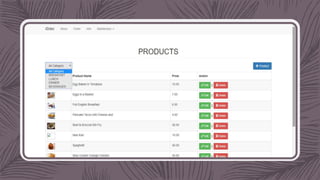
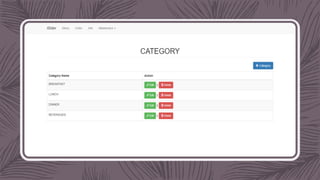
– Create, retrieve, update and delete category of products.
– Create, retrieve, update and delete products.
– Retrieve the order from customer.
Customer
– Register
– Retrieve the products.
– Create, retrieve, update and
delete order
SCOPE
LIMITATION
The system does not
include online payment.
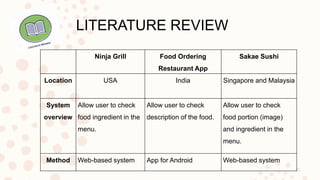
Ninja Grill Food Ordering
Restaurant App
Sakae Sushi
Location USA India Singapore and Malaysia
System
overview
Allow user to check
food ingredient in the
menu.
Allow user to check
description of the food.
Allow user to check
food portion (image)
and ingredient in the
menu.
Method Web-based system App for Android Web-based system
LITERATURE REVIEW
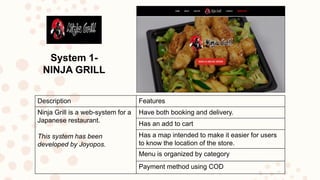
System 1-
NINJA GRILL
Description Features
Ninja Grill is a web-system for a
Japanese restaurant.
This system has been
developed by Joyopos.
Have both booking and delivery.
Has an add to cart
Has a map intended to make it easier for users
to know the location of the store.
Menu is organized by category
Payment method using COD
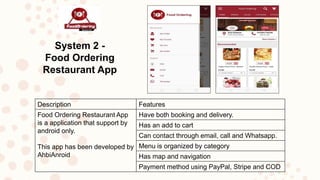
System 2 -
Food Ordering
Restaurant App
Description Features
Food Ordering Restaurant App
is a application that support by
android only.
This app has been developed by
AhbiAnroid
Have both booking and delivery.
Has an add to cart
Can contact through email, call and Whatsapp.
Menu is organized by category
Has map and navigation
Payment method using PayPal, Stripe and COD
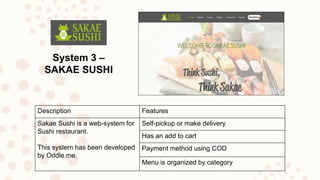
System 3 –
SAKAE SUSHI
Description Features
Sakae Sushi is a web-system for
Sushi restaurant.
This system has been developed
by Oddle.me.
Self-pickup or make delivery
Has an add to cart
Payment method using COD
Menu is organized by category
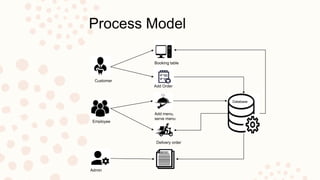
Process Model
Customer
Employee
Add Order
Add menu,
serve menu
Delivery order
Database
Admin
Booking table
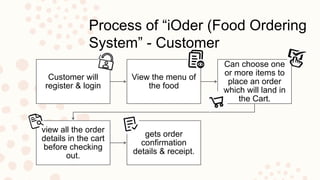
Process of “iOder (Food Ordering
System” - Customer
Customer will
register & login
View the menu of
the food
Can choose one
or more items to
place an order
which will land in
the Cart.
view all the order
details in the cart
before checking
out.
gets order
confirmation
details & receipt.
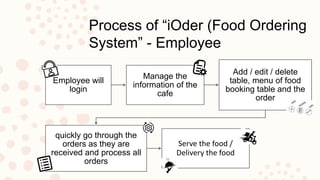
Employee will
login
Manage the
information of the
cafe
Add / edit / delete
table, menu of food
booking table and the
order
quickly go through the
orders as they are
received and process all
orders
Serve the food /
Delivery the food
Process of “iOder (Food Ordering
System” - Employee
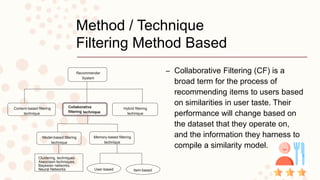
Method / Technique
Filtering Method Based
– Collaborative Filtering (CF) is a
broad term for the process of
recommending items to users based
on similarities in user taste. Their
performance will change based on
the dataset that they operate on,
and the information they harness to
compile a similarity model.
Clustering, techniques
Associaon techniques,
Bayesian networks,
Neural Networks
Recommender
System
Content-based filtering Collaborative
filtering
Hybrid filtering
Model-based filtering Memory-based filtering
User-based Item-based
technique technique
technique technique
technique
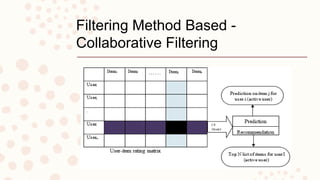
Filtering Method Based -
Collaborative Filtering
Filtering Method Based -
Collaborative Filtering
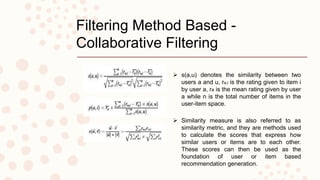
 s(a,u) denotes the similarity between two
users a and u, ra;i is the rating given to item i
by user a, ra is the mean rating given by user
a while n is the total number of items in the
user-item space.
 Similarity measure is also referred to as
similarity metric, and they are methods used
to calculate the scores that express how
similar users or items are to each other.
These scores can then be used as the
foundation of user or item based
recommendation generation.
EXPECTED RESULT
Make order
Enable real-time feedback
Get the analytic of report
System Development Methodology
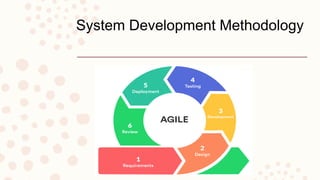
Requirement Phase
– In this phase, the project title had been selected. The project title for the system
was iOder (Food Ordering System). This project starting with brainstorming ideas
with supervisor and proposed the title of the project.
Design Phase
– In the design phase, all the data or requirement obtained during planning and
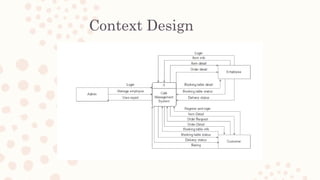
analysis phase transformed into the design. Diagrams to show the flow of the
system will be develop in this chapter such as Context Diagram (CD), Data Flow
Diagram (DFD) Level 0 and 1, Entity Relationship Diagram (ERD).
Development Phase
– This phase is where the design will implement into the coding. The system will
develop regarding the user and system requirement
System Development Methodology
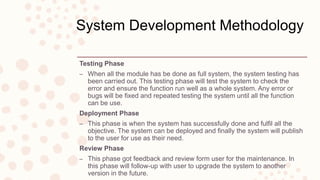
Testing Phase
– When all the module has be done as full system, the system testing has
been carried out. This testing phase will test the system to check the
error and ensure the function run well as a whole system. Any error or
bugs will be fixed and repeated testing the system until all the function
can be use.
Deployment Phase
– This phase is when the system has successfully done and fulfil all the
objective. The system can be deployed and finally the system will publish
to the user for use as their need.
Review Phase
– This phase got feedback and review form user for the maintenance. In
this phase will follow-up with user to upgrade the system to another
version in the future.
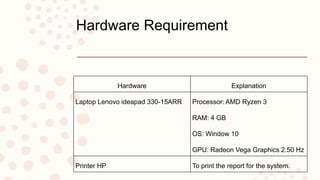
Hardware Requirement
Hardware Explanation
Laptop Lenovo ideapad 330-15ARR Processor: AMD Ryzen 3
RAM: 4 GB
OS: Window 10
GPU: Radeon Vega Graphics 2.50 Hz
Printer HP To print the report for the system.
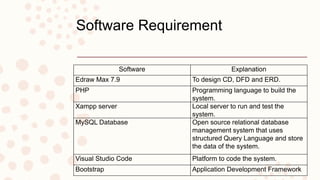
Software Requirement
Software Explanation
Edraw Max 7.9 To design CD, DFD and ERD.
PHP Programming language to build the
system.
Xampp server Local server to run and test the
system.
MySQL Database Open source relational database
management system that uses
structured Query Language and store
the data of the system.
Visual Studio Code Platform to code the system.
Bootstrap Application Development Framework
Context Design
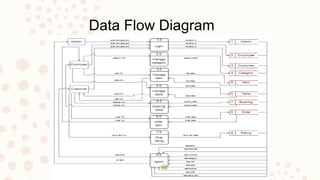
Data Flow Diagram
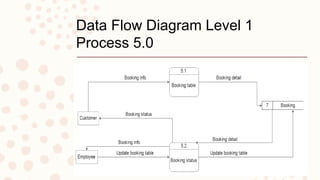
Data Flow Diagram Level 1
Process 5.0
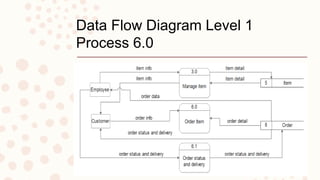
Data Flow Diagram Level 1
Process 6.0
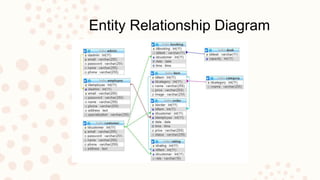
Entity Relationship Diagram
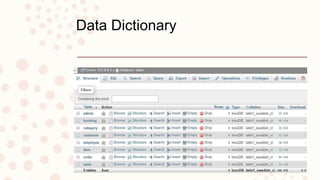
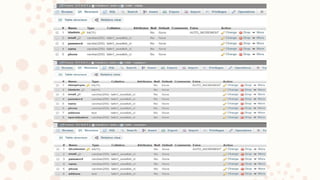
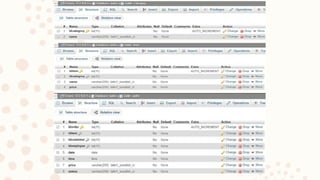
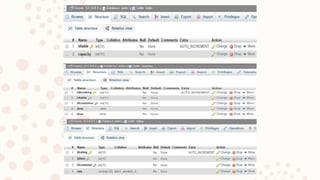
Data Dictionary
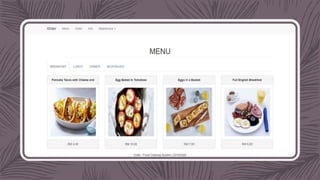
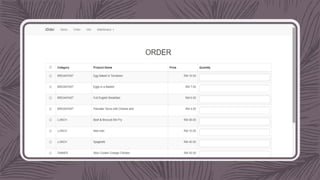
INTERFACE
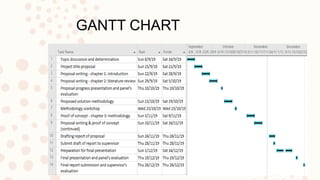
GANTT CHART
REFERENCES
 John O'Donovan and John Dunnionv (2014), “A Framework for Evaluation of Information Filtering
Techniques in an Adaptive Recommender System”, Conference Paper in Lecture Notes in Computer
Science, August 2004, doi: 10.1007/978-3-540-24630-5_62; Link:
https://www.researchgate.net/publication/227279431_A_Framework_for_Evaluation_of_Information_Fil
tering_Techniques_in_an_Adaptive_Recommender_System
 F.O. Isinkaye , Y.O. Folajimi , B.A. Ojokoh (2015), ‘Recommendation systems: Principles, methods and
evaluation”, Egyption Information Journal, 20 August 2015, 16, 261-273; Link:
https://www.sciencedirect.com/science/article/pii/S1110866515000341
 http://services.lovelycoding.org/food-ordering-system/
 Author: Vincent; Title: Star Rating; Article name: Survey Anyplace; Year: 6 Jan, 2019; Link:
https://help.surveyanyplace.com/en/support/solutions/articles/35000042298-star-rating
 https://www.ninjagrillusa.com/Store2/index.html
 https://apkpure.com/food-ordering-india-restaurant-app-demo/com.abhiandroid.foodorderingin
 https://www.sakaedelivery.com.my/en_MY#8a818c796cf6060b016cf670ff4625b5

iOder (Food Ordering System)

  • 1.
    iOder (Food OrderingSystem) NUR ANIS FADLIN BINTI GHAZALI 051543 BACHELOR OF COMPUTER SCIENCE IN SOFTWARE DEVELOPMENT PROF DR. MOHD NORDIN BIN ABDUL RAHMAN
  • 2.
    INTRODUCTION – Majority peoplewant to make order anywhere, anytime they want. They don’t have enough time to drive car, walk in to the cafe, make order and spent their time at there. – Some people also want to booking table and make order first before they arrived at the cafe to save their time for waiting the food. – These problems have led to the idea of developing a system which is ‘iOder (Food Ordering System)’ that would help the customer in making order.
  • 3.
    PROBLEM STATEMENT – Thislack of visibility leads to difficulties in budgeting, planning and forecasting, and the inability to identify and prioritize urgent orders. – Multiple touch points are involved in manually processing orders, an elevated risk of errors are present. Such errors can include incorrect order entry. – Manual processes of keying-in orders and physically handling documents are still in place, the Order to Cash cycle is constantly put on hold. Other than the human error aspect of sales order processing, there are still other considerations that can add processing times and costs.
  • 4.
    OBJECTIVE To study theproblem and its potential to solve the manual system in taking order to the online system. To design and develop a system for customer to make order and cafe employee to manage the order. To testing the developed system for its usability and functionality.
  • 5.
    SCOPE Admin – Create, retrieve,update Cafe information. – Create, retrieve, update and delete cafe branches. – Create, retrieve, update and delete employee. – View all report Employee – Create, retrieve, update and delete category of products. – Create, retrieve, update and delete products. – Retrieve the order from customer.
  • 6.
    Customer – Register – Retrievethe products. – Create, retrieve, update and delete order SCOPE
  • 7.
    LIMITATION The system doesnot include online payment.
  • 8.
    Ninja Grill FoodOrdering Restaurant App Sakae Sushi Location USA India Singapore and Malaysia System overview Allow user to check food ingredient in the menu. Allow user to check description of the food. Allow user to check food portion (image) and ingredient in the menu. Method Web-based system App for Android Web-based system LITERATURE REVIEW
  • 9.
    System 1- NINJA GRILL DescriptionFeatures Ninja Grill is a web-system for a Japanese restaurant. This system has been developed by Joyopos. Have both booking and delivery. Has an add to cart Has a map intended to make it easier for users to know the location of the store. Menu is organized by category Payment method using COD
  • 10.
    System 2 - FoodOrdering Restaurant App Description Features Food Ordering Restaurant App is a application that support by android only. This app has been developed by AhbiAnroid Have both booking and delivery. Has an add to cart Can contact through email, call and Whatsapp. Menu is organized by category Has map and navigation Payment method using PayPal, Stripe and COD
  • 11.
    System 3 – SAKAESUSHI Description Features Sakae Sushi is a web-system for Sushi restaurant. This system has been developed by Oddle.me. Self-pickup or make delivery Has an add to cart Payment method using COD Menu is organized by category
  • 12.
    Process Model Customer Employee Add Order Addmenu, serve menu Delivery order Database Admin Booking table
  • 13.
    Process of “iOder(Food Ordering System” - Customer Customer will register & login View the menu of the food Can choose one or more items to place an order which will land in the Cart. view all the order details in the cart before checking out. gets order confirmation details & receipt.
  • 14.
    Employee will login Manage the informationof the cafe Add / edit / delete table, menu of food booking table and the order quickly go through the orders as they are received and process all orders Serve the food / Delivery the food Process of “iOder (Food Ordering System” - Employee
  • 15.
    Method / Technique FilteringMethod Based – Collaborative Filtering (CF) is a broad term for the process of recommending items to users based on similarities in user taste. Their performance will change based on the dataset that they operate on, and the information they harness to compile a similarity model. Clustering, techniques Associaon techniques, Bayesian networks, Neural Networks Recommender System Content-based filtering Collaborative filtering Hybrid filtering Model-based filtering Memory-based filtering User-based Item-based technique technique technique technique technique
  • 16.
    Filtering Method Based- Collaborative Filtering
  • 17.
    Filtering Method Based- Collaborative Filtering  s(a,u) denotes the similarity between two users a and u, ra;i is the rating given to item i by user a, ra is the mean rating given by user a while n is the total number of items in the user-item space.  Similarity measure is also referred to as similarity metric, and they are methods used to calculate the scores that express how similar users or items are to each other. These scores can then be used as the foundation of user or item based recommendation generation.
  • 18.
    EXPECTED RESULT Make order Enablereal-time feedback Get the analytic of report
  • 19.
  • 20.
    System Development Methodology RequirementPhase – In this phase, the project title had been selected. The project title for the system was iOder (Food Ordering System). This project starting with brainstorming ideas with supervisor and proposed the title of the project. Design Phase – In the design phase, all the data or requirement obtained during planning and analysis phase transformed into the design. Diagrams to show the flow of the system will be develop in this chapter such as Context Diagram (CD), Data Flow Diagram (DFD) Level 0 and 1, Entity Relationship Diagram (ERD). Development Phase – This phase is where the design will implement into the coding. The system will develop regarding the user and system requirement
  • 21.
    System Development Methodology TestingPhase – When all the module has be done as full system, the system testing has been carried out. This testing phase will test the system to check the error and ensure the function run well as a whole system. Any error or bugs will be fixed and repeated testing the system until all the function can be use. Deployment Phase – This phase is when the system has successfully done and fulfil all the objective. The system can be deployed and finally the system will publish to the user for use as their need. Review Phase – This phase got feedback and review form user for the maintenance. In this phase will follow-up with user to upgrade the system to another version in the future.
  • 22.
    Hardware Requirement Hardware Explanation LaptopLenovo ideapad 330-15ARR Processor: AMD Ryzen 3 RAM: 4 GB OS: Window 10 GPU: Radeon Vega Graphics 2.50 Hz Printer HP To print the report for the system.
  • 23.
    Software Requirement Software Explanation EdrawMax 7.9 To design CD, DFD and ERD. PHP Programming language to build the system. Xampp server Local server to run and test the system. MySQL Database Open source relational database management system that uses structured Query Language and store the data of the system. Visual Studio Code Platform to code the system. Bootstrap Application Development Framework
  • 24.
  • 25.
  • 26.
    Data Flow DiagramLevel 1 Process 5.0
  • 27.
    Data Flow DiagramLevel 1 Process 6.0
  • 28.
  • 29.
  • 33.
  • 39.
  • 40.
    REFERENCES  John O'Donovanand John Dunnionv (2014), “A Framework for Evaluation of Information Filtering Techniques in an Adaptive Recommender System”, Conference Paper in Lecture Notes in Computer Science, August 2004, doi: 10.1007/978-3-540-24630-5_62; Link: https://www.researchgate.net/publication/227279431_A_Framework_for_Evaluation_of_Information_Fil tering_Techniques_in_an_Adaptive_Recommender_System  F.O. Isinkaye , Y.O. Folajimi , B.A. Ojokoh (2015), ‘Recommendation systems: Principles, methods and evaluation”, Egyption Information Journal, 20 August 2015, 16, 261-273; Link: https://www.sciencedirect.com/science/article/pii/S1110866515000341  http://services.lovelycoding.org/food-ordering-system/  Author: Vincent; Title: Star Rating; Article name: Survey Anyplace; Year: 6 Jan, 2019; Link: https://help.surveyanyplace.com/en/support/solutions/articles/35000042298-star-rating  https://www.ninjagrillusa.com/Store2/index.html  https://apkpure.com/food-ordering-india-restaurant-app-demo/com.abhiandroid.foodorderingin  https://www.sakaedelivery.com.my/en_MY#8a818c796cf6060b016cf670ff4625b5