Submitted BY :
AMANINDER SANDHU
B.ED 1st year (18146)
SOHAN LAL DAV COLLEGE OF
EDUCATION ( AMBALA CITY )
Submitted TO :
DR. SATNAM KAUR
(ASSOCIATE PROFESSOR)
SOHAN LAL DAV COLLEGE OF
EDUCATION (AMBALA CITY)
18146
@ammesandhu
Equity: Equity implies giving as much
advantage, consideration, or latitude to
one party what he need actually. Along
with economy, effectiveness, and
efficiency, Equity is essential for ensuring
that extent and costs of funds, goods and
services are fairly divided among their
recipients. It involves trying to understand
and give people what they need actually.
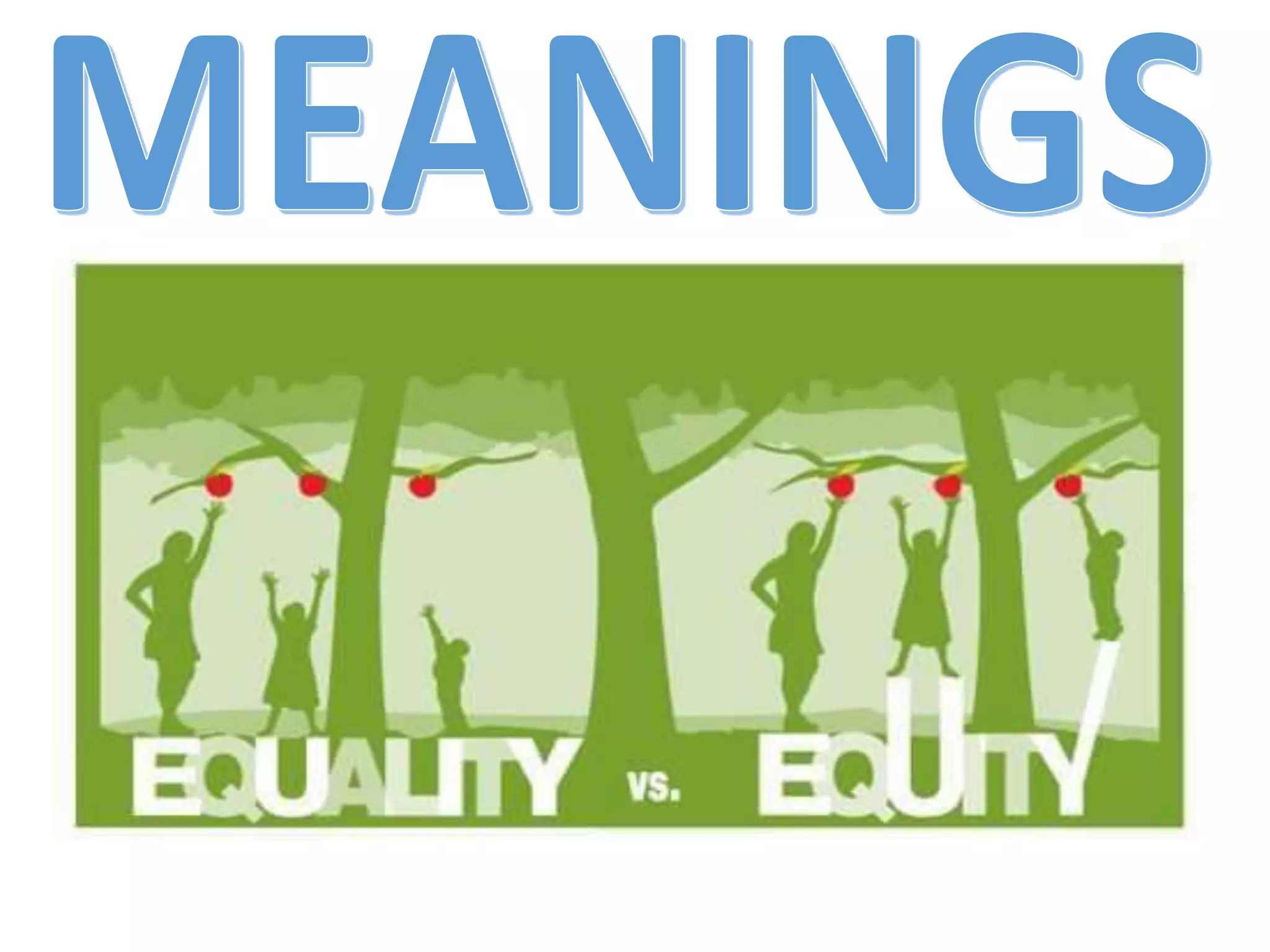
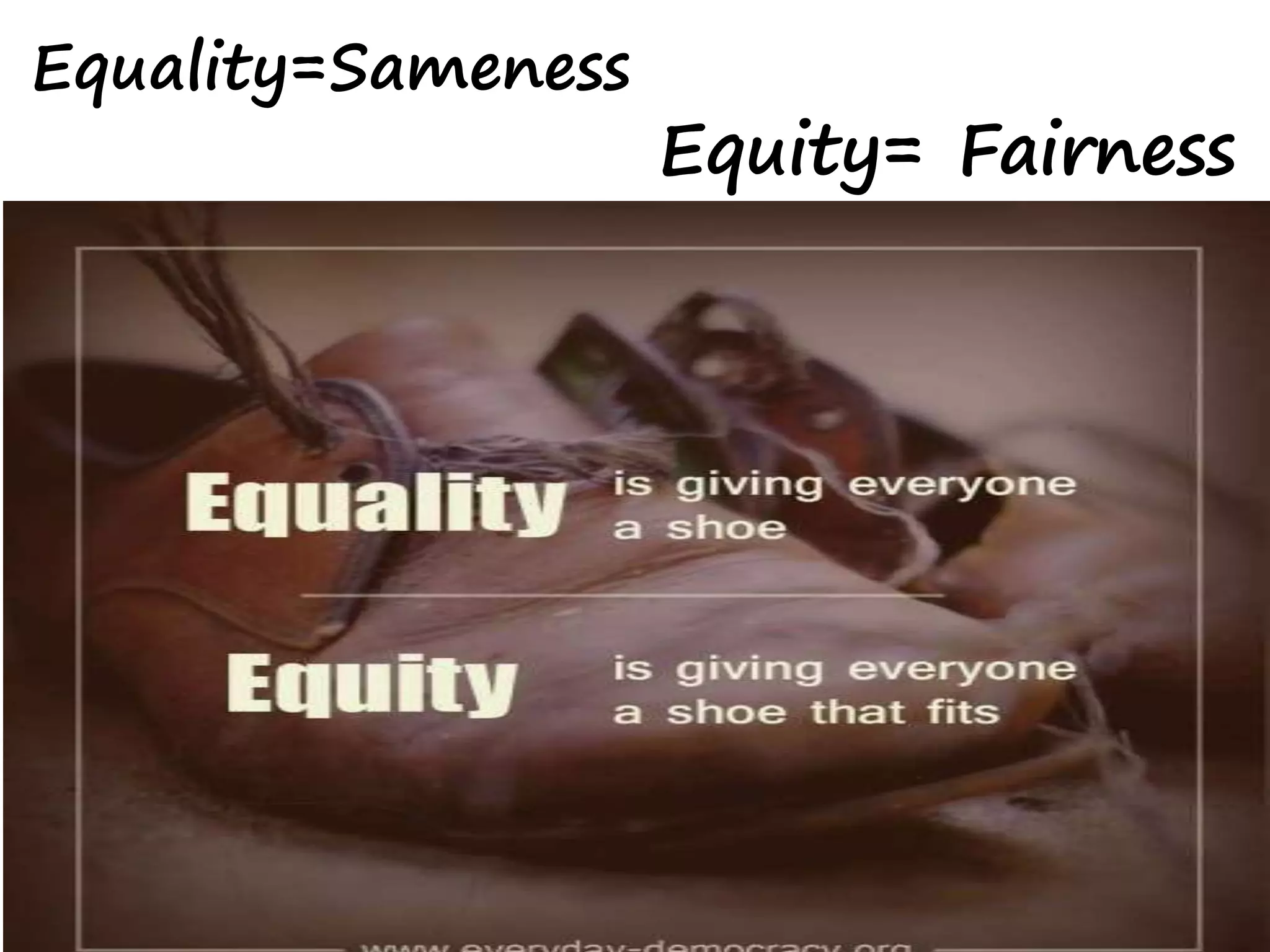
Equality=Sameness
Equity= Fairness
Equality vs Equity
Equality is about sameness. It promotes
fairness and justice by giving everyone
the same thing. But it can only work
if everyone starts from the same
place.
Equity is about fairness. It is about
making sure people get access to the
same opportunities. Sometimes our
differences or history can create
barriers to participation,sowe must
ensure equity before we can enjoy
equality.
IN ODER TO RESOLVE THIS ISSUE, THE
FOLLOWING MEASURE CAN BE ADOPTED
1. ROLE OF PARENTS
• Parents have a great responsibility to create a
sense of equity among the children of both the
gender.
• Equal share with regard to food, dress, play
material, independent space for studies and sleep
need to be provided.
• Children of both gender need to be listened and
heard carefully.
• Their opinion and views should be appreciated.
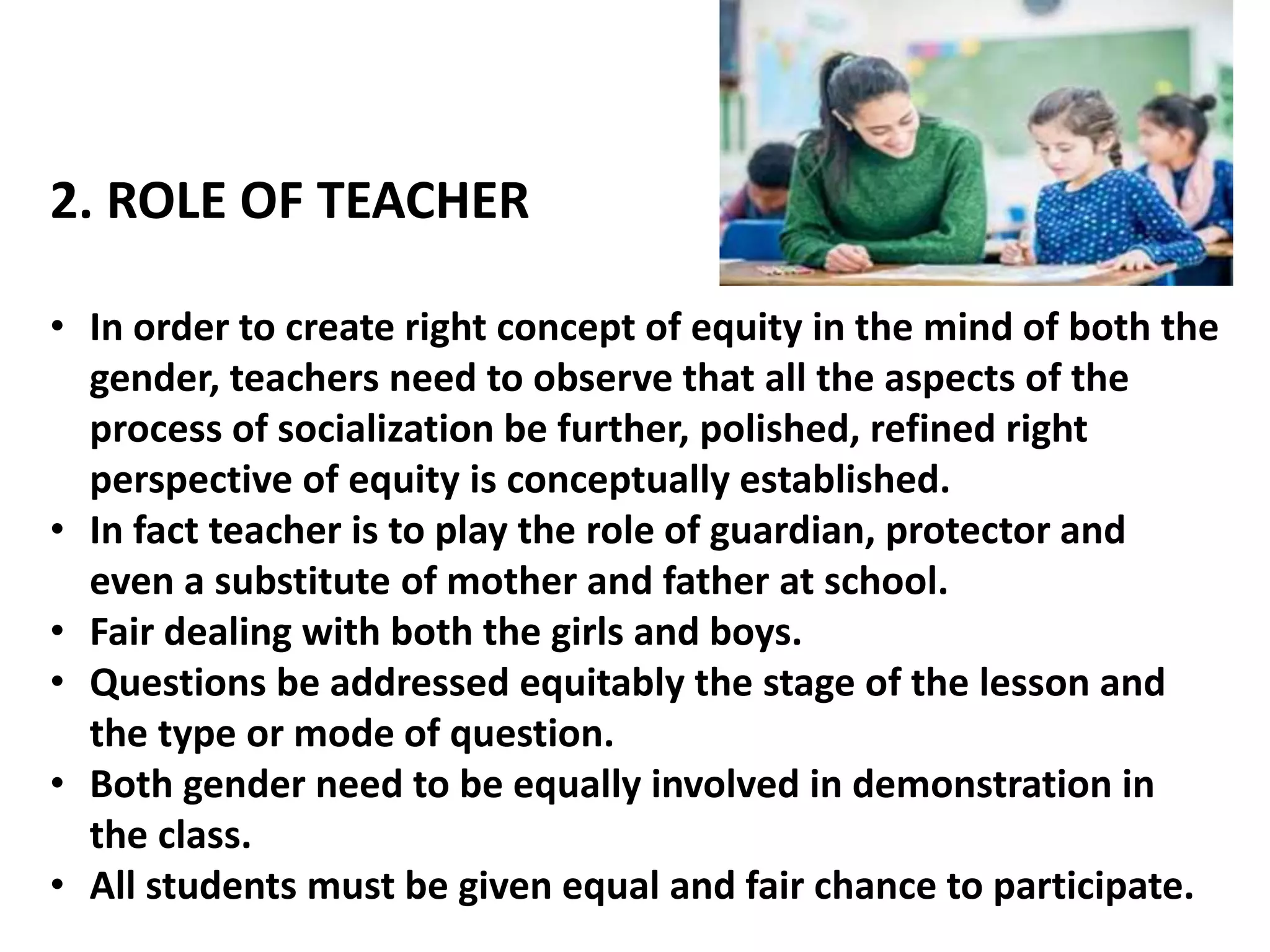
2. ROLE OF TEACHER
• In order to create right concept of equity in the mind of both the
gender, teachers need to observe that all the aspects of the
process of socialization be further, polished, refined right
perspective of equity is conceptually established.
• In fact teacher is to play the role of guardian, protector and
even a substitute of mother and father at school.
• Fair dealing with both the girls and boys.
• Questions be addressed equitably the stage of the lesson and
the type or mode of question.
• Both gender need to be equally involved in demonstration in
the class.
• All students must be given equal and fair chance to participate.
3. ROLE OF SCHOOL
• School is a nursery or the institution where the both girls and
boys are groomed and shaped under a fine and rich
environment.
• A complete growth and development takes place. At school the
following resources need to be equitably used by every student:
• Proper use of space, furniture, material, and other conveniences
provided in the school.
• All children must be involve in reading newspaper, magazines
and books on personality development.
• Proper use library and equipment in labs be made available.
• Debate, declamation and brain storming sessions be organized.
ROLE OF SOCIETY
• Society is an agency where social, economic, political and
ethical parameters related to one’s growth and socialization,
are vital to be considered. The following measures can be
adopted in this regard:
• Frequent views of social groups on equity can be invented to
gender identify the gaps and lacunas.
• Affected gender may be listened by other gender to visualize
and make the right assessment regarding unfair treatment
rendered to them.
• A mechanism may be worked out in order to maintained
equity among the genders.
• Governments with their concerned departments, may remove
such anomalies and existing gaps, if any.
Here An example, which would bring out
the principal difference between the two,
would like a family is in dinner table.
Equality would mean that everybody; father,
mother and children – would get a piece of
the same size. Equity, on the other hand,
would mean that they take the sensible
option, and divide it according to their
needs, i.e. larger sized pieces for the adult
and smaller pieces for the children.
When we say equity, we refer to the qualities of
justness , fairness , impartiality and even
handedness. When we talk about equality ,we
are talking about equal sharing and exact
division . Equality equals quantity, whereas
equity equals quality.
A perfect example to understand the differences
of this two concept is the feminist movement.
If women demand they should be
treated in the same way as men,
that would not be possible,
equality is not possible here,
because women and men are
different, and cannot be treated in
exactly the same way. However, if
they demand equity in how the
world treats them, it would be a
genuine demand. And now they
are demanding that they should be
given the same rights as men have
as human beings. It is fairness, not
sameness.
The ideas of equality and equity
are often misunderstood and
misused. If we talk about equity
and equality in education we
should be clear that educational
equality is that schools should
offer all students the same
education. This way all students
will have an equal chance. And a
common understanding of
educational equity is that all
children should be given the
education they need to achieve
certain outcomes.
There is a common misconception that
equity and equality mean the same
thing and that they can be used
interchangeably. But the truth is they
do not and cannot. Yes, the two
words are similar, but the difference
between them is crucial. So please,
do not talk about equality when you
really mean equity and do not talk
about equity when you mean equality.
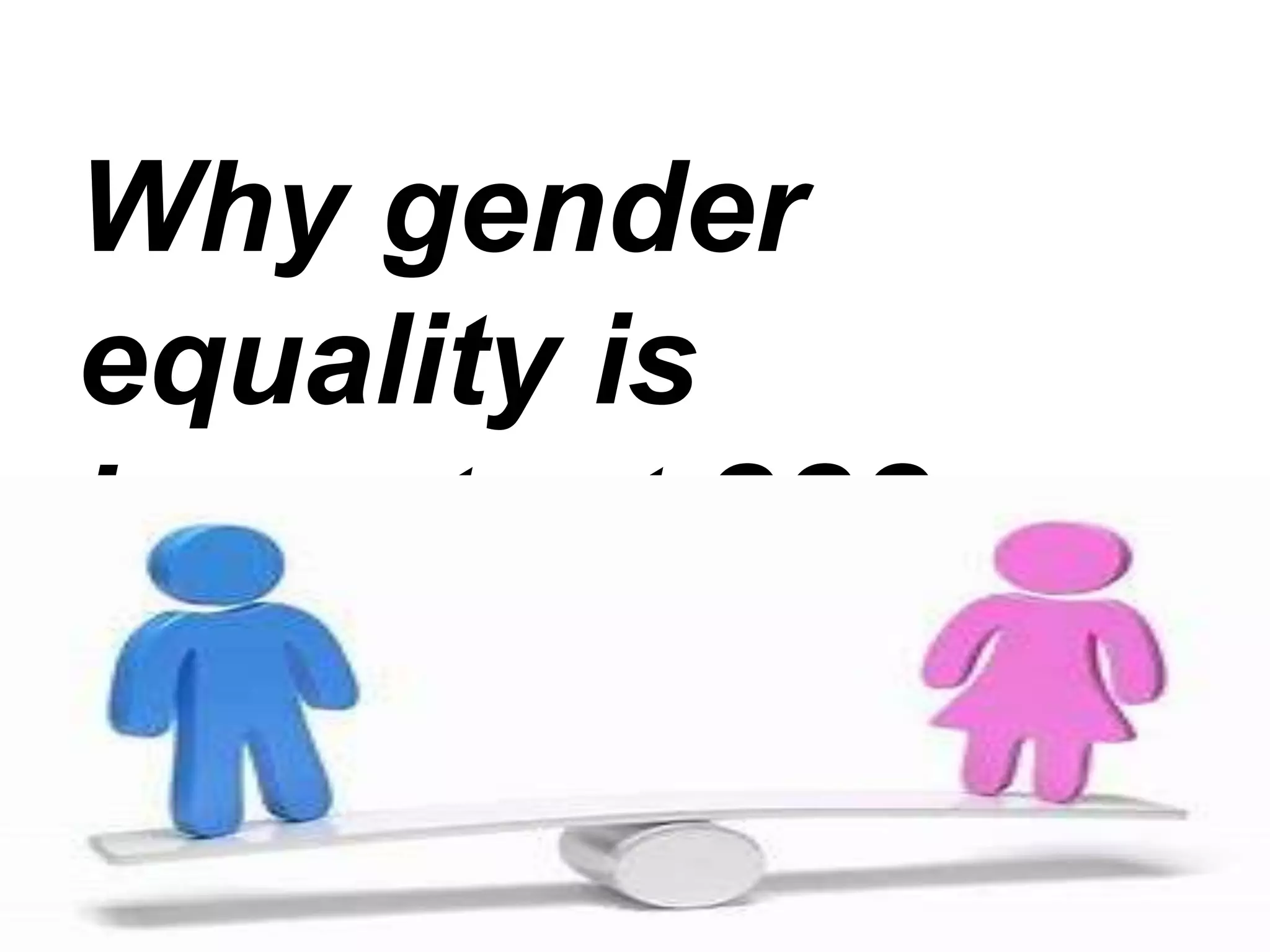
Why gender
equality is
important ???
1. Better utilization of
resources
In many cultures in the world, particularly the
heavily patriarchal ones, there is usually a clear
distinction between the sexes in terms of
profession. Traditionally in these societies,
women are pushed toward the finer arts
whereas men are expected to opt for the more
‘masculine’ professions, such as engineering
and medicine.
It has been seen, in many cases, where men who
work as nurses are discriminated against as not
being masculine enough. This kind of social
pressure leads many to opt for professions that
are not really their calling, which in turn
translates to waste of resources, as people are
forced to work in jobs they don’t excel.
Gender equality would get rid of this issue by
ensuring that one chooses their profession
without being subjected to social prejudice.
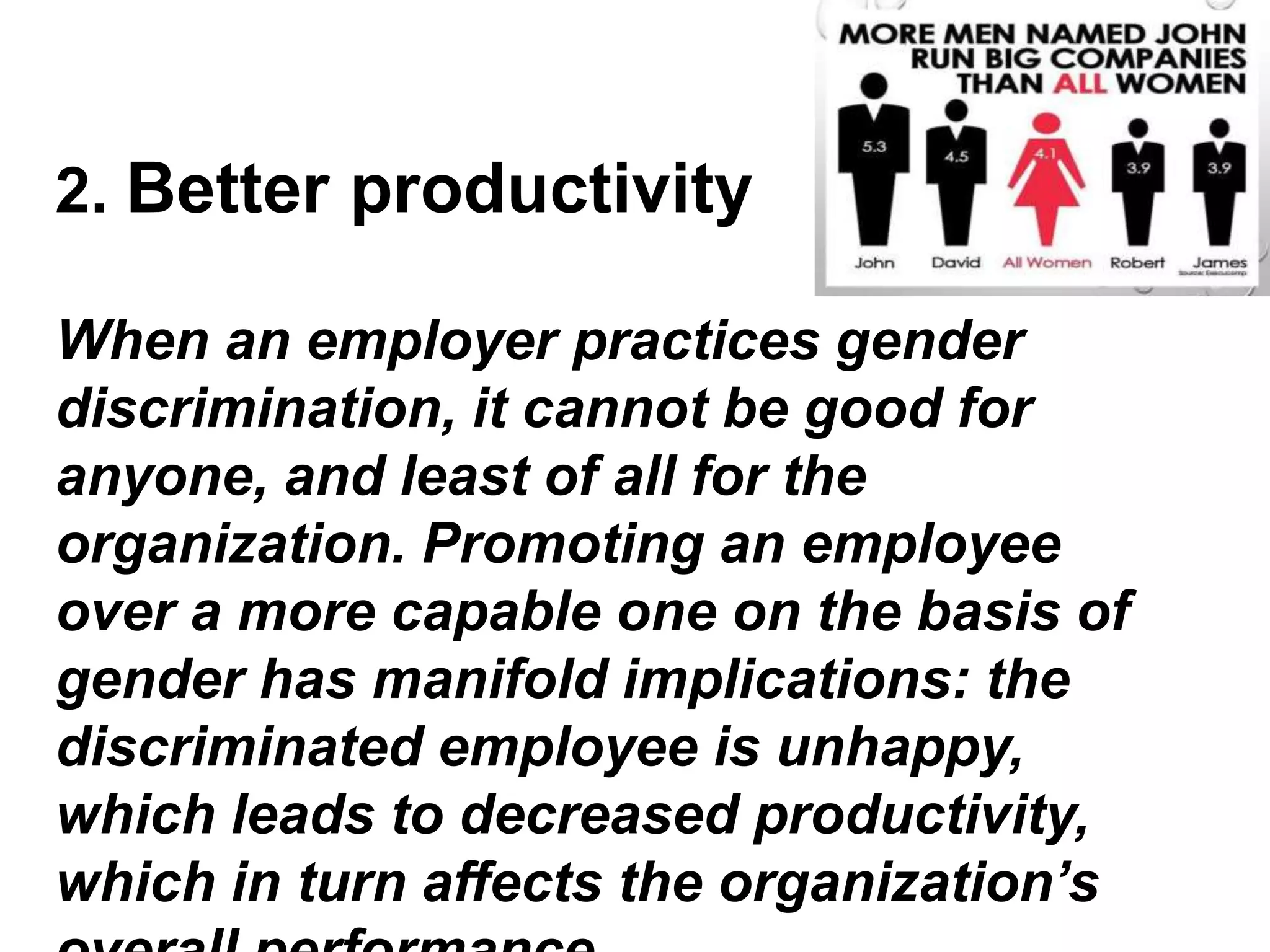
2. Better productivity
When an employer practices gender
discrimination, it cannot be good for
anyone, and least of all for the
organization. Promoting an employee
over a more capable one on the basis of
gender has manifold implications: the
discriminated employee is unhappy,
which leads to decreased productivity,
which in turn affects the organization’s
On the other hand, having a less
capable person in a more
responsible position leads to
organizational mayhem. In the end,
the employer benefits the least.
Moreover, if an employer
discriminates between the sexes,
there is a chance that they would be
employing more people of their
preferred gender, or, would employ
the other gender at a far lower pay.
3. A better life
If we look at a country like Afghanistan,
we find women in a pitiful condition. That
is because of the inequality that exists in
their extant culture. While the situation is
not as horrific in other cultures, there is
still this kind of intangible bases of
discrimination present in many others.
Moreover, domestic abuse
on women is pretty
rampant because of the
belief that women are the
weaker sex and can hence
be blamed for almost
anything. Gender equality
would help get rid of such
issues and ensure a better
life for the oppressed sex.
4. End to stereotyping
In most cultures across the world, men are
seen as the primary caregivers, while women
are traditionally the homemakers. Even today,
this stereotyping of social roles is highly
present. A man who wants to be a homemaker
is subject to ridicule, while women are
expected to give more priority to the home
than their career, failing which she is
considered ‘unfeminine’ and ‘unmarriageable’.
• Conclusion
Gender equality is not a question up for
debate. It is something that should be
adopted as a way of life. In many
countries, women are still not allowed to
own property, and their signatures are
invalid on legal documents if
unaccompanied by the signature of a
man.
Women still face inadequate representation
politically, and in many regions, it is hard
for women to come by legal help. It is
important to understand that differences
between the two sexes are not a basis for
holding one on a pedestal and trampling on
the other. Men and women are both
human, and deserve the same treatment in
the same circumstance.
@ammesandhu

Gender : Equity vs Equality

  • 2.
    Submitted BY : AMANINDERSANDHU B.ED 1st year (18146) SOHAN LAL DAV COLLEGE OF EDUCATION ( AMBALA CITY ) Submitted TO : DR. SATNAM KAUR (ASSOCIATE PROFESSOR) SOHAN LAL DAV COLLEGE OF EDUCATION (AMBALA CITY) 18146
  • 3.
  • 5.
    Equity: Equity impliesgiving as much advantage, consideration, or latitude to one party what he need actually. Along with economy, effectiveness, and efficiency, Equity is essential for ensuring that extent and costs of funds, goods and services are fairly divided among their recipients. It involves trying to understand and give people what they need actually.
  • 6.
  • 7.
  • 8.
    Equality is aboutsameness. It promotes fairness and justice by giving everyone the same thing. But it can only work if everyone starts from the same place. Equity is about fairness. It is about making sure people get access to the same opportunities. Sometimes our differences or history can create barriers to participation,sowe must ensure equity before we can enjoy equality.
  • 9.
    IN ODER TORESOLVE THIS ISSUE, THE FOLLOWING MEASURE CAN BE ADOPTED 1. ROLE OF PARENTS • Parents have a great responsibility to create a sense of equity among the children of both the gender. • Equal share with regard to food, dress, play material, independent space for studies and sleep need to be provided. • Children of both gender need to be listened and heard carefully. • Their opinion and views should be appreciated.
  • 10.
    2. ROLE OFTEACHER • In order to create right concept of equity in the mind of both the gender, teachers need to observe that all the aspects of the process of socialization be further, polished, refined right perspective of equity is conceptually established. • In fact teacher is to play the role of guardian, protector and even a substitute of mother and father at school. • Fair dealing with both the girls and boys. • Questions be addressed equitably the stage of the lesson and the type or mode of question. • Both gender need to be equally involved in demonstration in the class. • All students must be given equal and fair chance to participate.
  • 11.
    3. ROLE OFSCHOOL • School is a nursery or the institution where the both girls and boys are groomed and shaped under a fine and rich environment. • A complete growth and development takes place. At school the following resources need to be equitably used by every student: • Proper use of space, furniture, material, and other conveniences provided in the school. • All children must be involve in reading newspaper, magazines and books on personality development. • Proper use library and equipment in labs be made available. • Debate, declamation and brain storming sessions be organized.
  • 12.
    ROLE OF SOCIETY •Society is an agency where social, economic, political and ethical parameters related to one’s growth and socialization, are vital to be considered. The following measures can be adopted in this regard: • Frequent views of social groups on equity can be invented to gender identify the gaps and lacunas. • Affected gender may be listened by other gender to visualize and make the right assessment regarding unfair treatment rendered to them. • A mechanism may be worked out in order to maintained equity among the genders. • Governments with their concerned departments, may remove such anomalies and existing gaps, if any.
  • 13.
    Here An example,which would bring out the principal difference between the two, would like a family is in dinner table. Equality would mean that everybody; father, mother and children – would get a piece of the same size. Equity, on the other hand, would mean that they take the sensible option, and divide it according to their needs, i.e. larger sized pieces for the adult and smaller pieces for the children.
  • 14.
    When we sayequity, we refer to the qualities of justness , fairness , impartiality and even handedness. When we talk about equality ,we are talking about equal sharing and exact division . Equality equals quantity, whereas equity equals quality. A perfect example to understand the differences of this two concept is the feminist movement.
  • 15.
    If women demandthey should be treated in the same way as men, that would not be possible, equality is not possible here, because women and men are different, and cannot be treated in exactly the same way. However, if they demand equity in how the world treats them, it would be a genuine demand. And now they are demanding that they should be given the same rights as men have as human beings. It is fairness, not sameness.
  • 16.
    The ideas ofequality and equity are often misunderstood and misused. If we talk about equity and equality in education we should be clear that educational equality is that schools should offer all students the same education. This way all students will have an equal chance. And a common understanding of educational equity is that all children should be given the education they need to achieve certain outcomes.
  • 17.
    There is acommon misconception that equity and equality mean the same thing and that they can be used interchangeably. But the truth is they do not and cannot. Yes, the two words are similar, but the difference between them is crucial. So please, do not talk about equality when you really mean equity and do not talk about equity when you mean equality.
  • 18.
  • 19.
    1. Better utilizationof resources In many cultures in the world, particularly the heavily patriarchal ones, there is usually a clear distinction between the sexes in terms of profession. Traditionally in these societies, women are pushed toward the finer arts whereas men are expected to opt for the more ‘masculine’ professions, such as engineering and medicine.
  • 20.
    It has beenseen, in many cases, where men who work as nurses are discriminated against as not being masculine enough. This kind of social pressure leads many to opt for professions that are not really their calling, which in turn translates to waste of resources, as people are forced to work in jobs they don’t excel. Gender equality would get rid of this issue by ensuring that one chooses their profession without being subjected to social prejudice.
  • 21.
    2. Better productivity Whenan employer practices gender discrimination, it cannot be good for anyone, and least of all for the organization. Promoting an employee over a more capable one on the basis of gender has manifold implications: the discriminated employee is unhappy, which leads to decreased productivity, which in turn affects the organization’s
  • 22.
    On the otherhand, having a less capable person in a more responsible position leads to organizational mayhem. In the end, the employer benefits the least. Moreover, if an employer discriminates between the sexes, there is a chance that they would be employing more people of their preferred gender, or, would employ the other gender at a far lower pay.
  • 23.
    3. A betterlife If we look at a country like Afghanistan, we find women in a pitiful condition. That is because of the inequality that exists in their extant culture. While the situation is not as horrific in other cultures, there is still this kind of intangible bases of discrimination present in many others.
  • 24.
    Moreover, domestic abuse onwomen is pretty rampant because of the belief that women are the weaker sex and can hence be blamed for almost anything. Gender equality would help get rid of such issues and ensure a better life for the oppressed sex.
  • 25.
    4. End tostereotyping In most cultures across the world, men are seen as the primary caregivers, while women are traditionally the homemakers. Even today, this stereotyping of social roles is highly present. A man who wants to be a homemaker is subject to ridicule, while women are expected to give more priority to the home than their career, failing which she is considered ‘unfeminine’ and ‘unmarriageable’.
  • 26.
    • Conclusion Gender equalityis not a question up for debate. It is something that should be adopted as a way of life. In many countries, women are still not allowed to own property, and their signatures are invalid on legal documents if unaccompanied by the signature of a man.
  • 27.
    Women still faceinadequate representation politically, and in many regions, it is hard for women to come by legal help. It is important to understand that differences between the two sexes are not a basis for holding one on a pedestal and trampling on the other. Men and women are both human, and deserve the same treatment in the same circumstance.
  • 28.