Traditional 
American Values
Outline 
• The context of traditional American values 
• Individual freedom and self-reliance 
• Equality of opportunity and competition 
• Material wealth and hard work
The context of traditional values 
When the 21th century began, the US had 
the greatest diversity of racial, ethnic, 
cultural and religious groups due to the large 
immigration.
The context of traditional values 
Racial and ethnic diversity: 6 racial and ethnic 
categories 
Latin American 
Asian American 
African American 
White American 
Native American 
Native Hawaiian
The context of traditional values 
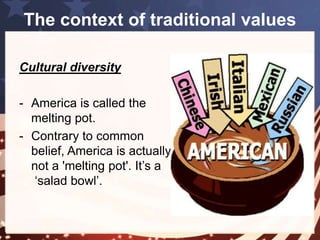
Cultural diversity 
- America is called the 
melting pot. 
- Contrary to common 
belief, America is actually 
not a 'melting pot'. It’s a 
‘salad bowl’.
The context of traditional values 
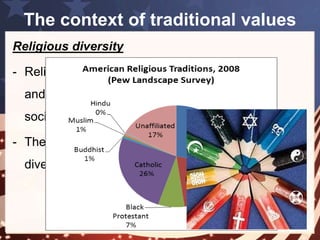
Religious diversity 
- Religion plays a very important role 
and influence to the culture, 
social life and politics. 
- The US has a religious 
diversity.
The context of traditional values 
Traditional American values 
- The chance for individual freedom 
- Equality of opportunity 
- Material wealth 
- Self-reliance 
- Competition 
- Hard work
Outline 
• The context of traditional American values 
• Individual freedom and self-reliance 
• Equality of opportunity and competition 
• Material wealth and hard work
Individual freedom 
• A gift of France to 
America 
• Famous symbol of 
freedom 
Statue of Liberty (1886)
Individual freedom 
• Historic decision: 
Earliest settlers came to 
North American => escape 
the controls 
1776, the British colonial settlers 
declared independence and 
overthrow the kings 
1789, they separated church 
=> limited power of church. 
Profound effect on 
American character 
shaping
Individual freedom 
• Impacts of historic decision: 
- Created a climate of freedom => on individual 
By freedom, Americans mean the desire and the ability 
of all individuals to control their own destiny without 
outside interference from the government, a ruling 
noble class, the church, or any other organized 
authority.
Individual freedom 
• Roles of individual freedom: 
- The most basic of all the American values. 
- Attracting immigrants to America 
+ Having no controlling of government and 
church 
+ New nation, “promise land”
Individual freedom 
• Examples: 
- People can express their own ideas and 
opinions freely (at school, in public, etc.) 
- People can choose any kind of lifestyle they 
want.
Self-reliance 
• A result of individual freedom => rely on 
themselves or lose freedom. 
• Example: 
By the age of 18 or 21 => independence from 
parents 
 part-time jobs => pay for cost of attending 
colleague 
 improving: “stand on their own feet” – be 
independent and manage their live without help 
of other
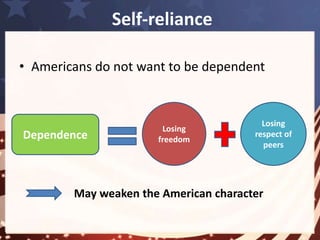
Self-reliance 
• Americans do not want to be dependent 
Losing 
freedom 
Losing 
respect of 
peers 
Dependence 
May weaken the American character
Self-reliance 
• In America, receiving 
financial support is 
allowed. 
Never be admired. 
Lose the respect of 
peers.
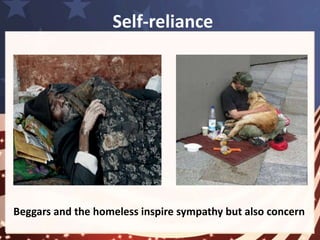
Self-reliance 
Beggars and the homeless inspire sympathy but also concern
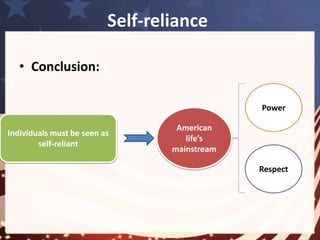
Self-reliance 
• Conclusion: 
American 
life’s 
mainstream 
Power 
Respect 
Individuals must be seen as 
self-reliant
Outline 
• The context of traditional American values 
• Individual freedom and self-reliance 
• Equality of opportunity and competition 
• Material wealth and hard work
Equality of Opportunity and Competition 
• Immigrants to the US believe that everyone 
has the chance to succeed 
• People are free from excessive political, 
religious, and social control 
• One reason is the lack of a hereditary 
aristocracy
Equality of Opportunity and Competition 
• No formal class system exists in the US 
• Their social class would determine how 
successful they could be 
• They would not have to compete with rich 
and powerful noble families
Equality of Opportunity and Competition 
• Many immigrants were very successful in 
the US – regardless of their background 
• This lead to the idea of equality of 
opportunity 
The more I advanced in the study of American society, 
the more I perceived that … equality of condition is the 
fundamental fact from which all others seem to be 
derived. 
Tocqueville
Equality of Opportunity and Competition 
• “Equality of opportunity” 
– Each individual has an equal 
opportunity for success 
• “Success” is the main goal of American 
life 
• An “ethical” rule (similar to “fair play”)
Equality of Opportunity and Competition 
We… wish to allow the humblest man an 
equal chance to get rich with everybody else. 
When one starts poor, as most do in the race 
of life, free society is such that he knows he 
can better his condition; he knows that there 
is no fixed condition of labour for his whole 
life. 
Abraham Lincoln
Equality of Opportunity and Competition 
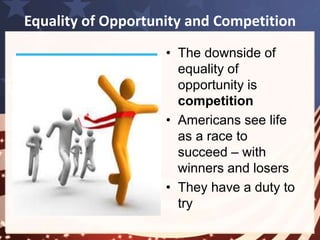
• The downside of equality of opportunity 
is competition 
• Americans see life as a race to 
succeed – with winners and losers 
• They have a duty to try
Equality of Opportunity and Competition 
• The downside of 
equality of 
opportunity is 
competition 
• Americans see life 
as a race to 
succeed – with 
winners and losers 
• They have a duty to 
try
Equality of Opportunity and Competition 
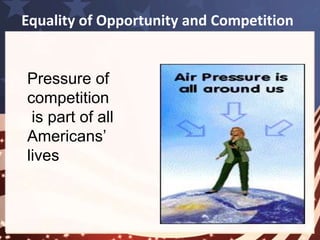
Pressure of 
competition 
is part of all 
Americans’ 
lives
Equality of Opportunity and Competition 
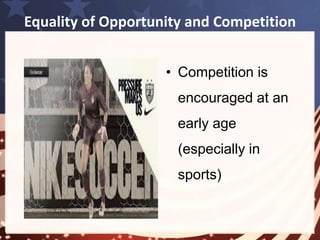
• Competition is 
encouraged at an 
early age 
(especially in 
sports)
Equality of Opportunity and Competition 
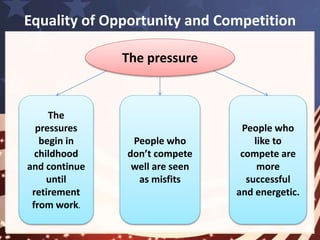
The 
pressures 
begin in 
childhood 
and continue 
until 
retirement 
from work. 
People who 
like to 
compete are 
more 
successful 
and energetic. 
The pressure 
People who 
don’t compete 
well are seen 
as misfits
Outline 
• The context of traditional American values 
• Individual freedom and self-reliance 
• Equality of opportunity and competition 
• Material wealth and hard work
Material wealth and hard work 
• Some people view America 
has the land of opportunity 
with its incredibly abundant 
natural resources 
They describe America is 
“The American dream” 
 The aspiration to material 
wealth was one of the main 
reasons why immigrants 
came to the United States.
Material wealth and hard work 
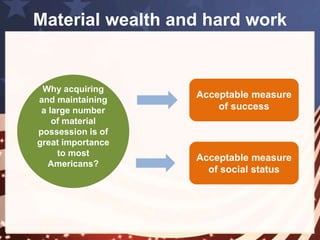
Why acquiring 
and maintaining 
a large number 
of material 
possession is of 
great importance 
to most 
Americans? 
Acceptable measure 
of success 
Acceptable measure 
of social status
Material wealth and hard work 
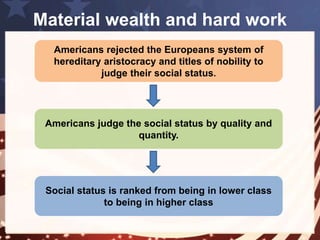
Americans rejected the Europeans system of 
hereditary aristocracy and titles of nobility to 
judge their social status. 
Americans judge the social status by quality and 
quantity. 
Social status is ranked from being in lower class 
to being in higher class
Material wealth and hard work 
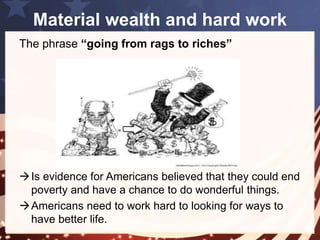
The phrase “going from rags to riches” 
Is evidence for Americans believed that they could end 
poverty and have a chance to do wonderful things. 
Americans need to work hard to looking for ways to 
have better life.
Material wealth and hard work 
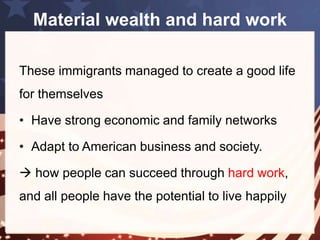
These immigrants managed to create a good life 
for themselves 
• Have strong economic and family networks 
• Adapt to American business and society. 
 how people can succeed through hard work, 
and all people have the potential to live happily
Material wealth and hard work 
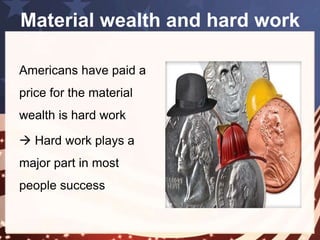
Americans have paid a 
price for the material 
wealth is hard work 
 Hard work plays a 
major part in most 
people success
Material wealth and hard work 
A good example of how American people tried 
to contribute to social life will set women of 
those times. 
 They took care 
of the household 
and kids 
 They dealt with a 
small home 
business 
The true 
American spirit 
and desire to 
work hard and be 
rewarded 
materially

American belief and values

  • 1.
  • 2.
    Outline • Thecontext of traditional American values • Individual freedom and self-reliance • Equality of opportunity and competition • Material wealth and hard work
  • 3.
    The context oftraditional values When the 21th century began, the US had the greatest diversity of racial, ethnic, cultural and religious groups due to the large immigration.
  • 4.
    The context oftraditional values Racial and ethnic diversity: 6 racial and ethnic categories Latin American Asian American African American White American Native American Native Hawaiian
  • 5.
    The context oftraditional values Cultural diversity - America is called the melting pot. - Contrary to common belief, America is actually not a 'melting pot'. It’s a ‘salad bowl’.
  • 6.
    The context oftraditional values Religious diversity - Religion plays a very important role and influence to the culture, social life and politics. - The US has a religious diversity.
  • 7.
    The context oftraditional values Traditional American values - The chance for individual freedom - Equality of opportunity - Material wealth - Self-reliance - Competition - Hard work
  • 8.
    Outline • Thecontext of traditional American values • Individual freedom and self-reliance • Equality of opportunity and competition • Material wealth and hard work
  • 9.
    Individual freedom •A gift of France to America • Famous symbol of freedom Statue of Liberty (1886)
  • 10.
    Individual freedom •Historic decision: Earliest settlers came to North American => escape the controls 1776, the British colonial settlers declared independence and overthrow the kings 1789, they separated church => limited power of church. Profound effect on American character shaping
  • 11.
    Individual freedom •Impacts of historic decision: - Created a climate of freedom => on individual By freedom, Americans mean the desire and the ability of all individuals to control their own destiny without outside interference from the government, a ruling noble class, the church, or any other organized authority.
  • 12.
    Individual freedom •Roles of individual freedom: - The most basic of all the American values. - Attracting immigrants to America + Having no controlling of government and church + New nation, “promise land”
  • 13.
    Individual freedom •Examples: - People can express their own ideas and opinions freely (at school, in public, etc.) - People can choose any kind of lifestyle they want.
  • 14.
    Self-reliance • Aresult of individual freedom => rely on themselves or lose freedom. • Example: By the age of 18 or 21 => independence from parents  part-time jobs => pay for cost of attending colleague  improving: “stand on their own feet” – be independent and manage their live without help of other
  • 15.
    Self-reliance • Americansdo not want to be dependent Losing freedom Losing respect of peers Dependence May weaken the American character
  • 16.
    Self-reliance • InAmerica, receiving financial support is allowed. Never be admired. Lose the respect of peers.
  • 17.
    Self-reliance Beggars andthe homeless inspire sympathy but also concern
  • 18.
    Self-reliance • Conclusion: American life’s mainstream Power Respect Individuals must be seen as self-reliant
  • 19.
    Outline • Thecontext of traditional American values • Individual freedom and self-reliance • Equality of opportunity and competition • Material wealth and hard work
  • 20.
    Equality of Opportunityand Competition • Immigrants to the US believe that everyone has the chance to succeed • People are free from excessive political, religious, and social control • One reason is the lack of a hereditary aristocracy
  • 21.
    Equality of Opportunityand Competition • No formal class system exists in the US • Their social class would determine how successful they could be • They would not have to compete with rich and powerful noble families
  • 22.
    Equality of Opportunityand Competition • Many immigrants were very successful in the US – regardless of their background • This lead to the idea of equality of opportunity The more I advanced in the study of American society, the more I perceived that … equality of condition is the fundamental fact from which all others seem to be derived. Tocqueville
  • 23.
    Equality of Opportunityand Competition • “Equality of opportunity” – Each individual has an equal opportunity for success • “Success” is the main goal of American life • An “ethical” rule (similar to “fair play”)
  • 24.
    Equality of Opportunityand Competition We… wish to allow the humblest man an equal chance to get rich with everybody else. When one starts poor, as most do in the race of life, free society is such that he knows he can better his condition; he knows that there is no fixed condition of labour for his whole life. Abraham Lincoln
  • 25.
    Equality of Opportunityand Competition • The downside of equality of opportunity is competition • Americans see life as a race to succeed – with winners and losers • They have a duty to try
  • 26.
    Equality of Opportunityand Competition • The downside of equality of opportunity is competition • Americans see life as a race to succeed – with winners and losers • They have a duty to try
  • 27.
    Equality of Opportunityand Competition Pressure of competition is part of all Americans’ lives
  • 28.
    Equality of Opportunityand Competition • Competition is encouraged at an early age (especially in sports)
  • 29.
    Equality of Opportunityand Competition The pressures begin in childhood and continue until retirement from work. People who like to compete are more successful and energetic. The pressure People who don’t compete well are seen as misfits
  • 30.
    Outline • Thecontext of traditional American values • Individual freedom and self-reliance • Equality of opportunity and competition • Material wealth and hard work
  • 31.
    Material wealth andhard work • Some people view America has the land of opportunity with its incredibly abundant natural resources They describe America is “The American dream”  The aspiration to material wealth was one of the main reasons why immigrants came to the United States.
  • 32.
    Material wealth andhard work Why acquiring and maintaining a large number of material possession is of great importance to most Americans? Acceptable measure of success Acceptable measure of social status
  • 33.
    Material wealth andhard work Americans rejected the Europeans system of hereditary aristocracy and titles of nobility to judge their social status. Americans judge the social status by quality and quantity. Social status is ranked from being in lower class to being in higher class
  • 34.
    Material wealth andhard work The phrase “going from rags to riches” Is evidence for Americans believed that they could end poverty and have a chance to do wonderful things. Americans need to work hard to looking for ways to have better life.
  • 35.
    Material wealth andhard work These immigrants managed to create a good life for themselves • Have strong economic and family networks • Adapt to American business and society.  how people can succeed through hard work, and all people have the potential to live happily
  • 36.
    Material wealth andhard work Americans have paid a price for the material wealth is hard work  Hard work plays a major part in most people success
  • 37.
    Material wealth andhard work A good example of how American people tried to contribute to social life will set women of those times.  They took care of the household and kids  They dealt with a small home business The true American spirit and desire to work hard and be rewarded materially