PSYCHIATRIC MENTAL HEALTH
NURSING
GROUP 5b
QN:EXTRAPYRAMIDAL SIDE EFFECT
(EPS)
Learning objective
• By the end of this topic every one will be able
to
Define extrapyramidal side effect
Describe common major extrapyramidal side
effect
Management of each major EPS
Assessment scale of AIMS
introduction
• When the substantial number of D2 receptor are
blocked in the nigrostriatal DA pathway, this will
produce various disorder of the movement that can
appear very much like those in the Parkinson's disease
• Sometime this movement are called drug induced
parkinsonism
• The major function of dopamine is to control voluntary
movement
• Since the nigrostriatal pathway is part of the
extrapyramidal nervous system .when the D2 is
blocked will show sign of EPS
Definition
• Extrapyramidal side effect refer to serious
neurological symptoms causing major side
effect of antipsychotic drugs.
• The symptoms include
Dystonia
Akathisia
Pseudo parkinsonism
Tardive dyskinesia
 Dystonia
• Movement disorder that causes the muscles to
contract involuntary either repetitive or twisting
movement .
• Involuntary muscle spasm in face ,arm ,legs and
neck occur most often in men
• Acute muscular rigidity and cramping ,stiff or
thick tongue with difficult swallowing , and , in
severe cases ,laryngospasm and respiratory
difficulty.
• It occur in the first week treatment in client
younger than 40years
Dystonia cont…
• Those receiving high potency drug such as
haloperidol and thiothixine
• Show the following sign and symptoms
Torticollis–spasm or stiffness in muscles group
(twisted head and neck)
Opisthotonus tightening in the entire body with
head ,back and arched neck
Oculogyric crisis eyes uncontrolled rolling back of
the eyes sometimes can be mistaken for seizures
activity
Cont….
• Acute dystonia can be painful and frightening
for the client
• Should be treated as emergency situation
because laryngospasm follow this symptoms
can be fatal.
Treatment of dystonia
• Immediate treatment with anticholinergic
drug eg I/M Benzotropine , or IV
diphenhydramine usually bring relief
• Lowering dose of antipsychotic drug or change
antipsychotic drug
• To stay with the patient or client and offer
reassurance and support during the frighting
time.
 Akathisia
• Inability to remain still
• Argue to move that you can’t control
• Feeling of internal and the inability to sit still or
rest this cause the patient to discontinue anti
psychotic medication
• the client appear restless or anxious and
agitated , often with rigid posture or gait and lack
of spontaneous gestures .
• This disorder common reported by the client as
an intense need to move about
Treatment of akathisia
• Give beta blocker
• Reduce dose of antipsychotic or stop the
medication
• Administer anticholinergic drug
 Pseudo parkinsonism or drug
induced parkinsonism
• Is the reaction to medication that imitates the
symptoms and appearance of Parkinson
disease.
• This condition generally is reversible and
stopping medication .
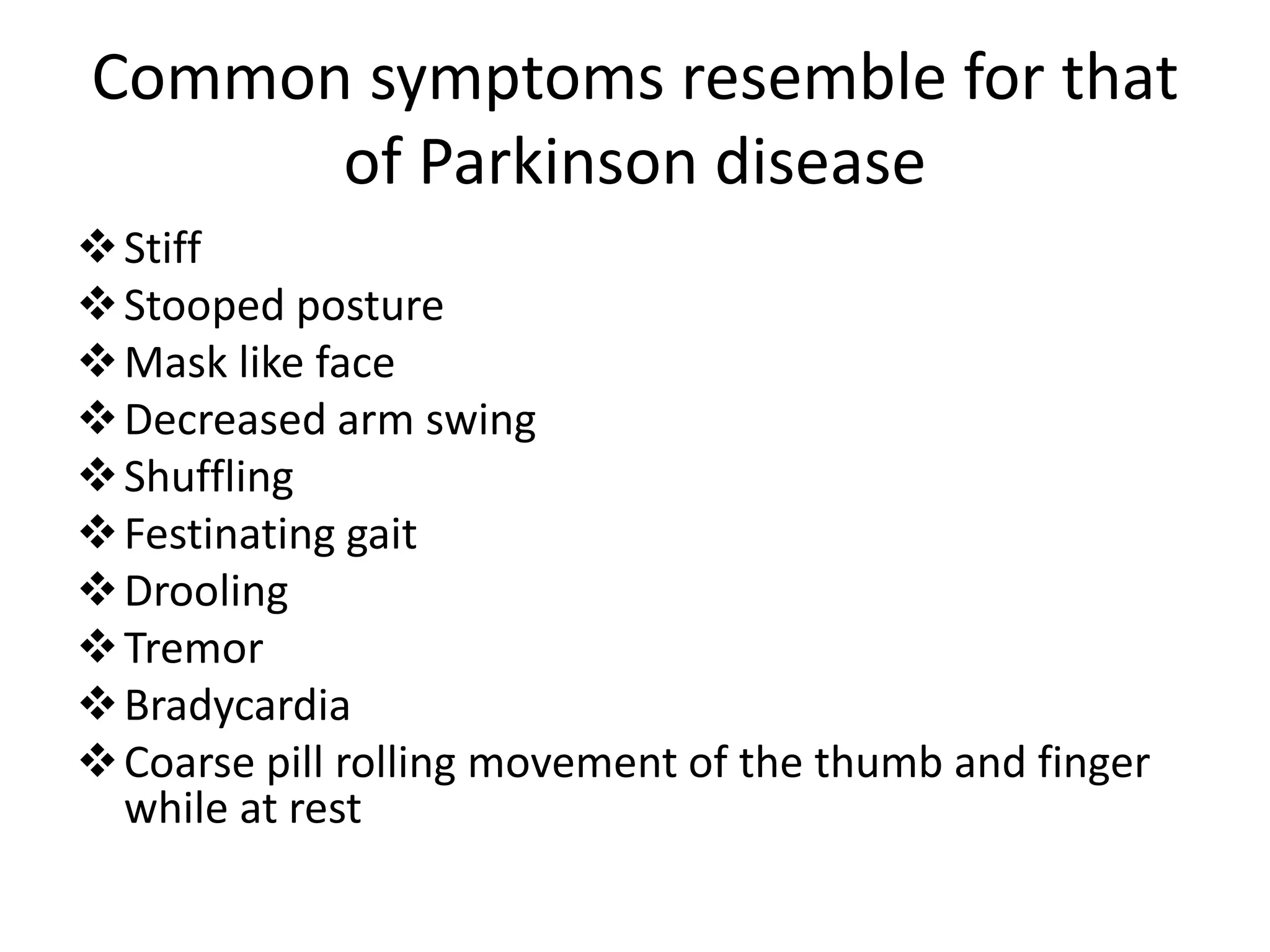
Common symptoms resemble for that
of Parkinson disease
Stiff
Stooped posture
Mask like face
Decreased arm swing
Shuffling
Festinating gait
Drooling
Tremor
Bradycardia
Coarse pill rolling movement of the thumb and finger
while at rest
 Tardive dyskinesia
• Tardive dyskinesia (TD), a syndrome of
permanent involuntary movements, is most
commonly caused by the long-term use of
conventional antipsychotic drugs.
• About 20% to 30% of patients on long-term
treatment develop symptoms of TD (Sadock &
Sadock, 2008).
• The pathophysiology is still unclear, and no
effective treatment has been approved for
general use.
ASSESSMENT USING ABNORMAL INVOLUNTARY
MOVEMENT SCALE (AIMS)
• Complete the examination procedure before
making ratings. For movement ratings, circle
the highest severity observed.
• Rate movements that occur upon activation
one less than those observed spontaneously.
Circle movement as well as code number that
applies.
SCALE CODE
• Code: 0 = None
• 1 = Minimal, may be normal
• 2 = Mild
• 3 = Moderate
• 4 = Severe
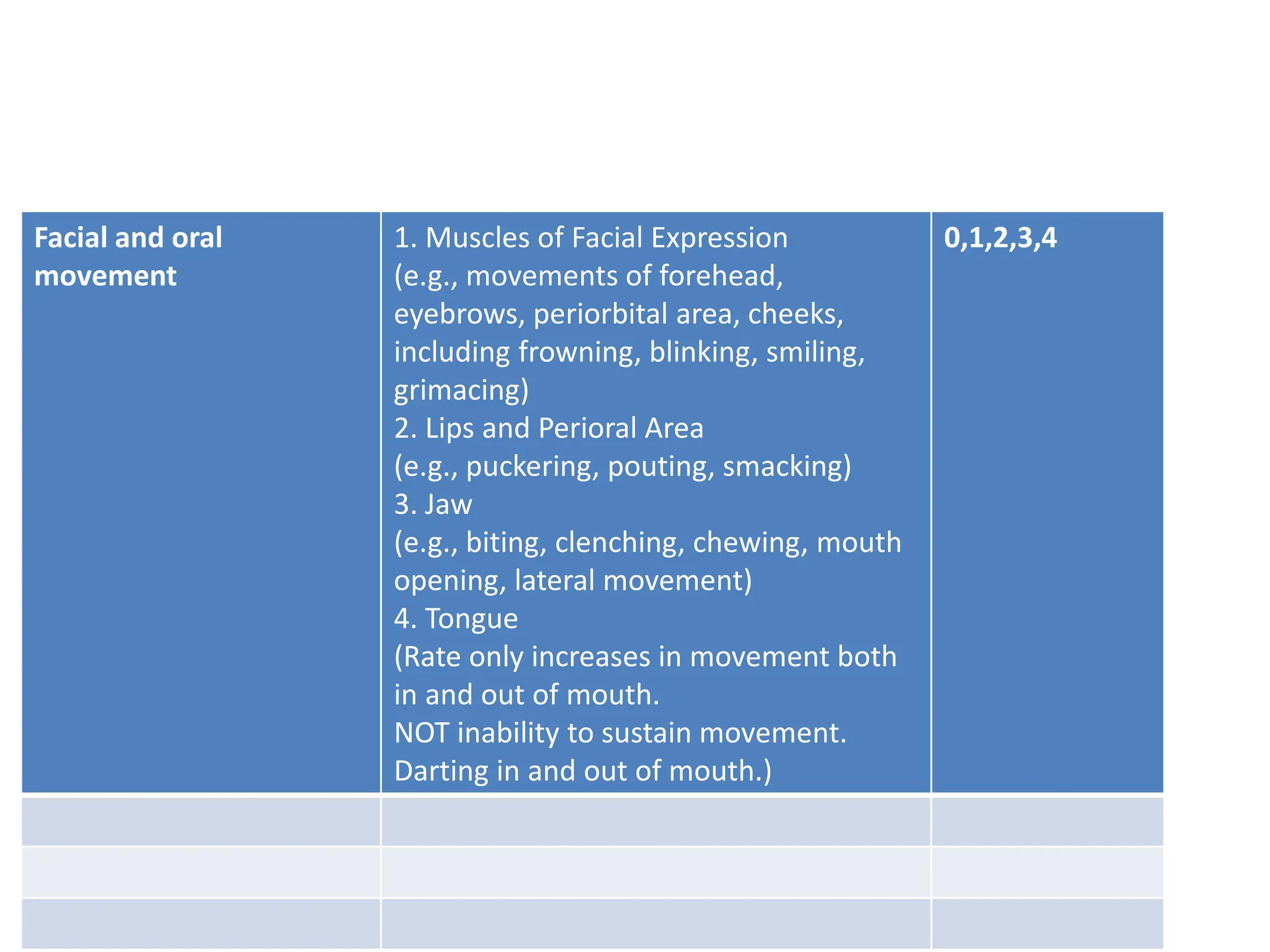
Facial and oral
movement
1. Muscles of Facial Expression
(e.g., movements of forehead,
eyebrows, periorbital area, cheeks,
including frowning, blinking, smiling,
grimacing)
2. Lips and Perioral Area
(e.g., puckering, pouting, smacking)
3. Jaw
(e.g., biting, clenching, chewing, mouth
opening, lateral movement)
4. Tongue
(Rate only increases in movement both
in and out of mouth.
NOT inability to sustain movement.
Darting in and out of mouth.)
0,1,2,3,4
Extrimity movement Upper (arms, wrists, hands, fingers)
Include choreic movements (i.e., rapid,
objectively purposeless,
irregular, spontaneous) and athetoid
movements (i.e., slow, irregular,
complex serpentine). Do not include
tremor (i.e., repetitive,
regular, rhythmic)
6. Lower (legs, knees, ankles, toes)
(e.g., lateral knee movement, foot
tapping, heel dropping, foot
squirming, inversion and eversion of
foot)
7. Neck, shoulders, hips
(e.g., rocking, twisting, squirming, pelvic
gyrations)
0,1,2,3,4
Global jugdement  Severity of abnormal
movements overall
 Incapacitation due to
abnormal movements
Patient’s awareness of
abnormal movements
(Rate only the client’s
report)
No awareness
Aware, no distress
Aware, mild distress
Aware, moderate distress
Aware, severe distress
Dental status Current problems with
teeth and/or dentures?
. Are dentures usually
worn?
. Edentia?
. Do movements disappear
in sleep?
Yes/No
NOTE
• Before or after completing the Examination
Procedure, observe the client unobtrusively, at
rest (e.g., in waiting room).
• The chair to be used in this examination
should be a hard, firm one without arms.
REFERENCE
• Psychiatric mental health nursing concept of
care in evidence based practice 9th ED (2018)
by mary C At all
• Stahl’s Essential psychopharmacology 4th ED
by stephan M Stahl’s (2013)
• Psychiatric mental health nursing 5th ED (2011)
by Shaila.L.Vendebeck

EPS. .pptx

  • 1.
    PSYCHIATRIC MENTAL HEALTH NURSING GROUP5b QN:EXTRAPYRAMIDAL SIDE EFFECT (EPS)
  • 2.
    Learning objective • Bythe end of this topic every one will be able to Define extrapyramidal side effect Describe common major extrapyramidal side effect Management of each major EPS Assessment scale of AIMS
  • 4.
    introduction • When thesubstantial number of D2 receptor are blocked in the nigrostriatal DA pathway, this will produce various disorder of the movement that can appear very much like those in the Parkinson's disease • Sometime this movement are called drug induced parkinsonism • The major function of dopamine is to control voluntary movement • Since the nigrostriatal pathway is part of the extrapyramidal nervous system .when the D2 is blocked will show sign of EPS
  • 5.
    Definition • Extrapyramidal sideeffect refer to serious neurological symptoms causing major side effect of antipsychotic drugs. • The symptoms include Dystonia Akathisia Pseudo parkinsonism Tardive dyskinesia
  • 6.
     Dystonia • Movementdisorder that causes the muscles to contract involuntary either repetitive or twisting movement . • Involuntary muscle spasm in face ,arm ,legs and neck occur most often in men • Acute muscular rigidity and cramping ,stiff or thick tongue with difficult swallowing , and , in severe cases ,laryngospasm and respiratory difficulty. • It occur in the first week treatment in client younger than 40years
  • 7.
    Dystonia cont… • Thosereceiving high potency drug such as haloperidol and thiothixine • Show the following sign and symptoms Torticollis–spasm or stiffness in muscles group (twisted head and neck) Opisthotonus tightening in the entire body with head ,back and arched neck Oculogyric crisis eyes uncontrolled rolling back of the eyes sometimes can be mistaken for seizures activity
  • 8.
    Cont…. • Acute dystoniacan be painful and frightening for the client • Should be treated as emergency situation because laryngospasm follow this symptoms can be fatal.
  • 9.
    Treatment of dystonia •Immediate treatment with anticholinergic drug eg I/M Benzotropine , or IV diphenhydramine usually bring relief • Lowering dose of antipsychotic drug or change antipsychotic drug • To stay with the patient or client and offer reassurance and support during the frighting time.
  • 10.
     Akathisia • Inabilityto remain still • Argue to move that you can’t control • Feeling of internal and the inability to sit still or rest this cause the patient to discontinue anti psychotic medication • the client appear restless or anxious and agitated , often with rigid posture or gait and lack of spontaneous gestures . • This disorder common reported by the client as an intense need to move about
  • 11.
    Treatment of akathisia •Give beta blocker • Reduce dose of antipsychotic or stop the medication • Administer anticholinergic drug
  • 12.
     Pseudo parkinsonismor drug induced parkinsonism • Is the reaction to medication that imitates the symptoms and appearance of Parkinson disease. • This condition generally is reversible and stopping medication .
  • 13.
    Common symptoms resemblefor that of Parkinson disease Stiff Stooped posture Mask like face Decreased arm swing Shuffling Festinating gait Drooling Tremor Bradycardia Coarse pill rolling movement of the thumb and finger while at rest
  • 14.
     Tardive dyskinesia •Tardive dyskinesia (TD), a syndrome of permanent involuntary movements, is most commonly caused by the long-term use of conventional antipsychotic drugs. • About 20% to 30% of patients on long-term treatment develop symptoms of TD (Sadock & Sadock, 2008). • The pathophysiology is still unclear, and no effective treatment has been approved for general use.
  • 15.
    ASSESSMENT USING ABNORMALINVOLUNTARY MOVEMENT SCALE (AIMS) • Complete the examination procedure before making ratings. For movement ratings, circle the highest severity observed. • Rate movements that occur upon activation one less than those observed spontaneously. Circle movement as well as code number that applies.
  • 16.
    SCALE CODE • Code:0 = None • 1 = Minimal, may be normal • 2 = Mild • 3 = Moderate • 4 = Severe
  • 17.
    Facial and oral movement 1.Muscles of Facial Expression (e.g., movements of forehead, eyebrows, periorbital area, cheeks, including frowning, blinking, smiling, grimacing) 2. Lips and Perioral Area (e.g., puckering, pouting, smacking) 3. Jaw (e.g., biting, clenching, chewing, mouth opening, lateral movement) 4. Tongue (Rate only increases in movement both in and out of mouth. NOT inability to sustain movement. Darting in and out of mouth.) 0,1,2,3,4
  • 18.
    Extrimity movement Upper(arms, wrists, hands, fingers) Include choreic movements (i.e., rapid, objectively purposeless, irregular, spontaneous) and athetoid movements (i.e., slow, irregular, complex serpentine). Do not include tremor (i.e., repetitive, regular, rhythmic) 6. Lower (legs, knees, ankles, toes) (e.g., lateral knee movement, foot tapping, heel dropping, foot squirming, inversion and eversion of foot) 7. Neck, shoulders, hips (e.g., rocking, twisting, squirming, pelvic gyrations) 0,1,2,3,4
  • 19.
    Global jugdement Severity of abnormal movements overall  Incapacitation due to abnormal movements Patient’s awareness of abnormal movements (Rate only the client’s report) No awareness Aware, no distress Aware, mild distress Aware, moderate distress Aware, severe distress
  • 20.
    Dental status Currentproblems with teeth and/or dentures? . Are dentures usually worn? . Edentia? . Do movements disappear in sleep? Yes/No
  • 21.
    NOTE • Before orafter completing the Examination Procedure, observe the client unobtrusively, at rest (e.g., in waiting room). • The chair to be used in this examination should be a hard, firm one without arms.
  • 22.
    REFERENCE • Psychiatric mentalhealth nursing concept of care in evidence based practice 9th ED (2018) by mary C At all • Stahl’s Essential psychopharmacology 4th ED by stephan M Stahl’s (2013) • Psychiatric mental health nursing 5th ED (2011) by Shaila.L.Vendebeck