MENTAL HEALTH AND PSYCHIATRY
NURSING
DISSOCIATIVE DISORDERS
Learning objectives
At the end of this session each learner is expected to be able to
understand;
• Definition of dissociative disorder
• Types of dissociative disorder
• Treatment of dissociative disorders
• Nursing management of dissociative disorders
DISSOCIATIVE DISORDES
•Are mental health conditions that involves experiencing a loss of
connection between thoughts, memories, feelings, surroundings,
behavior and identity.
•Dissociative symptoms can potentially disrupt every area of
psychological functioning.
•They usually rise as a reaction to shocking, distressing or painful
events and help push away difficult memories.
TYPES OF DISSOCIATIVE DISORDERS
There are three major types of dissociative disorders
Depersonalization/derealization disorder
Dissociative Amnesia
Dissociative identity disorder
DEPERSONALIZATION/DEREALIZATION
DISORDER
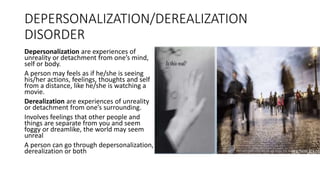
Depersonalization are experiences of
unreality or detachment from one’s mind,
self or body.
A person may feels as if he/she is seeing
his/her actions, feelings, thoughts and self
from a distance, like he/she is watching a
movie.
Derealization are experiences of unreality
or detachment from one’s surrounding.
Involves feelings that other people and
things are separate from you and seem
foggy or dreamlike, the world may seem
unreal
A person can go through depersonalization,
derealization or both
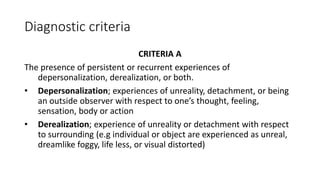
Diagnostic criteria
CRITERIA A
The presence of persistent or recurrent experiences of
depersonalization, derealization, or both.
• Depersonalization; experiences of unreality, detachment, or being
an outside observer with respect to one’s thought, feeling,
sensation, body or action
• Derealization; experience of unreality or detachment with respect
to surrounding (e.g individual or object are experienced as unreal,
dreamlike foggy, life less, or visual distorted)
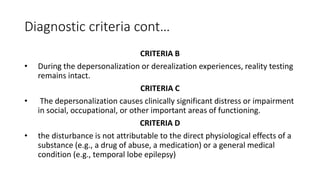
Diagnostic criteria cont…
CRITERIA B
• During the depersonalization or derealization experiences, reality testing
remains intact.
CRITERIA C
• The depersonalization causes clinically significant distress or impairment
in social, occupational, or other important areas of functioning.
CRITERIA D
• the disturbance is not attributable to the direct physiological effects of a
substance (e.g., a drug of abuse, a medication) or a general medical
condition (e.g., temporal lobe epilepsy)
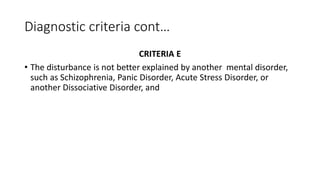
Diagnostic criteria cont…
CRITERIA E
• The disturbance is not better explained by another mental disorder,
such as Schizophrenia, Panic Disorder, Acute Stress Disorder, or
another Dissociative Disorder, and
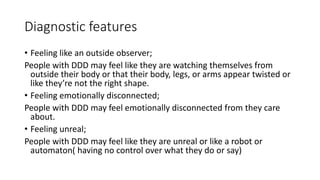
Diagnostic features
• Feeling like an outside observer;
People with DDD may feel like they are watching themselves from
outside their body or that their body, legs, or arms appear twisted or
like they’re not the right shape.
• Feeling emotionally disconnected;
People with DDD may feel emotionally disconnected from they care
about.
• Feeling unreal;
People with DDD may feel like they are unreal or like a robot or
automaton( having no control over what they do or say)
Diagnostic features cont…
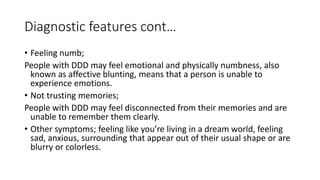
• Feeling numb;
People with DDD may feel emotional and physically numbness, also
known as affective blunting, means that a person is unable to
experience emotions.
• Not trusting memories;
People with DDD may feel disconnected from their memories and are
unable to remember them clearly.
• Other symptoms; feeling like you’re living in a dream world, feeling
sad, anxious, surrounding that appear out of their usual shape or are
blurry or colorless.
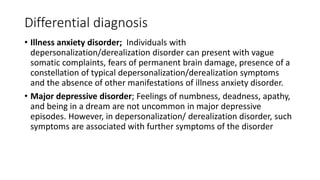
Differential diagnosis
• Illness anxiety disorder; Individuals with
depersonalization/derealization disorder can present with vague
somatic complaints, fears of permanent brain damage, presence of a
constellation of typical depersonalization/derealization symptoms
and the absence of other manifestations of illness anxiety disorder.
• Major depressive disorder; Feelings of numbness, deadness, apathy,
and being in a dream are not uncommon in major depressive
episodes. However, in depersonalization/ derealization disorder, such
symptoms are associated with further symptoms of the disorder
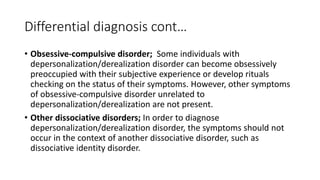
Differential diagnosis cont…
• Obsessive-compulsive disorder; Some individuals with
depersonalization/derealization disorder can become obsessively
preoccupied with their subjective experience or develop rituals
checking on the status of their symptoms. However, other symptoms
of obsessive-compulsive disorder unrelated to
depersonalization/derealization are not present.
• Other dissociative disorders; In order to diagnose
depersonalization/derealization disorder, the symptoms should not
occur in the context of another dissociative disorder, such as
dissociative identity disorder.
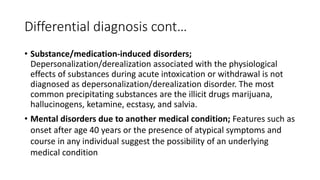
Differential diagnosis cont…
• Substance/medication-induced disorders;
Depersonalization/derealization associated with the physiological
effects of substances during acute intoxication or withdrawal is not
diagnosed as depersonalization/derealization disorder. The most
common precipitating substances are the illicit drugs marijuana,
hallucinogens, ketamine, ecstasy, and salvia.
• Mental disorders due to another medical condition; Features such as
onset after age 40 years or the presence of atypical symptoms and
course in any individual suggest the possibility of an underlying
medical condition
Risk and Prognostic Factors
• Temperamental. Individuals with depersonalization/derealization
disorder are characterized by harm-avoidant temperament, immature
defenses, and both disconnection and overconnection schemata.
• Environmental. There is a clear association between the disorder and
childhood interpersonal traumas in a substantial portion of
individuals, emotional abuse and emotional neglect have been most
strongly and consistently associated with the disorder.
prevalence
• Transient depersonalization/derealization symptoms lasting hours to
days are common in the general population. The 12-month
prevalence of depersonalization/derealization disorder is thought to
be markedly less than for transient symptoms.
• Although precise estimates for the disorder are unavailable. In
general, approximately one-half of all adults have experienced at least
one lifetime episode of depersonalization/derealization.
• Life time prevalence in U.S and non U.S countries is approximately
20% (range of 0.8% to 2.8%).
Treatment
• Psychotherapy; sometimes called talk therapy is the main treatment
for dissociative disorder
• Cognitive-behavioral therapy; this form of psychotherapy focuses on
changing dysfunctional thinking patterns, feelings, and behaviors.
• Family therapy; this help to teach the family about the disorder as
well as to help family members recognize symptoms of a recurrence.
• Creative therapy; these therapies allow patients to explore and
express their thought, feelings, and experiences in a safe and creative
environment.(art therapy, music therapy)
Cont…
• Clinical hypnosis; this is a treatment methods that uses intense
relaxation, concentration, and focused attention to achieve an altered
state of consciousness, allowing people to explore thoughts, feelings,
and memories they may have hidden from their conscious minds.
• Medication; there is no medication to treat dissociative disorders
themselves. However, people with dissociative disorders, especially
those with associated depression and/or anxiety, may benefit from
treatment with antidepressant or anti-anxiety medications.
Complications of DDD
• Without treatment, possible complications for a person with a
dissociative disorder may include
Life difficulties such as broken relationships and job loss
Sleep problems such as insomnia
Sexual problems
Severe depression
Anxiety disorders
Eating disorders such as anorexia or bulimia
Self harm including suicide.
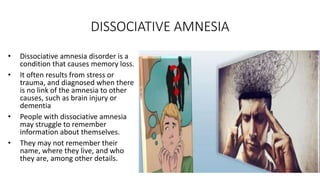
DISSOCIATIVE AMNESIA
• Dissociative amnesia disorder is a
condition that causes memory loss.
• It often results from stress or
trauma, and diagnosed when there
is no link of the amnesia to other
causes, such as brain injury or
dementia
• People with dissociative amnesia
may struggle to remember
information about themselves.
• They may not remember their
name, where they live, and who
they are, among other details.
Types of dissociative disorder
The types of dissociative amnesia includes:
I. localized,
II. selective,
III. continuous,
IV. systematized,
V. generalized, and
VI. dissociative fugue.
Localized amnesia
• Localized amnesia means that someone cannot recall a specific event
or series of events, which creates a gap in their memory.
• These memory gaps often relate to stress or trauma.
• For example, someone who experienced childhood abuse may forget
that entire chunk of time.
• Those with localized amnesia often have more than one episode of
memory loss.
Selective amnesia
• Selective amnesia involves losing only some of one’s memory from a
certain period.
• For instance, this could mean forgetting some parts of a traumatic
event, but not all of it.
• Can recall some, but not all parts of a circumscribed period of time or
traumatic event.
• A person can have both selective and localized amnesia
Continuous amnesia
• In this type of amnesia, a person forgets each new event as it occurs.
• A certain traumatic event may trigger this continuous forgetting
Systematize amnesia
•Systematized amnesia is a loss of memories related to a specific
category of information or individual.
•For example, someone may forget all of their memories involving a
particular person.
Generalized amnesia
• This rare form of amnesia occurs when an individual completely forgets
their own identity and life experiences. They can forget who they are, who
they spoke to, where they went, what they did, and how they felt.
Dissociative fugue
• Dissociative fugue sometimes occurs in people with dissociative amnesia
disorder.
• It is severe and rare, affecting just 0.2% of the general population.
Dissociative fugue cont…
• It typically manifests as sudden, unexpected travel away from a
person’s home.
• A person with dissociative fugue may wander about in a bewildered,
confused manner. They may also have memory loss and an inability
to recognize people they know.
Diagnostic criteria
CRITERIA A
An inability to recall important autobiographical information, usually of
a traumatic or stressful nature, that is inconsistent with ordinary
forgetting.
CRITERIA B
The symptoms cause clinically significant distress or impairment in
social, occupational, or other important areas of functioning.
Cont…
CRITERIA C
The disturbance is not attributable to the physiological effects of a
substance (e.g., alcohol or other drug of abuse, a medication) or a
neurological or other medical condition (e.g., partial complex seizures,
transient global amnesia, sequelae of a closed head injury/traumatic
brain injury, other neurological condition).
CRITERIA D
The disturbance is not better explained by dissociative identity disorder,
posttraumatic stress disorder, acute stress disorder, somatic symptom
disorder, or major or mild neurocognitive disorder.
Diagnostic criteria
• Dissociative identity disorders; the amnesias of individuals with
localized, selective, and or systematized dissociative amnesias are
relatively stable. Amnesia in dissociative identity disorder include
amnesia for everyday events, finding of unexplained possessions,
sudden fluctuations in skills and knowledge, major gaps in recall of
life history, and brief amnesia gaps in interpersonal interactions.
• Posttraumatic stress disorder; some individuals with PTSD cannot
recall part or all of a specific traumatic event (e.g., a rape victim with
depersonalization and or derealization symptoms who cannot recall
most events for the entire day of the rape). When that amnesia
extends beyond the immediate time of trauma, a comorbid diagnosis
of dissociative amnesia is warranted.
Cont…
• Neurocognitive disorders; in NCD, memory loss for personal
information is usually embedded in cognitive, linguistic, affective,
attentional, and behavioral disturbance. In dissociative amnesia,
memory deficits are primarily for autobiographical information;
intellectual and cognitive abilities are preserved.
• Substance-related disorder; in the context of repeated intoxication
with alcohol or other substances/medications, there may be episodes
of lack out or periods for which the individual has no memory. To aid
in distinguishing these episodes from dissociative amnesia, a
longitudinal history noting that the amnestic episodes occur only in
the context of intoxication and do not occur in other situations would
help identify the source as substance-induced.
Clinical manifestation
•The primary symptom of dissociative amnesia is memory loss that is more
extensive than normal forgetfulness.
•People with dissociative amnesia forget crucial personal information.
•Amnesic episodes can last several minutes or many months.
•Those who have recently experienced amnesia may feel confused or
depressed
• Feeling disconnected from yourself and world around.
• Forgetting about certain time periods, events, anpersonal information.
• Feeling uncertain about yourself.
• Having multiple distinct identities
etiology
• While Dissociative Amnesia can run in families, it is usually a result of
traumatic events.
• The causes of Dissociative Amnesia are usually extremely intense, such as;
Memories of war or combat,
Witnessing brutal crimes,
Experiencing abuse,
Violence in the personal life
• These events are so immensely overwhelming that the person’s
psychological state is completely disrupted for at least a short period of
time.
prognosis
• Environment; single or repeated traumatic experiences (e.g., war,
childhood maltreatment, natural disaster, internment in
concentration camps, genocide) are common antecedents. Disociative
amnesia is more likely to occur with 1) a greater number of adverse
childhood experiences, particularly physical and/or sexual abuse, 2)
interpersonal violence; and 3) increased severity, frequency, and
violence of the trauma.
• Genetic and physiological; there are no genetic studies of
Dissociative amnesia. Studies of Dissociative report significant genetic
and environmental factors in both clinical and nonclinical samples.
Cont…
• Course modifiers; Removal from the traumatic circumstances
underlying the dissociative amnesia (e.g., combat) may bring about a
rapid return of memory.
Treatment
• The first goals of treatment for dissociative amnesia is to relieve symptoms
and control any problems behavior. Treatment then aims to help the
person safely express and process painful memories, develop new coping
and life skills, restore functioning, and improve relationships. Treatment
may includes the following;
Psychotherapy
Cognitive therapy
Family therapy
Creative therapies(art therapy, music therapy)
Clinical hypnosis
medication
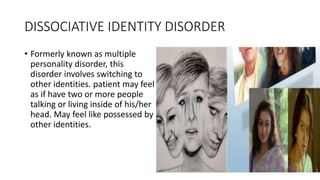
DISSOCIATIVE IDENTITY DISORDER
• Formerly known as multiple
personality disorder, this
disorder involves switching to
other identities. patient may feel
as if have two or more people
talking or living inside of his/her
head. May feel like possessed by
other identities.
Cont…
• Each identities may have a unique name, personal history and
features. These identities sometimes include differences in voice,
gender, mannerisms and even such physical qualities as the need for
eyeglasses. There are also differences in how familiar each identity is
with the others. Dissociative identity disorder usually also includes
bouts of amnesia and often includes times of confused wandering.
Diagnostic criteria
CRITERIA A
Disruption of identify characterized by two or more distinct personality
states, which may be described in some cultures as an experience of
possession. The disruption in identity involves marked discontinuity in
sense of self and sense of agency, accompanied by related alteration in
affect, behavior, consciousness, memory, perception, cognition, and/or
sensory-motor functioning. These signs and symptoms may be observed by
others or reported by the individual.
CRITERIA B
Recurrent gaps in the recall of everyday events, important personal
information, and/or traumatic events that are inconsistent with ordinary
forgetting.
Cont..
CRITERIA C
The symptoms cause clinically significant distress or impairment in social,
occupational, or other important areas of functioning.
CRITERIA D
The disturbance is not a normal part o a broadly accepted cultural or
religious practice. Not; in children, the symptoms are not better explained
by imaginary playmates or other fantasy play.
CRITERIA E
The symptoms are not attributable to the physiological effects of a substance
(e,g., blackouts or chaotic behaviour during alcohol intoxication or other
medical condition, eg complex partial seizures.
Differential diagnosis
• Major depressive disorder; individuals with DID are often depressed,
and their symptoms may appear to meet the criteria for a major
depressive episode. Rigorous assessment indicates that this
depression in some cases does not meet full criteria for major
depressive disorder.
• Bipolar disorder; individual with DID are after misdiagnosed with a
bipolar disorder, most often bipolar II disorder. There is relatively
rapid shifts in mood in individuals with his disorder, typically within
minutes or hours, in contrast to the slower mood changes typically
seen in individuals with bipolar.
Cont..
• Posttraumatic stress disorder;
• Psychotic disorder
• Substance/medication-induced disorders
• Personality disorders
• Conversional disorder
• Seizure disorder
Clinical manifestation
• Individual with DID may report the feeling that they have suddenly become
depersonalized observers of their own speech and actions, which they may
feel powerless to stop (sense of self). Such individuals may also report
perceptions of voices (eg a child’s voice; crying; the voice of a spiritual
being)
• Strong emotions, impulses and even speech or other actions may suddenly
emerge, without a sense of personal ownership or control ( sense of
agency).
• Attitudes, outlooks, and personal preferences(eg about food, activities,
dress) may suddenly shift and then shift back, individuals, may report that
their bodies feel different ( eg like a small child, like the opposite gender,
huge and muscular).
Cont…
• Amnesia ( in absence of substance)
• The person referring him or herself as ‘we’
• Auditory hallucination
• Undifferentiated fears
• Problems in trusting other
• Problems with sexual adjustment
etiology
• Dissociative identity disorder is associated with overwhelming
experiences, repeated traumatic abuse occurring in childhood. (the
child creates stable internal persons to cope with powerlessness)
• Childhood neglect such as locked in the room or being left
unattended for long period of time. (this usually occurs when the
mother is psychiatrically impaired.)
• DID arise as a consequence of incompetent and misguided treatment
for misdiagnosed other types of disorder.
Prognosis
• Environmental; interpersonal physical and sexual abuse is associated
with an increased risk of dissociative identity disorder.
• Course modifiers; ongoing abuse, later-life retraumatization,
comorbidity with mental disorders, severe medical illness, and delay
in appropriate treatment are associated with poorer prognosis.
Treatment
• The first goals of treatment for dissociative amnesia is to relieve symptoms
and control any problems behavior. Treatment then aims to help the
person safely express and process painful memories, develop new coping
and life skills, restore functioning, and improve relationships. Treatment
may includes the following;
Psychotherapy
Cognitive therapy
Family therapy
Creative therapies(art therapy, music therapy)
Clinical hypnosis
medication
Nursing Assessment
• Assessment of the client includes:
Psychiatric interview. The psychiatric interview must contain a
description of the client’s mental status with a thorough description
of behavior, the flow of thought and speech, affect, thought
processes and mental content, sensorium and intellectual resources,
cognitive status, insight, and judgement.
Nursing Diagnosis
Nursing diagnosis for patients with dissociative disorders include:
• Ineffective coping related to inadequate coping skills.
• Disturbed thought process related to childhood trauma or abuse.
• Disturbed personal identity related to severe level of anxiety.
• Disturbed sensory perception (kinesthetic) related to threat to self-
concept.
Nursing Care Planning and Goals
The major nursing care plan goals for dissociative disorders are:
• Client will verbalize understanding that he or she is employing dissociative
behaviors in times of psychosocial stress.
• Client will verbalize more adaptive ways of coping in stressful situations
than resorting to dissociation.
• Client will verbalize understanding that loss of memory is related to
stressful situation and begin discussing stressful situation with nurses or
therapist.
• Client will recover deficits in memory and develop more adaptive coping
mechanisms to deal with stressful situations.
• Client will verbalize adaptive ways of coping with stress.
Nursing Interventions
The nursing interventions for dissociative disorders are:
• Promote client safety. Reassure client of safety and security by your presence.;
dissociative behaviors may be frightening to the client.
• Assess for stressors. Identify stressor that precipitated severe anxiety; this information is
necessary to the development of an effective plan of client care and problem resolution.
• Explore client’s feelings. Explore feelings that client experienced in response to the
stressor; help client understand that the disequilibrium felt is acceptable-indeed, even
expected-in times of severe stress.
• Encourage methods for coping. Have client identify methods of coping with stress in the
past and determine whether the response was adaptive or maladaptive.
• Enhance client’s self-esteem. Provide positive reinforcement for client’s attempts to
change; positive reinforcement enhances self-esteem and encourages repetition of
desired behaviors.
Evaluation
Outcome goals include:
• Client was able to verbalize understanding that he or she is employing
dissociative behaviors in times of psychosocial stress.
• Client was able to verbalize more adaptive ways of coping in stressful
situations than resorting to dissociation.
• Client was able to verbalize understanding that loss of memory is related to
stressful situation and begin discussing stressful situation with nurse or
therapist.
• Client was able to recover deficits in memory and develop more adaptive
coping mechanisms to deal with stressful situations.
• Client was able to verbalize adaptive ways of coping with stress.
references
• American Psychiatric Association. (2013). Diagnostic and statistical
manual of mental disorders (DSM-5®). American Psychiatric Pub.
• Videbeck, S. L. (2010). Psychiatric-mental health nursing. Lippincott
Williams & Wilkins.
• http://www.betterhealth.vic.gov.au/bhcv2/bhcarticles.nsf/pages/Diss
ociation_and_dissociative_disorders
• http://www.mind.org.uk/information-support/types-of-mental-
health-problems/dissociative-disorders/
Participant
• NEEMA SENGEU
• HAPPINESS ARIA
• JOSEPHINE MAGOMA
• GEORGE JOHAHES
• ANNASTAZIA KAYONGA
• BARAKA WAMBULA
• ELIZABETH BENJAMIN
GROUP 6-1                          .pptx

GROUP 6-1 .pptx

  • 1.
    MENTAL HEALTH ANDPSYCHIATRY NURSING DISSOCIATIVE DISORDERS
  • 2.
    Learning objectives At theend of this session each learner is expected to be able to understand; • Definition of dissociative disorder • Types of dissociative disorder • Treatment of dissociative disorders • Nursing management of dissociative disorders
  • 3.
    DISSOCIATIVE DISORDES •Are mentalhealth conditions that involves experiencing a loss of connection between thoughts, memories, feelings, surroundings, behavior and identity. •Dissociative symptoms can potentially disrupt every area of psychological functioning. •They usually rise as a reaction to shocking, distressing or painful events and help push away difficult memories.
  • 4.
    TYPES OF DISSOCIATIVEDISORDERS There are three major types of dissociative disorders Depersonalization/derealization disorder Dissociative Amnesia Dissociative identity disorder
  • 5.
    DEPERSONALIZATION/DEREALIZATION DISORDER Depersonalization are experiencesof unreality or detachment from one’s mind, self or body. A person may feels as if he/she is seeing his/her actions, feelings, thoughts and self from a distance, like he/she is watching a movie. Derealization are experiences of unreality or detachment from one’s surrounding. Involves feelings that other people and things are separate from you and seem foggy or dreamlike, the world may seem unreal A person can go through depersonalization, derealization or both
  • 6.
    Diagnostic criteria CRITERIA A Thepresence of persistent or recurrent experiences of depersonalization, derealization, or both. • Depersonalization; experiences of unreality, detachment, or being an outside observer with respect to one’s thought, feeling, sensation, body or action • Derealization; experience of unreality or detachment with respect to surrounding (e.g individual or object are experienced as unreal, dreamlike foggy, life less, or visual distorted)
  • 7.
    Diagnostic criteria cont… CRITERIAB • During the depersonalization or derealization experiences, reality testing remains intact. CRITERIA C • The depersonalization causes clinically significant distress or impairment in social, occupational, or other important areas of functioning. CRITERIA D • the disturbance is not attributable to the direct physiological effects of a substance (e.g., a drug of abuse, a medication) or a general medical condition (e.g., temporal lobe epilepsy)
  • 8.
    Diagnostic criteria cont… CRITERIAE • The disturbance is not better explained by another mental disorder, such as Schizophrenia, Panic Disorder, Acute Stress Disorder, or another Dissociative Disorder, and
  • 9.
    Diagnostic features • Feelinglike an outside observer; People with DDD may feel like they are watching themselves from outside their body or that their body, legs, or arms appear twisted or like they’re not the right shape. • Feeling emotionally disconnected; People with DDD may feel emotionally disconnected from they care about. • Feeling unreal; People with DDD may feel like they are unreal or like a robot or automaton( having no control over what they do or say)
  • 10.
    Diagnostic features cont… •Feeling numb; People with DDD may feel emotional and physically numbness, also known as affective blunting, means that a person is unable to experience emotions. • Not trusting memories; People with DDD may feel disconnected from their memories and are unable to remember them clearly. • Other symptoms; feeling like you’re living in a dream world, feeling sad, anxious, surrounding that appear out of their usual shape or are blurry or colorless.
  • 11.
    Differential diagnosis • Illnessanxiety disorder; Individuals with depersonalization/derealization disorder can present with vague somatic complaints, fears of permanent brain damage, presence of a constellation of typical depersonalization/derealization symptoms and the absence of other manifestations of illness anxiety disorder. • Major depressive disorder; Feelings of numbness, deadness, apathy, and being in a dream are not uncommon in major depressive episodes. However, in depersonalization/ derealization disorder, such symptoms are associated with further symptoms of the disorder
  • 12.
    Differential diagnosis cont… •Obsessive-compulsive disorder; Some individuals with depersonalization/derealization disorder can become obsessively preoccupied with their subjective experience or develop rituals checking on the status of their symptoms. However, other symptoms of obsessive-compulsive disorder unrelated to depersonalization/derealization are not present. • Other dissociative disorders; In order to diagnose depersonalization/derealization disorder, the symptoms should not occur in the context of another dissociative disorder, such as dissociative identity disorder.
  • 13.
    Differential diagnosis cont… •Substance/medication-induced disorders; Depersonalization/derealization associated with the physiological effects of substances during acute intoxication or withdrawal is not diagnosed as depersonalization/derealization disorder. The most common precipitating substances are the illicit drugs marijuana, hallucinogens, ketamine, ecstasy, and salvia. • Mental disorders due to another medical condition; Features such as onset after age 40 years or the presence of atypical symptoms and course in any individual suggest the possibility of an underlying medical condition
  • 14.
    Risk and PrognosticFactors • Temperamental. Individuals with depersonalization/derealization disorder are characterized by harm-avoidant temperament, immature defenses, and both disconnection and overconnection schemata. • Environmental. There is a clear association between the disorder and childhood interpersonal traumas in a substantial portion of individuals, emotional abuse and emotional neglect have been most strongly and consistently associated with the disorder.
  • 15.
    prevalence • Transient depersonalization/derealizationsymptoms lasting hours to days are common in the general population. The 12-month prevalence of depersonalization/derealization disorder is thought to be markedly less than for transient symptoms. • Although precise estimates for the disorder are unavailable. In general, approximately one-half of all adults have experienced at least one lifetime episode of depersonalization/derealization. • Life time prevalence in U.S and non U.S countries is approximately 20% (range of 0.8% to 2.8%).
  • 16.
    Treatment • Psychotherapy; sometimescalled talk therapy is the main treatment for dissociative disorder • Cognitive-behavioral therapy; this form of psychotherapy focuses on changing dysfunctional thinking patterns, feelings, and behaviors. • Family therapy; this help to teach the family about the disorder as well as to help family members recognize symptoms of a recurrence. • Creative therapy; these therapies allow patients to explore and express their thought, feelings, and experiences in a safe and creative environment.(art therapy, music therapy)
  • 17.
    Cont… • Clinical hypnosis;this is a treatment methods that uses intense relaxation, concentration, and focused attention to achieve an altered state of consciousness, allowing people to explore thoughts, feelings, and memories they may have hidden from their conscious minds. • Medication; there is no medication to treat dissociative disorders themselves. However, people with dissociative disorders, especially those with associated depression and/or anxiety, may benefit from treatment with antidepressant or anti-anxiety medications.
  • 18.
    Complications of DDD •Without treatment, possible complications for a person with a dissociative disorder may include Life difficulties such as broken relationships and job loss Sleep problems such as insomnia Sexual problems Severe depression Anxiety disorders Eating disorders such as anorexia or bulimia Self harm including suicide.
  • 19.
    DISSOCIATIVE AMNESIA • Dissociativeamnesia disorder is a condition that causes memory loss. • It often results from stress or trauma, and diagnosed when there is no link of the amnesia to other causes, such as brain injury or dementia • People with dissociative amnesia may struggle to remember information about themselves. • They may not remember their name, where they live, and who they are, among other details.
  • 20.
    Types of dissociativedisorder The types of dissociative amnesia includes: I. localized, II. selective, III. continuous, IV. systematized, V. generalized, and VI. dissociative fugue.
  • 21.
    Localized amnesia • Localizedamnesia means that someone cannot recall a specific event or series of events, which creates a gap in their memory. • These memory gaps often relate to stress or trauma. • For example, someone who experienced childhood abuse may forget that entire chunk of time. • Those with localized amnesia often have more than one episode of memory loss.
  • 22.
    Selective amnesia • Selectiveamnesia involves losing only some of one’s memory from a certain period. • For instance, this could mean forgetting some parts of a traumatic event, but not all of it. • Can recall some, but not all parts of a circumscribed period of time or traumatic event. • A person can have both selective and localized amnesia
  • 23.
    Continuous amnesia • Inthis type of amnesia, a person forgets each new event as it occurs. • A certain traumatic event may trigger this continuous forgetting Systematize amnesia •Systematized amnesia is a loss of memories related to a specific category of information or individual. •For example, someone may forget all of their memories involving a particular person.
  • 24.
    Generalized amnesia • Thisrare form of amnesia occurs when an individual completely forgets their own identity and life experiences. They can forget who they are, who they spoke to, where they went, what they did, and how they felt. Dissociative fugue • Dissociative fugue sometimes occurs in people with dissociative amnesia disorder. • It is severe and rare, affecting just 0.2% of the general population.
  • 25.
    Dissociative fugue cont… •It typically manifests as sudden, unexpected travel away from a person’s home. • A person with dissociative fugue may wander about in a bewildered, confused manner. They may also have memory loss and an inability to recognize people they know.
  • 26.
    Diagnostic criteria CRITERIA A Aninability to recall important autobiographical information, usually of a traumatic or stressful nature, that is inconsistent with ordinary forgetting. CRITERIA B The symptoms cause clinically significant distress or impairment in social, occupational, or other important areas of functioning.
  • 27.
    Cont… CRITERIA C The disturbanceis not attributable to the physiological effects of a substance (e.g., alcohol or other drug of abuse, a medication) or a neurological or other medical condition (e.g., partial complex seizures, transient global amnesia, sequelae of a closed head injury/traumatic brain injury, other neurological condition). CRITERIA D The disturbance is not better explained by dissociative identity disorder, posttraumatic stress disorder, acute stress disorder, somatic symptom disorder, or major or mild neurocognitive disorder.
  • 28.
    Diagnostic criteria • Dissociativeidentity disorders; the amnesias of individuals with localized, selective, and or systematized dissociative amnesias are relatively stable. Amnesia in dissociative identity disorder include amnesia for everyday events, finding of unexplained possessions, sudden fluctuations in skills and knowledge, major gaps in recall of life history, and brief amnesia gaps in interpersonal interactions. • Posttraumatic stress disorder; some individuals with PTSD cannot recall part or all of a specific traumatic event (e.g., a rape victim with depersonalization and or derealization symptoms who cannot recall most events for the entire day of the rape). When that amnesia extends beyond the immediate time of trauma, a comorbid diagnosis of dissociative amnesia is warranted.
  • 29.
    Cont… • Neurocognitive disorders;in NCD, memory loss for personal information is usually embedded in cognitive, linguistic, affective, attentional, and behavioral disturbance. In dissociative amnesia, memory deficits are primarily for autobiographical information; intellectual and cognitive abilities are preserved. • Substance-related disorder; in the context of repeated intoxication with alcohol or other substances/medications, there may be episodes of lack out or periods for which the individual has no memory. To aid in distinguishing these episodes from dissociative amnesia, a longitudinal history noting that the amnestic episodes occur only in the context of intoxication and do not occur in other situations would help identify the source as substance-induced.
  • 30.
    Clinical manifestation •The primarysymptom of dissociative amnesia is memory loss that is more extensive than normal forgetfulness. •People with dissociative amnesia forget crucial personal information. •Amnesic episodes can last several minutes or many months. •Those who have recently experienced amnesia may feel confused or depressed • Feeling disconnected from yourself and world around. • Forgetting about certain time periods, events, anpersonal information. • Feeling uncertain about yourself. • Having multiple distinct identities
  • 31.
    etiology • While DissociativeAmnesia can run in families, it is usually a result of traumatic events. • The causes of Dissociative Amnesia are usually extremely intense, such as; Memories of war or combat, Witnessing brutal crimes, Experiencing abuse, Violence in the personal life • These events are so immensely overwhelming that the person’s psychological state is completely disrupted for at least a short period of time.
  • 32.
    prognosis • Environment; singleor repeated traumatic experiences (e.g., war, childhood maltreatment, natural disaster, internment in concentration camps, genocide) are common antecedents. Disociative amnesia is more likely to occur with 1) a greater number of adverse childhood experiences, particularly physical and/or sexual abuse, 2) interpersonal violence; and 3) increased severity, frequency, and violence of the trauma. • Genetic and physiological; there are no genetic studies of Dissociative amnesia. Studies of Dissociative report significant genetic and environmental factors in both clinical and nonclinical samples.
  • 33.
    Cont… • Course modifiers;Removal from the traumatic circumstances underlying the dissociative amnesia (e.g., combat) may bring about a rapid return of memory.
  • 34.
    Treatment • The firstgoals of treatment for dissociative amnesia is to relieve symptoms and control any problems behavior. Treatment then aims to help the person safely express and process painful memories, develop new coping and life skills, restore functioning, and improve relationships. Treatment may includes the following; Psychotherapy Cognitive therapy Family therapy Creative therapies(art therapy, music therapy) Clinical hypnosis medication
  • 35.
    DISSOCIATIVE IDENTITY DISORDER •Formerly known as multiple personality disorder, this disorder involves switching to other identities. patient may feel as if have two or more people talking or living inside of his/her head. May feel like possessed by other identities.
  • 36.
    Cont… • Each identitiesmay have a unique name, personal history and features. These identities sometimes include differences in voice, gender, mannerisms and even such physical qualities as the need for eyeglasses. There are also differences in how familiar each identity is with the others. Dissociative identity disorder usually also includes bouts of amnesia and often includes times of confused wandering.
  • 37.
    Diagnostic criteria CRITERIA A Disruptionof identify characterized by two or more distinct personality states, which may be described in some cultures as an experience of possession. The disruption in identity involves marked discontinuity in sense of self and sense of agency, accompanied by related alteration in affect, behavior, consciousness, memory, perception, cognition, and/or sensory-motor functioning. These signs and symptoms may be observed by others or reported by the individual. CRITERIA B Recurrent gaps in the recall of everyday events, important personal information, and/or traumatic events that are inconsistent with ordinary forgetting.
  • 38.
    Cont.. CRITERIA C The symptomscause clinically significant distress or impairment in social, occupational, or other important areas of functioning. CRITERIA D The disturbance is not a normal part o a broadly accepted cultural or religious practice. Not; in children, the symptoms are not better explained by imaginary playmates or other fantasy play. CRITERIA E The symptoms are not attributable to the physiological effects of a substance (e,g., blackouts or chaotic behaviour during alcohol intoxication or other medical condition, eg complex partial seizures.
  • 39.
    Differential diagnosis • Majordepressive disorder; individuals with DID are often depressed, and their symptoms may appear to meet the criteria for a major depressive episode. Rigorous assessment indicates that this depression in some cases does not meet full criteria for major depressive disorder. • Bipolar disorder; individual with DID are after misdiagnosed with a bipolar disorder, most often bipolar II disorder. There is relatively rapid shifts in mood in individuals with his disorder, typically within minutes or hours, in contrast to the slower mood changes typically seen in individuals with bipolar.
  • 40.
    Cont.. • Posttraumatic stressdisorder; • Psychotic disorder • Substance/medication-induced disorders • Personality disorders • Conversional disorder • Seizure disorder
  • 41.
    Clinical manifestation • Individualwith DID may report the feeling that they have suddenly become depersonalized observers of their own speech and actions, which they may feel powerless to stop (sense of self). Such individuals may also report perceptions of voices (eg a child’s voice; crying; the voice of a spiritual being) • Strong emotions, impulses and even speech or other actions may suddenly emerge, without a sense of personal ownership or control ( sense of agency). • Attitudes, outlooks, and personal preferences(eg about food, activities, dress) may suddenly shift and then shift back, individuals, may report that their bodies feel different ( eg like a small child, like the opposite gender, huge and muscular).
  • 42.
    Cont… • Amnesia (in absence of substance) • The person referring him or herself as ‘we’ • Auditory hallucination • Undifferentiated fears • Problems in trusting other • Problems with sexual adjustment
  • 43.
    etiology • Dissociative identitydisorder is associated with overwhelming experiences, repeated traumatic abuse occurring in childhood. (the child creates stable internal persons to cope with powerlessness) • Childhood neglect such as locked in the room or being left unattended for long period of time. (this usually occurs when the mother is psychiatrically impaired.) • DID arise as a consequence of incompetent and misguided treatment for misdiagnosed other types of disorder.
  • 44.
    Prognosis • Environmental; interpersonalphysical and sexual abuse is associated with an increased risk of dissociative identity disorder. • Course modifiers; ongoing abuse, later-life retraumatization, comorbidity with mental disorders, severe medical illness, and delay in appropriate treatment are associated with poorer prognosis.
  • 45.
    Treatment • The firstgoals of treatment for dissociative amnesia is to relieve symptoms and control any problems behavior. Treatment then aims to help the person safely express and process painful memories, develop new coping and life skills, restore functioning, and improve relationships. Treatment may includes the following; Psychotherapy Cognitive therapy Family therapy Creative therapies(art therapy, music therapy) Clinical hypnosis medication
  • 46.
    Nursing Assessment • Assessmentof the client includes: Psychiatric interview. The psychiatric interview must contain a description of the client’s mental status with a thorough description of behavior, the flow of thought and speech, affect, thought processes and mental content, sensorium and intellectual resources, cognitive status, insight, and judgement.
  • 47.
    Nursing Diagnosis Nursing diagnosisfor patients with dissociative disorders include: • Ineffective coping related to inadequate coping skills. • Disturbed thought process related to childhood trauma or abuse. • Disturbed personal identity related to severe level of anxiety. • Disturbed sensory perception (kinesthetic) related to threat to self- concept.
  • 48.
    Nursing Care Planningand Goals The major nursing care plan goals for dissociative disorders are: • Client will verbalize understanding that he or she is employing dissociative behaviors in times of psychosocial stress. • Client will verbalize more adaptive ways of coping in stressful situations than resorting to dissociation. • Client will verbalize understanding that loss of memory is related to stressful situation and begin discussing stressful situation with nurses or therapist. • Client will recover deficits in memory and develop more adaptive coping mechanisms to deal with stressful situations. • Client will verbalize adaptive ways of coping with stress.
  • 49.
    Nursing Interventions The nursinginterventions for dissociative disorders are: • Promote client safety. Reassure client of safety and security by your presence.; dissociative behaviors may be frightening to the client. • Assess for stressors. Identify stressor that precipitated severe anxiety; this information is necessary to the development of an effective plan of client care and problem resolution. • Explore client’s feelings. Explore feelings that client experienced in response to the stressor; help client understand that the disequilibrium felt is acceptable-indeed, even expected-in times of severe stress. • Encourage methods for coping. Have client identify methods of coping with stress in the past and determine whether the response was adaptive or maladaptive. • Enhance client’s self-esteem. Provide positive reinforcement for client’s attempts to change; positive reinforcement enhances self-esteem and encourages repetition of desired behaviors.
  • 50.
    Evaluation Outcome goals include: •Client was able to verbalize understanding that he or she is employing dissociative behaviors in times of psychosocial stress. • Client was able to verbalize more adaptive ways of coping in stressful situations than resorting to dissociation. • Client was able to verbalize understanding that loss of memory is related to stressful situation and begin discussing stressful situation with nurse or therapist. • Client was able to recover deficits in memory and develop more adaptive coping mechanisms to deal with stressful situations. • Client was able to verbalize adaptive ways of coping with stress.
  • 51.
    references • American PsychiatricAssociation. (2013). Diagnostic and statistical manual of mental disorders (DSM-5®). American Psychiatric Pub. • Videbeck, S. L. (2010). Psychiatric-mental health nursing. Lippincott Williams & Wilkins. • http://www.betterhealth.vic.gov.au/bhcv2/bhcarticles.nsf/pages/Diss ociation_and_dissociative_disorders • http://www.mind.org.uk/information-support/types-of-mental- health-problems/dissociative-disorders/
  • 52.
    Participant • NEEMA SENGEU •HAPPINESS ARIA • JOSEPHINE MAGOMA • GEORGE JOHAHES • ANNASTAZIA KAYONGA • BARAKA WAMBULA • ELIZABETH BENJAMIN