PROJECT PLANNING AND CONTROL
CONTENTS
• What is project and project management
• Project life cycle
• Project planning
• Steps in Planning
• Project Scheduling
• Project control
• conclusion
What is Project?
What is the different between normal
business activities and Project?
Project
Unique, one time operations design to
accomplish a specific set of objectives
in a limited time frame.
Examples of project…
1. Building a house
2. Building a factory
3. Add assembly line in the factory
4. Merging to companies
5. Managing political campaign
6. Designing a new product
7. Soft ware development
Project Management
• Project
– Lengthy network of activities needed to
complete a major output.
• Project Management
– Planning, execution, and controlling resources
to needed to complete the project.
Project Life Cycle
• Definition
– Why we need to start new project
– Feasibility Analysis (Cost, Benefit , risk of under taking a
project)
• Planning
– Details of the work, estimates time, Human resource and
cost
• Execution
– During which a project itself is done
• Termination
– During which closer is achieved
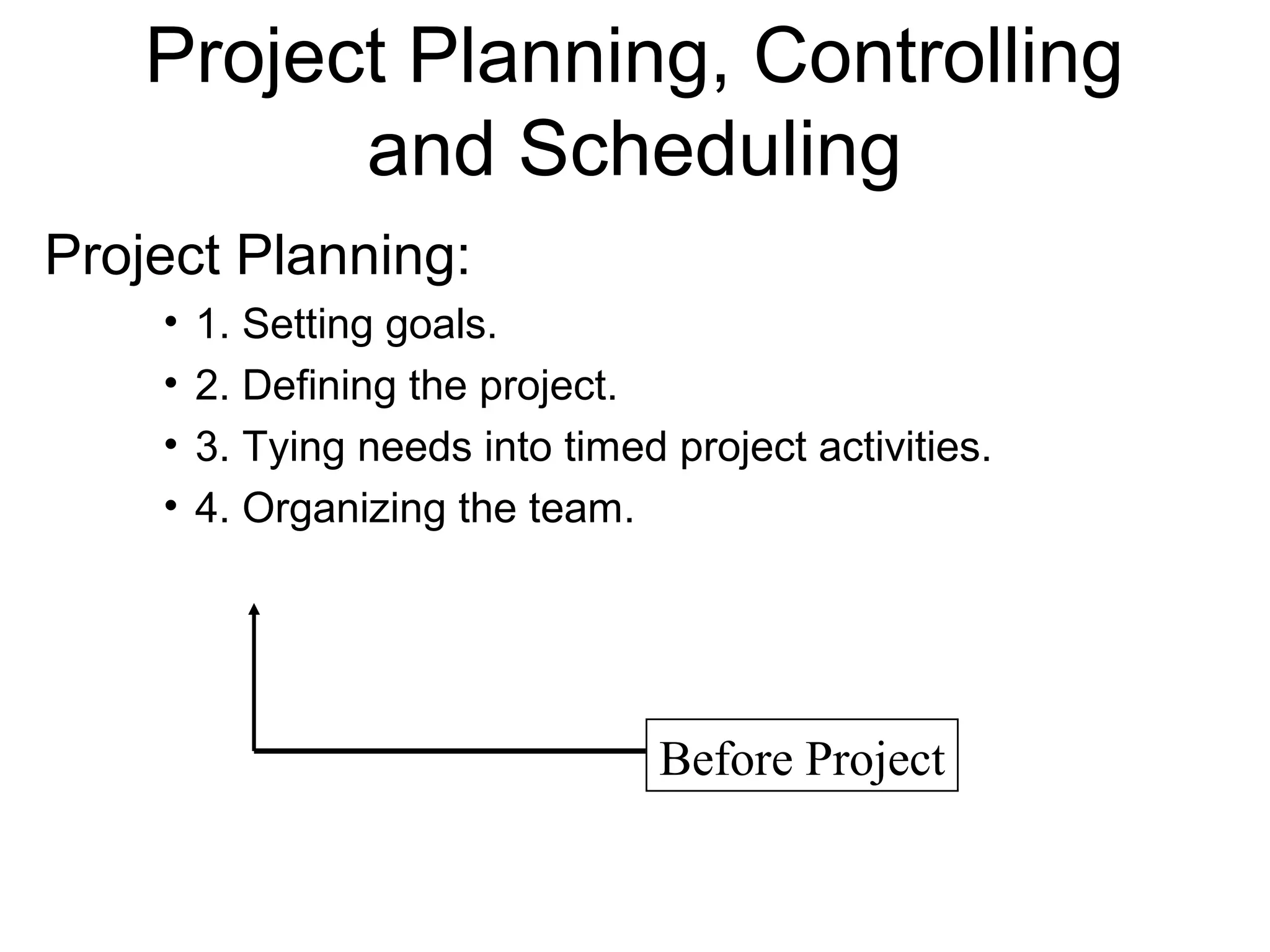
Project Planning, Controlling
and Scheduling
Project Planning:
• 1. Setting goals.
• 2. Defining the project.
• 3. Tying needs into timed project activities.
• 4. Organizing the team.
Before Project
Steps in Planning
• Specification
• Global Structure
• Project Breakdown
• Task Delegation
• Time Estimation
• Identification of needed resources
• Integration of Time/Personnel
• Setting Controls/Gates
Specification
• A statement of the problem, not the solution.
• Normally contains errors, ambiguities, &
misunderstandings
• Need a written definition of requirements and
deadlines
• Should be clear, complete and rigorous to
eliminate misunderstandings, contradictions,
oversight of technical difficulties
Structure
• Tasks that must be accomplished
• Relationship of each task to the
specifications
• Who will do what?
• When will it be done?
Project Breakdown
• Break project down into a series of task
• Break each task down into subtasks
• Continue until all items are doable and
understandable
Project Breakdown
• Skills/processes that must be learned
• Equipment/supplies that must be ordered
• Preliminary tests
• Sample collection
• Sample preparation
• Measurements
– Experimental setup
– Protocol
• Data analysis
• Statistical Analysis
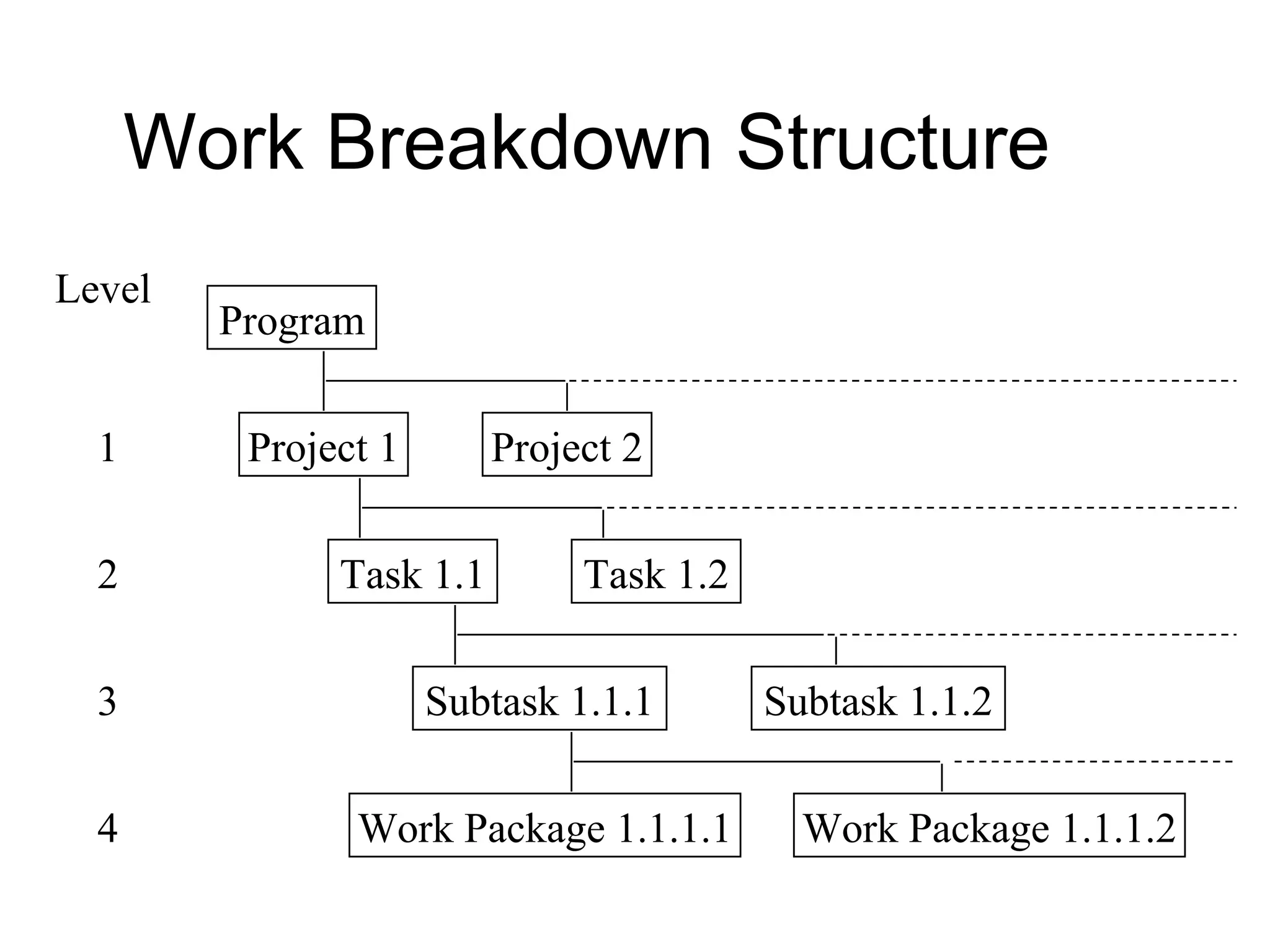
Work Breakdown Structure
Program
Project 1 Project 2
Task 1.1
Subtask 1.1.1
Work Package 1.1.1.1
Level
1
2
3
4
Task 1.2
Subtask 1.1.2
Work Package 1.1.1.2
Task Allocation
• Assign tasks to specific people (or teams)
• Order tasks so that they occur in a logical sequence
• Match tasks to abilities of the team
• Allow for flexibilities – the team can do sub-planning
• Match task with personalities and goals
– Person 1 needs more responsibility
– Person 2 needs more detail
– Person 3 needs to learn how to use the fluorescent microscope
• One person (or team) may do multiple tasks (e.g. to
reduce boredom).
• Do not overspecify
Time Guesstimation
• Start at the bottom of the tree. I.e. sum the time for
individual subtasks to estimate total task time.
• Times are based on previous experience
• They are always wrong – plan accordingly
• Example: How long should it take you to climb the statue
of Liberty?
– Estimate the number of steps
– Estimate the time per step
– Can do a preliminary study on a flight of stairs
• Add extra buffer where tasks depend on one another
• Weigh speed against quality
Planning Strategy
• Formulate an initial plan
• Check with team members for
– Input on timing
– Review of tasks and feasibility
• Revise the plan
• Check with your supervisor
• Revise the plan
• Get consensus of team members
• Get supervisor approval
Planning for Unknowns
• Identify risky tasks
– Have not been done before
– Rely on new equipment
– Depend on training of personnel
• Allow extra margins for risky tasks
• Rehearse risky (and expensive) tasks prior to
the real thing
– E.g. run the experiment with an inexpensive peptide
before using that $2,000/mg designer peptide.
Project Planning, Controlling
and Scheduling
• Project Scheduling:
• 1. Tying resources to specific activities.
• 2. Relating activities to each other.
• 3. Updating and revising on regular basis.
Project Planning, Controlling
and Scheduling
• Project Controlling:
• 1. Monitoring resources, costs, quality and
budgets.
• 2. Revising and changing plans.
• 3. Shifting resources to meet demands.
During Project
Project Controls
• Include
– milestones (clear, unambiguous targets of what, by
when)
– established means of communication
• Provide job satisfaction
• Indicate progress to your supervisors
• Allow for quality control checkponts
• Provide points of communication
• You should distinguish milestones from mill-
stones
Project Control: Gantt Chart
• The Gantt chart is a popular tool for
planning and scheduling simple project.
• It enables a manager to initially schedule
project activities and then to monitor
progress over time by comparing planned
progress to actual progress
Project Control: Gantt Chart
Activity 1
Activity 2
Activity 3
Activity 4
Activity 5
Activity 6
Time
a
b
a
b
c
c
d
d
d
PERT and CPM
• PERT (program evaluation and review
technique)
• U.S. Navy Special Projects Office (1958)
• Polaris missile project
• CPM (critical path method)
• J. E. Kelly of Remington-Rand and M. R. Walker of
Du Pont (1957)
• Scheduling maintenance shutdowns of chemical
processing plants
PERT/ CPM
• CPM uses two sets of time and cost estimates
for activities:
• A normal time and cost and
• A crash time and cost
 The normal cost is an estimate of cost to complete
an activity in normal time.
 The crash time is the shortest possible activity
time.
 Crash cost is the cost of completing the activity on
a crash or deadline basis.
Sources of Problems
• The work duplicates or negates work
already done
• The deliverable is not appropriate
• The time frame is unrealistic
• The work depends on work of others
• The resources are not available
• The cost is prohibitive
CONCLUSION
• For doing any activity planning is one of
the most important step.
“A good plan and execution is leads to a
successful business.”
• With out control we don’t know where the
project is going, so achieving objective this
is one of the important step.
• Thanks to all

EpM

  • 1.
  • 2.
    CONTENTS • What isproject and project management • Project life cycle • Project planning • Steps in Planning • Project Scheduling • Project control • conclusion
  • 3.
    What is Project? Whatis the different between normal business activities and Project? Project Unique, one time operations design to accomplish a specific set of objectives in a limited time frame.
  • 4.
    Examples of project… 1.Building a house 2. Building a factory 3. Add assembly line in the factory 4. Merging to companies 5. Managing political campaign 6. Designing a new product 7. Soft ware development
  • 5.
    Project Management • Project –Lengthy network of activities needed to complete a major output. • Project Management – Planning, execution, and controlling resources to needed to complete the project.
  • 6.
    Project Life Cycle •Definition – Why we need to start new project – Feasibility Analysis (Cost, Benefit , risk of under taking a project) • Planning – Details of the work, estimates time, Human resource and cost • Execution – During which a project itself is done • Termination – During which closer is achieved
  • 7.
    Project Planning, Controlling andScheduling Project Planning: • 1. Setting goals. • 2. Defining the project. • 3. Tying needs into timed project activities. • 4. Organizing the team. Before Project
  • 8.
    Steps in Planning •Specification • Global Structure • Project Breakdown • Task Delegation • Time Estimation • Identification of needed resources • Integration of Time/Personnel • Setting Controls/Gates
  • 9.
    Specification • A statementof the problem, not the solution. • Normally contains errors, ambiguities, & misunderstandings • Need a written definition of requirements and deadlines • Should be clear, complete and rigorous to eliminate misunderstandings, contradictions, oversight of technical difficulties
  • 10.
    Structure • Tasks thatmust be accomplished • Relationship of each task to the specifications • Who will do what? • When will it be done?
  • 11.
    Project Breakdown • Breakproject down into a series of task • Break each task down into subtasks • Continue until all items are doable and understandable
  • 12.
    Project Breakdown • Skills/processesthat must be learned • Equipment/supplies that must be ordered • Preliminary tests • Sample collection • Sample preparation • Measurements – Experimental setup – Protocol • Data analysis • Statistical Analysis
  • 13.
    Work Breakdown Structure Program Project1 Project 2 Task 1.1 Subtask 1.1.1 Work Package 1.1.1.1 Level 1 2 3 4 Task 1.2 Subtask 1.1.2 Work Package 1.1.1.2
  • 14.
    Task Allocation • Assigntasks to specific people (or teams) • Order tasks so that they occur in a logical sequence • Match tasks to abilities of the team • Allow for flexibilities – the team can do sub-planning • Match task with personalities and goals – Person 1 needs more responsibility – Person 2 needs more detail – Person 3 needs to learn how to use the fluorescent microscope • One person (or team) may do multiple tasks (e.g. to reduce boredom). • Do not overspecify
  • 15.
    Time Guesstimation • Startat the bottom of the tree. I.e. sum the time for individual subtasks to estimate total task time. • Times are based on previous experience • They are always wrong – plan accordingly • Example: How long should it take you to climb the statue of Liberty? – Estimate the number of steps – Estimate the time per step – Can do a preliminary study on a flight of stairs • Add extra buffer where tasks depend on one another • Weigh speed against quality
  • 16.
    Planning Strategy • Formulatean initial plan • Check with team members for – Input on timing – Review of tasks and feasibility • Revise the plan • Check with your supervisor • Revise the plan • Get consensus of team members • Get supervisor approval
  • 17.
    Planning for Unknowns •Identify risky tasks – Have not been done before – Rely on new equipment – Depend on training of personnel • Allow extra margins for risky tasks • Rehearse risky (and expensive) tasks prior to the real thing – E.g. run the experiment with an inexpensive peptide before using that $2,000/mg designer peptide.
  • 18.
    Project Planning, Controlling andScheduling • Project Scheduling: • 1. Tying resources to specific activities. • 2. Relating activities to each other. • 3. Updating and revising on regular basis.
  • 19.
    Project Planning, Controlling andScheduling • Project Controlling: • 1. Monitoring resources, costs, quality and budgets. • 2. Revising and changing plans. • 3. Shifting resources to meet demands. During Project
  • 20.
    Project Controls • Include –milestones (clear, unambiguous targets of what, by when) – established means of communication • Provide job satisfaction • Indicate progress to your supervisors • Allow for quality control checkponts • Provide points of communication • You should distinguish milestones from mill- stones
  • 21.
    Project Control: GanttChart • The Gantt chart is a popular tool for planning and scheduling simple project. • It enables a manager to initially schedule project activities and then to monitor progress over time by comparing planned progress to actual progress
  • 22.
    Project Control: GanttChart Activity 1 Activity 2 Activity 3 Activity 4 Activity 5 Activity 6 Time a b a b c c d d d
  • 23.
    PERT and CPM •PERT (program evaluation and review technique) • U.S. Navy Special Projects Office (1958) • Polaris missile project • CPM (critical path method) • J. E. Kelly of Remington-Rand and M. R. Walker of Du Pont (1957) • Scheduling maintenance shutdowns of chemical processing plants
  • 24.
    PERT/ CPM • CPMuses two sets of time and cost estimates for activities: • A normal time and cost and • A crash time and cost  The normal cost is an estimate of cost to complete an activity in normal time.  The crash time is the shortest possible activity time.  Crash cost is the cost of completing the activity on a crash or deadline basis.
  • 25.
    Sources of Problems •The work duplicates or negates work already done • The deliverable is not appropriate • The time frame is unrealistic • The work depends on work of others • The resources are not available • The cost is prohibitive
  • 26.
    CONCLUSION • For doingany activity planning is one of the most important step. “A good plan and execution is leads to a successful business.” • With out control we don’t know where the project is going, so achieving objective this is one of the important step.
  • 27.