AGENDA Role of Government, Role of  IDBI – By 09HP1E0037 & 12 Role of IDBI, NIESBUD – By 09HP1E0020 & 46 Role of SISI, DIC – By 09HP1E0018 & 46 Other Financial Institutions – By 09HP1E0032 & 13 Commercial Banks – By 09HP1E0007 & 13 Entrepreneurial Development Institutes – By 09HP1E0014 & 09 Universities and other Educational Institutions offering  EDP – By 09HP1E0048 Entrepreneurial Development Programme – By 09HP1E0008
Everyone in the world has at least one talent, one passion, one hobby that can become profitable if used correctly.
Entrepreneur: One who organizes, manages and assumes the risks of a business or enterprise. Entrepreneurship is the process of creating or seizing an opportunity and pursuing it regardless of the resources currently controlled.
Entrepreneurship Development: Role of Financial Institutions Industrial growth and economic development of developing nations depend to a great extent on the role played by entrepreneurs.  There are many instances of individual entrepreneurs whose creativity has led to the industrialization of many nations. However, in India the economic and industrial growth was slow due to lack of efficient entrepreneurs, industrial environment, technical know-how. Government and financial institutions have played a very important role in the entrepreneurship development.
Efforts to Foster Entrepreneurship in India Many of India's leaders have perceived the need for the development of entrepreneurship in their country, and a number of programs have emerged to meet this need.  The National Institute for Entrepreneurship and Small Business Development (NIESBUD). The Entrepreneurship Development Institute of India (EDII). Industrial Development Bank of India (IDBI). Small Industries Development Bank of India (SIDBI). North Eastern Development Finance Corporation Limited (NEDFCL) RBI’s role and steps for the development of SSI sector
The Entrepreneurship Development Institute of India Sponsored by several financial institutions, namely (ICICI), (IDBI), the Industrial Finance Corporation of India (IFCI), and the State Bank of India. One of the institute that, focuses on creating entrepreneurial personalities among youth. EDII launched a variety of programs to do just that. The Rural Entrepreneurship Development division, for instance, concentrates on rural development, employment generation, and poverty all aviation through the promotion of micro-enterprises. This divisional so has an informal micro-credit delivery system.
Industrial Development Bank of India (IDBI)  IDBI is the tenth largest bank in the world in terms of development. The National Stock Exchange (NSE), The National Securities Depository Services Ltd. (NSDL), Stock Holding Corporation of India (SHCIL) are some of the institutions which has been built by IDBI. IDBI is a strategic investor in a plethor a of institutions which have revolutionized the Indian Financial Markets. IDBI Bank, promoted by IDBI Group started in November 1995 with a branch at Indor with an equity capital base of Rs.1000million
Main functions of IDBI IDBI invested with the responsibility of coordinating the working of institutions engaged in financing, promoting and developing industries. It has evolved an appropriate mechanism for this purpose. Developmental Activities of IDBI :- Promotional activities : The Bank continues to perform a wide range of promotional activities relating to developmental programmes for new entrepreneurs, consultancy services for small and medium enterprises and programmes designed for accredited voluntary agencies for the economic up liftmen of the under privileged.
Contents Introduction Role of IDBI IDBI Operations conclusion
 
IDBI OPERATIONS Idbi intially provided long term assistance to industries such as textiles, fertilizers, chemicals products and machinery. In 1964, IDBI also began a role in assisting the state finance corporations (SFC) of various states. By 1965, IDBI entered into rediscounting of machinery bills.
Cont…, Subsequently, IDBI entered into financing exports on a different payment basis , till the time export –import ( EXIM) bank of india was formed in 1982. In 1986, IDBI created a small industries development fund(sidf) Played a major role in setting up of stock holding corporation india limited (SHCIL)
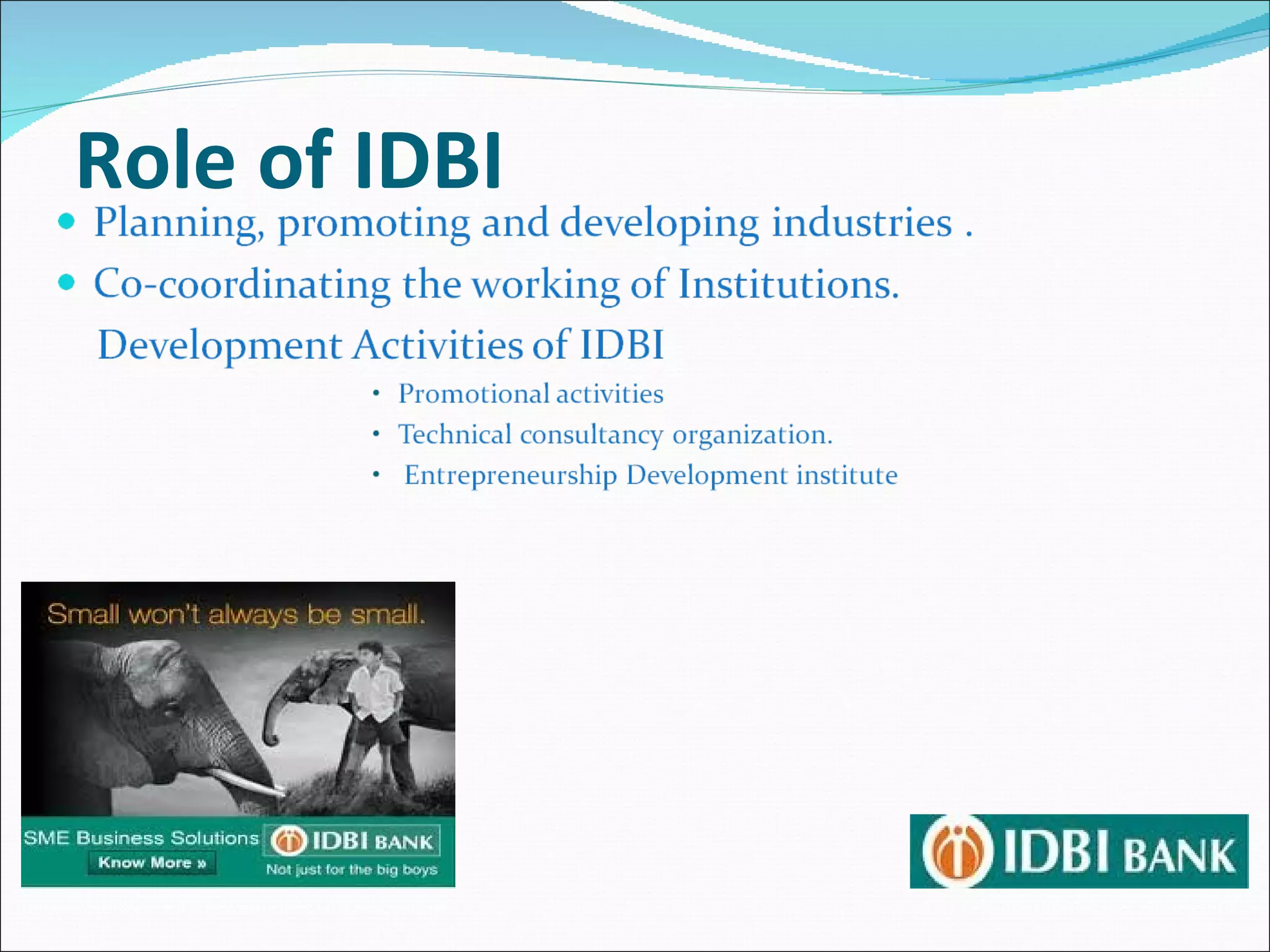
Role of IDBI Planning , promoting and developing industries Co ordinating the working of institutions. IDBI’s role as a catalyst. Development activities of IDBI promotional activities technical consultancy org. entrepreneurship develop in
 
Contents  Introduction Definition of entrepreneurship ROLE OF IDBI  &  NIESBUD
Defintion of enterpreneurship  The concept of  entrepreneurship  has a wide range of meanings.  On the one extreme an  entrepreneur  is a person of very high aptitude who pioneers change, possessing characteristics found in only a very small fraction of the population. On the other extreme of definitions, anyone who wants to work for himself or herself is considered to be an entrepreneur.
To provide national international forums for interaction and exchange of experiences helpful  for policy  formulation and motivation .
entrepreneur The word  entrepreneur  originates from the French word,  entreprendre , which means "to undertake." In a business context, it means to start a business.  The Merriam-Webster Dictionary presents the definition of an entrepreneur as one who organizes, manages, and assumes the risks of a business or enterprise
NIESBUD The national institute for entrepreneurship and small business development (NIESBUD). NIESBUD was established in1983. NIESBUD limits its only training activities and conducting such programmes.
OBJECTIVES The following are the main objectives of NIESBUD To  help support an affiliate institution organization in carrying out training. And other entrepreneurship development related activities with greater success. To evolve standardized materials and process of selection, training support and sustenance to potential entrepreneurs.
ROLE OF IDBI IDBI role as a catalyst to industrial development encompasses a wise spectrum of activities. IDBI can finance all types industrial concerns covered under provisions of the IDBI act  its 3 activities The IDBI developmental role the bank continues to perform a wide range of  promotional activities.
Technical consultancy organization India financial institutions has a set up network of technical consultancy organizations its covering to the entire country
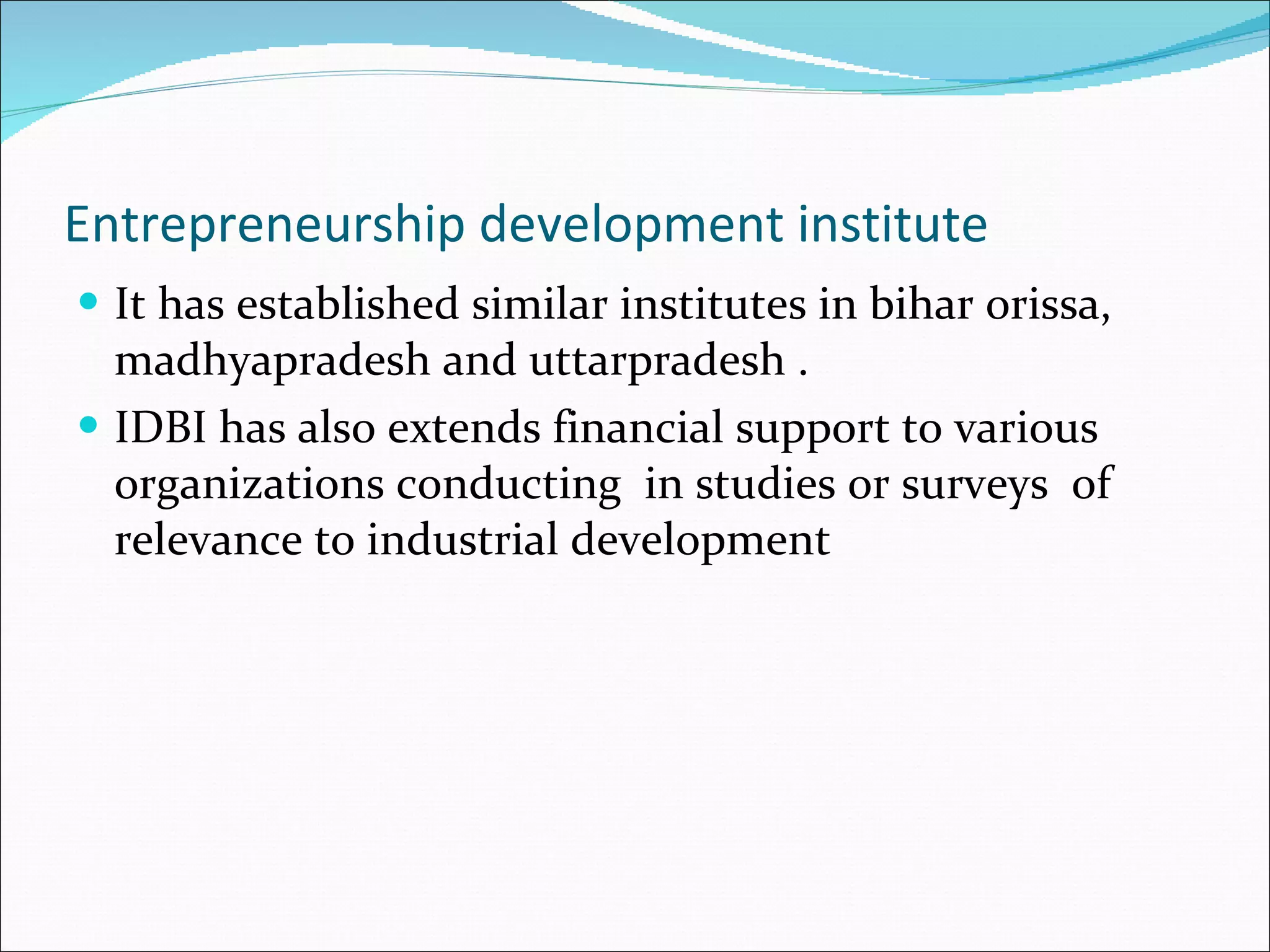
Entrepreneurship development institute It has established similar institutes in bihar orissa, madhyapradesh and uttarpradesh . IDBI has also extends financial support to various organizations conducting  in studies or surveys  of relevance to industrial development
OBJECTIVES To evolve standardized materials and processes for selection, training, support and sustenance of entrepreneurs, potential and existing. To help/support and affiliate institutions/organizations in carrying out training and other entrepreneurship development related activities . To train trainers, promoters and consultants in various areas of entrepreneurship development  To provide vital information and support to trainers, promoters and entrepreneurs by organizing research and documentation relevant to entrepreneurship development
ROLE OF NIESBUD The institute organizes:- Entrepreneurship development programs, Prepares manuals , and produces educational videos; Its training activities are stimulating, supporting, and sustaining  entrepreneurship.
ROLE OF SISI 1) Technical Consultancy 2) Industrial Management Training 3) Economic Information 4) Marketing Assistance 5)Export Promotion Marketing
ROLE OF DIC Technical support for preparation of Project Report.  Information on sources of machinery & Equipment.  Priority in Power supply/ Telephone connection.  Promotion of new Industrial Estates/ Growth Centers.    Land/ Shed in Industrial Estate.    Approval of Project Reports of special types.    Promotion of Electronic Industries.
CONCLUSION Entrepreneur is a play vital role in the Financial institutions This about the role of NESBUD,SISI,DIC
 
CONTENT: INTRODUCTION ROLE OF NIESBUD,SISI,DIC CONCLUSION
Entrepreneur One who organizes, manages and assumes the risks of a business or  enterprise "Entrepreneurship is the process of creating or seizing an opportunity and pursuing it regardless of the resources currently controlled"
NIESBUD: The National Institute for Entrepreneurship and Small Business Development (NIESBUD) was established in 1983 by the then Ministry of Industry [now Ministry of Micro, Small & Medium Enterprises (MSMEs)], Government of India, as an apex body for coordinating and overseeing the activities of various institutions/agencies engaged in Entrepreneurship Development particularly in the area of small industry and small business. The Institute which is registered as a Society under Societies Registration Act, 1860 (XXI of 1860), started functioning from 6th July, 1983 .
OBJECTIVES To evolve standardized materials and processes for selection, training, support and sustenance of entrepreneurs, potential and existing. To help/support and affiliate institutions/organizations in carrying out training and other entrepreneurship development related activities . To train trainers, promoters and consultants in various areas of entrepreneurship development  To provide vital information and support to trainers, promoters and entrepreneurs by organizing research and documentation relevant to entrepreneurship development
ROLE OF NIESBUD The institute organizes:- Entrepreneurship development programs, Prepares manuals , and produces educational videos; Its training activities are stimulating, supporting, and sustaining  entrepreneurship.
ROLE OF SISI 1) Technical Consultancy 2) Industrial Management Training 3) Economic Information 4) Marketing Assistance 5)Export Promotion Marketing
ROLE OF DIC Technical support for preparation of Project Report.  Information on sources of machinery & Equipment.  Priority in Power supply/ Telephone connection.  Promotion of new Industrial Estates/ Growth Centers.    Land/ Shed in Industrial Estate.    Approval of Project Reports of special types.    Promotion of Electronic Industries.
CONCLUSION Entrepreneur is a play vital role in the Financial institutions This about the role of NESBUD,SISI,DIC
District Industries Centre
Small Industries Service Institute The field offices of Small Industries Development Organization (SIDO), Ministry of Small Scale Industries, Govt. of India, set up for the promotion and development of Small Scale Industries in the State in the early fifties
Major Extension Services provided in the Institute   Technical Consultancy Industrial Management Training Economic Information Entrepreneurial Development Programme, Scheme
For Educated Unemployed Youth / Prime Minister's  Rojgar Yojana Ancillary Developments / Sub-Contract Exchange Marketing Assistance
Export Promotion Marketing Modernisation / Upgradation Technology Assistance to Rehabilitation of sick units Common Facility & Training Assistance to District Industries Centre / State Govt. / Technical Assistance to various Central Government
Various Developmental Agencies in the State National Small Industries Corporation, Central Excise,  Bureau of Indian Standards, CSIR etc. Exhibition / Demonstration
District Industries Centre To develop and promote Cottage and Small Scale Industries in the district. The Small Scale Industries (SSI) means the Industries with investment upto Rs 1 (one) crore in plant & machinery
FINANCIAL ASSISTANCE SCHEMES (DEPARTMENTAL)   Prime Minister Rozgar Yojona (PMRY) Normal Bank Finance Scheme  Loan Under BSAI Act
INCENTIVE SCHEME Registration  Preference for power connection  Project/Scheme Vetting  Marketing Assistance to Handicraft Products  Special Assistance rendered
National Project of Bio-Gas Development (NPBD)  Pollution Clearance Training Programme  Minority Loans  Rural Employment generation programme
By  Laxman Naik 09HP1E0032 MBA-II
Synopsis of Presentation  Introduction to financial institutions Role of different banks in development of entrepreneurship Contribution to the economy conclusion
Financial Institutions A financial institution is an  institution which collects funds from the public and places them in financial assets, such as deposits, loans, and bonds, rather than tangible property.
Non Banking Financial Institutions(NBFC) NBFCs help to bridge the credit gaps in several sector which traditional institution  are unable to fulfill.  NBFCs are more flexible in their operations and  quick in decision-making .
 
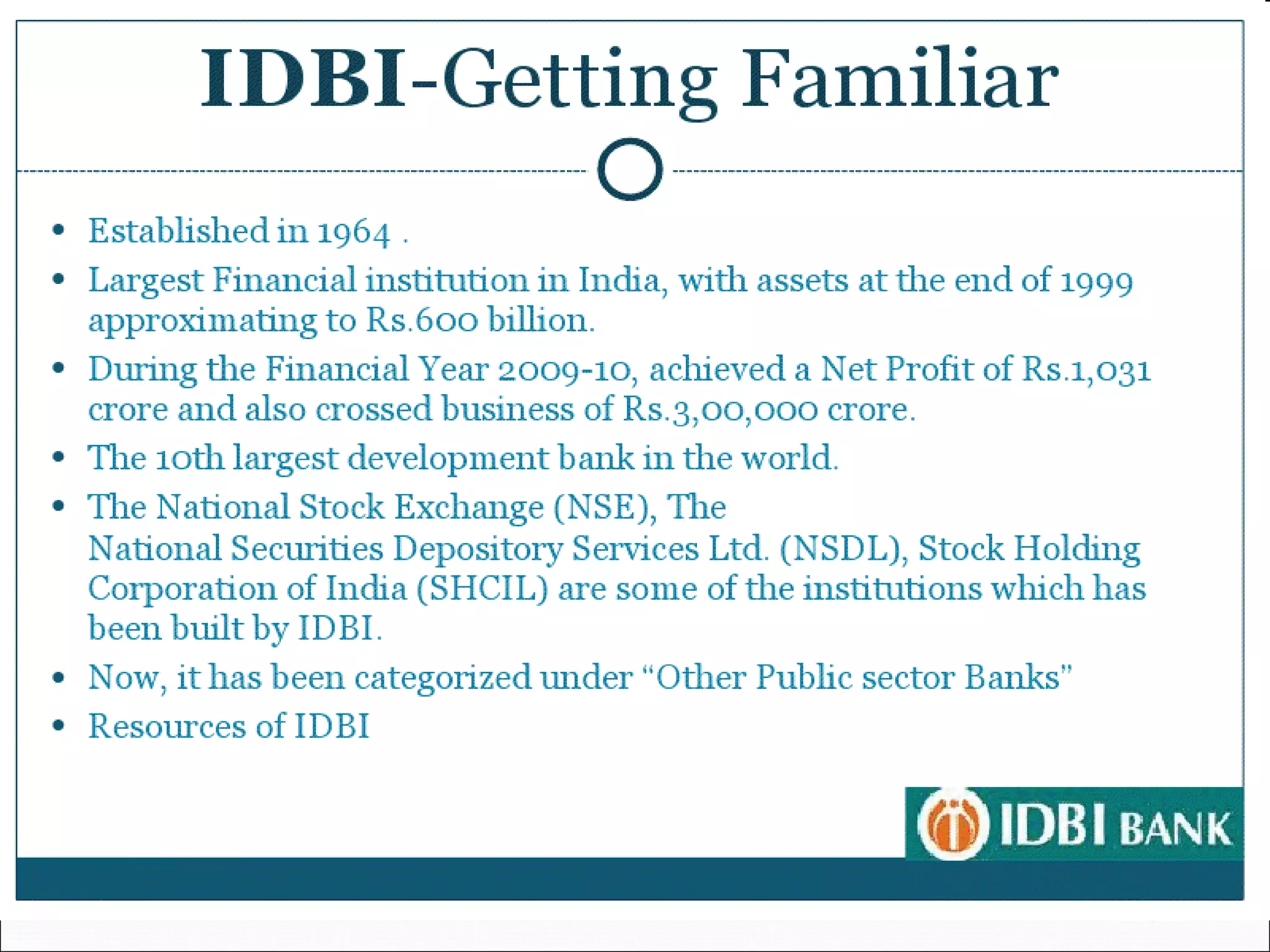
IDBI -Getting Familiar Established in 1964 .  Largest Financial institution in India, with assets at the end of 1999 approximating to Rs.600 billion.  During the Financial Year 2009-10, achieved a Net Profit of Rs.1,031 crore and also crossed business of Rs.3,00,000 crore.  The 10th largest development bank in the world.  The National Stock Exchange (NSE), The National Securities Depository Services Ltd. (NSDL), Stock Holding Corporation of India (SHCIL) are some of the institutions which has been built by IDBI.  Now, it has been categorized under “Other Public sector Banks”  Resources of IDBI
Role of IDBI
 
Exim bank  SET UP BY AN ACT OF PARLIAMENT , 1981 WHOLLY OWNED BY GOVERNMENT OF INDIA COMMENCED OPERATIONS IN MARCH 1982 APEX FINANCIAL INSTITUTION OBJECTIVES:  “…  for providing financial assistance to exporters and importers, and for functioning as the principal financial institution for coordinating the working of institutions engaged in financing export and import of goods and services with a view to promoting the country’s international trade…”  “…  shall act on business principles with due regard to public interest”
FINANCIAL ASSISTANCE TO INDIAN COMPANIES Delayed Payment Exports Pre-Shipment Credit Term Loans for Export Production Foreign Investment Finance Financing Export Marketing.
Export Marketing Finance  Administered an Export Marketing Fund from  World Bank  SMEs extended export marketing finance to implement strategic export marketing plans  Exim Bank’s assistance resulted in generation of significant exports to developed country markets. Successes achieved in this Programme . Over 300 Companies supported in variety sectors  : Knitting  Needles Polyester Ropes Home Appliances
Introduction of IFCI The government of India set up the IFCI under the IFCI act in July in 1948. It is the first development financial institution in the country to cater to the long term financial needs of the industrial sectors. The main objective of IFCI is to make medium and long term credits more readily available for  industrial concerns in India.
Role of IFCI To provide much needed guidance in project identification , formulation, implementation, operation to the new, tiny, small scale and medium scale entrepreneurs. Fill in the gaps in the industrial infrastructure for promotion and growth of industries.
conclusion Different banks playing a major role in financial and other kind of assistance to the new and hopeful entrepreneurs and leading them to their development and  to the economy as a whole
 
FINANCIAL INSTITUTES National level State level National level: large scale industries Ex: ICICI,NIDC,IFCI,LIC,UTI etc., State level: medium and small scale industries Ex : state financial corporations(SFCs), State small industries devlopment corp(SSIDs).,
Commercial Banks These are the easiest and quickest sources. Three familiar methods  of obtaining loans from commercial banks are: 1.Cash credits 2.overdrafts 3.term loans
Cont., ICICI : Fast decisioning - decentralised operations, centralised decision making.  Fast disbursement - subject to complete documentation, disbursement in 25 days.  Working capital limits - ranging from 25 lacs to 5 crores.  Exclusive relationship managers - who can provide you all financial services - including trade accounts & services, remittances.
Cont., Key Features:  Loan amount of up to Rs. 50 lacs*.  Charge on current assets .  No requirement of third-party guarantee.  No requirement of collateral security.
Cont., Interest rate : Maximum – IBAR + 3% p.a.  (ICICI Bank Benchmark Advance Rate) . ICICI Bank has also announced an increase of 0.50% in its benchmark prime-lending rate and in its Floating Reference Rate (FRR) for consumer loans.
Cont., With effect from July 1, 2010, interest rate on new loans and advances including consumer loans is determined with reference to ICICI Bank Base Rate (“I-Base”). IBase is currently at 7.75% p.a.
 
Contents Entrepreneurship  Commercial Bank IFCI promotion for entrepreneurship ICICI promotion for entrepreneurship Conclusion
Entrepreneurship, Entrepreneur Entrepreneurship  is the act of being an entrepreneur, which can be defined as "one who undertakes innovations, finance and business acumen in an effort to transform innovations into economic goods". Entrepreneurs have been defined as “persons who are ingenious and creative in finding ways that add to their own wealth, power, and prestige”.
Commercial Bank A  commercial bank  is a type of financial intermediary and a type of bank. Commercial banking is also known as  business banking . It is a bank that provides checking accounts, savings accounts, and money market accounts and that accepts time deposits.
Cont … Banks are expected to provide entrepreneurs with financial assistance as well as inputs to support and promote their enterprise. The banks have been found to be lacking on both counts and the concept of integrated approach to entrepreneurship development is totally absent One of the major causes that may be identified for huge Non-Performing Assets (NPAs) is the negligence on the part of banks in realizing their role in the proper development of entrepreneurs..
IFCI Policies & Strategies Entrepreneurship is the backbone or a mother of healthy industrialization. Entrepreneurship & industrialization encourages the drive, skills, motive, trait, innovative spirit in the dynamic world of trade, industry, commerce, science, technology and management.  To provide assistance and guidance for the revival & rehabilitation of sick & ailing Entrepreneurship in the country.
To provide assistance in the form of rupee and foreign currency loans, underwriting of shares & debentures, guarantee for  deferred payments & foreign loans for the promotion of medium & large scale entrepreneurship in the country. To provide assistance for expansion, diversification, modernization, renovation, & rehabilitation so as to encourage, accentuate the pace of Entrepreneurship promotion, creation & profile ration in the country.
To encourage the wide network of TCOs with concrete support for the promotion of tiny, small & medium scale Entrepreneurship in every nook & corner of the country. To encourage co-operative Entrepreneurship in co-operative sector. IFCI has been giving due attention to the industrialization of backward areas & no industry districts through the promotion of regional Entrepreneurship. IFCI is extending developmental finance to potential entrepreneurs on concessional terms.
ICICI ICICI is one of the principle development bank’s of the country which was established after IFCI but before IDBI on Jan 05, 1955
Policies & objectives of ICICI Policy of entrepreneurship promotion is based on following objectives: To broden the entrepreneurial base in the country. To sponsor small scale entrepreneurship in rural areas. To encourage and promote entrepreneurship in backward areas, special hill regions & no industry districts. To assist in the rehabilitation of sick, ailing and withering Entrepreneurship.
Cont … The main reasons accounted for growing corporate sickness in ICICI assisted units are: Increasing demand recession. Withering health of agriculture sector due to severe natural disasters. Uncertain policy environment caused by Government announcement from time to time. Imbalance in internal and external resources resulting in high capital expenditure.
Conclusion ICICI is dedicated to the national task of entrepreneurship promotion and its dispersal in every sector of the national economy. This is performing the role in a great deal of enthusiasm. IFCI also encouraging the growth of co-operative entrepreneurship in rural India.
 
Contents Who is an entrepreneur? What is entrepreneurship? Requirements to be an entrepreneur Qualities for entrepreneur The Entrepreneurship Development Institutes Conclusion
Who is an entrepreneur? A person who takes the risk of converting a new ideas into reality  According to Babson college research team USA An entrepreneur is a person who habitually creates and innovative something to build a recognized value through perceived opportunities. Examples for successful entrepreneur is dhirubhai ambani, N R Narayana Murty
What is entrepreneurship? The process of bearing risk and running business. Requirements to be an entrepreneur: Innovation Creativity Risk taking Organizing
Qualities for entrepreneur Commonsense Specialized knowledge in the field Self confidence Ability to get things done Creativity Leadership Communication Willingness to take risk Self motivation Determination
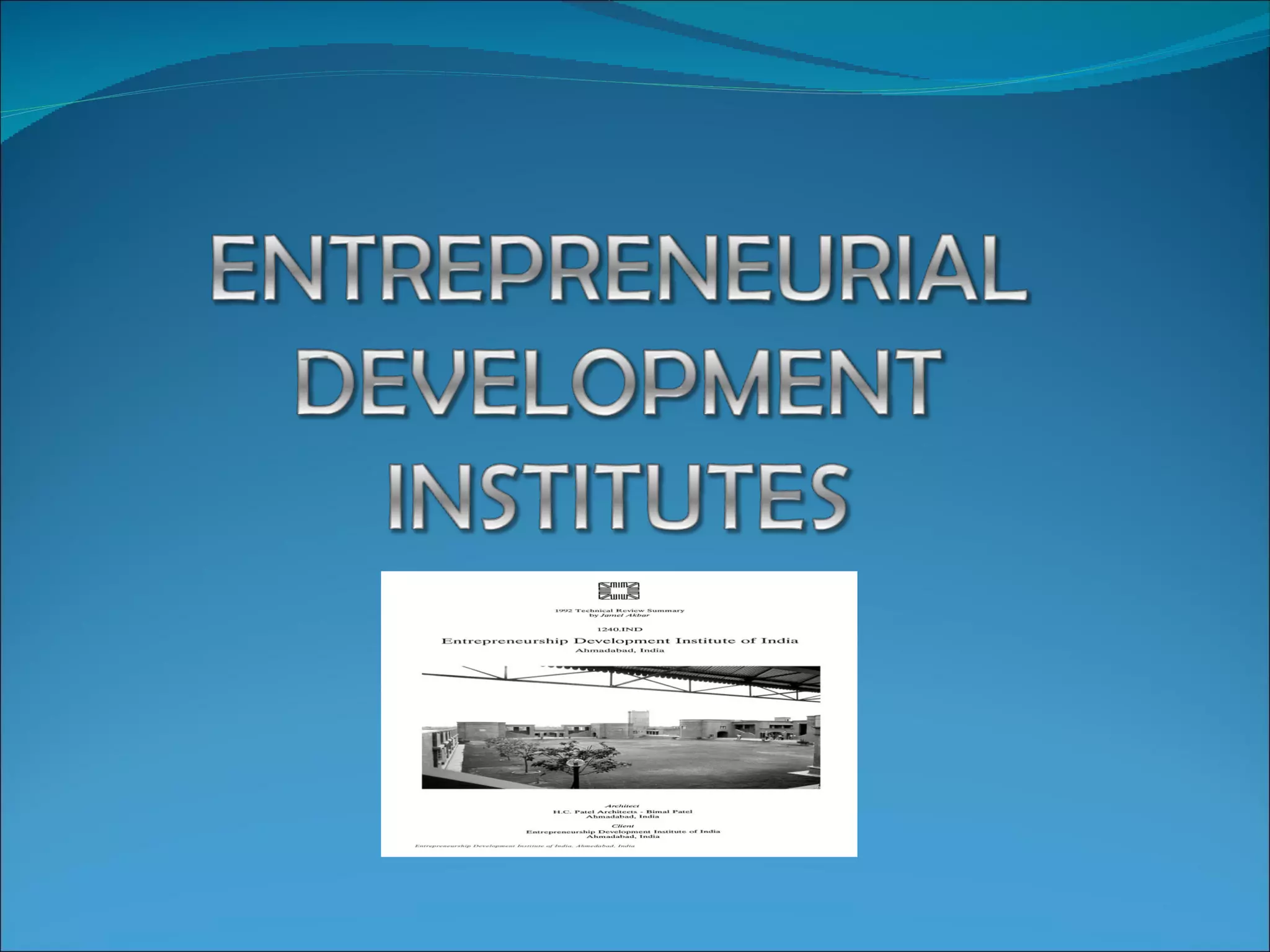
Entrepreneurship Development Institute  The Entrepreneurship Development Institute of India (EDI), an autonomous body and not-for-profit institution, set up in 1983, is sponsored by apex financial institutions, namely the IDBI Bank Ltd, IFCI Ltd. ICICI Ltd and State Bank of India (SBI).
The Institute is registered under the Societies Registration Act 1860 and the Public Trust Act 1950.  The EDI has been selected as a member of the Economic and Social Commission for Asia and the Pacific (ESCAP) network of Centres of Excellence for HRD Research and Training.
ALIST OF ENTREPRENEURSHIP DEVELOPMENT INSTITUTES . Shri K. Srivastave (Director) Institute of Entrepreneurship Development (UP) A 1 & 2 Sarojini Nagar, Industrial Area, Kanpur Road, Lucknow-226008 (UP)  Sh. G. Nagraju (Director) Centre for Entrepreneurship Development of Karnataka, "West View" UB Hills, Near D.C. office,  Dharward-580007
Sh. B.V. Rathod (Director) Maharashtra Centre for Entrepreneurship Development A-38, MIDC near Railway Station Aurangabad-431005  Sh. P.N. Mishra, (Executive Dir) Centre for Entrepreneurship Development, 60 Jail Road, Jahangirabad, Bhopal-462008  Sh. B.P. Rayaguru, (Director ) Institute of Entrepreneurship Development, IEDO, Plot No. 123, Sector-A, Zone-A,  Mancheswar Industrial Estate (near Postal Printing Press)  Bhubneswar-751010 Orissa
conclusion Entrepreneurship  was potential to support economic growth
 
CONTENTS Entrepreneur  Entrepreneurship Entrepreneurial Development Institute in India Entrepreneur  Development Institutes Conclusion
Entrepreneur  An  entrepreneur  is a person who has possession of a new enterprise, venture or idea and is accountable for the inherent risks and the outcome.
Entrepreneurship  “ Entrepreneurship is the purposeful activity of an individual or a group of associated individuals, undertaken to initiate, maintain or aggrandize profit by production or distribution of economic goods and services.”
 
 
Entrepreneurial Development Institute in India Entrepreneurship Development Institute of India (EDI), Ahmedabad conducted a research study to identify what makes an entrepreneur successful. The study was conducted under the guidance of professor David C. McClelland, a well known behavioural scientist in the countries-India, Malawi and Equador. The outcome of the study has been identification of set of entrepreneurial competencies or characteristics that result in superior performance.
Competencies possess by an entrepreneur  Initiative  Looking for Opportunities  Persistence Information Seeker Quality Conscious Committed to Work Efficiency Seeker
Cont…. Proper Planning Problem Solver Self-Confidence Assertive Persuative Efficient Monitor Employees’ Well Wisher Effective Strategist
 
Entrepreneurial Development Institutes Shri A.K. Srivastave (Director) Institute of Entrepreneurship Development (UP) A 1 & 2 Sarojini Nagar, Industrial Area, Kanpur Road, Lucknow-226008 (UP)  Sh. G. Nagraju (Director) Centre for Entrepreneurship Development of Karnataka, "West View" UB Hills, Near D.C. office,  Dharward-580007  Sh. B.V. Rathod (Director) Maharashtra Centre for Entrepreneurship Development A-38, MIDC near Railway Station Aurangabad-431005
Cont…  Sh. P.N. Mishra, (Executive Dir) Centre for Entrepreneurship Development, 60 Jail Road, Jahangirabad, Bhopal-462008  Sh. B.P. Rayaguru, (Director ) Institute of Entrepreneurship Development, IEDO, Plot No. 123, Sector-A, Zone-A,  Sh. P.A. Ramaswamy, (M.D.)  Kerala Industrial & Technical Consultancy organisation Ltd., P.B. No. 1820, Ravipuram,  M.G. Road, Cochin-682016  Sh. P.C. Gupta, (Executive Dir.) H.P.C.E.D., Udyog Bhawan, Bemloe, Shimla-171001  Smt. K. Rama Devi, (President,) CED an undertaking of Association Andhra Pradesh, 3-5-1091/15  Narayanaguda, Hyderabad-500029
C ONCLUSION  Entrepreneurial Development Institutes are help to develop  the entrepreneurial characteristics and to improve the performances of an individual who are going to establish the enterprise.
 
A university, especially in Europe, tends to be a long-established organization, but one that is constantly changing
This is a challenge for those that wish to understand it and to improve its effectiveness. The longevity of a university is not accidental: it is associated with the university’s knowledge production processes. This project will look at the internal workings of universities, and how their respective national planning and funding arrangements affect them. It will seek to identify steps that can be taken to improve their effectiveness as knowledge producers and as knowledge transmitters in Europe today and in the future.


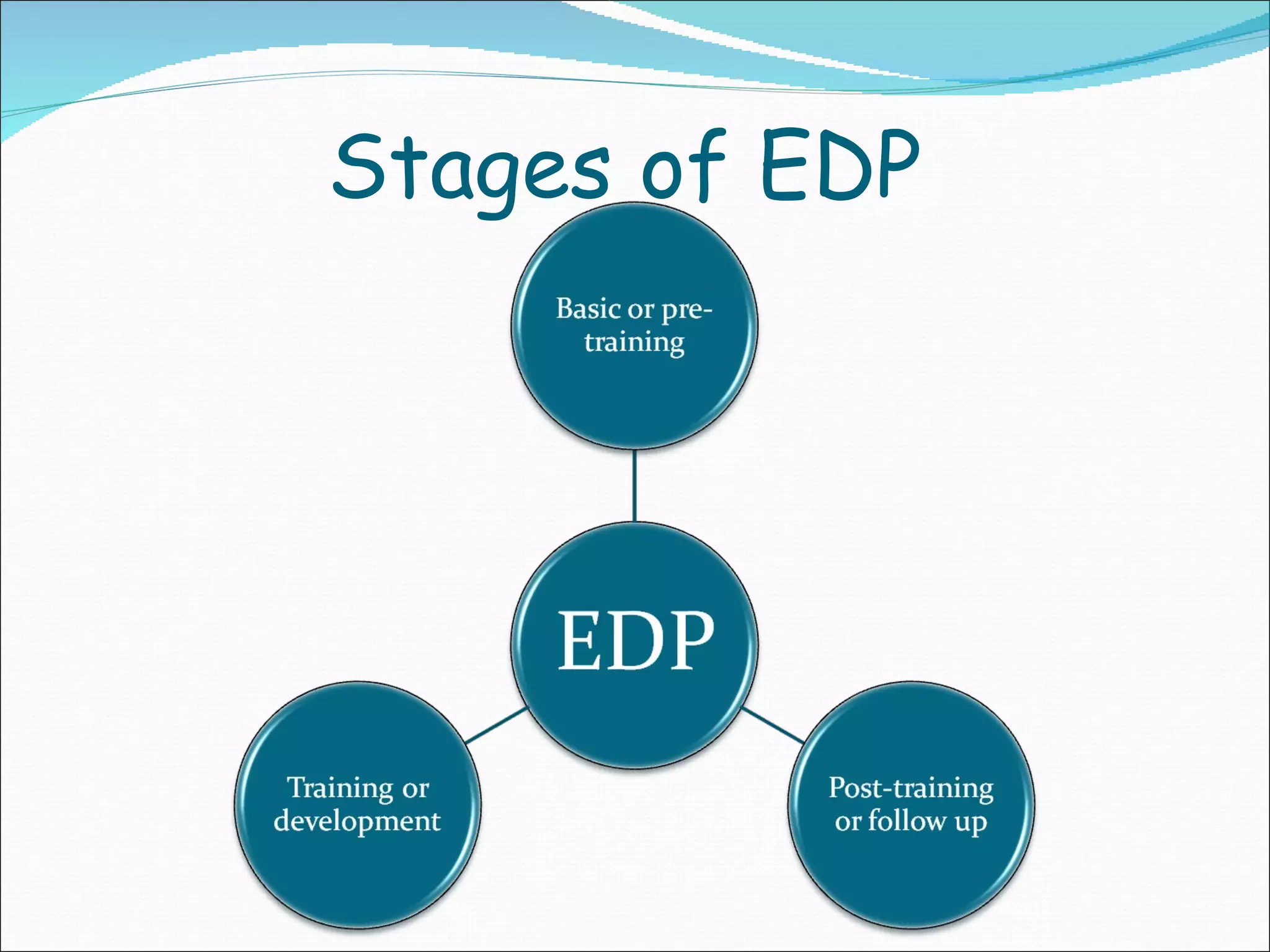
Contents Introduction EDP Need for EDP Objectives of EDP Stages of EDP Courses contents and curriculum of EDPs Limitations of EDP Lessons from experiences of EDP
EDP Entrepreneurship development is essentially an educational process and an endeavour in human resource development. Its an environment where an entrepreneur can learn and discharge its functions. Designed with an aim of encouraging self employment
Imparts training and motivates potential and existing entrepreneurs to start new business or diversify and expand the existing one Helps employment and wealth creation among educated unemployed youth Well equipped to face risks and challenges as an entrepreneur Government needs considerable human and material resource, importance to detailed planning & implementation
Need for EDP Quest 1: whether characteristics are in born in entrepreneur or can they be induced and developed ? According to behavioural scientist a David McClelland answer was ‘need for achievement’ called nach factor  It means it was need to achieve to motivate people to work hard.
Quest 2: whether this need for achievement can be induced? For the answer David conducted a 5 yr. experiment in a district of A.P. in collaboration with Small Industries Extension And Training Institute(SIET), Hyd.  Experiment popularly know as ‘ Kakinada Experiment’.
Objectives of EDP Accelerating industrial development by enlarging pool of entrepreneurs Assessing industrial development of rural and less developed areas Enlarging small and medium enterprise sector Providing productive self employment Improving performance of small industries  Diversifying sources of entrepreneurship, thereby promoting dispersal of business.
Stages of EDP
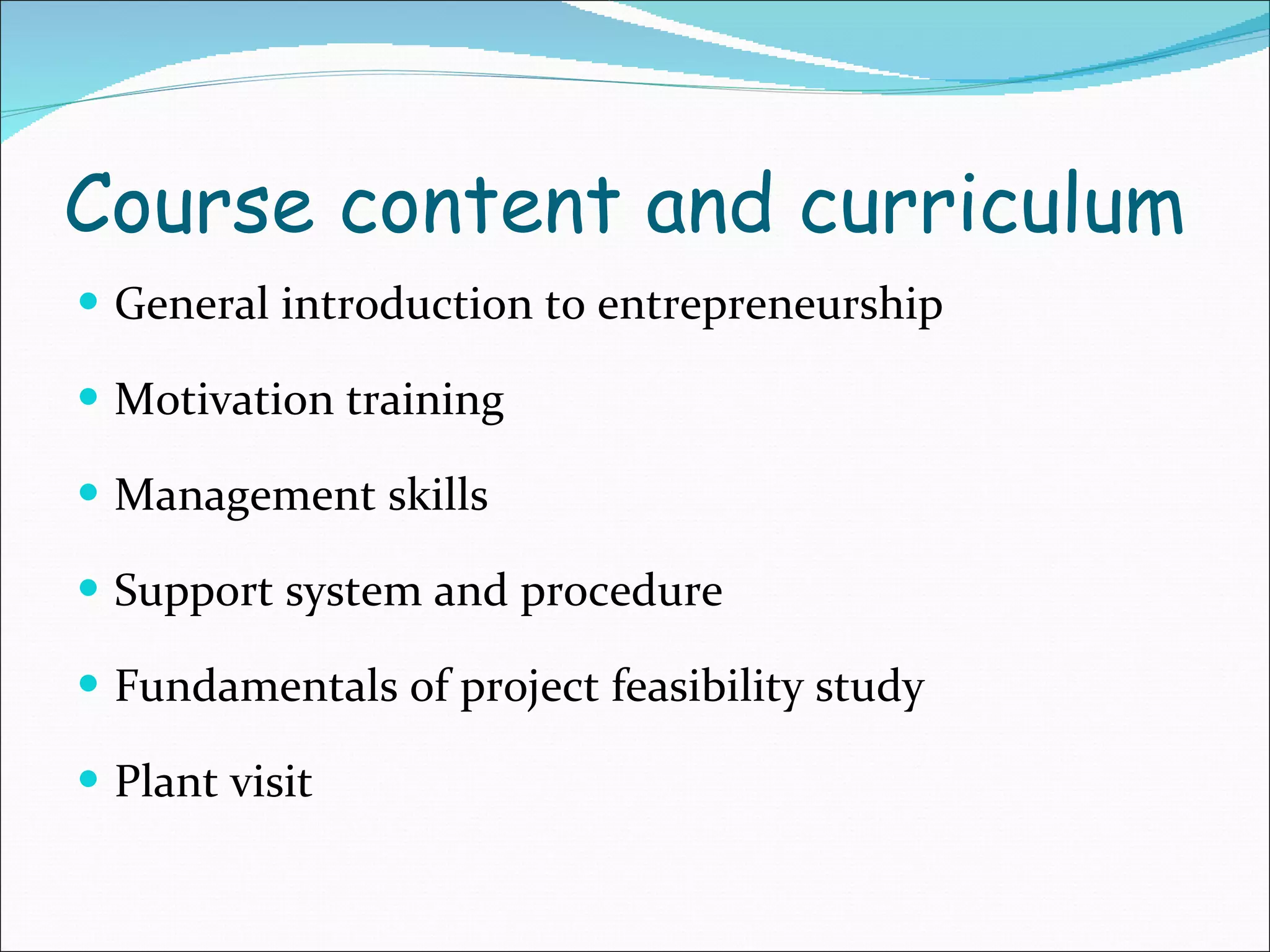
Course content and curriculum General introduction to entrepreneurship Motivation training Management skills Support system and procedure Fundamentals of project feasibility study Plant visit
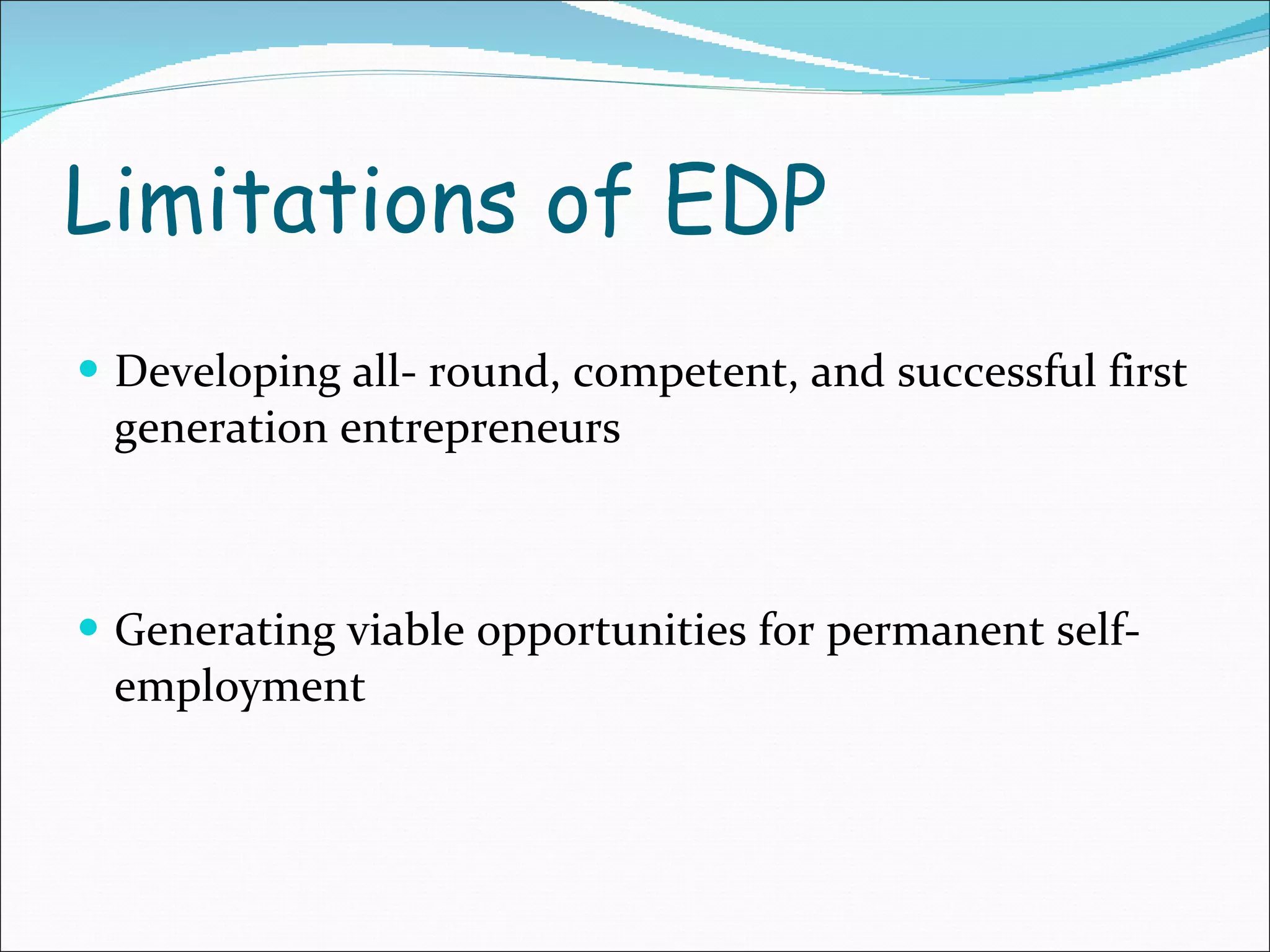
Limitations of EDP Developing all- round, competent, and successful first generation entrepreneurs Generating viable opportunities for permanent self- employment
Lessons from EDP experience  Comprehensive as against partial approach Integrated approach Development approach Goal-oriented concerns Need-based flexibility Individual counselling Introspective critical attitude
conclusion
 

Entrepreneurship and project management

  • 1.
  • 2.
  • 3.
    AGENDA Role ofGovernment, Role of IDBI – By 09HP1E0037 & 12 Role of IDBI, NIESBUD – By 09HP1E0020 & 46 Role of SISI, DIC – By 09HP1E0018 & 46 Other Financial Institutions – By 09HP1E0032 & 13 Commercial Banks – By 09HP1E0007 & 13 Entrepreneurial Development Institutes – By 09HP1E0014 & 09 Universities and other Educational Institutions offering EDP – By 09HP1E0048 Entrepreneurial Development Programme – By 09HP1E0008
  • 4.
    Everyone in theworld has at least one talent, one passion, one hobby that can become profitable if used correctly.
  • 5.
    Entrepreneur: One whoorganizes, manages and assumes the risks of a business or enterprise. Entrepreneurship is the process of creating or seizing an opportunity and pursuing it regardless of the resources currently controlled.
  • 6.
    Entrepreneurship Development: Roleof Financial Institutions Industrial growth and economic development of developing nations depend to a great extent on the role played by entrepreneurs. There are many instances of individual entrepreneurs whose creativity has led to the industrialization of many nations. However, in India the economic and industrial growth was slow due to lack of efficient entrepreneurs, industrial environment, technical know-how. Government and financial institutions have played a very important role in the entrepreneurship development.
  • 7.
    Efforts to FosterEntrepreneurship in India Many of India's leaders have perceived the need for the development of entrepreneurship in their country, and a number of programs have emerged to meet this need. The National Institute for Entrepreneurship and Small Business Development (NIESBUD). The Entrepreneurship Development Institute of India (EDII). Industrial Development Bank of India (IDBI). Small Industries Development Bank of India (SIDBI). North Eastern Development Finance Corporation Limited (NEDFCL) RBI’s role and steps for the development of SSI sector
  • 8.
    The Entrepreneurship DevelopmentInstitute of India Sponsored by several financial institutions, namely (ICICI), (IDBI), the Industrial Finance Corporation of India (IFCI), and the State Bank of India. One of the institute that, focuses on creating entrepreneurial personalities among youth. EDII launched a variety of programs to do just that. The Rural Entrepreneurship Development division, for instance, concentrates on rural development, employment generation, and poverty all aviation through the promotion of micro-enterprises. This divisional so has an informal micro-credit delivery system.
  • 9.
    Industrial Development Bankof India (IDBI)  IDBI is the tenth largest bank in the world in terms of development. The National Stock Exchange (NSE), The National Securities Depository Services Ltd. (NSDL), Stock Holding Corporation of India (SHCIL) are some of the institutions which has been built by IDBI. IDBI is a strategic investor in a plethor a of institutions which have revolutionized the Indian Financial Markets. IDBI Bank, promoted by IDBI Group started in November 1995 with a branch at Indor with an equity capital base of Rs.1000million
  • 10.
    Main functions ofIDBI IDBI invested with the responsibility of coordinating the working of institutions engaged in financing, promoting and developing industries. It has evolved an appropriate mechanism for this purpose. Developmental Activities of IDBI :- Promotional activities : The Bank continues to perform a wide range of promotional activities relating to developmental programmes for new entrepreneurs, consultancy services for small and medium enterprises and programmes designed for accredited voluntary agencies for the economic up liftmen of the under privileged.
  • 11.
    Contents Introduction Roleof IDBI IDBI Operations conclusion
  • 12.
  • 13.
    IDBI OPERATIONS Idbiintially provided long term assistance to industries such as textiles, fertilizers, chemicals products and machinery. In 1964, IDBI also began a role in assisting the state finance corporations (SFC) of various states. By 1965, IDBI entered into rediscounting of machinery bills.
  • 14.
    Cont…, Subsequently, IDBIentered into financing exports on a different payment basis , till the time export –import ( EXIM) bank of india was formed in 1982. In 1986, IDBI created a small industries development fund(sidf) Played a major role in setting up of stock holding corporation india limited (SHCIL)
  • 15.
    Role of IDBIPlanning , promoting and developing industries Co ordinating the working of institutions. IDBI’s role as a catalyst. Development activities of IDBI promotional activities technical consultancy org. entrepreneurship develop in
  • 16.
  • 17.
    Contents IntroductionDefinition of entrepreneurship ROLE OF IDBI & NIESBUD
  • 18.
    Defintion of enterpreneurship The concept of entrepreneurship has a wide range of meanings. On the one extreme an entrepreneur is a person of very high aptitude who pioneers change, possessing characteristics found in only a very small fraction of the population. On the other extreme of definitions, anyone who wants to work for himself or herself is considered to be an entrepreneur.
  • 19.
    To provide nationalinternational forums for interaction and exchange of experiences helpful for policy formulation and motivation .
  • 20.
    entrepreneur The word entrepreneur originates from the French word, entreprendre , which means "to undertake." In a business context, it means to start a business. The Merriam-Webster Dictionary presents the definition of an entrepreneur as one who organizes, manages, and assumes the risks of a business or enterprise
  • 21.
    NIESBUD The nationalinstitute for entrepreneurship and small business development (NIESBUD). NIESBUD was established in1983. NIESBUD limits its only training activities and conducting such programmes.
  • 22.
    OBJECTIVES The followingare the main objectives of NIESBUD To help support an affiliate institution organization in carrying out training. And other entrepreneurship development related activities with greater success. To evolve standardized materials and process of selection, training support and sustenance to potential entrepreneurs.
  • 23.
    ROLE OF IDBIIDBI role as a catalyst to industrial development encompasses a wise spectrum of activities. IDBI can finance all types industrial concerns covered under provisions of the IDBI act its 3 activities The IDBI developmental role the bank continues to perform a wide range of promotional activities.
  • 24.
    Technical consultancy organizationIndia financial institutions has a set up network of technical consultancy organizations its covering to the entire country
  • 25.
    Entrepreneurship development instituteIt has established similar institutes in bihar orissa, madhyapradesh and uttarpradesh . IDBI has also extends financial support to various organizations conducting in studies or surveys of relevance to industrial development
  • 26.
    OBJECTIVES To evolvestandardized materials and processes for selection, training, support and sustenance of entrepreneurs, potential and existing. To help/support and affiliate institutions/organizations in carrying out training and other entrepreneurship development related activities . To train trainers, promoters and consultants in various areas of entrepreneurship development To provide vital information and support to trainers, promoters and entrepreneurs by organizing research and documentation relevant to entrepreneurship development
  • 27.
    ROLE OF NIESBUDThe institute organizes:- Entrepreneurship development programs, Prepares manuals , and produces educational videos; Its training activities are stimulating, supporting, and sustaining entrepreneurship.
  • 28.
    ROLE OF SISI1) Technical Consultancy 2) Industrial Management Training 3) Economic Information 4) Marketing Assistance 5)Export Promotion Marketing
  • 29.
    ROLE OF DICTechnical support for preparation of Project Report.  Information on sources of machinery & Equipment. Priority in Power supply/ Telephone connection. Promotion of new Industrial Estates/ Growth Centers.   Land/ Shed in Industrial Estate.   Approval of Project Reports of special types.   Promotion of Electronic Industries.
  • 30.
    CONCLUSION Entrepreneur isa play vital role in the Financial institutions This about the role of NESBUD,SISI,DIC
  • 31.
  • 32.
    CONTENT: INTRODUCTION ROLEOF NIESBUD,SISI,DIC CONCLUSION
  • 33.
    Entrepreneur One whoorganizes, manages and assumes the risks of a business or enterprise "Entrepreneurship is the process of creating or seizing an opportunity and pursuing it regardless of the resources currently controlled"
  • 34.
    NIESBUD: The NationalInstitute for Entrepreneurship and Small Business Development (NIESBUD) was established in 1983 by the then Ministry of Industry [now Ministry of Micro, Small & Medium Enterprises (MSMEs)], Government of India, as an apex body for coordinating and overseeing the activities of various institutions/agencies engaged in Entrepreneurship Development particularly in the area of small industry and small business. The Institute which is registered as a Society under Societies Registration Act, 1860 (XXI of 1860), started functioning from 6th July, 1983 .
  • 35.
    OBJECTIVES To evolvestandardized materials and processes for selection, training, support and sustenance of entrepreneurs, potential and existing. To help/support and affiliate institutions/organizations in carrying out training and other entrepreneurship development related activities . To train trainers, promoters and consultants in various areas of entrepreneurship development To provide vital information and support to trainers, promoters and entrepreneurs by organizing research and documentation relevant to entrepreneurship development
  • 36.
    ROLE OF NIESBUDThe institute organizes:- Entrepreneurship development programs, Prepares manuals , and produces educational videos; Its training activities are stimulating, supporting, and sustaining entrepreneurship.
  • 37.
    ROLE OF SISI1) Technical Consultancy 2) Industrial Management Training 3) Economic Information 4) Marketing Assistance 5)Export Promotion Marketing
  • 38.
    ROLE OF DICTechnical support for preparation of Project Report.  Information on sources of machinery & Equipment. Priority in Power supply/ Telephone connection. Promotion of new Industrial Estates/ Growth Centers.   Land/ Shed in Industrial Estate.   Approval of Project Reports of special types.   Promotion of Electronic Industries.
  • 39.
    CONCLUSION Entrepreneur isa play vital role in the Financial institutions This about the role of NESBUD,SISI,DIC
  • 40.
  • 41.
    Small Industries ServiceInstitute The field offices of Small Industries Development Organization (SIDO), Ministry of Small Scale Industries, Govt. of India, set up for the promotion and development of Small Scale Industries in the State in the early fifties
  • 42.
    Major Extension Servicesprovided in the Institute Technical Consultancy Industrial Management Training Economic Information Entrepreneurial Development Programme, Scheme
  • 43.
    For Educated UnemployedYouth / Prime Minister's Rojgar Yojana Ancillary Developments / Sub-Contract Exchange Marketing Assistance
  • 44.
    Export Promotion MarketingModernisation / Upgradation Technology Assistance to Rehabilitation of sick units Common Facility & Training Assistance to District Industries Centre / State Govt. / Technical Assistance to various Central Government
  • 45.
    Various Developmental Agenciesin the State National Small Industries Corporation, Central Excise, Bureau of Indian Standards, CSIR etc. Exhibition / Demonstration
  • 46.
    District Industries CentreTo develop and promote Cottage and Small Scale Industries in the district. The Small Scale Industries (SSI) means the Industries with investment upto Rs 1 (one) crore in plant & machinery
  • 47.
    FINANCIAL ASSISTANCE SCHEMES(DEPARTMENTAL) Prime Minister Rozgar Yojona (PMRY) Normal Bank Finance Scheme Loan Under BSAI Act
  • 48.
    INCENTIVE SCHEME Registration Preference for power connection Project/Scheme Vetting Marketing Assistance to Handicraft Products Special Assistance rendered
  • 49.
    National Project ofBio-Gas Development (NPBD) Pollution Clearance Training Programme Minority Loans Rural Employment generation programme
  • 50.
    By LaxmanNaik 09HP1E0032 MBA-II
  • 51.
    Synopsis of Presentation Introduction to financial institutions Role of different banks in development of entrepreneurship Contribution to the economy conclusion
  • 52.
    Financial Institutions Afinancial institution is an institution which collects funds from the public and places them in financial assets, such as deposits, loans, and bonds, rather than tangible property.
  • 53.
    Non Banking FinancialInstitutions(NBFC) NBFCs help to bridge the credit gaps in several sector which traditional institution are unable to fulfill. NBFCs are more flexible in their operations and quick in decision-making .
  • 54.
  • 55.
    IDBI -Getting FamiliarEstablished in 1964 . Largest Financial institution in India, with assets at the end of 1999 approximating to Rs.600 billion. During the Financial Year 2009-10, achieved a Net Profit of Rs.1,031 crore and also crossed business of Rs.3,00,000 crore. The 10th largest development bank in the world. The National Stock Exchange (NSE), The National Securities Depository Services Ltd. (NSDL), Stock Holding Corporation of India (SHCIL) are some of the institutions which has been built by IDBI. Now, it has been categorized under “Other Public sector Banks” Resources of IDBI
  • 56.
  • 57.
  • 58.
    Exim bank SET UP BY AN ACT OF PARLIAMENT , 1981 WHOLLY OWNED BY GOVERNMENT OF INDIA COMMENCED OPERATIONS IN MARCH 1982 APEX FINANCIAL INSTITUTION OBJECTIVES: “… for providing financial assistance to exporters and importers, and for functioning as the principal financial institution for coordinating the working of institutions engaged in financing export and import of goods and services with a view to promoting the country’s international trade…” “… shall act on business principles with due regard to public interest”
  • 59.
    FINANCIAL ASSISTANCE TOINDIAN COMPANIES Delayed Payment Exports Pre-Shipment Credit Term Loans for Export Production Foreign Investment Finance Financing Export Marketing.
  • 60.
    Export Marketing Finance Administered an Export Marketing Fund from World Bank SMEs extended export marketing finance to implement strategic export marketing plans Exim Bank’s assistance resulted in generation of significant exports to developed country markets. Successes achieved in this Programme . Over 300 Companies supported in variety sectors : Knitting Needles Polyester Ropes Home Appliances
  • 61.
    Introduction of IFCIThe government of India set up the IFCI under the IFCI act in July in 1948. It is the first development financial institution in the country to cater to the long term financial needs of the industrial sectors. The main objective of IFCI is to make medium and long term credits more readily available for industrial concerns in India.
  • 62.
    Role of IFCITo provide much needed guidance in project identification , formulation, implementation, operation to the new, tiny, small scale and medium scale entrepreneurs. Fill in the gaps in the industrial infrastructure for promotion and growth of industries.
  • 63.
    conclusion Different banksplaying a major role in financial and other kind of assistance to the new and hopeful entrepreneurs and leading them to their development and to the economy as a whole
  • 64.
  • 65.
    FINANCIAL INSTITUTES Nationallevel State level National level: large scale industries Ex: ICICI,NIDC,IFCI,LIC,UTI etc., State level: medium and small scale industries Ex : state financial corporations(SFCs), State small industries devlopment corp(SSIDs).,
  • 66.
    Commercial Banks Theseare the easiest and quickest sources. Three familiar methods of obtaining loans from commercial banks are: 1.Cash credits 2.overdrafts 3.term loans
  • 67.
    Cont., ICICI :Fast decisioning - decentralised operations, centralised decision making. Fast disbursement - subject to complete documentation, disbursement in 25 days. Working capital limits - ranging from 25 lacs to 5 crores. Exclusive relationship managers - who can provide you all financial services - including trade accounts & services, remittances.
  • 68.
    Cont., Key Features: Loan amount of up to Rs. 50 lacs*. Charge on current assets . No requirement of third-party guarantee. No requirement of collateral security.
  • 69.
    Cont., Interest rate: Maximum – IBAR + 3% p.a. (ICICI Bank Benchmark Advance Rate) . ICICI Bank has also announced an increase of 0.50% in its benchmark prime-lending rate and in its Floating Reference Rate (FRR) for consumer loans.
  • 70.
    Cont., With effectfrom July 1, 2010, interest rate on new loans and advances including consumer loans is determined with reference to ICICI Bank Base Rate (“I-Base”). IBase is currently at 7.75% p.a.
  • 71.
  • 72.
    Contents Entrepreneurship Commercial Bank IFCI promotion for entrepreneurship ICICI promotion for entrepreneurship Conclusion
  • 73.
    Entrepreneurship, Entrepreneur Entrepreneurship is the act of being an entrepreneur, which can be defined as "one who undertakes innovations, finance and business acumen in an effort to transform innovations into economic goods". Entrepreneurs have been defined as “persons who are ingenious and creative in finding ways that add to their own wealth, power, and prestige”.
  • 74.
    Commercial Bank A commercial bank  is a type of financial intermediary and a type of bank. Commercial banking is also known as  business banking . It is a bank that provides checking accounts, savings accounts, and money market accounts and that accepts time deposits.
  • 75.
    Cont … Banksare expected to provide entrepreneurs with financial assistance as well as inputs to support and promote their enterprise. The banks have been found to be lacking on both counts and the concept of integrated approach to entrepreneurship development is totally absent One of the major causes that may be identified for huge Non-Performing Assets (NPAs) is the negligence on the part of banks in realizing their role in the proper development of entrepreneurs..
  • 76.
    IFCI Policies &Strategies Entrepreneurship is the backbone or a mother of healthy industrialization. Entrepreneurship & industrialization encourages the drive, skills, motive, trait, innovative spirit in the dynamic world of trade, industry, commerce, science, technology and management. To provide assistance and guidance for the revival & rehabilitation of sick & ailing Entrepreneurship in the country.
  • 77.
    To provide assistancein the form of rupee and foreign currency loans, underwriting of shares & debentures, guarantee for deferred payments & foreign loans for the promotion of medium & large scale entrepreneurship in the country. To provide assistance for expansion, diversification, modernization, renovation, & rehabilitation so as to encourage, accentuate the pace of Entrepreneurship promotion, creation & profile ration in the country.
  • 78.
    To encourage thewide network of TCOs with concrete support for the promotion of tiny, small & medium scale Entrepreneurship in every nook & corner of the country. To encourage co-operative Entrepreneurship in co-operative sector. IFCI has been giving due attention to the industrialization of backward areas & no industry districts through the promotion of regional Entrepreneurship. IFCI is extending developmental finance to potential entrepreneurs on concessional terms.
  • 79.
    ICICI ICICI isone of the principle development bank’s of the country which was established after IFCI but before IDBI on Jan 05, 1955
  • 80.
    Policies & objectivesof ICICI Policy of entrepreneurship promotion is based on following objectives: To broden the entrepreneurial base in the country. To sponsor small scale entrepreneurship in rural areas. To encourage and promote entrepreneurship in backward areas, special hill regions & no industry districts. To assist in the rehabilitation of sick, ailing and withering Entrepreneurship.
  • 81.
    Cont … Themain reasons accounted for growing corporate sickness in ICICI assisted units are: Increasing demand recession. Withering health of agriculture sector due to severe natural disasters. Uncertain policy environment caused by Government announcement from time to time. Imbalance in internal and external resources resulting in high capital expenditure.
  • 82.
    Conclusion ICICI isdedicated to the national task of entrepreneurship promotion and its dispersal in every sector of the national economy. This is performing the role in a great deal of enthusiasm. IFCI also encouraging the growth of co-operative entrepreneurship in rural India.
  • 83.
  • 84.
    Contents Who isan entrepreneur? What is entrepreneurship? Requirements to be an entrepreneur Qualities for entrepreneur The Entrepreneurship Development Institutes Conclusion
  • 85.
    Who is anentrepreneur? A person who takes the risk of converting a new ideas into reality According to Babson college research team USA An entrepreneur is a person who habitually creates and innovative something to build a recognized value through perceived opportunities. Examples for successful entrepreneur is dhirubhai ambani, N R Narayana Murty
  • 86.
    What is entrepreneurship?The process of bearing risk and running business. Requirements to be an entrepreneur: Innovation Creativity Risk taking Organizing
  • 87.
    Qualities for entrepreneurCommonsense Specialized knowledge in the field Self confidence Ability to get things done Creativity Leadership Communication Willingness to take risk Self motivation Determination
  • 88.
    Entrepreneurship Development Institute The Entrepreneurship Development Institute of India (EDI), an autonomous body and not-for-profit institution, set up in 1983, is sponsored by apex financial institutions, namely the IDBI Bank Ltd, IFCI Ltd. ICICI Ltd and State Bank of India (SBI).
  • 89.
    The Institute isregistered under the Societies Registration Act 1860 and the Public Trust Act 1950. The EDI has been selected as a member of the Economic and Social Commission for Asia and the Pacific (ESCAP) network of Centres of Excellence for HRD Research and Training.
  • 90.
    ALIST OF ENTREPRENEURSHIPDEVELOPMENT INSTITUTES . Shri K. Srivastave (Director) Institute of Entrepreneurship Development (UP) A 1 & 2 Sarojini Nagar, Industrial Area, Kanpur Road, Lucknow-226008 (UP) Sh. G. Nagraju (Director) Centre for Entrepreneurship Development of Karnataka, "West View" UB Hills, Near D.C. office, Dharward-580007
  • 91.
    Sh. B.V. Rathod(Director) Maharashtra Centre for Entrepreneurship Development A-38, MIDC near Railway Station Aurangabad-431005 Sh. P.N. Mishra, (Executive Dir) Centre for Entrepreneurship Development, 60 Jail Road, Jahangirabad, Bhopal-462008 Sh. B.P. Rayaguru, (Director ) Institute of Entrepreneurship Development, IEDO, Plot No. 123, Sector-A, Zone-A, Mancheswar Industrial Estate (near Postal Printing Press) Bhubneswar-751010 Orissa
  • 92.
    conclusion Entrepreneurship  waspotential to support economic growth
  • 93.
  • 94.
    CONTENTS Entrepreneur Entrepreneurship Entrepreneurial Development Institute in India Entrepreneur Development Institutes Conclusion
  • 95.
    Entrepreneur An entrepreneur is a person who has possession of a new enterprise, venture or idea and is accountable for the inherent risks and the outcome.
  • 96.
    Entrepreneurship “Entrepreneurship is the purposeful activity of an individual or a group of associated individuals, undertaken to initiate, maintain or aggrandize profit by production or distribution of economic goods and services.”
  • 97.
  • 98.
  • 99.
    Entrepreneurial Development Institutein India Entrepreneurship Development Institute of India (EDI), Ahmedabad conducted a research study to identify what makes an entrepreneur successful. The study was conducted under the guidance of professor David C. McClelland, a well known behavioural scientist in the countries-India, Malawi and Equador. The outcome of the study has been identification of set of entrepreneurial competencies or characteristics that result in superior performance.
  • 100.
    Competencies possess byan entrepreneur Initiative Looking for Opportunities Persistence Information Seeker Quality Conscious Committed to Work Efficiency Seeker
  • 101.
    Cont…. Proper PlanningProblem Solver Self-Confidence Assertive Persuative Efficient Monitor Employees’ Well Wisher Effective Strategist
  • 102.
  • 103.
    Entrepreneurial Development InstitutesShri A.K. Srivastave (Director) Institute of Entrepreneurship Development (UP) A 1 & 2 Sarojini Nagar, Industrial Area, Kanpur Road, Lucknow-226008 (UP) Sh. G. Nagraju (Director) Centre for Entrepreneurship Development of Karnataka, "West View" UB Hills, Near D.C. office, Dharward-580007 Sh. B.V. Rathod (Director) Maharashtra Centre for Entrepreneurship Development A-38, MIDC near Railway Station Aurangabad-431005
  • 104.
    Cont… Sh.P.N. Mishra, (Executive Dir) Centre for Entrepreneurship Development, 60 Jail Road, Jahangirabad, Bhopal-462008 Sh. B.P. Rayaguru, (Director ) Institute of Entrepreneurship Development, IEDO, Plot No. 123, Sector-A, Zone-A, Sh. P.A. Ramaswamy, (M.D.) Kerala Industrial & Technical Consultancy organisation Ltd., P.B. No. 1820, Ravipuram, M.G. Road, Cochin-682016 Sh. P.C. Gupta, (Executive Dir.) H.P.C.E.D., Udyog Bhawan, Bemloe, Shimla-171001 Smt. K. Rama Devi, (President,) CED an undertaking of Association Andhra Pradesh, 3-5-1091/15 Narayanaguda, Hyderabad-500029
  • 105.
    C ONCLUSION Entrepreneurial Development Institutes are help to develop the entrepreneurial characteristics and to improve the performances of an individual who are going to establish the enterprise.
  • 106.
  • 107.
    A university, especiallyin Europe, tends to be a long-established organization, but one that is constantly changing
  • 108.
    This is achallenge for those that wish to understand it and to improve its effectiveness. The longevity of a university is not accidental: it is associated with the university’s knowledge production processes. This project will look at the internal workings of universities, and how their respective national planning and funding arrangements affect them. It will seek to identify steps that can be taken to improve their effectiveness as knowledge producers and as knowledge transmitters in Europe today and in the future.
  • 109.
  • 110.
  • 111.
  • 112.
  • 113.
  • 114.
  • 115.
  • 116.
  • 117.
    Contents Introduction EDPNeed for EDP Objectives of EDP Stages of EDP Courses contents and curriculum of EDPs Limitations of EDP Lessons from experiences of EDP
  • 118.
    EDP Entrepreneurship developmentis essentially an educational process and an endeavour in human resource development. Its an environment where an entrepreneur can learn and discharge its functions. Designed with an aim of encouraging self employment
  • 119.
    Imparts training andmotivates potential and existing entrepreneurs to start new business or diversify and expand the existing one Helps employment and wealth creation among educated unemployed youth Well equipped to face risks and challenges as an entrepreneur Government needs considerable human and material resource, importance to detailed planning & implementation
  • 120.
    Need for EDPQuest 1: whether characteristics are in born in entrepreneur or can they be induced and developed ? According to behavioural scientist a David McClelland answer was ‘need for achievement’ called nach factor It means it was need to achieve to motivate people to work hard.
  • 121.
    Quest 2: whetherthis need for achievement can be induced? For the answer David conducted a 5 yr. experiment in a district of A.P. in collaboration with Small Industries Extension And Training Institute(SIET), Hyd. Experiment popularly know as ‘ Kakinada Experiment’.
  • 122.
    Objectives of EDPAccelerating industrial development by enlarging pool of entrepreneurs Assessing industrial development of rural and less developed areas Enlarging small and medium enterprise sector Providing productive self employment Improving performance of small industries Diversifying sources of entrepreneurship, thereby promoting dispersal of business.
  • 123.
  • 124.
    Course content andcurriculum General introduction to entrepreneurship Motivation training Management skills Support system and procedure Fundamentals of project feasibility study Plant visit
  • 125.
    Limitations of EDPDeveloping all- round, competent, and successful first generation entrepreneurs Generating viable opportunities for permanent self- employment
  • 126.
    Lessons from EDPexperience Comprehensive as against partial approach Integrated approach Development approach Goal-oriented concerns Need-based flexibility Individual counselling Introspective critical attitude
  • 127.
  • 128.