

SCHEDULING OF A PROJECT
SAILISH CEPHAS E
17MK09
M.E. INFRASTRUCTURE ENGINEERING
PSG COLLEGE OF TECHNOLOGY
COIMBATORE
Contents
• Introduction
• Planning-overview
• Scheduling
• Why do we schedule?
• When do we schedule?
• What do we schedule?
• Questions the scheduler asks
• Terms used in scheduling
• Steps in creating a project schedule
• Hierarchy of schedules
• Scheduling software
Introduction
• Before I start project scheduling I will summarize
shortly what is project and project management.
• Project-Planned set of interrelated tasks to be
executed over a fixed period and within certain
cost and other limitations.
• Construction project
• Project management-Project management is the
application of processes, methods, knowledge,
skills and experience to achieve the project
objectives.
– Buying clothes
Planning-overview
• Making decisions with the objective of
influencing the future.
• What tasks will be performed?
• How tasks will be performed?
• Who will perform the tasks?
• Its an ‘ART’ form based on experience and
knowledge.
scheduling
• Determination of timing of events in the
Project.
• When tasks will be performed?
• In what sequence the tasks will be performed?
• Reflection of plan.
• Its like ‘SCIENCE’.
• Formalized method of managing time and
resources.
Why do we schedule?
• Better manage the project.
• Control change.
• Satisfy customer or contractual requirements.
• Monitor and measure progress against goals
What do you schedule?
• Milestones- it’s a reference point that marks a
major event or a branching decision point
within a project.
• Activities required by contract or customer.
• Activities critical to the performance of the
project.
• Changes to the original plan.
When do you schedule?
• Prior to, or at the beginning of a project. This
schedule is referred to as the “baseline”.
• At periodic intervals during the project. This is
commonly referred to “updating”.
• If there are changes in the scope of the
project.
• If the project is substantially behind or ahead
of the baseline.
Questions the Scheduler Asks
• What tasks will be performed? (Scope)
• How will the tasks be performed? (Execution Plan)
• What is the sequence in which the tasks will be
performed?(Execution Plan & Resources)
• Who will perform the tasks? (Resources & Execution Plan)
• Where is the equipment list, is there any exotic material
used? (Scope & Execution Plan)
• How many s/c’s do we plan to use? (Execution Plan &
Resources)
• What Permits are required and who is responsible for
them? (Scope & Execution Plan)
• Where is the Project to be executed? (Scope, Execution
Plan & Resources)
Terms used in scheduling
• Activity (Schedule or Task).
• Duration.
• Predecessor & successor.
• Relationship
– Finish to Start ‐ FS-the start of the next activity is
dependent upon the completion of the previous
activity.
• E.g.: on a construction project, you can’t pour the concrete
until the reinforcing steel is in place.
– Start to Start ‐ SS
– Finish to Finish ‐ FF
– Start to Finish ‐ SF
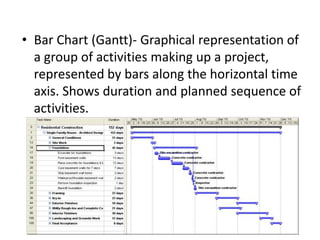
• Bar Chart (Gantt)- Graphical representation of
a group of activities making up a project,
represented by bars along the horizontal time
axis. Shows duration and planned sequence of
activities.
• Critical Path - The path or paths which are the
series of activities having zero float and must
be completed on their scheduled dates.
• Milestone-A point in time that signifies either
the beginning or the end of a series of related
activities.
• Float- amount of time that a task in a project
can be delayed without causing a delay to
subsequent tasks.
• Resource-Anything needed to complete an
activity: labor, materials, equipment, design,
etc.
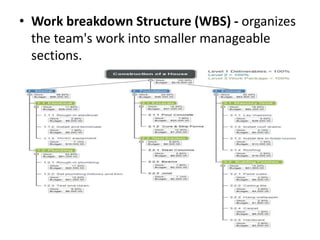
• Work breakdown Structure (WBS) - organizes
the team's work into smaller manageable
sections.
Steps in creating a project schedule
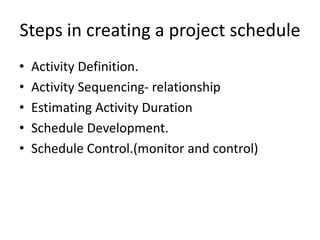
• Activity Definition.
• Activity Sequencing- relationship
• Estimating Activity Duration
• Schedule Development.
• Schedule Control.(monitor and control)
Hierarchy of Schedules
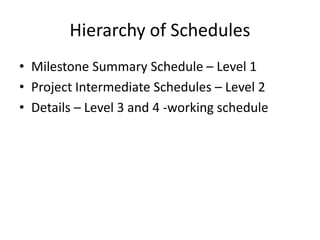
• Milestone Summary Schedule – Level 1
• Project Intermediate Schedules – Level 2
• Details – Level 3 and 4 -working schedule
Scheduling software
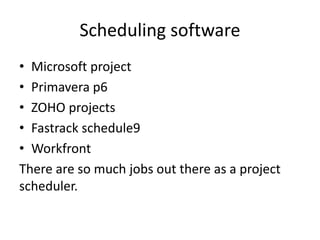
• Microsoft project
• Primavera p6
• ZOHO projects
• Fastrack schedule9
• Workfront
There are so much jobs out there as a project
scheduler.
Scheduling of a project

Scheduling of a project

  • 1.
    SCHEDULING OF APROJECT SAILISH CEPHAS E 17MK09 M.E. INFRASTRUCTURE ENGINEERING PSG COLLEGE OF TECHNOLOGY COIMBATORE
  • 2.
    Contents • Introduction • Planning-overview •Scheduling • Why do we schedule? • When do we schedule? • What do we schedule? • Questions the scheduler asks • Terms used in scheduling • Steps in creating a project schedule • Hierarchy of schedules • Scheduling software
  • 3.
    Introduction • Before Istart project scheduling I will summarize shortly what is project and project management. • Project-Planned set of interrelated tasks to be executed over a fixed period and within certain cost and other limitations. • Construction project • Project management-Project management is the application of processes, methods, knowledge, skills and experience to achieve the project objectives. – Buying clothes
  • 4.
    Planning-overview • Making decisionswith the objective of influencing the future. • What tasks will be performed? • How tasks will be performed? • Who will perform the tasks? • Its an ‘ART’ form based on experience and knowledge.
  • 5.
    scheduling • Determination oftiming of events in the Project. • When tasks will be performed? • In what sequence the tasks will be performed? • Reflection of plan. • Its like ‘SCIENCE’. • Formalized method of managing time and resources.
  • 6.
    Why do weschedule? • Better manage the project. • Control change. • Satisfy customer or contractual requirements. • Monitor and measure progress against goals
  • 7.
    What do youschedule? • Milestones- it’s a reference point that marks a major event or a branching decision point within a project. • Activities required by contract or customer. • Activities critical to the performance of the project. • Changes to the original plan.
  • 8.
    When do youschedule? • Prior to, or at the beginning of a project. This schedule is referred to as the “baseline”. • At periodic intervals during the project. This is commonly referred to “updating”. • If there are changes in the scope of the project. • If the project is substantially behind or ahead of the baseline.
  • 9.
    Questions the SchedulerAsks • What tasks will be performed? (Scope) • How will the tasks be performed? (Execution Plan) • What is the sequence in which the tasks will be performed?(Execution Plan & Resources) • Who will perform the tasks? (Resources & Execution Plan) • Where is the equipment list, is there any exotic material used? (Scope & Execution Plan) • How many s/c’s do we plan to use? (Execution Plan & Resources) • What Permits are required and who is responsible for them? (Scope & Execution Plan) • Where is the Project to be executed? (Scope, Execution Plan & Resources)
  • 10.
    Terms used inscheduling • Activity (Schedule or Task). • Duration. • Predecessor & successor. • Relationship – Finish to Start ‐ FS-the start of the next activity is dependent upon the completion of the previous activity. • E.g.: on a construction project, you can’t pour the concrete until the reinforcing steel is in place. – Start to Start ‐ SS – Finish to Finish ‐ FF – Start to Finish ‐ SF
  • 11.
    • Bar Chart(Gantt)- Graphical representation of a group of activities making up a project, represented by bars along the horizontal time axis. Shows duration and planned sequence of activities.
  • 12.
    • Critical Path- The path or paths which are the series of activities having zero float and must be completed on their scheduled dates. • Milestone-A point in time that signifies either the beginning or the end of a series of related activities. • Float- amount of time that a task in a project can be delayed without causing a delay to subsequent tasks. • Resource-Anything needed to complete an activity: labor, materials, equipment, design, etc.
  • 13.
    • Work breakdownStructure (WBS) - organizes the team's work into smaller manageable sections.
  • 14.
    Steps in creatinga project schedule • Activity Definition. • Activity Sequencing- relationship • Estimating Activity Duration • Schedule Development. • Schedule Control.(monitor and control)
  • 15.
    Hierarchy of Schedules •Milestone Summary Schedule – Level 1 • Project Intermediate Schedules – Level 2 • Details – Level 3 and 4 -working schedule
  • 16.
    Scheduling software • Microsoftproject • Primavera p6 • ZOHO projects • Fastrack schedule9 • Workfront There are so much jobs out there as a project scheduler.