
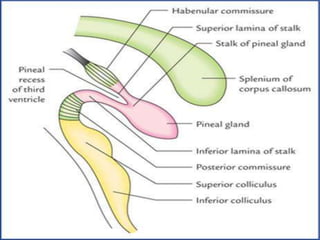
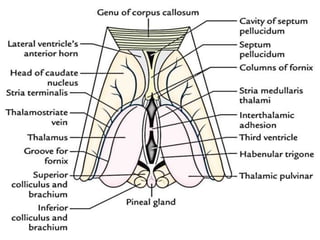
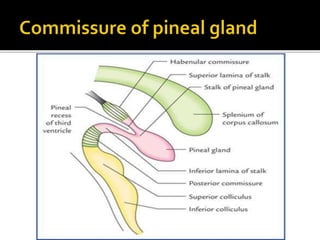
 The Epithalamus includes those structures
which occupy the caudal part of roof of third
ventricle.
 It comprises of
 Pineal body/gland/epiphysis cerebri
 Habenular nuclei
 Habenular commissure
 Posterior commissure
 Introduction
 Colour
 Size
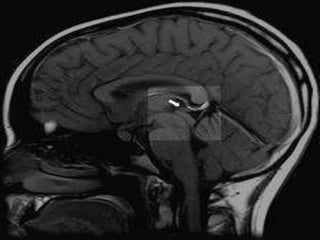
 Location
 Parts
EPIPHYSIS (PINEAL GLAND)
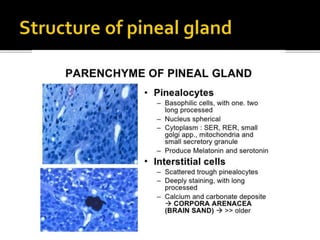
Stained with haematoxylin and eosin
1 - pinealocytes
2- pineal sand (salts of calcium,
magnesium and silicon
 Descartes described the pineal gland as
the seat of soul.
 It has a neuroendocrine activity in regulation
and modulation of the pituitary and all other
endocrine organs, mostly inhibitory.
 It acts as biological clock for physiological
and behavioural control.
 It secretes a hormone, melatonin which
inhibits secretion of gonadotrophins (GnRH)
from hypothalamus.Thus, it has inhibitory
effect on the reproductive system (sexual
maturity).The melatonin is produced at night
and its production falls during day
time. Melatonin probably holds back the
reproductive development until a suitable age
has reached by inhibiting the secretion of
gonadotro-phic hormones.
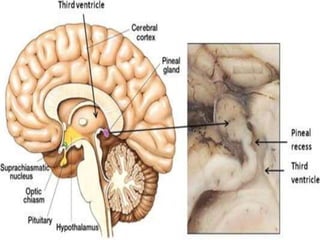
 Pineal gland is the only part of the brain,
which has no nerve cells in it.
 It is the only part of the brain which is
supplied by a nerve (nervus conarii) which
arises from outside the brain.
 Afferents: Auditory pathways through lateral
lemniscus either directly or after relay in the
inferior colliculus.These fibres pass through
brachium of inferior colliculus (inferior
brachium).
 Efferents: Geniculocortical fibres project
as auditory radiation through sublentiform
part of internal capsule to the primary
auditory area in the temporal lobe (area 41,
42).
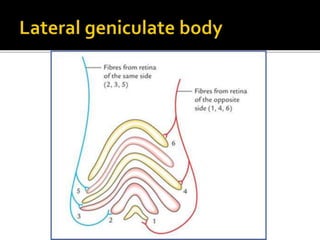
 Afferents: Lateral root of the optic tract
consisting of most of the retinal fibres of both
the eyes (temporal fibres of the same side
and nasal fibres of the opposite side).
 Efferents: Geniculocalcarine fibres project as
the optic radiation through retrolentiform
part of internal capsule to the visual cortex of
the occipital lobe (areas 17, 18, and 19).
Medial geniculate body Lateral geniculate body
Oval-shaped collection of grey matter on
the inferior aspect of the pulvinar
Bean-shaped collection of grey
matter on the inferior aspect of
inferior aspect of the pulvinar
Hilum absent Hilum present
No lamination Consists of 6 laminae, numbered 1
to 6 from ventral surface to dorsal
surface
Destruction of medial geniculate on one
side has little or no effect on hearing
Destruction of lateral geniculate
body on one side produces
blindness in the opposite half of the
field of vision
Last relay station on the auditory pathway Last relay station on the optic
pathway
Sends auditory impulse through auditory
radiation to the auditory area of the
temporal lobe
Sends visual impulses through optic
radiation to the visual radiation to
the cortex of the occipital lobe
Comparison between the medial and lateral geniculate bodies
 Lesion of pineal gland- Precocious Puberty
 Calcification of PinealGland
 precocious puberty is puberty occurring at an
unusually early age.
 Central
 Pheripheral
 Precocious puberty signs and symptoms include
development of the following before age 8 in girls and
before age 9 in boys.
 Breast growth and first period in girls
 Enlarged testicles and penis, facial hair and deepening
voice in boys
 Pubic or underarm hair
 Rapid growth
 Acne
 Adult body odor
 Calcification of the pineal gland is typical in
young adults, and has been observed in
children as young as two years of age.The
internal secretions of the pineal gland inhibit
the development of the reproductive glands
because when it is severely damaged in
children, development of the sexual organs
and the skeleton are accelerated.
Epithalamus & metathalamus

Epithalamus & metathalamus

  • 3.
     The Epithalamusincludes those structures which occupy the caudal part of roof of third ventricle.  It comprises of  Pineal body/gland/epiphysis cerebri  Habenular nuclei  Habenular commissure  Posterior commissure
  • 4.
     Introduction  Colour Size  Location  Parts
  • 9.
    EPIPHYSIS (PINEAL GLAND) Stainedwith haematoxylin and eosin 1 - pinealocytes 2- pineal sand (salts of calcium, magnesium and silicon
  • 10.
     Descartes describedthe pineal gland as the seat of soul.  It has a neuroendocrine activity in regulation and modulation of the pituitary and all other endocrine organs, mostly inhibitory.  It acts as biological clock for physiological and behavioural control.
  • 11.
     It secretesa hormone, melatonin which inhibits secretion of gonadotrophins (GnRH) from hypothalamus.Thus, it has inhibitory effect on the reproductive system (sexual maturity).The melatonin is produced at night and its production falls during day time. Melatonin probably holds back the reproductive development until a suitable age has reached by inhibiting the secretion of gonadotro-phic hormones.
  • 12.
     Pineal glandis the only part of the brain, which has no nerve cells in it.  It is the only part of the brain which is supplied by a nerve (nervus conarii) which arises from outside the brain.
  • 19.
     Afferents: Auditorypathways through lateral lemniscus either directly or after relay in the inferior colliculus.These fibres pass through brachium of inferior colliculus (inferior brachium).  Efferents: Geniculocortical fibres project as auditory radiation through sublentiform part of internal capsule to the primary auditory area in the temporal lobe (area 41, 42).
  • 21.
     Afferents: Lateralroot of the optic tract consisting of most of the retinal fibres of both the eyes (temporal fibres of the same side and nasal fibres of the opposite side).  Efferents: Geniculocalcarine fibres project as the optic radiation through retrolentiform part of internal capsule to the visual cortex of the occipital lobe (areas 17, 18, and 19).
  • 22.
    Medial geniculate bodyLateral geniculate body Oval-shaped collection of grey matter on the inferior aspect of the pulvinar Bean-shaped collection of grey matter on the inferior aspect of inferior aspect of the pulvinar Hilum absent Hilum present No lamination Consists of 6 laminae, numbered 1 to 6 from ventral surface to dorsal surface Destruction of medial geniculate on one side has little or no effect on hearing Destruction of lateral geniculate body on one side produces blindness in the opposite half of the field of vision Last relay station on the auditory pathway Last relay station on the optic pathway Sends auditory impulse through auditory radiation to the auditory area of the temporal lobe Sends visual impulses through optic radiation to the visual radiation to the cortex of the occipital lobe Comparison between the medial and lateral geniculate bodies
  • 23.
     Lesion ofpineal gland- Precocious Puberty  Calcification of PinealGland
  • 24.
     precocious pubertyis puberty occurring at an unusually early age.  Central  Pheripheral  Precocious puberty signs and symptoms include development of the following before age 8 in girls and before age 9 in boys.  Breast growth and first period in girls  Enlarged testicles and penis, facial hair and deepening voice in boys  Pubic or underarm hair  Rapid growth  Acne  Adult body odor
  • 25.
     Calcification ofthe pineal gland is typical in young adults, and has been observed in children as young as two years of age.The internal secretions of the pineal gland inhibit the development of the reproductive glands because when it is severely damaged in children, development of the sexual organs and the skeleton are accelerated.