IC Fabrication Technology
Lecture No.9
Date . 02/09/2023
• Epitaxy is the type of silicon
deposition that results in single
crystal growth due to contact with a
suitable crystalline lattice.
• Epitaxy usually performed using the
wafer, for economic reasons.
• Mechanism of epitaxial growth
• Methods of epitaxial deposition
• Properties of epitaxial layers
• Applications of epitaxial layers
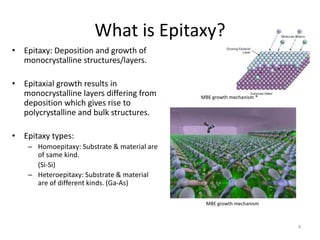
What is Epitaxy?
• Epitaxy: Deposition and growth of
monocrystalline structures/layers.
• Epitaxial growth results in
monocrystalline layers differing from
deposition which gives rise to
polycrystalline and bulk structures.
• Epitaxy types:
– Homoepitaxy: Substrate & material are
of same kind.
(Si-Si)
– Heteroepitaxy: Substrate & material
are of different kinds. (Ga-As)
4
MBE growth mechanism *
MBE growth mechanism
Epitaxial Growth
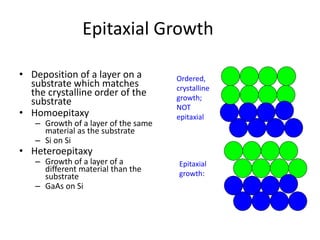
• Deposition of a layer on a
substrate which matches
the crystalline order of the
substrate
• Homoepitaxy
– Growth of a layer of the same
material as the substrate
– Si on Si
• Heteroepitaxy
– Growth of a layer of a
different material than the
substrate
– GaAs on Si
Ordered,
crystalline
growth;
NOT
epitaxial
Epitaxial
growth:
Why Epitaxy?
• Epitaxial growth is useful for applications that place
stringent demands on a deposited layer:
– High purity
– Low defect density
– Abrupt interfaces
– Controlled doping profiles
– High repeatability and uniformity
– Safe, efficient operation
• Can create clean, fresh surface for device fabrication
General Epitaxial Deposition
Requirements
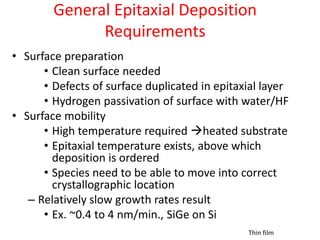
• Surface preparation
• Clean surface needed
• Defects of surface duplicated in epitaxial layer
• Hydrogen passivation of surface with water/HF
• Surface mobility
• High temperature required heated substrate
• Epitaxial temperature exists, above which
deposition is ordered
• Species need to be able to move into correct
crystallographic location
– Relatively slow growth rates result
• Ex. ~0.4 to 4 nm/min., SiGe on Si
Thin film
Epitaxy Techniques
• Vapor-Phase Epitaxy (VPE)
– Modified method of chemical
vapor deposition (CVD).
– Undesired polycrystalline layers
– Growth rate: ~2 µm/min.
• Liquid-Phase Epitaxy (LPE)
– Crystal layers are from the melt
existent on the substrate.
– Hard to make thin films
– Growth rate: 0.1-1 µm/min.
• Molecular Beam Epitaxy
(MBE)
– Relies on the sublimation of
ultrapure elements, then
condensation of them on wafer
– In a vacuum chamber (pressure:
~10-11 Torr).
– “Beam”: molecules do not collide
to either chamber walls or existent
gas atoms.
– Growth rate: 1µm/hr.
8
• Epitaxy is the type of silicon deposition
that results in single crystal growth due to
contact with a suitable crystalline lattice.
• Epitaxy usually performed using the
wafer, for economic reasons.
• Mechanism of epitaxial growth
• Methods of epitaxial deposition
• Properties of epitaxial layers
• Applications of epitaxial layers
Epitaxial Growth
• Deposition of a layer on a
substrate which matches
the crystalline order of the
substrate
• Homoepitaxy
– Growth of a layer of the same
material as the substrate
– Si on Si
• Heteroepitaxy
– Growth of a layer of a
different material than the
substrate
– GaAs on Si
Ordered,
crystalline
growth;
NOT
epitaxial
Epitaxial
growth:
Why Epitaxy?
• Epitaxial growth is useful for applications that place
stringent demands on a deposited layer:
– High purity
– Low defect density
– Abrupt interfaces
– Controlled doping profiles
– High repeatability and uniformity
– Safe, efficient operation
• Can create clean, fresh surface for device fabrication
General Epitaxial Deposition
Requirements
• Surface preparation
– Clean surface needed
– Defects of surface duplicated in epitaxial layer
– Hydrogen passivation of surface with water/HF
• Surface mobility
– High temperature required heated substrate
– Epitaxial temperature exists, above which deposition is ordered
– Species need to be able to move into correct crystallographic
location
– Relatively slow growth rates result
• Ex. ~0.4 to 4 nm/min., SiGe on Si
Defects in epitaxial layers
• Defects from substrates
• Defects from interface.
• Precipitates or dislocation loops.
• Misoriented areas of an epitaxial film (low
angle grain boundary)
• Edge dislocation
• In heteroepitaxy of two lattice-mismatched
semiconductor.
Molecular Beam Epitaxy
• Evaporation at very low deposition rates
• Typically in ultra-high vacuum
• Very well controlled
• Grow films with good crystal structure
• Expensive
• Often use multiple sources to grow alloy films
• Deposition rate is so low that substrate temperature
does not need to be as high
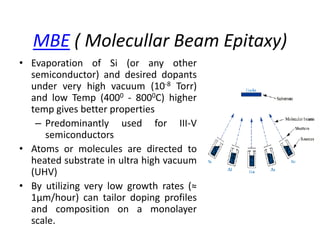
MBE ( Molecullar Beam Epitaxy)
• Evaporation of Si (or any other
semiconductor) and desired dopants
under very high vacuum (10-8 Torr)
and low Temp (4000 - 8000C) higher
temp gives better properties
– Predominantly used for III-V
semiconductors
• Atoms or molecules are directed to
heated substrate in ultra high vacuum
(UHV)
• By utilizing very low growth rates (≈
1μm/hour) can tailor doping profiles
and composition on a monolayer
scale.
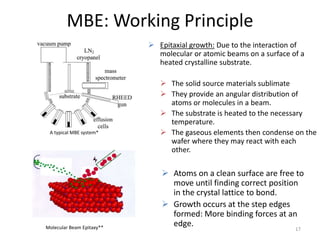
MBE: Working Principle
17
A typical MBE system*
 Epitaxial growth: Due to the interaction of
molecular or atomic beams on a surface of a
heated crystalline substrate.
 The solid source materials sublimate
 They provide an angular distribution of
atoms or molecules in a beam.
 The substrate is heated to the necessary
temperature.
 The gaseous elements then condense on the
wafer where they may react with each
other.
Molecular Beam Epitaxy**
 Atoms on a clean surface are free to
move until finding correct position
in the crystal lattice to bond.
 Growth occurs at the step edges
formed: More binding forces at an
edge.
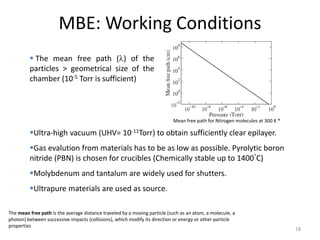
MBE: Working Conditions
18
 The mean free path (l) of the
particles > geometrical size of the
chamber (10-5 Torr is sufficient)
Ultra-high vacuum (UHV= 10-11Torr) to obtain sufficiently clear epilayer.
Gas evalution from materials has to be as low as possible. Pyrolytic boron
nitride (PBN) is chosen for crucibles (Chemically stable up to 1400°C)
Molybdenum and tantalum are widely used for shutters.
Ultrapure materials are used as source.
Mean free path for Nitrogen molecules at 300 K *
The mean free path is the average distance traveled by a moving particle (such as an atom, a molecule, a
photon) between successive impacts (collisions), which modify its direction or energy or other particle
properties
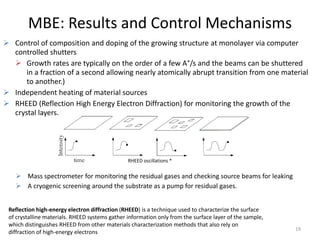
MBE: Results and Control Mechanisms
19
RHEED oscillations *
 Control of composition and doping of the growing structure at monolayer via computer
controlled shutters
 Growth rates are typically on the order of a few A°/s and the beams can be shuttered
in a fraction of a second allowing nearly atomically abrupt transition from one material
to another.)
 Independent heating of material sources
 RHEED (Reflection High Energy Electron Diffraction) for monitoring the growth of the
crystal layers.
 Mass spectrometer for monitoring the residual gases and checking source beams for leaking
 A cryogenic screening around the substrate as a pump for residual gases.
Reflection high-energy electron diffraction (RHEED) is a technique used to characterize the surface
of crystalline materials. RHEED systems gather information only from the surface layer of the sample,
which distinguishes RHEED from other materials characterization methods that also rely on
diffraction of high-energy electrons
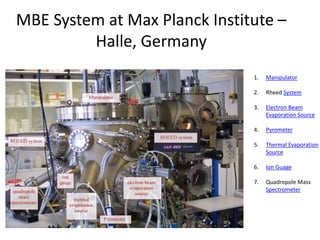
MBE System at Max Planck Institute –
Halle, Germany
1. Manipulator
2. Rheed System
3. Electron Beam
Evaporation Source
4. Pyrometer
5. Thermal Evaporation
Source
6. Ion Guage
7. Quadropole Mass
Spectrometer
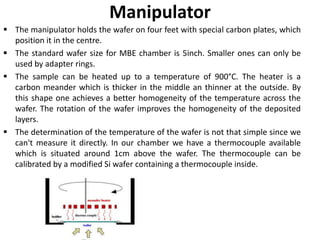
Manipulator
 The manipulator holds the wafer on four feet with special carbon plates, which
position it in the centre.
 The standard wafer size for MBE chamber is 5inch. Smaller ones can only be
used by adapter rings.
 The sample can be heated up to a temperature of 900°C. The heater is a
carbon meander which is thicker in the middle an thinner at the outside. By
this shape one achieves a better homogeneity of the temperature across the
wafer. The rotation of the wafer improves the homogeneity of the deposited
layers.
 The determination of the temperature of the wafer is not that simple since we
can't measure it directly. In our chamber we have a thermocouple available
which is situated around 1cm above the wafer. The thermocouple can be
calibrated by a modified Si wafer containing a thermocouple inside.
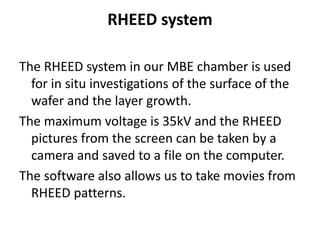
RHEED system
The RHEED system in our MBE chamber is used
for in situ investigations of the surface of the
wafer and the layer growth.
The maximum voltage is 35kV and the RHEED
pictures from the screen can be taken by a
camera and saved to a file on the computer.
The software also allows us to take movies from
RHEED patterns.
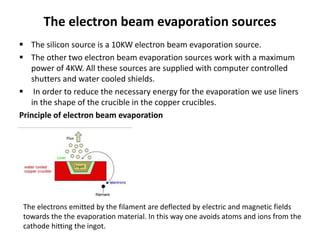
The electron beam evaporation sources
 The silicon source is a 10KW electron beam evaporation source.
 The other two electron beam evaporation sources work with a maximum
power of 4KW. All these sources are supplied with computer controlled
shutters and water cooled shields.
 In order to reduce the necessary energy for the evaporation we use liners
in the shape of the crucible in the copper crucibles.
Principle of electron beam evaporation
The electrons emitted by the filament are deflected by electric and magnetic fields
towards the the evaporation material. In this way one avoids atoms and ions from the
cathode hitting the ingot.
Pyrometer
 The pyrometer applied to our MBE chamber is used for
additional control of the wafer temperature.
 As long as the emission coefficient of the wafer doesn't
change, we can compare the temperatures measured by
pyrometer and by thermocouple respectively.
 The pyroelectric detector of our pyrometer is sensitive for a
wave length range from 12 to 14 µm.
 In this range the transmission of silicon is lower than 50%
so that it measures the temperature of the wafer as well as
the temperature of the heater above.
 For such measurements in the mentioned IR region, a
special window material has to be used. In our cse we have
chosen ZnSe.
Thermal evaporation source
For the evaporation of the doping materials we
apply thermal evaporation sources.
They are installed in water cooled flanges at the
side of the chamber.
They are inclined to the wafer normal by about 30°.
The crucibles of our doping sources are heated by
thermal radiation.
The temperatures of the crucibles are measured by
a thermocouples and regulated by EurothermTM
controllers.
Ion gauge
The pressure in MBE machine is measured by
several not screened hot filament ion gauges.
In the range of 10-11mbars one normally should
use an ion gauge with a screened cathode to
reduce the error by x-rays.
But during growth processes we have a working
pressure of 10-9mbars so that the unscreened
cathode is totally sufficient for our purposes.
The quadrupole mass spectrometer
Our growth chamber is supplied with two quadrupole
mass spectrometers which are mainly used to control
the flux of the electron beam evaporation sources.
They are connected to EurothermTM controllers which
regulate the heating current of the filaments of the
electron beam evaporation sources.
Our mass spectrometers work in a mass range from 1
to 300 amu
MBE System consists of-
• Three vacuum chambers:
• the loading chamber,
• the buffer chamber and
• the growth chamber.
– The loading chamber and the buffer chamber are pumped by turbomolecular pumps.
– The growth chamber is equipped with an ion pump, a turbo-molecular pump and a
titanium sublimation pump.
– Additionally the chamber contains cooling shields (liquid nitrogen). The typical
working pressure in the growth chamber is in the range of 2 x 10⁻⁹mbars.
– The growth chamber is equipped with three electron beam evaporation sources
which we use for the evaporation of silicon, germanium and other materials and with
up to four thermal evaporation cells which are mainly used as doping sources-use
materials like aluminium, antimony and boron.
– The growth chamber contains a manipulator for 5 inch wafers, a RHEED system,
2 quadrupole mass spectrometers and 2 quartz monitors.
– The buffer chamber is equipped with a transport system which can hold a cassette. In
this cassette we can store up to eight wafers under ultra high vacuum conditions. Via
a transfer rod the wafers can be moved into the growth chamber.
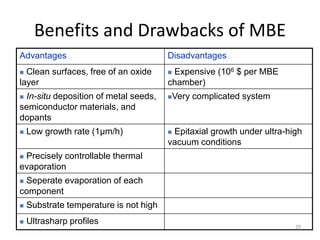
Benefits and Drawbacks of MBE
Advantages Disadvantages
 Clean surfaces, free of an oxide
layer
 Expensive (106 $ per MBE
chamber)
 In-situ deposition of metal seeds,
semiconductor materials, and
dopants
Very complicated system
 Low growth rate (1μm/h)  Epitaxial growth under ultra-high
vacuum conditions
 Precisely controllable thermal
evaporation
 Seperate evaporation of each
component
 Substrate temperature is not high
 Ultrasharp profiles 29
Applications
• Novel structures as quantum devices
• Silicon/Insulator/Metal Sandwiches
• Superlattices
• Microelectronic Devices
30
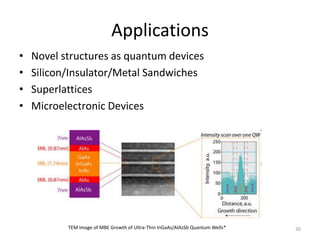
TEM image of MBE Growth of Ultra-Thin InGaAs/AlAsSb Quantum Wells*
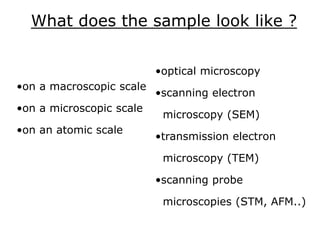
What does the sample look like ?
•on a macroscopic scale
•on a microscopic scale
•on an atomic scale
•optical microscopy
•scanning electron
microscopy (SEM)
•transmission electron
microscopy (TEM)
•scanning probe
microscopies (STM, AFM..)
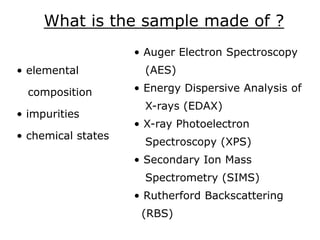
What is the sample made of ?
• elemental
composition
• impurities
• chemical states
• Auger Electron Spectroscopy
(AES)
• Energy Dispersive Analysis of
X-rays (EDAX)
• X-ray Photoelectron
Spectroscopy (XPS)
• Secondary Ion Mass
Spectrometry (SIMS)
• Rutherford Backscattering
(RBS)
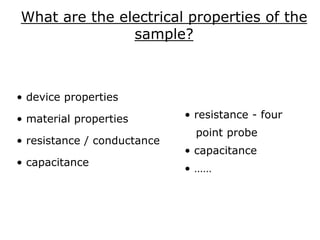
What are the electrical properties of the
sample?
• device properties
• material properties
• resistance / conductance
• capacitance
• resistance - four
point probe
• capacitance
• ……
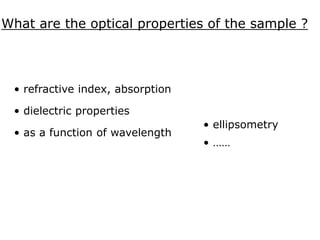
What are the optical properties of the sample ?
• refractive index, absorption
• dielectric properties
• as a function of wavelength
• ellipsometry
• ……
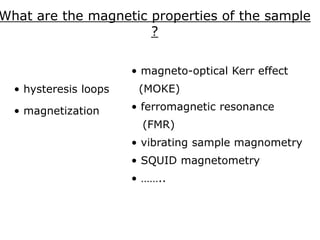
What are the magnetic properties of the sample
?
• hysteresis loops
• magnetization
• magneto-optical Kerr effect
(MOKE)
• ferromagnetic resonance
(FMR)
• vibrating sample magnometry
• SQUID magnetometry
• ……..

Class 8_2ndsept1_upload.pptx

  • 1.
    IC Fabrication Technology LectureNo.9 Date . 02/09/2023
  • 2.
    • Epitaxy isthe type of silicon deposition that results in single crystal growth due to contact with a suitable crystalline lattice. • Epitaxy usually performed using the wafer, for economic reasons.
  • 3.
    • Mechanism ofepitaxial growth • Methods of epitaxial deposition • Properties of epitaxial layers • Applications of epitaxial layers
  • 4.
    What is Epitaxy? •Epitaxy: Deposition and growth of monocrystalline structures/layers. • Epitaxial growth results in monocrystalline layers differing from deposition which gives rise to polycrystalline and bulk structures. • Epitaxy types: – Homoepitaxy: Substrate & material are of same kind. (Si-Si) – Heteroepitaxy: Substrate & material are of different kinds. (Ga-As) 4 MBE growth mechanism * MBE growth mechanism
  • 5.
    Epitaxial Growth • Depositionof a layer on a substrate which matches the crystalline order of the substrate • Homoepitaxy – Growth of a layer of the same material as the substrate – Si on Si • Heteroepitaxy – Growth of a layer of a different material than the substrate – GaAs on Si Ordered, crystalline growth; NOT epitaxial Epitaxial growth:
  • 6.
    Why Epitaxy? • Epitaxialgrowth is useful for applications that place stringent demands on a deposited layer: – High purity – Low defect density – Abrupt interfaces – Controlled doping profiles – High repeatability and uniformity – Safe, efficient operation • Can create clean, fresh surface for device fabrication
  • 7.
    General Epitaxial Deposition Requirements •Surface preparation • Clean surface needed • Defects of surface duplicated in epitaxial layer • Hydrogen passivation of surface with water/HF • Surface mobility • High temperature required heated substrate • Epitaxial temperature exists, above which deposition is ordered • Species need to be able to move into correct crystallographic location – Relatively slow growth rates result • Ex. ~0.4 to 4 nm/min., SiGe on Si Thin film
  • 8.
    Epitaxy Techniques • Vapor-PhaseEpitaxy (VPE) – Modified method of chemical vapor deposition (CVD). – Undesired polycrystalline layers – Growth rate: ~2 µm/min. • Liquid-Phase Epitaxy (LPE) – Crystal layers are from the melt existent on the substrate. – Hard to make thin films – Growth rate: 0.1-1 µm/min. • Molecular Beam Epitaxy (MBE) – Relies on the sublimation of ultrapure elements, then condensation of them on wafer – In a vacuum chamber (pressure: ~10-11 Torr). – “Beam”: molecules do not collide to either chamber walls or existent gas atoms. – Growth rate: 1µm/hr. 8
  • 9.
    • Epitaxy isthe type of silicon deposition that results in single crystal growth due to contact with a suitable crystalline lattice. • Epitaxy usually performed using the wafer, for economic reasons.
  • 10.
    • Mechanism ofepitaxial growth • Methods of epitaxial deposition • Properties of epitaxial layers • Applications of epitaxial layers
  • 11.
    Epitaxial Growth • Depositionof a layer on a substrate which matches the crystalline order of the substrate • Homoepitaxy – Growth of a layer of the same material as the substrate – Si on Si • Heteroepitaxy – Growth of a layer of a different material than the substrate – GaAs on Si Ordered, crystalline growth; NOT epitaxial Epitaxial growth:
  • 12.
    Why Epitaxy? • Epitaxialgrowth is useful for applications that place stringent demands on a deposited layer: – High purity – Low defect density – Abrupt interfaces – Controlled doping profiles – High repeatability and uniformity – Safe, efficient operation • Can create clean, fresh surface for device fabrication
  • 13.
    General Epitaxial Deposition Requirements •Surface preparation – Clean surface needed – Defects of surface duplicated in epitaxial layer – Hydrogen passivation of surface with water/HF • Surface mobility – High temperature required heated substrate – Epitaxial temperature exists, above which deposition is ordered – Species need to be able to move into correct crystallographic location – Relatively slow growth rates result • Ex. ~0.4 to 4 nm/min., SiGe on Si
  • 14.
    Defects in epitaxiallayers • Defects from substrates • Defects from interface. • Precipitates or dislocation loops. • Misoriented areas of an epitaxial film (low angle grain boundary) • Edge dislocation • In heteroepitaxy of two lattice-mismatched semiconductor.
  • 15.
    Molecular Beam Epitaxy •Evaporation at very low deposition rates • Typically in ultra-high vacuum • Very well controlled • Grow films with good crystal structure • Expensive • Often use multiple sources to grow alloy films • Deposition rate is so low that substrate temperature does not need to be as high
  • 16.
    MBE ( MolecullarBeam Epitaxy) • Evaporation of Si (or any other semiconductor) and desired dopants under very high vacuum (10-8 Torr) and low Temp (4000 - 8000C) higher temp gives better properties – Predominantly used for III-V semiconductors • Atoms or molecules are directed to heated substrate in ultra high vacuum (UHV) • By utilizing very low growth rates (≈ 1μm/hour) can tailor doping profiles and composition on a monolayer scale.
  • 17.
    MBE: Working Principle 17 Atypical MBE system*  Epitaxial growth: Due to the interaction of molecular or atomic beams on a surface of a heated crystalline substrate.  The solid source materials sublimate  They provide an angular distribution of atoms or molecules in a beam.  The substrate is heated to the necessary temperature.  The gaseous elements then condense on the wafer where they may react with each other. Molecular Beam Epitaxy**  Atoms on a clean surface are free to move until finding correct position in the crystal lattice to bond.  Growth occurs at the step edges formed: More binding forces at an edge.
  • 18.
    MBE: Working Conditions 18 The mean free path (l) of the particles > geometrical size of the chamber (10-5 Torr is sufficient) Ultra-high vacuum (UHV= 10-11Torr) to obtain sufficiently clear epilayer. Gas evalution from materials has to be as low as possible. Pyrolytic boron nitride (PBN) is chosen for crucibles (Chemically stable up to 1400°C) Molybdenum and tantalum are widely used for shutters. Ultrapure materials are used as source. Mean free path for Nitrogen molecules at 300 K * The mean free path is the average distance traveled by a moving particle (such as an atom, a molecule, a photon) between successive impacts (collisions), which modify its direction or energy or other particle properties
  • 19.
    MBE: Results andControl Mechanisms 19 RHEED oscillations *  Control of composition and doping of the growing structure at monolayer via computer controlled shutters  Growth rates are typically on the order of a few A°/s and the beams can be shuttered in a fraction of a second allowing nearly atomically abrupt transition from one material to another.)  Independent heating of material sources  RHEED (Reflection High Energy Electron Diffraction) for monitoring the growth of the crystal layers.  Mass spectrometer for monitoring the residual gases and checking source beams for leaking  A cryogenic screening around the substrate as a pump for residual gases. Reflection high-energy electron diffraction (RHEED) is a technique used to characterize the surface of crystalline materials. RHEED systems gather information only from the surface layer of the sample, which distinguishes RHEED from other materials characterization methods that also rely on diffraction of high-energy electrons
  • 20.
    MBE System atMax Planck Institute – Halle, Germany 1. Manipulator 2. Rheed System 3. Electron Beam Evaporation Source 4. Pyrometer 5. Thermal Evaporation Source 6. Ion Guage 7. Quadropole Mass Spectrometer
  • 21.
    Manipulator  The manipulatorholds the wafer on four feet with special carbon plates, which position it in the centre.  The standard wafer size for MBE chamber is 5inch. Smaller ones can only be used by adapter rings.  The sample can be heated up to a temperature of 900°C. The heater is a carbon meander which is thicker in the middle an thinner at the outside. By this shape one achieves a better homogeneity of the temperature across the wafer. The rotation of the wafer improves the homogeneity of the deposited layers.  The determination of the temperature of the wafer is not that simple since we can't measure it directly. In our chamber we have a thermocouple available which is situated around 1cm above the wafer. The thermocouple can be calibrated by a modified Si wafer containing a thermocouple inside.
  • 22.
    RHEED system The RHEEDsystem in our MBE chamber is used for in situ investigations of the surface of the wafer and the layer growth. The maximum voltage is 35kV and the RHEED pictures from the screen can be taken by a camera and saved to a file on the computer. The software also allows us to take movies from RHEED patterns.
  • 23.
    The electron beamevaporation sources  The silicon source is a 10KW electron beam evaporation source.  The other two electron beam evaporation sources work with a maximum power of 4KW. All these sources are supplied with computer controlled shutters and water cooled shields.  In order to reduce the necessary energy for the evaporation we use liners in the shape of the crucible in the copper crucibles. Principle of electron beam evaporation The electrons emitted by the filament are deflected by electric and magnetic fields towards the the evaporation material. In this way one avoids atoms and ions from the cathode hitting the ingot.
  • 24.
    Pyrometer  The pyrometerapplied to our MBE chamber is used for additional control of the wafer temperature.  As long as the emission coefficient of the wafer doesn't change, we can compare the temperatures measured by pyrometer and by thermocouple respectively.  The pyroelectric detector of our pyrometer is sensitive for a wave length range from 12 to 14 µm.  In this range the transmission of silicon is lower than 50% so that it measures the temperature of the wafer as well as the temperature of the heater above.  For such measurements in the mentioned IR region, a special window material has to be used. In our cse we have chosen ZnSe.
  • 25.
    Thermal evaporation source Forthe evaporation of the doping materials we apply thermal evaporation sources. They are installed in water cooled flanges at the side of the chamber. They are inclined to the wafer normal by about 30°. The crucibles of our doping sources are heated by thermal radiation. The temperatures of the crucibles are measured by a thermocouples and regulated by EurothermTM controllers.
  • 26.
    Ion gauge The pressurein MBE machine is measured by several not screened hot filament ion gauges. In the range of 10-11mbars one normally should use an ion gauge with a screened cathode to reduce the error by x-rays. But during growth processes we have a working pressure of 10-9mbars so that the unscreened cathode is totally sufficient for our purposes.
  • 27.
    The quadrupole massspectrometer Our growth chamber is supplied with two quadrupole mass spectrometers which are mainly used to control the flux of the electron beam evaporation sources. They are connected to EurothermTM controllers which regulate the heating current of the filaments of the electron beam evaporation sources. Our mass spectrometers work in a mass range from 1 to 300 amu
  • 28.
    MBE System consistsof- • Three vacuum chambers: • the loading chamber, • the buffer chamber and • the growth chamber. – The loading chamber and the buffer chamber are pumped by turbomolecular pumps. – The growth chamber is equipped with an ion pump, a turbo-molecular pump and a titanium sublimation pump. – Additionally the chamber contains cooling shields (liquid nitrogen). The typical working pressure in the growth chamber is in the range of 2 x 10⁻⁹mbars. – The growth chamber is equipped with three electron beam evaporation sources which we use for the evaporation of silicon, germanium and other materials and with up to four thermal evaporation cells which are mainly used as doping sources-use materials like aluminium, antimony and boron. – The growth chamber contains a manipulator for 5 inch wafers, a RHEED system, 2 quadrupole mass spectrometers and 2 quartz monitors. – The buffer chamber is equipped with a transport system which can hold a cassette. In this cassette we can store up to eight wafers under ultra high vacuum conditions. Via a transfer rod the wafers can be moved into the growth chamber.
  • 29.
    Benefits and Drawbacksof MBE Advantages Disadvantages  Clean surfaces, free of an oxide layer  Expensive (106 $ per MBE chamber)  In-situ deposition of metal seeds, semiconductor materials, and dopants Very complicated system  Low growth rate (1μm/h)  Epitaxial growth under ultra-high vacuum conditions  Precisely controllable thermal evaporation  Seperate evaporation of each component  Substrate temperature is not high  Ultrasharp profiles 29
  • 30.
    Applications • Novel structuresas quantum devices • Silicon/Insulator/Metal Sandwiches • Superlattices • Microelectronic Devices 30 TEM image of MBE Growth of Ultra-Thin InGaAs/AlAsSb Quantum Wells*
  • 31.
    What does thesample look like ? •on a macroscopic scale •on a microscopic scale •on an atomic scale •optical microscopy •scanning electron microscopy (SEM) •transmission electron microscopy (TEM) •scanning probe microscopies (STM, AFM..)
  • 32.
    What is thesample made of ? • elemental composition • impurities • chemical states • Auger Electron Spectroscopy (AES) • Energy Dispersive Analysis of X-rays (EDAX) • X-ray Photoelectron Spectroscopy (XPS) • Secondary Ion Mass Spectrometry (SIMS) • Rutherford Backscattering (RBS)
  • 33.
    What are theelectrical properties of the sample? • device properties • material properties • resistance / conductance • capacitance • resistance - four point probe • capacitance • ……
  • 34.
    What are theoptical properties of the sample ? • refractive index, absorption • dielectric properties • as a function of wavelength • ellipsometry • ……
  • 35.
    What are themagnetic properties of the sample ? • hysteresis loops • magnetization • magneto-optical Kerr effect (MOKE) • ferromagnetic resonance (FMR) • vibrating sample magnometry • SQUID magnetometry • ……..