MPA 209
Project Planning and
Development
What is a project?
• The starting point in discussing how projects should be properly managed is to
first understand what a project is and, just as importantly, what it is not.
• People have been undertaking projects since the earliest days of organized
human activity. The hunting parties of our prehistoric ancestors were projects, for
example; they were temporary undertakings directed at the goal of obtaining
meat for the community.
• Large complex projects have also been with us for a long time. The pyramids and
the Great Wall of China were in their day of roughly the same dimensions as the
Apollo project to send men to the moon. We use the term “project” frequently in
our daily conversations. A husband, for example may tell his wife, “My main
project for this weekend is to straighten out the garage.” Going hunting, building
pyramids, and fixing faucets all share certain features that make them projects.
Understanding Project Terms
Project • Project – is a temporary endeavor to create a unique product, ( a
rare and collectible variety of ceramic cups/mugs), service
(delivery service company), or information ( planning a new
DIY product)
• It is divided into several phases to improve management control
and provide links to the ongoing operations of the performing
organization
• Collectively the project phases are known as the project life cycle
A project is completed when its goals and objectives are accomplished. It is these goals
that drive the project, and all the planning and implementation efforts undertaken to achieve them.
Sometimes projects end when it is determined that the goals and objectives cannot be
accomplished or when the product or service of the project is no longer needed and the project is
cancelled.
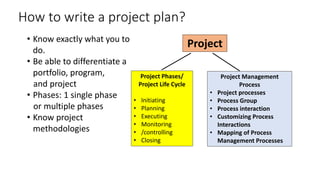
How to write a project plan?
• Know exactly what you to
do.
• Be able to differentiate a
portfolio, program,
and project
• Phases: 1 single phase
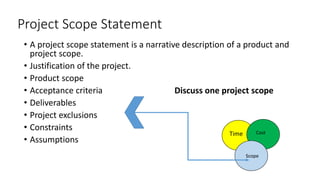
or multiple phases
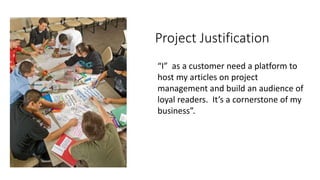
• Know project
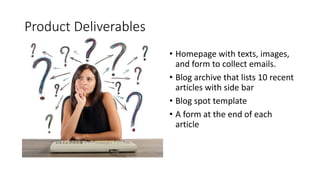
methodologies
Project
Project Phases/
Project Life Cycle
• Initiating
• Planning
• Executing
• Monitoring
• /controlling
• Closing
Project Management
Process
• Project processes
• Process Group
• Process interaction
• Customizing Process
Interactions
• Mapping of Process
Management Processes
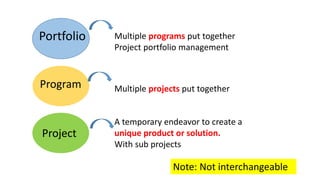
Portfolio
Program
Project
Multiple programs put together
Project portfolio management
Multiple projects put together
A temporary endeavor to create a
unique product or solution.
With sub projects
Note: Not interchangeable
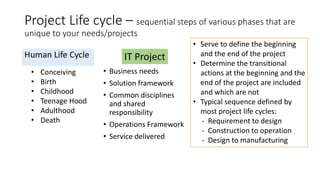
Project Life cycle – sequential steps of various phases that are
unique to your needs/projects
Human Life Cycle
• Conceiving
• Birth
• Childhood
• Teenage Hood
• Adulthood
• Death
• Business needs
• Solution framework
• Common disciplines
and shared
responsibility
• Operations Framework
• Service delivered
IT Project
• Serve to define the beginning
and the end of the project
• Determine the transitional
actions at the beginning and the
end of the project are included
and which are not
• Typical sequence defined by
most project life cycles:
- Requirement to design
- Construction to operation
- Design to manufacturing
Element of Project Management Process
There are five processes that are not quite customizable
1. Initiation – at this point your product or service is only an idea. Determine project needs, scale
industry ( simple/complex)
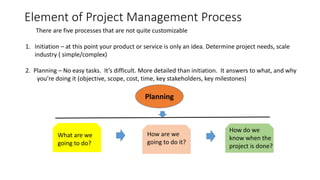
2. Planning – No easy tasks. It’s difficult. More detailed than initiation. It answers to what, and why
you’re doing it (objective, scope, cost, time, key stakeholders, key milestones)
Planning
What are we
going to do?
How are we
going to do it?
How do we
know when the
project is done?
Cont.
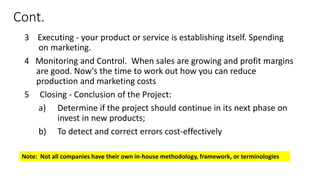
3 Executing - your product or service is establishing itself. Spending
on marketing.
4 Monitoring and Control. When sales are growing and profit margins
are good. Now's the time to work out how you can reduce
production and marketing costs
5 Closing - Conclusion of the Project:
a) Determine if the project should continue in its next phase on
invest in new products;
b) To detect and correct errors cost-effectively
Note: Not all companies have their own in-house methodology, framework, or terminologies
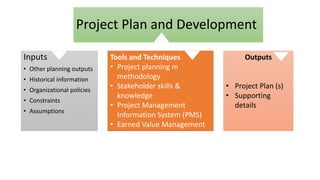
Project Plan and Development
Inputs
• Other planning outputs
• Historical information
• Organizational policies
• Constraints
• Assumptions
Tools and Techniques
• Project planning m
methodology
• Stakeholder skills &
knowledge
• Project Management
Information System (PMS)
• Earned Value Management
Outputs
• Project Plan (s)
• Supporting
details
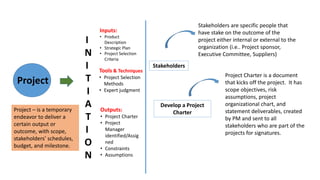
I
N
I
T
I
A
T
I
O
N
Project
Project – is a temporary
endeavor to deliver a
certain output or
outcome, with scope,
stakeholders’ schedules,
budget, and milestone.
Stakeholders
Develop a Project
Charter
Stakeholders are specific people that
have stake on the outcome of the
project either internal or external to the
organization (i.e.. Project sponsor,
Executive Committee, Suppliers)
Project Charter is a document
that kicks off the project. It has
scope objectives, risk
assumptions, project
organizational chart, and
statement deliverables, created
by PM and sent to all
stakeholders who are part of the
projects for signatures.
Inputs:
• Product
Description
• Strategic Plan
• Project Selection
Criteria
Tools & Techniques
• Project Selection
Methods
• Expert judgment
Outputs:
• Project Charter
• Project
Manager
identified/Assig
ned
• Constraints
• Assumptions
P
L
A
N
N
I
N
G
S
T
E
P
S
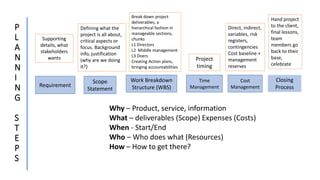
Requirement
Scope
Statement
Work Breakdown
Structure (WBS)
Time
Management
Cost
Management
Closing
Process
Why – Product, service, information
What – deliverables (Scope) Expenses (Costs)
When - Start/End
Who – Who does what (Resources)
How – How to get there?
Defining what the
project is all about,
critical aspects or
focus. Background
info, justification
(why are we doing
it?)
Supporting
details, what
stakeholders
wants
Break down project
deliverables, a
hierarchical fashion in
manageable sections,
chunks
L1 Directors
L2 Middle management
L3 Doers
Creating Action plans,
bringing accountabilities
Project
timing
Direct, indirect,
variables, risk
registers,
contingencies
Cost baseline +
management
reserves
Hand project
to the client,
final lessons,
team
members go
back to their
base,
celebrate
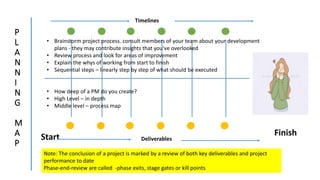
P
L
A
N
N
I
N
G
M
A
P
Start Finish
Timelines
Deliverables
• Brainstorm project process. consult members of your team about your development
plans - they may contribute insights that you've overlooked
• Review process and look for areas of improvement
• Explain the whys of working from start to finish
• Sequential steps – linearly step by step of what should be executed
• How deep of a PM do you create?
• High Level – in depth
• Middle level – process map
Note: The conclusion of a project is marked by a review of both key deliverables and project
performance to date
Phase-end-review are called -phase exits, stage gates or kill points
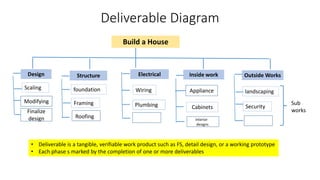
Deliverable Diagram
Build a House
Structure
Design Electrical Inside work Outside Works
Scaling
Modifying
y
Finalize
design
foundation
Framing
Wiring
Plumbing
Appliance
Cabinets
landscaping
Security
Roofing
Sub
works
• Deliverable is a tangible, verifiable work product such as FS, detail design, or a working prototype
• Each phase s marked by the completion of one or more deliverables
Interior
designs
Requirements
• The requirement is a condition or capability that is required to be present in a
product, service of information to satisfy a contract or other formally imposed
specification.
• Collecting the requirements of what the stakeholders want (interview)
• Project charter – fully signed ( in agreement with what is expected of them)
• WBS
• Action Plan
• Risk Plan
• Consider the budget, quality, and scheduling
• Change Control Documents
• Docs for reference
• Learn to create key docs file/email/chat windows
Project Sponsor
• Sponsor to decide Go or No Go
• Steering Committee (Executive
Committee)
• Identify stakeholders
• Determine their requirements
• Manage and influence those
requirements to ensure
successfully project completion
Project Management Team
Stakeholders
• Stakeholder registry (internal and external).
• Individuals and organizations that are actively involved in the
project or whose interests may be positively or negatively
affected as a result of project execution or project completion.
• May also exert influence over the project and its result,
• Key stakeholders: Project Manager, Customers, Performing
organizations, Project team members, sponsors, and many
others who may have an interest.
Note: Managing stakeholder’s expectations may be difficult because most often
they have different objectives that may come into conflict
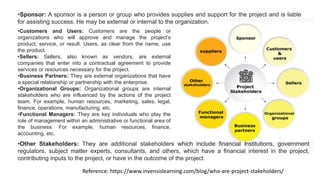
•Customers and Users: Customers are the people or
organizations who will approve and manage the project’s
product, service, or result. Users, as clear from the name, use
the product.
•Sellers: Sellers, also known as vendors, are external
companies that enter into a contractual agreement to provide
services or resources necessary for the project.
•Business Partners: They are external organizations that have
a special relationship or partnership with the enterprise.
•Organizational Groups: Organizational groups are internal
stakeholders who are influenced by the actions of the project
team. For example, human resources, marketing, sales, legal,
finance, operations, manufacturing, etc.
•Functional Managers: They are key individuals who play the
role of management within an administrative or functional area of
the business. For example, human resources, finance,
accounting, etc.
•Sponsor: A sponsor is a person or group who provides supplies and support for the project and is liable
for assisting success. He may be external or internal to the organization.
•Other Stakeholders: They are additional stakeholders which include financial institutions, government
regulators, subject matter experts, consultants, and others, which have a financial interest in the project,
contributing inputs to the project, or have in the outcome of the project.
Reference: https://www.invensislearning.com/blog/who-are-project-stakeholders/
Process Mapping
• Visual tools that explain way of
working from start to finish, explaining
all steps in a sequential order of the
inputs and the actual activities for the
output and in the visual
representation.
• Easy to understand
Why project mapping?
• It is a great way to explain to other people the
current state map from start to finish.
• Future state. Brainstorm with team members on
the new process, and present the sequential ways
of working. Review and take a look at the current
process. And find areas for improvement.
• With great details, project mapping lays all the
activities out.
• Amazing tool for training documents.
• Big challenge is how deep a project mapping to
create (too high level, in depth, overwhelming)
Project Charter
Understanding project charter
• Justification (why of the project)
• Background information
• Scope statement
• Roles/responsibilities ) Sponsor,
Steering Committee, Team
Members
• Schedule
• Communication channel
• Risks
Project Scope
Note: Solicit comment from the
sponsor – clarity on the deliverables
• The most critical aspect of the project. It is the work
performed to deliver a product, service or information with
the specified features and functions (described in a
contract or other formally imposed specification)
• Defining project scope (clear not vague)
• Defining what the project is all about (Project Charter)
• Requirements, justification, assumptions, constraints
• Summary of deliverables for greater clarity
• Supporting details (overall project timelines)
• Standard processes
• Get assumptions/risks from a high level ( project and
organization related). Reach out to sponsor, executive
committee
• Quality products at a reasonable cost
• Success criteria
• Finally, the scope goes to project plan
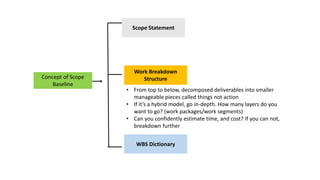
Concept of Scope
Baseline
Scope Statement
Work Breakdown
Structure
WBS Dictionary
• From top to below, decomposed deliverables into smaller
manageable pieces called things not action
• If it’s a hybrid model, go in-depth. How many layers do you
want to go? (work packages/work segments)
• Can you confidently estimate time, and cost? If you can not,
breakdown further
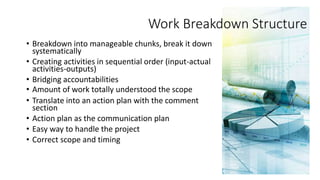
• Breakdown into manageable chunks, break it down
systematically
• Creating activities in sequential order (input-actual
activities-outputs)
• Bridging accountabilities
• Amount of work totally understood the scope
• Translate into an action plan with the comment
section
• Action plan as the communication plan
• Easy way to handle the project
• Correct scope and timing
Work Breakdown Structure
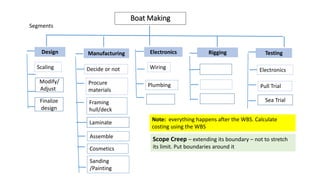
Boat Making
Manufacturing
Design Electronics Rigging Testing
Scaling
Modify/
Adjusty
Finalize
design
Decide or not
Procure
materials
Wiring
Plumbing
Laminate
Electronics
Pull Trial
Sea Trial
Framing
hull/deck
Assemble
Cosmetics
Sanding
/Painting
Segments
Note: everything happens after the WBS. Calculate
costing using the WBS
Scope Creep – extending its boundary – not to stretch
its limit. Put boundaries around it
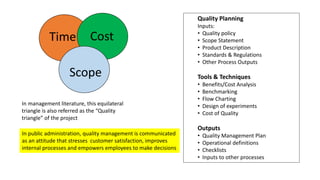
Time Cost
Scope
In management literature, this equilateral
triangle is also referred as the “Quality
triangle” of the project
Quality Planning
Inputs:
• Quality policy
• Scope Statement
• Product Description
• Standards & Regulations
• Other Process Outputs
Tools & Techniques
• Benefits/Cost Analysis
• Benchmarking
• Flow Charting
• Design of experiments
• Cost of Quality
Outputs
• Quality Management Plan
• Operational definitions
• Checklists
• Inputs to other processes
In public administration, quality management is communicated
as an attitude that stresses customer satisfaction, improves
internal processes and empowers employees to make decisions
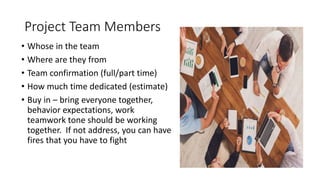
Project Team Members
• Whose in the team
• Where are they from
• Team confirmation (full/part time)
• How much time dedicated (estimate)
• Buy in – bring everyone together,
behavior expectations, work
teamwork tone should be working
together. If not address, you can have
fires that you have to fight
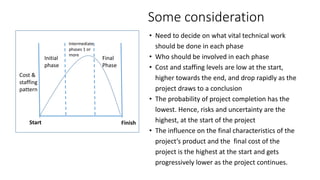
Some consideration
• Need to decide on what vital technical work
should be done in each phase
• Who should be involved in each phase
• Cost and staffing levels are low at the start,
higher towards the end, and drop rapidly as the
project draws to a conclusion
• The probability of project completion has the
lowest. Hence, risks and uncertainty are the
highest, at the start of the project
• The influence on the final characteristics of the
project’s product and the final cost of the
project is the highest at the start and gets
progressively lower as the project continues.
Initial
phase
Intermediate
phases 1 or
more
Final
Phase
Start Finish
Cost &
staffing
pattern
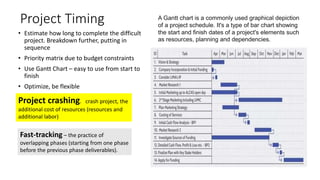
Project Timing
• Estimate how long to complete the difficult
project. Breakdown further, putting in
sequence
• Priority matrix due to budget constraints
• Use Gantt Chart – easy to use from start to
finish
• Optimize, be flexible
A Gantt chart is a commonly used graphical depiction
of a project schedule. It's a type of bar chart showing
the start and finish dates of a project's elements such
as resources, planning and dependencies.
Project crashing. crash project, the
additional cost of resources (resources and
additional labor)
Fast-tracking – the practice of
overlapping phases (starting from one phase
before the previous phase deliverables).
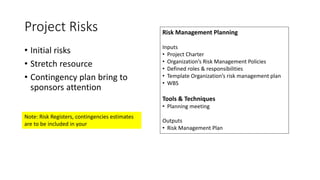
Project Risks
• Initial risks
• Stretch resource
• Contingency plan bring to
sponsors attention
Note: Risk Registers, contingencies estimates
are to be included in your
Risk Management Planning
Inputs
• Project Charter
• Organization’s Risk Management Policies
• Defined roles & responsibilities
• Template Organization’s risk management plan
• WBS
Tools & Techniques
• Planning meeting
Outputs
• Risk Management Plan
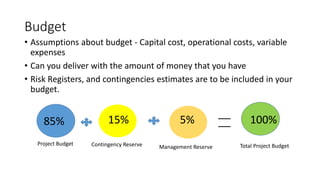
Budget
• Assumptions about budget - Capital cost, operational costs, variable
expenses
• Can you deliver with the amount of money that you have
• Risk Registers, and contingencies estimates are to be included in your
budget.
85% 15% 5% 100%
Project Budget Contingency Reserve Management Reserve Total Project Budget
Signatories
• Secure the approval
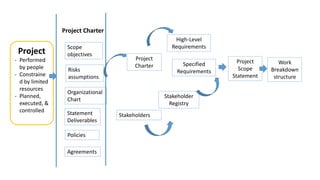
Scope
objectives
Risks
assumptions
Organizational
Chart
Statement
Deliverables
Policies
Agreements
Project
Charter
High-Level
Requirements
Specified
Requirements
Stakeholder
Registry
Stakeholders
Project
Scope
Statement
Work
Breakdown
structure
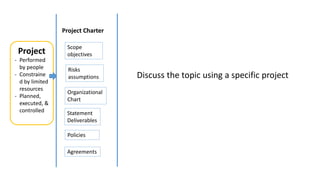
Project Charter
Project
- Performed
by people
- Constraine
d by limited
resources
- Planned,
executed, &
controlled
Scope
objectives
Risks
assumptions
Organizational
Chart
Statement
Deliverables
Policies
Agreements
Project Charter
Project
- Performed
by people
- Constraine
d by limited
resources
- Planned,
executed, &
controlled
Discuss the topic using a specific project
Product Scope
“we need to deliver a website
based on WordPress (It’s a
platform that half on the internet
used) with minimum customer
software development. This site
needs a homepage, blog
archive, an article template as it
was designed, and a special
form to collect emails”.
Project Scope Statement
• A project scope statement is a narrative description of a product and
project scope.
• Justification of the project.
• Product scope
• Acceptance criteria
• Deliverables
• Project exclusions
• Constraints
• Assumptions
Project Scope Management
• Scope Initiation
• Scope Planning
• Scope Definition
• Scope Verification
• Scope Change Control
Project Scope Statement
• A project scope statement is a narrative description of a product and
project scope.
• Justification of the project.
• Product scope
• Acceptance criteria
• Deliverables
• Project exclusions
• Constraints
• Assumptions
Discuss one project scope
Time Cost
Scope
Project Justification
“I” as a customer need a platform to
host my articles on project
management and build an audience of
loyal readers. It’s a cornerstone of my
business”.
Product Deliverables
• Homepage with texts, images,
and form to collect emails.
• Blog archive that lists 10 recent
articles with side bar
• Blog spot template
• A form at the end of each
article
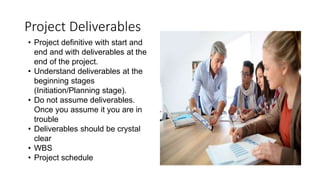
Project Deliverables
• Project definitive with start and
end and with deliverables at the
end of the project.
• Understand deliverables at the
beginning stages
(Initiation/Planning stage).
• Do not assume deliverables.
Once you assume it you are in
trouble
• Deliverables should be crystal
clear
• WBS
• Project schedule
Project Exclusions
• Websites will be created on
WordPress so custom software
development is beyond this
project
• (Explicit exclusion) for the perfect
Junior Project Manager Program
is out of the scope of the project.
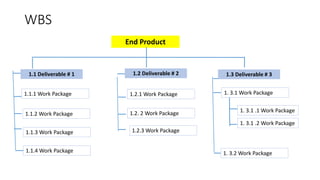
WBS
End Product
1.1 Deliverable # 1
1.1.1 Work Package
1.2 Deliverable # 2 1.3 Deliverable # 3
1.1.2 Work Package
1.1.3 Work Package
1.1.4 Work Package
1.2.1 Work Package
1.2. 2 Work Package
1.2.3 Work Package
1. 3.1 Work Package
1. 3.2 Work Package
1. 3.1 .1 Work Package
1. 3.1 .2 Work Package
Constraints
• Project budget P 230,000.00
• Deadline Dec 25, 2022
• Technology: WordPress
Acceptance Criteria
“We agree this is delivered when I can access
the pm basics 101.com site on the internet and
see the main deliverables”. There should be no
defects that prevent using the main
functionality doesn’t have a single workaround.
Visually and functionally, the site should look
and perform as described in specifications and
designs.
“Client should provide a sign off on the final
results
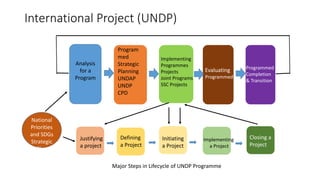
International Project (UNDP)
Program
med
Strategic
Planning
UNDAP
UNDP
CPD
Analysis
for a
Program
Implementing
Programmes
Projects
Joint Programs
SSC Projects
Evaluating
Programmed
Programmed
Completion
& Transition
National
Priorities
and SDGs
Strategic
Plan
Justifying
a project
Defining
a Project
Initiating
a Project
Implementing
a Project
Closing a
Project
Major Steps in Lifecycle of UNDP Programme
Internationalization
• Projects can span national boundaries.
• Must consider
1. Effect of time zone differences
2. National and regional holidays
3. Travel requirements for f2f meetings
4. Logistics of teleconferencing
5. Volatile political differences
Kick-Off Meeting – Establishing the Project Rhythms
1st official meeting (Project Manager; Team
Members) to get orientation and timelines of what
exactly to do (Project Charter)
1. Opening Remarks from Sr Officials
2. Meeting reminders house keeping time outs
3. Meeting Logistics
4. Team intro – cross department
• Sets up expectations – accountability down
the road
• Charter Review and O & M (Provide copy in
advance)
• Ways of working – Communication plan
(Channel) where to upload docs?
Cont:
5. WBS Creation
• High-level and complex break it down into
buckets
• Version A Project Manager
• Version B Team Members contributing
Note: need longer hours for inputting; team
creating it taking note of vacation/travel sched
6. Layout next step for everybody
• Initial tasks to execute
• Tasks items in WBS are send to team members.
• Guide, lead, make sure that team members are
accountable down the road
• Bring agility from A-Z
Cont:
7. Closing
• Thanks team for attending,
reminding them of the WBS
status
• establish project share points
(tasks, expectations, when to do
it)
Negotiating
• Involves conferring with others to come to
terms with them or reach an agreement.
• Negotiated directly or with assistance;
mediation and arbitration are two types of
assisted negotiation/
• Occurs around many issues, at many times
at many levels of the projects
• Scope, cost, and schedule objectives
• Changes to scope, cost, or schedule
• Contract terms and conditions
• Assignments
• Resources
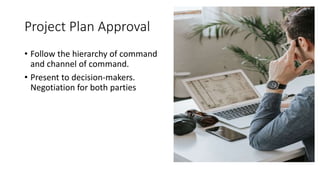
Project Plan Approval
• Follow the hierarchy of command
and channel of command.
• Present to decision-makers.
Negotiation for both parties
Effective Meetings
Pre-meeting preparation
• Documents are in order
• Meeting kit preparation
Post meeting
• Resolutions
• Management approval
• 2-3 hrs after the meeting info
are collected within 24 hrs
Actual meeting (F2F or Virtual)
• Arrive early, Get everything set up
• Admin announcements: Meeting rules, Timeouts,
etiquette, Face the window, virtual – cam eye level, mute
yourself, use chat or raise hand functionality, keep it
professional, check your background, check what you are
wearing, Video off when snacking, coffee
• Agenda
• Share innovative ideas; Brainstorming; create ideas
• Avoid updates (email update summary)
• Last 10-15 minutes – Summarize all the times all items
acted upon review tasks lists, emphasize responsibilities,
and due dates associated with the tasks.
Do not waste precious time
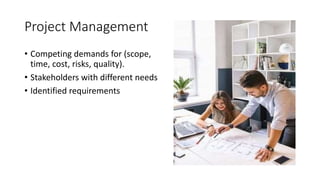
Project Management
• Competing demands for (scope,
time, cost, risks, quality).
• Stakeholders with different needs
• Identified requirements
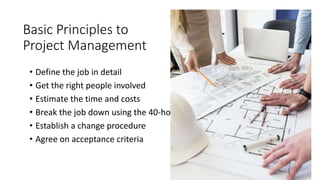
Basic Principles to
Project Management
• Define the job in detail
• Get the right people involved
• Estimate the time and costs
• Break the job down using the 40-hour rule
• Establish a change procedure
• Agree on acceptance criteria
Relationship to Other Management
Disciplines
• Functional Departments and
supporting disciplines
• Technical elements
• Management Specialization
• Industry groups
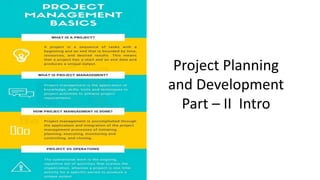
Project Planning
and Development
Part – II Intro
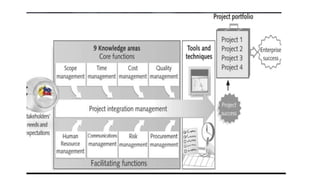
The
9
Knowledge
Areas
Project Integration Management
Project Scope Management
Project Time Management
Project Cost Management
Project Quality Management
Pro9ject Human Resource Management
Project Communication Management
Project Risk Management
Project Procurement Management
Key General PM Skills
1. Communication skills. Listening to a lot of information.
Keep people aware of the foundation, changes, and
direction, getting everyone aware of new information.
Repeat things over and over, practicing and repeating.
2. Organization skills. Have a macro view, zooming into a
particular activity. Activities should impact everybody
else. Use SharePoint clickable updates on track.
3. Leadership skills. Using leadership hut. Office politics –
competing players, inspire and motivate them, provide
guidance (i.e.. Technical team and digital teams),
removing roadblocks, ensuring that team has clear path.
Cont.
4. Problem-solving. Involves a combination of
problem definition and decision making
• Problem definition: Requires distinguishing
between causes and symptoms ( internal or
external, technical, managerial, and I
interpersonal)
• Decision-making – It includes analyzing the
problem to identify viable solutions.
• Once made, decisions must be implemented
How to Organize at Work
1. Stop multitasking people cant control multitasking.
Hence, stop the myth that multi-tasking works.
2. Organize your brain – de-stress your brain, have the
right amount of sleep, have min break, and be
physically well.
3. Organize your workspace/ 360 degrees circle. Things
you don’t need, get rid of it. Avoid clutter. What you
need is within your fingertips. Get the habit of
checking your emails. Touch it once. Make sure you
have 20 things in your inbox. Organize your email
calendar.
Project Success/Failure
• Do not avoid conflict.
• Address that elephant in the room, if not, it will spiral out
of control and will impact the scope, time, and budget
• Vague/unrealistic team expectations. Motivate team on
the job deliverables and due dates.
• Poor communication. Over-communication, check on
your team, validate what you’re looking to jobs done.
• Non-Project Manager. Understand the basics of project
management skills from start initiatives.
• Poor Risks Management or no risk management. Risks
are part of projects. Have a simple analysis. I.e. members
have several workloads- apply mitigation and
contingency.
• If you don’t understand deliverables, the project become
loose and muddy.
• Guidance to think big pic, a task list on your tactical
approach. Remind why and where they’re doing it.
• Focus on time management and prioritization. Whose
urgent for? Do not get lost in the needs of all your tasks
• Look back, step back, look at everything around you
• Prioritization. Must have a clear timetable as you will be
bombarded with a lot of “urgent” things. Where is the
priority sequence that would get things done?
• On the important item, where does if fit in? = negotiation
skills.
• Make a big difference in your project.
Cont.
If you are a new Project
Manager
• Know your HR policies
• Continuous education
• Emotional Quotient
• Psychology 101
• Look at the companies strategies
• Get to know your team, talk to people, get
feedback. Start the relationship on the right foot.
• Find a mentor. bounce off ideas, situations,
• Avail of a mentorship program, business coaches,
get 2nd opinions
Cont
• Lead by example. Be on time.
Show the way, Be the shining
representation of the
expectations.
• Time management techniques.
List of things. Do things in the
morning, book off power but
come back later
Organizational System
1. Project-Based Organization
• Organizations that derive their revenue primarily from
performing projects for others ( architectural firms,
engineering firms, consultants, construction
contractors, government contractors, NGOs, etc.
• Organizations that adopted management by projects
2. Have management systems in place to facilitate project
management
2. The project management team should be acutely aware
of how the organization’s systems affect the project.
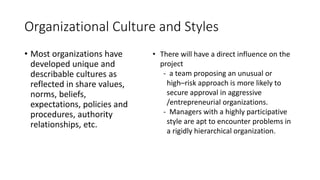
Organizational Culture and Styles
• Most organizations have
developed unique and
describable cultures as
reflected in share values,
norms, beliefs,
expectations, policies and
procedures, authority
relationships, etc.
• There will have a direct influence on the
project
- a team proposing an unusual or
high–risk approach is more likely to
secure approval in aggressive
/entrepreneurial organizations.
- Managers with a highly participative
style are apt to encounter problems in
a rigidly hierarchical organization.
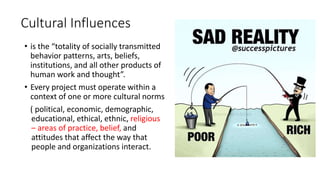
Cultural Influences
• is the “totality of socially transmitted
behavior patterns, arts, beliefs,
institutions, and all other products of
human work and thought”.
• Every project must operate within a
context of one or more cultural norms
( political, economic, demographic,
educational, ethical, ethnic, religious
– areas of practice, belief, and
attitudes that affect the way that
people and organizations interact.
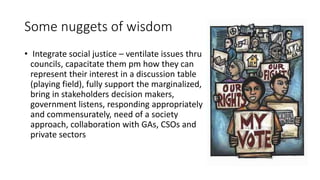
Some nuggets of wisdom
• Integrate social justice – ventilate issues thru
councils, capacitate them pm how they can
represent their interest in a discussion table
(playing field), fully support the marginalized,
bring in stakeholders decision makers,
government listens, responding appropriately
and commensurately, need of a society
approach, collaboration with GAs, CSOs and
private sectors
Building the resilience can be
achieved by adopting a
development path that is
disaster resilience, risk
sensitive, eco system based
and correlated with poverty
reduction.
Sources
• https://www.youtube.com/watch?v=ZKOL-rZ79gs&t=484s
• https://www.youtube.com/watch?v=f2IdKUGl0zE
• https://www.youtube.com/watch?v=Lt9_4vzPdlo&t=100s

MPA-209-Intro 1st Sem 2023

  • 1.
    MPA 209 Project Planningand Development
  • 2.
    What is aproject? • The starting point in discussing how projects should be properly managed is to first understand what a project is and, just as importantly, what it is not. • People have been undertaking projects since the earliest days of organized human activity. The hunting parties of our prehistoric ancestors were projects, for example; they were temporary undertakings directed at the goal of obtaining meat for the community. • Large complex projects have also been with us for a long time. The pyramids and the Great Wall of China were in their day of roughly the same dimensions as the Apollo project to send men to the moon. We use the term “project” frequently in our daily conversations. A husband, for example may tell his wife, “My main project for this weekend is to straighten out the garage.” Going hunting, building pyramids, and fixing faucets all share certain features that make them projects.
  • 3.
    Understanding Project Terms Project• Project – is a temporary endeavor to create a unique product, ( a rare and collectible variety of ceramic cups/mugs), service (delivery service company), or information ( planning a new DIY product) • It is divided into several phases to improve management control and provide links to the ongoing operations of the performing organization • Collectively the project phases are known as the project life cycle A project is completed when its goals and objectives are accomplished. It is these goals that drive the project, and all the planning and implementation efforts undertaken to achieve them. Sometimes projects end when it is determined that the goals and objectives cannot be accomplished or when the product or service of the project is no longer needed and the project is cancelled.
  • 4.
    How to writea project plan? • Know exactly what you to do. • Be able to differentiate a portfolio, program, and project • Phases: 1 single phase or multiple phases • Know project methodologies Project Project Phases/ Project Life Cycle • Initiating • Planning • Executing • Monitoring • /controlling • Closing Project Management Process • Project processes • Process Group • Process interaction • Customizing Process Interactions • Mapping of Process Management Processes
  • 5.
    Portfolio Program Project Multiple programs puttogether Project portfolio management Multiple projects put together A temporary endeavor to create a unique product or solution. With sub projects Note: Not interchangeable
  • 6.
    Project Life cycle– sequential steps of various phases that are unique to your needs/projects Human Life Cycle • Conceiving • Birth • Childhood • Teenage Hood • Adulthood • Death • Business needs • Solution framework • Common disciplines and shared responsibility • Operations Framework • Service delivered IT Project • Serve to define the beginning and the end of the project • Determine the transitional actions at the beginning and the end of the project are included and which are not • Typical sequence defined by most project life cycles: - Requirement to design - Construction to operation - Design to manufacturing
  • 7.
    Element of ProjectManagement Process There are five processes that are not quite customizable 1. Initiation – at this point your product or service is only an idea. Determine project needs, scale industry ( simple/complex) 2. Planning – No easy tasks. It’s difficult. More detailed than initiation. It answers to what, and why you’re doing it (objective, scope, cost, time, key stakeholders, key milestones) Planning What are we going to do? How are we going to do it? How do we know when the project is done?
  • 8.
    Cont. 3 Executing -your product or service is establishing itself. Spending on marketing. 4 Monitoring and Control. When sales are growing and profit margins are good. Now's the time to work out how you can reduce production and marketing costs 5 Closing - Conclusion of the Project: a) Determine if the project should continue in its next phase on invest in new products; b) To detect and correct errors cost-effectively Note: Not all companies have their own in-house methodology, framework, or terminologies
  • 9.
    Project Plan andDevelopment Inputs • Other planning outputs • Historical information • Organizational policies • Constraints • Assumptions Tools and Techniques • Project planning m methodology • Stakeholder skills & knowledge • Project Management Information System (PMS) • Earned Value Management Outputs • Project Plan (s) • Supporting details
  • 10.
    I N I T I A T I O N Project Project – isa temporary endeavor to deliver a certain output or outcome, with scope, stakeholders’ schedules, budget, and milestone. Stakeholders Develop a Project Charter Stakeholders are specific people that have stake on the outcome of the project either internal or external to the organization (i.e.. Project sponsor, Executive Committee, Suppliers) Project Charter is a document that kicks off the project. It has scope objectives, risk assumptions, project organizational chart, and statement deliverables, created by PM and sent to all stakeholders who are part of the projects for signatures. Inputs: • Product Description • Strategic Plan • Project Selection Criteria Tools & Techniques • Project Selection Methods • Expert judgment Outputs: • Project Charter • Project Manager identified/Assig ned • Constraints • Assumptions
  • 11.
    P L A N N I N G S T E P S Requirement Scope Statement Work Breakdown Structure (WBS) Time Management Cost Management Closing Process Why– Product, service, information What – deliverables (Scope) Expenses (Costs) When - Start/End Who – Who does what (Resources) How – How to get there? Defining what the project is all about, critical aspects or focus. Background info, justification (why are we doing it?) Supporting details, what stakeholders wants Break down project deliverables, a hierarchical fashion in manageable sections, chunks L1 Directors L2 Middle management L3 Doers Creating Action plans, bringing accountabilities Project timing Direct, indirect, variables, risk registers, contingencies Cost baseline + management reserves Hand project to the client, final lessons, team members go back to their base, celebrate
  • 12.
    P L A N N I N G M A P Start Finish Timelines Deliverables • Brainstormproject process. consult members of your team about your development plans - they may contribute insights that you've overlooked • Review process and look for areas of improvement • Explain the whys of working from start to finish • Sequential steps – linearly step by step of what should be executed • How deep of a PM do you create? • High Level – in depth • Middle level – process map Note: The conclusion of a project is marked by a review of both key deliverables and project performance to date Phase-end-review are called -phase exits, stage gates or kill points
  • 13.
    Deliverable Diagram Build aHouse Structure Design Electrical Inside work Outside Works Scaling Modifying y Finalize design foundation Framing Wiring Plumbing Appliance Cabinets landscaping Security Roofing Sub works • Deliverable is a tangible, verifiable work product such as FS, detail design, or a working prototype • Each phase s marked by the completion of one or more deliverables Interior designs
  • 14.
    Requirements • The requirementis a condition or capability that is required to be present in a product, service of information to satisfy a contract or other formally imposed specification. • Collecting the requirements of what the stakeholders want (interview) • Project charter – fully signed ( in agreement with what is expected of them) • WBS • Action Plan • Risk Plan • Consider the budget, quality, and scheduling • Change Control Documents • Docs for reference • Learn to create key docs file/email/chat windows
  • 15.
    Project Sponsor • Sponsorto decide Go or No Go • Steering Committee (Executive Committee)
  • 16.
    • Identify stakeholders •Determine their requirements • Manage and influence those requirements to ensure successfully project completion Project Management Team
  • 17.
    Stakeholders • Stakeholder registry(internal and external). • Individuals and organizations that are actively involved in the project or whose interests may be positively or negatively affected as a result of project execution or project completion. • May also exert influence over the project and its result, • Key stakeholders: Project Manager, Customers, Performing organizations, Project team members, sponsors, and many others who may have an interest. Note: Managing stakeholder’s expectations may be difficult because most often they have different objectives that may come into conflict
  • 18.
    •Customers and Users:Customers are the people or organizations who will approve and manage the project’s product, service, or result. Users, as clear from the name, use the product. •Sellers: Sellers, also known as vendors, are external companies that enter into a contractual agreement to provide services or resources necessary for the project. •Business Partners: They are external organizations that have a special relationship or partnership with the enterprise. •Organizational Groups: Organizational groups are internal stakeholders who are influenced by the actions of the project team. For example, human resources, marketing, sales, legal, finance, operations, manufacturing, etc. •Functional Managers: They are key individuals who play the role of management within an administrative or functional area of the business. For example, human resources, finance, accounting, etc. •Sponsor: A sponsor is a person or group who provides supplies and support for the project and is liable for assisting success. He may be external or internal to the organization. •Other Stakeholders: They are additional stakeholders which include financial institutions, government regulators, subject matter experts, consultants, and others, which have a financial interest in the project, contributing inputs to the project, or have in the outcome of the project. Reference: https://www.invensislearning.com/blog/who-are-project-stakeholders/
  • 19.
    Process Mapping • Visualtools that explain way of working from start to finish, explaining all steps in a sequential order of the inputs and the actual activities for the output and in the visual representation. • Easy to understand
  • 20.
    Why project mapping? •It is a great way to explain to other people the current state map from start to finish. • Future state. Brainstorm with team members on the new process, and present the sequential ways of working. Review and take a look at the current process. And find areas for improvement. • With great details, project mapping lays all the activities out. • Amazing tool for training documents. • Big challenge is how deep a project mapping to create (too high level, in depth, overwhelming)
  • 21.
    Project Charter Understanding projectcharter • Justification (why of the project) • Background information • Scope statement • Roles/responsibilities ) Sponsor, Steering Committee, Team Members • Schedule • Communication channel • Risks
  • 22.
    Project Scope Note: Solicitcomment from the sponsor – clarity on the deliverables • The most critical aspect of the project. It is the work performed to deliver a product, service or information with the specified features and functions (described in a contract or other formally imposed specification) • Defining project scope (clear not vague) • Defining what the project is all about (Project Charter) • Requirements, justification, assumptions, constraints • Summary of deliverables for greater clarity • Supporting details (overall project timelines) • Standard processes • Get assumptions/risks from a high level ( project and organization related). Reach out to sponsor, executive committee • Quality products at a reasonable cost • Success criteria • Finally, the scope goes to project plan
  • 23.
    Concept of Scope Baseline ScopeStatement Work Breakdown Structure WBS Dictionary • From top to below, decomposed deliverables into smaller manageable pieces called things not action • If it’s a hybrid model, go in-depth. How many layers do you want to go? (work packages/work segments) • Can you confidently estimate time, and cost? If you can not, breakdown further
  • 24.
    • Breakdown intomanageable chunks, break it down systematically • Creating activities in sequential order (input-actual activities-outputs) • Bridging accountabilities • Amount of work totally understood the scope • Translate into an action plan with the comment section • Action plan as the communication plan • Easy way to handle the project • Correct scope and timing Work Breakdown Structure
  • 25.
    Boat Making Manufacturing Design ElectronicsRigging Testing Scaling Modify/ Adjusty Finalize design Decide or not Procure materials Wiring Plumbing Laminate Electronics Pull Trial Sea Trial Framing hull/deck Assemble Cosmetics Sanding /Painting Segments Note: everything happens after the WBS. Calculate costing using the WBS Scope Creep – extending its boundary – not to stretch its limit. Put boundaries around it
  • 26.
    Time Cost Scope In managementliterature, this equilateral triangle is also referred as the “Quality triangle” of the project Quality Planning Inputs: • Quality policy • Scope Statement • Product Description • Standards & Regulations • Other Process Outputs Tools & Techniques • Benefits/Cost Analysis • Benchmarking • Flow Charting • Design of experiments • Cost of Quality Outputs • Quality Management Plan • Operational definitions • Checklists • Inputs to other processes In public administration, quality management is communicated as an attitude that stresses customer satisfaction, improves internal processes and empowers employees to make decisions
  • 27.
    Project Team Members •Whose in the team • Where are they from • Team confirmation (full/part time) • How much time dedicated (estimate) • Buy in – bring everyone together, behavior expectations, work teamwork tone should be working together. If not address, you can have fires that you have to fight
  • 28.
    Some consideration • Needto decide on what vital technical work should be done in each phase • Who should be involved in each phase • Cost and staffing levels are low at the start, higher towards the end, and drop rapidly as the project draws to a conclusion • The probability of project completion has the lowest. Hence, risks and uncertainty are the highest, at the start of the project • The influence on the final characteristics of the project’s product and the final cost of the project is the highest at the start and gets progressively lower as the project continues. Initial phase Intermediate phases 1 or more Final Phase Start Finish Cost & staffing pattern
  • 29.
    Project Timing • Estimatehow long to complete the difficult project. Breakdown further, putting in sequence • Priority matrix due to budget constraints • Use Gantt Chart – easy to use from start to finish • Optimize, be flexible A Gantt chart is a commonly used graphical depiction of a project schedule. It's a type of bar chart showing the start and finish dates of a project's elements such as resources, planning and dependencies. Project crashing. crash project, the additional cost of resources (resources and additional labor) Fast-tracking – the practice of overlapping phases (starting from one phase before the previous phase deliverables).
  • 30.
    Project Risks • Initialrisks • Stretch resource • Contingency plan bring to sponsors attention Note: Risk Registers, contingencies estimates are to be included in your Risk Management Planning Inputs • Project Charter • Organization’s Risk Management Policies • Defined roles & responsibilities • Template Organization’s risk management plan • WBS Tools & Techniques • Planning meeting Outputs • Risk Management Plan
  • 31.
    Budget • Assumptions aboutbudget - Capital cost, operational costs, variable expenses • Can you deliver with the amount of money that you have • Risk Registers, and contingencies estimates are to be included in your budget. 85% 15% 5% 100% Project Budget Contingency Reserve Management Reserve Total Project Budget
  • 32.
  • 33.
  • 34.
    Scope objectives Risks assumptions Organizational Chart Statement Deliverables Policies Agreements Project Charter Project - Performed bypeople - Constraine d by limited resources - Planned, executed, & controlled Discuss the topic using a specific project
  • 35.
    Product Scope “we needto deliver a website based on WordPress (It’s a platform that half on the internet used) with minimum customer software development. This site needs a homepage, blog archive, an article template as it was designed, and a special form to collect emails”.
  • 36.
    Project Scope Statement •A project scope statement is a narrative description of a product and project scope. • Justification of the project. • Product scope • Acceptance criteria • Deliverables • Project exclusions • Constraints • Assumptions Project Scope Management • Scope Initiation • Scope Planning • Scope Definition • Scope Verification • Scope Change Control
  • 37.
    Project Scope Statement •A project scope statement is a narrative description of a product and project scope. • Justification of the project. • Product scope • Acceptance criteria • Deliverables • Project exclusions • Constraints • Assumptions Discuss one project scope Time Cost Scope
  • 38.
    Project Justification “I” asa customer need a platform to host my articles on project management and build an audience of loyal readers. It’s a cornerstone of my business”.
  • 39.
    Product Deliverables • Homepagewith texts, images, and form to collect emails. • Blog archive that lists 10 recent articles with side bar • Blog spot template • A form at the end of each article
  • 40.
    Project Deliverables • Projectdefinitive with start and end and with deliverables at the end of the project. • Understand deliverables at the beginning stages (Initiation/Planning stage). • Do not assume deliverables. Once you assume it you are in trouble • Deliverables should be crystal clear • WBS • Project schedule
  • 41.
    Project Exclusions • Websiteswill be created on WordPress so custom software development is beyond this project • (Explicit exclusion) for the perfect Junior Project Manager Program is out of the scope of the project.
  • 42.
    WBS End Product 1.1 Deliverable# 1 1.1.1 Work Package 1.2 Deliverable # 2 1.3 Deliverable # 3 1.1.2 Work Package 1.1.3 Work Package 1.1.4 Work Package 1.2.1 Work Package 1.2. 2 Work Package 1.2.3 Work Package 1. 3.1 Work Package 1. 3.2 Work Package 1. 3.1 .1 Work Package 1. 3.1 .2 Work Package
  • 43.
    Constraints • Project budgetP 230,000.00 • Deadline Dec 25, 2022 • Technology: WordPress
  • 44.
    Acceptance Criteria “We agreethis is delivered when I can access the pm basics 101.com site on the internet and see the main deliverables”. There should be no defects that prevent using the main functionality doesn’t have a single workaround. Visually and functionally, the site should look and perform as described in specifications and designs. “Client should provide a sign off on the final results
  • 45.
    International Project (UNDP) Program med Strategic Planning UNDAP UNDP CPD Analysis fora Program Implementing Programmes Projects Joint Programs SSC Projects Evaluating Programmed Programmed Completion & Transition National Priorities and SDGs Strategic Plan Justifying a project Defining a Project Initiating a Project Implementing a Project Closing a Project Major Steps in Lifecycle of UNDP Programme
  • 46.
    Internationalization • Projects canspan national boundaries. • Must consider 1. Effect of time zone differences 2. National and regional holidays 3. Travel requirements for f2f meetings 4. Logistics of teleconferencing 5. Volatile political differences
  • 48.
    Kick-Off Meeting –Establishing the Project Rhythms 1st official meeting (Project Manager; Team Members) to get orientation and timelines of what exactly to do (Project Charter) 1. Opening Remarks from Sr Officials 2. Meeting reminders house keeping time outs 3. Meeting Logistics 4. Team intro – cross department • Sets up expectations – accountability down the road • Charter Review and O & M (Provide copy in advance) • Ways of working – Communication plan (Channel) where to upload docs?
  • 49.
    Cont: 5. WBS Creation •High-level and complex break it down into buckets • Version A Project Manager • Version B Team Members contributing Note: need longer hours for inputting; team creating it taking note of vacation/travel sched 6. Layout next step for everybody • Initial tasks to execute • Tasks items in WBS are send to team members. • Guide, lead, make sure that team members are accountable down the road • Bring agility from A-Z
  • 50.
    Cont: 7. Closing • Thanksteam for attending, reminding them of the WBS status • establish project share points (tasks, expectations, when to do it)
  • 51.
    Negotiating • Involves conferringwith others to come to terms with them or reach an agreement. • Negotiated directly or with assistance; mediation and arbitration are two types of assisted negotiation/ • Occurs around many issues, at many times at many levels of the projects • Scope, cost, and schedule objectives • Changes to scope, cost, or schedule • Contract terms and conditions • Assignments • Resources
  • 52.
    Project Plan Approval •Follow the hierarchy of command and channel of command. • Present to decision-makers. Negotiation for both parties
  • 53.
    Effective Meetings Pre-meeting preparation •Documents are in order • Meeting kit preparation Post meeting • Resolutions • Management approval • 2-3 hrs after the meeting info are collected within 24 hrs Actual meeting (F2F or Virtual) • Arrive early, Get everything set up • Admin announcements: Meeting rules, Timeouts, etiquette, Face the window, virtual – cam eye level, mute yourself, use chat or raise hand functionality, keep it professional, check your background, check what you are wearing, Video off when snacking, coffee • Agenda • Share innovative ideas; Brainstorming; create ideas • Avoid updates (email update summary) • Last 10-15 minutes – Summarize all the times all items acted upon review tasks lists, emphasize responsibilities, and due dates associated with the tasks. Do not waste precious time
  • 54.
    Project Management • Competingdemands for (scope, time, cost, risks, quality). • Stakeholders with different needs • Identified requirements
  • 55.
    Basic Principles to ProjectManagement • Define the job in detail • Get the right people involved • Estimate the time and costs • Break the job down using the 40-hour rule • Establish a change procedure • Agree on acceptance criteria
  • 56.
    Relationship to OtherManagement Disciplines • Functional Departments and supporting disciplines • Technical elements • Management Specialization • Industry groups
  • 57.
  • 58.
    The 9 Knowledge Areas Project Integration Management ProjectScope Management Project Time Management Project Cost Management Project Quality Management Pro9ject Human Resource Management Project Communication Management Project Risk Management Project Procurement Management
  • 60.
    Key General PMSkills 1. Communication skills. Listening to a lot of information. Keep people aware of the foundation, changes, and direction, getting everyone aware of new information. Repeat things over and over, practicing and repeating. 2. Organization skills. Have a macro view, zooming into a particular activity. Activities should impact everybody else. Use SharePoint clickable updates on track. 3. Leadership skills. Using leadership hut. Office politics – competing players, inspire and motivate them, provide guidance (i.e.. Technical team and digital teams), removing roadblocks, ensuring that team has clear path.
  • 61.
    Cont. 4. Problem-solving. Involvesa combination of problem definition and decision making • Problem definition: Requires distinguishing between causes and symptoms ( internal or external, technical, managerial, and I interpersonal) • Decision-making – It includes analyzing the problem to identify viable solutions. • Once made, decisions must be implemented
  • 62.
    How to Organizeat Work 1. Stop multitasking people cant control multitasking. Hence, stop the myth that multi-tasking works. 2. Organize your brain – de-stress your brain, have the right amount of sleep, have min break, and be physically well. 3. Organize your workspace/ 360 degrees circle. Things you don’t need, get rid of it. Avoid clutter. What you need is within your fingertips. Get the habit of checking your emails. Touch it once. Make sure you have 20 things in your inbox. Organize your email calendar.
  • 63.
    Project Success/Failure • Donot avoid conflict. • Address that elephant in the room, if not, it will spiral out of control and will impact the scope, time, and budget • Vague/unrealistic team expectations. Motivate team on the job deliverables and due dates. • Poor communication. Over-communication, check on your team, validate what you’re looking to jobs done. • Non-Project Manager. Understand the basics of project management skills from start initiatives. • Poor Risks Management or no risk management. Risks are part of projects. Have a simple analysis. I.e. members have several workloads- apply mitigation and contingency. • If you don’t understand deliverables, the project become loose and muddy.
  • 64.
    • Guidance tothink big pic, a task list on your tactical approach. Remind why and where they’re doing it. • Focus on time management and prioritization. Whose urgent for? Do not get lost in the needs of all your tasks • Look back, step back, look at everything around you • Prioritization. Must have a clear timetable as you will be bombarded with a lot of “urgent” things. Where is the priority sequence that would get things done? • On the important item, where does if fit in? = negotiation skills. • Make a big difference in your project. Cont.
  • 65.
    If you area new Project Manager • Know your HR policies • Continuous education • Emotional Quotient • Psychology 101 • Look at the companies strategies • Get to know your team, talk to people, get feedback. Start the relationship on the right foot. • Find a mentor. bounce off ideas, situations, • Avail of a mentorship program, business coaches, get 2nd opinions
  • 66.
    Cont • Lead byexample. Be on time. Show the way, Be the shining representation of the expectations. • Time management techniques. List of things. Do things in the morning, book off power but come back later
  • 67.
    Organizational System 1. Project-BasedOrganization • Organizations that derive their revenue primarily from performing projects for others ( architectural firms, engineering firms, consultants, construction contractors, government contractors, NGOs, etc. • Organizations that adopted management by projects 2. Have management systems in place to facilitate project management 2. The project management team should be acutely aware of how the organization’s systems affect the project.
  • 68.
    Organizational Culture andStyles • Most organizations have developed unique and describable cultures as reflected in share values, norms, beliefs, expectations, policies and procedures, authority relationships, etc. • There will have a direct influence on the project - a team proposing an unusual or high–risk approach is more likely to secure approval in aggressive /entrepreneurial organizations. - Managers with a highly participative style are apt to encounter problems in a rigidly hierarchical organization.
  • 69.
    Cultural Influences • isthe “totality of socially transmitted behavior patterns, arts, beliefs, institutions, and all other products of human work and thought”. • Every project must operate within a context of one or more cultural norms ( political, economic, demographic, educational, ethical, ethnic, religious – areas of practice, belief, and attitudes that affect the way that people and organizations interact.
  • 70.
    Some nuggets ofwisdom • Integrate social justice – ventilate issues thru councils, capacitate them pm how they can represent their interest in a discussion table (playing field), fully support the marginalized, bring in stakeholders decision makers, government listens, responding appropriately and commensurately, need of a society approach, collaboration with GAs, CSOs and private sectors
  • 71.
    Building the resiliencecan be achieved by adopting a development path that is disaster resilience, risk sensitive, eco system based and correlated with poverty reduction.
  • 72.