COLLEGE OF HEALTH SCENCE
DEPARTMENT OF NURSING AND MIDWIFERY
POST GRADUATE PROGRAM
ADVANCED MIDSURGE III PRESENTATION
ASSIGNMENT
TITLE: PORTAL HYPERTENSION
Prepared by: Shiferaw. G
July, 2018
Outline of presentation
• Definition Of Epilepsy
• Cause of Epilepsy
• Pathophysiology of Epilepsy
• Classification Of Seizure
• Treatment Of Epilepsy
• Special Issue In Epilepsy
• Complications Of Epilepsy
Objective
 Up on completion of this session, the learners
will be able to;
 Define epilepsy
 Identifying causes of epilepsy
 Identifies Diagnostic Procedures for epilepsy
Differentiating types of epilepsy
Managing epileptic case
Common Descriptors regarding epilepsy
Brain Storming
What is the difference b/n epilepsy and
seizure disorder?
Seizure Disorder
• A seizure is initiated by an electrical disturbance in the
neurons, which, in turn, causes an aberrant discharge of electrical
activity from any part of the cerebral cortex and possibly
from other areas of the brain.
• This electrical discharge may cause involuntary episodes of loss
of consciousness, excessive muscular movement or loss of muscle
tone, and changes in behavior, mood, sensation, and/or perception.
(Foundation of adult health nursing 4th
edition, p-327)
Seizure Disorder
 Having a seizure doesn't necessarily mean that have epilepsy. Many
conditions have symptoms similar to epilepsy including;
 first seizures
 febrile seizures
 non epileptic events
 eclampsia
 meningitis
 encephalitis, and
 migraine headache
https://www.webmd.com/epilepsy/conditions
First seizure
 A first seizure is a one-time event that can be brought on by a
drug or by anesthesia.
 These seizures usually don't recur.
 In the majority of cases, these seizures won't take place again
unless the person has suffered brain damage.
Febrile Seizures
 Febrile seizures can occur in a child with a high fever, and
usually don't develop into epilepsy.
 The chances of having another febrile seizure are 25% to 30%.
 There is a higher risk of seizure recurrence if the child has a
family history of epilepsy, some damage to the nervous system
before the seizure, or a long or complicated seizure.
Non epileptic Events
• Non epileptic events look like seizures, but actually are not.
• Conditions that may cause non epileptic events include
narcolepsy (a sleep disorder causing recurrent episodes of
sleep during the day), Tourette's syndrome (a neurological
condition characterized by vocal and body tics), and abnormal
heart rhythms (arrhythmias).
• Non epileptic events that have a psychological basis are
known as psychogenic seizures.
• A person who has this type of seizure may simply be trying to
avoid stressful situations or may have a psychiatric problem.
• Because most people who have these types of seizures don't have
epilepsy, they are often treated by psychiatrists and/or other
mental health specialists.
• One way of distinguishing an epileptic seizure with a non
epileptic seizure is through an electroencephalogram (EEG),
coupled with video monitoring.
• The EEG detects abnormal electrical discharges in the brain that
are characteristic of epilepsy, and along with video monitoring to
capture a seizure on camera, can confirm a diagnosis
Epilepsy
 Is a group of syndromes characterized by; unprovoked ,
recurring seizures
 it is a disorder characterized by chronic seizure activity and
indicate brain irritation.
(Brunner & Sadderth`s 12th
edition, p-1881).
Epidemiology
• Epilepsy is a common neurological disorder that affects 70 million
people around the world. Nearly 80% of people with epilepsy in
low income country with limithed resource( south east asia, latin
america, subsaharan africa) the rate of case two fold to developed
country.
• The prevalence of epilepsy is highest in sub Saharan Africa
‐
(15.0/1000) and Latin America (17.8/1000), whereas in Asia it is
approximately 6 in 1000.
Eugan Trink,patrick Kwan,(28 June, 2018).
Prevalence Of Epilepsy In Ethiopia
• The study conducted in Addis Ababa University neurologic
department in 2011 shows that prevalence of epilepsy was
5.2/1000 inhabitants at risk, 5.8 for males, and 4.6 for females.
• The highest age-specific prevalence was ages 10-19 years.
• Generalized tonic-clonic seizure type and occurred in 69 - 81%.
• Partial seizures occurred in 18 - 20%.
• 1/3 (16%) of these is secondary generalize
• Unclassifiable seizures occurred in 11%
https://www.researchgate.net/publication/270592320_Review_artic
• Study conducted in 2013 on Zay Society, Society lives on the shore
and three islands of Lake Zeway in the Ethiopian Rift Valley
screening data were obtained from 1154 individuals of whom 82
were positive for epilepsy.
• The subjects confirming to the definition of active epilepsy were 34,
The prevalence rate being 29.5 per 1000. Of those with active
epilepsy,
• 28 (82%) had primary generalised tonic-clonic seizures,
• 2 -had generalised tonic seizures,
• 2- secondary generalised partial seizures,
• 1 - had complex partial sei-zures and
• 1 - had myoclonic seizures
https://www.researchgate.net/publication/7289334_The_prevalence_
Cause Of Epilepsy
• The causes of seizures are can be categorized as
 idiopathic (genetic, developmental defects) and acquired.
 The acquired cause includes;
• Cerebrovascular disease • Hypoxemia of any cause
• Head injury • Hypertension
Fever (childhood) • CNS infections
• Brain tumor • Drug and alcohol withdraw
• Metabolic and toxic conditions:
- renal failure, hyponatremia, hypocalcemia, hypoglycemia,
18
Pathophysiology
Causative factor for seizures(abnormality of Na+,Ca+
channel)
This firing spreads by physiologic pathways to involve adjacent or
distant areas of brain.
That attributed to a group of abnormal neurons firing
If the activity spreads to involve the small area brain, a partial
seizure occurs.
If the activity spreads to involve the whole area brain, a
generalized seizure occurs.
Brunner 12th Edition) Brunner &Sadd2th Edition)
Aggravating And Precipitating Factors
– Sleep disturbance
– Alcohol
– Stress
– Drugs
– watching TV
– Bright lights, flashing lights
– Caffeine
– Overeating, or specific food ingredients
(https://www.healthline.com/health/epilepsy)
HIV and Mental illness, Dire Dawa August
2015
20
1. Generalized Epilepsy ( bilaterally symmetric)
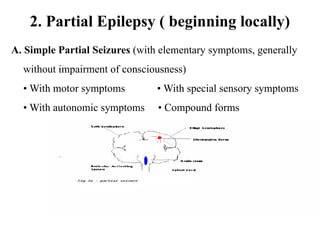
2. Partial Epilepsy ( beginning locally)
A. Simple Partial Seizures (with elementary symptoms, generally
without impairment of consciousness)
• With motor symptoms • With special sensory symptoms
• With autonomic symptoms • Compound forms
B. Complex Partial Seizures
 With complex symptoms, generally with impairment of consciousness.
• With impairment of consciousness only
• With cognitive symptoms
• With affective symptoms
• With psychosensory symptoms
• With psychomotor symptoms (automatisms)
3. Psychogenic seizures
Involving behaviour that, to an observer may look like a seizure
but that don’t seem to be associated with abnormal brain impulses.
Underlying psychological issue
Mostly adolescents and young women
Past history of abuse – physical, sexual
1. Generalized Epilepsy
There are six types:
• Tonic-clonic seizures called “grand mal” seizures.
• Absence seizures called “petit mal seizures,”
• Tonic seizures cause muscle stiffness.
• Atonic seizures lead to loss of muscle control and can make fall
down suddenly.
• Clonic seizures are characterized by repeated, jerky muscle
movements of the face, neck, and arms.
• Myoclonic seizures cause spontaneous quick twitching of the arms
and legs
A. Tonic-clonic (Grand mal seizures)
Grand mal seizures involve four phases; family members or
observers can usually describe the last two:
1. Prodromal subjective phenomena: for minutes, hours or days
priority to occurrence of seizure.
– often only the patient can talk about this.
– It may be manifested as a change in mood – irritability,
depression, or being easily startled(frightened)
27
Grand mal seizures
2. Aura: occur seconds to minutes
– a feeling that the seizure is about to happen; may
pass so quickly that the person isn’t aware of it.
– It might involves some twitching or numbness in a
particular part of the body.
28
Grand mal seizures
3. The seizure: three phases that usually last a few minutes.
a. Tonic phase- tonic contraction sudden cry, tongue biting
may occur, urine incontinence
b. Clonic phase - clonic jerks, frothing of saliva, generalized
sweating.
c. Terminal phase - remain unconscious
29
4. Post ictal phase - headache, drowsiness, confusion
state – with no memory of the seizure itself
HIV and Mental illness, Dire Dawa August
2015
Grand mal seizures
30
Psychogenic versus generalized seizures
Psychogenic
seizure
Grand mal epilepsy
Onset Gradual Sudden
Tongue bite No Yes
Incontinence No Yes
Nocturnal occurrence No Yes
Injuries No Yes
Eyes Closed Open, turn
upward, side ward
Postictal state Alert Confused
Recollecting events
during the attack
Not
impaired
Amnestic
31
B. Petit mal epilepsy
• Usually start in childhood (ages 5-9)
• No aura symptom
• Clonic movements- eye lids, facial muscles,
• Simple automatism - lip smacking, chewing, etc
• a brief seizure lasts for sec.
• may or may not loss of consciousness.
• no change of muscle tones.
• seizure may occur several times per day.
• the victims appear to be a day dreaming.
32
C. Myoclonic seizure
 A Brief generalized seizure cause jerking or stiffening
of extremities.
 The victim may fall down.
D. Atonic Or Akinetic:
• Drop attacks.
• Sudden momentary loss of muscle tone.
• The victim may fall down.
Simple Partial Seizure
 A simple partial seizure doesn’t involve loss of consciousness.
Symptoms include:
 Alterations to sense of taste, smell, sight, hearing, or touch
dizziness tingling and twitching of limbs
• Turning of the head and the eyes to the opposite side of
the lesion
• Unilateral tonic contraction of the trunk and extremities
• no falling down
• No generalized convulsion
35
• Complex partial seizures can have three components
• An aura, often accompanied by hallucinations
• The seizure which can involve:
o Alterations in psychic function- perceptual distortions
o Motor disturbance – simple automatism like lip smacking, sucking
or turning the head
o Complex automatic behaviour – e.g. laughing, running, picking,
undressing
• Postictal phase -amnesia for the seizure, deep sleep, headache
Complex partial seizure
36
Differential Diagnosis
A number of other conditions may present very similar signs and
symptoms to seizures, including
• syncope
• hyperventilation
• migraines
• Narcolepsy (sudden deep sleep)
• panic attacks
• Medical History
• Brief neurologic examination (muscle tone, strength,
memory)
• Complete blood count.
• Urinalysis.
• Electrolytes.
• Creatinine level.
• Fasting blood glucose level.
• Lumbar puncture for CSF analysis.
• PET scan.
• MRI, which provides a detailed picture of certain parts of
your brain.
• Electro elcephalography(EEG) which shows the patterns
of electrical activity in your brain.
Diagnostic Studies
First aid during seizure
• Rolling a person onto side and into the recovery position helps
prevent fluids from getting into the lungs.
• Provide privacy and Protect patient from injury during seizure
• Not putting bite block or tongue depressor in the mouth
• Do not attempt to restrain seizure
• Remove or loosen tight clothing
• If the patient is in bed, remove pillows and raise side rails
• Do not attempt to open jaws that are clenched in a spasm
• Do not light matches
• Do not give anything to drink
Care After the Seizure
• On an average a seizure attack lasts anywhere between few seconds
and to a maximum of 5 minutes. so that,
• Make sure the airway is patent.
• Period of confusion ,short apneic may after a grand mal seizure.
• The patient, on awakening, should be reoriented to the environment.
• check vital signs, level of consciousness, oxygen saturation.
• Glasgow coma scale results
• Pupil size and reactivity
• Psycho Education And Supportive Measures
Psycho Education And Supportive Measures
1) Hygiene
2) Regular sleep
3) Avoid substances
4) Avoid dangerous situations
5) Moderate physical exercise
6) Removal of precipitating factors- E.g. TV watching
7) Supportive psychotherapy – education about the illness
42
Referral criteria
• Status epilepticus not responding to initial diazepam IV
treatment (emergency transfer to hospital)
• New onset of seizures with any localizing/focal neurologic
signs (emergency transfer to hospital)
• Seizures in pregnancy (emergency if elevated blood pressure)
• Seizures that can not be controlled on a single
anticonvulsant (or can only be controlled with side effects
that are difficult to tolerate)
43
• Seizures accompanied by loss of mental or physical abilities
over time (seen in some childhood disorders)
• Diagnostic challenge, Not clearly one type of seizures, or
“intractable” but likely psychogenic seizures
• Medication challenge, Combination of ART and other
medications
Referral criteria
44
Emergency Care Management
•If a seizure lasts longer than 5 minutes without the person returning to
normal considered a medical emergency.
•ABC
A: Oxygen, oral airway.
B: Consider bag-valve mask ventilation. Consider intubation
C: IV access. Treat hypotension
• Suction as needed.
• Anticipate administration of Phenobarbital, Phenytoin (Dilantin) or
benzodiazapines(eg)diazepam, midazolam.
• Give IV dextrose for hypoglycemia
• Monitor vital signs, level of consciousness, oxygen saturation
.
Medication –Antiepileptic Drug
Principles of drug treatment
1. Select the appropriate drug
2. Start drug treatment with one drug
3. Start drug treatment with a small dose
4. Gradually increase dosage until complete control of seizure
5. Aim to achieve lowest maintenance dose
6. Control dosage –seizure frequency / marked side effects
7. If initial drug is not well tolerated, or cannot control seizure
substitute with another 51 46
47
48
49
50
Drugs Interactions common anti epileptic agent
Phenobarbital Can decrease PI and NNRTI levels(OK with NRTIs).
Not recommended for use with LPV/r.
Phenytoin Can decrease PI and NNRTI levels (OK with NRTIs).
Not recommended with LPV/r. If have to use with LPV,
may need higher dose of both
LPV and phenytoin.
Carbamazepin
e
Can decrease PI and NNRTI levels (OK with NRTIs).
Not recommended with LPV/r. Carbamazepine toxicity
possible when used with
RTV.
Sodium
valproate
Minimal or insignificant interaction with
antiretrovirals . 52
New anti epileptic drugs journal of medical science/jan 2015/vol4
Drug Mechanism Of Action Indication
Brivaracetam (Brivlera™) Na Channel Blocking Uncontrolled Focal , Generalized Epilepsy
Eslicarbazepine (Aptiom®) Na Blocking Channels Uncontrolled Focal Epilepsy(Phase III study
completed,2016)
Perampanel (Fycompa™) Reducing AMPA Receptor
Activity In The Brain
Focal, Generalized Tonic-clonic Epilepsy
Bumetanide Inhibitor Of Na-k-cl
Cotransporter
Temporal Lobe Epilepsy
BGG492 (Selurampanel) Ampa-glutamate Receptor
Antagonism
With Partial Epilepsy ( Stage II)
Ganaxolone Potentiate GABA Inhibitory
Effect
Partial Epilepsy(phase III)
GWP42003-P (Cannabidiol) Resistant Seizure In Pediatrics (Phase III
Trials )
Retigabine/Ezogabine Activating K Channels And
GABA Receptors
Partial Epilepsy (Phase III)
Pregabalin Inhibit Glutamate Partial Epilepsy (Phase III
Topiramate Immediate Release (TPM-
IR
GABA Agonist, Glutamate And
Sodium Channel Antagonist
Partial-seizures, Generalized Tonic–clonic
Seizures (Phase III)
54
KETOGENIC DIET %
 Fat-70-80%
 Protein-20-25%
 Carbohydrate-5-10%
https://www.perfectketo.com/keto-macro-calculator/ 55
How ketogenic Diet Works?
• Usually the body uses glucose (a form of sugar) from
carbohydrates (found in foods like sugar, bread or pasta) for its
energy source.
• Chemicals called ketones are made when the body uses fat for
energy (this is called ‘ketosis’). The body uses ketones instead of
glucose for its energy source.
• Another chemical, decanoic acid, is also produced as a result of
the diet. These chemicals help to reduce seizures for some people.
• A clinical trial at Great Ormond Street Hospital in 2015 showed
that the diet significantly reduced the number of seizures in some
children whose seizures did not respond well to AEDs.
• After three months, 4 in 10 (40%) children who started the diet
had the number of their seizures reduced by over half and were
able to reduce their medication.
• Although not all children had better seizure control, some had
other benefits such as increased alertness, awareness and
responsiveness.62
58
59
60
61
62
Prognosis
• Epilepsy cannot usually be cured, but medication can control
seizures effectively in about 70% of cases.
• Factors increasing the risk of a poor outcome include;
. little response to the initial treatment
.generalized seizures
.a family history of epilepsy
. psychiatric problems
• In the developing world, 75% of people are either untreated or not
appropriately treated.
• In Africa, 90% do not get treatment.
• This is partly related to appropriate medications not being available
or being too expensive.
https://en.wikipedia.org/wiki/Epilepsy#Research
Mortality
• People with epilepsy are at an increased risk of death by 1.6 and 4.1
fold greater than that of the general population.
• This related to the underlying cause of the seizures, status
epilepticus, suicide, trauma, and sudden unexpected death in
epilepsy.
• In the United Kingdom, it is estimated that 40–60% of deaths are
possibly preventable.
• In the developing world, many deaths are due to untreated epilepsy
leading to falls or status epilepticus.
• https://en.wikipedia.org/wiki/Epilepsy#Research
Reading assignment
Special Issues In Epilepsy
1. Women And Epilepsy
2. Hiv/Aids And Epilepsy
3. Epilepsy And other psychiatric Disorders
3- Women and epilepsy
Contraception
Fertility
Seizure during pregnancy
Obstetrical risk
Teratogenecity
Breast feeding
66
Women and Epilepsy
 The frequency of seizure increase during the premenstrual
period.
Some anti-epileptic drugs lead to contraceptive failure –
Phenobarbital, phenytoin, carbamazepine
Oral contraceptives do not increase seizure risk
67
Women and Epilepsy cont'd
 Fertility is lower in epileptic women .The Possible causes of
low fertility;
• Direct effect of seizures on the hypothalamus, disrupting
ovulation, elevation of prolactin
• AEDs
– Interfere with the hypothalamic-pituitary axis- menstrual
irregularities, anovulatory cycles
• Diminished libido
68
Women and Epilepsy cont’d
 obstetric complications related to epilepsy
o Low birth weight, preterm delivery, still births
o Labor induction, operative delivery-cesarean section,
forceps
 Increased risk of congenital malformation ~ twice as high as
the general population
69
Complication of epilepsy during Pregnancy
• The type of seizure experienced with epilepsy can cause different
degrees of complications.
• If you experience partial or absence seizures, the risk to the baby is
minimal.
• If you suffer from a tonic-clonic (grand mal) form of seizure, the risk
of injury to the baby and mother is increased.
• During a tonic-clonic seizure, there is a temporary interruption of
breathing; although this interruption rarely affects the mother, it can
lead to oxygen deprivation in your baby. Additionally your baby’s
heart rate can slow for as long as 30 minutes after a tonic-clonic
seizure.
http://americanpregnancy.org/pregnancy-complications/epilepsy-pregna
ncy
Management –epileptic women
 Never stop medication during pregnancy, labor or breast-
feeding
 Avoid poly drug therapy and do not use carbamazepine and
sodium valproate during pregnancy
 Give fefol tab (4mg folic acid/day) during the whole
pregnancy
 Delivery should be in a health institution
 Give vitamin K for the mother – 10mg/day orally, from the
36th
week of gestation until delivery
 Vitamin K for new born - 1mg IM stat at birth
71
https://www.pharmaceutical-journal.com/research/review-
AED and breast feeding
• Older AEDs, such as carbamazepine, valproic acid,
phenytoin, phenobarbital, primidone are considered to have
a good level of safety during lactation, due to the long term
clinical experience and the consequent amount of available
data from the scientific literature.
• On the contrary, fewer data are available on the use of new
AEDs. Therefore, gabapentin, lamotrigine, oxcarbazepine,
vigabatrin, tiagabine, pregabalin, leviracetam and topiramate
are compatible with breastfeeding with a less documented
safety profile.
https://www.ncbi.nlm.nih.gov/pmc/articles/PMC3844381
- HIV/AIDS and Epilepsy
Cause of seizure in HIV
 Directly due to the HIV
 Secondary to HIV related tumors, hemorrhages
 Secondary to opportunistic infections
 Drug toxicity – ART and drugs used to treat other
related illnesses
74
Time of occurrence “new-onset seizure”
 Occurs at any stage of the illness
From seroconversion to late stage
In 3-18% the first presenting symptom
Strong association with focal lesion
75
Type of seizure
1. ~70% generalized – grand mal
2. Simple partial
3. Complex partial
4. Status epilepticus could also occur
76
HIV/AIDS And Epilepsy
• Study in German in 2013 on 831 HIV-infected patients treated in
ART department, 51 (6.1%) had seizures or epilepsy.
• Three of the 51 patients (6%) were diagnosed with epilepsy before
the onset of the HIV infection.
• 14 - acute cerebral disorders
• 8-drug withdrawal
• 2-sleep withdrawal
• 4-of unknown cause
• 7-Toxoplasmosis ,
• 7- progressive multifocal encephalopathy
• 5- acute or subacute cerebral infections
https://linkinghub.elsevier.com
Treatment of epilepsy in HIV/AIDS cont’d
 No anticonvulsant has absolute contraindication
Valproate –hepatotoxicity, AZT toxicity
Carbamazepine – bone marrow depression,
leucopenia
Phenobarbital - over sedation
Phenytoin –neurotoxicty
 Special attention for those taking protease
inhibitors- stronger drug-drug interactions
78
AED-ARV
• AED-ARV interactions that raise blood levels of drugs in
either class may increase toxicity risk.
• Use of ARVs that reduce AED levels could lead to loss of
therapeutic effects, including seizure control.
• Use of AEDs that decrease ARV levels (e.g., the enzyme-
inducing AEDs [EI-AEDs] phenytoin, phenobarbital, and
carbamazepine) may lead to virologic failure.
AED-ARV cont…
• Because first-line AED availability in most developing countries
is limited to phenobarbital, carbamazepine, and phenytoin, and
ARV regimen options may also be limited, there is substantial
risk for occurrence of clinically important drug interactions.
• Phenytoin possibly reduces lopinavir and ritonavir levels by
about 30%. Patients receiving phenytoin may require a
lopinavir/ritonavir dosage increase of about 50% to maintain
unchanged serum concentrations
 Ritonavir/atazanavir possibly reduces lamotrigine by about
30%. Patients receiving ritonavir/atazanavir may require a
lamotrigine dosage increase of about 50% to maintain
unchanged lamotrigine serum concentrations.
Report of the American Academy of Neurology and the International League Against
Epilepsy,2010
Epilepsy And Psychiatric Disorders
• Patients who have epilepsy have a higher incidence of psychi­
atric
illness than the general population—at a prevalence of 60%.
• Risk factors for people who have epilepsy include; psychosocial
stressors, genetic factors, early age of onset of seizures, and each
ictal event.
• AEDs can produce psychiatric effects, 28% of cases of depression
that are comorbid with epilepsy induced by barbi­
turates,
topiramate, vigabatrin, tiagabine, and levetiracetam.
 Study in United Arab Emirates University, 2014 including 319 patients with focal
epilepsy suggested that about 58% of patients with focal epilepsy have either a current
or past history of a psychiatric disorder.
. Depression 32.6% of patients. . Psychotic disorders (7.2%)
. Anxiety (6.9%) .Substance misuse/ dependence
(3.1%)
. Somatoform disorders (4.7%) . Personality disorders (13.8%)
 Data from the California Health Interview Survey conducted in 2015, including data
from 604 adult participants with history of epilepsy, indicated
• 27% had psychological distress associated with epilepsy.
• 84% of them needed mental health care.
• 57% have been seen by a mental health professional.
Complications Of Epilepsy
Temporar
y
systemic
changes
Life
threatening
systemic
changes
Deat
h
Duration of seizure
 Hypoxemia
•Result from impaired ventilation, increased oxygen consumption, excessive
salivation/ tracheobronchial secretions
Acidosis
•Respiratory
•Lactic
- Impaired tissue oxygenation
- Increased energy expenditure
Glucose alteration
Glucose
Seizure
duration
30 min
SE
SE + hypoxia
• Hyperdynamic phase
- Hyperglycemia
• Exhaustion phase
- Hypoglycemia develops
- Hypoglycemia appears
earlier in presence of hypoxia
• Neuronal damage ensues
Cerebral blood flow - Cerebral O2
requirement
87
Neuronal damage ens
Blood pressure
Blood flow
O2 requirement
Seizure
duration
• Hyperdynamic phase
-CBF meets CMRO2
• Exhaustion phase
- CBF drops as hypotension
sets in
-Autoregulation exhausted
Hyperpyrexia
• Hyperpyrexia may develop during protracted status
epilepticus, and aggravate possible mismatch of
cerebral metabolic requirement and substrate
delivery
• Treat hyperpyrexia aggressively
- Antipyretics, external cooling
- Consider intubation, relaxation, ventilation
89
Reference
• (Brunner &Sadderth`S 12th Edition)
• Foundation Of Adult Health Nursing 3th Edition
• https://www.healthline.com/health/epilepsy
• https://www.ncbi.nlm.nih.gov/pmc/
• https://www.researchgate.net/publication
• https://en.wikipedia.org/wiki/Epilepsy#Research
• http://americanpregnancy.org/pregnancy-complications/epilepsy-pregnancy
• https://linkinghub.elsevier.com
• https://www.epilepsysociety.org.uk/ketogenic-diet
• https://www.sciencedirect.com/science/article/pii/S2405650216300259
• https://www.pharmaceutical-journal.com/research/review-
• https://www.ncbi.nlm.nih.gov/pmc/articles/PMC3844381/
Acknowledgement
• First of all, we are extremely delighted to express my
deepest gratified to Tefera Mulugeta ( MSc, PHD follow)
for giving this opportunity ,which help me to develop
Capacity Of independent learning.
THANK YOU!

Presentation epilepsy.pptxggghhhhhhhhhhh

  • 1.
    COLLEGE OF HEALTHSCENCE DEPARTMENT OF NURSING AND MIDWIFERY POST GRADUATE PROGRAM ADVANCED MIDSURGE III PRESENTATION ASSIGNMENT TITLE: PORTAL HYPERTENSION Prepared by: Shiferaw. G July, 2018
  • 3.
    Outline of presentation •Definition Of Epilepsy • Cause of Epilepsy • Pathophysiology of Epilepsy • Classification Of Seizure • Treatment Of Epilepsy • Special Issue In Epilepsy • Complications Of Epilepsy
  • 4.
    Objective  Up oncompletion of this session, the learners will be able to;  Define epilepsy  Identifying causes of epilepsy  Identifies Diagnostic Procedures for epilepsy Differentiating types of epilepsy Managing epileptic case
  • 5.
  • 6.
    Brain Storming What isthe difference b/n epilepsy and seizure disorder?
  • 7.
    Seizure Disorder • Aseizure is initiated by an electrical disturbance in the neurons, which, in turn, causes an aberrant discharge of electrical activity from any part of the cerebral cortex and possibly from other areas of the brain. • This electrical discharge may cause involuntary episodes of loss of consciousness, excessive muscular movement or loss of muscle tone, and changes in behavior, mood, sensation, and/or perception. (Foundation of adult health nursing 4th edition, p-327)
  • 8.
    Seizure Disorder  Havinga seizure doesn't necessarily mean that have epilepsy. Many conditions have symptoms similar to epilepsy including;  first seizures  febrile seizures  non epileptic events  eclampsia  meningitis  encephalitis, and  migraine headache https://www.webmd.com/epilepsy/conditions
  • 9.
    First seizure  Afirst seizure is a one-time event that can be brought on by a drug or by anesthesia.  These seizures usually don't recur.  In the majority of cases, these seizures won't take place again unless the person has suffered brain damage.
  • 10.
    Febrile Seizures  Febrileseizures can occur in a child with a high fever, and usually don't develop into epilepsy.  The chances of having another febrile seizure are 25% to 30%.  There is a higher risk of seizure recurrence if the child has a family history of epilepsy, some damage to the nervous system before the seizure, or a long or complicated seizure.
  • 11.
    Non epileptic Events •Non epileptic events look like seizures, but actually are not. • Conditions that may cause non epileptic events include narcolepsy (a sleep disorder causing recurrent episodes of sleep during the day), Tourette's syndrome (a neurological condition characterized by vocal and body tics), and abnormal heart rhythms (arrhythmias). • Non epileptic events that have a psychological basis are known as psychogenic seizures.
  • 12.
    • A personwho has this type of seizure may simply be trying to avoid stressful situations or may have a psychiatric problem. • Because most people who have these types of seizures don't have epilepsy, they are often treated by psychiatrists and/or other mental health specialists. • One way of distinguishing an epileptic seizure with a non epileptic seizure is through an electroencephalogram (EEG), coupled with video monitoring. • The EEG detects abnormal electrical discharges in the brain that are characteristic of epilepsy, and along with video monitoring to capture a seizure on camera, can confirm a diagnosis
  • 13.
    Epilepsy  Is agroup of syndromes characterized by; unprovoked , recurring seizures  it is a disorder characterized by chronic seizure activity and indicate brain irritation. (Brunner & Sadderth`s 12th edition, p-1881).
  • 14.
    Epidemiology • Epilepsy isa common neurological disorder that affects 70 million people around the world. Nearly 80% of people with epilepsy in low income country with limithed resource( south east asia, latin america, subsaharan africa) the rate of case two fold to developed country. • The prevalence of epilepsy is highest in sub Saharan Africa ‐ (15.0/1000) and Latin America (17.8/1000), whereas in Asia it is approximately 6 in 1000. Eugan Trink,patrick Kwan,(28 June, 2018).
  • 15.
    Prevalence Of EpilepsyIn Ethiopia • The study conducted in Addis Ababa University neurologic department in 2011 shows that prevalence of epilepsy was 5.2/1000 inhabitants at risk, 5.8 for males, and 4.6 for females. • The highest age-specific prevalence was ages 10-19 years. • Generalized tonic-clonic seizure type and occurred in 69 - 81%. • Partial seizures occurred in 18 - 20%. • 1/3 (16%) of these is secondary generalize • Unclassifiable seizures occurred in 11% https://www.researchgate.net/publication/270592320_Review_artic
  • 16.
    • Study conductedin 2013 on Zay Society, Society lives on the shore and three islands of Lake Zeway in the Ethiopian Rift Valley screening data were obtained from 1154 individuals of whom 82 were positive for epilepsy. • The subjects confirming to the definition of active epilepsy were 34, The prevalence rate being 29.5 per 1000. Of those with active epilepsy, • 28 (82%) had primary generalised tonic-clonic seizures, • 2 -had generalised tonic seizures, • 2- secondary generalised partial seizures, • 1 - had complex partial sei-zures and • 1 - had myoclonic seizures https://www.researchgate.net/publication/7289334_The_prevalence_
  • 17.
    Cause Of Epilepsy •The causes of seizures are can be categorized as  idiopathic (genetic, developmental defects) and acquired.  The acquired cause includes; • Cerebrovascular disease • Hypoxemia of any cause • Head injury • Hypertension Fever (childhood) • CNS infections • Brain tumor • Drug and alcohol withdraw • Metabolic and toxic conditions: - renal failure, hyponatremia, hypocalcemia, hypoglycemia,
  • 18.
  • 19.
    Pathophysiology Causative factor forseizures(abnormality of Na+,Ca+ channel) This firing spreads by physiologic pathways to involve adjacent or distant areas of brain. That attributed to a group of abnormal neurons firing If the activity spreads to involve the small area brain, a partial seizure occurs. If the activity spreads to involve the whole area brain, a generalized seizure occurs. Brunner 12th Edition) Brunner &Sadd2th Edition)
  • 20.
    Aggravating And PrecipitatingFactors – Sleep disturbance – Alcohol – Stress – Drugs – watching TV – Bright lights, flashing lights – Caffeine – Overeating, or specific food ingredients (https://www.healthline.com/health/epilepsy) HIV and Mental illness, Dire Dawa August 2015 20
  • 22.
    1. Generalized Epilepsy( bilaterally symmetric)
  • 23.
    2. Partial Epilepsy( beginning locally) A. Simple Partial Seizures (with elementary symptoms, generally without impairment of consciousness) • With motor symptoms • With special sensory symptoms • With autonomic symptoms • Compound forms
  • 24.
    B. Complex PartialSeizures  With complex symptoms, generally with impairment of consciousness. • With impairment of consciousness only • With cognitive symptoms • With affective symptoms • With psychosensory symptoms • With psychomotor symptoms (automatisms)
  • 25.
    3. Psychogenic seizures Involvingbehaviour that, to an observer may look like a seizure but that don’t seem to be associated with abnormal brain impulses. Underlying psychological issue Mostly adolescents and young women Past history of abuse – physical, sexual
  • 26.
    1. Generalized Epilepsy Thereare six types: • Tonic-clonic seizures called “grand mal” seizures. • Absence seizures called “petit mal seizures,” • Tonic seizures cause muscle stiffness. • Atonic seizures lead to loss of muscle control and can make fall down suddenly. • Clonic seizures are characterized by repeated, jerky muscle movements of the face, neck, and arms. • Myoclonic seizures cause spontaneous quick twitching of the arms and legs
  • 27.
    A. Tonic-clonic (Grandmal seizures) Grand mal seizures involve four phases; family members or observers can usually describe the last two: 1. Prodromal subjective phenomena: for minutes, hours or days priority to occurrence of seizure. – often only the patient can talk about this. – It may be manifested as a change in mood – irritability, depression, or being easily startled(frightened) 27
  • 28.
    Grand mal seizures 2.Aura: occur seconds to minutes – a feeling that the seizure is about to happen; may pass so quickly that the person isn’t aware of it. – It might involves some twitching or numbness in a particular part of the body. 28
  • 29.
    Grand mal seizures 3.The seizure: three phases that usually last a few minutes. a. Tonic phase- tonic contraction sudden cry, tongue biting may occur, urine incontinence b. Clonic phase - clonic jerks, frothing of saliva, generalized sweating. c. Terminal phase - remain unconscious 29
  • 30.
    4. Post ictalphase - headache, drowsiness, confusion state – with no memory of the seizure itself HIV and Mental illness, Dire Dawa August 2015 Grand mal seizures 30
  • 31.
    Psychogenic versus generalizedseizures Psychogenic seizure Grand mal epilepsy Onset Gradual Sudden Tongue bite No Yes Incontinence No Yes Nocturnal occurrence No Yes Injuries No Yes Eyes Closed Open, turn upward, side ward Postictal state Alert Confused Recollecting events during the attack Not impaired Amnestic 31
  • 32.
    B. Petit malepilepsy • Usually start in childhood (ages 5-9) • No aura symptom • Clonic movements- eye lids, facial muscles, • Simple automatism - lip smacking, chewing, etc • a brief seizure lasts for sec. • may or may not loss of consciousness. • no change of muscle tones. • seizure may occur several times per day. • the victims appear to be a day dreaming. 32
  • 33.
    C. Myoclonic seizure A Brief generalized seizure cause jerking or stiffening of extremities.  The victim may fall down.
  • 34.
    D. Atonic OrAkinetic: • Drop attacks. • Sudden momentary loss of muscle tone. • The victim may fall down.
  • 35.
    Simple Partial Seizure A simple partial seizure doesn’t involve loss of consciousness. Symptoms include:  Alterations to sense of taste, smell, sight, hearing, or touch dizziness tingling and twitching of limbs • Turning of the head and the eyes to the opposite side of the lesion • Unilateral tonic contraction of the trunk and extremities • no falling down • No generalized convulsion 35
  • 36.
    • Complex partialseizures can have three components • An aura, often accompanied by hallucinations • The seizure which can involve: o Alterations in psychic function- perceptual distortions o Motor disturbance – simple automatism like lip smacking, sucking or turning the head o Complex automatic behaviour – e.g. laughing, running, picking, undressing • Postictal phase -amnesia for the seizure, deep sleep, headache Complex partial seizure 36
  • 37.
    Differential Diagnosis A numberof other conditions may present very similar signs and symptoms to seizures, including • syncope • hyperventilation • migraines • Narcolepsy (sudden deep sleep) • panic attacks
  • 38.
    • Medical History •Brief neurologic examination (muscle tone, strength, memory) • Complete blood count. • Urinalysis. • Electrolytes. • Creatinine level. • Fasting blood glucose level. • Lumbar puncture for CSF analysis. • PET scan. • MRI, which provides a detailed picture of certain parts of your brain. • Electro elcephalography(EEG) which shows the patterns of electrical activity in your brain. Diagnostic Studies
  • 40.
    First aid duringseizure • Rolling a person onto side and into the recovery position helps prevent fluids from getting into the lungs. • Provide privacy and Protect patient from injury during seizure • Not putting bite block or tongue depressor in the mouth • Do not attempt to restrain seizure • Remove or loosen tight clothing • If the patient is in bed, remove pillows and raise side rails • Do not attempt to open jaws that are clenched in a spasm • Do not light matches • Do not give anything to drink
  • 41.
    Care After theSeizure • On an average a seizure attack lasts anywhere between few seconds and to a maximum of 5 minutes. so that, • Make sure the airway is patent. • Period of confusion ,short apneic may after a grand mal seizure. • The patient, on awakening, should be reoriented to the environment. • check vital signs, level of consciousness, oxygen saturation. • Glasgow coma scale results • Pupil size and reactivity • Psycho Education And Supportive Measures
  • 42.
    Psycho Education AndSupportive Measures 1) Hygiene 2) Regular sleep 3) Avoid substances 4) Avoid dangerous situations 5) Moderate physical exercise 6) Removal of precipitating factors- E.g. TV watching 7) Supportive psychotherapy – education about the illness 42
  • 43.
    Referral criteria • Statusepilepticus not responding to initial diazepam IV treatment (emergency transfer to hospital) • New onset of seizures with any localizing/focal neurologic signs (emergency transfer to hospital) • Seizures in pregnancy (emergency if elevated blood pressure) • Seizures that can not be controlled on a single anticonvulsant (or can only be controlled with side effects that are difficult to tolerate) 43
  • 44.
    • Seizures accompaniedby loss of mental or physical abilities over time (seen in some childhood disorders) • Diagnostic challenge, Not clearly one type of seizures, or “intractable” but likely psychogenic seizures • Medication challenge, Combination of ART and other medications Referral criteria 44
  • 45.
    Emergency Care Management •Ifa seizure lasts longer than 5 minutes without the person returning to normal considered a medical emergency. •ABC A: Oxygen, oral airway. B: Consider bag-valve mask ventilation. Consider intubation C: IV access. Treat hypotension • Suction as needed. • Anticipate administration of Phenobarbital, Phenytoin (Dilantin) or benzodiazapines(eg)diazepam, midazolam. • Give IV dextrose for hypoglycemia • Monitor vital signs, level of consciousness, oxygen saturation
  • 46.
    . Medication –Antiepileptic Drug Principlesof drug treatment 1. Select the appropriate drug 2. Start drug treatment with one drug 3. Start drug treatment with a small dose 4. Gradually increase dosage until complete control of seizure 5. Aim to achieve lowest maintenance dose 6. Control dosage –seizure frequency / marked side effects 7. If initial drug is not well tolerated, or cannot control seizure substitute with another 51 46
  • 47.
  • 48.
  • 49.
  • 50.
  • 52.
    Drugs Interactions commonanti epileptic agent Phenobarbital Can decrease PI and NNRTI levels(OK with NRTIs). Not recommended for use with LPV/r. Phenytoin Can decrease PI and NNRTI levels (OK with NRTIs). Not recommended with LPV/r. If have to use with LPV, may need higher dose of both LPV and phenytoin. Carbamazepin e Can decrease PI and NNRTI levels (OK with NRTIs). Not recommended with LPV/r. Carbamazepine toxicity possible when used with RTV. Sodium valproate Minimal or insignificant interaction with antiretrovirals . 52
  • 53.
    New anti epilepticdrugs journal of medical science/jan 2015/vol4 Drug Mechanism Of Action Indication Brivaracetam (Brivlera™) Na Channel Blocking Uncontrolled Focal , Generalized Epilepsy Eslicarbazepine (Aptiom®) Na Blocking Channels Uncontrolled Focal Epilepsy(Phase III study completed,2016) Perampanel (Fycompa™) Reducing AMPA Receptor Activity In The Brain Focal, Generalized Tonic-clonic Epilepsy Bumetanide Inhibitor Of Na-k-cl Cotransporter Temporal Lobe Epilepsy BGG492 (Selurampanel) Ampa-glutamate Receptor Antagonism With Partial Epilepsy ( Stage II) Ganaxolone Potentiate GABA Inhibitory Effect Partial Epilepsy(phase III) GWP42003-P (Cannabidiol) Resistant Seizure In Pediatrics (Phase III Trials ) Retigabine/Ezogabine Activating K Channels And GABA Receptors Partial Epilepsy (Phase III) Pregabalin Inhibit Glutamate Partial Epilepsy (Phase III Topiramate Immediate Release (TPM- IR GABA Agonist, Glutamate And Sodium Channel Antagonist Partial-seizures, Generalized Tonic–clonic Seizures (Phase III)
  • 54.
  • 55.
    KETOGENIC DIET % Fat-70-80%  Protein-20-25%  Carbohydrate-5-10% https://www.perfectketo.com/keto-macro-calculator/ 55
  • 56.
    How ketogenic DietWorks? • Usually the body uses glucose (a form of sugar) from carbohydrates (found in foods like sugar, bread or pasta) for its energy source. • Chemicals called ketones are made when the body uses fat for energy (this is called ‘ketosis’). The body uses ketones instead of glucose for its energy source. • Another chemical, decanoic acid, is also produced as a result of the diet. These chemicals help to reduce seizures for some people.
  • 57.
    • A clinicaltrial at Great Ormond Street Hospital in 2015 showed that the diet significantly reduced the number of seizures in some children whose seizures did not respond well to AEDs. • After three months, 4 in 10 (40%) children who started the diet had the number of their seizures reduced by over half and were able to reduce their medication. • Although not all children had better seizure control, some had other benefits such as increased alertness, awareness and responsiveness.62
  • 58.
  • 59.
  • 60.
  • 61.
  • 62.
  • 63.
    Prognosis • Epilepsy cannotusually be cured, but medication can control seizures effectively in about 70% of cases. • Factors increasing the risk of a poor outcome include; . little response to the initial treatment .generalized seizures .a family history of epilepsy . psychiatric problems • In the developing world, 75% of people are either untreated or not appropriately treated. • In Africa, 90% do not get treatment. • This is partly related to appropriate medications not being available or being too expensive. https://en.wikipedia.org/wiki/Epilepsy#Research
  • 64.
    Mortality • People withepilepsy are at an increased risk of death by 1.6 and 4.1 fold greater than that of the general population. • This related to the underlying cause of the seizures, status epilepticus, suicide, trauma, and sudden unexpected death in epilepsy. • In the United Kingdom, it is estimated that 40–60% of deaths are possibly preventable. • In the developing world, many deaths are due to untreated epilepsy leading to falls or status epilepticus. • https://en.wikipedia.org/wiki/Epilepsy#Research
  • 65.
    Reading assignment Special IssuesIn Epilepsy 1. Women And Epilepsy 2. Hiv/Aids And Epilepsy 3. Epilepsy And other psychiatric Disorders
  • 66.
    3- Women andepilepsy Contraception Fertility Seizure during pregnancy Obstetrical risk Teratogenecity Breast feeding 66
  • 67.
    Women and Epilepsy The frequency of seizure increase during the premenstrual period. Some anti-epileptic drugs lead to contraceptive failure – Phenobarbital, phenytoin, carbamazepine Oral contraceptives do not increase seizure risk 67
  • 68.
    Women and Epilepsycont'd  Fertility is lower in epileptic women .The Possible causes of low fertility; • Direct effect of seizures on the hypothalamus, disrupting ovulation, elevation of prolactin • AEDs – Interfere with the hypothalamic-pituitary axis- menstrual irregularities, anovulatory cycles • Diminished libido 68
  • 69.
    Women and Epilepsycont’d  obstetric complications related to epilepsy o Low birth weight, preterm delivery, still births o Labor induction, operative delivery-cesarean section, forceps  Increased risk of congenital malformation ~ twice as high as the general population 69
  • 70.
    Complication of epilepsyduring Pregnancy • The type of seizure experienced with epilepsy can cause different degrees of complications. • If you experience partial or absence seizures, the risk to the baby is minimal. • If you suffer from a tonic-clonic (grand mal) form of seizure, the risk of injury to the baby and mother is increased. • During a tonic-clonic seizure, there is a temporary interruption of breathing; although this interruption rarely affects the mother, it can lead to oxygen deprivation in your baby. Additionally your baby’s heart rate can slow for as long as 30 minutes after a tonic-clonic seizure. http://americanpregnancy.org/pregnancy-complications/epilepsy-pregna ncy
  • 71.
    Management –epileptic women Never stop medication during pregnancy, labor or breast- feeding  Avoid poly drug therapy and do not use carbamazepine and sodium valproate during pregnancy  Give fefol tab (4mg folic acid/day) during the whole pregnancy  Delivery should be in a health institution  Give vitamin K for the mother – 10mg/day orally, from the 36th week of gestation until delivery  Vitamin K for new born - 1mg IM stat at birth 71
  • 72.
  • 73.
    AED and breastfeeding • Older AEDs, such as carbamazepine, valproic acid, phenytoin, phenobarbital, primidone are considered to have a good level of safety during lactation, due to the long term clinical experience and the consequent amount of available data from the scientific literature. • On the contrary, fewer data are available on the use of new AEDs. Therefore, gabapentin, lamotrigine, oxcarbazepine, vigabatrin, tiagabine, pregabalin, leviracetam and topiramate are compatible with breastfeeding with a less documented safety profile. https://www.ncbi.nlm.nih.gov/pmc/articles/PMC3844381
  • 74.
    - HIV/AIDS andEpilepsy Cause of seizure in HIV  Directly due to the HIV  Secondary to HIV related tumors, hemorrhages  Secondary to opportunistic infections  Drug toxicity – ART and drugs used to treat other related illnesses 74
  • 75.
    Time of occurrence“new-onset seizure”  Occurs at any stage of the illness From seroconversion to late stage In 3-18% the first presenting symptom Strong association with focal lesion 75
  • 76.
    Type of seizure 1.~70% generalized – grand mal 2. Simple partial 3. Complex partial 4. Status epilepticus could also occur 76
  • 77.
    HIV/AIDS And Epilepsy •Study in German in 2013 on 831 HIV-infected patients treated in ART department, 51 (6.1%) had seizures or epilepsy. • Three of the 51 patients (6%) were diagnosed with epilepsy before the onset of the HIV infection. • 14 - acute cerebral disorders • 8-drug withdrawal • 2-sleep withdrawal • 4-of unknown cause • 7-Toxoplasmosis , • 7- progressive multifocal encephalopathy • 5- acute or subacute cerebral infections https://linkinghub.elsevier.com
  • 78.
    Treatment of epilepsyin HIV/AIDS cont’d  No anticonvulsant has absolute contraindication Valproate –hepatotoxicity, AZT toxicity Carbamazepine – bone marrow depression, leucopenia Phenobarbital - over sedation Phenytoin –neurotoxicty  Special attention for those taking protease inhibitors- stronger drug-drug interactions 78
  • 79.
    AED-ARV • AED-ARV interactionsthat raise blood levels of drugs in either class may increase toxicity risk. • Use of ARVs that reduce AED levels could lead to loss of therapeutic effects, including seizure control. • Use of AEDs that decrease ARV levels (e.g., the enzyme- inducing AEDs [EI-AEDs] phenytoin, phenobarbital, and carbamazepine) may lead to virologic failure.
  • 80.
    AED-ARV cont… • Becausefirst-line AED availability in most developing countries is limited to phenobarbital, carbamazepine, and phenytoin, and ARV regimen options may also be limited, there is substantial risk for occurrence of clinically important drug interactions. • Phenytoin possibly reduces lopinavir and ritonavir levels by about 30%. Patients receiving phenytoin may require a lopinavir/ritonavir dosage increase of about 50% to maintain unchanged serum concentrations
  • 81.
     Ritonavir/atazanavir possiblyreduces lamotrigine by about 30%. Patients receiving ritonavir/atazanavir may require a lamotrigine dosage increase of about 50% to maintain unchanged lamotrigine serum concentrations. Report of the American Academy of Neurology and the International League Against Epilepsy,2010
  • 82.
    Epilepsy And PsychiatricDisorders • Patients who have epilepsy have a higher incidence of psychi­ atric illness than the general population—at a prevalence of 60%. • Risk factors for people who have epilepsy include; psychosocial stressors, genetic factors, early age of onset of seizures, and each ictal event. • AEDs can produce psychiatric effects, 28% of cases of depression that are comorbid with epilepsy induced by barbi­ turates, topiramate, vigabatrin, tiagabine, and levetiracetam.
  • 83.
     Study inUnited Arab Emirates University, 2014 including 319 patients with focal epilepsy suggested that about 58% of patients with focal epilepsy have either a current or past history of a psychiatric disorder. . Depression 32.6% of patients. . Psychotic disorders (7.2%) . Anxiety (6.9%) .Substance misuse/ dependence (3.1%) . Somatoform disorders (4.7%) . Personality disorders (13.8%)  Data from the California Health Interview Survey conducted in 2015, including data from 604 adult participants with history of epilepsy, indicated • 27% had psychological distress associated with epilepsy. • 84% of them needed mental health care. • 57% have been seen by a mental health professional.
  • 84.
  • 85.
     Hypoxemia •Result fromimpaired ventilation, increased oxygen consumption, excessive salivation/ tracheobronchial secretions Acidosis •Respiratory •Lactic - Impaired tissue oxygenation - Increased energy expenditure
  • 86.
    Glucose alteration Glucose Seizure duration 30 min SE SE+ hypoxia • Hyperdynamic phase - Hyperglycemia • Exhaustion phase - Hypoglycemia develops - Hypoglycemia appears earlier in presence of hypoxia • Neuronal damage ensues
  • 87.
    Cerebral blood flow- Cerebral O2 requirement 87 Neuronal damage ens Blood pressure Blood flow O2 requirement Seizure duration • Hyperdynamic phase -CBF meets CMRO2 • Exhaustion phase - CBF drops as hypotension sets in -Autoregulation exhausted
  • 88.
    Hyperpyrexia • Hyperpyrexia maydevelop during protracted status epilepticus, and aggravate possible mismatch of cerebral metabolic requirement and substrate delivery • Treat hyperpyrexia aggressively - Antipyretics, external cooling - Consider intubation, relaxation, ventilation
  • 89.
  • 90.
    Reference • (Brunner &Sadderth`S12th Edition) • Foundation Of Adult Health Nursing 3th Edition • https://www.healthline.com/health/epilepsy • https://www.ncbi.nlm.nih.gov/pmc/ • https://www.researchgate.net/publication • https://en.wikipedia.org/wiki/Epilepsy#Research • http://americanpregnancy.org/pregnancy-complications/epilepsy-pregnancy • https://linkinghub.elsevier.com • https://www.epilepsysociety.org.uk/ketogenic-diet • https://www.sciencedirect.com/science/article/pii/S2405650216300259 • https://www.pharmaceutical-journal.com/research/review- • https://www.ncbi.nlm.nih.gov/pmc/articles/PMC3844381/
  • 91.
    Acknowledgement • First ofall, we are extremely delighted to express my deepest gratified to Tefera Mulugeta ( MSc, PHD follow) for giving this opportunity ,which help me to develop Capacity Of independent learning.
  • 92.