WHAT IS EPILEPSY? 
Professor (Dr.) Ennapadam S. Krishnamoorthy 
Founder & Director 
Neurokrish & Trimed 
Adjunct Professor: Public Health Foundation of India
Seizures and Epilepsy 
• A fit or seizure represents a transient abnormal 
electrical discharge in the brain with or without: 
alteration in consciousness, motor (movement) or 
sensory (perceptual) symptoms 
• Seizures represent a focal (ex: Tumor) or 
generalized (ex: infection) abnormality in 
electrical brain activity 
• Seizures represent underlying brain dysfunction 
Seizures¹Epilepsy
What is Epilepsy? 
• A tendency to have recurring unprovoked 
seizures 
• Does not include single or occasional seizures or 
those occurring during acute illness (symptomatic 
seizures) 
• Unprovoked seizures occurring on two separate 
occasions are required for epilepsy diagnosis 
• A cluster of seizures is considered as a single 
seizure for the purpose of epilepsy diagnosis
How common is epilepsy? 
•Most common serious neurological disease 
• Affects 1/200 people worldwide 
•Could be as much as 1/100 in developing 
nations like India due to increased: 
- poor antenatal care and perinatal injury 
- infections (tuberculosis & cysticercosis) 
- road traffic accidents
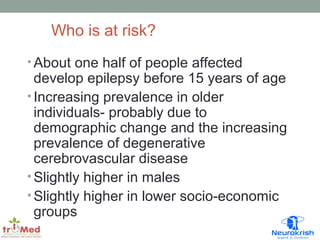
Who is at risk? 
•About one half of people affected 
develop epilepsy before 15 years of age 
• Increasing prevalence in older 
individuals- probably due to 
demographic change and the increasing 
prevalence of degenerative 
cerebrovascular disease 
• Slightly higher in males 
• Slightly higher in lower socio-economic 
groups
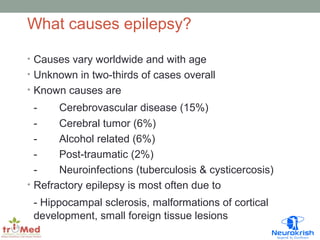
What causes epilepsy? 
• Causes vary worldwide and with age 
• Unknown in two-thirds of cases overall 
• Known causes are 
- Cerebrovascular disease (15%) 
- Cerebral tumor (6%) 
- Alcohol related (6%) 
- Post-traumatic (2%) 
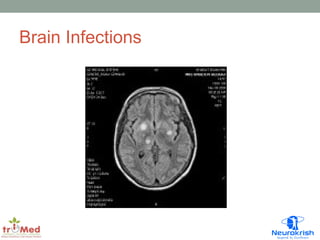
- Neuroinfections (tuberculosis & cysticercosis) 
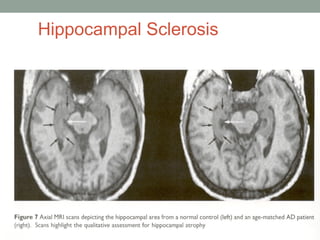
• Refractory epilepsy is most often due to 
- Hippocampal sclerosis, malformations of cortical 
development, small foreign tissue lesions
Hippocampal Sclerosis
Brain Infections
Genes and Epilepsy 
• Over 200 disorders showing a Mendelian pattern 
of inheritance feature epilepsy as a manifestation 
• Single gene disorders where epilepsy is the sole 
or major manifestation are being discovered but 
will account only for a small proportion of cases 
(10%) 
• In most forms of epilepsy the inheritance is 
probably polygenic (i.e. many genes are 
responsible for the disorder)
Mechanisms 
• Generalized Seizures: Reciprocal cortico-thalamic 
interaction 
• Partial Seizures: Local excitation-inhibition 
imbalance 
• Disorder of membrane ion channels: complex 
changes in brain receptor, membrane and system 
levels in most cases 
• Pathological, functional imaging and genetics will 
probably redefine our understanding and promote 
rational drug design
Epileptic Seizures 
• Epileptic seizures are paroxysmal events 
• Symptoms: 
- Generalized convulsive movements, drop 
attacks, transient focal motor or sensory 
attacks (including facial and eye movements), 
psychic experiences, episodic phenomena in 
sleep, prolonged confusional states are all 
possible 
• Several well described types of seizure are 
recognized and are usually stereotyped in an 
individual
Diagnosis 
• Almost always clinical: a detailed history and an 
eyewitness account are essential 
• Information about: 
- The circumstances of the episode 
- Patterns of occurrence 
- Preceding symptoms- localizing or diagnostic 
- Timing, pattern, tempo and evolution of symptoms 
- Reported behaviors- before, during and after 
- Investigations are seldom necessary for making 
diagnosis: but are helpful in terms of 
management
Differential Diagnosis 
• Syncope 
vasovagal, micturition, 
postural, vascular, 
respiratory, cardiac 
• Cardiac Disorders 
arrhythmias, aortic or 
mitral stenosis, cardio-myopathies, 
myxoma.. 
• Metabolic/ Endocrine 
hypoglycemia, 
phaeochromocytoma, 
porphyria, carcinoid 
syndrome 
• Neurological 
TIA, cataplexy-narcolepsy, 
basilar 
migraine, III ventricle 
cyst, Meniere’s disease, 
episodic ataxias, 
movement and sleep 
disorders 
• Psychogenic 
hyperventilation, panic 
attacks, non-epileptic 
attack disorder, episodic 
dyscontrol syndrome, 
malingering, 
Munchausen
Type of Seizure 
• Partial: Begin focally in cortex- may become 
generalized involving entire cortex 
• Generalized: Involve much of the cortex bilaterally 
from the outset and therefore loss of consciousness 
-- GGeenneerraalliizzeedd ttoonniicc cclloonniicc sseeiizzuurreess:: ccrryy,, lloocc,, ffaallll,, ssppaassmm,, ccyyaannoossiiss,, 
nnooiissyy bbrreeaatthhiinngg,, jjeerrkkiinngg,, ttoonngguuee bbiittee,, iinnccoonnttiinneennccee 
-- AAbbsseenncceess:: ssuuddddeenn && bbrriieeff cceessssaattiioonn iinn aaccttiivviittyy wwiitthh rraappiidd rreettuurrnn 
ttoo nnoorrmmaalliittyy,, mmaayy bbee ffrreeqquueenntt,, 33HHzz ssppiikkee aanndd wwaavvee 
-- PPaarrttiiaall SSeeiizzuurreess:: ssiimmppllee ((pprreesseerrvveedd ccoonnsscciioouussnneessss)) vvss.. ccoommpplleexx 
((iimmppaaiirreedd ccoonnsscciioouussnneessss));; tteemmppoorraall ((ttaassttee,, ssmmeellll,, eeppiiggaassttrriicc 
sseennssaattiioonnss,, aauuttoonnoommiicc,, ffeeaarr,, ddééjjàà vvuu,, jjaammaaiiss vvuu));; ffrroonnttaall ((bbrriieeff wwiitthh 
rraappiidd rreeccoovveerryy,, bbiizzaarrrree,, vveerrssiioonn ooff eeyyeess,, bbiillaatteerraall lliimmbb mmoovveemmeenntt,, 
ppoossttuurriinngg));; ppaarriieettaall ((sseennssoorryy,, ppaaiinn));; oocccciippiittaall ((ccoolloorreedd vviissuuaall 
pphheennoommeennaa,, vviissuuaall lloossss)) 
• AAuuttoommaattiissmmss:: sseemmii--ppuurrppoosseeffuull oorr rreelleeaassee pphheennoommeennaa,, ooccccuurr iinn 
bbootthh aabbsseenncceess aanndd ccoommpplleexx ppaarrttiiaall;; lliipp ssmmaacckkiinngg,, sswwaalllloowwiinngg,, 
ffiiddggeettiinngg wwiitthh hhaannddss,, ccoommpplleexx bbeehhaavviioorrss
Status Epilepticus 
• Usually occurs in a person with history of 
seizures 
• Repeated seizures lasting 30 minutes or 
longer without recovery of consciousness 
• Usually due to AED withdrawal (non-compliance), 
acute infections or metabolic 
states 
• GTC status is a medical emergency 
• Complex partial and absence status present 
with impaired awareness
Issues in Caring for the person with 
epilepsy 
• Investigations, Medical Treatment, Non-Medical 
Therapies, Counseling and Support 
• Learning, Behavior, Education, Employment, 
Marriage, Pregnancy, Driving, Safety in Home, 
Safety in the Work Place, Social Stigma 
• Awareness and Empowerment
Thank you for your attention & 
interest

What is Epilepsy?

  • 1.
    WHAT IS EPILEPSY? Professor (Dr.) Ennapadam S. Krishnamoorthy Founder & Director Neurokrish & Trimed Adjunct Professor: Public Health Foundation of India
  • 2.
    Seizures and Epilepsy • A fit or seizure represents a transient abnormal electrical discharge in the brain with or without: alteration in consciousness, motor (movement) or sensory (perceptual) symptoms • Seizures represent a focal (ex: Tumor) or generalized (ex: infection) abnormality in electrical brain activity • Seizures represent underlying brain dysfunction Seizures¹Epilepsy
  • 3.
    What is Epilepsy? • A tendency to have recurring unprovoked seizures • Does not include single or occasional seizures or those occurring during acute illness (symptomatic seizures) • Unprovoked seizures occurring on two separate occasions are required for epilepsy diagnosis • A cluster of seizures is considered as a single seizure for the purpose of epilepsy diagnosis
  • 4.
    How common isepilepsy? •Most common serious neurological disease • Affects 1/200 people worldwide •Could be as much as 1/100 in developing nations like India due to increased: - poor antenatal care and perinatal injury - infections (tuberculosis & cysticercosis) - road traffic accidents
  • 5.
    Who is atrisk? •About one half of people affected develop epilepsy before 15 years of age • Increasing prevalence in older individuals- probably due to demographic change and the increasing prevalence of degenerative cerebrovascular disease • Slightly higher in males • Slightly higher in lower socio-economic groups
  • 6.
    What causes epilepsy? • Causes vary worldwide and with age • Unknown in two-thirds of cases overall • Known causes are - Cerebrovascular disease (15%) - Cerebral tumor (6%) - Alcohol related (6%) - Post-traumatic (2%) - Neuroinfections (tuberculosis & cysticercosis) • Refractory epilepsy is most often due to - Hippocampal sclerosis, malformations of cortical development, small foreign tissue lesions
  • 7.
  • 8.
  • 9.
    Genes and Epilepsy • Over 200 disorders showing a Mendelian pattern of inheritance feature epilepsy as a manifestation • Single gene disorders where epilepsy is the sole or major manifestation are being discovered but will account only for a small proportion of cases (10%) • In most forms of epilepsy the inheritance is probably polygenic (i.e. many genes are responsible for the disorder)
  • 10.
    Mechanisms • GeneralizedSeizures: Reciprocal cortico-thalamic interaction • Partial Seizures: Local excitation-inhibition imbalance • Disorder of membrane ion channels: complex changes in brain receptor, membrane and system levels in most cases • Pathological, functional imaging and genetics will probably redefine our understanding and promote rational drug design
  • 11.
    Epileptic Seizures •Epileptic seizures are paroxysmal events • Symptoms: - Generalized convulsive movements, drop attacks, transient focal motor or sensory attacks (including facial and eye movements), psychic experiences, episodic phenomena in sleep, prolonged confusional states are all possible • Several well described types of seizure are recognized and are usually stereotyped in an individual
  • 12.
    Diagnosis • Almostalways clinical: a detailed history and an eyewitness account are essential • Information about: - The circumstances of the episode - Patterns of occurrence - Preceding symptoms- localizing or diagnostic - Timing, pattern, tempo and evolution of symptoms - Reported behaviors- before, during and after - Investigations are seldom necessary for making diagnosis: but are helpful in terms of management
  • 13.
    Differential Diagnosis •Syncope vasovagal, micturition, postural, vascular, respiratory, cardiac • Cardiac Disorders arrhythmias, aortic or mitral stenosis, cardio-myopathies, myxoma.. • Metabolic/ Endocrine hypoglycemia, phaeochromocytoma, porphyria, carcinoid syndrome • Neurological TIA, cataplexy-narcolepsy, basilar migraine, III ventricle cyst, Meniere’s disease, episodic ataxias, movement and sleep disorders • Psychogenic hyperventilation, panic attacks, non-epileptic attack disorder, episodic dyscontrol syndrome, malingering, Munchausen
  • 14.
    Type of Seizure • Partial: Begin focally in cortex- may become generalized involving entire cortex • Generalized: Involve much of the cortex bilaterally from the outset and therefore loss of consciousness -- GGeenneerraalliizzeedd ttoonniicc cclloonniicc sseeiizzuurreess:: ccrryy,, lloocc,, ffaallll,, ssppaassmm,, ccyyaannoossiiss,, nnooiissyy bbrreeaatthhiinngg,, jjeerrkkiinngg,, ttoonngguuee bbiittee,, iinnccoonnttiinneennccee -- AAbbsseenncceess:: ssuuddddeenn && bbrriieeff cceessssaattiioonn iinn aaccttiivviittyy wwiitthh rraappiidd rreettuurrnn ttoo nnoorrmmaalliittyy,, mmaayy bbee ffrreeqquueenntt,, 33HHzz ssppiikkee aanndd wwaavvee -- PPaarrttiiaall SSeeiizzuurreess:: ssiimmppllee ((pprreesseerrvveedd ccoonnsscciioouussnneessss)) vvss.. ccoommpplleexx ((iimmppaaiirreedd ccoonnsscciioouussnneessss));; tteemmppoorraall ((ttaassttee,, ssmmeellll,, eeppiiggaassttrriicc sseennssaattiioonnss,, aauuttoonnoommiicc,, ffeeaarr,, ddééjjàà vvuu,, jjaammaaiiss vvuu));; ffrroonnttaall ((bbrriieeff wwiitthh rraappiidd rreeccoovveerryy,, bbiizzaarrrree,, vveerrssiioonn ooff eeyyeess,, bbiillaatteerraall lliimmbb mmoovveemmeenntt,, ppoossttuurriinngg));; ppaarriieettaall ((sseennssoorryy,, ppaaiinn));; oocccciippiittaall ((ccoolloorreedd vviissuuaall pphheennoommeennaa,, vviissuuaall lloossss)) • AAuuttoommaattiissmmss:: sseemmii--ppuurrppoosseeffuull oorr rreelleeaassee pphheennoommeennaa,, ooccccuurr iinn bbootthh aabbsseenncceess aanndd ccoommpplleexx ppaarrttiiaall;; lliipp ssmmaacckkiinngg,, sswwaalllloowwiinngg,, ffiiddggeettiinngg wwiitthh hhaannddss,, ccoommpplleexx bbeehhaavviioorrss
  • 15.
    Status Epilepticus •Usually occurs in a person with history of seizures • Repeated seizures lasting 30 minutes or longer without recovery of consciousness • Usually due to AED withdrawal (non-compliance), acute infections or metabolic states • GTC status is a medical emergency • Complex partial and absence status present with impaired awareness
  • 16.
    Issues in Caringfor the person with epilepsy • Investigations, Medical Treatment, Non-Medical Therapies, Counseling and Support • Learning, Behavior, Education, Employment, Marriage, Pregnancy, Driving, Safety in Home, Safety in the Work Place, Social Stigma • Awareness and Empowerment
  • 17.
    Thank you foryour attention & interest