


By Dr. SAFINA MUFTI
TMO GCU
Obstetric analgesia and anesthesia
DEFINITION OF PAIN
 It is an UNPLEASANT SENSORY and
EMOTINAL EXPERIECE associated with ACTUAL
POTENTIAL TISSUE DAMAGE or DESCRIBED IN
TERMS OF SUCH DAMAGE.
NATURE OF LABOUR PAINS
1st stage
Visceral pain
 Diffuse abdominal cramping
 Uterine contractions
 Dilatation of cervix
 T10-L1
2nd stage
Somatic pain
 Perineum- sharper and more continuous
 Pressure or nerve entrapment-caused by
fetal head, may cause severe leg or back pain
S2-S4
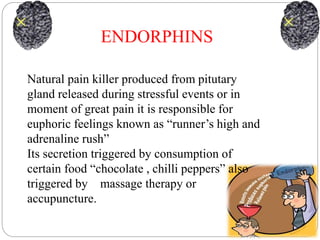
EEE EENDORPHINS
Natural pain killer produced from pituitary
gland released during stressful events or
in moment of grate pain it is responsible for
euphoric feelings known as “runner’s high”
and “adrenaline rush
Natural pain killer produced from pitutary
gland released during stressful events or in
moment of great pain it is responsible for
euphoric feelings known as “runner’s high and
adrenaline rush”
Its secretion triggered by consumption of
certain food “chocolate , chilli peppers” also
triggered by massage therapy or
accupuncture.
METHODS OF LABOUR PAIN
RELIEF
PHARMACOLOGICAL NON PHARMACOLOGICAL
1)SYSTEMIC PSYCHOPROPHYLAXIS+ BREATHING
EXERCISES
PARENTRAL HYPNOSIS
NARCOTICS TENS
TRANQUILISERS ACCUPUNCTURE
INHALATIONAL HYDROTHERPY
N2O ACCUPRESSURE
METHOXYFLURANE AUDIO ANALGESIA
ENFLURANE HOT &COLD APPLICATION
ISOFLURANE AROMATHERAPY
2)REGIONAL DOUBLE HIP SQUEEZ
EPIDURAL STERILE WATER INJECTIONS
SPINAL
PUDENDAL BLOCK
PARACERVICAL BLOCK
3) GA
4) LA or PERINEAL INFILTERATION
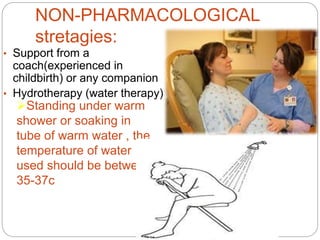
NON-PHARMACOLOGICAL
stretagies:
• Support from a
coach(experienced in
childbirth) or any companion
• Hydrotherapy (water therapy)
Standing under warm
shower or soaking in
tube of warm water , the
temperature of water
used should be between
35-37c .
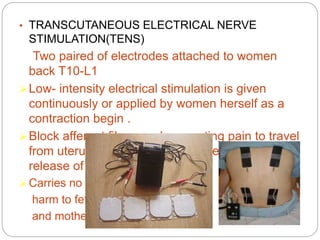
• TRANSCUTANEOUS ELECTRICAL NERVE
STIMULATION(TENS)
Two paired of electrodes attached to women
back T10-L1 .
Low- intensity electrical stimulation is given
continuously or applied by women herself as a
contraction begin .
Block afferent fibers and preventing pain to travel
from uterus to spinal cord synapses and facilitate
release of endorphin
 Carries no
harm to fetus
and mother.
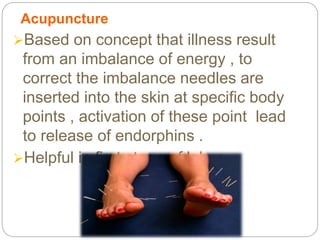
Acupuncture
Based on concept that illness result
from an imbalance of energy , to
correct the imbalance needles are
inserted into the skin at specific body
points , activation of these point lead
to release of endorphins .
Helpful in first stage of labor
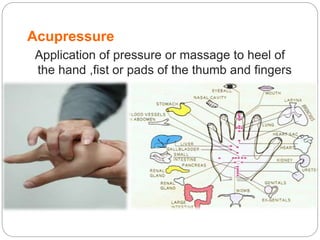
Acupressure
Application of pressure or massage to heel of
the hand ,fist or pads of the thumb and fingers
Application of Heat and Cold
Heat Application
•To increase blood flow and
relieves muscle ischemia.
•increases relaxation
Cold application
• slowing transmission of pain.
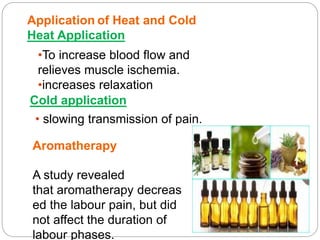
Aromatherapy
A study revealed
that aromatherapy decreas
ed the labour pain, but did
not affect the duration of
labour phases.
Hypnosis
In this the focus of attention is to reduce
awareness of the external environment.
For childbirth, hypnosis is often used to focus
attention on feelings of comfort or numbness as
well as to enhance women's feelings of relaxation
and sense
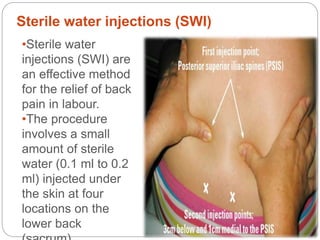
Sterile water injections (SWI)
•Sterile water
injections (SWI) are
an effective method
for the relief of back
pain in labour.
•The procedure
involves a small
amount of sterile
water (0.1 ml to 0.2
ml) injected under
the skin at four
locations on the
lower back
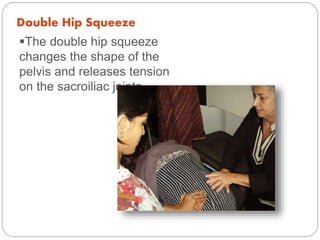
Double Hip Squeeze
The double hip squeeze
changes the shape of the
pelvis and releases tension
on the sacroiliac joints.
PHARMACOLOGICAL
STRETAGIES
OBSTETRIC ANALGESIA
OBSTETRIC ANESTHESIA
PHARMACOLOGICAL
STRETAGIES
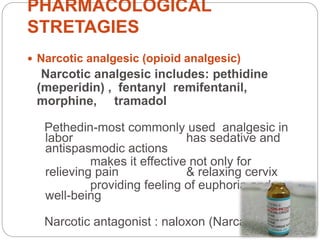
 Narcotic analgesic (opioid analgesic)
Narcotic analgesic includes: pethidine
(meperidin) , fentanyl remifentanil,
morphine, tramadol
Pethedin-most commonly used analgesic in
labor has sedative and
antispasmodic actions
makes it effective not only for
relieving pain & relaxing cervix
providing feeling of euphoria and
well-being
Narcotic antagonist : naloxon (Narcan)
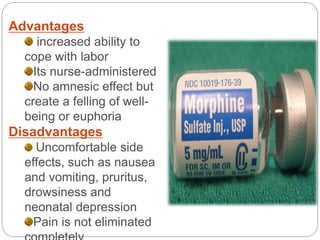
Advantages
increased ability to
cope with labor
Its nurse-administered
No amnesic effect but
create a felling of well-
being or euphoria
Disadvantages
Uncomfortable side
effects, such as nausea
and vomiting, pruritus,
drowsiness and
neonatal depression
Pain is not eliminated
OBSTETRIC ANESTHESIA
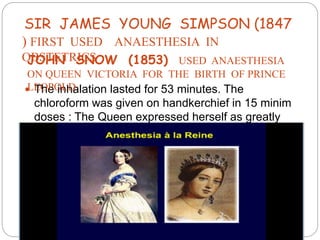
 The inhalation lasted for 53 minutes. The
chloroform was given on handkerchief in 15 minim
doses : The Queen expressed herself as greatly
relived .
SIR JAMES YOUNG SIMPSON (1847
) FIRST USED ANAESTHESIA IN
OBSTETRICSJOHN SNOW (1853) USED ANAESTHESIA
ON QUEEN VICTORIA FOR THE BIRTH OF PRINCE
LEOPOLD.
. Anesthesia
The use of medication to partially or totally block all
sensation to an area of the body
Local anesthesia
Reduce ability of local nerve fiber to conduct pain
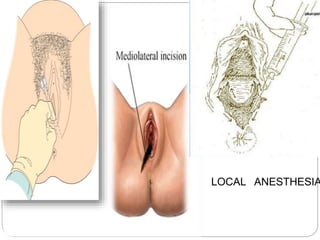
Numbs the perineum just before birth to allow for episiotomy
and repair
Regional anesthesia
injection of local anesthetic agent -tetracaine or
bupivacine to block specific nerve pathways that supply a
particular organ or area of the body
spinal analgesia
 epidural analgesia
 combined spinal epidural
•General anesthesia
 Intra Venous Analgesia
Inhalational Analgesia
LOCAL ANESTHESIA
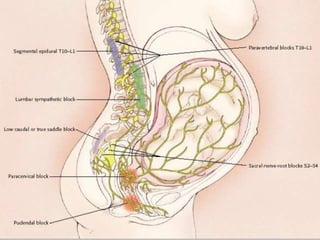
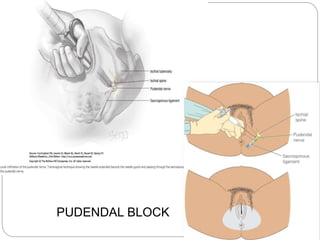
PUDENDAL BLOCK
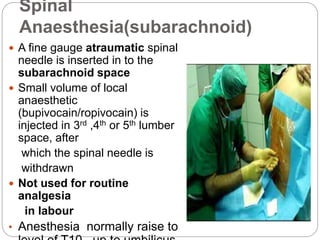
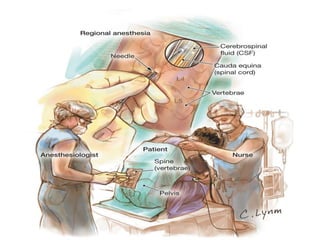
Spinal
Anaesthesia(subarachnoid)
 A fine gauge atraumatic spinal
needle is inserted in to the
subarachnoid space
 Small volume of local
anaesthetic
(bupivocain/ropivocain) is
injected in 3rd ,4th or 5th lumber
space, after
which the spinal needle is
withdrawn
 Not used for routine
analgesia
in labour
• Anesthesia normally raise to
Complication
hypotension from sympathetic blockage lead
to impaired placental perfusion and ineffective
breathing pattern may occur during spinal
anesthesia
Turn the women to her left side
I.V fluid administration to increase blood volume
Vasopressin to increase BP
O2 may be used
Check V/S every 5-10min
pharmacological strategies
Complication
spinal headache
Occur because continuous leakage of CSF from the
needle insertion site or by instillation of air into CSF ,
shift in pressure of CSF cause strain in vertebral
meanings.
Incidence reduced by using of :
 small-gauge needle (25G)
 Increase fluid intake to replace spinal fluid
Epidural analgesia
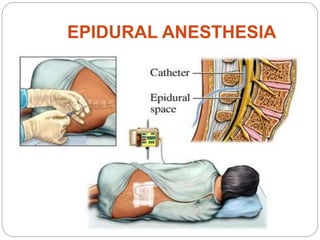
 Epidural catheter inserted at the level of L2-L3
L3-L4 or L4-L5 interspace & to the epidural
space.
 Catheter is aspirated to check the position
 Test dose given to confirm the catheter position
small volume of diluted local anaesthetic (10-
15ml)
 After 5mins loading dose of mixture of 0.1%
Bupivacaine with fentanyl 12mcg/ml is given
 Prepare ephedrine for IV injection(30mg diluted
in 9mg of saline or water)
 Infusion of epidural solution 6-12ml/hr
EPIDURAL ANESTHESIA
Important…
 Secure IV access
 Establishment/after each bolus measure BP every
5min for 15min,provide continuous EFM for 30 min
 Every hour; check level of sensory block.
 Continue until completion of the 3rd stage & any
perineal repair.
 Birth should take place within 4hours.
Contraindications
 Coagulation disorders
 Local or systemic sepsis
 Hypovolemia
 Insufficient no.of trained staff
Complications
 Accidental dural puncture-leak of CSF causing
spinal headache
 Accidental total spinal anaesthesia -severe
hypotension, respiratory failure, unconsciousness &
death
 Drug toxicity occur with
accidental placement of catheter
within a blood vessel
 Bladder dysfunction
 Short term respiratory distress in
baby
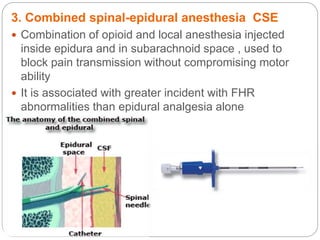
3. Combined spinal-epidural anesthesia CSE
 Combination of opioid and local anesthesia injected
inside epidura and in subarachnoid space , used to
block pain transmission without compromising motor
ability
 It is associated with greater incident with FHR
abnormalities than epidural analgesia alone
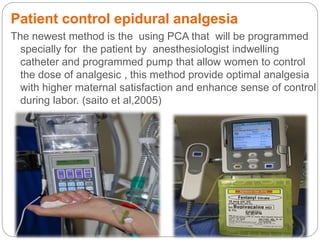
Patient control epidural analgesia
The newest method is the using PCA that will be programmed
specially for the patient by anesthesiologist indwelling
catheter and programmed pump that allow women to control
the dose of analgesic , this method provide optimal analgesia
with higher maternal satisfaction and enhance sense of control
during labor. (saito et al,2005)
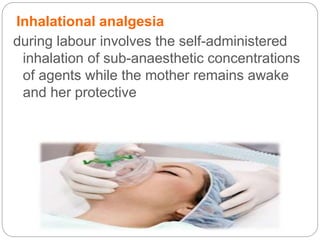
Inhalational analgesia
during labour involves the self-administered
inhalation of sub-anaesthetic concentrations
of agents while the mother remains awake
and her protective laryngeal reflexes remain
intact
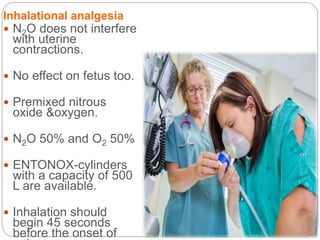
Inhalational analgesia
 N2O does not interfere
with uterine
contractions.
 No effect on fetus too.
 Premixed nitrous
oxide &oxygen.
 N2O 50% and O2 50%
 ENTONOX-cylinders
with a capacity of 500
L are available.
 Inhalation should
begin 45 seconds
before the onset of
Systemic/General anesthesia
Indication
for cesarean section delivery when regional
techniques cannot be used:
Coagulopathy, infection (spinal),
hypovolemia , moderate to severe vulvular
stenosis, progressive neurologic disease
Mother : unconscious, no pain, unpleasant
memories
Fetus: should not be injured with minimal
depression and intact reflex irritability so
deliver baby as soon as possible.
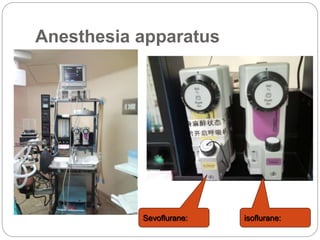
Anesthesia apparatus
Sevoflurane: isoflurane:
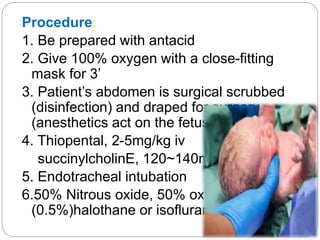
Procedure:
1. Be prepared with antacid
2. Give 100% oxygen with a close-fitting
mask for 3’
3. Patient’s abdomen is surgical scrubbed
(disinfection) and draped for surgery
(anesthetics act on the fetus ↓)
4. Thiopental, 2-5mg/kg iv
succinylcholinE, 120~140mg iv
5. Endotracheal intubation
6.50% Nitrous oxide, 50% oxygen,
(0.5%)halothane or isofluran
Special side effects of general
anesthesia in obstetrics
1.Aspiration of gastric contents into the
lung
Before endotracheal intubation ,
apply cricoid pressure to prevent
aspiration.
2.narcotics and barbiturates may cause
neonatal depress after delivery.
The use of a narcotic antogonist
(naloxone) may reverse the effects
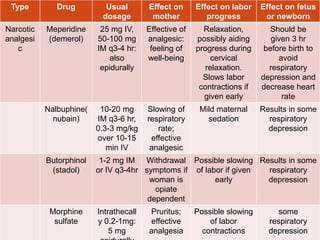
Type Drug Usual
dosage
Effect on
mother
Effect on labor
progress
Effect on fetus
or newborn
Narcotic
analgesi
c
Meperidine
(demerol)
25 mg IV,
50-100 mg
IM q3-4 hr:
also
epidurally
Effective of
analgesic:
feeling of
well-being
Relaxation,
possibly aiding
progress during
cervical
relaxation.
Slows labor
contractions if
given early
Should be
given 3 hr
before birth to
avoid
respiratory
depression and
decrease heart
rate
Nalbuphine(
nubain)
10-20 mg
IM q3-6 hr,
0.3-3 mg/kg
over 10-15
min IV
Slowing of
respiratory
rate;
effective
analgesic
Mild maternal
sedation
Results in some
respiratory
depression
Butorphinol
(stadol)
1-2 mg IM
or IV q3-4hr
Withdrawal
symptoms if
woman is
opiate
dependent
Possible slowing
of labor if given
early
Results in some
respiratory
depression
Morphine
sulfate
Intrathecall
y 0.2-1mg:
5 mg
Pruritus;
effective
analgesia
Possible slowing
of labor
contractions
some
respiratory
depression
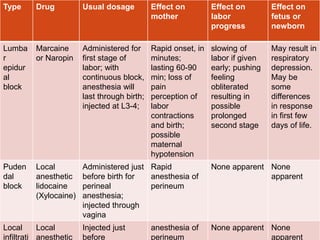
Type Drug Usual dosage Effect on
mother
Effect on
labor
progress
Effect on
fetus or
newborn
Lumba
r
epidur
al
block
Marcaine
or Naropin
Administered for
first stage of
labor; with
continuous block,
anesthesia will
last through birth;
injected at L3-4;
Rapid onset, in
minutes;
lasting 60-90
min; loss of
pain
perception of
labor
contractions
and birth;
possible
maternal
hypotension
slowing of
labor if given
early; pushing
feeling
obliterated
resulting in
possible
prolonged
second stage
May result in
respiratory
depression.
May be
some
differences
in response
in first few
days of life.
Puden
dal
block
Local
anesthetic
lidocaine
(Xylocaine)
Administered just
before birth for
perineal
anesthesia;
injected through
vagina
Rapid
anesthesia of
perineum
None apparent None
apparent
Local
infiltrati
Local
anesthetic
Injected just
before
anesthesia of
perineum
None apparent None
apparent
Analgesia and anesthesia for
abnormal obstetrics
The trapped head in breech
delivery
 If an epidural block is in place, no further
analgesia will be required (forceps?)
 General anesthesia is acceptable
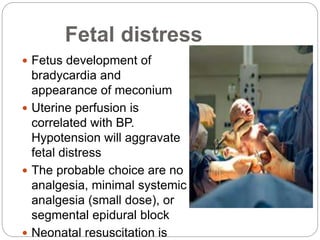
Fetal distress
 Fetus development of
bradycardia and
appearance of meconium
 Uterine perfusion is
correlated with BP.
Hypotension will aggravate
fetal distress
 The probable choice are no
analgesia, minimal systemic
analgesia (small dose), or
segmental epidural block
 Neonatal resuscitation is
Preeclmpsia-Eclampsia
 Composed of hypertension, generalized
edema, and proteinuria.
 The primary pathologic characteristics is
generalized arterial spasm
 Regional and general anesthesia are used
 Contraindications to regional anesthesia
include coagulopathy, urgency for fetal
distress
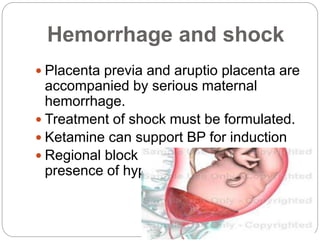
Hemorrhage and shock
 Placenta previa and aruptio placenta are
accompanied by serious maternal
hemorrhage.
 Treatment of shock must be formulated.
 Ketamine can support BP for induction
 Regional block is contraindicated in the
presence of hypovolemia
Anesthesia
Anesthesia

Anesthesia

  • 2.
    By Dr. SAFINAMUFTI TMO GCU Obstetric analgesia and anesthesia
  • 3.
    DEFINITION OF PAIN It is an UNPLEASANT SENSORY and EMOTINAL EXPERIECE associated with ACTUAL POTENTIAL TISSUE DAMAGE or DESCRIBED IN TERMS OF SUCH DAMAGE.
  • 4.
    NATURE OF LABOURPAINS 1st stage Visceral pain  Diffuse abdominal cramping  Uterine contractions  Dilatation of cervix  T10-L1 2nd stage Somatic pain  Perineum- sharper and more continuous  Pressure or nerve entrapment-caused by fetal head, may cause severe leg or back pain S2-S4
  • 6.
    EEE EENDORPHINS Natural painkiller produced from pituitary gland released during stressful events or in moment of grate pain it is responsible for euphoric feelings known as “runner’s high” and “adrenaline rush Natural pain killer produced from pitutary gland released during stressful events or in moment of great pain it is responsible for euphoric feelings known as “runner’s high and adrenaline rush” Its secretion triggered by consumption of certain food “chocolate , chilli peppers” also triggered by massage therapy or accupuncture.
  • 7.
    METHODS OF LABOURPAIN RELIEF PHARMACOLOGICAL NON PHARMACOLOGICAL 1)SYSTEMIC PSYCHOPROPHYLAXIS+ BREATHING EXERCISES PARENTRAL HYPNOSIS NARCOTICS TENS TRANQUILISERS ACCUPUNCTURE INHALATIONAL HYDROTHERPY N2O ACCUPRESSURE METHOXYFLURANE AUDIO ANALGESIA ENFLURANE HOT &COLD APPLICATION ISOFLURANE AROMATHERAPY 2)REGIONAL DOUBLE HIP SQUEEZ EPIDURAL STERILE WATER INJECTIONS SPINAL PUDENDAL BLOCK PARACERVICAL BLOCK 3) GA 4) LA or PERINEAL INFILTERATION
  • 8.
    NON-PHARMACOLOGICAL stretagies: • Support froma coach(experienced in childbirth) or any companion • Hydrotherapy (water therapy) Standing under warm shower or soaking in tube of warm water , the temperature of water used should be between 35-37c .
  • 9.
    • TRANSCUTANEOUS ELECTRICALNERVE STIMULATION(TENS) Two paired of electrodes attached to women back T10-L1 . Low- intensity electrical stimulation is given continuously or applied by women herself as a contraction begin . Block afferent fibers and preventing pain to travel from uterus to spinal cord synapses and facilitate release of endorphin  Carries no harm to fetus and mother.
  • 10.
    Acupuncture Based on conceptthat illness result from an imbalance of energy , to correct the imbalance needles are inserted into the skin at specific body points , activation of these point lead to release of endorphins . Helpful in first stage of labor
  • 11.
    Acupressure Application of pressureor massage to heel of the hand ,fist or pads of the thumb and fingers
  • 12.
    Application of Heatand Cold Heat Application •To increase blood flow and relieves muscle ischemia. •increases relaxation Cold application • slowing transmission of pain. Aromatherapy A study revealed that aromatherapy decreas ed the labour pain, but did not affect the duration of labour phases.
  • 13.
    Hypnosis In this thefocus of attention is to reduce awareness of the external environment. For childbirth, hypnosis is often used to focus attention on feelings of comfort or numbness as well as to enhance women's feelings of relaxation and sense
  • 14.
    Sterile water injections(SWI) •Sterile water injections (SWI) are an effective method for the relief of back pain in labour. •The procedure involves a small amount of sterile water (0.1 ml to 0.2 ml) injected under the skin at four locations on the lower back
  • 15.
    Double Hip Squeeze Thedouble hip squeeze changes the shape of the pelvis and releases tension on the sacroiliac joints.
  • 16.
  • 17.
    PHARMACOLOGICAL STRETAGIES  Narcotic analgesic(opioid analgesic) Narcotic analgesic includes: pethidine (meperidin) , fentanyl remifentanil, morphine, tramadol Pethedin-most commonly used analgesic in labor has sedative and antispasmodic actions makes it effective not only for relieving pain & relaxing cervix providing feeling of euphoria and well-being Narcotic antagonist : naloxon (Narcan)
  • 18.
    Advantages increased ability to copewith labor Its nurse-administered No amnesic effect but create a felling of well- being or euphoria Disadvantages Uncomfortable side effects, such as nausea and vomiting, pruritus, drowsiness and neonatal depression Pain is not eliminated
  • 19.
  • 20.
     The inhalationlasted for 53 minutes. The chloroform was given on handkerchief in 15 minim doses : The Queen expressed herself as greatly relived . SIR JAMES YOUNG SIMPSON (1847 ) FIRST USED ANAESTHESIA IN OBSTETRICSJOHN SNOW (1853) USED ANAESTHESIA ON QUEEN VICTORIA FOR THE BIRTH OF PRINCE LEOPOLD.
  • 21.
    . Anesthesia The useof medication to partially or totally block all sensation to an area of the body Local anesthesia Reduce ability of local nerve fiber to conduct pain Numbs the perineum just before birth to allow for episiotomy and repair Regional anesthesia injection of local anesthetic agent -tetracaine or bupivacine to block specific nerve pathways that supply a particular organ or area of the body spinal analgesia  epidural analgesia  combined spinal epidural •General anesthesia  Intra Venous Analgesia Inhalational Analgesia
  • 22.
  • 23.
  • 24.
    Spinal Anaesthesia(subarachnoid)  A finegauge atraumatic spinal needle is inserted in to the subarachnoid space  Small volume of local anaesthetic (bupivocain/ropivocain) is injected in 3rd ,4th or 5th lumber space, after which the spinal needle is withdrawn  Not used for routine analgesia in labour • Anesthesia normally raise to
  • 26.
    Complication hypotension from sympatheticblockage lead to impaired placental perfusion and ineffective breathing pattern may occur during spinal anesthesia Turn the women to her left side I.V fluid administration to increase blood volume Vasopressin to increase BP O2 may be used Check V/S every 5-10min
  • 27.
    pharmacological strategies Complication spinal headache Occurbecause continuous leakage of CSF from the needle insertion site or by instillation of air into CSF , shift in pressure of CSF cause strain in vertebral meanings. Incidence reduced by using of :  small-gauge needle (25G)  Increase fluid intake to replace spinal fluid
  • 28.
    Epidural analgesia  Epiduralcatheter inserted at the level of L2-L3 L3-L4 or L4-L5 interspace & to the epidural space.  Catheter is aspirated to check the position  Test dose given to confirm the catheter position small volume of diluted local anaesthetic (10- 15ml)  After 5mins loading dose of mixture of 0.1% Bupivacaine with fentanyl 12mcg/ml is given  Prepare ephedrine for IV injection(30mg diluted in 9mg of saline or water)  Infusion of epidural solution 6-12ml/hr
  • 29.
  • 30.
    Important…  Secure IVaccess  Establishment/after each bolus measure BP every 5min for 15min,provide continuous EFM for 30 min  Every hour; check level of sensory block.  Continue until completion of the 3rd stage & any perineal repair.  Birth should take place within 4hours.
  • 31.
    Contraindications  Coagulation disorders Local or systemic sepsis  Hypovolemia  Insufficient no.of trained staff
  • 32.
    Complications  Accidental duralpuncture-leak of CSF causing spinal headache  Accidental total spinal anaesthesia -severe hypotension, respiratory failure, unconsciousness & death  Drug toxicity occur with accidental placement of catheter within a blood vessel  Bladder dysfunction  Short term respiratory distress in baby
  • 33.
    3. Combined spinal-epiduralanesthesia CSE  Combination of opioid and local anesthesia injected inside epidura and in subarachnoid space , used to block pain transmission without compromising motor ability  It is associated with greater incident with FHR abnormalities than epidural analgesia alone
  • 34.
    Patient control epiduralanalgesia The newest method is the using PCA that will be programmed specially for the patient by anesthesiologist indwelling catheter and programmed pump that allow women to control the dose of analgesic , this method provide optimal analgesia with higher maternal satisfaction and enhance sense of control during labor. (saito et al,2005)
  • 35.
    Inhalational analgesia during labourinvolves the self-administered inhalation of sub-anaesthetic concentrations of agents while the mother remains awake and her protective laryngeal reflexes remain intact
  • 36.
    Inhalational analgesia  N2Odoes not interfere with uterine contractions.  No effect on fetus too.  Premixed nitrous oxide &oxygen.  N2O 50% and O2 50%  ENTONOX-cylinders with a capacity of 500 L are available.  Inhalation should begin 45 seconds before the onset of
  • 37.
    Systemic/General anesthesia Indication for cesareansection delivery when regional techniques cannot be used: Coagulopathy, infection (spinal), hypovolemia , moderate to severe vulvular stenosis, progressive neurologic disease Mother : unconscious, no pain, unpleasant memories Fetus: should not be injured with minimal depression and intact reflex irritability so deliver baby as soon as possible.
  • 38.
  • 39.
    Procedure: 1. Be preparedwith antacid 2. Give 100% oxygen with a close-fitting mask for 3’ 3. Patient’s abdomen is surgical scrubbed (disinfection) and draped for surgery (anesthetics act on the fetus ↓) 4. Thiopental, 2-5mg/kg iv succinylcholinE, 120~140mg iv 5. Endotracheal intubation 6.50% Nitrous oxide, 50% oxygen, (0.5%)halothane or isofluran
  • 40.
    Special side effectsof general anesthesia in obstetrics 1.Aspiration of gastric contents into the lung Before endotracheal intubation , apply cricoid pressure to prevent aspiration. 2.narcotics and barbiturates may cause neonatal depress after delivery. The use of a narcotic antogonist (naloxone) may reverse the effects
  • 41.
    Type Drug Usual dosage Effecton mother Effect on labor progress Effect on fetus or newborn Narcotic analgesi c Meperidine (demerol) 25 mg IV, 50-100 mg IM q3-4 hr: also epidurally Effective of analgesic: feeling of well-being Relaxation, possibly aiding progress during cervical relaxation. Slows labor contractions if given early Should be given 3 hr before birth to avoid respiratory depression and decrease heart rate Nalbuphine( nubain) 10-20 mg IM q3-6 hr, 0.3-3 mg/kg over 10-15 min IV Slowing of respiratory rate; effective analgesic Mild maternal sedation Results in some respiratory depression Butorphinol (stadol) 1-2 mg IM or IV q3-4hr Withdrawal symptoms if woman is opiate dependent Possible slowing of labor if given early Results in some respiratory depression Morphine sulfate Intrathecall y 0.2-1mg: 5 mg Pruritus; effective analgesia Possible slowing of labor contractions some respiratory depression
  • 42.
    Type Drug Usualdosage Effect on mother Effect on labor progress Effect on fetus or newborn Lumba r epidur al block Marcaine or Naropin Administered for first stage of labor; with continuous block, anesthesia will last through birth; injected at L3-4; Rapid onset, in minutes; lasting 60-90 min; loss of pain perception of labor contractions and birth; possible maternal hypotension slowing of labor if given early; pushing feeling obliterated resulting in possible prolonged second stage May result in respiratory depression. May be some differences in response in first few days of life. Puden dal block Local anesthetic lidocaine (Xylocaine) Administered just before birth for perineal anesthesia; injected through vagina Rapid anesthesia of perineum None apparent None apparent Local infiltrati Local anesthetic Injected just before anesthesia of perineum None apparent None apparent
  • 43.
    Analgesia and anesthesiafor abnormal obstetrics
  • 44.
    The trapped headin breech delivery  If an epidural block is in place, no further analgesia will be required (forceps?)  General anesthesia is acceptable
  • 45.
    Fetal distress  Fetusdevelopment of bradycardia and appearance of meconium  Uterine perfusion is correlated with BP. Hypotension will aggravate fetal distress  The probable choice are no analgesia, minimal systemic analgesia (small dose), or segmental epidural block  Neonatal resuscitation is
  • 46.
    Preeclmpsia-Eclampsia  Composed ofhypertension, generalized edema, and proteinuria.  The primary pathologic characteristics is generalized arterial spasm  Regional and general anesthesia are used  Contraindications to regional anesthesia include coagulopathy, urgency for fetal distress
  • 47.
    Hemorrhage and shock Placenta previa and aruptio placenta are accompanied by serious maternal hemorrhage.  Treatment of shock must be formulated.  Ketamine can support BP for induction  Regional block is contraindicated in the presence of hypovolemia

Editor's Notes

  • #11 stimulate the acupoints on the body by using thin needles that are inserted into the skin. Done by trained certified therapist.