Disclaimer Proper consent that, their photographs may be used for teaching (presentation before other doctors) and scientific publications has been taken from the patients shown in the procedures. I do not have any financial obligations towards company or their products named during presentation. I acknowledge that, some of the material in this presentation is contributed by two leading pain physicians, Dr Gautam Das,  MD FIPP (India)  and Dr Vikram B Patel,  MD FIPP (USA) .
Interventional Pain Management;  Way forward to  manage chronic pain Dr Ashok Jadon,  MD DNB   Aesculap Academy   IPM Fellowship   Sr Consultant Anaesthesia
Objectives Introduction of IPM Its Scope IPM in LBP Our Experience Gapes  Resource Results
Interventional Pain Management is some minimally invasive procedures which gives permanent/long term pain relief. What it is ?
Non-opioids Weak opioids +/- non-opioids Strong opioids Recovery   Operation Treatment of Low Back Pain World of Misery   Non-pharmacological methods
Non-opioids Weak opioids +/- non-opioids Strong opioids Recovery   Operation Treatment of Pain IPM Non-pharmacological methods It fills the gap between pharmacologic management of  pain & more invasive operative procedure.
Targeted delivery of drugs. Aims to correct the pathology Blocking of nerve signals corrects neuropathy. Steroids, Neurolytics, Local anaesthetics Adhesinolysis, Vertebroplasty, Kypho-plasty LA, Ozone Neurolytics, Radiofrequency ablation, Chemical & Electrical Neuromodulation IPM IPM are group of procedures with different mechanism of actions
Scope/ indications Head & Neck  Headache:  nerve blocks,  PNS,  Gasserian ganglion block  -trigeminal neuralgia Cervical epidural , facet, RF, stellate gn block Thorax Cryo Intercostal nerves, Facet, RF Pelvic pain:  hypogastric plexus block Abdominal Cancer pain:  celiac plexus Low Back Pain…………
Structures responsible for LBP
Major Causes of Low Back Pain Facet joint arthropathy 15-45% Interval disc disruption 25-40% Sacro-Iliac joint arthropathy 15-30% Disc prolapse/ herniated disc/ slipped disc-2-5% Chronic Regional Pain Syndrome 2-8% Failed Back Surgery Syndrome 1% Pyriform syndrome www. pain india.net
Low Back Pain:  Red Flags Possible fracture  Possible tumor or infection.  Bladder or Bowel dysfunction. Severe or progressive neurologic dysfunction in the legs. Major motor weakness in quadriceps, plantar flexors, evertors, and dorsiflexors.
Facet Joint Interventions Intra-articular injections Medial branch block Radiofrequency ablation Facet joint ( zygapophysial)   arthropathy 15-45%
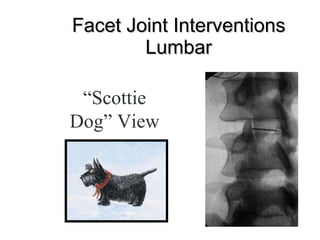
Facet Joint Interventions Lumbar “ Scottie Dog” View
C-arm should be rotated such a way so that facet joint is opened up maximally & end plate of two adjacent vertebrae are in line. Disc space between L4-L5 disc Facet joint Inferior end plate of L4 Vertebra  Superior end plate of L5 Vertebra
Facet Joint Interventions Lumbar - RF L5 L4 S1
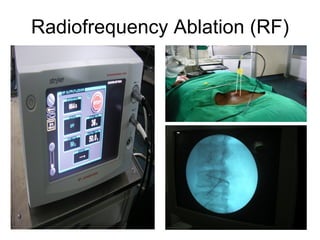
Radiofrequency Ablation (RF)
LBP ; Disc (Disc Cause LBP 25% to 45%)
Disc procedures Epidural Steroid Inj. Selective Nerve root / transforaminal Inj. Discectomy Ozone nucleolysis  RF procedures  (Intradiscal Electrothermal Annuloplasty (IDEA), or IDET   www. pain india.net
Epidural Approaches Decrease phospholipase A2 and complements Histamine Antagonist Anti-inflammatory Local Anaesthetic Volume effect Non-specific Midline Interlaminar L5-S1
Transforaminal Approach
 
Transforaminal Approach
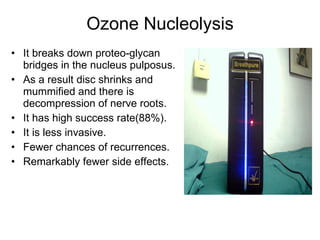
Ozone Nucleolysis It breaks down proteo-glycan bridges in the nucleus pulposus.  As a result disc shrinks and mummified and there is decompression of nerve roots.   It has high success rate(88%). It is less invasive. Fewer chances of recurrences.  Remarkably fewer side effects.
Intradiscal Procedures Intradiscal coagulation with conventional RF  Intradiscal electromagnetic field (with Pulsed RF) Posterior annuloplasty (Coblation)  IDET (Intradiscal electro-thermal coagulation &
I-DET
Percutaneous Disc Decompression/Discectomy www. pain india.net   17G needle introduced, motorized probe is introduced It breaks the nucleus pulposus into fine particles and sucks it out.
Vertebroplasty
POST LAMINECTOMY SYNDROME Mechanical lesion * Spinal stenosis * Recurrent disk * Spinal instability Often can be corrected with additional surgical procedures Non mechanical lesion   *Epidural fibrosis * Arachnoiditis * Neuropathic pain *Psychosomatic pain Not amenable to surgical treatment
POST LAMINECTOMY SYNDROME Surgery (success rate 20%-30%)   Interventions  Management   of FBSS   * Epidural adhesinolysis: Fluoroscopic hydrodynamic process using corticosteroids, hypertonic saline,  L.A., hyaluronidase.
Epidural Adhesinolysis Normal Filling defect in FBSS www. pain india.net
POST LAMINECTOMY SYNDROME Epiduroscopy
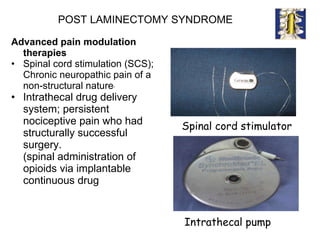
POST LAMINECTOMY SYNDROME Advanced pain modulation therapies Spinal cord stimulation (SCS); Chronic neuropathic pain of a non-structural nature *  Intrathecal drug delivery system; persistent nociceptive pain who had structurally successful surgery.  (spinal administration of opioids via implantable continuous drug   Spinal cord stimulator Intrathecal pump
Evidence based practices Outcome studies Even in patients of PIVD with neuro-deficits (numbness & weakness) there is equal chance of cure between surgical and non-surgical managements. 83% of patients for whom urgent surgery was recommended could avoid surgery & still achieved good/excellent outcome. A large scale English study showed that 86% good outcome with non-surgical treatment.   www. pain india.net


Results & Gapes 50% relief in 50% of the patient for reasonable duration (3wks 14 months) Our results Gapes: Vertebroplasty and Discectomy kits RF Future……
Thanks Thank you

IPM

  • 1.
    Disclaimer Proper consentthat, their photographs may be used for teaching (presentation before other doctors) and scientific publications has been taken from the patients shown in the procedures. I do not have any financial obligations towards company or their products named during presentation. I acknowledge that, some of the material in this presentation is contributed by two leading pain physicians, Dr Gautam Das, MD FIPP (India) and Dr Vikram B Patel, MD FIPP (USA) .
  • 2.
    Interventional Pain Management; Way forward to manage chronic pain Dr Ashok Jadon, MD DNB Aesculap Academy IPM Fellowship Sr Consultant Anaesthesia
  • 3.
    Objectives Introduction ofIPM Its Scope IPM in LBP Our Experience Gapes Resource Results
  • 4.
    Interventional Pain Managementis some minimally invasive procedures which gives permanent/long term pain relief. What it is ?
  • 5.
    Non-opioids Weak opioids+/- non-opioids Strong opioids Recovery Operation Treatment of Low Back Pain World of Misery Non-pharmacological methods
  • 6.
    Non-opioids Weak opioids+/- non-opioids Strong opioids Recovery Operation Treatment of Pain IPM Non-pharmacological methods It fills the gap between pharmacologic management of pain & more invasive operative procedure.
  • 7.
    Targeted delivery ofdrugs. Aims to correct the pathology Blocking of nerve signals corrects neuropathy. Steroids, Neurolytics, Local anaesthetics Adhesinolysis, Vertebroplasty, Kypho-plasty LA, Ozone Neurolytics, Radiofrequency ablation, Chemical & Electrical Neuromodulation IPM IPM are group of procedures with different mechanism of actions
  • 8.
    Scope/ indications Head& Neck Headache: nerve blocks, PNS, Gasserian ganglion block -trigeminal neuralgia Cervical epidural , facet, RF, stellate gn block Thorax Cryo Intercostal nerves, Facet, RF Pelvic pain: hypogastric plexus block Abdominal Cancer pain: celiac plexus Low Back Pain…………
  • 9.
  • 10.
    Major Causes ofLow Back Pain Facet joint arthropathy 15-45% Interval disc disruption 25-40% Sacro-Iliac joint arthropathy 15-30% Disc prolapse/ herniated disc/ slipped disc-2-5% Chronic Regional Pain Syndrome 2-8% Failed Back Surgery Syndrome 1% Pyriform syndrome www. pain india.net
  • 11.
    Low Back Pain: Red Flags Possible fracture Possible tumor or infection. Bladder or Bowel dysfunction. Severe or progressive neurologic dysfunction in the legs. Major motor weakness in quadriceps, plantar flexors, evertors, and dorsiflexors.
  • 12.
    Facet Joint InterventionsIntra-articular injections Medial branch block Radiofrequency ablation Facet joint ( zygapophysial) arthropathy 15-45%
  • 13.
    Facet Joint InterventionsLumbar “ Scottie Dog” View
  • 14.
    C-arm should berotated such a way so that facet joint is opened up maximally & end plate of two adjacent vertebrae are in line. Disc space between L4-L5 disc Facet joint Inferior end plate of L4 Vertebra Superior end plate of L5 Vertebra
  • 15.
    Facet Joint InterventionsLumbar - RF L5 L4 S1
  • 16.
  • 17.
    LBP ; Disc(Disc Cause LBP 25% to 45%)
  • 18.
    Disc procedures EpiduralSteroid Inj. Selective Nerve root / transforaminal Inj. Discectomy Ozone nucleolysis RF procedures (Intradiscal Electrothermal Annuloplasty (IDEA), or IDET www. pain india.net
  • 19.
    Epidural Approaches Decreasephospholipase A2 and complements Histamine Antagonist Anti-inflammatory Local Anaesthetic Volume effect Non-specific Midline Interlaminar L5-S1
  • 20.
  • 21.
  • 22.
  • 23.
    Ozone Nucleolysis Itbreaks down proteo-glycan bridges in the nucleus pulposus. As a result disc shrinks and mummified and there is decompression of nerve roots. It has high success rate(88%). It is less invasive. Fewer chances of recurrences. Remarkably fewer side effects.
  • 24.
    Intradiscal Procedures Intradiscalcoagulation with conventional RF Intradiscal electromagnetic field (with Pulsed RF) Posterior annuloplasty (Coblation) IDET (Intradiscal electro-thermal coagulation &
  • 25.
  • 26.
    Percutaneous Disc Decompression/Discectomywww. pain india.net 17G needle introduced, motorized probe is introduced It breaks the nucleus pulposus into fine particles and sucks it out.
  • 27.
  • 28.
    POST LAMINECTOMY SYNDROMEMechanical lesion * Spinal stenosis * Recurrent disk * Spinal instability Often can be corrected with additional surgical procedures Non mechanical lesion *Epidural fibrosis * Arachnoiditis * Neuropathic pain *Psychosomatic pain Not amenable to surgical treatment
  • 29.
    POST LAMINECTOMY SYNDROMESurgery (success rate 20%-30%) Interventions Management of FBSS * Epidural adhesinolysis: Fluoroscopic hydrodynamic process using corticosteroids, hypertonic saline, L.A., hyaluronidase.
  • 30.
    Epidural Adhesinolysis NormalFilling defect in FBSS www. pain india.net
  • 31.
  • 32.
    POST LAMINECTOMY SYNDROMEAdvanced pain modulation therapies Spinal cord stimulation (SCS); Chronic neuropathic pain of a non-structural nature * Intrathecal drug delivery system; persistent nociceptive pain who had structurally successful surgery. (spinal administration of opioids via implantable continuous drug Spinal cord stimulator Intrathecal pump
  • 33.
    Evidence based practicesOutcome studies Even in patients of PIVD with neuro-deficits (numbness & weakness) there is equal chance of cure between surgical and non-surgical managements. 83% of patients for whom urgent surgery was recommended could avoid surgery & still achieved good/excellent outcome. A large scale English study showed that 86% good outcome with non-surgical treatment. www. pain india.net
  • 34.
  • 35.
  • 36.
  • 37.
  • 38.
  • 39.
  • 40.
  • 41.
  • 42.
  • 43.
  • 44.
  • 45.
    Results & Gapes50% relief in 50% of the patient for reasonable duration (3wks 14 months) Our results Gapes: Vertebroplasty and Discectomy kits RF Future……
  • 46.

Editor's Notes

  • #10 What are the structures and their pathology responsible for low back pain